
NCERT Solutions for Class 7 Social Science (Exploring Society) Chapter 2: Understanding the Weather (NCERT 2026–27)
These Class 7 Social Science Exploring Society Chapter 2 solutions cover Understanding the Weather from Exploring Society: India and Beyond (Part 1), the NCF-2023 textbook (2026–27 reprint). The chapter belongs to the theme India and the World: Land and the People and explains what weather is, the five elements of weather (temperature, precipitation, atmospheric pressure, wind and humidity), the instruments used to measure each of them, how a weather station and an Automated Weather Station work, and how weather prediction helps us prepare for events like heavy rain, storms, droughts and heat waves. Below you get step-by-step answers to all Questions and activities, clear notes on key terms, extra practice, MCQs, Assertion–Reason and FAQs.
Class 7 Social Science Exploring Society Chapter 2 – Overview
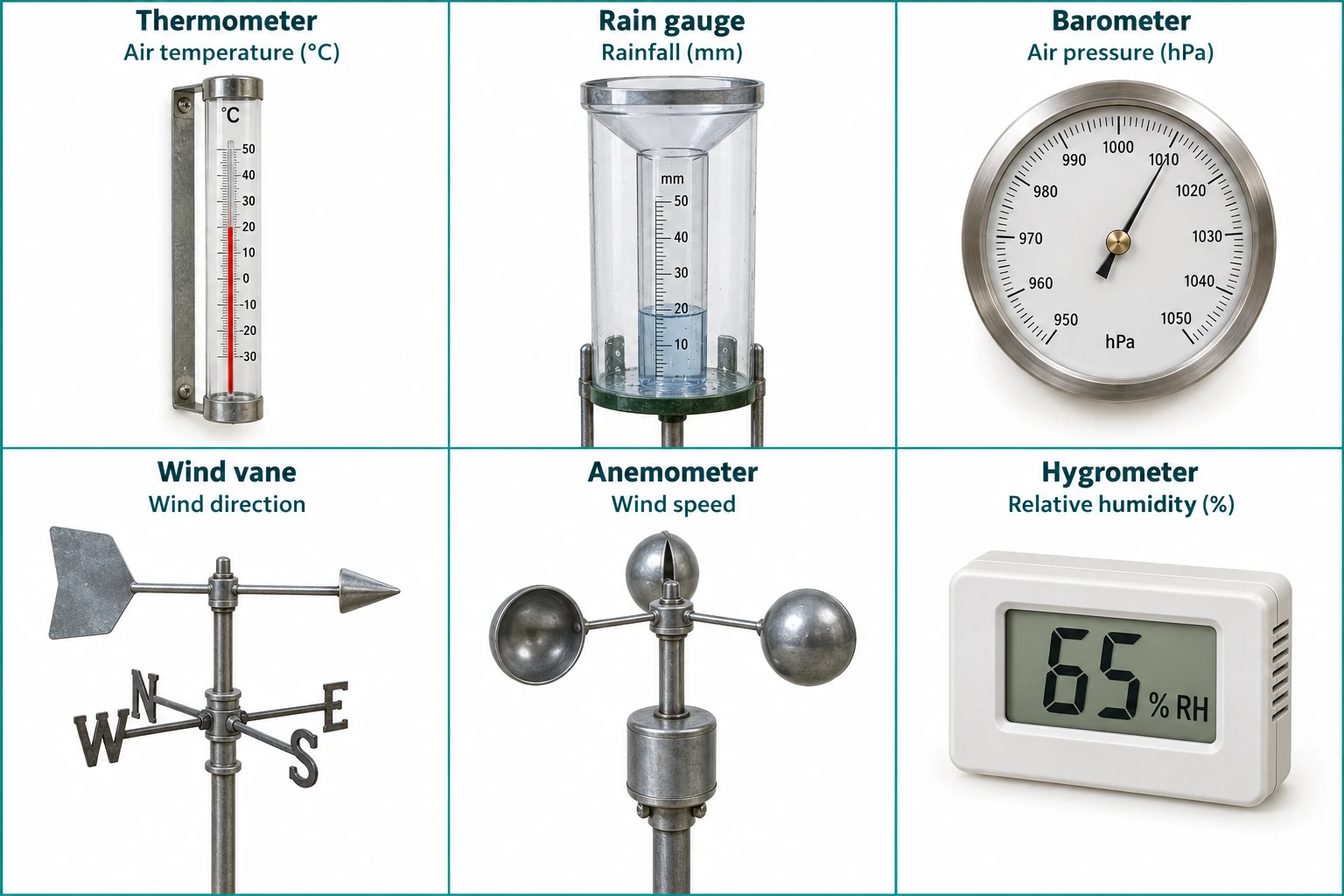
Chapter 2, Understanding the Weather, begins with the idea that weather is the state of the Earth’s atmosphere at a particular time and place. The atmosphere is the layer of gases (air) around the Earth, and almost all weather happens in its lowest layer, the troposphere. The chapter identifies five elements of weather — temperature, precipitation, atmospheric pressure, wind and humidity — and shows why we need a common standard to measure them (recall the Krishnan–Amir conversation). It then introduces the main weather instruments: the thermometer (temperature), rain gauge (precipitation), barometer (atmospheric pressure), wind vane and anemometer (wind), and hygrometer (humidity). These instruments are brought together at a weather station, and modern Automated Weather Stations (AWS) record data automatically between maintenance visits. Finally, the chapter explains how meteorologists study long-term data to forecast the weather and issue warnings (like the IMD colour-coded alerts), which help people prepare for floods, cyclones, droughts and heat waves.
Key Concepts & Terms
Weather: the state of the Earth’s atmosphere at a particular time and place — described using words like hot, cold, rainy, cloudy, humid, snowy or windy.
Atmosphere & troposphere: the atmosphere is the layer of gases (air) surrounding the Earth. Its lowest layer, the troposphere, is where plants, animals and humans live and where almost all weather happens; it is 6–18 km thick (thinner at the poles, thicker over the tropics).
The five elements of weather: Temperature (how hot or cold the atmosphere is), Precipitation (rain, snow, sleet or hail falling from the sky), Atmospheric pressure (the weight of the air above us), Wind (the movement of air — speed and direction), and Humidity (the amount of water vapour in the air).
Precipitation types: rain, snow, sleet (frozen or partly frozen rain) and hail (small hard balls of ice that fall like rain). Water vapour is water in gaseous form.
Temperature scales: the Celsius (°C) and Fahrenheit (°F) scales; for example 15°C is the same as 59°F. Range = maximum temperature − minimum temperature; Mean daily temperature = (maximum + minimum) ÷ 2.
Weather instruments: thermometer (temperature), rain gauge (rainfall, in mm), barometer (atmospheric pressure, in millibars — standard sea-level pressure is about 1013 mb; 1 mb = 1 hPa), wind vane / wind sock (wind direction) and anemometer (wind speed, in km/h), and hygrometer (humidity).
Relative humidity: humidity measured as a percentage — 0% means no water vapour and 100% means air saturated with water vapour. Dry weather is usually 20–40% and humid weather 60–80%.
Forecast & meteorology: to forecast is to predict or find out in advance (here, the weather). Meteorology is the systematic study of weather and its evolution, the basis for weather forecasting.
Weather station & AWS: a weather station brings all the instruments together for regular readings; an Automated Weather Station (AWS) is a self-operating system that uses sensors to record weather data automatically; people still maintain and calibrate the equipment.
Other key terms: ambient (of the immediate surroundings), acclimatise (adjust to a new climate or condition), depression / low-pressure system (a sharp drop in pressure that can grow into a storm or cyclone), and the India Meteorological Department (IMD), set up in 1875, which issues colour-coded weather warnings.
“Questions and activities” — Full Solutions
The four end-of-chapter tasks follow NCERT, pp. 42–43. These are ClearStudy model answers, not an official NCERT answer key. The historical weather chart is an exercise, not a current forecast.
1. Match the instrument with the weather element it measures.
| Instrument used | Element of the Weather |
|---|---|
| (1) Hygrometer | (d) Humidity |
| (2) Anemometer | (c) Wind direction and speed |
| (3) Barometer | (b) Atmospheric pressure |
| (4) Thermometer | (e) Temperature |
| (5) Rain gauge | (a) Precipitation |
2. Jyotsna is deciding what clothes to pack for her school trip to Mumbai in June. She looks at the weather forecast, which predicts 29°C and 84% humidity. What would be your advice to her?
3. Imagine that a small group of students is setting up a rain gauge. Here are some options for the site. 1. The school vegetable garden. 2. The terrace of the school building. 3. Open ground with elevated platform. 4. Compound wall of school. 5. Verandah of the school laboratory. Discuss in your group and finalise the site. Write down the reasons for your decision.
4. Below is a chart taken from IMD, Jammu and Kashmir. Looking at the data available, write a short script to report the weather conditions in different parts of Jammu and Kashmir on the date shown. (Hint: Cover the temperature range, maximum and minimum temperatures, humidity, precipitation, etc.)
| Station | Max °C | Min °C | Range °C | Rain 08:30–17:30 (mm) | Snow 08:30–17:30 (cm) | Rain: 24 h ending 08:30 (mm) | Snow: period ending 08:30 (cm) | RH at 08:30 / 17:30 (%) |
|---|---|---|---|---|---|---|---|---|
| Srinagar | 6.5 | 0.2 | 6.3 | TR | 0.0 | 13.4 | 2.4 | 89 / 89 |
| Qazigund | 3.2 | -0.4 | 3.6 | 11.8 | 10.0 | 36.2 | 22.0 | 97 / 90 |
| Pahalgam | 1.1 | -4.1 | 5.2 | 6.0 | 8.0 | 19.4 | 23.0 | 96 / 96 |
| Kupwara | 5.1 | -0.7 | 5.8 | 0.5 | 0.0 | 21.9 | 10.0 | 97 / 94 |
| Kukernag | 2.6 | -1.4 | 4.0 | 12.0 | 8.0 | 35.2 | 30.0 | 96 / 97 |
| Gulmarg | -2.6 | -7.6 | 5.0 | 8.2 | 6.35 | 35.2 | 35.0 | 76 / 100 |
| Muzaffarabad | 8.5 | 5.6 | 2.9 | — | — | 25.8 | — | 93 / — |
Extra Practice Questions
These questions and MCQs are ClearStudy practice, separate from the NCERT exercise.
Short Answer Type Questions
Q1. What is weather?
Q2. Name the five elements of weather.
Q3. How is the range of temperature and the mean daily temperature calculated?
Q4. Why does atmospheric pressure decrease as we climb a mountain?
Q5. What is an Automated Weather Station (AWS)?
Long Answer Type Questions
Q1. Describe the main weather instruments and the element each one measures.
Q2. How did people predict the weather before modern instruments, and how do meteorologists do it today?
Q3. Why is humidity an important element of weather, and how does it affect daily life?
MCQs & Assertion–Reason
1. Weather is best defined as:
(a) the average condition over 30 years (b) the state of the atmosphere at a particular time and place (c) the temperature of the sea (d) the rotation of the Earth
2. Almost all weather phenomena take place in which layer of the atmosphere?
(a) Stratosphere (b) Ozone layer (c) Troposphere (d) Tropopause
3. Which instrument is used to measure rainfall?
(a) Barometer (b) Hygrometer (c) Anemometer (d) Rain gauge
4. The instrument that measures wind speed is the:
(a) wind vane (b) anemometer (c) thermometer (d) barometer
5. Atmospheric pressure is generally measured in:
(a) millimetres (b) degrees Celsius (c) millibars (d) kilometres per hour
6. Which term describes an organised cyclonic low-pressure disturbance?
(a) heat wave (b) depression (c) clear sky (d) high-pressure system
7. Small, hard balls of ice that fall from the sky like rain are called:
(a) sleet (b) hail (c) snow (d) dew
8. If the relative humidity is 84%, the weather can be described as:
(a) very dry (b) moderately dry (c) very humid (d) freezing
9. The India Meteorological Department (IMD) was set up in the year:
(a) 1857 (b) 1875 (c) 1905 (d) 1947
10. The mean daily temperature is calculated by:
(a) maximum − minimum (b) (maximum + minimum) ÷ 2 (c) maximum × minimum (d) maximum + minimum
For each Assertion–Reason question, choose: (A) Both true and the Reason correctly explains the Assertion; (B) Both true but the Reason is not the correct explanation; (C) Assertion true, Reason false; (D) Assertion false, Reason true.
A-R 1. Assertion: We need a common standard, such as the Celsius scale, to measure temperature.
Reason: What feels ‘cold’ to one person may feel ‘pleasant’ to another, so personal feeling alone cannot convey how cold it is.
A-R 2. Assertion: Atmospheric pressure is lower on a high mountain than in the plains.
Reason: There is less air above at higher altitudes, so the air is thinner and presses down with less weight.
A-R 3. Assertion: Wet clothes dry faster on a day with very high humidity.
Reason: When the air already holds a lot of water vapour, water evaporates more slowly.
A-R 4. Assertion: Accurate weather predictions help save lives during cyclones.
Reason: Forecasts allow governments to warn fishermen and evacuate coastal areas in advance.
A-R 5. Assertion: A wind vane is used to measure how strong the wind is.
Reason: A wind vane has a rotating arm with a pointer and a tail that turns to show the direction of the wind.
In-text activities and worked calculations
Temperature table, p. 33: the weekly highest maximum is 32°C (3 March) and the lowest minimum is 14°C (5 March), so the overall range is 18°C. Daily ranges are 13, 15, 14, 14, 13, 14 and 14°C. For 3 March, mean daily temperature = (32 + 18) ÷ 2 = 25°C.
Common standards: “cold” depends on experience, but 20°C gives Krishnan and Amir a shared measurement. Precise forecasts help plan farming, travel, outdoor events, fishing and emergency responses.
Humidity comparison, pp. 37–38: compare hygrometer readings taken at the same time. At the same temperature and similar airflow, clothes are likely to dry faster in Delhi at 52% relative humidity than Kochi at 84%. Slower sweat evaporation in Kochi makes skin feel wetter.
Rain and the Sun: solar energy drives evaporation; vapour can later condense into clouds and fall as precipitation. To find mean daily rainfall for a seven-day week, add all seven daily readings, including zero-rain days, and divide by 7.
Weather warnings: use the dated map on p. 40 with its own colour and symbol legends: green—no warning; yellow—stay updated; orange—be prepared; red—take action. It is a historical map for 19 May 2024, not today’s warning.
Pressure clarification: the textbook’s “below 1000 mb” statement is a simplified example, not a universal definition. Pressure is naturally low at high altitude. IMD classifies cyclonic disturbances using circulation and wind intensity as well as pressure. IMD cyclone operational guidance.
Exam Tips & Common Mistakes
How to write a clear answer
Memorise the five elements of weather and their instruments as matched pairs — temperature/thermometer, precipitation/rain gauge, atmospheric pressure/barometer, wind/wind vane & anemometer, humidity/hygrometer. Learn the two formulas (range = max − min; mean daily temperature = (max + min) ÷ 2) and practise the chart-reading question by finding the highest, lowest and widest-range values. Remember key numbers — standard sea-level pressure ≈ 1013 mb, dry air 20–40% and humid air 60–80% humidity, IMD set up in 1875 — and the difference between a wind vane (direction) and an anemometer (speed).
Common mistakes to avoid
- Confusing weather (one place at one time) with climate (the long-term pattern) — the chapter is only about weather.
- Mixing up the wind vane (measures direction) with the anemometer (measures speed).
- Thinking high humidity makes clothes dry faster — it makes them dry slower.
- Assuming atmospheric pressure is always high in the plains — it can drop sharply into a depression.
- Confusing sleet (frozen or partly frozen rain) with hail (hard balls of ice).
- Forgetting to keep a rain gauge in an open, flat, stable spot, away from walls and trees.
Frequently Asked Questions
What is Chapter 2 of Class 7 Social Science Exploring Society about?
Chapter 2, Understanding the Weather, explains what weather is, the five elements of weather (temperature, precipitation, atmospheric pressure, wind and humidity), the instruments used to measure each of them, how weather stations and Automated Weather Stations work, and how meteorologists forecast the weather to help us prepare for events like heavy rain, storms, droughts and heat waves.
What are the five elements of weather and which instruments measure them?
The five elements are temperature (thermometer), precipitation or rainfall (rain gauge), atmospheric pressure (barometer), wind — direction by a wind vane and speed by an anemometer — and humidity (hygrometer). A weather station brings all these instruments together for regular readings.
What is the exercise heading for Chapter 2 of Exploring Society?
The end-of-chapter exercise in Exploring Society: India and Beyond (Part 1) Chapter 2 is headed Questions and activities and contains 4 numbered questions, all answered step by step on this page.
Reviewed 10 October 2026 against NCERT Exploring Society: India and Beyond, Grade 7 Part 1, Chapter 2, pp. 27–43 (2026–27 reprint). Browse all Class 7 Social Science chapters.