
Verghese Kurien — Class 8 Poorvi Questions and Answers
Read the values in Verghese Kurien’s letter to his grandson through textbook-based comprehension answers, vocabulary and grammar explanations. The guide also supplies the printed listening key and original models for speaking, writing and research tasks.
Source: NCERT Poorvi, Grade 8, Unit 2, printed pages 82–97; listening transcript 100; supplied reprint 2026–27. Open-ended and personal responses are examples to adapt. These explanations are study support, not an official NCERT answer key.
About the chapter
This Unit 2 non-fiction selection is Kurien’s letter “To My Grandson”, addressed to Siddharth from Anand in 2005 and drawn from I Too Had A Dream. He explains his choice to serve dairy farmers and the importance of integrity, responsibility, gratitude and the common good. Its reflections are the writer’s views, rather than universal rules about everyone’s happiness or career.
About the author
Verghese Kurien is known as the Milkman of India and a leader of India’s White Revolution. The cooperative at Anand existed before his arrival in 1949; he developed its work with Tribhuvandas Patel, farmers and other colleagues. He was not its sole original founder. Amul Dairy’s account documents his work and subsequent leadership of NDDB and other institutions. The letter specifically recalls his Padma Vibhushan in 1999.
Summary
This chapter is a letter that Dr Verghese Kurien writes to his grandson, Siddharth, from Anand in 2005. He begins by reflecting on how, in today’s fast-paced world, people prefer the telephone for instant communication, which gives only a brief, fleeting joy. Writing, he says, is different – a letter becomes a treasured possession that can be re-read over the years with lasting pleasure, helping later generations understand the world their grandparents lived in.
Dr Kurien recalls that he began working soon after India became independent, when the noblest task was to help build a nation free from hunger and poverty, where people could live with equal respect for one another. He admits that serving farmers was not the career he had imagined – he could have become a company executive, an army general or a successful NRI – yet he chose to work for a small cooperative of dairy farmers in Anand because he believed he could make a more meaningful contribution there. He warmly credits his wife (Siddharth’s grandmother), who gave up comforts to support his choice and gave him strength.
He stresses that all his achievements were the result of values he inherited from his family and from his mentor, Tribhuvandas Patel – above all, integrity, which he defines as being honest with oneself. Life, he writes, is a privilege that must not be wasted; one should use one’s talents fully and contribute to the common good. Recalling how Siddharth, as a child, wanted to keep his Padma Vibhushan medal, Dr Kurien says he told the boy to earn his own rewards. He ends by dedicating these ‘musings’ to Siddharth and the millions of children of his generation, urging them to work tirelessly for the larger good of the country and of humanity.
Theme & message
The central theme of the chapter is the value of integrity, responsibility and selfless service. Through a personal letter, Dr Kurien shows that true success lies not in wealth or position but in honesty with oneself, in contributing to the common good, and in cherishing what one has rather than envying others. The chapter also celebrates the joy and permanence of writing, the importance of family support, and the idea that real rewards come from a life well-spent in service of others.
Word meanings
| Word | Meaning |
|---|---|
| addicted | dependent on something |
| fleeting | momentary or short-lived |
| abiding pleasure | a feeling of happiness that lasts a long time |
| jottings | brief notes |
| foremost | leading; most important |
| humility | modesty; the quality of being humble |
| pursue | to follow or aim for |
| envisioned | imagined or expected something in a particular way |
| cooperative | an organisation owned and run jointly by its members |
| metallurgy | the study and working of metals |
| ardently | in a way that shows strong feelings |
| poise | calmness, confidence and composure |
| adhered | continued to support or follow |
| integrity | honesty and strong moral principles |
| inherited | received (qualities/values) from one’s family |
| mentor | an experienced and trusted guide |
| correlation | a connection between two or more things |
| acquaintance | a person one knows slightly |
| cherish | to value and care for something deeply |
| musings | thoughts carefully considered over a long time |
Before you read
I. Communication timeline — a defined historical order
Carrier pigeons → electric telegraph → postcard → telephone → network email → handheld mobile phone. The textbook asks for a timeline without specifying invention versus widespread use. This answer uses major historical milestones: telegraph by the 1830s–1840s, official Austrian postal cards in 1869, Bell’s telephone in 1876, network email in 1971 and a handheld cellular demonstration in 1973. Earlier car-radio phones would change the last comparison.
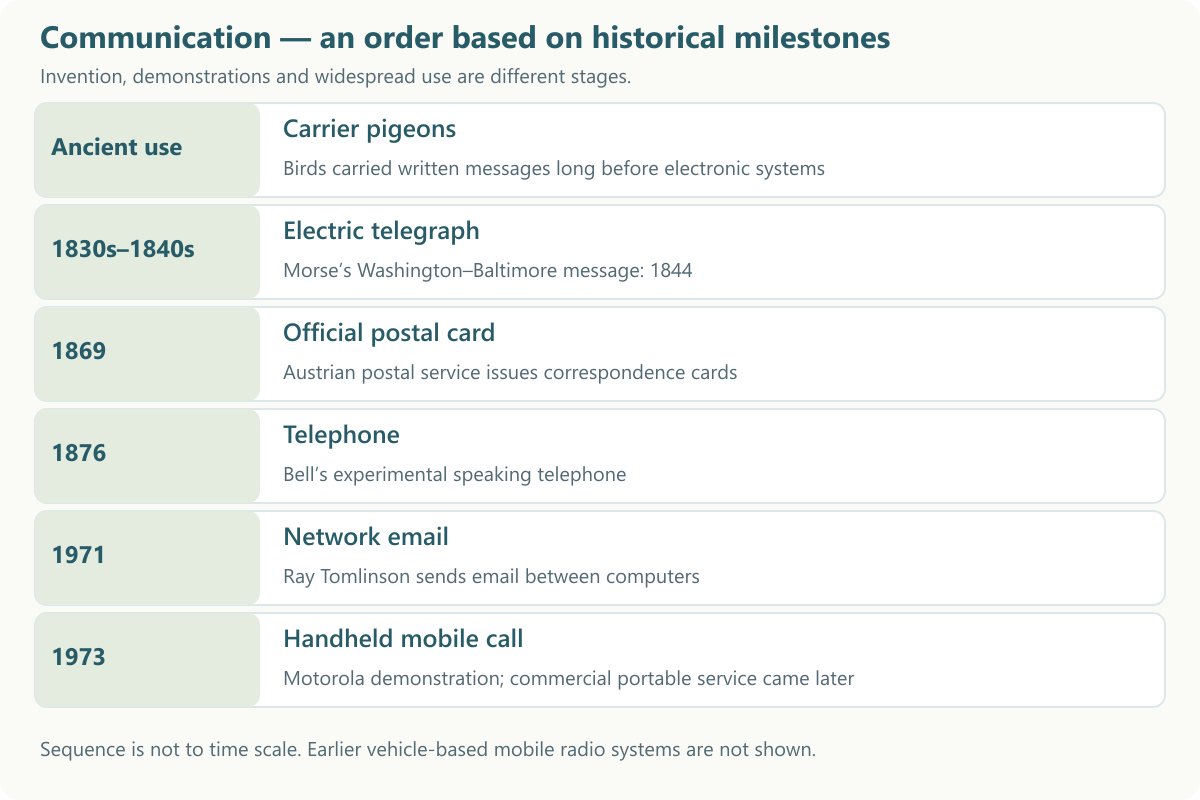
Open the full-size timeline. Text order and dates above provide a readable alternative on small screens.
Historical sources: Smithsonian telegraph record, Austrian Post history, Smithsonian Bell exhibit, Centre for Computing History and Motorola’s historical account.
II. Pair discussion — sample ideas
- Technology and the need for faster communication across distances have changed how people exchange messages.
- I prefer email for a considered message because I can revise it and keep a record. For an urgent conversation I prefer a phone call. Explain your own choice.
- Social media can connect people and share learning. Check information before forwarding, limit public personal details, use privacy settings and balance screen time with other activities.
Let us discuss
Using the exercise’s distinction between verifiable reports and personal judgements:
- Opinion — his assessment of the pleasure of a phone call.
- Fact — his career began soon after independence.
- Fact / autobiographical report — he reports what career he had envisaged; he is not saying which career is best for everyone.
- Opinion — his belief that work in Anand would be more meaningful.
- Fact / autobiographical report — Patel was his mentor and supporter; appreciating those values involves his perspective.
- Opinion — a moral judgement about life.
- Opinion — his definition of failure.
- Fact — the President awarded him the Padma Vibhushan in 1999. The adjective “magnificent” is his opinion about the ceremony.
Let us think and reflect
I.1. Extract – “In today’s fast-paced world we have become so addicted to instant communication… Writing—even if it is a letter—not only conveys our present concerns and views… but it becomes a possession that can be treasured and re-read over the years, with great, abiding pleasure.”
I.2. Extract – “Your grandmother too made an important choice… she ardently supported my choice to live and work in Anand. That choice of your grandmother to stand by me has given me an everlasting strength, always ensuring that I shouldered my responsibilities with poise.”
II. Answer the following questions.
Let us learn
I. Synonyms
1 splendid; 2 momentary; 3 swift; 4 essential; 5 useful; 6 lifelong.
II. Expressions
1–iv, 2–vi, 3–i, 4–ii, 5–iii, 6–v. In all humility = without self-importance; hold heads high = feel confident; quite honest = truthful; best of ability = use all skills; in awe = with respect and wonder; deep down = innermost self.
III. Words within words — checked samples
Use only letters present in the original, no more times than they occur.
- community — city, toy, unity, mutiny, cot, count
- important — port, part, paint, point, mint, ramp, trim
- magnificent — magic, finance, manic, fig, fine, gain
- satisfied — sad, fast, side, fit, aid, fade
- generation — gene, great, nation, region, train, anger, rage
- achievement — achieve, eat, cave, heat, mean, time, chime
The source example “tune” cannot be made from community because community contains no e. “Cement” likewise needs two e’s, but magnificent has only one.
IV. Antakshari — a valid sample chain
IMPORTANT → TROUBLE → EQUAL → LETTER → RESPONSIBILITY → YEARS → SUCCESS → SURVIVE. Each word starts with the last letter of the preceding word. Equal is the opposite of uneven in the sense of unequal; letter relates to the post office, responsibility to moral duty, years to time, success to prosperity, and survive to staying alive. Discuss the clue meanings and the grid with your teacher; synonyms depend on context. National does not mean “related to the post office”.
V. En and em dashes
- The conference will be held from March 15–March 20. This is the requested dash insertion; in polished writing use “March 15–20” or “from March 15 to March 20”.
- I have lived in Kanpur—Raipur—for five years now. An em-dash interruption can mark a correction to Raipur. Without clarification, two towns cannot be treated as a five-year numerical range; if both are intended, write “in Kanpur and Raipur”. The printed sentence is ambiguous.
- The artist—known for her vibrant paintings—will be showcasing her work in Guwahati.
- The scores for the final match were 2–3.
- My favourite snacks—samosas, pakoras, and jalebis—are all from India.
- The train journey from Belagavi–Bengaluru takes less than ten hours. This illustrates a route, not a checked current timetable; more natural prose is “from Belagavi to Bengaluru”.
- I just finished reading the book—it was absolutely amazing!
- The event will take place on September 1–September 5. More concise: September 1–5.
VI. Possessives and contractions
(i) your, (ii) their, (iii) It’s, (iv) you’re, (v) they’re, (vi) its. Its belongs to the thing/person referred to by it, not to “you”. It’s = it is / it has; your = possession, you’re = you are; their = possession, they’re = they are.
VII. Prepositional phrases — sample completions
- The children played happily in the school garden.
- Nisha placed the vase on the wooden table.
- We discussed the project in the conference room.
- Preethi found the lost book under the old bed.
- The cat slept on the soft cushion.
The printed preposition is already supplied. Write only the following noun phrase in each blank.
VIII. Jumbled sentences
- The dog barked loudly at the strangers walking by the house.
- My classmate wrote a story during the summer vacations.
- They enjoyed a picnic by the lake under the trees.
- He hung the painting in his grandfather’s room.
- The students studied for the exam with great determination.
Let us listen
Use the teacher transcript on page 100.
I. Matching
1–i, 2–v, 3–iv, 4–ii, 5–iii. Percussionist plays drums and similar instruments; impaired means weakened; vibrations are physical oscillations felt or heard; determination means persistence; gradual means developing slowly. The duplicated “damaged or weakened” phrase at the end of option iv is a source printing error.
II. True or false
- False — her hearing loss was gradual.
- False — the headmistress urged her parents to consult a specialist.
- True — percussionist Ron Forbes helped her.
- True — the transcript describes sensing vibrations through skin and cheekbones.
- False — she continued pursuing music.
III. One or two words — possible concise responses
- Sensing vibrations
- Mentor
- Respect abilities
These summarise the ideas within the requested word limit; they are not all verbatim quotations. Read Glennie’s own Hearing Essay for her explanation. Her experience should not be generalised to every deaf person.
Let us speak
I. Word stress
PROduce (noun) / proDUCE (verb); conTRACT (verb) / CONtract (noun); PROject (noun) / proJECT (verb); conTENT (verb) / CONtent (noun); REfuse (noun) / reFUSE (verb). The capitalised part is stressed. This pattern applies to these pairs, not every English noun and verb.
II. -sure consonant sounds
| /ʒ/ — as in pleasure | /ʃ/ — as in pressure |
|---|---|
| measure, leisure, enclosure, exposure, seizure, composure | reassure, ensure, fissure, unsure |
Focus on the consonant. The following vowel and final r vary with accent; “shuh” and “zhuh” are simplified classroom prompts.
III. Pausing and chunking
First read the marked example on page 95. Then compare this possible grouping for the next extract. Short pause = /; longer pause = //. Other meaningful groupings are possible.
As everyone of us / sometimes learns. //
And many a fellow turns about / when he might have won / had he stuck it out. //
Don’t give up / though the pace seems slow— //
you may succeed / with another blow. //
Often the goal is nearer than it seems / to a faint and faltering man. //
Pause at meaningful phrase boundaries rather than every written line. The textbook credits the reading to Edgar Albert Guest. If you know a related Hindi or regional-language song, share your own comparison.
Let us write
Original sample; replace bracketed details and describe your own grandparents’ lessons.
[Your address]
[Date]
Dear Grandpa and Grandma,
Thank you for teaching me to be honest and considerate. Your stories have shown me why admitting a mistake matters more than hiding it. When you share food with neighbours or listen patiently to someone who is worried, I see those lessons in action.
Because of your example, I now offer to help classmates with their notes and take responsibility for tidying our study area. I want to join a neighbourhood cleanliness activity too. Your kindness reminds me that contributing to society can begin with small everyday acts. I hope to keep learning from you and turn your advice into useful actions.
With love,
Your grandchild,
[Your name]
Let us explore
I. Researching the three revolutions
| Revolution | Textbook focus and further research |
|---|---|
| White | Milk production and dairy cooperatives; Kurien was a major leader, working with farmers and colleagues. Research Operation Flood using NDDB. |
| Green | High-yielding wheat and rice, with M. S. Swaminathan a major contributor. The textbook lists Padma Shri 1967, Padma Bhushan 1972, Padma Vibhushan 1989 and Bharat Ratna 2024. These changes involved many scientists, farmers and public institutions. |
| Blue | Fisheries production. NCERT names Hiralal Chaudhuri. More precisely, ICAR documents the successful induced breeding work of Hiralal Chaudhuri and K. H. Alikunhi in 1957; avoid calling one person the sole leader of every fisheries programme. |
Prepare a group chart with the product, method, people involved, benefits and a source for each fact.
II. Jan Shikshan Sansthan
JSS offers community-based vocational training under the Ministry of Skill Development and Entrepreneurship. The April 2026 government description identifies non-literates, people with limited schooling and school dropouts, mainly ages 15–45, with priority to disadvantaged groups in rural and urban low-income areas. It is not exclusively a rural scheme. Find the nearest centre and a locally offered course through the Ministry’s scheme page; actual available courses require local checking.
III. Financial literacy — all four discussion prompts
- Why learn early? It helps us distinguish needs from wants and plan. For example, record pocket money and save regularly towards a school bag instead of buying every attractive item.
- Gift money? First consider necessary expenses, a saving goal and when the money is needed. Discuss any investment choice with a responsible adult; consider risks and avoid assuming every investment grows like a tree.
- School event budget, fictional example: from ₹1,000 allow ₹500 for materials, ₹300 for refreshments and ₹200 as a reserve. Compare prices, reuse items, record receipts and keep the total within the budget.
- Why for everyone? Households, cooperatives and businesses all need to plan spending and saving, compare choices and account for resources responsibly.
Additional ClearStudy questions
This practice is separate from the printed textbook exercises.
Short answer
1. To whom is the letter addressed, and from where?
2. Why does Dr Kurien value writing over speaking on the telephone?
3. Who was Tribhuvandas Patel?
4. What career options did Dr Kurien give up to work in Anand?
5. How does Dr Kurien define integrity?
Long answer
6. What values does Dr Kurien wish to pass on to his grandson and his generation?
7. How does the chapter show the importance of family support in a person’s success?
ClearStudy MCQs and assertion–reason practice
1. Dr Verghese Kurien is popularly known as the:
(a) Father of the Green Revolution (b) Milkman of India (c) Father of the Blue Revolution (d) Iron Man of India
2. The letter is written to Dr Kurien’s:
(a) son (b) daughter (c) grandson (d) brother
3. According to Dr Kurien, which value is the most important?
(a) wealth (b) fame (c) integrity (d) power
4. In which year was Dr Kurien awarded the Padma Vibhushan, as mentioned in the letter?
(a) 1989 (b) 1999 (c) 2005 (d) 2012
5. The career Dr Kurien had originally trained for was in:
(a) medicine (b) metallurgy (c) law (d) teaching
6. Dr Kurien chose to work for a cooperative of:
(a) cotton growers (b) dairy farmers (c) sugarcane farmers (d) fishermen
7. The town where Dr Kurien chose to live and work was:
(a) Surat (b) Anand (c) Ahmedabad (d) Vadodara
8. According to Dr Kurien, failure is really about:
(a) not winning a prize (b) not putting in your best effort (c) losing money (d) being criticised
9. When Siddharth wanted to keep the medal, Dr Kurien told him to:
(a) sell it (b) earn his own reward through his work (c) give it to a museum (d) frame it on the wall
10. Dr Kurien calls his reflections in the letter his:
(a) memoirs (b) musings (c) lectures (d) diaries
Assertion–Reason – choose: (a) A and R true, R explains A; (b) A and R true, R does not explain A; (c) A true, R false; (d) A false, R true.
1. Assertion (A): Dr Kurien values writing letters more than speaking on the telephone.
Reason (R): A letter becomes a possession that can be treasured and re-read over the years.
2. Assertion (A): Dr Kurien gave up a comfortable career to work for dairy farmers in Anand.
Reason (R): He believed he could make a more meaningful contribution there.
3. Assertion (A): Dr Kurien’s wife had an easy and comfortable life in Anand.
Reason (R): She ardently supported his choice to live and work in Anand.
4. Assertion (A): Dr Kurien believes integrity is the most important value.
Reason (R): He defines integrity as being honest to oneself.
5. Assertion (A): Dr Kurien allowed his grandson to keep the Padma Vibhushan medal as his own achievement.
Reason (R): He wanted Siddharth to earn his own reward through his own work.
Exam tips & common mistakes
Exam tips
Remember the key facts: Dr Kurien is the ‘Milkman of India’, the letter is written from Anand (2005) to his grandson Siddharth, and he received the Padma Vibhushan in 1999. For value-based questions, link your answer to integrity, responsibility and selfless service. When asked about fact vs opinion, remember that a fact can be proven true or false, while an opinion is a personal belief or judgement.
Common mistakes to avoid
Do not confuse Dr Kurien (White Revolution – milk) with Dr M.S. Swaminathan (Green Revolution – wheat/rice) or Dr Hiralal Chaudhuri (Blue Revolution – fisheries). Do not write that the grandmother had a comfortable life – she gave up comforts to support him. In grammar answers, do not mix up its/it’s (possession vs ‘it is’) or use the en dash (–) where an em dash (—) is needed for extra information.
FAQs
Who wrote ‘I Too Had A Dream’, and what kind of text is this chapter?
It was written by Dr Verghese Kurien, the ‘Milkman of India’. This chapter is an extract from his autobiography, presented as a letter to his grandson Siddharth.
Why did Dr Kurien choose to work in Anand?
He believed he could make a more meaningful contribution by serving a cooperative of dairy farmers in Anand than by pursuing a comfortable career in metallurgy, the army or abroad.
What is the most important value according to Dr Kurien?
Integrity – which he defines as being honest to oneself. He says if you are always honest with yourself, it is easy to be honest with others.
What is the central message of the chapter?
That life is a privilege to be used for the common good; real success comes from integrity, responsibility and selfless service, and the true rewards of life are earned through a life well-spent.
Textbook-based exercises and additional ClearStudy practice are identified separately. Use your textbook alongside these explanations.