
The Case of the Fifth Word — Class 8 English Poorvi Questions and Answers
Explore The Case of the Fifth Word through its calendar code, story summary and textbook-based comprehension answers. This guide includes checked crossword and rebus solutions, reported speech, the printed listening key and original writing models.
Source: NCERT Poorvi, Grade 8, Unit 3, printed pages 101–121; listening transcript 151–152; supplied reprint 2026–27. Open-ended and personal responses are examples to adapt. These explanations are study support, not an official NCERT answer key.
- About the chapter
- Theme, characters & message
- About the author
- Summary
- Word meanings
- Before you read
- Let us discuss (Part I)
- Let us discuss (Part II – Fact/Opinion & Traits)
- Let us think and reflect
- Let us learn (grammar & vocabulary)
- Let us listen
- Let us speak
- Let us write
- Let us explore
- Extra questions
- MCQs & Assertion–Reason
- FAQs
About the chapter
This adapted detective story by Donald J. Sobol appears in Unit 3, Mystery and Magic. Leroy, nicknamed Encyclopedia Brown, helps his father Chief Brown reason through a hidden-jewellery puzzle. The story calls him the best detective alive as an admiring description within its fictional world, not a verified real-world ranking.
Theme, characters & message
Theme: The power of sharp observation, logical thinking and general knowledge to solve a mystery that even the police cannot.
Main characters: Encyclopedia Brown (Leroy) – a knowledgeable, modest and keenly observant boy detective; Chief Brown – his father, an honest, smart police chief who proudly relies on his son; Mrs. Brown – an alert former teacher who follows the case with interest; and Tim Nolan & Daniel Davenport – the jewellery thieves whose hidden loot drives the plot.
Message: Knowledge and clear, patient reasoning are powerful tools. A simple code can hide in plain sight, and a clever mind that connects small clues – days of the week, a calendar sheet, a single fir tree – can uncover the truth.
About the author
NCERT credits Donald J. Sobol and marks this selection “Adapted”. Leroy, Chief Brown, Mrs Brown, Nolan and Davenport are characters in the story. Read the clues before the solution if you wish to solve the puzzle yourself.
Summary
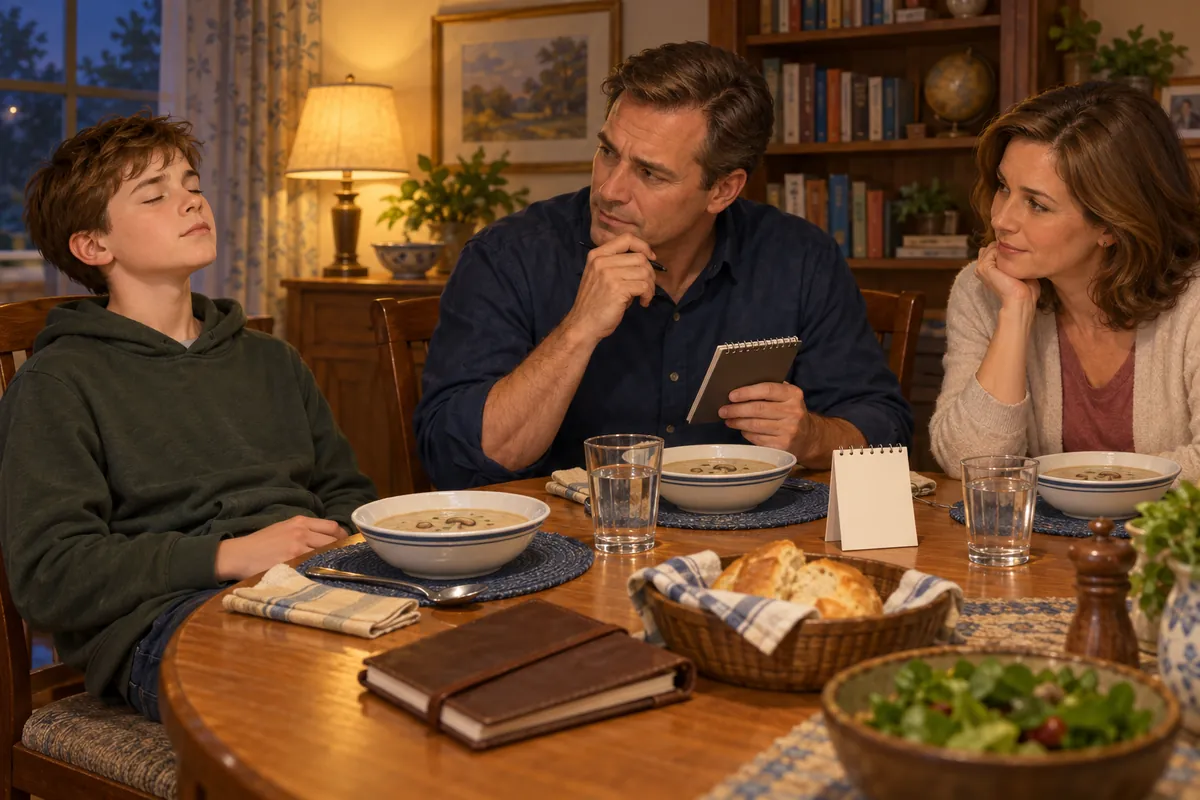
Encyclopedia Brown is a young boy living in Idaville, USA, whose father is the Chief of Police. Though only in the eighth grade, Encyclopedia (real name Leroy) is so full of facts and so quick at reasoning that the narrator describes him as the best detective alive. His father cannot tell anyone – no one would believe a boy could solve cases the police could not – so the two quietly discuss mysteries at the dinner table, and Encyclopedia usually cracks them before dessert.
One Tuesday, Chief Brown brings home a puzzle. Tim Nolan, a man he had long suspected of a million-dollar jewellery robbery five years earlier (along with a friend, Daniel Davenport), has just died of a stroke. The stolen jewellery was never found, and Davenport had vanished after the hold-up. As he was dying, Nolan left a will giving everything, including his palm-tree nursery, to Davenport. Clipped to the will was a calendar sheet bearing Davenport’s name and address and four strange words: Nom Utes Sweden Hurts.
Mrs. Brown, a former English teacher, explains the literal meanings of the words but cannot crack the message. Encyclopedia closes his eyes, thinks hard, and asks just one question: is there a young fir tree in Nolan’s nursery? There is – one. The four words, he reveals, are a simple code. Written on a calendar sheet, they stand for days of the week with the letters ‘d-a-y’ dropped: Nom = Monday, Utes = Tuesday, Sweden = Wednesday, Hurts = Thursday. The remaining letters are anagrams; for Friday, Fri is rearranged to Fir. The unwritten fifth word is ‘Fir’ – Friday. The jewellery is hidden under the fifth word, that is, beneath the fir tree – inside a twenty-gallon jug of earth from which it grew, exactly as Encyclopedia had foreseen.
Word meanings
| Word/Phrase | English meaning | Hindi meaning |
|---|---|---|
| nickname | pet name | उपनाम |
| in a matter-of-fact manner | without showing much emotion | भावहीन ढंग से |
| hold-ups | robberies done using threat or violence | हथियारबंद लूट |
| nursery | place where young plants are grown for sale | पौधशाला, नर्सरी |
| testify | make a statement in court to prove something | गवाही देना |
| hunch | a strong feeling about something | अंदेशा, पूर्वाभास |
| loot | stolen goods | लूट का माल |
| stroke | a sudden serious illness affecting movement | आघात, लकवा |
| will | legal document stating who gets one’s property after death | वसीयत |
| leafed through | quickly turned the pages | पन्ने पलटना |
| confessed | admitted | स्वीकार किया |
| code | hidden message | गुप्त संकेत, कूट |
| foreseen | predicted | पहले से जान लेना |
| suspicious | causing doubt or distrust | संदेहास्पद |
| nominative | a grammatical term (the subject form) | कर्ता-कारक |
| recognised | identified as known before | पहचाना |
| arrested | taken into custody by the police | गिरफ़्तार |
| yielded | (here) produced (income) | उपज देना, मिलना |
| fir | a kind of evergreen cone-bearing tree | देवदार जैसा वृक्ष |
| matter-of-fact | plain, unemotional | सीधा-सपाट |
Before you read
I. Work in pairs. Solve the crossword puzzle with the clues in the form of anagrams (Across: 3. Declare, 6. Tucks, 7. Heart, 9. Felt, 10. Sown, 12. Sword, 13. Evil; Down: 1. Aces, 2. Read, 4. Tool, 5. Alps, 6. Hooks, 8. Mane, 11. Loves).
II. Match the different meanings of ‘case’ in Column 2 with the correct usage in Column 1.
Let us discuss (after Part I)
I. Complete the following statements with suitable reasons.
II. Do you think Chief Brown would need Leroy’s help to solve this case? If yes, why? If no, why not?
Let us discuss (after Part II)
I. Identify which statements are facts or opinions. (1 has been done: “Encyclopedia’s father was the Chief of Police” – Fact.)
II. Complete the table with the character traits of Leroy from the box (cleverness, knowledgeable, keen listener, gentle, humble). One is done: trait 1 = knowledgeable.
| Textual Evidence | Trait |
|---|---|
| 1. He read more books than anyone in Idaville, and he never forgot a fact. | knowledgeable |
| 2. Encyclopedia never spoke of the help he gave his father. He didn’t want to seem different from other boys. | humble |
| 3. Encyclopedia sat quietly. He knew his mother and father were discussing the case for his benefit. | keen listener (attentive) |
| 4. Usually, he needed to ask only one question to solve a case before dessert. | cleverness |
(‘Gentle’ is the extra word not needed.)
Let us think and reflect
I.1. Extract – “Chief Brown would have liked to tell everyone about his only child. But who would believe him?… He was stuck with it… Only his parents and teachers called him by his real name, Leroy.”
I.2. Extract – “Chief Brown studied the four words: Nom Utes Sweden Hurts… ‘Nom is a shortening of nominative, a grammatical term,’ stated Mrs. Brown… ‘I can’t figure it out,’ she confessed. ‘Davenport disappeared right after the hold-up,’ Encyclopedia reminded her.”
II. Answer the following questions.
The story’s clues justify investigating Nolan and Davenport; earlier imprisonment or acquaintance alone does not prove guilt. Davenport’s plan to wait and retrieve the loot is a reasoned inference, not a directly stated confession.
Let us learn
I. Phrasal verbs
Matching: 1–iv, 2–iii, 3–i, 4–vi, 5–ii, 6–v.
Blanks: A turned up; B cooled down; C figure out; D put on; E got away with; F make of.
II. Word pairs
- week, weak
- four, fore
- brake, break
- piece, peace
- dyeing, dying
These complete the language exercise; the driving sentence is not a technical account of how braking causes a breakdown.
III. All eight rebus puzzles — page 112
Read left to right, top row then bottom row.
- Middle-aged — the middle AGED is underlined.
- Try to understand — Try + 2 (“to”) under stand.
- Up to you — upward arrow + two u’s.
- Go for it — GO + four it’s.
- Sixth sense — the sixth sense is circled.
- One in a million — 1 inside MILLION.
- Once upon a time — ONCE above a clock.
- Crossroads — two ROADS cross.
The three SECRET words with an arrow pointing to the top one form the supplied example Top secret.
IV. Spoonerisms
- Probable intended phrase: sewing kits. The printed “knowing sits” is problematic: knowing begins with /n/, kits with /k/, so this is not an exact exchange of the two initial sounds. “Sewing knits” is not a natural phrase. Check this source item with your teacher rather than learning it as a clear example.
- It’s pouring with rain.
- Master plan.
- Warm blanket.
- Cars and trucks.
- Take a shower.
- Read a book.
- Pardon me, madam.
V. Linking words
(i) who, (ii) where, (iii) Though, (iv) why, (v) which, (vi) When, (vii) how, (viii) because. Unused: whose, if.
VI. Combining sentences
- We gave him the signal that he was waiting for. (Given example.)
- We went to a place where the incident occurred.
- The teacher, who is now nearly sixty, said she would retire soon.
- It was the day when half the class was absent.
VII. Reporting the story’s questions
- Mrs Brown asked what was suspicious about that.
- Mrs Brown questioned Leroy about what he made of the four words. With asked, write “asked Leroy what he made …”.
- Mrs Brown inquired whether he had not been mixed up in a jewellery robbery a few years before.
- Mrs Brown asked Chief Brown whether he had not searched Nolan’s house.
- Mrs Brown inquired whether there was a young fir tree in Mr Nolan’s palm-tree nursery. This follows the printed answer stem; in the story, Leroy actually asks the fir-tree question.
“Dear” is an address term, not part of the reported question. These are conventional backshifted reports made later. Pronouns and time words depend on the real speaker, listener and reporting time; plural you does not automatically become us.
VIII. Reported speech — assuming I was addressed in items 1, 2, 3 and 5
- Rohan questioned why I had stopped talking to him.
- My aunt asked whether I had enjoyed the family gathering the day before.
- My grandmother inquired when I would visit them again. Them refers to her and the people included in her us.
- Madavi asked Ravi whether he would come with her to meet their old teacher the following day.
- My friend inquired what gift I was planning to give my brother.
- Veenu asked her teacher whether she should carry those notebooks to the staffroom.
IX. Aditi and Rahul — paragraph completions
- whether he had seen anyone leave a package near the lift
- what time he had seen that happen
- whether he had been able to see the man’s face
The last reference is to the man, not Rahul. A clearer completed report is: Rahul said that the man had worn a hood, so Rahul had not been able to see his face.
Let us listen
Checked against the teacher transcript on pages 151–152.
I. True or false
- True as a reasonable inference: awareness and better decisions can support common sense. The phrase common sense itself is not used in the script.
- False: rushing causes missed details.
- True: notes and sketches reinforce memory.
- False / not supported as stated: the script promises better noticing, not general success soon.
II. Exact words, one to three
- take your time
- information
- curious
- details
- present
The last question compresses the script’s “stay present” and “fully engage” ideas. Present is an exact word; connected is not in this transcript.
Let us speak
I. Pronunciation practice
Use the textbook’s simplified guide: jewellery (jool-ree), clerk (claak in the indicated British pronunciation), dessert (dih-zuht), January (ja-nyoo-uh-ree), sour (sau-uh), Wednesday (wenz-day), bowl (bol), pronunciation (pruh-nuhn-see-ay-shn), pizza (peet-zaa), buffet (buh-fay). Notice dessert has second-syllable stress, unlike the noun desert. These prompts are approximations; natural vowels and final r vary with accent.
II. Group discussion — original sample outline
Choose a moderator, a time limit and five or six participants. Discuss suspense, fair clues, plausible red herrings, logical deduction and a satisfying solution. One speaker might say, “I enjoy mysteries where the clues are available to the reader.” Another could add, “I agree, but the ending must also make sense.” The moderator invites quieter members and concludes by summarising the group’s ideas. Practise respectful turn-taking, not a memorised personal opinion.
Let us write
I. Features of the sample football report
A title and byline identify the event and reporter. The first paragraph answers what, who, when and where; later paragraphs describe events in sequence and the conclusion. Past tense, appropriate passive constructions and clear facts help the reader follow it. A real report should use actual information.
Original fictional model — inter-school art exhibition
Inter-school Art Exhibition
By [Reporter’s name], Class 8
An inter-school art exhibition was organised by our school’s Art and Craft Club from 12 to 14 March 20XX in the auditorium. Eight schools displayed paintings, sketches and crafts prepared by their students.
The invited artist opened the exhibition and encouraged students to explain their work. Entries were grouped under nature, community life and conservation. Visitors discussed the students’ choice of materials and the ideas behind their pictures.
On the final day, certificates were presented to participants and selected works received prizes. The club thanked the schools and volunteers. The exhibition gave young artists an opportunity to share their creativity and learn from one another.
Replace the fictional numbers, dates and events with verified details of your school’s exhibition. No weekday can be fixed for the placeholder year 20XX.
Let us explore
I. Optical illusions — possible readings of page 121
- The word design learn / teach, viewed in different orientations.
- Hate / love, viewed in different orientations.
- Good / evil, viewed in different orientations.
- A tree with concealed animal-face shapes in and around its branches. Compare what you can identify, rather than assuming everyone sees the same details.
- A penguin / human face in profile, using dark and light areas.
- Columns / people in silhouette, switching attention between light and dark shapes.
Turn the word designs or change which shapes you focus on, then explain your observations to a partner.
II. Name the Mystery Object
The book’s clues identify a classroom board — blackboard, green board or whiteboard. A new sample object is an umbrella: (1) I open wider when needed; (2) I have a handle and folding ribs; (3) I protect you from rain. Score 20, 10 or 5 points for a correct answer after the first, second or third clue.
III. Encyclopedia and dictionary
An encyclopedia provides articles and fuller explanations about subjects, people and events. A dictionary mainly explains words, spellings, meanings and pronunciation. Many printed encyclopedias are arranged alphabetically, but organisation varies, especially digitally. Compare an actual entry in each.
IV. Thesaurus — five sample sets
Happy: joyful, glad, cheerful. Big: large, huge, enormous. Quick: fast, swift, rapid. Clever: smart, intelligent, ingenious. Hide: conceal, cover, screen. Check the sentence: synonyms can differ in tone and precise meaning.
Additional ClearStudy questions
This practice is separate from the printed textbook exercises.
Short answer
1. Why was Leroy nicknamed ‘Encyclopedia’?
2. What were the four words written on the calendar sheet?
3. Where was the stolen jewellery finally found?
4. What did Chief Brown do when he could not solve a case?
5. How did Encyclopedia behave when he did his hardest thinking?
Long answer
6. Explain in detail how Nolan’s four-word code worked and what the fifth word was.
7. How does the story show that knowledge and observation are more useful than guesswork?
ClearStudy MCQs and assertion–reason practice
1. Where does Encyclopedia Brown live?
(a) Idaville (b) Sixth Avenue (c) South Carolina (d) Sweden
2. What is Encyclopedia’s real name?
(a) Tim (b) Daniel (c) Leroy (d) Brown
3. What was Encyclopedia’s father’s profession?
(a) Lawyer (b) Chief of Police (c) Teacher (d) Jeweller
4. How many years before the story did the Diamond Mart hold-up take place?
(a) Two years (b) Three years (c) Five years (d) Ten years
5. What business did Nolan run in Idaville?
(a) A jewellery shop (b) A palm-tree nursery (c) A bakery (d) A bookstore
6. The four coded words stood for:
(a) names of months (b) days of the week (c) colours (d) countries
7. What was the unwritten fifth word?
(a) Friday (Fir) (b) Saturday (c) Sunday (d) Money
8. The jewellery was hidden:
(a) under the kitchen table (b) in a bank (c) in a jug of earth under the fir tree (d) in Davenport’s house
9. Why did Mrs. Brown fail to decode the message?
(a) She could not read (b) She explained only the literal meanings (c) The words were in Swedish (d) The sheet was torn
10. Who is the author of the story?
(a) Ruskin Bond (b) Donald J. Sobol (c) Roald Dahl (d) O. Henry
Assertion–Reason – choose: (a) A and R true, R explains A; (b) A and R true, R does not explain A; (c) A true, R false; (d) A false, R true.
1. Assertion (A): Chief Brown did not tell anyone that his son solved his cases.
Reason (R): No one would believe that the best detective alive was an eighth grader.
2. Assertion (A): The coded words were written on a sheet from a desk calendar.
Reason (R): The calendar sheet was the key that hinted the words stood for days of the week.
3. Assertion (A): Mrs. Brown easily decoded the hidden message.
Reason (R): She had taught English and other subjects in high school.
4. Assertion (A): Encyclopedia asked whether there was a young fir tree in the nursery.
Reason (R): The fifth word in the code was ‘Fir’ (Friday), pointing to the hiding place.
5. Assertion (A): Nolan left the will and the coded sheet for Davenport.
Reason (R): Nolan and Davenport were strangers who had never met before the robbery.
Exam tips & common mistakes
Exam tips
Remember the decoding clearly: the words are on a calendar sheet, so they are days of the week with ‘d-a-y’ removed (Nom-Monday, Utes-Tuesday, Sweden-Wednesday, Hurts-Thursday), and the fifth word is Fir = Friday → under the fir tree. Be ready to explain Leroy’s traits with textual evidence (knowledgeable, humble, keen listener, clever) and to tell facts from opinions (an opinion can’t be proved; a hunch/belief is an opinion).
Common mistakes
Do not write that Mrs. Brown solved the code – she only gave the literal meanings and failed to decode it. Do not say Nolan and Davenport were strangers – they met in prison and were close partners. Spell the boy’s real name Leroy (nickname Encyclopedia), and remember the jewellery was inside a jug of earth under the fir tree, not buried loose in the ground.
FAQs
What was the fifth word?
Fir, an anagram of Fri left after removing day from Friday, points to the young fir tree in Nolan’s nursery.
How does the code work?
Remove day from each weekday name and rearrange the remaining letters: Mon becomes Nom, Tues becomes Utes, Wednes becomes Sweden and Thurs becomes Hurts. The missing fifth day is Friday, giving Fir.
Where was the jewellery found?
In a twenty-gallon jug of earth from which the young fir tree grew. It was not lying loose under an ordinary palm tree.
Why is Leroy called Encyclopedia?
He reads widely and remembers many facts, so his friends compare his head to an encyclopedia. He remains modest about helping his father.