
The Magic Brush of Dreams — Class 8 English Poorvi Questions and Answers
The Magic Brush of Dreams in Class 8 English Poorvi tells how Gopi uses a magical gift with kindness and courage. Find a story summary, vocabulary, textbook exercise explanations, a checked crossword key, listening answers and sample speaking and writing activities below.
Source: NCERT Poorvi, Grade 8, Unit 3, printed pages 122–136; listening transcript 152–153; supplied reprint 2026–27. Open-ended and personal responses are examples to adapt. These explanations are study support, not an official NCERT answer key.
Poem Overview – Theme, Characters & Message
The Magic Brush of Dreams is a narrative folk poem that tells the story of Gopi, a poor village girl who loves to draw pictures in the sand. A mysterious man gifts her a magic paintbrush with one condition – she must paint only for the poor, never for the wealthy. Whatever Gopi paints turns real, so she creates food, clothes and useful things for the needy villagers. When the greedy Zamindar demands a fortress and treasures for himself, Gopi refuses and is thrown into prison. Using the brush cleverly, she paints a road, a horse and a wide river to escape and to defeat the Zamindar and his men. The central message is that true power lies in kindness, courage and using one’s gifts to serve others, not in greed.
About the Source – A Folk Tale Adaptation
NCERT credits this poem as “Adapted from a Folk Tale”; the supplied textbook does not name an individual author or adaptor. It tells a story in verse, with dialogue, magic and a conflict between generosity and greed. Do not assign it to a named poet without evidence.
Central Idea of the Poem
The central idea of The Magic Brush of Dreams is that art and imagination, when used selflessly, have the power to change the world for the better. The magic brush is a gift meant to serve the poor, and Gopi honours that trust by helping the needy instead of enriching herself. The poem contrasts Gopi’s generosity with the Zamindar’s greed, and shows that courage and cleverness can defeat even the mighty. Its message is that real magic is not in wealth but in kindness, and that those who misuse power for selfish ends are finally defeated.
Story summary in five stages
Gopi is sent by her family to gather wild beans, fetch rice and pluck mangoes. Instead, she sits under the banyan tree drawing pictures in the sand with a twig, but the wind sweeps them away. A mysterious man sitting on a stone with a brush calls her over, whispers that the village must not know about his magic brush, and slips it into her hand. He instructs her firmly: “Paint not for the wealthy ones, but only for the poor.”
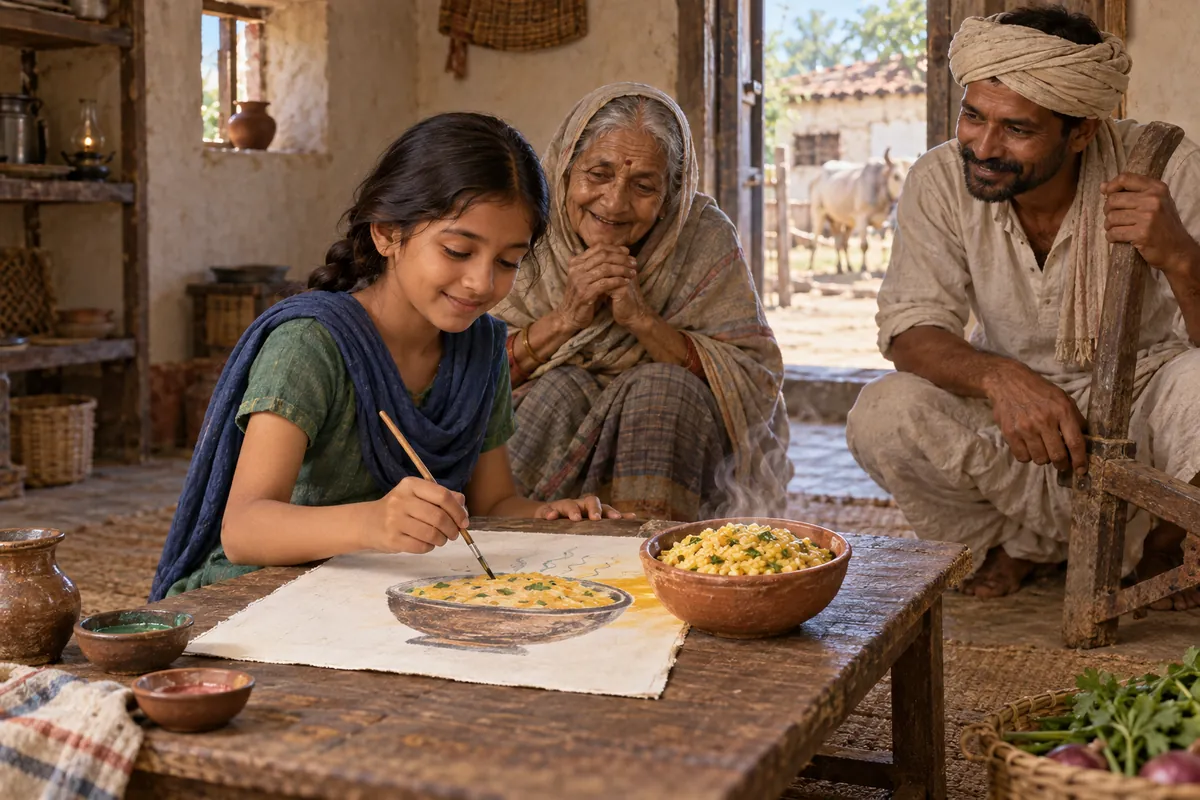
When her family asks if she brought food, Gopi grins, runs inside and paints a bowl of khichdi – which becomes real. The villagers, young and old, stream in to see the magic brush of dreams. Gopi paints useful gifts for the poor: a muffler for a farmer, a plough for another man, a shawl for a grandmother and a fan for a girl. The news of these “magic gains” spreads far and wide through forests, fields and plains.
The Zamindar hears of the brush and orders Gopi to paint him a tall, grand fortress and treasures, jewels and riches “enough to rule this land.” Gopi bows but refuses, saying she swore to use the brush only to help the needy. Enraged, the Zamindar roars, stamps his foot and orders his men to seize the brush and the girl and throw her in prison. In the cold cell he returns and again demands a fortress, gold and rubies in exchange for her freedom.
That night, while the Zamindar dreams of gold, Gopi paints a winding road and a strong, bold horse. The road leads out of the prison gates; she leaps onto the horse and gallops away through fields and villages. The happy villagers cheer her return. With the Zamindar’s men chasing, Gopi paints a mighty, deep river that stops them. She threatens to paint a beast to chase them, and the terrified Zamindar cries “No more!” and flees with his men.
Having defeated the Zamindar, Gopi paints for the village folk a joyous feast of sweets and tea, a bright courtyard, a band to play and songs of victory. Good triumphs over greed, and the poem ends in celebration.
Word Meanings (शब्दार्थ)
| Word | English Meaning | हिंदी अर्थ |
|---|---|---|
| banyan | a large Indian tree with spreading branches | बरगद का पेड़ |
| twig | a small thin branch of a tree | टहनी, छोटी डाली |
| sweeps away | blows or carries off | उड़ा ले जाना |
| hush | a call for silence; keep quiet | चुप! शांत रहो |
| slips | puts quietly or secretly | चुपके से रखना |
| wealthy | having a lot of money; rich | धनवान, अमीर |
| khichdi | a dish of rice and lentils cooked together | खिचड़ी |
| muffler | a scarf worn around the neck for warmth | गुलूबंद, मफलर |
| plough | a farm tool used to turn over soil | हल |
| shawl | a large piece of cloth worn over the shoulders | शॉल, दुशाला |
| Zamindar | a landlord who owns and rents out land | ज़मींदार, भू-स्वामी |
| fortress | a large strong building built for defence | किला, गढ़ |
| comply | to obey or act according to an order | आज्ञा का पालन करना |
| bellows | shouts very loudly in a deep voice | दहाड़ना, चिल्लाना |
| seize | to take hold of something suddenly and forcibly | पकड़ लेना, ज़ब्त करना |
| pen | (here) a small enclosure or cell | बाड़ा, कोठरी |
| thunders | speaks loudly and angrily | गरजना |
| winding | having many bends and turns | घुमावदार, टेढ़ा-मेढ़ा |
| gallops | runs fast (of a horse) at its quickest pace | सरपट दौड़ना |
| feast | a large special meal | दावत, भोज |
Let us do these activities before we read
I. Imagine a magical object — sample responses
- Object and power: A pencil that creates books would help children get stories and learning materials.
- For myself: I would choose a reading lamp that works without electricity, so I could read during a power cut.
- For others: I would choose a pump that provides clean water to homes where water is difficult to obtain.
II. Share an act of kindness — sample
A classmate missed school for several days. A friend shared notes and explained a difficult exercise patiently. This small act made the classmate feel included. Replace this example with something you have experienced or observed.
III. Group the words and draw symbols
| Group | Suitable words |
|---|---|
| Things | paintbrush, fortress, feast, twig; drawing when it means a picture |
| Actions | bows; drawing when it means making a picture; winding when used as a verb |
| Emotions | joy, fear |
| Descriptions needing discussion | cold describes a temperature or sensation; winding describes the road’s bends in the poem. |
The three supplied groups do not neatly cover every word. Explain your choice instead of calling “cold” an emotion. A word’s category depends on its use. For drawings, try a brush, a smiling face, a fortress, a meal and a person shivering.
NCERT textbook exercises
Let us discuss
I. Arrange the events in order of occurrence in the poem. The last one has been marked for you.
| Order | Event |
|---|---|
| 1 | Gopi is told to gather food but instead sits drawing pictures in the sand. (3) |
| 2 | A man gives a magic brush to Gopi to paint only for the poor. (9) |
| 3 | Gopi paints a bowl of khichdi, which becomes real and amazes the villagers. (1) |
| 4 | Gopi uses the magic brush to paint useful items for the villagers. (7) |
| 5 | The Zamindar orders Gopi to paint treasures for him. (2) |
| 6 | The Zamindar throws Gopi into prison. (5) |
| 7 | Gopi paints a road and a horse to escape. (6) |
| 8 | Gopi returns to the village with the Zamindar and his men chasing her. (4) |
| 9 | Gopi paints a wide river, stopping the Zamindar and his men. (8) |
| 10 | Gopi scares the Zamindar away, and celebrates with the villagers. (10) |
(The number in brackets is the statement’s original number in the textbook.) Numbers to write in the printed blanks, from statement 1 to 10: 3, 5, 1, 8, 6, 7, 4, 9, 2, 10.
II. Fill in the blanks by choosing the correct answer from the box given below. (triumphant and celebratory / tension and suspense / playful and innocent)
1. playful and innocent 2. tension and suspense 3. triumphant and celebratory
III. Fill in the blanks by choosing the correct option from within the brackets.
1. The poem mostly follows a simple rhyme scheme, ABCB, which adds a rhythmic flow.
2. This poem belongs to the narrative or ballad poetry genre, which tells a story through verse.
IV. Give examples from the poem for the following explanations.
1. The poem is rich in imagery, creating clear pictures in the reader’s mind. For example, “Gopi sits beneath the banyan, / A twig is in her hand. / She sits there drawing pictures, / Pictures in the sand.” This creates a vivid picture of the little girl drawing in the sand. Other examples are “She paints a mighty river wide, / Its currents fast and deep” and the closing “feast of sweets and tea, / A courtyard bright, a band to play.”
2. What is the effect of repetition in the line – ‘On you, and you and you!’? The repetition of “you” makes Gopi’s warning sound forceful and threatening, as though she is pointing at the Zamindar and each of his men one by one. It builds a sense of fear and urgency, emphasises that no one will be spared by the beast, and gives the line a strong, dramatic rhythm that helps frighten the men into fleeing.
V. Match the phrases from the poem in Column 1 with what they symbolise in Column 2.
| Column 1 | Column 2 |
|---|---|
| 1. The magic paintbrush | (iii) the power of art and imagination to change the world |
| 2. The grand fortress | (i) greed and the desire for wealth |
| 3. The river and the beast | (ii) barriers to protect Gopi from the Zamindar’s anger; the river is painted, but the beast is only threatened |
VI. Identify whether the following statement is true or false. “While Gopi uses the magic brush to help others, the Zamindar wants to use it for personal gain. This contrast drives the moral of the story.”
True. Gopi uses the brush selflessly to help poor villagers, while the Zamindar wants it only for fortresses, gold and riches. This contrast between selflessness and greed is exactly what drives the poem’s moral – that gifts and power should be used for the good of others, not for personal greed.
Let us think and reflect
I. Read the given extracts and answer the questions that follow.
1. Read the first extract on printed page 128: the man gives Gopi the brush.
(i) The man is whispering and telling Gopi to keep the brush a secret reflects his careful and secretive nature.
(ii) What is the significance of the man slipping the brush into Gopi’s hand? It marks the quiet handing over of a great, secret responsibility. By slipping it in unseen, the man shows that the gift is precious and must be protected from the wrong people, and that he trusts Gopi – a poor, kind girl – to use it wisely for the good of the needy.
(iii) The most likely reason the man instructs Gopi to ‘Paint not for wealthy ones but only for the poor’ is because he wants the magic brush to serve those who truly need help, not to make the already-rich even richer. He believes the gift should reduce suffering and inequality rather than feed greed.
(iv) The most appropriate title for the extract is A. The Magic Brush’s Secret, because the whole extract centres on the man secretly passing on the magic brush and warning Gopi to keep it hidden.
2. Read the second extract on printed page 129: the Zamindar demands riches.
(i) The news of Gopi’s magic brush spreads ‘through forests, fields, and plains’ because of its amazing, magical power that turns paintings into real, useful things – something so wonderful that everyone wants to talk about it and see it.
(ii) Why does the poet refer to things painted by Gopi’s paintbrush as ‘magic gains’? Because whatever Gopi paints magically becomes real, so the villagers “gain” real food, clothes and useful objects out of nothing. They are gains produced by magic, given freely to the poor, which is why the poet calls them “magic gains.”
(iii) Which statement is false? Rectify it. Statement B is false. The Zamindar does not request Gopi to paint a grand fortress and jewels – he orders / commands her to do so (“I order you to paint for me”). His tone is harsh and demanding, not polite.
(iv) What does the Zamindar’s demand for a grand fortress and jewels reveal about his character? It reveals that he is greedy, power-hungry and selfish. He wants riches “enough to rule this land,” showing his hunger for wealth and control. Unlike Gopi, he thinks only of himself and is ready to misuse the magic brush for personal gain.
II. Answer the following questions.
1. Explain why Gopi made the right decision by refusing to paint for the Zamindar.
Gopi made the right decision because she had given her word to use the magic brush only to help the poor and needy. Painting fortresses and treasures for the greedy Zamindar would have broken that promise and misused a gift meant for the good of others. By refusing, Gopi showed honesty, courage and loyalty to her values, even at the risk of being imprisoned. Her choice protected the true purpose of the brush and kept its power on the side of kindness rather than greed.
2. Gopi threatens to draw a beast to scare away the Zamindar. Justify her action. How would you have dealt with the situation differently?
Gopi’s threat is justified because the Zamindar and his men were chasing her to seize the brush and harm her; she needed a quick, powerful way to stop them without actually hurting anyone. The mere threat of a beast was enough to frighten them away, so it was a clever and non-violent solution. I might have dealt with it differently by painting a high wall or a thick forest to block their path, or by painting a fast vehicle to escape further – using the brush to create barriers rather than fear, so that no one feels threatened.
3. What is the significance of Gopi celebrating with the villagers at the end of the poem?
The celebration shows that good has triumphed over greed and that the brush’s power belongs to the whole community, not to one person. By painting a feast, music and songs of victory for the village folk, Gopi shares her joy and her gift with everyone, just as she promised. It highlights the values of unity, generosity and gratitude, and gives the poem a happy, hopeful ending in which the poor and kind are rewarded.
4. Compare Gopi’s use of the magic brush to how the Zamindar would have used it.
Gopi uses the brush selflessly – she paints food, clothes, tools and finally a feast for the poor, helping her family and neighbours, and later securing her own escape. The Zamindar, on the other hand, wants the brush only for personal gain: a tall fortress, gold, rubies and treasures “enough to rule this land.” Gopi’s use spreads happiness and helps the needy, while the Zamindar’s use would have increased his own wealth and power. The contrast shows kindness and service against greed and selfishness.
5. What can be inferred about Gopi’s character based on her refusal to follow the Zamindar’s orders?
Her refusal shows that Gopi is brave, honest and firm in her principles. Even though the Zamindar is powerful and can imprison her, she does not give in. She values her promise and the welfare of the poor more than her own safety. This tells us she is courageous, kind-hearted, loyal and strong-willed – willing to stand up against injustice and greed.
6. Justify the appropriateness of the title of the poem.
The title “The Magic Brush of Dreams” is apt because the brush is truly magical – whatever is painted with it becomes real. It is a “brush of dreams” because it turns hopes and wishes into reality: the dream of food for the hungry, warmth for the cold, and freedom from a cruel landlord. The brush makes the villagers’ dreams come true and helps Gopi’s own dream of justice succeed, so the title captures both the magic and the hopeful spirit of the poem.
7. If you had the magic brush, how would you use it in today’s world?
If I had the magic brush, I would use it to solve problems that hurt many people. I would paint clean drinking water and food for those who go hungry, hospitals and medicines for the sick, and schools and books for children who cannot afford them. I would paint trees and clean air to fight pollution, and shelters for the homeless and for stray animals. Like Gopi, I would use it only to help the needy and never for personal greed, so that the gift truly serves the world.
Let us learn
I. The verb ‘draw’ has different meanings in different contexts. Match the sentences in Column 1 with their appropriate meanings in Column 2.
| Column 1 | Meaning |
|---|---|
| 1. His speech drew loud applause from the audience. | (iii) got a reaction |
| 2. The event will draw huge crowds from all neighbouring places. | (iv) attract |
| 3. Plants draw water from the soil. | (vi) absorb |
| 4. I reached the station when the train was drawing into the station. | (v) moving |
| 5. The room was dark, so she drew the curtains to let the sunlight in. | (i) opened |
| 6. He drew a piece of paper from the folder. | (ii) pulled out |
II. Fill in the crossword. Clues have been given below. You will find the words in the poem.
Across: 2. the fastest pace of a horse – GALLOP 4. happen fast – SWIFT 7. speaks very softly – WHISPERS 10. take hold of (something) and quickly remove it from its place – PLUCK 11. having a lot of money; rich – WEALTHY 12. take hold of something suddenly and forcibly – SEIZE
Down: 1. runs away from a place – FLEES 3. possessing a great deal of strength or power – MIGHTY 5. a deep loud shout in pain or anger – BELLOW 6. to act according to rules – COMPLY 8. moved in a continuous flow in a specified direction – STREAMED 9. a win after overcoming an enemy – VICTORY
Grid check: Across 4 needs SWIFT (5 letters), although the poem uses “swiftly” and the clue is loosely worded. Down 5 needs BELLOW (6 letters); the poem uses “bellows”. These forms fit the printed spaces and crossings. “Swiftly” and “roars” do not fit.
III. There are certain expressions that convey a sudden feeling or reaction. Match the expressions in Column 1 with what emotions or reactions they convey, in Column 2. Then create sentences using any five expressions.
| Expression | Emotion / Reaction |
|---|---|
| 1. Phew! | (v) relief |
| 2. Eek! | (vii) alarm |
| 3. Ouch! | (ii) pain |
| 4. Yippee! | (vi) delight |
| 5. Whoa! | (i) surprise |
| 6. Oops! | (iii) mistake |
| 7. Hey! | (iv) attract attention |
Sample sentences:
1. Phew! I finally finished my homework before the deadline.
2. Ouch! That pin pricked my finger.
3. Yippee! We won the inter-school quiz competition.
4. Whoa! I never expected to see a peacock in our garden.
5. Oops! I have written the wrong date on my answer sheet.
Let us listen — wishes and speakers
The key follows the listening transcript on printed pages 152–153. Match the statement number to the speaker’s Roman numeral.
| Statement | Speaker | Reason |
|---|---|---|
| 1. Healing people | iv | Wants to remove illness and suffering. |
| 3. Controlling the weather | v | Wants weather to suit people’s needs. |
| 4. Making business decisions | i | Wants foresight to help with business choices. |
| 6. Remembering quickly | ii | Wants to retain what is read or learnt. |
| 7. Travelling without a vehicle | iii | Wants to reach places directly. |
Unused statements: 2 and 5. Although speaker i mentions seeing the future, the specific purpose is business decision-making, making statement 4 the closer match.
Let us speak — intonation and polite requests
I. Practise a falling tone
For the firm commands in the poem, let your voice fall towards the end: “Come here! ↘”, “Seize this magic brush! ↘”, “Paint my fortress tall! ↘” and “Go and fetch some rice! ↘”. Read the full sentences from the textbook, stressing the important words. Tone depends on purpose: practise politeness in the requests below rather than copying the Zamindar’s threatening voice.
II. Six situations — sample requests
| Situation | Model request |
|---|---|
| Teacher: class picnic | Ma’am, could we please organise a class picnic? We can help make a plan. |
| Teacher: missed sports period | Sir, could we have an extra sports period this week, since we missed one last week? |
| Activity in-charge: school event | Ma’am, may I please participate in the school event? I am willing to practise regularly. |
| Sibling: project help | Could you help me arrange these pictures for my project, please? |
| Mother: dance class | Mum, could I join the dance class? Can we discuss its timings? |
| Cousin: weekend visit | Could you come over this weekend? We could finish our puzzle together. |
Work in pairs. Add an appropriate reply, say thank you, and swap roles. Accept a refusal politely.
Let us write — an imaginative essay
I–II. Read the model and use its checklist
Read the textbook’s EcoFlash model. Notice its title, opening, setting, characters, main idea, descriptive details, resolution and closing thought. The magical idea should connect the events; give the story a clear ending. Use the eight checklist items to review your own work.
III. A magical scarf — original sample essay
This model chooses the scarf prompt. The events are invented; adapt the ideas and language rather than presenting them as a real experience.
The Scarf That Came Home
I was a blue scarf drying on a clothesline when a playful gust lifted me into the sky. Below me, rooftops glittered after the rain. I had never travelled beyond my owner’s garden, and every street seemed full of surprises.
First, I landed beside a vegetable seller. His basket had fallen, scattering tomatoes across the pavement. I stretched my corners and caught the rolling fruit. He laughed with relief and carefully folded me on his stall. Before he could discover my secret, another breeze carried me away.
Next, I floated through the open window of a small library. A child sat reading beside her grandmother. The room was chilly, so I settled gently around the child’s shoulders. She smiled and continued reading aloud. For an hour, I listened to stories about rivers, mountains and distant islands.
At sunset, I wished to return home. The breeze seemed to understand. It carried me back to the garden, where my owner recognised the little yellow flower stitched at my edge. She wrapped me around her neck and sighed happily.
Flying had been wonderful, but my most valuable experience was discovering that even a small scarf could bring someone comfort.
Let us explore — magic, riddles and design
I. P. C. Sorcar’s profile
Read the textbook’s profile of P. C. Sorcar (Senior), the Indian stage magician. It records his Padma Shri award in 1964. Discuss how performance, practice and illusion differ from the supernatural brush in this fictional poem. If researching further, record the source of each new fact.
II. Riddle answers
- Sound or music: it can fill a room and be heard without being seen.
- Footsteps: the more steps you take, the more you leave behind.
- A map: it shows places and features through symbols, rather than containing the real things.
- A candle: it becomes shorter as it burns.
For the first riddle, “sound” is a broad answer and “music” is a suitable example. Explain why your answer fits every clue.
III. Design a magical object — sample plan
Name: Kindness Compass. Special quality: it points towards a nearby task where help is welcome. Draw a round compass with three labels: helping needle, request light and reset button. In your explanation, describe how its owner asks permission before helping and how it can guide someone to a lost book, an untidy shared space or a neighbour needing assistance. This is an imaginative classroom design.
Additional ClearStudy questions
This practice is separate from the printed textbook exercises.
Short Answer Questions (30–40 words)
Q1. Where was Gopi sitting and what was she doing instead of gathering food?
Gopi was sitting beneath the banyan tree with a twig in her hand. Instead of gathering wild beans, fetching rice and plucking mangoes as she was told, she was drawing pictures in the sand.
Q2. What condition did the mysterious man set when he gave Gopi the brush?
The man told Gopi to keep the magic brush a secret from the village and to use it carefully. His firm condition was: “Paint not for the wealthy ones, but only for the poor.”
Q3. What were some of the useful things Gopi painted for the villagers?
Gopi painted a bowl of khichdi that became real, a muffler for a farmer, a plough for another man, a shawl for a grandmother and a fan for a girl – useful gifts for the poor villagers.
Q4. How did Gopi escape from the prison cell?
At night, while the Zamindar dreamt of gold, Gopi painted a winding road and a strong, bold horse. The road led out of the prison gates, so she leapt onto the horse and galloped away to freedom.
Q5. How did Gopi finally make the Zamindar give up the chase?
Gopi painted a wide, deep river that stopped the Zamindar and his men, who could not leap across it. She then threatened to paint a fierce beast to chase them, and the frightened Zamindar fled with his men.
Long Answer Questions (100–120 words)
Q1. Describe how Gopi used the magic brush to help the poor villagers.
Once Gopi received the magic brush, she remembered the man’s instruction to paint only for the poor. She first tested the brush by painting a bowl of khichdi, which amazed everyone by becoming real. As word spread, the young and old streamed into her house to see the magic. Gopi then painted exactly what each needy person required – a warm muffler for a farmer, a plough for a labouring man, a shawl for an old grandmother and a fan for a little girl. She gave freely, asking nothing in return. Her selfless use of the brush brought comfort, warmth and food to the poor, spreading joy and making the magic a blessing for the whole community.
Q2. How does the poem contrast Gopi and the Zamindar, and what moral does this teach?
The poem sharply contrasts Gopi’s kindness with the Zamindar’s greed. Gopi, though poor, uses the magic brush only to help the needy – painting food, clothes and tools, and finally a feast for the village. The wealthy Zamindar, in contrast, wants the brush solely for personal gain, demanding a tall fortress, jewels and riches “enough to rule this land.” When Gopi refuses, he imprisons her, but she cleverly escapes and defeats him with a road, a horse, a river and the threat of a beast. The moral is clear: power and gifts should be used to serve others, not to feed selfishness. Honesty, courage and generosity finally triumph over greed and cruelty.
Q3. Why is “The Magic Brush of Dreams” a good example of a narrative folk poem?
The poem is a fine narrative folk poem because it tells a complete story in verse, with a clear beginning, middle and end. It has memorable characters – the poor, kind Gopi, the mysterious giver of the brush and the greedy Zamindar – and a sequence of events that builds tension and ends happily. Like traditional folk tales, it carries a strong moral about kindness defeating greed. Its mostly ABCB rhyme scheme and rhythmic, musical lines make it easy to recite and remember, just as folk stories were once passed down orally. The use of magic, repetition and vivid imagery gives it the timeless, story-telling charm typical of folk literature.
ClearStudy MCQ practice
1. The poem ‘The Magic Brush of Dreams’ is – (a) written by a famous poet (b) adapted from a folk tale (c) a true news report (d) a personal diary
2. What was Gopi supposed to gather? – (a) flowers and leaves (b) wild beans, rice and mangoes (c) gold and jewels (d) firewood
3. Where did Gopi draw her pictures before she got the brush? – (a) on paper (b) on a wall (c) in the sand (d) on a slate
4. What condition did the man set for using the brush? – (a) paint only for the rich (b) paint only for the poor (c) paint only animals (d) never paint anything
5. The first thing Gopi painted that became real was – (a) a fan (b) a plough (c) a bowl of khichdi (d) a shawl
6. What did the Zamindar order Gopi to paint? – (a) food for villagers (b) a fortress, treasures and jewels (c) a school (d) a garden
7. When Gopi refused, the Zamindar – (a) rewarded her (b) thanked her (c) threw her in prison (d) ran away
8. To escape from prison, Gopi painted a – (a) boat and a sail (b) road and a horse (c) ladder and a rope (d) tunnel and a lamp
9. What stopped the Zamindar and his men from catching Gopi? – (a) a high wall (b) a thick forest (c) a mighty wide river (d) heavy rain
10. At the end of the poem, Gopi paints for the villagers a – (a) fortress (b) feast, courtyard and a band (c) treasure chest (d) new house for herself
Answer key: 1-b, 2-b, 3-c, 4-b, 5-c, 6-b, 7-c, 8-b, 9-c, 10-b
ClearStudy assertion–reason practice
For each question choose: (a) Both A and R are true and R is the correct explanation of A. (b) Both A and R are true but R is not the correct explanation of A. (c) A is true but R is false. (d) A is false but R is true.
1. A: Gopi refused to paint a fortress for the Zamindar. R: She had promised to use the magic brush only to help the poor. — (a)
2. A: The man asked Gopi to keep the magic brush a secret. R: He wanted the whole village to gather and watch her paint. — (c)
3. A: The Zamindar finally fled in fear. R: Gopi threatened to paint a beast that would chase and feast on him and his men. — (a)
4. A: The poem is a narrative poem. R: It tells a complete story through verse. — (a)
5. A: Gopi celebrated alone after defeating the Zamindar. R: She painted a feast, a courtyard, a band and songs of victory for the whole village. — (d)
FAQs
Who wrote The Magic Brush of Dreams?
NCERT credits it as “Adapted from a Folk Tale” and does not name an individual author or adaptor in the supplied textbook.
What is the poem’s message?
Gopi’s choices show the value of kindness, courage and using a gift to meet people’s needs instead of satisfying greed.
What are the rhyme scheme and genre?
The rhyme scheme is mostly ABCB, with some variation. It is a narrative poem or ballad because it tells a story in verse.
Does Gopi paint a beast?
No. She paints a river to stop the pursuers and threatens to paint a beast. The frightened Zamindar flees before she does so.
Which words fit crossword clues 4 Across and 5 Down?
SWIFT fits the five cells of 4 Across; BELLOW fits the six cells of 5 Down. The poem uses the related forms “swiftly” and “bellows”.
Also read: Poorvi – All Chapters · Class 8 – All Subjects · NCERT Solutions Home. Official textbook PDF: ncert.nic.in