
Spectacular Wonders — Class 8 English Poorvi Questions and Answers
Spectacular Wonders introduces remarkable landscapes and natural phenomena in Class 8 English Poorvi. This guide explains the seven places, checks the vocabulary and grammar exercises, corrects the listening key, and provides models for the open-ended activities.
Source: NCERT Poorvi, Grade 8, Unit 3, printed pages 137–150; listening transcript 153–154; supplied reprint 2026–27. Open-ended and personal responses are examples to adapt. These explanations are study support, not an official NCERT answer key.
About the text
“Spectacular Wonders” is the prose / non-fiction piece in Unit 3, ‘Mystery and Magic’. It is a vivid, descriptive travel-and-nature article that takes the reader on a tour of seven of India’s most astonishing natural phenomena – the Valley of Flowers (Uttarakhand), the Living Root Bridges (Meghalaya), the Lonar Crater Lake (Maharashtra), the Magnetic Hills (Ladakh), the Glowing Waters of Kerala, the Sundarbans (West Bengal) and the Invisible Chandipur Beach (Odisha). The text blends scientific facts with a sense of wonder and folklore.
Summary
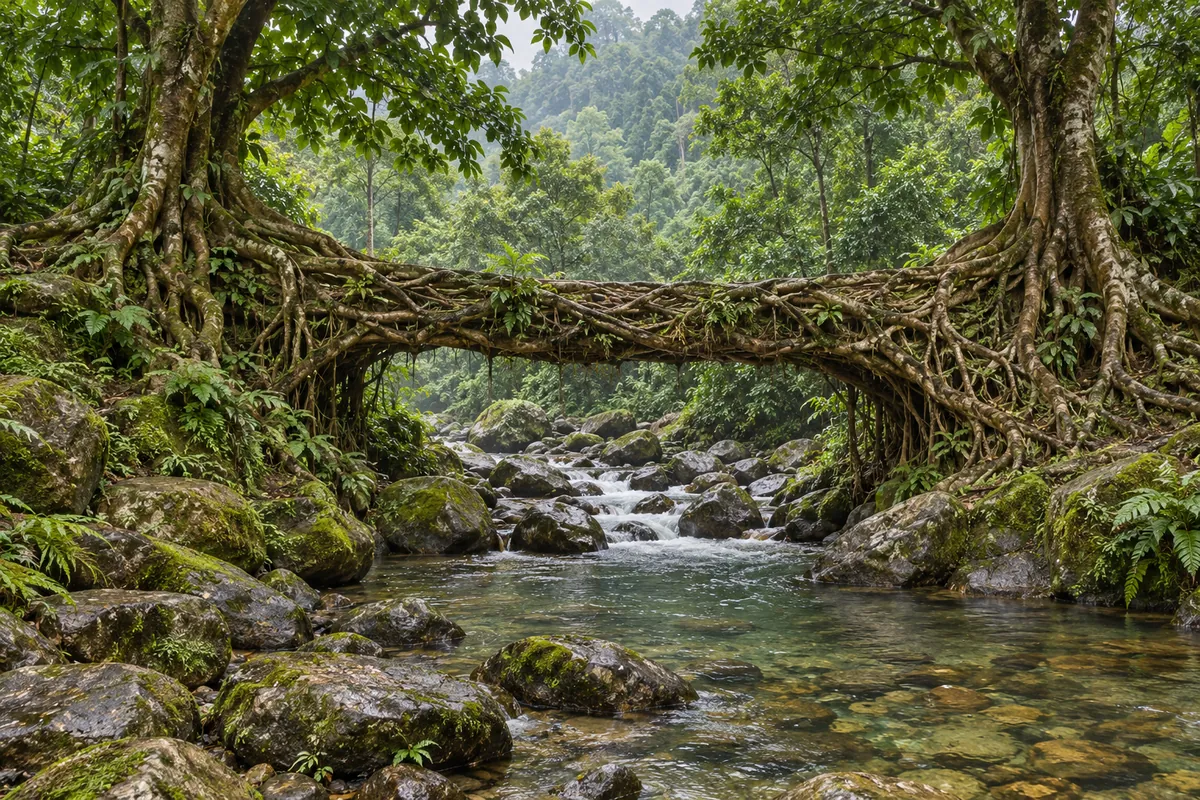
The chapter introduces seven places. The Valley of Flowers in Uttarakhand is known for alpine flowers and mountain scenery. The living root bridges of Meghalaya show how communities guide growing roots into useful crossings. These bridges combine human knowledge with living nature.
Lonar Lake in Maharashtra occupies an impact crater in basalt. At Magnetic Hill near Leh, the surrounding landscape creates the impression of vehicles rolling uphill; gravity is not reversed. Kumbalangi’s glowing waters are described through bioluminescence, light made by organisms.
The Sundarbans is a mangrove landscape; the chapter focuses on its Indian portion in West Bengal. At Chandipur Beach in Odisha, the shoreline shifts far out during ebb tide and returns with the rising tide. The sea does not literally vanish. Together, these examples encourage observation and care for the environment.
Theme & message
The central theme is the mystery, magic and power of nature. Each phenomenon – whether a meteorite crater, glowing water, or a vanishing sea – reminds us that nature is full of wonders that science can explain yet still leave us awestruck. The text encourages curiosity, scientific intrigue and respect for India’s rich natural heritage, and shows how human wisdom (like the living root bridges) can work in harmony with nature.
About the writer / text
This is an informational prose text in NCERT Poorvi, Unit 3, “Mystery and Magic”. The supplied text does not name an individual writer. Its questions, descriptive words and scientific explanations invite curiosity. Some factual statements in the supplied edition need clarification; see the source notes below.
Word meanings
| Word | Meaning |
|---|---|
| mystifying | strange or impossible to explain |
| spectacle | an unusual sight that attracts interest |
| exotic | uncommon, unusual |
| botanical | relating to plants |
| feats | tasks difficult to achieve, needing great skill |
| indigenous | native, belonging to a place |
| tangible | noticeable; able to be touched/seen |
| futile | useless |
| intertwined | twisted together |
| persist | continue to exist |
| whopping | huge |
| nestled | situated in a half-hidden or sheltered position |
| colossal | extremely large |
| cradles | holds gently |
| rugged | rough |
| terrestrial | on or related to earth |
| allure | attraction |
| optical illusion | something that tricks the eyes |
| serene | calm |
| backwaters | a part of a river where water does not flow |
| bioluminescence | light produced inside a living organism by a chemical reaction |
| estuarine | living in an estuary (where a river meets the ocean) |
| retreats | goes backwards |
| ebb tide | period when water flows away from the shore |
| mystique / enigmatic / intrigue | mystery / puzzling / interest |
Before you read
I. Classify the eight pictures on printed page 137
Textbook-style grouping: Natural: 1, 3, 7, 8. Man-made: 2, 4, 5, 6.
Important distinction: Picture 1 shows a living root bridge. Although grouped with nature here, people deliberately guide and nurture its roots; it is a partnership between nature and human engineering. Picture 4 shows an artificial ice stupa, so ice alone does not make it a wholly natural formation. The palace, metal bridge and pavilion are human constructions.
II. Which kind appeals to you? — sample
I prefer natural landscapes because their colours and forms make me curious about how they developed. I also admire buildings that show skilled design. Either preference is acceptable with a reason.
III. Two wonders — sample
A rainbow amazes me because sunlight and water droplets produce a coloured arc. A waterfall impresses me through its movement, sound and power. Choose examples you know and describe your own response.
IV. Nature’s Power — web-chart ideas
Growth, sunlight, wind, rain, waves, tides, waterfalls, erosion, lightning and earthquakes. Link words around the centre and explain one constructive effect and one potentially destructive effect.
Let us discuss
I. Complete the information in the table given below. (Amazing Natural Phenomena – Location – One Unique Feature)
| Amazing Natural Phenomena | Location | One Unique Feature |
|---|---|---|
| 1. The Valley of Flowers | Chamoli district, Uttarakhand | Around 600 species of exotic flowers |
| 2. The Living Root Bridges | Meghalaya | Bridges made of living, intertwined tree roots guided by local communities |
| 3. The Lonar Crater Lake | Buldhana district, Maharashtra | A circular saline lake formed by a meteorite impact in basaltic rock |
| 4. Magnetic Hills | Leh district, Ladakh | An optical illusion where parked vehicles appear to roll uphill |
| 5. Glowing Waters | Kumbalangi village, near Kochi, Kerala | Backwaters that glow at night due to bioluminescence |
| 6. The Sundarbans | West Bengal | A vast mangrove forest, home to the Bengal tiger |
| 7. The Invisible Chandipur Beach | Balasore district, Odisha | The sea disappears and reappears with the tides |
Let us think and reflect
I.1. Extract – “India is home to some of the most mystifying natural phenomena that surprise and spark our imagination.”
I.2. Extract – “Have you seen things disappearing in front of your eyes?… the Chandipur Beach which is known for its unique feature of playing hide-and-seek with its visitors.”
II. Answer the following questions.
Let us learn
I. Fill in the blanks with the correct expressions from the text.
II. Select the correct synonyms from the box that match the words in 1–5.
III. Match the binomials with their meanings.
| Column 1 (binomial) | Meaning |
|---|---|
| 1. odds and ends | (vii) small, unimportant things |
| 2. on and off | (v) sometimes, occasionally |
| 3. mix and match | (i) put different things together to get a range of possibilities |
| 4. all or nothing | (viii) something to be done completely or not at all |
| 5. part and parcel | (ii) complete part of or belong to |
| 6. pick and choose | (iii) choose only the best (things, people, etc.) |
| 7. sooner or later | (iv) at some time in the future |
| 8. leaps and bounds | (vi) increase or develop very quickly |
IV. Fill in the blanks using the present or past participle form of the verbs (stand, amaze, carve, scatter, glow).
V. Underline the gerunds and participles (write ‘G’ for gerund, ‘P’ for participle).
VI. Combine the pairs of sentences using participles or gerunds.
Learn I, item 1: The remaining phrase is “to name a few”, but the printed sentence is incomplete in meaning because it names no examples. A natural model is: “I have read many stories—The Cherry Tree and The Case of the Fifth Word, to name a few.” The other answers are 2 came into existence; 3 to no end; 4 age-old problem; 5 in disbelief; 6 in full glory.
Grammar clarification: An -ing form naming an activity is a gerund in this school-level classification; one describing a noun or introducing a participial clause is a participle. In V.7, “Forgetting” introduces a clause describing Kanchan, so it is P. “Rugged” is ordinarily an adjective meaning rough, not a productive past participle of an everyday verb “rug”. Do not decide only from an -ed ending.
Let us listen
Use the brother-and-sister conversation on printed pages 153–154. The four true statements are 2, 4, 5 and 6.
| Item | Answer | Evidence from the conversation |
|---|---|---|
| 1 | False / not supported | The brother says he liked the photographs. The explicit reaction of not believing one’s eyes belongs to the sister, not the brother. |
| 2 | True | He had not known that the Rainbow Mountain was also his sister’s favourite. |
| 3 | False | She finds its many colours extraordinary. |
| 4 | True | He explains the mineral layers. |
| 5 | True | He explicitly expresses disbelief that the mountain had been buried under snow until recently. Knowing a fact does not prevent him from being surprised by it. |
| 6 | True | She connects the colours and beauty to natural processes. |
These answers test what the speakers say in the supplied transcript. The dialogue’s simplified geological claims should not be treated as a complete scientific account.
Let us speak
Work in four-person groups. Choose a real place near your region and verify local details. This ten-slide outline is a planning model, not a claim about a particular destination.
| Slides | What to prepare |
|---|---|
| 1–2 | Name, a suitable image, and a short reason for choosing the place. |
| 3–4 | Location on a map and a checked route from your school or town. |
| 5–6 | Two main attractions and any documented historical significance; identify sources. |
| 7–8 | Typical weather, local food, customs and language, using respectful descriptions. |
| 9–10 | A suitable visiting season, reasons for the recommendation and care for the site. |
Sample opening: “Our group has chosen the lake near our town. We will explain where it is, what visitors can observe and how to keep its surroundings clean.” Divide the slides among speakers, practise transitions and invite questions. Add current timings or travel information only after checking them.
Let us write
Write a title, one introductory paragraph, two or three body paragraphs, and a conclusion. The textbook does not prescribe a word count here. The following is an original model; use your own experience for the final school-magazine piece.
A Morning Beside the Stream
During a visit to a hill village, I woke early and walked with my family to a stream. The morning was quiet, and the first sunlight had just reached the water.
The stream curved between dark, mossy rocks. Water slipped over a small ledge and broke into silver bubbles. Along the bank, drops of dew clung to blades of grass. Yellow flowers leaned towards the light, while a thin mist softened the outline of the distant trees.
I listened to the water’s steady murmur and the calls of birds hidden among the leaves. A fallen twig turned slowly in a little pool before the current carried it away. That tiny movement helped me notice how the stream was constantly changing, even though it seemed peaceful.
As we returned, I realised that a wonder need not be enormous or famous. Careful attention could make an ordinary stream unforgettable. I wanted other visitors to enjoy the same beauty, so we made sure to leave no litter behind.
Let us explore
I. Human achievements and checked source notes
- Kallanai Dam, Tamil Nadu: the textbook describes this ancient irrigation work and associates it with the Chola ruler Karikala.
- Nalanda, Bihar: an important ancient monastic and learning centre. Correction: the archaeological site was inscribed on UNESCO’s World Heritage List in 2016, not 1980 as printed in the supplied text. See the UNESCO Nalanda record.
- Hampi, Karnataka: the textbook highlights the Vittala Temple’s musical pillars. Study descriptions and demonstrations provided by authorised sources; do not strike heritage structures.
- Modern examples: Bandra–Worli Sea Link in Mumbai, the Statue of Unity in Gujarat, and the Dhola–Sadiya Bridge in Assam are the examples named in the text.
Clarifications for the main passage
Living root bridges: UNESCO’s record places “Jingkieng jri: Living Root Bridge Cultural Landscapes” on India’s Tentative List. Tentative listing is not World Heritage inscription. The bridges are maintained through community knowledge and living growth. See UNESCO’s tentative-list entry.
Lonar: the reliable point is that it is an impact crater in basalt with a saline lake. The textbook’s unrestricted “third largest in the world” claim is misleading without a defined category, so it is not repeated as a general crater ranking here. See USGS: Lonar Lake, an impact crater in basalt. The chapter’s numerical details should be identified as textbook statements rather than visitor guarantees.
II. Identify the glowing insect
Firefly — called जुगनू (jugnu) in Hindi. Its light is bioluminescence, produced by chemical reactions in its body. Observe insects without catching or disturbing them. Ask family members for the name used in your language.
Additional ClearStudy questions
This practice is separate from the printed textbook exercises.
Short answer
1. Where is the Valley of Flowers located and when does it bloom?
2. What causes the glowing waters of Kumbalangi in Kerala?
3. Why is the Sundarbans called a mangrove forest?
4. What happens at Chandipur Beach during ebb tide?
5. Why is the Lonar Lake water unusual?
Long answer
6. Describe how the Living Root Bridges of Meghalaya are built and why they are special.
7. How does the writer make ‘Spectacular Wonders’ both informative and exciting?
ClearStudy MCQs and assertion–reason practice
1. The Valley of Flowers is a UNESCO World Heritage Site in:
(a) Maharashtra (b) Uttarakhand (c) Meghalaya (d) Kerala
2. The Living Root Bridges are found in:
(a) Ladakh (b) Odisha (c) Meghalaya (d) West Bengal
3. The Lonar Crater Lake was formed by:
(a) a volcano (b) an earthquake (c) a meteorite impact (d) a river flood
4. At the Magnetic Hill near Leh, parked vehicles appear to:
(a) sink (b) roll uphill (c) vanish (d) float
5. The glowing waters of Kumbalangi are caused by:
(a) moonlight (b) bioluminescence (c) electric eels (d) reflection of stars
6. The Sundarbans mangrove forest is named after the:
(a) Bengal tiger (b) sundari trees (c) Sunder river (d) sandy banks
7. The Chandipur Beach in Odisha is famous for the sea:
(a) glowing (b) freezing (c) disappearing and reappearing (d) turning red
8. The word ‘colossal’ in the text means:
(a) calm (b) extremely large (c) hidden (d) useless
9. The Sundarbans lies in the delta of the Ganga, the Brahmaputra and the:
(a) Yamuna (b) Godavari (c) Meghna (d) Kaveri
10. ‘Flora and fauna’ and ‘hide-and-seek’ are examples of:
(a) similes (b) binomials (c) gerunds (d) idioms
Assertion–Reason – choose: (a) A and R true, R explains A; (b) A and R true, R does not explain A; (c) A true, R false; (d) A false, R true.
1. Assertion (A): The sea at Chandipur Beach appears to disappear.
Reason (R): The tides retreat drastically by 2–5 km during ebb tide, exposing the beach.
2. Assertion (A): The Living Root Bridges are incredible feats of engineering.
Reason (R): They are built quickly using cement, stones and concrete.
3. Assertion (A): The Lonar Crater Lake is a rare site.
Reason (R): It is the only crater in India formed in basaltic rock by a meteorite impact.
4. Assertion (A): Vehicles seem to roll uphill at the Magnetic Hill.
Reason (R): The hill contains a powerful magnet that pulls the vehicles upward.
5. Assertion (A): The glowing waters of Kumbalangi have made it an eco-tourism village.
Reason (R): Bioluminescence caused by micro-planktons attracts locals and tourists.
Exam tips & common mistakes
Exam tips
Learn the seven wonders with their states and one unique feature each – this helps you connect each place with its distinctive feature. Use the right key word for each (e.g. bioluminescence for Kerala, meteorite for Lonar, optical illusion for Magnetic Hill, mangrove for Sundarbans). In ‘think and reflect’ answers, always give a reason, not just a one-word reply. For the grammar section, remember: a gerund (-ing) acts as a noun, while a participle acts as an adjective.
Common mistakes
Do not mix up the locations (Lonar is in Maharashtra, not Madhya Pradesh; Chandipur is in Odisha). Do not say the Magnetic Hill works by a real magnet – it is an optical illusion. Do not confuse the Sundarbans being named after the sundari trees (not the tiger). Avoid writing ‘living root bridges are made of cement’ – they are grown from living roots. In the binomials and participle/gerund exercises, students often reverse ‘G’ and ‘P’ – check whether the -ing word is naming an action (G) or describing a noun (P).
FAQs
What is ‘Spectacular Wonders’ about?
It is a non-fiction text in Class 8 English Poorvi (Unit 3) describing seven mystifying natural phenomena of India – the Valley of Flowers, Living Root Bridges, Lonar Crater Lake, Magnetic Hills, Glowing Waters of Kerala, the Sundarbans and the Invisible Chandipur Beach.
Why does the sea ‘disappear’ at Chandipur Beach?
During ebb tide the sea water retreats by 2–5 km from the shore, so it looks as if the sea has vanished; it returns at high tide, as if playing hide-and-seek.
What causes the waters of Kumbalangi to glow at night?
The glow is caused by bioluminescence – light produced by a high concentration of tiny micro-planktons through a chemical reaction inside their bodies.
Textbook-based exercises and additional ClearStudy practice are identified separately. Use your textbook alongside these explanations.