
The Cherry Tree — Class 8 English Poorvi Questions and Answers
The Cherry Tree by Ruskin Bond follows Rakesh and his grandfather as they nurture a seed into a tree. This Class 8 English Poorvi guide includes the summary, textbook answers, grammar explanations, listening key, syllable practice and the “Trees–Our Lifeline” writing activity.
Source: NCERT Poorvi, Grade 8, Unit 4, printed pages 155–172; listening transcript 201–202; supplied reprint 2026–27. Open-ended and personal responses are examples to adapt. These explanations are study support, not an official NCERT answer key.
About the chapter
“The Cherry Tree” is a gentle, true-to-life story from Unit 4, ‘Environment’, set in the Himalayan foothills near Mussoorie. A six-year-old boy, Rakesh, plants a single cherry seed on his grandfather’s advice and watches it survive a goat, a grass-cutter’s scythe, snow and insects over several years to become a tall, blossoming tree. As the tree grows, Rakesh grows too. The story celebrates patience, nurture, the resilience of nature and the deep bond between a boy, his grandfather and a tree they planted together.
About the author
Ruskin Bond is the author named in the textbook. His stories often attend closely to children, companionship and the natural world. In this story, everyday details of a garden and changing seasons reveal the pleasure of caring for a living thing. See the publisher’s page for The Cherry Tree.
Summary
When Rakesh was six, he walked home from the Mussoorie bazaar eating cherries that had come from Kashmir. He gave one to his grandfather, with whom he lived on the outskirts of town, and kept the last seed. His grandfather told him that nothing is lucky if it is put away – if he wanted luck, he must put the seed to use and plant it. Rakesh pressed the seed into a soft, shady corner of the garden and soon forgot all about it.
Through winter and spring, life in the hills went on – grandfather told stories by the charcoal fire and Rakesh read him the newspaper. One morning Rakesh found that the seed had sprouted into a tiny rooted tree about four inches high. He watered it and circled it with pebbles “for privacy”. The young tree faced many dangers: a goat ate all its leaves, and later a woman cutting grass sliced it in two. But the cherry tree, as grandfather said, was tough and had “no intention of dying”. It sent out fresh shoots again and again.
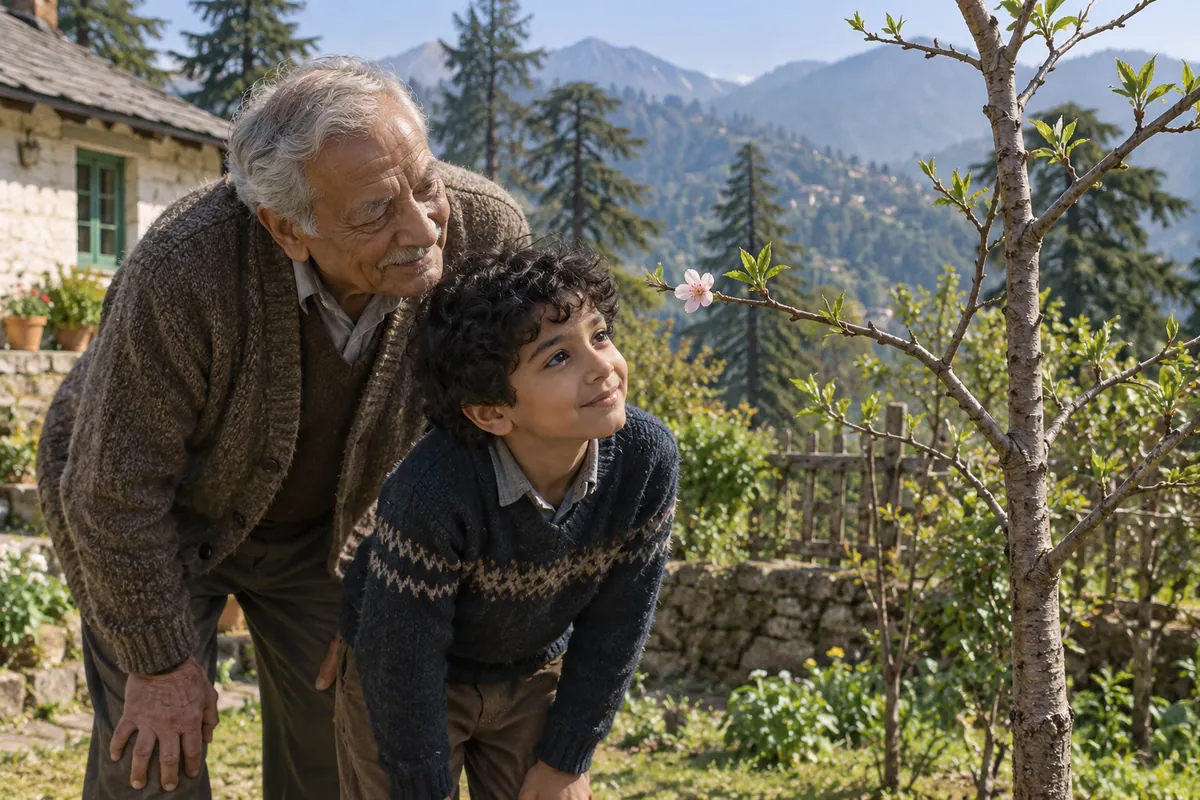
Over the years the tree grew taller while Rakesh grew from six to nine years old. It welcomed visitors – a praying-mantis, a caterpillar, bees and birds. One winter morning it produced its first pale pink blossom, which felt like a miracle. The following year brought more blossoms, and that summer the tree bore small, sour cherries that the birds enjoyed. One warm evening, sitting under the tree with grandfather, Rakesh asked why this tree was so special; grandfather said it was because they had planted it themselves. Touching the smooth bark of the tree he had grown from a single seed, Rakesh whispered in wonder, “Is this what it feels to be God?”
Theme & message
The central theme is the resilience of nature and the rewards of patient nurturing. A tiny seed, given a little care and time, survives many setbacks to become a beautiful, life-giving tree. The story also explores the loving bond between Rakesh and his grandfather, and the quiet joy of watching something one has planted slowly grow. Its message is that we must respect, protect and care for nature – and that creating and nurturing life, however small, gives a deep sense of wonder and fulfilment.
Word meanings
| Word | English meaning | Hindi meaning |
|---|---|---|
| stunted | stopped from growing to the usual size | बौने से रुका हुआ |
| outskirts | the areas that form the edge of a town | सिरे / बाहरी इलाका |
| tang | a strong, sharp taste | तीखा / चरपरा स्वाद |
| yielding | giving way under pressure; soft | दबाव में दब जाने वाला |
| haunches | sitting on the feet with legs bent | उकड़ू बैठना |
| peered down | looked carefully or with difficulty | ध्यान से नीचे देखा |
| plodded | walked slowly and heavily | धीमे-धीमे चलना |
| scrambled | moved quickly and with difficulty | लु୪कते हुए उतरना |
| scythe | a tool with a long, curved blade | हंसिया / दरांती |
| foliage | green leaves of a plant | पत्ते / हरियाली |
| tender | soft and delicate | कोमल / नरम |
| praying-mantis | a long green insect | भिंगा / मेंटिस कीट |
| grumpy | bad-tempered | चिड़चिड़ा / खीझ |
| gazed | looked at something for a long time | टकटकी से देखना |
| flitted | flew quickly and lightly | फुर्ती से उड़ना |
| reclining | lying back in a relaxed way | आराम से लेटना |
| sturdy | strong and healthy | हटा-कट्टा / मजबूत |
| nightjar | a kind of night bird | एक रात में बोलने वाला पक्षी |
| cicadas | insects with loud evening calls | झींगुर (कीट) |
| deodar | a tall Himalayan cedar tree | देवदार का पेड़ |
| blossom | flower of a tree | फूल / मंजरी |
Before reading — sample responses
I. Growing a plant
- I planted a bean seed in a pot with my grandfather’s help.
- It needed suitable light, water and drainage. We checked the soil instead of watering it excessively.
- I felt excited when new leaves appeared and became more responsible about its care.
II. Trees near homes
People grow fruit, shade or flowering trees suited to the space and local climate. Trees support other living things, provide shade and help keep surroundings pleasant. Choose species carefully rather than planting any tree in any location.
III. Fruit trees in your region
Example: Mango and guava grow in many warm regions. Apple trees are associated with suitable cooler growing conditions. Name trees you actually see locally, then ask a gardener about their soil, light and water needs. Your answer may differ from this example.
Let us discuss
I. Arrange the events in order of occurrence (Part I)
Arrange the events in order of occurrence in the story. (Two have been done for you: event 7 = 1 and event 3 = 5.)
II. Do you think the cherry tree would survive? Why do you think so?
I. Complete the cause-and-effect table (Part II)
Complete the table based on Part II of the story. (One example done: Cause 1 → Effect (i) Grandfather scolded the woman.)
| Cause | Effect |
|---|---|
| 1. A woman cut the cherry tree while cutting grass. | (i) Grandfather scolded the woman. (given) |
| 2. Rakesh went home to his village to help his father and mother with the planting, ploughing and sowing during the monsoon. | (ii) Rakesh was thinner but stronger when he came back. |
| 3. A hairy caterpillar started eating the leaves of the cherry tree. | (iii) Rakesh quickly removed it and dropped it on a heap of dry leaves, saying, “Come back when you’re a butterfly.” |
| 4. Grandfather saw a pale pink blossom at the end of a branch and called Rakesh to come quickly and look. | (iv) Rakesh and Grandfather gazed at the tree as though it was a miracle. |
| 5. Rakesh tasted one of the small cherries during summer. | (v) He spat it out because it was too sour, and Grandfather said they would be better next year. |
Part I blank numbers in printed statement order: 6, 2, 5, 8, 3, 9, 1, 7, 10, 4. These are ranks; they differ from the chronological list of statement numbers above. The printed (5) belongs to statement 3.
Let us think and reflect
I.1. Extract – “Have a cherry, Grandfather,” he said… “Nothing is lucky if you put it away. If you want luck, you must put it to some use.”
I.2. Extract – “Winter came early. The cherry tree bent low with the weight of snow… In February it was Rakesh’s birthday. He was nine—and the tree was four…”
II. Answer the following questions.
Let us learn
I. Identify the odd word in each list
Each list has one word that does not match. (Example 1: ‘chop’, ‘slice’, ‘mince’ are cutting with a knife; ‘trim’ is cutting with scissors.)
II. Choose the most suitable taste words
Write the most suitable taste word (sweet, sour, tangy, spicy, salty, bitter, bland) against each food item.
III. Choose the correct antonyms
Choose antonyms for the textual words from the box (growing, wide, ordinary, fasting, unprotected, shaky, cheerful, fussing, hard, coldness). Two extra words are not needed.
IV. Verbs and tenses
Underline all the verbs and identify the form of tense in the given sentences, then fill in the blanks with the correct tense.
V. Punctuation
Punctuate the given paragraph (about Roshni visiting her grandparents) appropriately.
Learn I: “Galloped” is the likely odd word because it names a fast gait particularly associated with horses, while the others describe human movement involving effort. “Scrambled” can be quick, so do not call all three alternatives slow. The example’s knife/scissors distinction is a classroom grouping, not an absolute rule about the verb “trim”.
Learn II: Taste depends on preparation. “Tangy” for tamarind, “sweet” for jaggery, “bitter” for neem, “bland” for plain paneer, “sour” for lemon, “spicy” for pickle and “salty” for a seasoned vegetable dish form one possible set. Vegetables need not be salty; other justified answers can fit.
Learn IV: “Was looking” is a finite past-progressive verb phrase; “finding” after “without” is non-finite and has no independent tense. In the gap-fill, were talking (ii) suits an ongoing conversation when the narrator realised something. “Talked” is also grammatical with a different emphasis. Past-perfect forms mark earlier experiences.
Punctuation note: The supplied paragraph ends with “he sat”. Punctuation alone does not change that pronoun: “He” can refer to Grandpa. If the intended subject is Roshni, “She” is an editorial correction, as used in the sample above. Plural “grandparents’” places the apostrophe after s because the house belongs to both grandparents.
Let us listen — environmental action
The four true statements are 2, 3, 5 and 7, based on the transcript on printed pages 201–202.
| Item | Answer and reason |
|---|---|
| 1 | False as a report of the task’s origin: the son already has the presentation assignment and asks for help; his mother did not set it. |
| 2 | True: his surprised response introduces his question about Appiko. |
| 3 | True: he says people coming together can make a difference. |
| 4 | False: the mother wants to hear what his teacher shared, rather than offering more details herself. |
| 5 | True: she explicitly shows interest in learning more about Thimakka. |
| 6 | False: they agree about Payeng’s work. |
| 7 | True: the son finds the account fascinating and inspiring. |
Item 1 is loosely worded: the mother does respond positively, but she does not initiate the presentation. The four clearest statements intended by the task are 2, 3, 5 and 7. These answers concern the dialogue; numerical claims in it are not independently established here.
Let us speak — syllables and Van Mahotsav
I. Count the spoken beats
| Word | Syllables |
|---|---|
| mountains | 2 |
| grandfather | 3 |
| tender | 2 |
| disturbed | 2 |
| caterpillar | 4 |
| Himalayan | 4 |
| performed | 2 |
| intention | 3 |
| slope | 1 |
| newspaper | 3 |
| favourite | Usually 2; 3 in a fuller pronunciation |
Clap the vowel beats you actually pronounce. Syllables are sounds, not a count of written vowels; the final e in “slope” adds no beat.
II. Assembly speech — sample
Good morning everyone. Van Mahotsav is India’s annual tree-planting festival, usually observed in the first week of July. Schools, communities and public organisations take part. It reminds us that trees support life and that planting is only the beginning. We can select suitable native species, protect saplings and share a regular care plan. Our class could keep a growth diary and check which plants survive. Let us celebrate by caring for trees throughout the year. Thank you.
Source for the timing: Ministry of Environment, Forest and Climate Change / PIB. Local events may take place on different dates.
Let us write — Trees–Our Lifeline
Complete the textbook article using these phrases in order. For the byline, write your own name and class.
| Blank | Answer |
|---|---|
| (i) | Trees–Our Lifeline |
| Byline | By [your name], Class 8 |
| (ii) | would stop existing |
| (iii) | absorb carbon dioxide |
| (iv) | reduces pollution |
| (v) | Additionally |
| (vi) | climate control |
| (vii) | If trees were not there |
| (viii) | Moreover, our planet |
| (ix) | To conclude |
| (x) | ensures a better future |
Blank (i) is the title, not your name. The name and class go in the separate byline. For a polished version, the opening can read “Without them, life as we know it would stop existing”; the printed sentence omits “it”. The article uses persuasive generalisations: trees are vital ecosystems, but they are not the only organisms that release oxygen.
Let us explore — trees and conservationists
I. Banyan trees
The textbook names the Great Banyan near Kolkata, Dodda Aalada Mara near Bengaluru, and Thimmamma Marrimanu in Andhra Pradesh. Use the examples to discuss how a banyan’s supporting roots spread and why large old trees need protection. Treat historical record dates as dated statements, not as proof of a current world record.
II. Research an environmentalist
The textbook introduces Kailash Sankhala and his role as the first director of Project Tiger. For your own short profile, choose an environmentalist, record the place and nature of their work, explain its significance, and cite a reliable source. The listening passage gives other starting points: Saalumarada Thimakka and Jadav Payeng.
Sample profile structure: name → conservation work → place → evidence/source → what students can learn. Do not copy impressive tree counts or awards without checking them. A possible lesson from sustained planting is that regular care matters as much as the initial act.
V-shaped flight formation
The textbook explains that birds can save energy by flying in a coordinated position behind and to the side of another bird, using helpful air movements. This is a separate nature fact, not something Rakesh deliberately teaches the birds.
Additional ClearStudy questions
This practice is separate from the printed textbook exercises.
Short answer (30–40 words)
1. Where did the cherries Rakesh ate come from, and how did they taste?
2. Why did Rakesh surround the young tree with pebbles?
3. What dangers did the cherry tree survive?
4. How did the cherry tree finally show its first sign of flowering?
5. What creatures visited the cherry tree, and how did Rakesh feel about them?
Long answer (100–120 words)
6. Trace the journey of the cherry seed from being planted to becoming a blossoming tree.
7. How does ‘The Cherry Tree’ convey the message of caring for nature and the environment?
ClearStudy MCQs and assertion–reason practice
1. Where had the cherries that Rakesh ate come from?
(a) Mussoorie (b) the Kashmir Valley (c) his village (d) Dehradun
2. Who did Rakesh live with in Mussoorie?
(a) his parents (b) his uncle (c) his grandfather (d) his teacher
3. According to Grandfather, when is something lucky?
(a) when you keep it (b) when you put it to some use (c) when you sell it (d) when you hide it
4. Why did Rakesh surround the little tree with pebbles?
(a) for decoration (b) for privacy (c) to mark it (d) to keep water in
5. What animal first ate all the leaves of the young cherry tree?
(a) a cow (b) a goat (c) a deer (d) a monkey
6. Who cut the cherry tree in two with a scythe?
(a) a woodcutter (b) a woman cutting grass (c) a gardener (d) a neighbour
7. What was the cherry tree’s first visitor?
(a) a caterpillar (b) a bee (c) a praying-mantis (d) a bulbul
8. What colour was the tree’s first blossom?
(a) white (b) pale pink (c) red (d) yellow
9. According to Grandfather, why was this tree special?
(a) it was the tallest (b) they planted it themselves (c) it gave fruit (d) it was very old
10. Who is the author of ‘The Cherry Tree’?
(a) Sarojini Naidu (b) Ruskin Bond (c) R. K. Narayan (d) Kamakshi Balasubramanian
Assertion–Reason – choose: (a) A and R true, R explains A; (b) A and R true, R does not explain A; (c) A true, R false; (d) A false, R true.
1. Assertion (A): Rakesh planted the cherry seed instead of keeping it.
Reason (R): Grandfather told him that nothing is lucky if it is put away and that luck comes from putting a thing to use.
2. Assertion (A): The cherry tree survived even after a goat and a scythe damaged it.
Reason (R): Cherry trees are tough and the tree had no intention of dying.
3. Assertion (A): Grandfather became grumpy during the early winter.
Reason (R): The blocked road meant there was no newspaper for several days.
4. Assertion (A): The small cherries tasted delicious the first time Rakesh tried them.
Reason (R): Rakesh tasted one cherry and spat it out because it was too sour.
5. Assertion (A): Rakesh felt a deep sense of wonder at the end of the story.
Reason (R): He realised that he had grown a great tree from a single tiny seed.
Exam tips & common mistakes
Exam tips
• Remember key details in order: bazaar → seed planted → sprouts → goat → scythe → blossom → cherries. Use this sequence to support answers.
• Where relevant, name the author (Ruskin Bond) and the setting (Mussoorie, Himalayan foothills) in long answers.
• Link the tree’s growth to Rakesh’s growth – explain this parallel with examples from the story.
• For value-based questions, mention patience, care for nature and the human-nature bond.
Common mistakes
• Do not write that the cherries came from Mussoorie – they came from the Kashmir Valley.
• Do not confuse the two creatures: the praying-mantis was the first visitor; the caterpillar ate leaves and was removed.
• The tree was cut by a woman cutting grass with a scythe, not a woodcutter.
• The first blossom was pale pink, not white – check colour words carefully.
FAQs
Who wrote ‘The Cherry Tree’ and where is it set?
It was written by Ruskin Bond and is set in the Himalayan foothills near Mussoorie, where the boy Rakesh lives with his grandfather.
What is the main message of ‘The Cherry Tree’?
The story teaches patience, the resilience of nature, and the joy and responsibility of nurturing and protecting living things, especially trees.
How did the cherry tree survive being cut and eaten?
Cherry trees are tough. Each time the tree was damaged – by a goat, a scythe, a caterpillar or snow – it sent out new shoots and kept growing.
What does Rakesh mean by ‘Is this what it feels to be God?’
Having grown a great tree from one tiny seed, Rakesh feels the wonder of having helped create and nurture life, much as a creator might feel.
Textbook-based exercises and additional ClearStudy practice are identified separately. Use your textbook alongside these explanations.