
Waiting for the Rain — Class 8 English Poorvi Questions and Answers
Waiting for the Rain by Kamakshi Balasubramanian follows Velu, a farmer distressed by delayed rainfall. This Class 8 English Poorvi guide explains the story, textbook answers, complete crossword, grammar, listening task and sample writing.
Source: NCERT Poorvi, Grade 8, Unit 4, printed pages 185–200; listening transcript 204; supplied reprint 2026–27. Open-ended and personal responses are examples to adapt. These explanations are study support, not an official NCERT answer key.
About the piece
“Waiting for the Rain” is the prose piece of Unit 4, ‘Environment’. It is a gentle, thought-provoking story about Velu, a hard-working farmer whose land lies dry and cracked because the rains have failed for an entire season. Anxious and dejected, Velu searches everywhere for an answer – at the weather office after rejecting a suggestion to consult astrologers – but finds none. The turning point comes when a wise old woman, resting under a tree, helps him see that even the earth, like all of us, needs rest. The piece quietly teaches respect for nature’s rhythms and the value of patience.
About the author
The supplied NCERT textbook credits Kamakshi Balasubramanian. The story uses a conversation between Velu and an older woman to explore patience, work and care for the land.
Summary
Velu is a sincere farmer who has cultivated his own piece of land for nearly six years, harvesting jowar one season and dhal the next, never thinking of rest. But this year the rains do not come. At the end of summer the sky stays cloudless; days, weeks and months pass and still there is no rain. The fields lie untended, the earth hardens, crusts and cracks, and the farmers live entirely on hope.
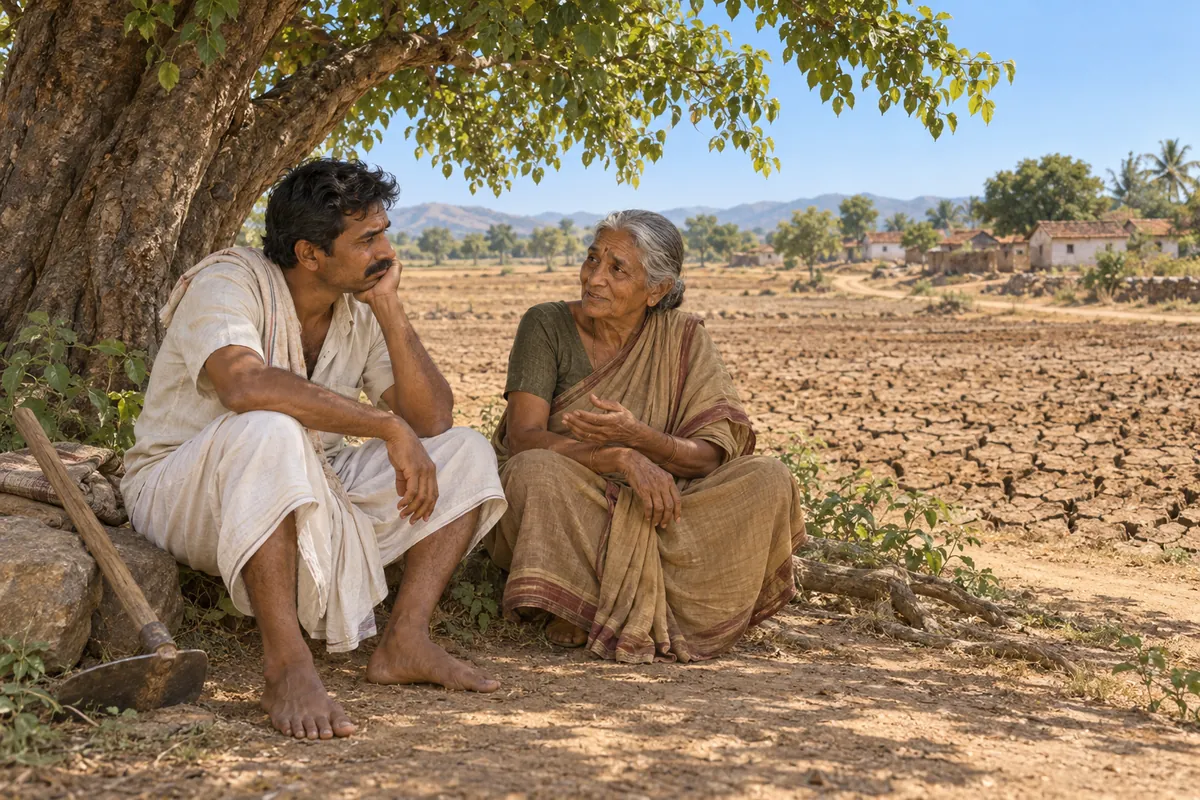
When a neighbour suggests consulting astrologers, Velu disagrees – the rains had always come without such consultations. Instead he walks to the weather office in the city, but the officials there admit they too are at a loss: despite many favourable conditions, there is still no rain. Tired, thirsty and dejected, Velu rests in the cool shade of a large tree, where an old woman is also sheltering from the sun.
The old woman smiles even though there is nothing to smile about. When Velu pours out his sorrow – that he has worked hard and honestly yet is being punished – she gently suggests that perhaps he has worked too hard. She reminds him that the earth, too, works when he ploughs, sows and plants, and that it has worked for thousands of years. Nature, she says, is a mother to all; when the rains fail, the land is simply left undisturbed to rest, and when the rains return it will spring back, fresh and ready. Comforted, Velu walks homeward thinking about his beloved land breathing peacefully. As he nears the village, he feels a cool breeze, then a tiny drop on his shoulder. Clouds gather, the sky darkens, and the sweet, fragrant rain begins. Velu runs home, laughing and happy.
Story and science: Nature’s motherhood and the earth’s “rest” are personification. A drought is a shortage of rainfall; it can damage crops and soil. Planned fallowing and soil conservation are management choices, not proof that drought happens to help the land.
Theme, characters & message
Theme: The story explores the deep relationship between humans and nature and the idea that the earth, like every living thing, needs rest. The old woman interprets the drought as a chance for the land to rest. This is her consoling perspective within the story, not a scientific explanation of why drought occurs.
Characters: Velu – a hard-working, honest and sincere farmer who is anxious during the drought but open-minded enough to learn; the old woman – a calm, wise and kindly figure who voices Nature’s wisdom.
Message: We should respect the rhythms of nature, be patient in hard times, and understand that rest and renewal are as important as constant work. Just as people need rest to stay healthy, the land needs fallow periods to regain its fertility.
Word meanings
| Word | Meaning |
|---|---|
| crimson | a deep red colour |
| scanned | looked at carefully all over |
| encouraging | giving hope or confidence |
| cultivated | prepared and used land to grow crops |
| untended | not cared for or looked after |
| crusted | formed a hard outer layer |
| barren | (of land) unable to produce crops |
| forlorn | sad, lonely and neglected |
| astrologers | people who study stars to foretell events |
| consultations | discussions to get advice |
| dejected | sad and disappointed |
| muttered | spoke in a low, unclear voice |
| wrinkled | having lines or folds (skin) |
| sparkled | shone brightly with joy |
| bitterly | in a hurt, resentful way |
| puzzled | confused, unable to understand |
| undisturbed | not interrupted or troubled |
| ceaseless | continuous, without stopping |
| fragrant | having a pleasant smell |
| till (the land) | to dig or turn over soil for crops |
Before you read
I. Have you ever waited for the rains? Why? II. How do you feel when it rains after a long time? III. Why do you think the farmers wait for the rains? IV. Discuss in groups what happens when you wait for something for a long period (how you spend the time, what you think about, how you feel).
Let us discuss
Part I – Complete the table (What was Said / Who Said)
I. Complete the table given below. One example has been done for you.
II. Do you think the old woman would help Velu? If yes, why? If no, why not?
III. Will Velu’s wait continue or will it rain?
Part II – Complete the statements with reasons
I. Complete the following statements given below with suitable reasons.
Let us think and reflect
I.1. Extract – “…I can’t see how talking to astrologers will bring rain.” He decided to go to the weather office in the city… “We are at a loss ourselves!” they exclaimed. “So many favourable conditions but still no rain. Very odd!”
I.2. Extract – “The soil, the land, the earth… shouldn’t someone let the land rest a bit?” the old woman said, softly, smiling. “Rest? Let the land rest? I don’t understand,” Velu looked at her, a little puzzled. “Yes, my son, that is the difficulty. You don’t realise that the earth is old…”
II. Answer the following questions.
Let us learn
I. Complete crossword key
Across: 5 HARVEST; 8 SUN; 9 CULTIVATE; 10 PLOUGH; 11 SOW.
Down: 1 BREEZE; 2 LIGHTNING; 3 THUNDER; 4 CROP; 6 CLOUDS; 7 RAIN.
The picture arrows distinguish the lightning bolt (2), clouds (6) and falling rain (7). The six cells for 6 require the plural CLOUDS. The four cells for 4 require CROP, not CROPS.
II. Homophones – complete the paragraph
Use rain (water from clouds), not reign (a ruler’s period of rule). The printed phrase “the next rain by nature” is awkward; the weather meaning is nevertheless clear.
III. Choose the correct meanings of the underlined words/phrases
IV. Adjective–noun collocations
| Adjective | Noun | Collocation |
|---|---|---|
| 1. favourable | (iii) weather | favourable weather (example) |
| 2. wrinkled | (iv) skin | wrinkled skin |
| 3. dejected | (vi) expression | dejected expression |
| 4. fragrant | (v) garden | fragrant garden |
| 5. ceaseless | (ii) activity | ceaseless activity |
| 6. beloved | (i) country | beloved country |
V. Underline the verbs and identify the tense; then fill in the blanks
VI. Determiners – fill in the blanks
Tense detail: In sentence 1, “is” is finite Simple Present; “to be” and “to work” are infinitives. Sentence 4 contains both “is” (Simple Present) and “am talking” (Present Progressive). In determiner item 7, both “each jump” and “every jump” are grammatical. Item 9 intends neither, but the complete sentence should read “neither sibling minded it” or “neither of the siblings minded it”.
Let us listen
These answers follow the textbook transcript on printed page 204. It is a listening exercise, not a current weather forecast.
Let us speak
I. Tongue twister about ‘weather’ – practise saying it fast.
II. Role-play – a conversation between the Rain and the Earth after a long dry spell.
The Rain’s promise to return on time is imaginative dialogue following the activity prompt, not a reliable weather prediction.
Let us write
I. Write a letter to the Councillor of your Municipal ward, requesting her/him to set up a rainwater harvesting unit, with suggestions to address the water scarcity in your neighbourhood.
The name, address, date and local conditions below are fictional examples. Replace them with your own details and observations.
12, Green Park ColonyWard No. 44
Chennai – 600 028
18 June 2026The Municipal Councillor
Ward No. 44, ChennaiSubject: Request to Install a Rainwater Harvesting Unit in Ward No. 44Dear Madam,I am a resident of Ward No. 44 and wish to draw your kind attention to the severe shortage of water in our locality, especially during the summer months.Every year the groundwater level drops sharply, taps run dry for hours, and families are forced to buy expensive tanker water. Wells and borewells in the area have almost no water left, and a great deal of rainwater is simply wasted during the monsoon as it runs off into the drains.I therefore request you to set up a community rainwater harvesting unit in our ward. Rooftop water from public buildings could be channelled into recharge pits, and residents could be encouraged, through awareness drives, to build small harvesting structures in their homes. This would refill the groundwater and ease our water problem.I am confident that this step will benefit hundreds of families. I look forward to your kind and early action in this matter.Yours sincerely,
R. Anand
(R. Anand) — (write your own name and details)
Let us explore
I. Fallowing
Fallowing means leaving land unsown for a growing period. The textbook describes alternating cropped and uncropped halves of a field. It is one example, not a method every farm must follow. Discuss how vegetation cover, moisture, soil and subsequent crops affect recovery. Distinguish planned management from a crop failure caused by drought.
II. Agriculture and related occupations
Prepare questions for your Vocational Education teacher: What does the work involve? Which skills and tools are needed? What training is available locally? How does weather affect the work? Compare farming, horticulture (growing garden crops), floriculture (flower cultivation), sericulture (silk production) and dairy farming.
III. Traditional weather knowledge
The textbook points to references to weather in ancient Indian writings. Choose one teacher-approved passage, record the source and explain the observation it describes. Compare traditional observations with modern measurements; do not assume every old prediction is scientifically reliable.
IV. IMD research activity
Visit the India Meteorological Department website and find its agricultural weather advisories. Record the issue date, location, forecast period and suggested farm action. A forecast is an estimate, not a guarantee. The textbook’s sample listening report should not be used as today’s advice.
Additional ClearStudy questions
This practice is separate from the printed textbook exercises.
Short answer (30–40 words)
1. What did Velu grow on his piece of land?
2. Why did Velu refuse to consult astrologers?
3. What did the people at the weather office tell Velu?
4. How did the drought change the appearance of the land?
5. What signs showed that the rain was finally coming?
Long answer (100–120 words)
6. How does the old woman change Velu’s way of thinking about the drought?
7. What is the message of “Waiting for the Rain” and how is it relevant today?
ClearStudy MCQs and assertion–reason practice
1. Who is the author of “Waiting for the Rain”?
(a) Ruskin Bond (b) Sarojini Naidu (c) Kamakshi Balasubramanian (d) R. K. Narayan
2. What crops did Velu harvest on his land?
(a) Wheat and rice (b) Jowar and dhal (c) Maize and barley (d) Cotton and sugarcane
3. Where did Velu go to find out when it would rain?
(a) To a temple (b) To an astrologer (c) To the weather office in the city (d) To the city market
4. According to the old woman, what does the land do when the rains fail?
(a) It dies forever (b) It rests and recovers (c) It produces poison (d) It must be sold
5. How did the old woman address Velu while giving advice?
(a) ‘Sir’ (b) ‘My son’ (c) ‘Friend’ (d) ‘Farmer’
6. The colour of the rising sun at the start of the story is described as:
(a) golden (b) crimson (c) pale yellow (d) silver
7. Why couldn’t the farmers tend their fields?
(a) They were lazy (b) The earth was hardened, crusted and cracked (c) They had no seeds (d) The fields were flooded
8. Velu’s attitude towards consulting astrologers shows that he is:
(a) superstitious (b) practical and rational (c) careless (d) fearful
9. The word ‘dejected’ in the story means:
(a) excited (b) sad and disappointed (c) angry (d) confused
10. The central theme of “Waiting for the Rain” is that:
(a) farmers should give up farming (b) astrology brings rain (c) the earth, like all of us, needs rest (d) cities are better than villages
Assertion–Reason – choose: (a) A and R true, R explains A; (b) A and R true, R does not explain A; (c) A true, R false; (d) A false, R true.
1. Assertion (A): Velu went to the weather office to ask when it would rain.
Reason (R): He wanted a practical answer to the drought and trusted experts more than astrologers.
2. Assertion (A): The fields lay untended during the drought.
Reason (R): The hard, cracked earth could not be ploughed or sown without rain.
3. Assertion (A): The old woman believed the drought was a complete disaster for the land.
Reason (R): She told Velu that the rest from rain allowed the tired earth to recover and renew itself.
4. Assertion (A): Velu was at first confused by the old woman’s advice.
Reason (R): He had never thought of the earth as something that works and needs rest.
5. Assertion (A): Velu ran home laughing and happy at the end of the story.
Reason (R): The astrologers had finally promised that the rain would come.
Exam tips
Always name the author Kamakshi Balasubramanian and the two key characters – Velu and the old woman. For the central message, link the title to the idea that the earth needs rest (fallowing). When answering ‘character’ questions about Velu, use words like hard-working, honest, rational, anxious, open-minded. Quote short phrases such as “Nature is a mother to all of us” to support your interpretation.
Common mistakes to avoid
Do not confuse this prose piece with the other Unit 4 texts – “The Cherry Tree” (Ruskin Bond) and the poem “Harvest Hymn” (Sarojini Naidu). Do not write that astrologers or the weather office solved Velu’s problem – it was the old woman’s wisdom and nature itself. Avoid saying the land ‘dies’ in a drought; the story’s point is that it rests. Finally, remember the crops are jowar and dhal, not wheat or rice.
FAQs
Who wrote ‘Waiting for the Rain’ in Class 8 Poorvi?
The prose piece “Waiting for the Rain”, in Unit 4 (Environment) of Class 8 English Poorvi, is written by Kamakshi Balasubramanian.
What is the main message of ‘Waiting for the Rain’?
The story teaches that the earth, like every living thing, needs rest. The old woman’s image of resting land encourages patience and care for nature. Drought itself does not automatically restore soil fertility.
How does the old woman help Velu?
The old woman gently explains that the earth also works and needs rest. She compares Nature to a caring mother, helping Velu see the drought as the land resting rather than a punishment.
Why did Velu run home laughing and happy at the end?
As he neared the village, Velu felt a cool breeze and the first raindrops, and saw clouds gathering for thunder and rain. His long wait was finally over, so he ran home laughing with joy.
Textbook-based exercises and additional ClearStudy practice are identified separately. Use your textbook alongside these explanations.