
Class 8 Maths Ganita Prakash Chapter 11 Solutions (NCERT 2026–27) – Exploring Some Geometric Themes
These Class 8 Maths Ganita Prakash Chapter 11 solutions cover Exploring Some Geometric Themes from the new NCF-2023 textbook (2026–27). This is Chapter 4 of Ganita Prakash Part II (the 11th chapter of the Class 8 course). The worked explanations include original diagrams for fractals, nets, cube views and surface paths. Where a printed activity has incompatible dimensions, the issue is identified explicitly.
- Chapter overview
- Key concepts & definitions
- Important formulas & facts
- Figure it Out — Sierpinski Gasket
- Figure it Out — Koch Snowflake
- Figure it Out — Nets of a Cube
- Figure it Out — Projections (Lines & Cuboids)
- Figure it Out — Views of Cube Combinations
- Figure it Out — Isometric Grids
- Math Talk & reflective questions
- Further textbook activities
- Common mistakes to avoid
- Practice MCQs & Assertion–Reason
- Quick revision summary
- FAQs
Chapter 11 Overview
Chapter 11, Exploring Some Geometric Themes (Chapter 4 of Ganita Prakash Part II), explores two big ideas. The first is fractals — self-similar shapes that repeat the same pattern at smaller and smaller scales, like the fern, the Sierpinski Carpet, the Sierpinski Gasket and the Koch Snowflake. The second is visualising solids — faces, edges and vertices of prisms and pyramids, building solids from nets, finding the shortest path on the surface of a cuboid by unfolding it, and representing solids on paper through projections (front, top and side views) and isometric drawing. Use the diagrams alongside the textbook figures, especially when a viewing direction or a hidden cube affects the answer.
Key Concepts & Definitions
Fractal: a self-similar shape that contains smaller copies of itself, repeating the same pattern at smaller and smaller scales (e.g. fern, coastline, Sierpinski Carpet, Koch Snowflake).
Face, Edge, Vertex: Faces are the flat surfaces forming the boundary of a solid; edges are the line segments where faces meet; vertices are the points where edges meet. A cube or cuboid has 6 faces, 12 edges and 8 vertices.
Prism: a solid with two congruent polygons as opposite faces and parallelograms as the side faces (triangular prism, pentagonal prism, …).
Pyramid: a solid with one polygonal base and a single apex joined to every vertex of the base (triangular pyramid = tetrahedron, square pyramid, …).
Net: a flat shape that can be folded to form a solid — obtained by ‘unfolding’ the solid onto a plane.
Projection / Views: the shadow-like image of a solid on a plane. The three standard views are the front view (on the vertical plane), top view (on the horizontal plane) and side view (on the side plane).
Isometric projection: an orientation in which the projections of all edges of a cube have equal length; drawn on a triangular (isometric) grid.
Important Formulas & Facts (Chapter 11)
Euler’s relation for a (convex) polyhedron: F − E + V = 2, where F = faces, E = edges, V = vertices.
n-sided prism: F = n + 2, E = 3n, V = 2n. Check: (n+2) − 3n + 2n = 2. ✓
n-sided pyramid: F = n + 1, E = 2n, V = n + 1. Check: (n+1) − 2n + (n+1) = 2. ✓
Sierpinski Carpet: remaining squares Rn = 8n; holes Hn = 1 + 8 + … + 8n−1 = (8n − 1)/7. Area remaining = (8/9)n.
Sierpinski Gasket (Triangle): remaining triangles Rn = 3n; holes Hn = (3n − 1)/2. Area remaining = (3/4)n.
Koch Snowflake: number of sides = 3 × 4n; perimeter = 3 × (4/3)n (starting side = 1 unit).
Shortest path on a cuboid: unfold the cuboid into a net so the path becomes a straight line; its length is found by the Baudhāyana (Pythagoras) theorem, d = √(a2 + b2).
Sierpinski carpet activity (pages 70–71)
Divide a square into nine equal squares and remove the centre. Repeat on every retained square. At steps 0, 1 and 2, the numbers of retained small squares are 1, 8, 64; the total holes are 0, 1, 9. The retained area is 1, 8/9, 64/81 of the starting area. Here a “hole” means a removed square of any size.
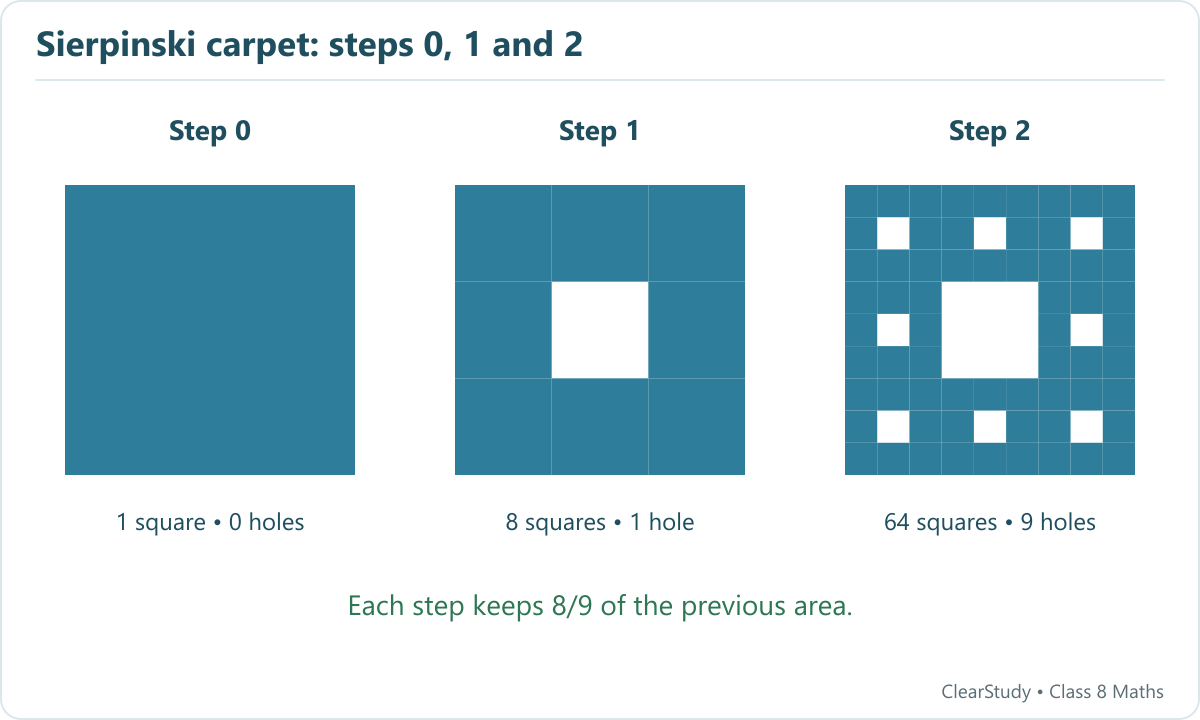
Figure it Out — Sierpinski Gasket
From the Sierpinski Gasket section. An equilateral triangle is divided into 4 identical equilateral triangles by joining the midpoints of its sides, and the central triangle is removed; the procedure is repeated on the 3 remaining triangles, and so on. (Take Step 0 = the full triangle.)
1. Draw the initial few steps (at least till Step 2) of the shape sequence that leads to the Sierpinski Triangle.
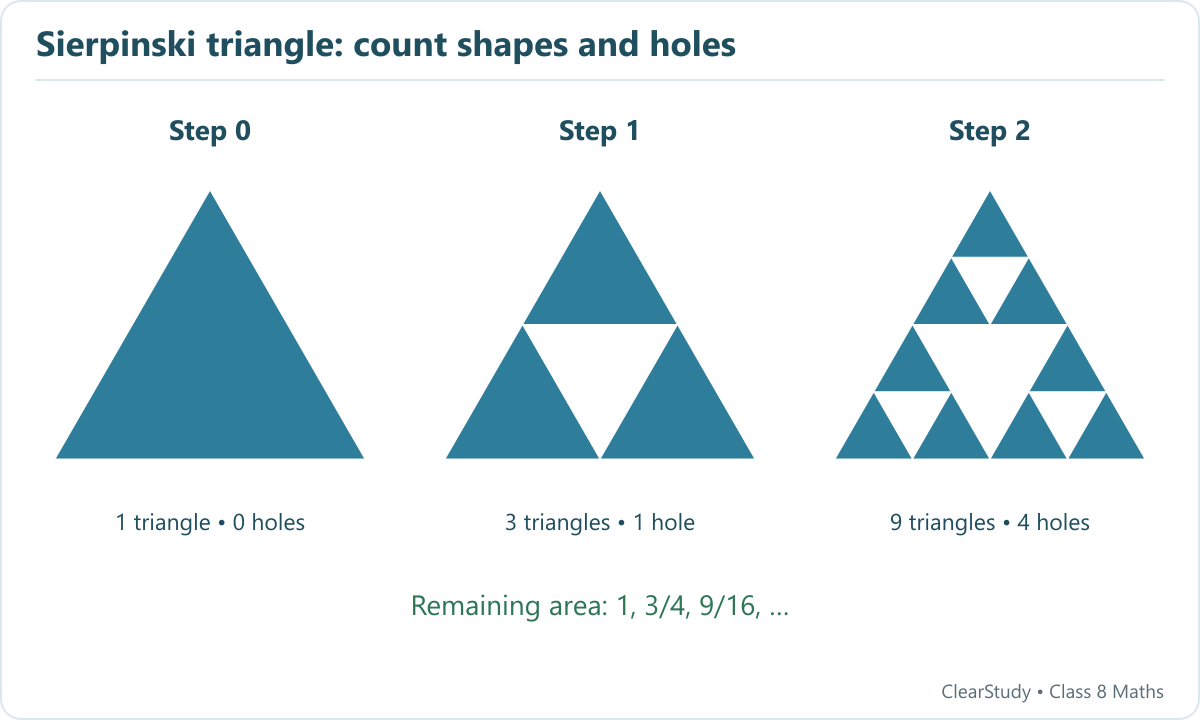
2. Find the number of holes, and the triangles that remain at each step of the shape sequence that leads to the Sierpinski Triangle.
| Step n | Remaining triangles Rn = 3n | Holes Hn = (3n−1)/2 |
|---|---|---|
| 0 | 1 | 0 |
| 1 | 3 | 1 |
| 2 | 9 | 4 |
| 3 | 27 | 13 |
| n | 3n | (3n − 1)/2 |
3. Find the area of the region remaining at the nth step in each of the shape sequences that lead to the Sierpinski fractals. Take the area of the starting square/triangle to be 1 sq. unit.
Figure it Out — Koch Snowflake
From the Koch Snowflake section. Start with an equilateral triangle; on each side, divide it into 3 equal parts, raise an equilateral triangle on the middle part, then remove that middle part, so each side becomes a ‘bump’. Repeat on every new side. (Take Step 0 = the starting triangle, which has 3 sides.)
1. Draw the initial few steps (at least till Step 2) of the shape sequence that leads to the Koch Snowflake.
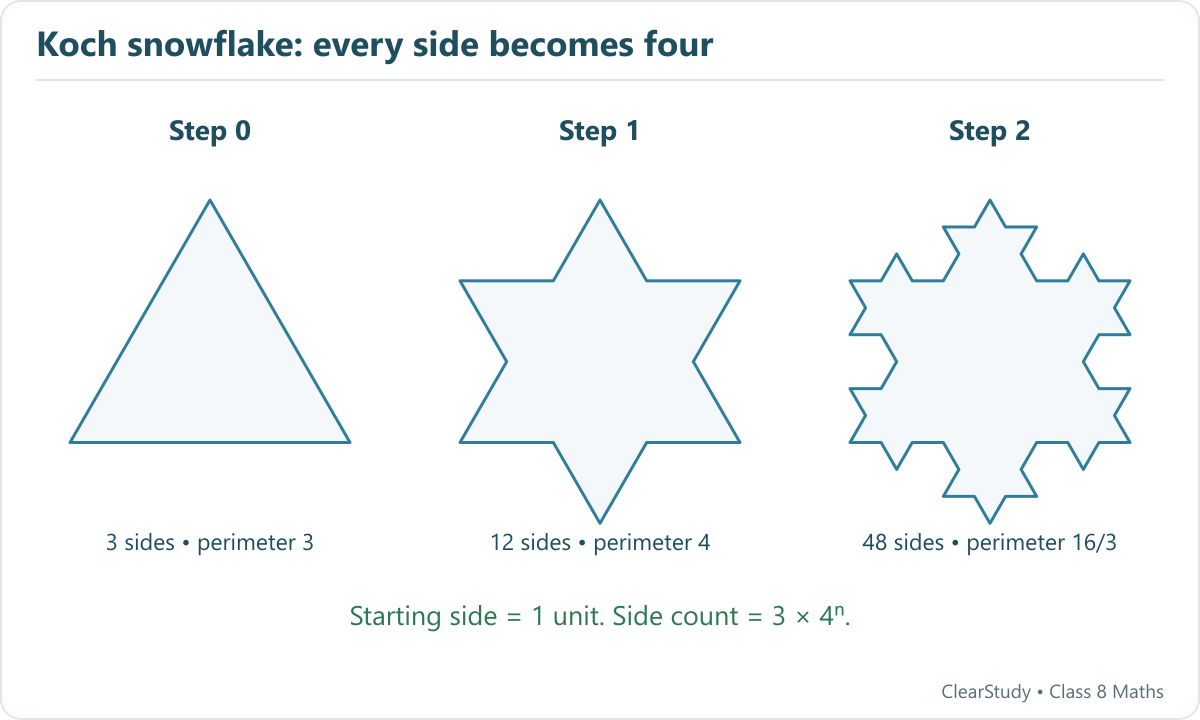
2. Find the number of sides in the nth step of the shape sequence that leads to the Koch Snowflake.
3. Find the perimeter of the shape at the nth step of the sequence. Take the starting equilateral triangle to have a sidelength of 1 unit.
Figure it Out — Nets of a Cube and Cuboid
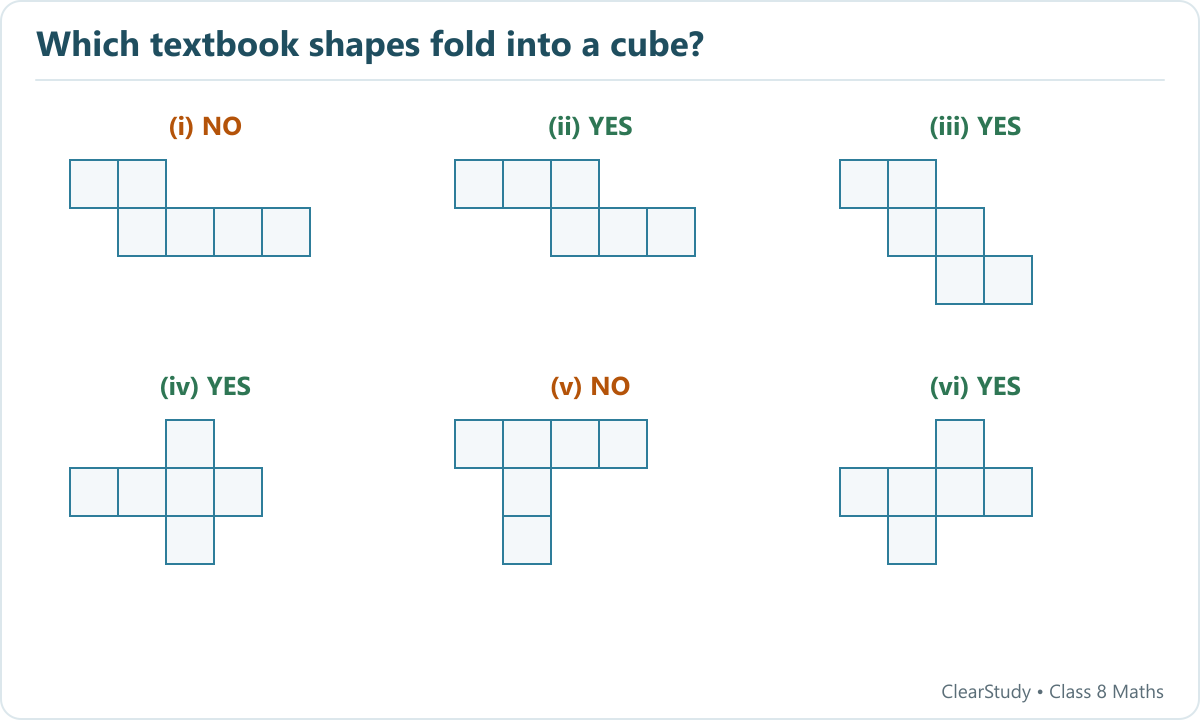
1. Which of the following are the nets of a cube? First, try to answer by visualisation. Then, you may use cutouts and try.
2. A cube has 11 possible net structures in total. In this count, two nets are considered the same if one can be obtained from the other by a rotation or a flip. Find all the 11 nets of a cube.
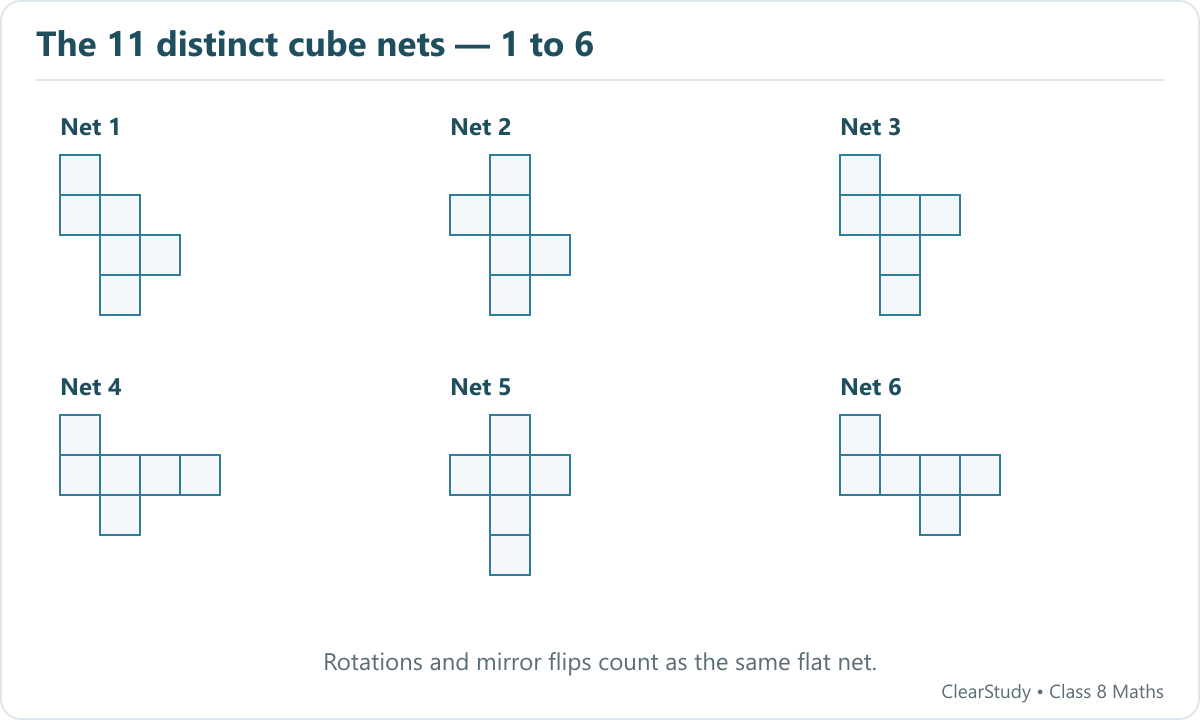
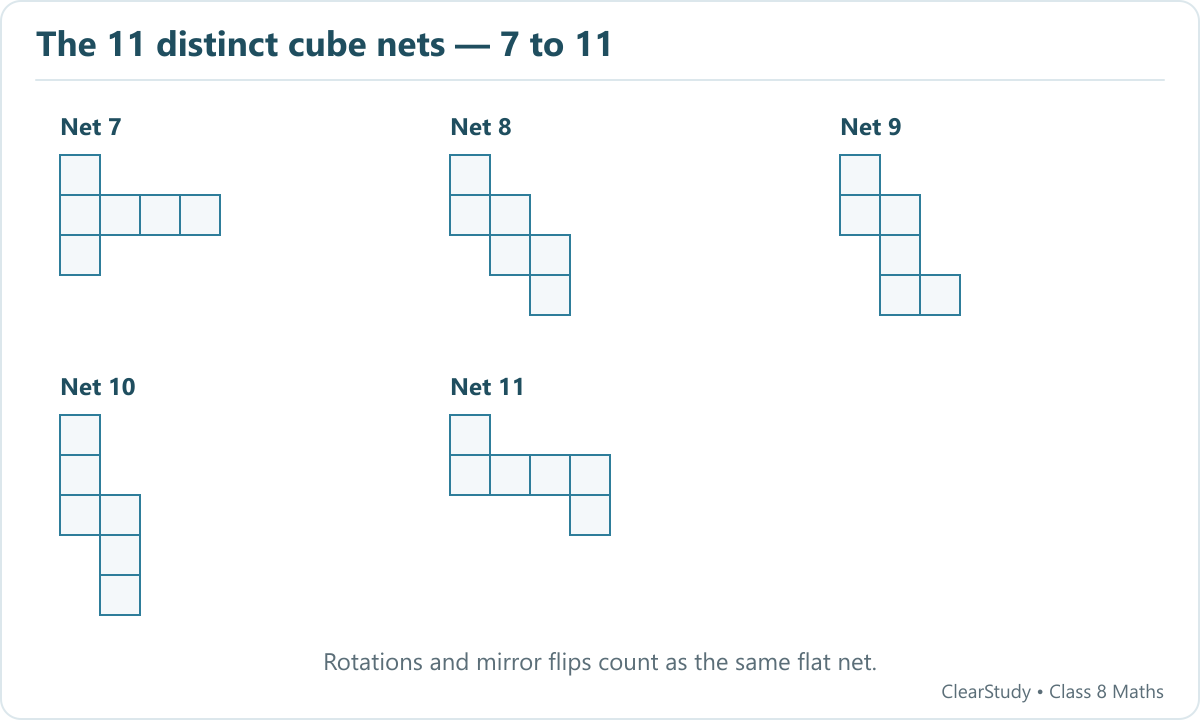
3. Draw a net of a cuboid having sidelengths: (i) 5 cm, 3 cm, and 1 cm (ii) 6 cm, 3 cm, and 2 cm
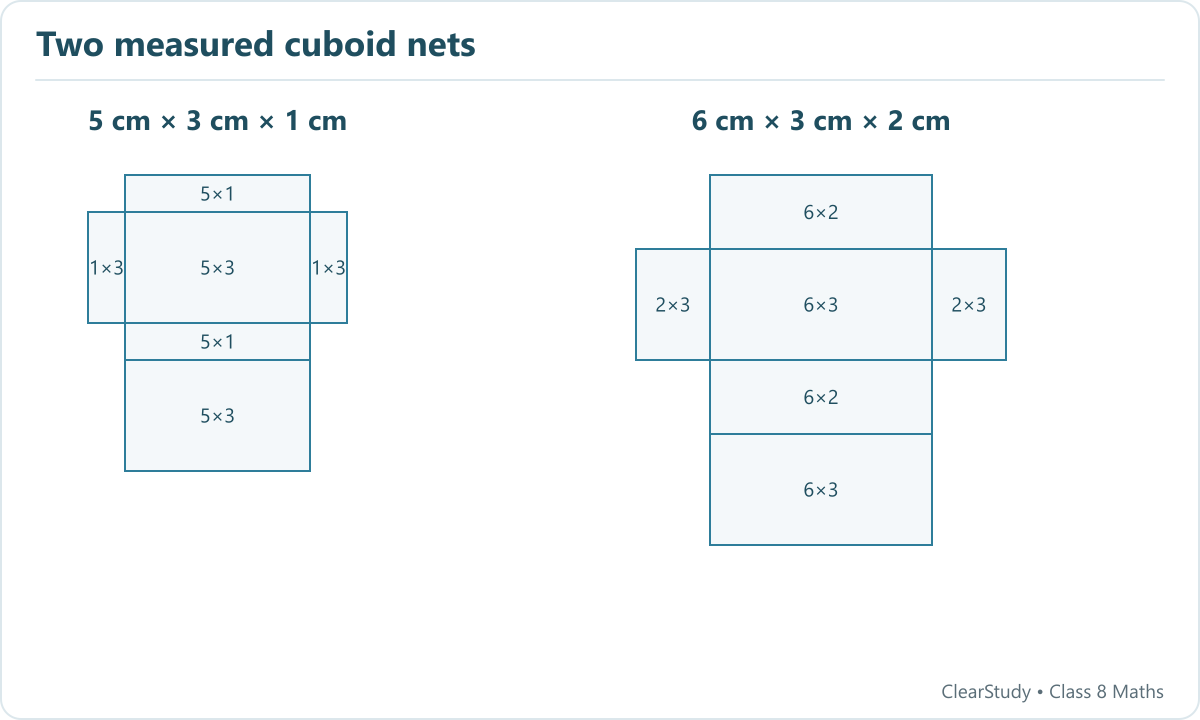
Figure it Out — Projections (Lines & Cuboids)
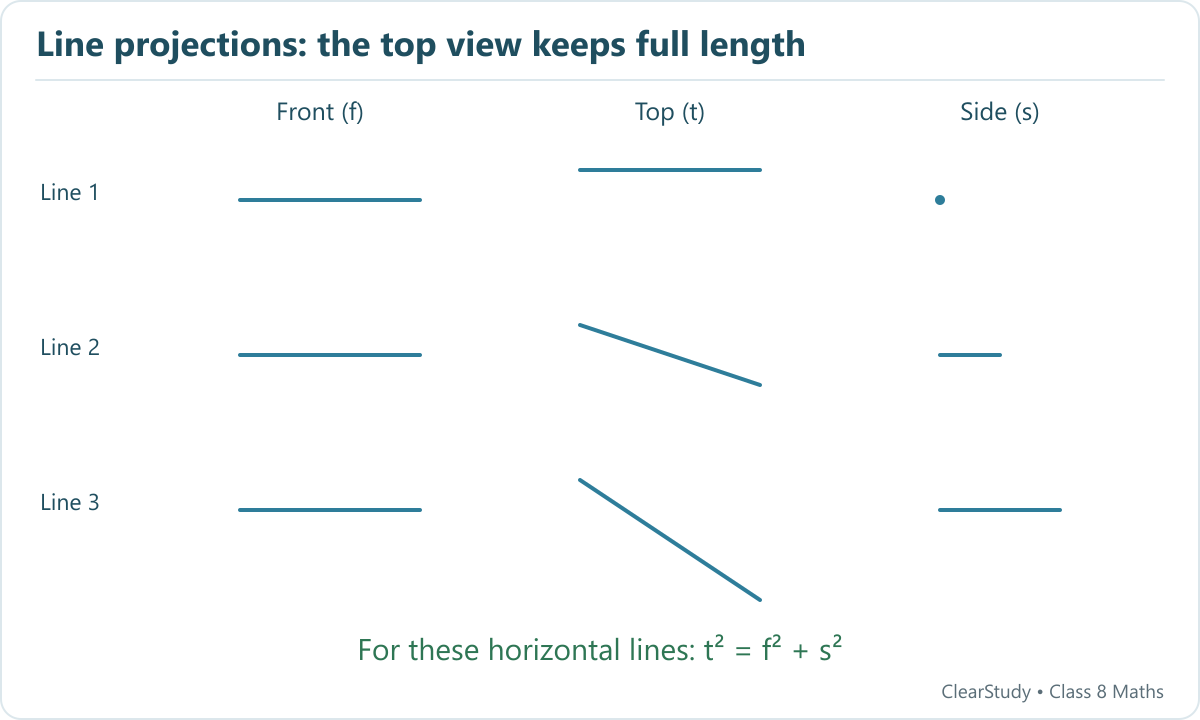
1. Observe the front view, top view and side view of the different lines in Fig. 4.6. Is there any relation between their lengths?
2. Find the front view, top view and side view of each of the following solids, fixing its orientation with respect to the vertical, horizontal and side planes: cube, cuboid, parallelepiped, cylinder, cone, prism, and pyramid.
| Solid and orientation | Front | Top | Side |
|---|---|---|---|
| Cube: edges along the three axes | Square | Square | Square |
| Cuboid: edges along the axes | Rectangle | Rectangle | Rectangle |
| Parallelepiped: rectangular base on the floor; top shifted sideways only | Parallelogram | Rectangle | Rectangle |
| Right circular cylinder: axis vertical | Rectangle | Circle | Rectangle |
| Right circular cone: axis vertical | Isosceles triangle | Circle | Isosceles triangle |
| Right triangular prism: triangular ends face left/right; base rests on floor | Rectangle | Rectangle | Triangle |
| Right square pyramid: base on floor, edges parallel to axes | Isosceles triangle | Square with apex projected at centre | Isosceles triangle |
3. Match each of the following objects with its projections (FRONT, TOP, SIDE) — a mug, funnel, hammer, car, slide/ramp, chair, ceiling fan and rice cooker shown with their three views.
| Object | Projection row |
|---|---|
| Mug | 8 |
| Funnel | 6 |
| Hammer | 7 |
| Car | 1 |
| Slide/ramp | 3 |
| Chair | 4 |
| Ceiling fan | 5 |
| Rice cooker | 2 |
Figure it Out — Views of Cube Combinations
1. Draw the top view, front view and the side view of each of the following combinations of identical cubes.
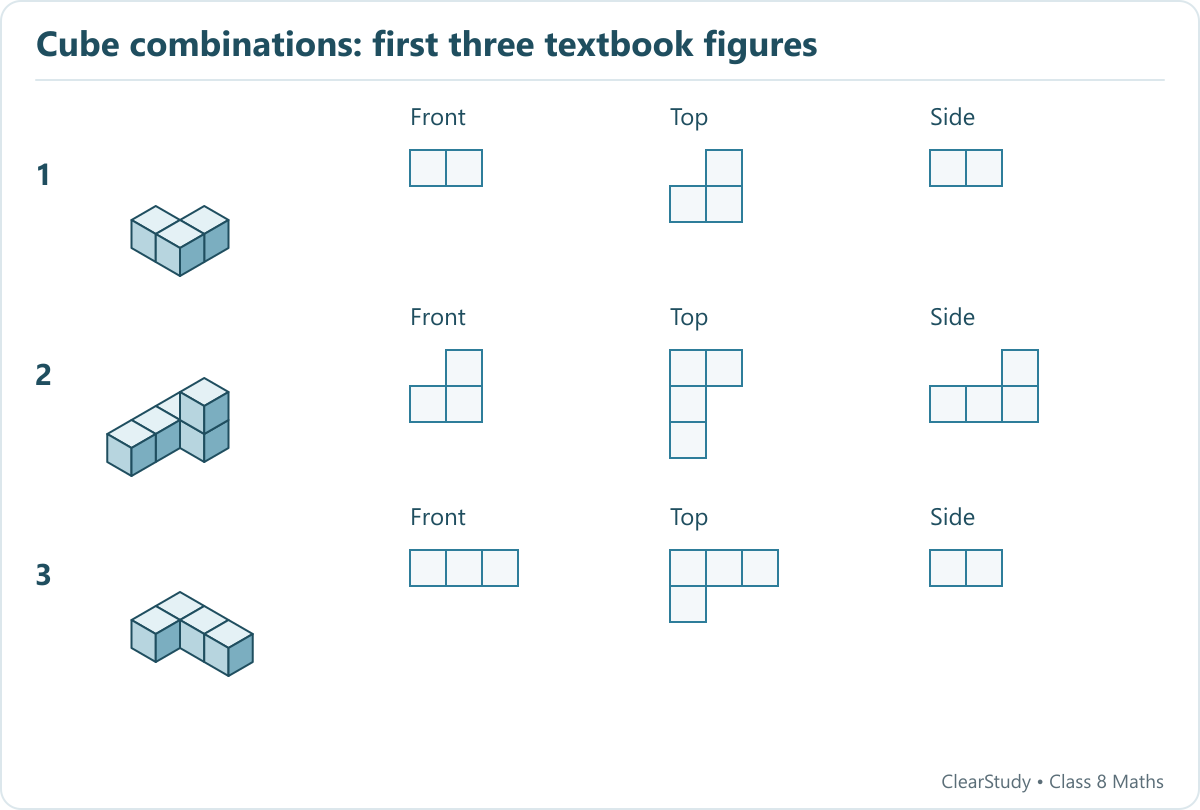
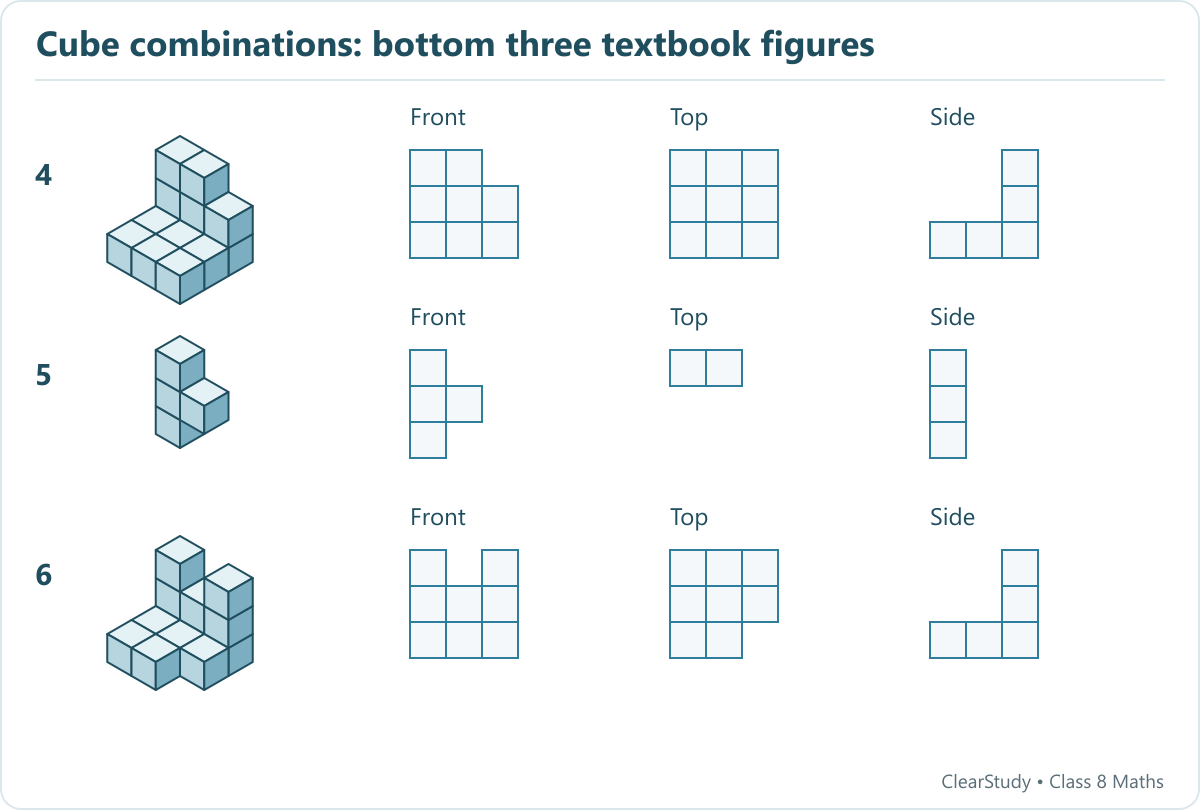
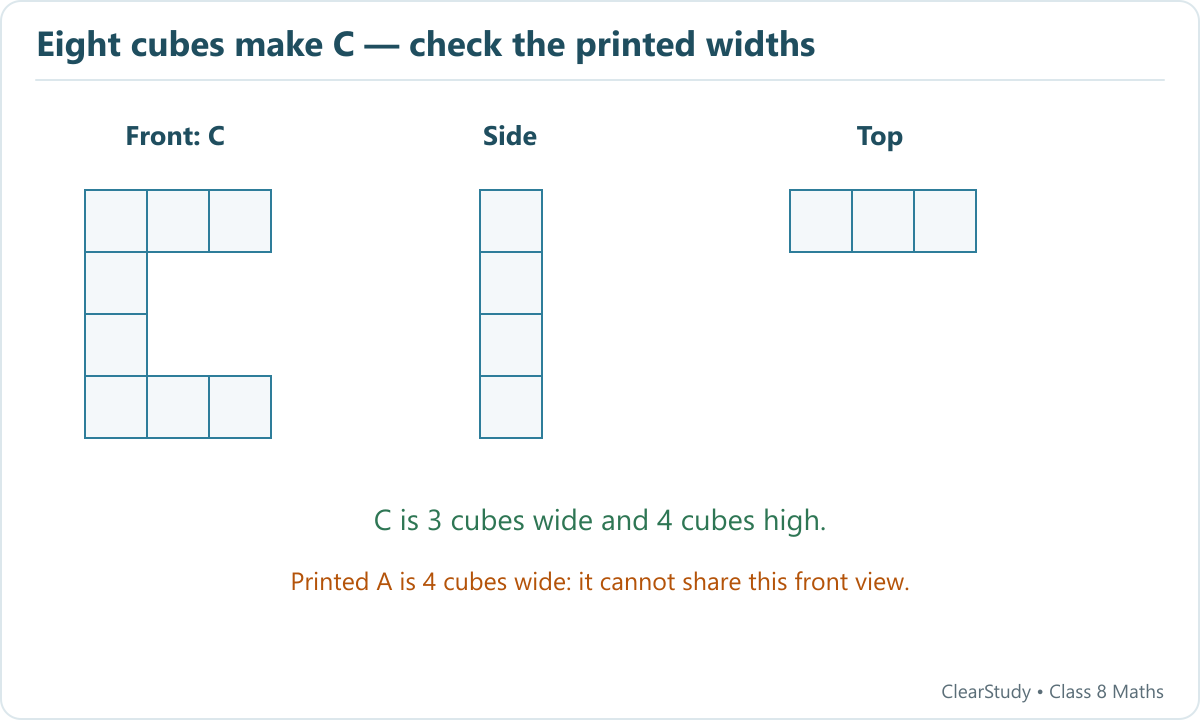
2. Imagine eight identical cubes, glued together along faces to form the letter ‘C’. (i) This looks like an ‘C’ from the front. What does it look like from the side? From the top? (ii) Glue additional cubes to make a shape that looks like ‘C’ from the front and a different given pattern from the top. (iii) Now, can you glue even more cubes to make it look like ‘C’ from the front, a given pattern from the top, and another given pattern from the side? (iv) Can you think of other letter combinations to make with a single combination of cubes in this manner?
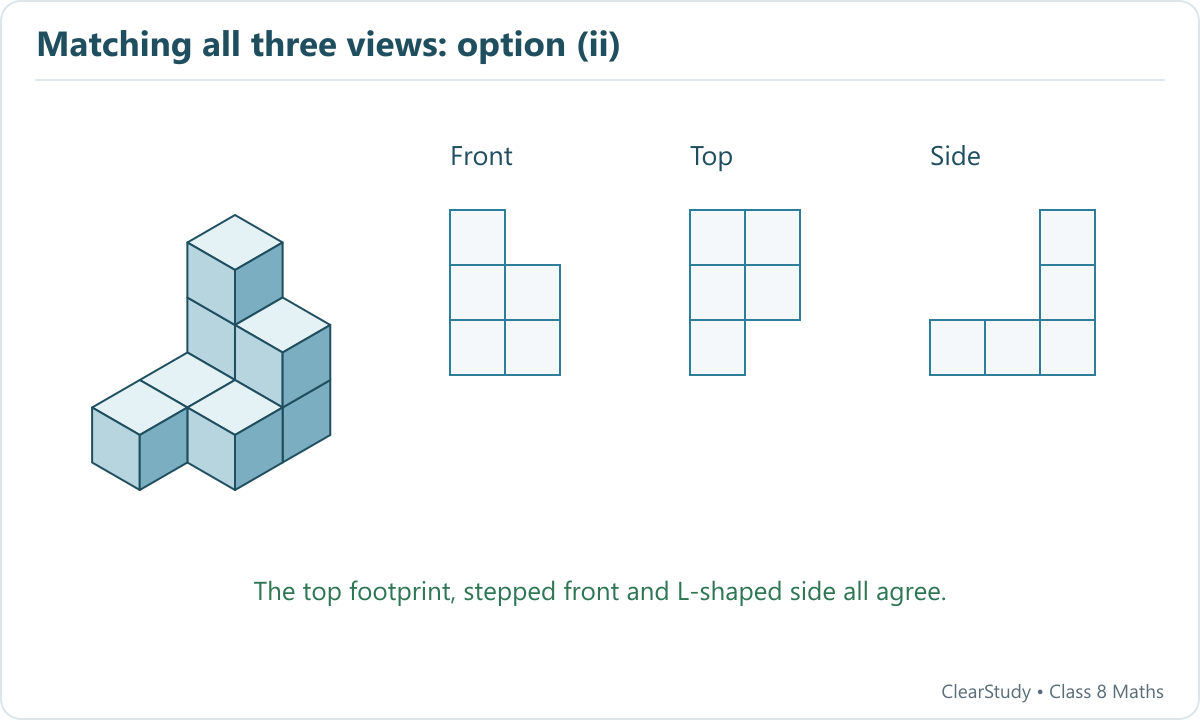
3. Which solid corresponds to the given top view, front view, and side view? (Choose from the solids (i)–(vii) made of glued cubes.)
4. Using identical cubes, make a solid that gives the following projections (nine drawings form three groups of Top/Front/Side views).
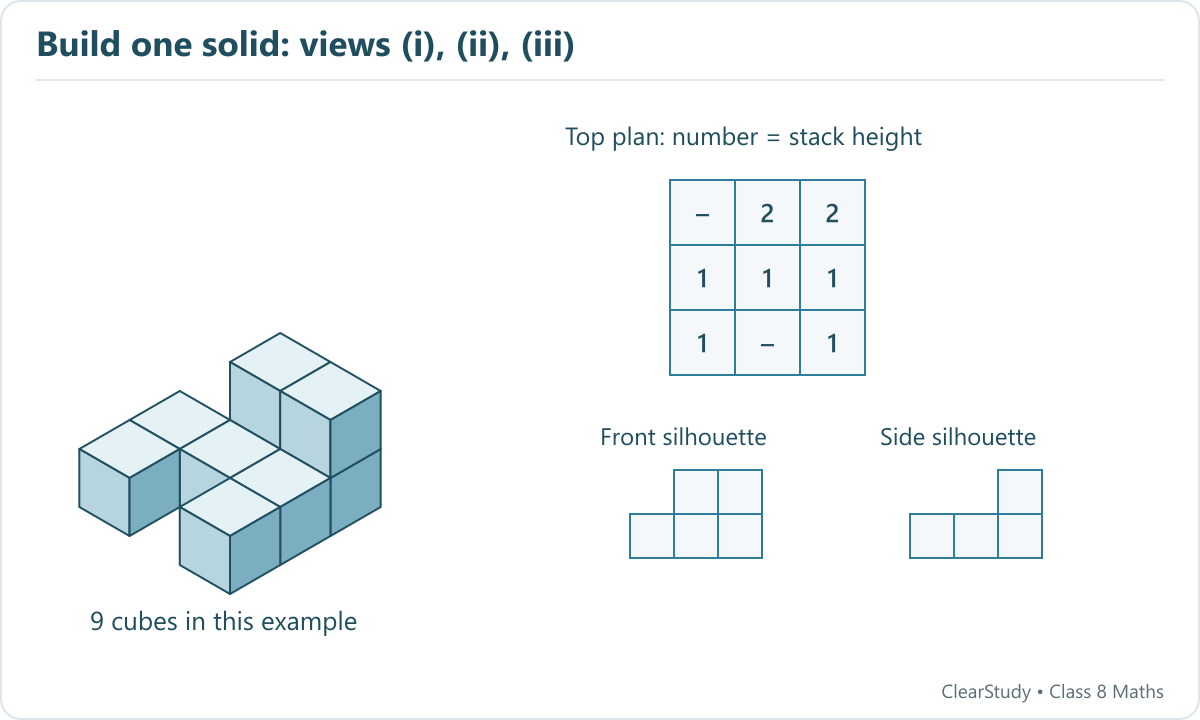
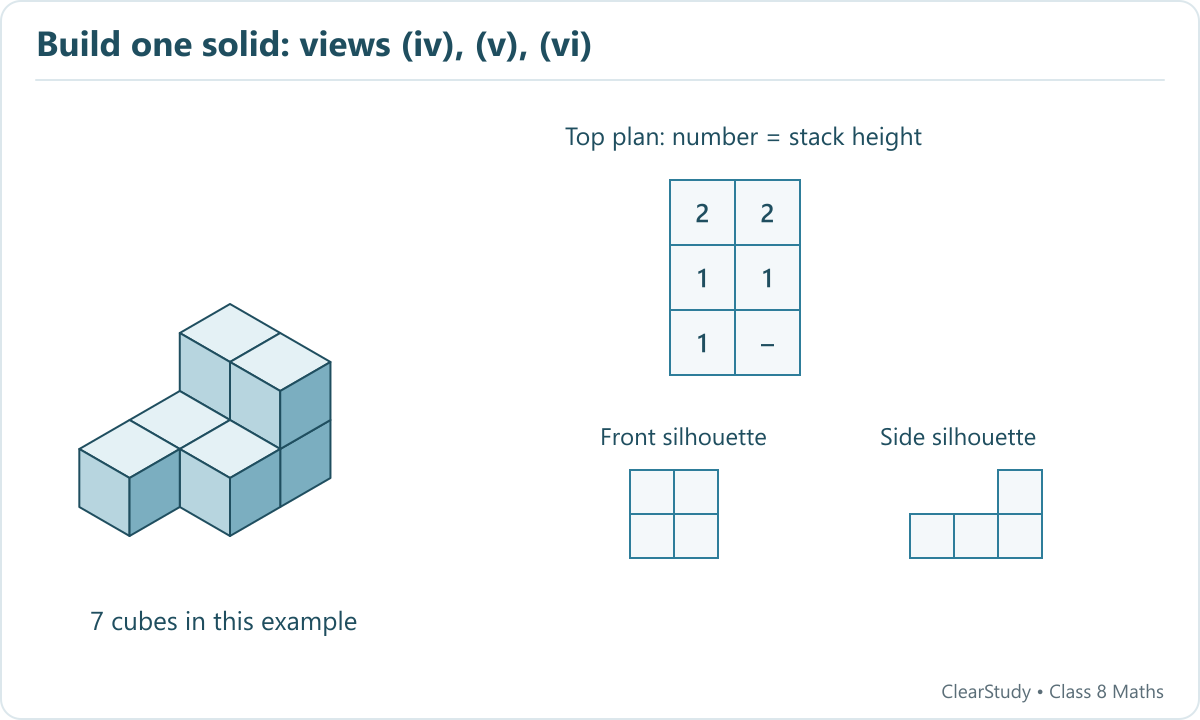
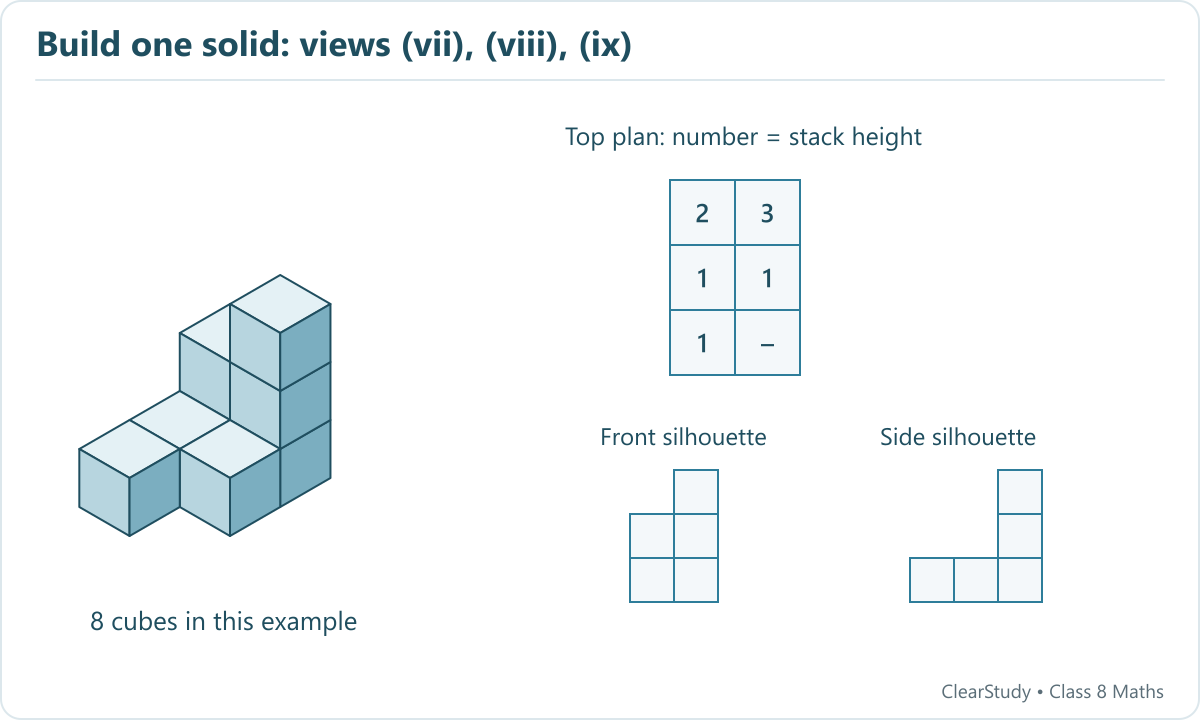
5. Find the number of cubes in this stack of identical cubes.
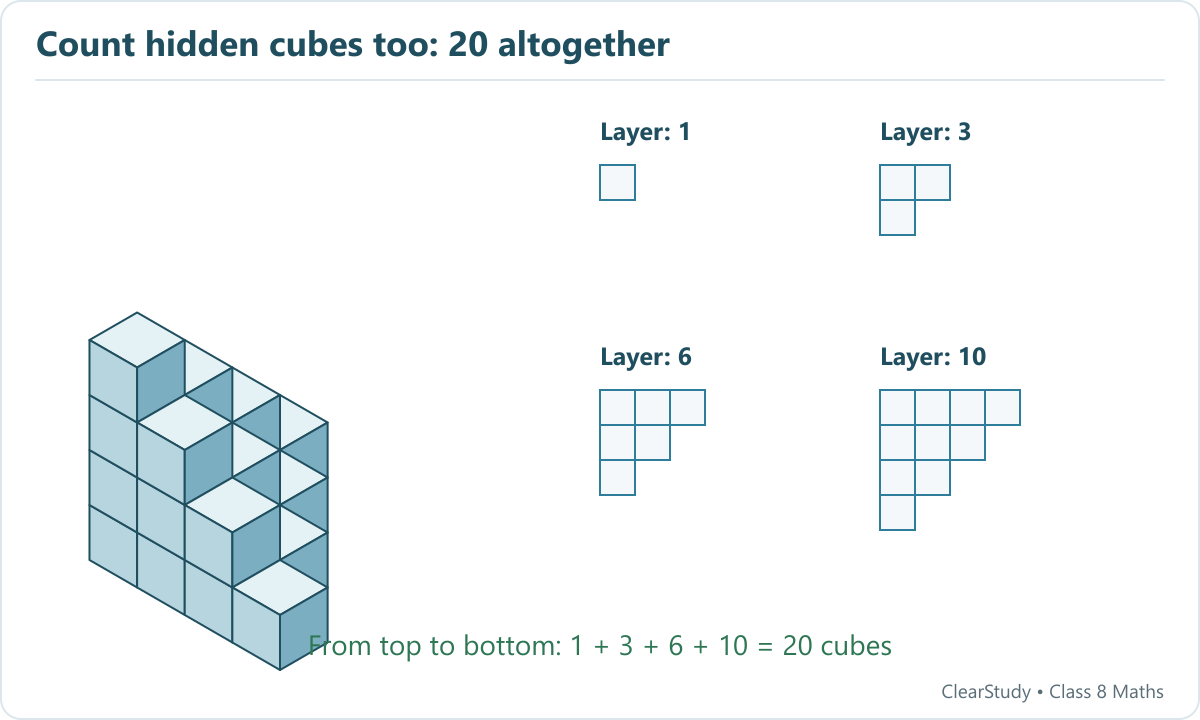
6. What are the different shapes the projection of a cube can make under different orientations?
Figure it Out — Isometric Grids
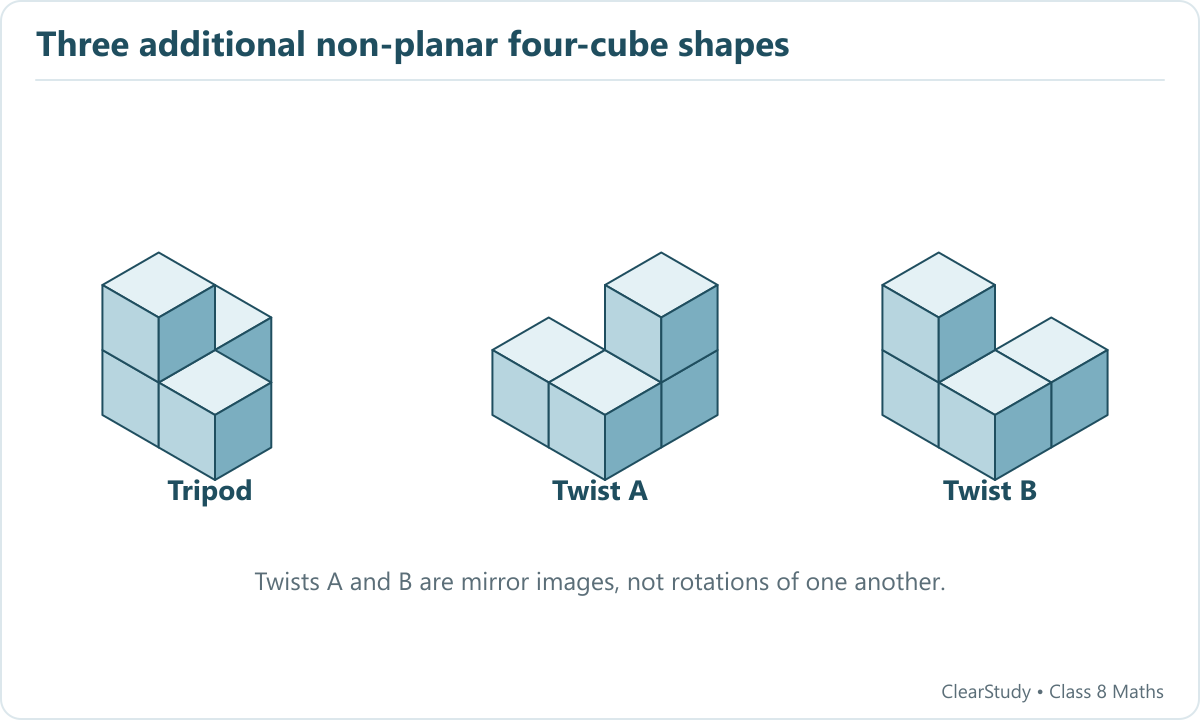
1. In addition to the 5 ways shown in Fig. 4.8, are there any additional ways of gluing four cubes together along faces? Can you visualise and draw these as well?
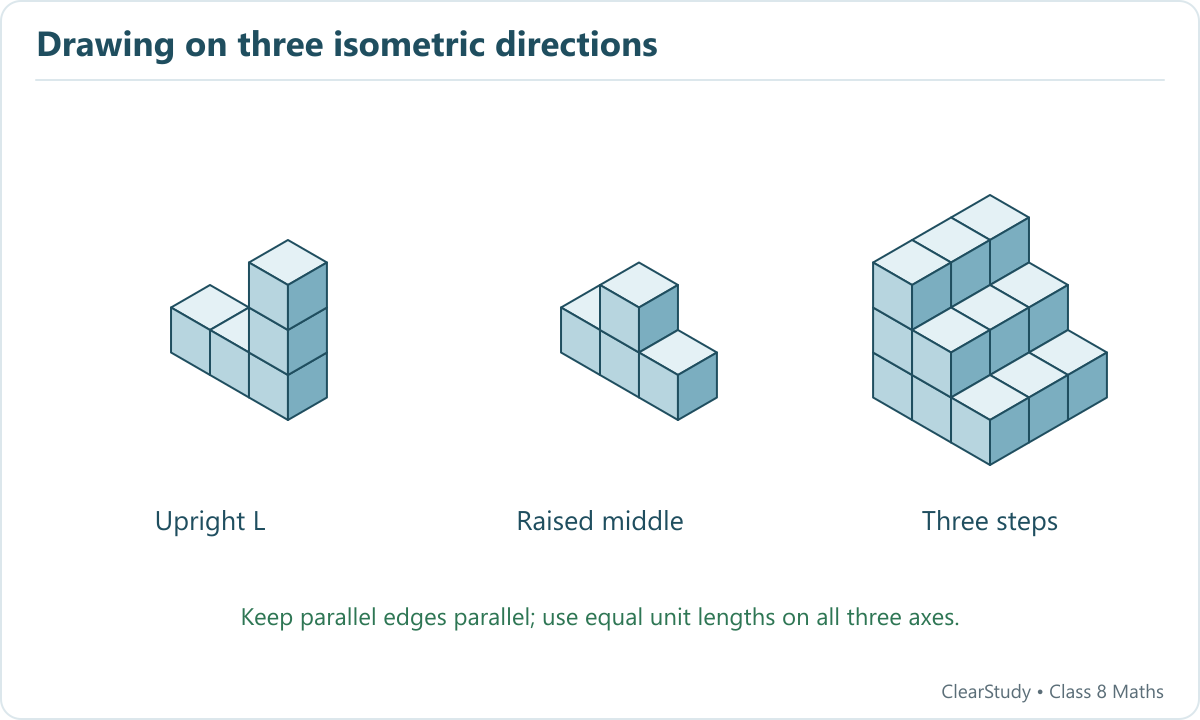
2. Draw the following figures on the isometric grid. [Hint: decide for each edge whether it goes up or down along the height, and draw it along the height axis or opposite to it.]
3. Is there anything strange about the path of this ball? Recreate it on the isometric grid. [Hint: Consider a portion of this figure that is physically realisable and identify the 3 primary directions.]
4. Observe this triangle. (i) Would it be possible to build a model out of actual cubes? What are the front, top, and side profiles of this impossible triangle? (ii) Recreate this on an isometric grid. (iii) Why does the illusion work?
Math Talk & Reflective Questions
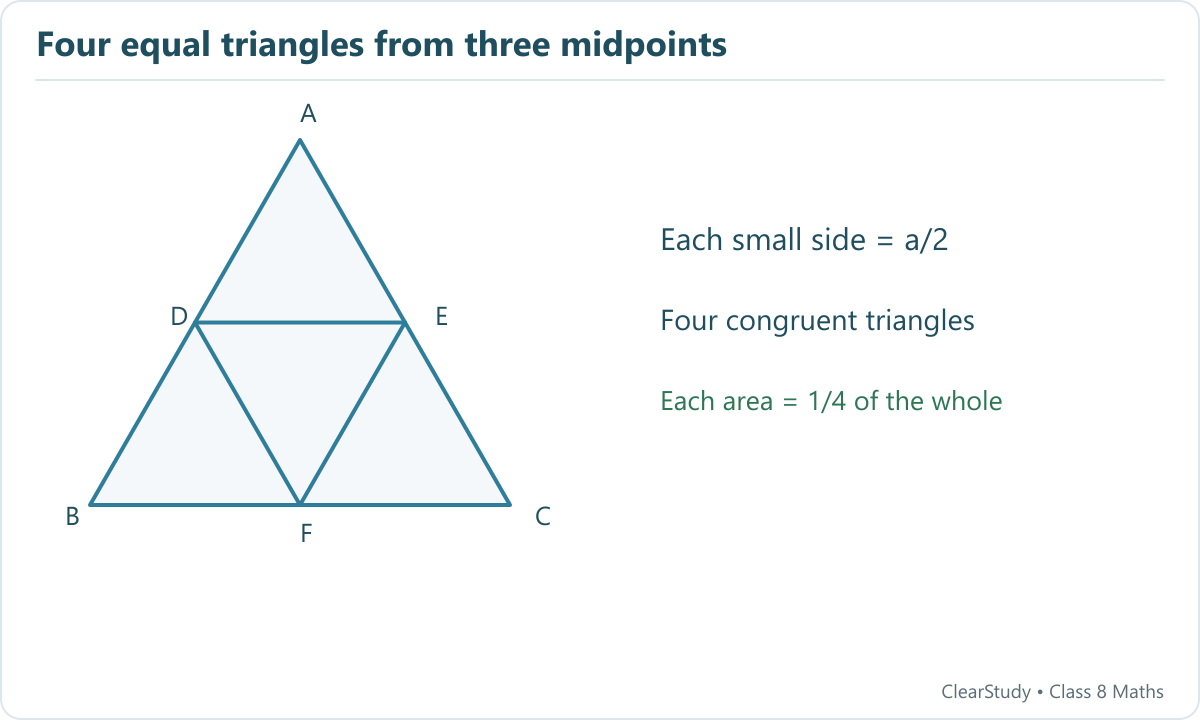
Show that by joining the midpoints of an equilateral triangle, we divide it into 4 identical equilateral triangles. [Hint: Note that the corner triangles are isosceles.]
If the congruent polygons of a prism have 10 sides, how many faces, edges and vertices does the prism have? What if the polygons have n sides?
If the base of a pyramid has 10 sides, how many faces, edges and vertices does the pyramid have? What if the base is an n-sided polygon?
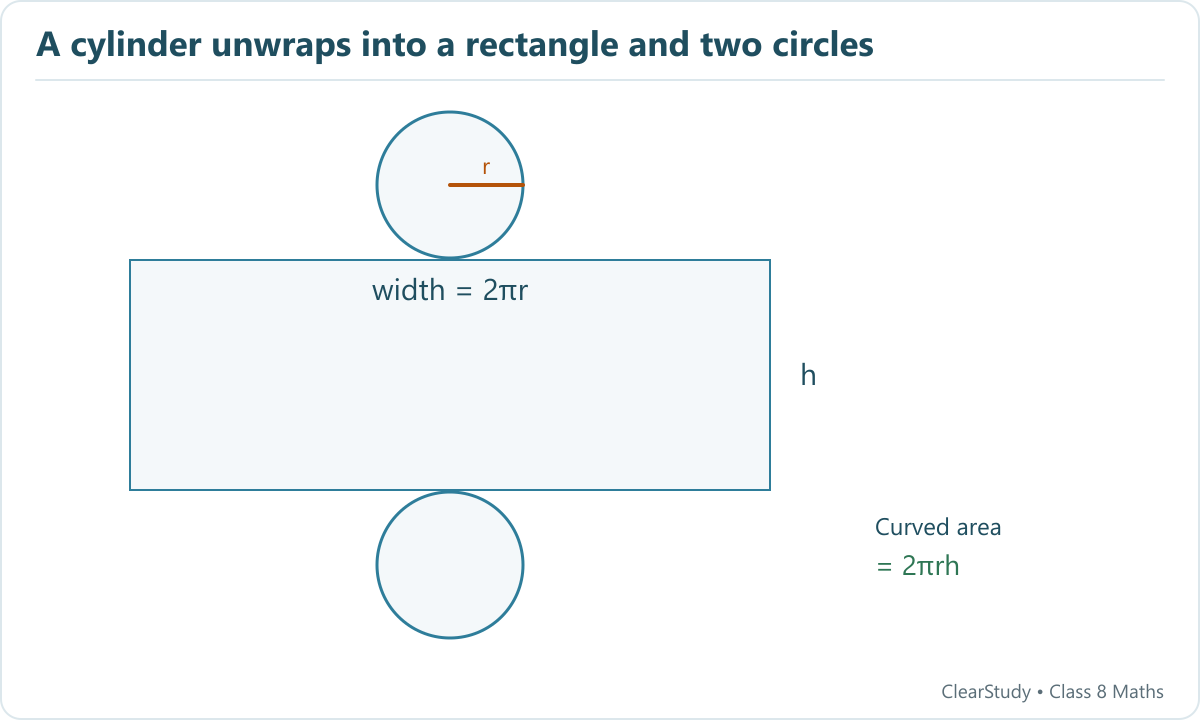
What are the sidelengths of the rectangle obtained in the net of a cylinder? (Cut along the height after unrolling the curved surface.)
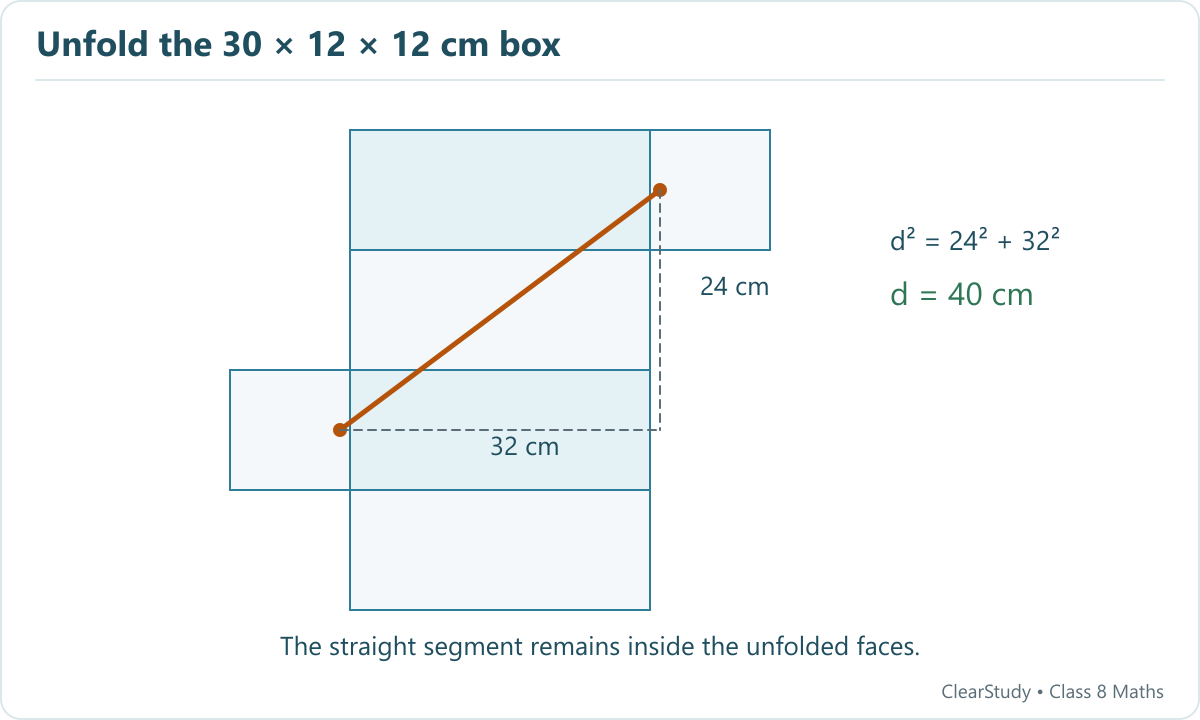
Find the shortest ant-to-laddu path on the 30 cm × 12 cm × 12 cm box (page 87). The ant is at the horizontal midpoint of one end face, 1 cm below its top; the laddu is at the horizontal midpoint of the opposite end face, 1 cm above its bottom.
When is the length of the projected line equal to its actual length? What can you say about the projection of an n-sided regular polygon, and of a pair of parallel lines?
Further textbook activities
Ant on the 8 cm × 4 cm × 4 cm box (page 86)
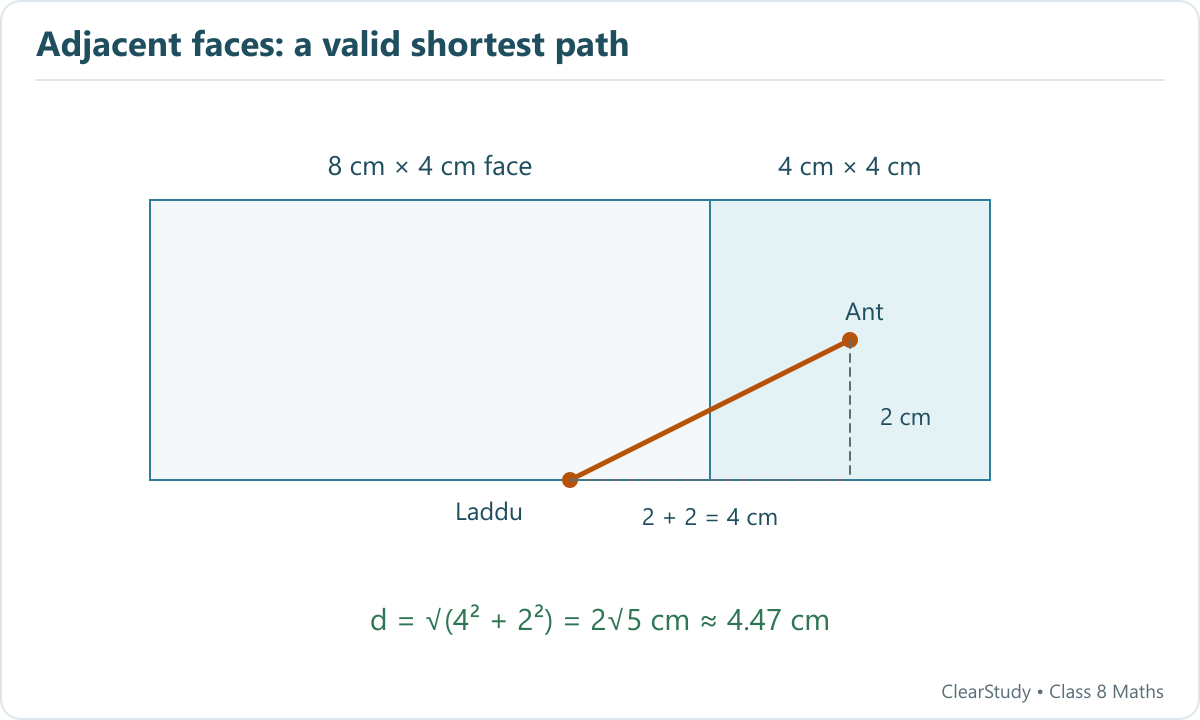
Unfold the end face directly beside the face containing the laddu. The ant is 2 cm from the shared edge and the laddu is 2 cm along the adjacent face, giving a 4 cm horizontal separation. Their vertical separation is 2 cm. Thus the shortest adjacent-face route has length √(4² + 2²) = 2√5 cm ≈ 4.47 cm. The straight line must remain within the two unfolded rectangles.
Cutting corners (page 76)
Joining adjacent side-midpoints of a square removes four equal corner triangles and leaves a smaller square with half the original area. The four removed triangles can be paired and rearranged to make another square of the same area. For an equilateral triangle, cutting corners at the one-third points leaves a regular hexagon. Doing the same to a square leaves an octagon that is not regular: if the original side is a, four edges have length a/3 and the four cut edges have length a√2/3.
Nets of other solids (pages 81–84)
A regular tetrahedron has two distinct nets: an equilateral triangle subdivided into four equal triangles, and a zigzag strip of four equal equilateral triangles. Among the four candidate drawings on page 81, the first and third are valid; the second does not join all triangles along edges, and the fourth has too many triangles.
A square pyramid can be made from a square with an equal isosceles triangle attached to each of its four sides. For example, use a 4 cm square and four triangles with sides 4 cm, 5 cm, 5 cm. A triangular prism needs three rectangles in a strip plus two matching triangular ends.
A cone of base radius r and slant height l unfolds to a circle of radius r and a sector of radius l. The sector arc is 2πr, so its angle is 360° × r/l. A sphere has no exact flat paper net that folds smoothly into its surface without stretching, tearing or overlap; globe gores are approximations.
Common Mistakes to Avoid
Watch out for these
- Confusing the fractal counts: for the Sierpinski Gasket use 3n triangles (it is the Carpet that uses 8n squares).
- Forgetting Step 0 starts the count — the Koch snowflake has 3 sides at Step 0, so sides = 3 × 4n, not 4n.
- Miscounting a pyramid’s edges: an n-sided pyramid has 2n edges (n base + n slant), not 3n like a prism.
- Saying a 2 × 2 block of squares is a cube net — it is not; four squares cannot meet at one point in a cube net.
- Using the wrong unfolding for the shortest path — always compare all unfoldings and pick the smallest straight-line distance.
- Assuming a projection (view) keeps the true length — it does so only when the edge is parallel to that plane.
- Leaving answers like √1600 unsimplified — simplify to 40 when it is a perfect square.
Practice MCQs & Assertion–Reason
1. A fractal is best described as a shape that is:
(a) always a circle (b) self-similar at smaller and smaller scales (c) always two-dimensional (d) made of only straight lines
2. In the Sierpinski Gasket, the number of remaining triangles at step n is:
(a) 8n (b) 4n (c) 3n (d) 2n
3. The number of sides of the Koch Snowflake at step n is:
(a) 4n (b) 3 × 4n (c) 3n (d) 3 + 4n
4. A cuboid has how many faces, edges and vertices?
(a) 6, 12, 8 (b) 8, 12, 6 (c) 6, 8, 12 (d) 4, 6, 4
5. Euler’s relation for a convex polyhedron is:
(a) F + E + V = 2 (b) F − E + V = 2 (c) F + E − V = 2 (d) F − E − V = 2
6. A pentagonal prism has how many edges?
(a) 10 (b) 12 (c) 15 (d) 20
7. A square pyramid has how many faces?
(a) 4 (b) 5 (c) 6 (d) 8
8. The total number of distinct nets of a cube is:
(a) 6 (b) 8 (c) 11 (d) 12
9. When the curved surface of a cylinder of radius r and height h is unrolled, the rectangle has sides:
(a) r and h (b) 2πr and h (c) πr2 and h (d) 2r and h
10. If a cuboid is unfolded into a right triangle with legs 24 cm and 32 cm, the shortest surface path is:
(a) 28 cm (b) 40 cm (c) 56 cm (d) 1600 cm
For each Assertion–Reason question, choose: (A) Both Assertion and Reason are true and the Reason is the correct explanation of the Assertion; (B) Both are true but the Reason is not the correct explanation; (C) Assertion is true but Reason is false; (D) Assertion is false but Reason is true.
A-R 1. Assertion: The Sierpinski Carpet keeps (8/9)n of the original area at step n.
Reason: At each step the square is divided into 9 equal squares and the central one is removed.
A-R 2. Assertion: A triangular pyramid (tetrahedron) has 4 faces, 6 edges and 4 vertices.
Reason: For an n-sided pyramid, F = n + 1, E = 2n and V = n + 1.
A-R 3. Assertion: Every arrangement of 6 squares is a net of a cube.
Reason: A cube has 6 faces.
A-R 4. Assertion: The shortest path between two points on a cuboid’s surface can be found by unfolding it into a net.
Reason: A path on the surface transforms to a path of the same length on the net, and a straight line on the net is the shortest.
A-R 5. Assertion: If two parallel lines have distinct, non-degenerate line projections on a plane, those projections are parallel.
Reason: A projection can never change the length of any line segment.
Quick Revision Summary
- Fractals are self-similar shapes (fern, Sierpinski Carpet/Gasket, Koch Snowflake) repeating at smaller scales.
- Sierpinski Gasket: triangles = 3n, holes = (3n−1)/2, area = (3/4)n. Sierpinski Carpet: area = (8/9)n.
- Koch Snowflake: sides = 3 × 4n, perimeter = 3 × (4/3)n — finite area but infinite perimeter.
- Faces, edges, vertices: cube/cuboid have 6, 12, 8. Euler: F − E + V = 2.
- n-sided prism: F = n+2, E = 3n, V = 2n. n-sided pyramid: F = n+1, E = 2n, V = n+1.
- A net folds into a solid; a cube has 11 nets, a regular tetrahedron has 2, an octahedron has 11.
- Shortest path on a cuboid = straight line on a suitable unfolded net (use Pythagoras, e.g. √(242+322) = 40).
- Solids are drawn using front, top and side views (projections), and isometric drawing on a triangular grid.
How to score full marks in this chapter
State the rule before computing — e.g. write “each triangle → 3 triangles, so Rn = 3n” before tabulating. For faces/edges/vertices, always finish with the Euler check F − E + V = 2. For shortest-path problems, draw the unfolded net, mark the right triangle, and simplify surds (√1600 = 40). For projection and net questions, label your diagram clearly and verify a net by mentally folding it.
Frequently Asked Questions
What is Class 8 Maths Ganita Prakash Chapter 11 about?
Chapter 11, Exploring Some Geometric Themes (Chapter 4 of Ganita Prakash Part II), covers two themes: fractals (self-similar shapes like the Sierpinski Carpet/Gasket and Koch Snowflake) and visualising solids (faces, edges, vertices, nets, shortest paths on cuboids, projections and isometric drawing).
What is Euler’s relation for solids?
For a convex polyhedron, F − E + V = 2, where F is the number of faces, E the number of edges and V the number of vertices. For example a cube gives 6 − 12 + 8 = 2.
How many nets does a cube have?
A cube has exactly 11 distinct nets (counting rotations and flips as the same). A regular tetrahedron has 2 nets and an octahedron has 11.
Are these Class 8 Maths Ganita Prakash Chapter 11 solutions free?
Yes. All solutions are free and follow the official NCERT Ganita Prakash textbook (Part II) for 2026–27, with original worked explanations and diagrams.
Textbook reference: NCERT Ganita Prakash, Chapter 11 (official PDF). ClearStudy diagrams and worked explanations are original teaching aids.