
Class 8 Maths Ganita Prakash Chapter 10 Solutions (NCERT 2026–27) – Proportional Reasoning-2
These Class 8 Maths Ganita Prakash Chapter 10 solutions cover Proportional Reasoning-2 from the new NCERT textbook (2026–27). This is Chapter 3 of Ganita Prakash Part II (the 10th chapter of the Class 8 course); it continues “Proportional Reasoning” from Part I, extending it to ratios with many terms, dividing a whole in a ratio, pie charts and inverse proportions. Every “Figure it Out” question is solved step by step, with each proportion and pie-chart angle verified.
- Chapter overview
- Key concepts & definitions
- Important formulas
- Figure it Out (Ratios with many terms)
- Figure it Out (Pie charts)
- Figure it Out (Inverse proportion – tables)
- Figure it Out (Inverse proportion – word problems)
- More textbook activities
- Common mistakes to avoid
- Practice MCQs & Assertion–Reason
- Quick revision summary
- FAQs
Chapter 10 Overview
Chapter 3 of Ganita Prakash Part II, Proportional Reasoning-2, builds on the ratio and proportion ideas from Part I. It begins with a quick recap of when two ratios are proportional (a × d = b × c), then looks at ratios in maps (Representative Fraction), ratios with more than two terms, and how to divide a whole in a given ratio. The chapter then introduces pie charts — turning each part of the data into a sector angle out of 360° — and finally inverse proportions, where two quantities satisfy x × y = k (one goes up by a factor n as the other goes down by 1/n). The solutions below work through all four “Figure it Out” sets step by step.
Key Concepts & Definitions
Proportional ratios: two ratios a : b and c : d are proportional if a × d = b × c (cross-multiplication).
Representative Fraction (RF): the ratio of a distance on a map to the actual distance on the ground (e.g. RF 1 : 60,00,000 means 1 cm on the map = 60,00,000 cm = 60 km on the ground).
Ratios with many terms: a : b : c : d … — for every a units of the first quantity there are b, c, d… units of the others.
Dividing a whole in a ratio: share each part as (total) × (its term) ÷ (sum of all terms).
Pie chart: a circle in which each category gets a sector whose angle is proportional to its value; all the sector angles add up to 360°.
Direct proportion: both quantities change by the same factor; their quotient x/y stays constant.
Inverse proportion: as one quantity is multiplied by n, the other is multiplied by 1/n; their product x × y = k stays constant.
Important Formulas (Chapter 10)
Proportion of two ratios: a : b :: c : d ⇒ a × d = b × c.
Dividing a whole x in the ratio p : q : r … : each part = x × (its term) ÷ (p + q + r + …).
Pie-chart sector angle = (value ÷ total) × 360°.
Direct proportion: x1/y1 = x2/y2 = k.
Inverse proportion: x × y = k, i.e. x1y1 = x2y2 (so x1/x2 = y2/y1).
Figure it Out — Ratios with Many Terms (after Example 5, page 60)
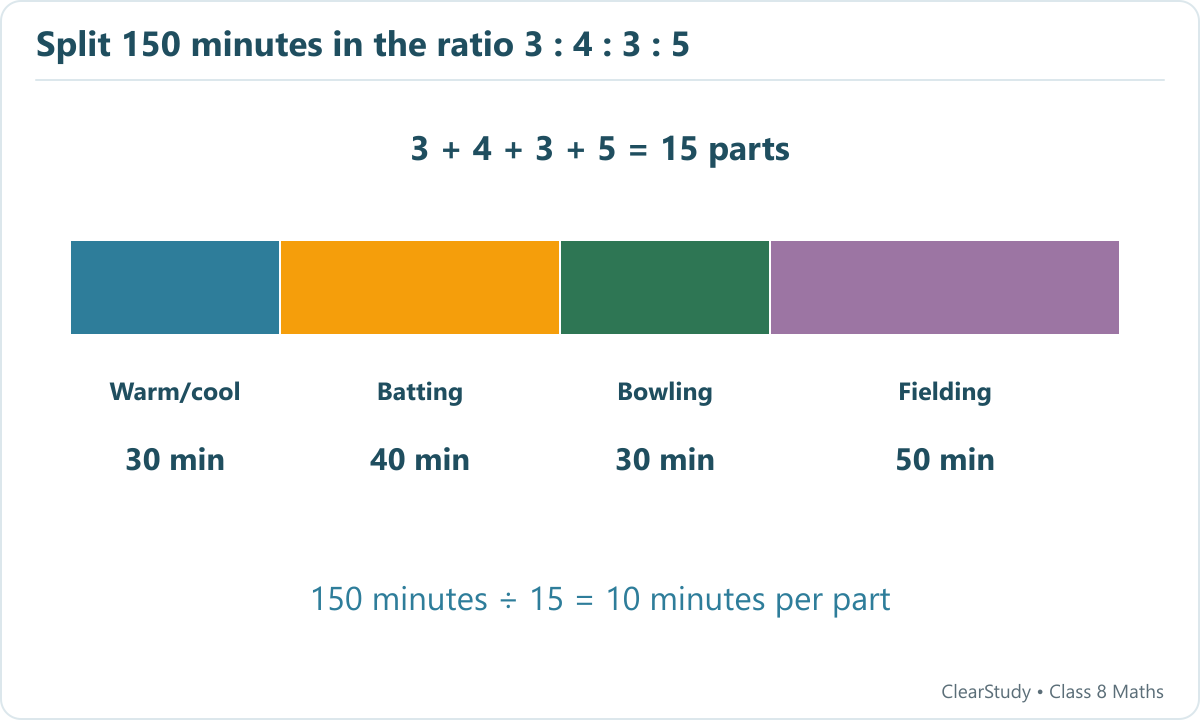
1. A cricket coach schedules practice sessions that include different activities in a specific ratio — time for warm-up/cool-down : time for batting : time for bowling : time for fielding :: 3 : 4 : 3 : 5. If each session is 150 minutes long, how much time is spent on each activity?
2. A school library has books in different languages in the following ratio — no. of Odiya books : no. of Hindi books : no. of English books :: 3 : 2 : 1. If the library has 288 Odiya books, how many Hindi and English books does it have?
3. I have 100 coins in the ratio — no. of ₹10 coins : no. of ₹5 coins : no. of ₹2 coins : no. of ₹1 coins :: 4 : 3 : 2 : 1. How much money do I have in coins?
| Coin | No. of coins | Value |
|---|---|---|
| ₹10 | 4 × 10 = 40 | 40 × 10 = ₹400 |
| ₹5 | 3 × 10 = 30 | 30 × 5 = ₹150 |
| ₹2 | 2 × 10 = 20 | 20 × 2 = ₹40 |
| ₹1 | 1 × 10 = 10 | 10 × 1 = ₹10 |
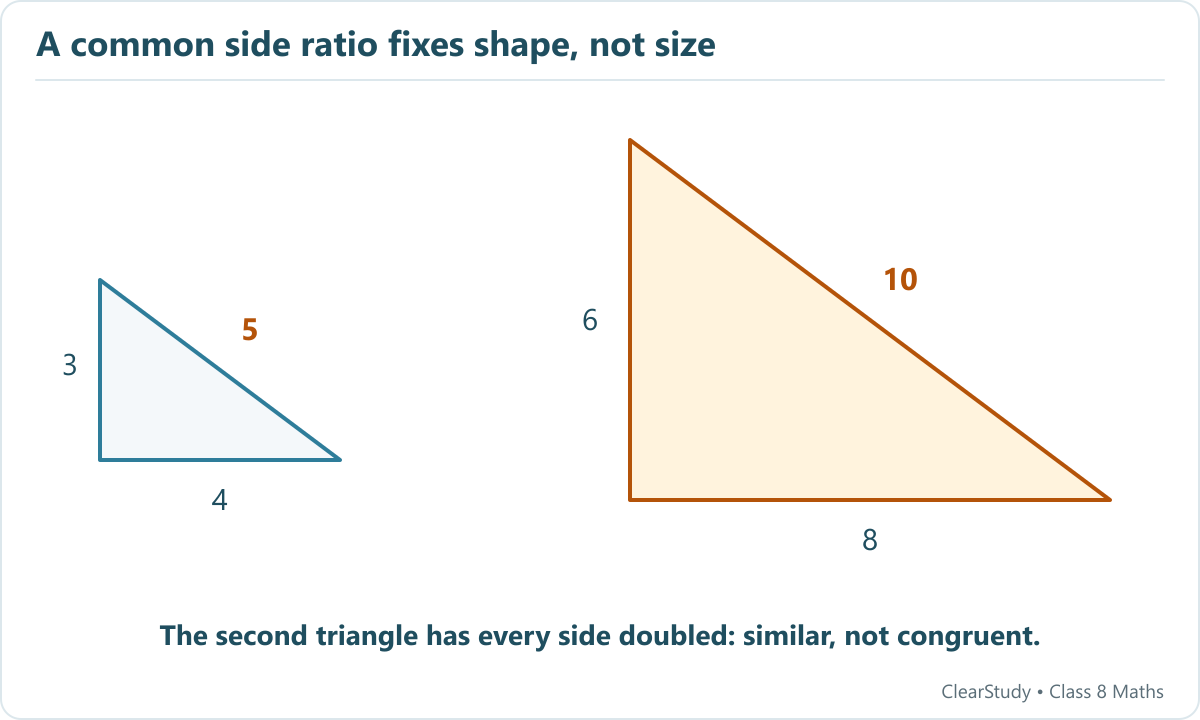
4. Construct a triangle with sidelengths in the ratio 3 : 4 : 5. Will all the triangles drawn with this ratio of sidelengths be congruent to each other? Why or why not?
5. Can you construct a triangle with sidelengths in the ratio 1 : 3 : 5? Why or why not?
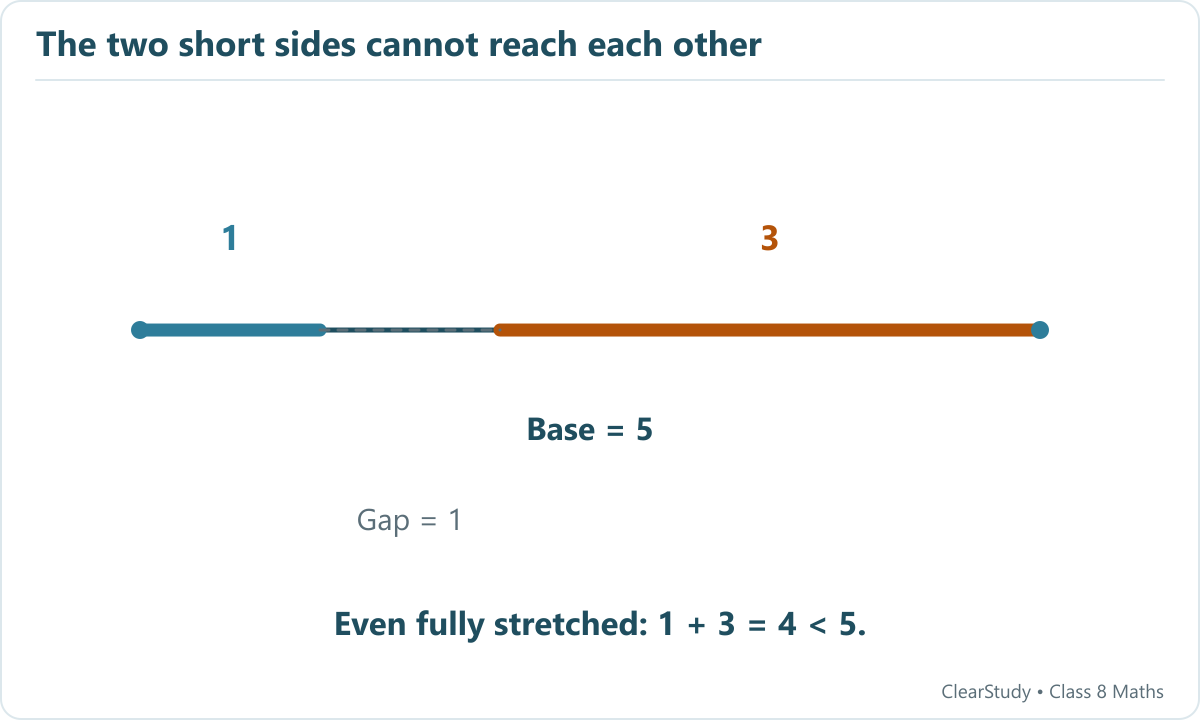
Figure it Out — Pie Charts (after Step 7, page 62)
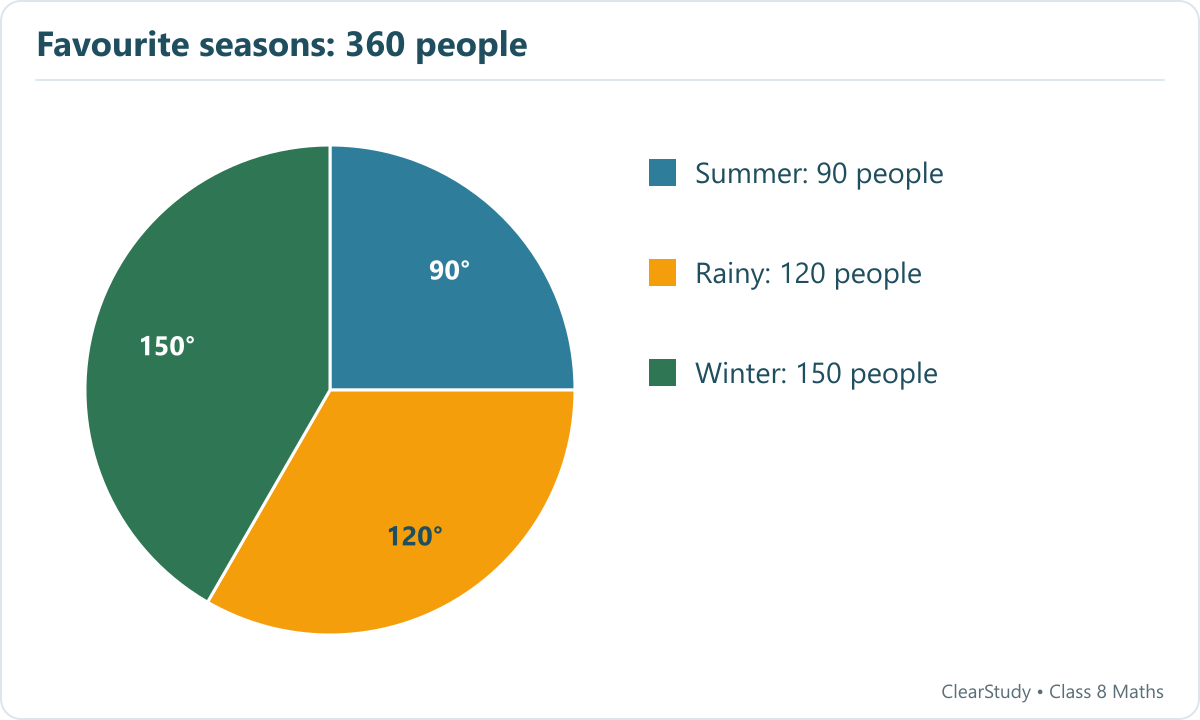
1. A group of 360 people were asked to vote for their favourite season from the three seasons — rainy, winter and summer. 90 liked the summer season, 120 liked the rainy season, and the rest liked the winter. Draw a pie chart to show this information.
| Season | People | Sector angle = (people ÷ 360) × 360° |
|---|---|---|
| Summer | 90 | (90 ÷ 360) × 360° = 90° |
| Rainy | 120 | (120 ÷ 360) × 360° = 120° |
| Winter | 150 | (150 ÷ 360) × 360° = 150° |
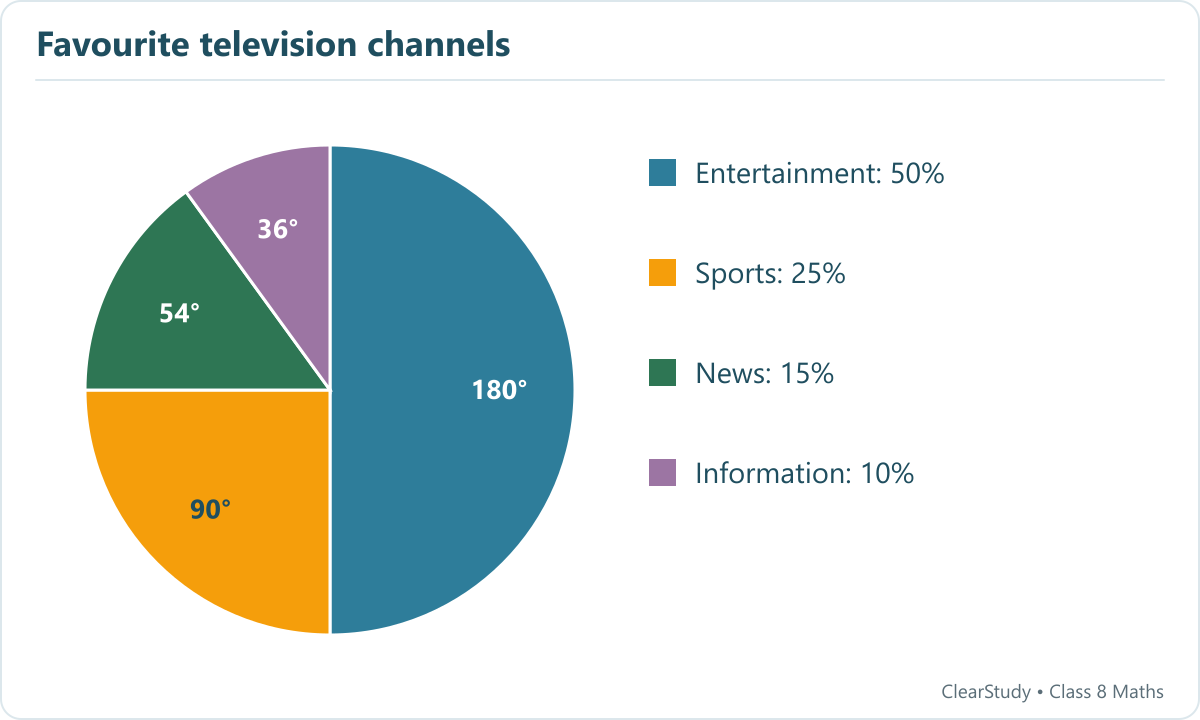
2. Draw a pie chart based on the following information about viewers’ favourite type of TV channel: Entertainment — 50%, Sports — 25%, News — 15%, Information — 10%.
| Channel type | Percentage | Sector angle = (% ÷ 100) × 360° |
|---|---|---|
| Entertainment | 50% | 0.50 × 360° = 180° |
| Sports | 25% | 0.25 × 360° = 90° |
| News | 15% | 0.15 × 360° = 54° |
| Information | 10% | 0.10 × 360° = 36° |
3. Prepare a pie chart that shows the favourite subjects of the students in your class. You can collect the data of the number of students for each subject shown in the table (each student should choose only one subject). Then write these numbers in the table and construct a pie chart: Subjects: Language, Arts Education, Vocational Education, Social Science, Physical Education, Maths, Science.
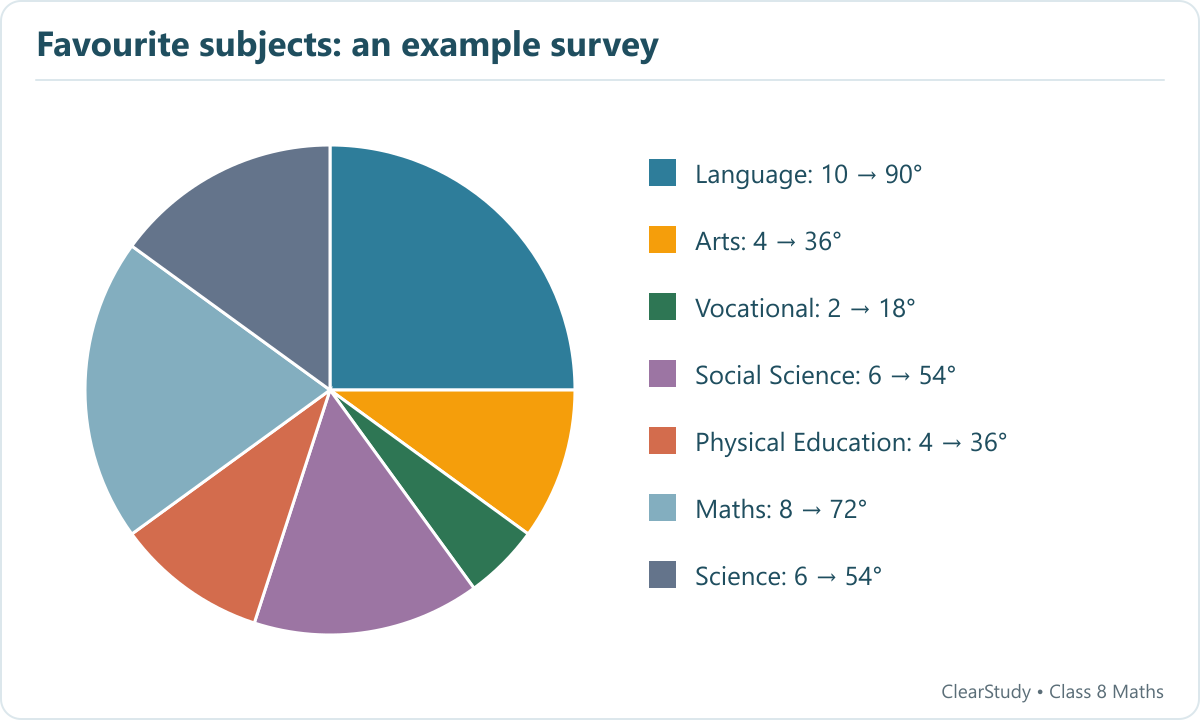
Figure it Out — Inverse Proportion (Tables) (after Example 2, page 65)
1. Which of these are in inverse proportion? (i) x: 40, 80, 25, 16 / y: 20, 10, 32, 50 (ii) x: 40, 80, 25, 16 / y: 20, 10, 12.5, 8 (iii) x: 30, 90, 150, 10 / y: 15, 5, 3, 45
2. Fill in the empty cells if x and y are in inverse proportion. x: 16, 12, __, 36 / y: 9, __, 48, __
| x | 16 | 12 | 3 | 36 |
|---|---|---|---|---|
| y | 9 | 12 | 48 | 4 |
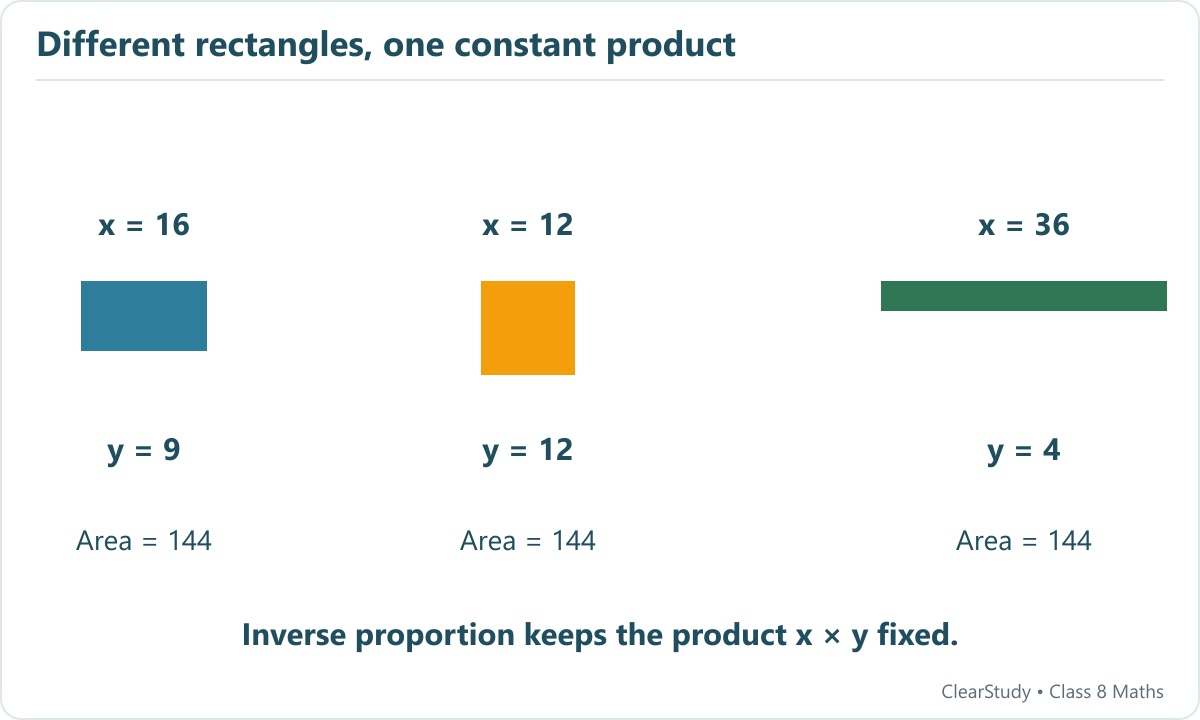
Figure it Out — Inverse Proportion (Word Problems) (after Example 6, pages 67–68)
1. Which of the following pairs of quantities are in inverse proportion? (i) The number of taps filling a water tank and the time taken to fill it. (ii) The number of painters hired and the days needed to paint a wall of fixed size. (iii) The distance a car can travel and the amount of petrol in the tank. (iv) The speed of a cyclist and the time taken to cover a fixed route. (v) The length of cloth bought and the price paid at a fixed rate per metre. (vi) The number of pages in a book and the time required to read it at a fixed reading speed.
2. If 24 pencils cost ₹120, how much will 20 such pencils cost?
3. A tank on a building has enough water to supply 20 families living there for 6 days. If 10 more families move in there, how long will the water last? What assumptions do you need to make to work out this problem?
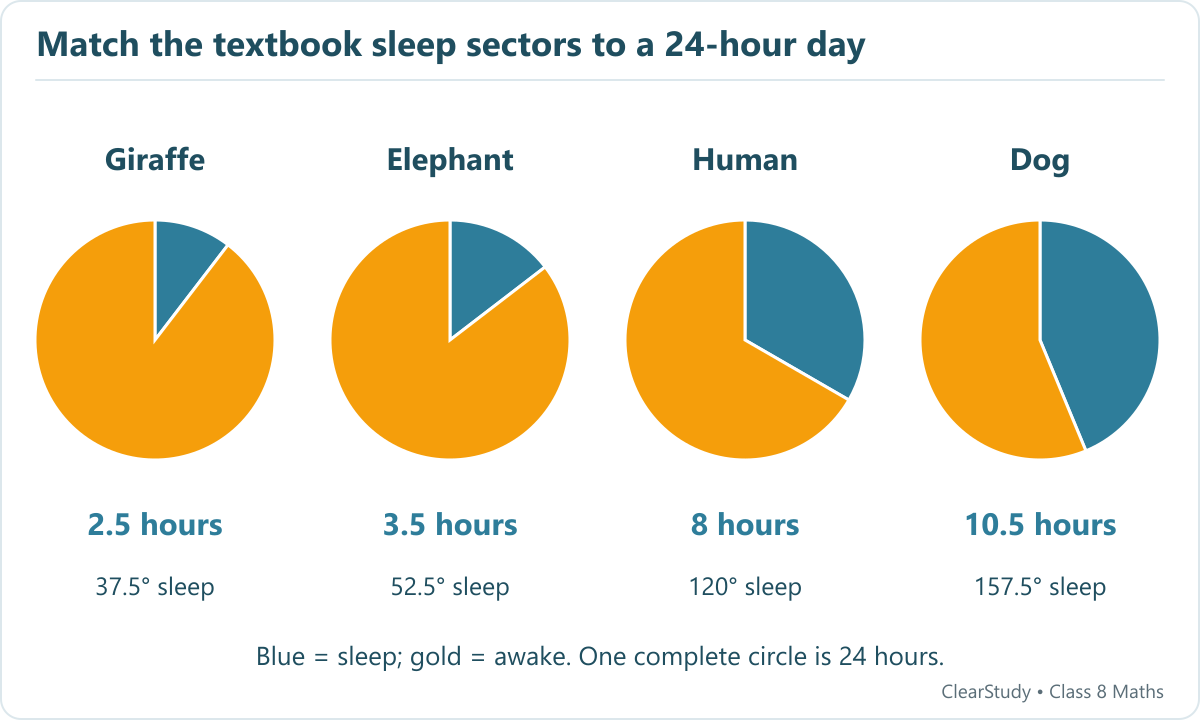
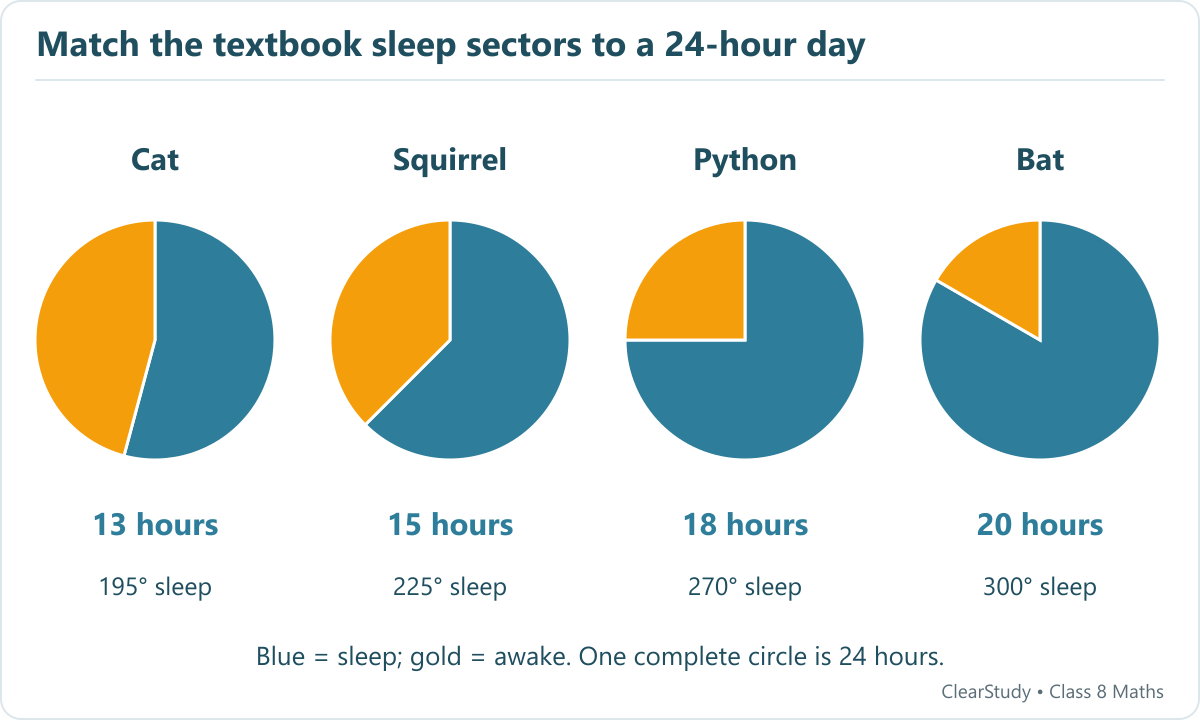
4. Fill in the average number of hours each living being sleeps in a day by looking at the charts. Select the appropriate hours from this list: 15, 2.5, 20, 8, 3.5, 13, 10.5, 18.
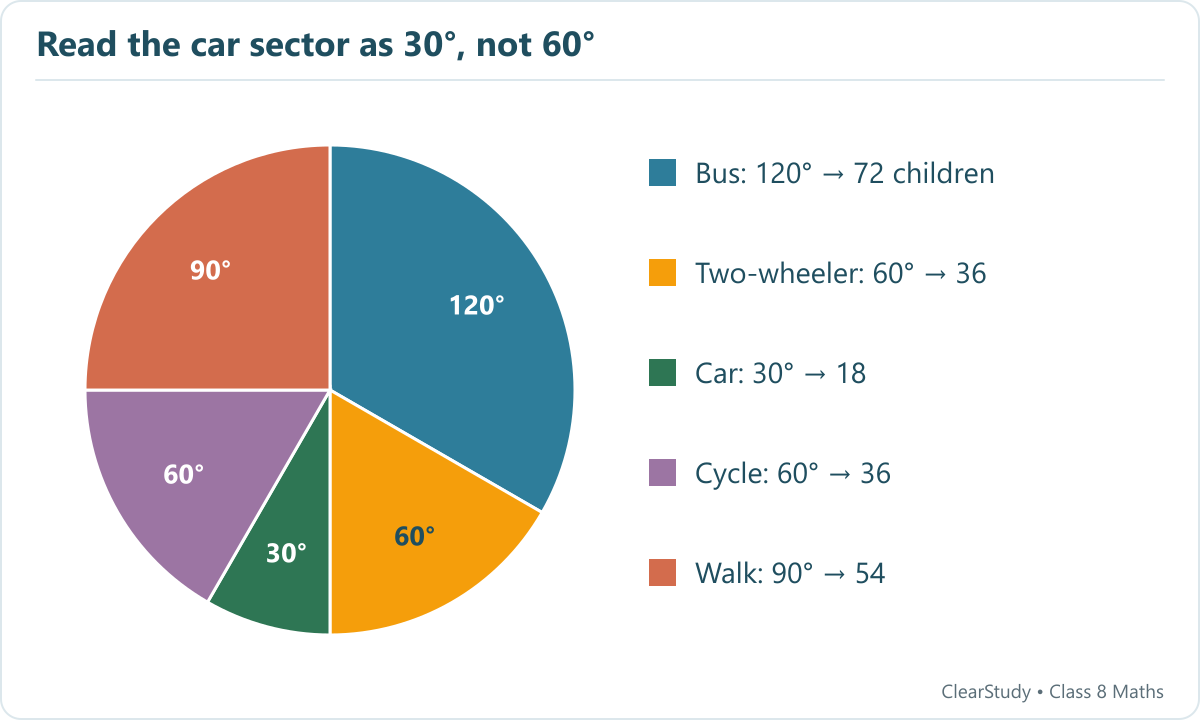
5. The pie chart on the right shows the result of a survey carried out to find the modes of transport used by children to go to school. Study the pie chart and answer the following questions. (Given angles: Walk 90°, Bus 120°, Two-wheeler 60°, Cycle 60°; Car is the unlabelled sector.) (i) What is the most common mode of transport? (ii) What fraction of children travel by car? (iii) If 18 children travel by car, how many children took part in the survey? How many children use taxis to travel to school? (iv) By which two modes of transport are equal numbers of children travelling?
| Mode | Angle | Fraction | Children |
|---|---|---|---|
| Bus | 120° | 1/3 | 72 |
| Walk | 90° | 1/4 | 54 |
| Two-wheeler | 60° | 1/6 | 36 |
| Cycle | 60° | 1/6 | 36 |
| Car | 30° | 1/12 | 18 |
6. Three workers can paint a fence in 4 days. If one more worker joins the team, how many days will it take them to finish the work? What are the assumptions you need to make?
7. It takes 6 hours to fill 2 tanks of the same size with a pump. How long will it take to fill 5 such tanks with the same pump?
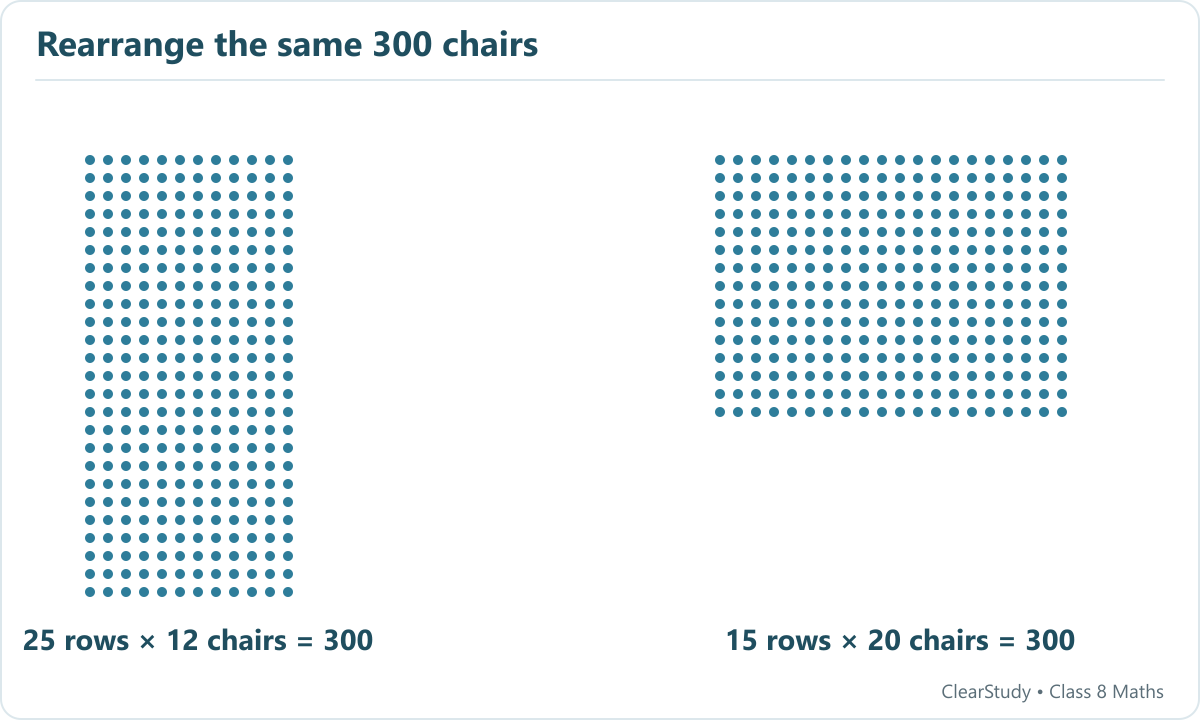
8. A given set of chairs are arranged in 25 rows, with 12 chairs in each row. If the chairs are rearranged with 20 chairs in each row, how many rows does this new arrangement have?
9. A school has 8 periods a day, each of 45 minutes duration. How long is each period, if the school has 9 periods a day, assuming that the number of school hours per day stays the same?
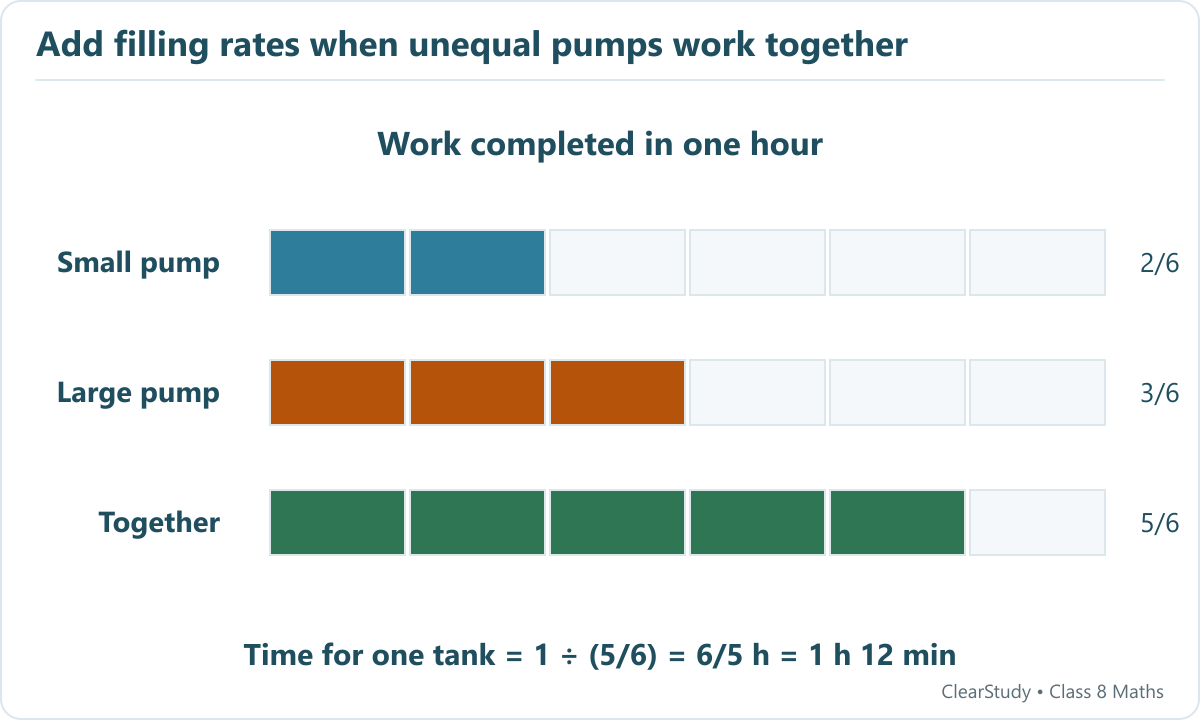
10. A small pump can fill a tank in 3 hours, while a large pump can fill the same tank in 2 hours. If both pumps are used together, how long will the tank take to fill?
11. A factory requires 42 machines to produce a given number of toys in 63 days. How many machines are required to produce the same number of toys in 54 days?
12. A car takes 2 hours to reach a destination, travelling at a speed of 60 km/h. How long will the car take if it travels at a speed of 80 km/h?
More textbook activities and examples
Map scale and classroom plan (pages 56–57)
RF 1:60,00,000 means 1 cm represents 60 km, with both lengths first expressed in the same unit. If the distance measured on a correctly scaled printed map is d cm, geographical distance = 60d km. Measure the Bengaluru–Chennai and Mangaluru–Chennai segments on your atlas and apply its stated scale. The textbook picture is marked “Map not to scale”, so a resized screen image cannot supply reliable ruler measurements. Geographical distance is not road distance.
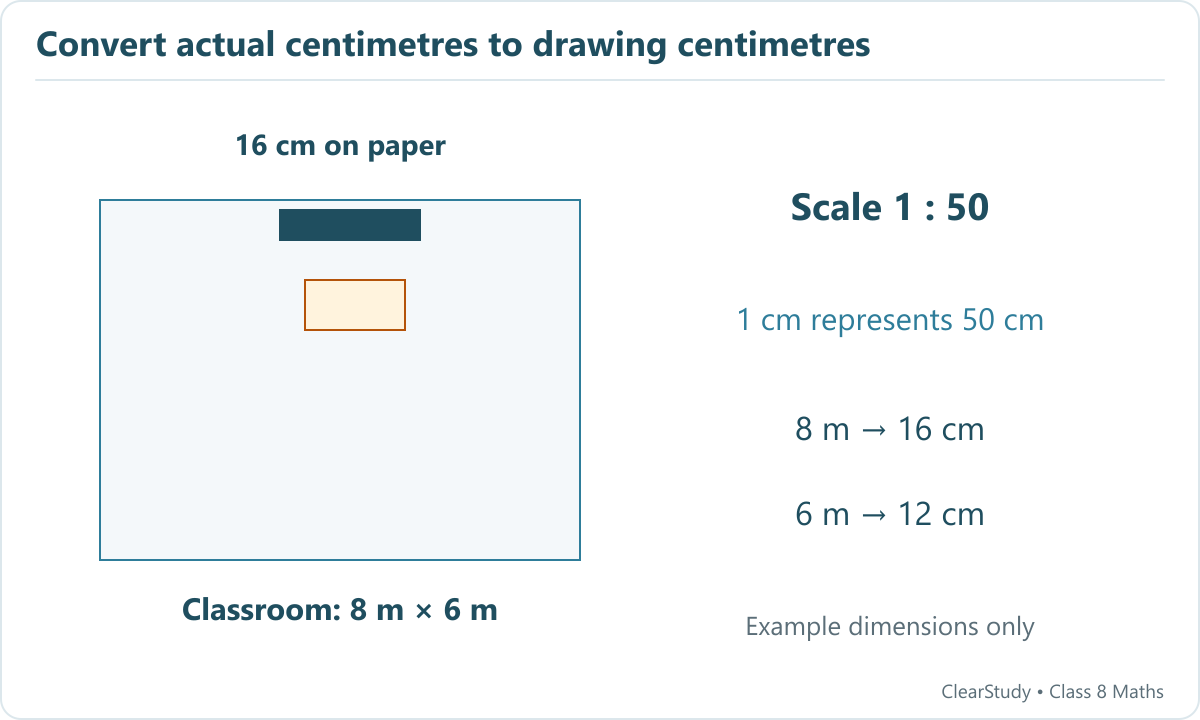
For a classroom plan at 1:50, convert each actual length to centimetres and divide by 50. For example, an 8 m × 6 m room becomes 16 cm × 12 cm on paper. Mark the board, desks, lights and fans from your own measured positions.
Ratios with several terms (pages 58–60)
For paint in ratio red:blue:white = 2:3:5, 10 L white corresponds to 5 parts, so 1 part = 2 L. Use 4 L red, 6 L blue and 10 L white, total 20 L. For 50 mL total paint, the amounts are 10 mL, 15 mL and 25 mL.
In the textbook concrete model, cement:sand:gravel = 1:1.5:3. Three cement units require 4.5 sand units and 9 gravel units, total 16.5. For 110 total units, use 20 cement, 30 sand and 60 gravel. These are the exercise’s additive ratio calculations.
Triangle angles in ratio 1:3:5 are possible: 180°/9 = 20°, so they are 20°, 60° and 100°. This differs from side lengths in ratio 1:3:5, which cannot form a triangle. To draw the angle example, choose a base AB, draw 20° at A and 60° at B on the same side of AB, and label their intersection C.
Grade-distribution pie chart (pages 60–62)
| Grade | Students | Angle |
|---|---|---|
| A | 12 | 108° |
| B | 10 | 90° |
| C | 8 | 72° |
| D | 6 | 54° |
| E | 4 | 36° |
The count ratio 12:10:8:6:4 reduces to 6:5:4:3:2. For 40 students, one student corresponds to 360°/40 = 9°. Draw the sectors consecutively and check their angles sum to 360°.
Work rates and inverse proportion (pages 63–67)
At a fixed daily productivity, 4500 bricks moved by 5 workers implies that 18,000 bricks need 20 workers. For a fixed road job, 20 workers × 4 days = 80 worker-days, so 10 workers need 8 days.
Four identical pumps fill the tank in (2 × 18)/4 = 9 hours. Food for 80 students for 15 days lasts (80 × 15)/100 = 12 days after 20 more students join, assuming equal consumption and no extra provisions.
Ram completes 1 vegetable-cutting job per hour and Shyam completes 1/1.5 = 2/3 job per hour. Together their rate is 5/3 jobs per hour. One job takes 1 ÷ (5/3) = 3/5 hour = 36 minutes. At this fixed combined rate, amount of work and time are directly proportional.
Common Mistakes to Avoid
Watch out for these
- Forgetting to add all the ratio terms before dividing a whole — the “one part” value uses the total of the terms.
- Treating an inverse relationship as a direct one (e.g. “more workers, more days”) — check whether the other quantity goes up or down.
- In a pie chart, using (value ÷ total) but forgetting to multiply by 360°, or letting the angles not add up to 360°.
- Mixing up the formula: direct → x/y constant; inverse → x × y constant.
- Reading a triangle’s “same ratio of sides” as “congruent” — same ratio means similar, not necessarily equal in size.
- Ignoring the triangle inequality — a ratio like 1 : 3 : 5 cannot form a triangle (1 + 3 < 5).
Practice MCQs & Assertion–Reason
1. Two quantities x and y are in inverse proportion if:
(a) x + y is constant (b) x − y is constant (c) x × y is constant (d) x ÷ y is constant
2. The total angle used for all sectors of a pie chart is:
(a) 90° (b) 180° (c) 270° (d) 360°
3. In a pie chart, a category that is 25% of the data is shown by a sector of:
(a) 25° (b) 90° (c) 60° (d) 45°
4. ₹600 is divided in the ratio 4 : 3 : 2 : 1. The largest share is:
(a) ₹60 (b) ₹120 (c) ₹240 (d) ₹400
5. If 6 workers finish a job in 8 days, how many days will 12 workers take (same rate)?
(a) 16 (b) 12 (c) 6 (d) 4
6. A car covers a fixed distance in 2 hours at 60 km/h. At 80 km/h it will take:
(a) 1 hour (b) 1.5 hours (c) 2.5 hours (d) 3 hours
7. Which pair is in direct proportion?
(a) Speed and time for a fixed distance (b) Number of taps and time to fill a tank (c) Length of cloth and its cost (d) Number of workers and days for a fixed job
8. A map has RF 1 : 60,00,000. A distance of 1 cm on the map represents:
(a) 6 km (b) 60 km (c) 600 km (d) 6,000 km
9. In the table x : 16, ? and y : 9, 12 (inverse proportion), the missing x value is:
(a) 8 (b) 10 (c) 12 (d) 16
10. A triangle with sides in the ratio 1 : 3 : 5:
(a) is a right triangle (b) is equilateral (c) cannot be constructed (d) is isosceles
For each Assertion–Reason question, choose: (A) Both Assertion and Reason are true and the Reason is the correct explanation of the Assertion; (B) Both are true but the Reason is not the correct explanation; (C) Assertion is true but Reason is false; (D) Assertion is false but Reason is true.
A-R 1. Assertion: For the same job at equal steady productivity, if 20 workers take 4 days, 10 workers take 8 days.
Reason: The number of workers and the number of days are in inverse proportion.
A-R 2. Assertion: In a pie chart, a sector of 90° represents one-fourth of the data.
Reason: The sector angle = (value ÷ total) × 360°.
A-R 3. Assertion: As the speed of a vehicle increases over a fixed distance, the travel time increases.
Reason: Speed and time over a fixed distance are inversely proportional.
A-R 4. Assertion: Two triangles with sides in the ratio 3 : 4 : 5 are always congruent.
Reason: Equal ratios of sides make triangles similar.
A-R 5. Assertion: At a fixed unit price, the cost of pencils is directly proportional to the number bought.
Reason: At a fixed rate, doubling the number of pencils doubles the total cost.
Quick Revision Summary
- Two ratios are proportional when a × d = b × c (cross-multiplication).
- Ratios can have many terms; for every a of the first there are b, c, d… of the others.
- To divide a whole x in ratio p : q : r…, each part = x × (its term) ÷ (sum of terms).
- Pie-chart sector angle = (value ÷ total) × 360°; all angles add to 360°.
- Direct proportion: x/y stays constant (both change by the same factor).
- Inverse proportion: x × y = k; if x is multiplied by n, y is multiplied by 1/n.
- RF on a map gives the ratio of map distance to real distance (1 : 60,00,000 → 1 cm = 60 km).
How to score full marks in this chapter
For every problem, first decide whether the quantities are directly or inversely proportional — write that line down before calculating. For pie charts, always show the angle as (value ÷ total) × 360° and verify the angles total 360°. Keep concrete units (km, ₹, days, minutes) in your working, and double-check word problems by asking “if one quantity goes up, does the other go up (direct) or down (inverse)?”
Frequently Asked Questions
What is Class 8 Maths Ganita Prakash Chapter 10 about?
Chapter 10 is Proportional Reasoning-2 (Chapter 3 of Ganita Prakash Part II). It covers proportional ratios, ratios in maps, ratios with many terms, dividing a whole in a ratio, drawing pie charts, and direct vs inverse proportion.
How do you find the sector angle for a pie chart?
Each sector angle = (value of that category ÷ total of all values) × 360°. The angles for all categories always add up to 360°.
What is the difference between direct and inverse proportion?
In direct proportion both quantities change by the same factor and x/y stays constant. In inverse proportion one increases as the other decreases, and the product x × y stays constant.
Are these Class 8 Maths Ganita Prakash Chapter 10 solutions free?
Yes. All solutions are free and follow the official NCERT Ganita Prakash (Part II) textbook for 2026–27.
Textbook reference: NCERT Ganita Prakash, Chapter 10 (official PDF). ClearStudy diagrams and worked explanations are original teaching aids.