
Class 8 Maths Ganita Prakash Chapter 9 Solutions (NCERT 2026–27) – The Baudhayana-Pythagoras Theorem
These Class 8 Maths Ganita Prakash Chapter 9 solutions cover The Baudhayana-Pythagoras Theorem from the new NCF-2023 textbook (2026–27). This is Chapter 2 of Ganita Prakash Part II (the 9th chapter of the Class 8 course). Work through the Figure it Out exercises with original diagrams, construction steps and explanations. The page also covers the main Math Talk and Try This activities, including the lotus problem and the colour-box puzzle.
Chapter 9 Overview
This chapter, The Baudhayana-Pythagoras Theorem, traces one of geometry’s most famous results back to Baudhayana’s Śulba-Sūtra (c. 800 BCE). It begins with doubling and halving a square using its diagonal, then finds the hypotenuse of an isosceles right triangle (c2 = 2a2) and introduces √2 as a non-terminating, non-repeating number. By combining two different squares it builds up to the general theorem a2 + b2 = c2, explores Baudhayana (Pythagorean) triples, touches on Fermat’s Last Theorem, and ends with real-life applications such as a problem from Bhaskaracharya’s Līlāvatī. The Class 8 Maths Ganita Prakash Chapter 9 solutions below solve every exercise on this journey.
Key Concepts & Definitions
Right triangle: a triangle with one angle of 90°. The side opposite the right angle is the longest side.
Hypotenuse: the side opposite the right angle in a right triangle — always its longest side.
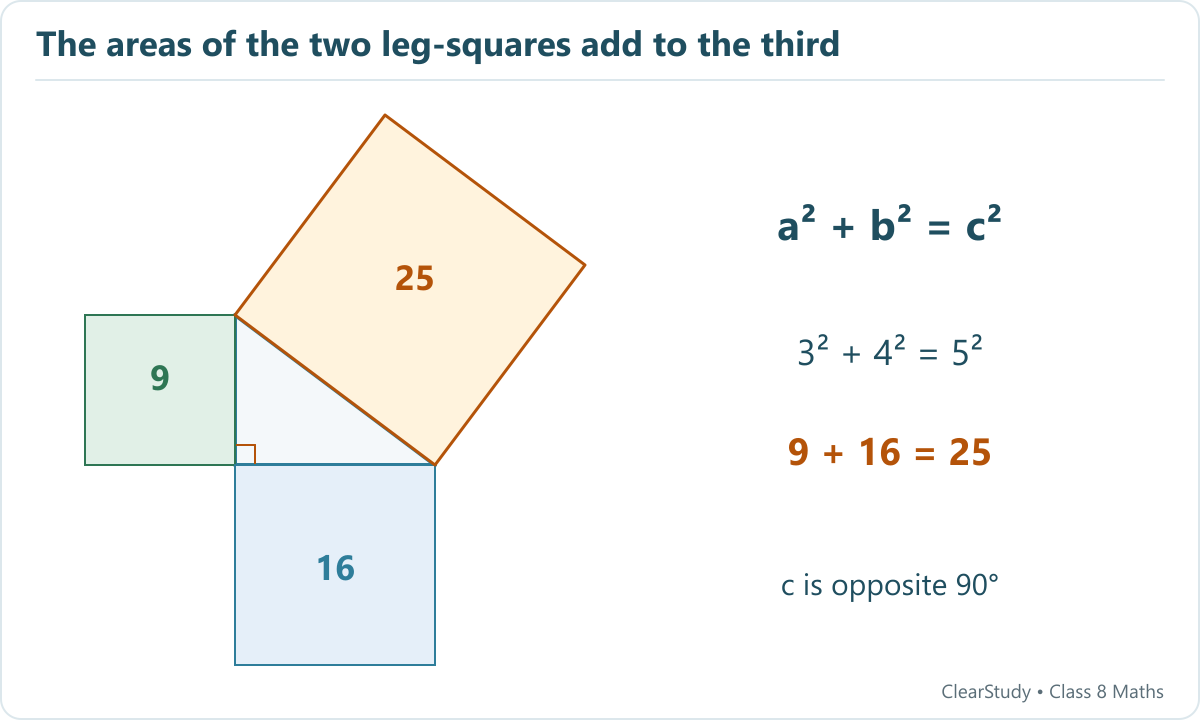
Baudhayana-Pythagoras Theorem: in a right triangle with legs a, b and hypotenuse c, a2 + b2 = c2. The chapter presents Baudhayana’s statement in the Śulba-Sūtra; the result is also called the Pythagorean Theorem.
Isosceles right triangle: a right triangle whose two legs are equal (a = b); then c2 = 2a2, so c = a√2.
Baudhayana (Pythagorean) triple: three positive integers (a, b, c) with a2 + b2 = c2, e.g. (3, 4, 5).
Primitive triple: a triple with no common factor greater than 1, e.g. (3, 4, 5). A scaled version (ka, kb, kc) is also a triple.
√2: the length of the diagonal of a unit square; it lies between 1.414 and 1.415 and cannot be written as a terminating decimal or a fraction.
Important Formulas (Chapter 9)
Baudhayana-Pythagoras Theorem: a2 + b2 = c2 (c = hypotenuse). So c = √(a2 + b2) and a missing leg = √(c2 − b2).
Isosceles right triangle: c2 = 2a2, i.e. c = a√2 (hypotenuse), or a = c/√2 (each equal side).
Diagonal of a square of side s: d = s√2.
Scaling rule: if (a, b, c) is a triple, so is (ka, kb, kc) for every positive integer k.
Bound on a surd: if n2 < N < (n+1)2, then n < √N < n + 1 (refine digit by digit for one decimal place).
Figure it Out (Pages 39–40)
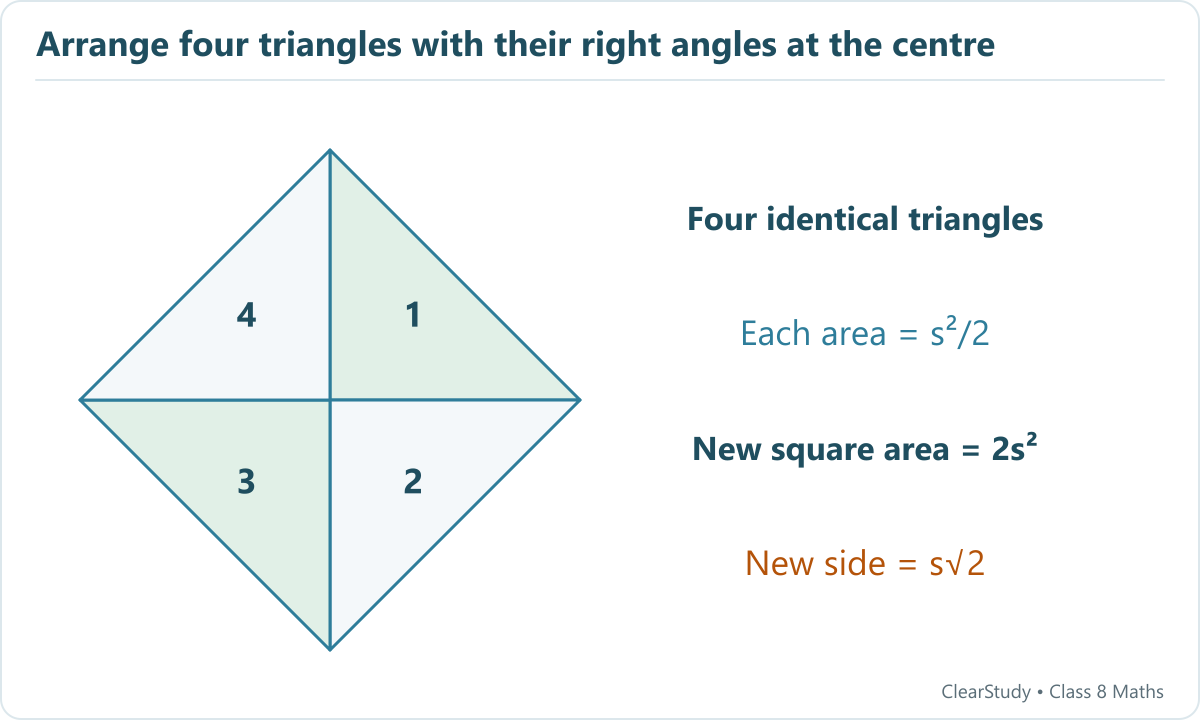
1. Earlier, we saw a method to create a square with double the area of a given square paper. There is another method to do this in which two identical square papers are cut in the following way. (Each square is cut along a diagonal into pieces 1 and 2, and 3 and 4.) Can you arrange these pieces to create a square with double the area of either square?
2. The length of the two equal sides of an isosceles right triangle is given. Find the length of the hypotenuse. Find bounds on the length of the hypotenuse such that they have at least one digit after the decimal point. (i) 3 (ii) 4 (iii) 6 (iv) 8 (v) 9
3. The hypotenuse of an isosceles right triangle is 10. What are its other two sidelengths? [Hint: Find the area of the square composed of two such right triangles.]
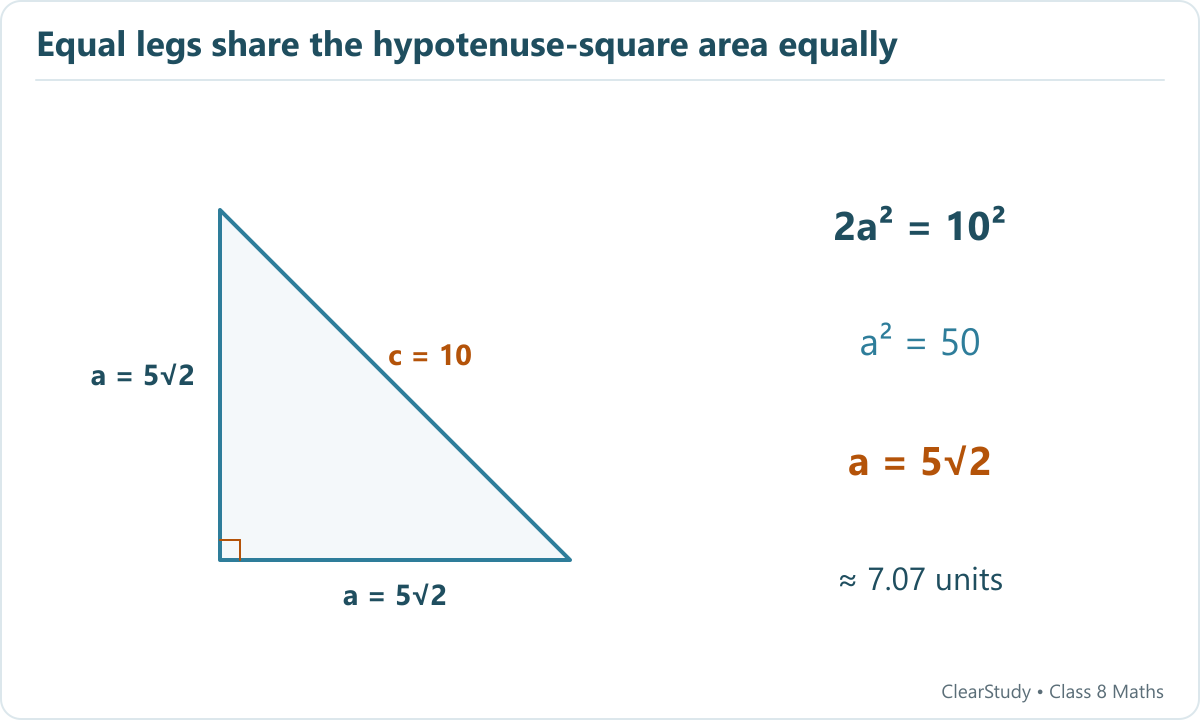
Figure it Out (Page 47)
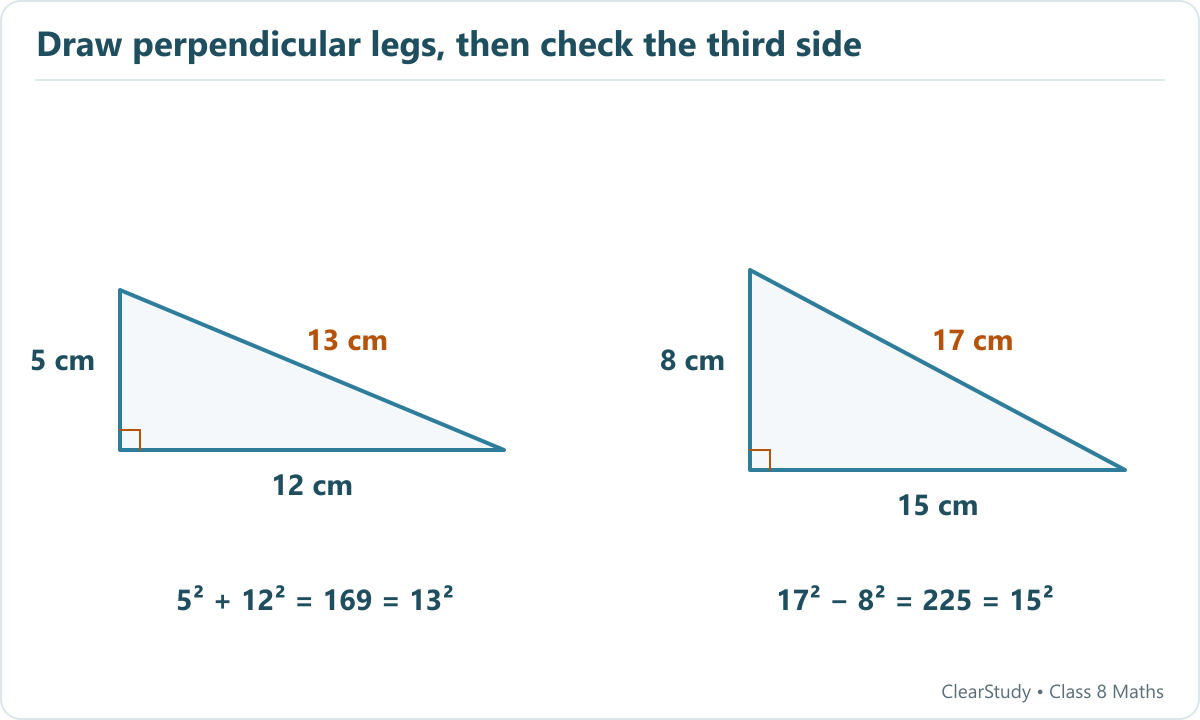
1. If a right-angled triangle has shorter sides of lengths 5 cm and 12 cm, then what is the length of its hypotenuse? First draw the right-angled triangle with these sidelengths and measure the hypotenuse, then check your answer using Baudhayana’s Theorem.
2. If a right-angled triangle has a short side of length 8 cm and hypotenuse of length 17 cm, what is the length of the third side? Again, try drawing the triangle and measuring, and then check your answer using Baudhayana’s Theorem.
3. Using the constructions you have now seen, how would you construct a square whose area is triple the area of a given square? Five times the area of a given square? (Baudhayana’s Śulba-Sūtra, Verse 1.10)
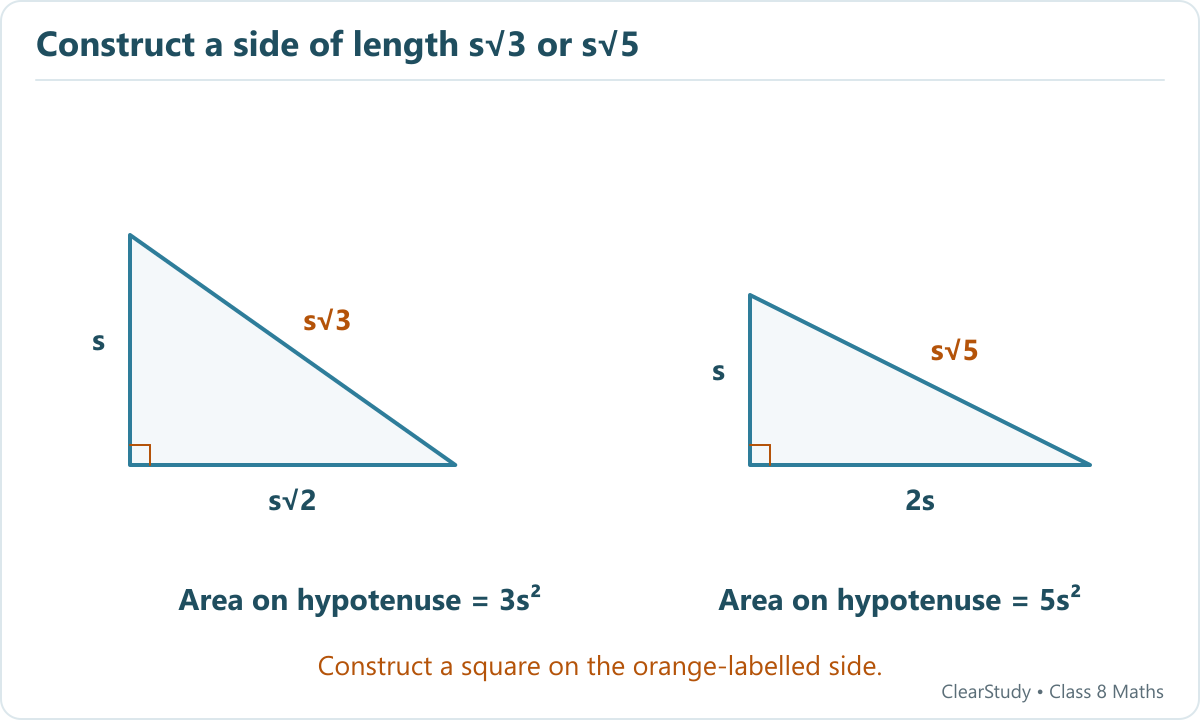
4. Let a, b and c denote the length of the sides of a right triangle, with c being the length of the hypotenuse. Find the missing sidelength in each of the following cases: (i) a = 5, b = 7 (ii) a = 8, b = 12 (iii) a = 9, c = 15 (iv) a = 7, b = 12 (v) a = 1.5, b = 3.5
Figure it Out (Page 50)
1. Find 5 more Baudhayana triples using this idea. (Use an odd square number 2n − 1; then (n − 1)2 + (2n − 1) = n2 gives a triple.)
2. Does this method yield non-primitive Baudhayana triples? [Hint: Observe that among the triples generated, one of the smaller sidelengths is one less than the hypotenuse.]
3. Are there primitive triples that cannot be obtained through this method? If yes, give examples.
Figure it Out (Pages 52–54)
1. Find the diagonal of a square with sidelength 5 cm.
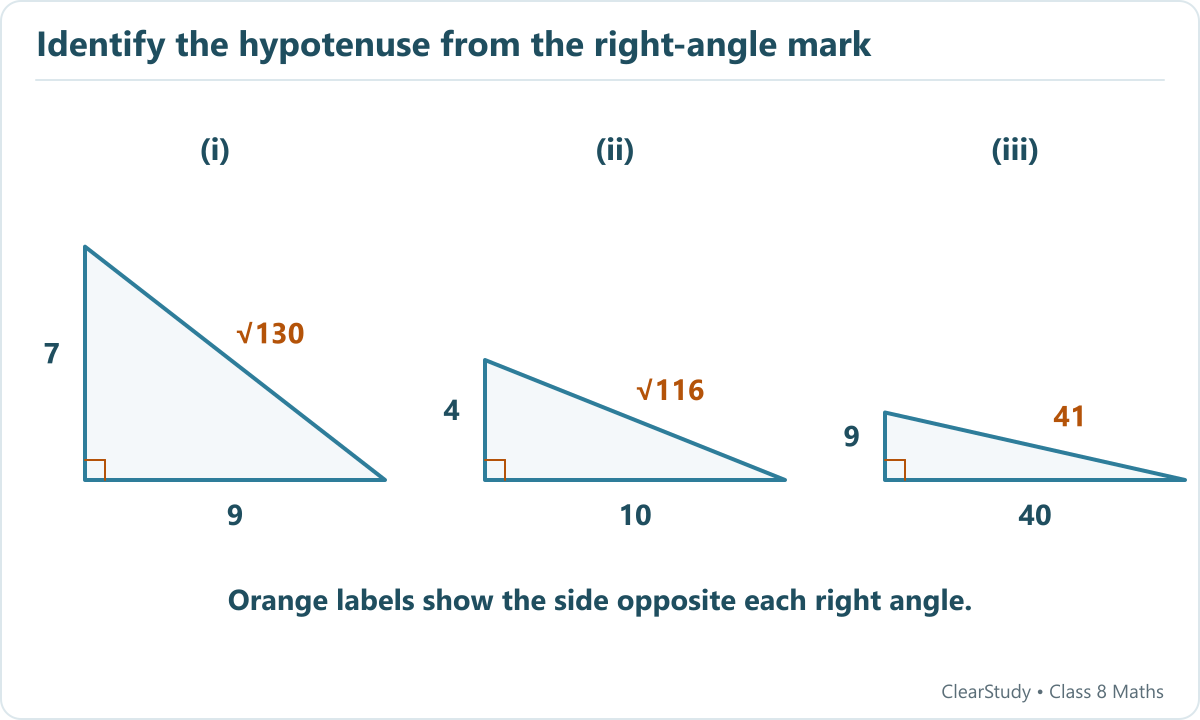
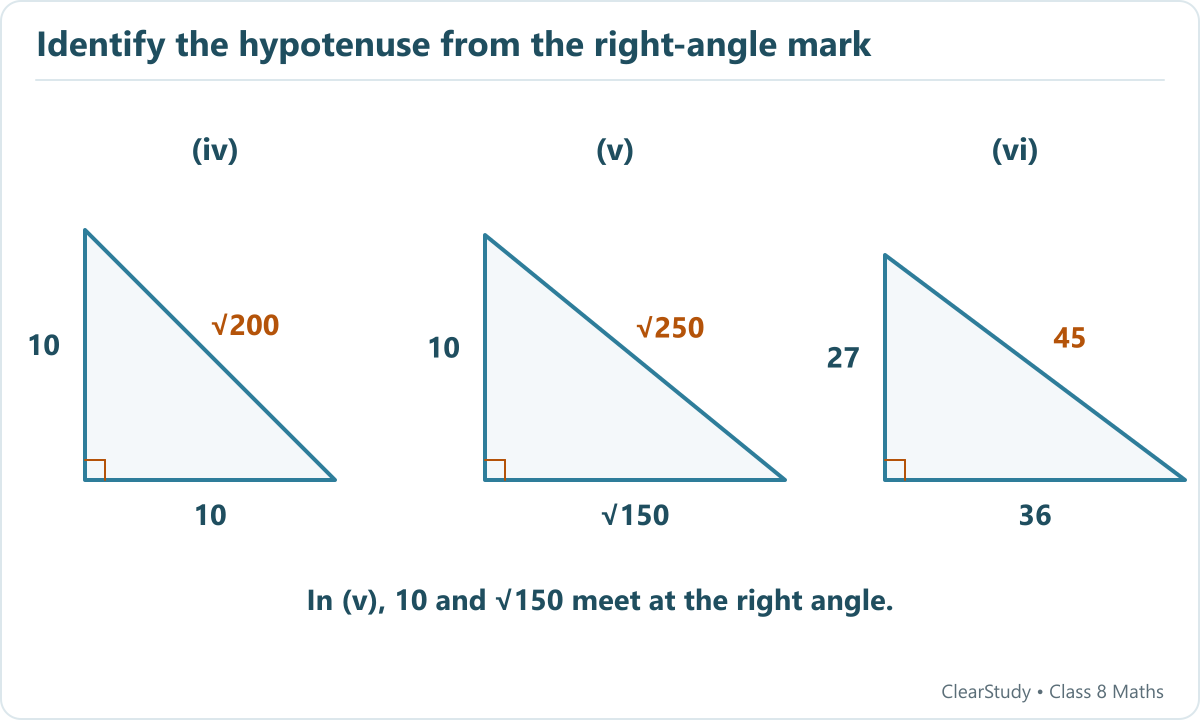
2. Find the missing sidelengths in the following right triangles: (legs 7 and 9; right angle with legs 4 and 10; right angle with leg 40 and hypotenuse 41; leg 10 and hypotenuse √200; legs 10 and √150; leg 27 and hypotenuse 45).
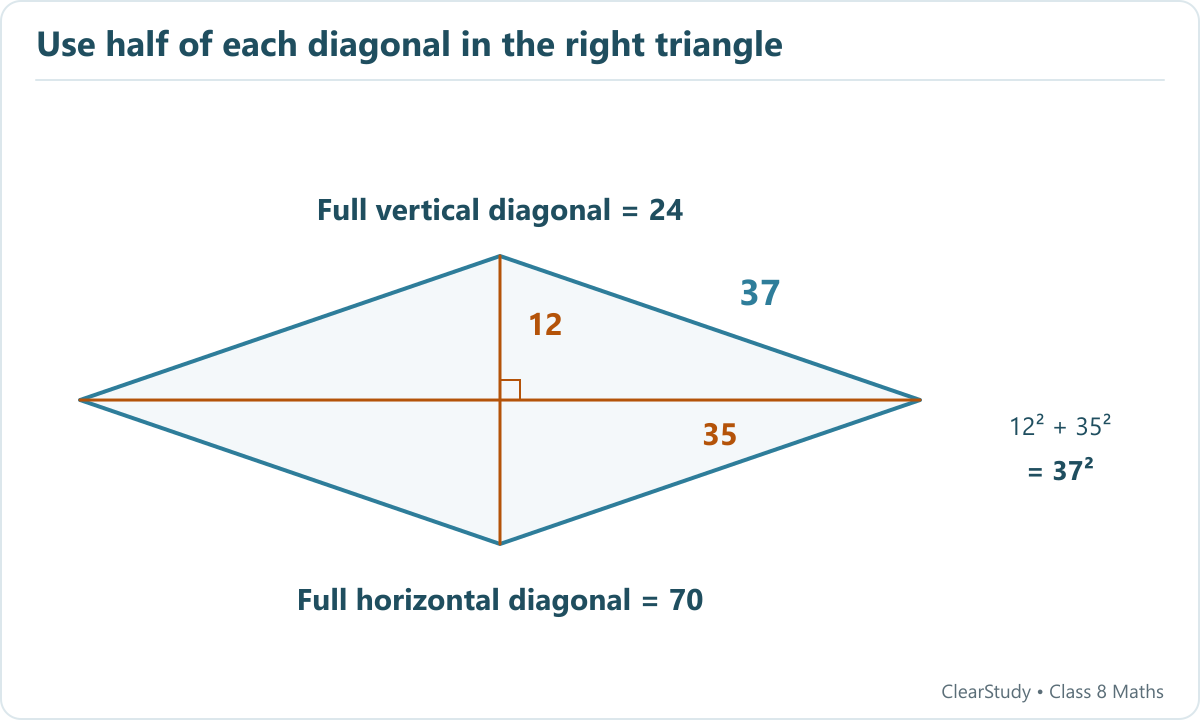
3. Find the sidelength of a rhombus whose diagonals are of length 24 units and 70 units.
4. Is the hypotenuse the longest side of a right triangle? Justify your answer.
5. True or False—Every Baudhayana triple is either a primitive triple or a scaled version of a primitive triple.
6. Give 5 examples of rectangles whose sidelengths and diagonals are all integers.
| Length | Breadth | Diagonal | Check (l2 + b2 = d2) |
|---|---|---|---|
| 4 | 3 | 5 | 16 + 9 = 25 |
| 12 | 5 | 13 | 144 + 25 = 169 |
| 8 | 6 | 10 | 64 + 36 = 100 |
| 15 | 8 | 17 | 225 + 64 = 289 |
| 24 | 7 | 25 | 576 + 49 = 625 |
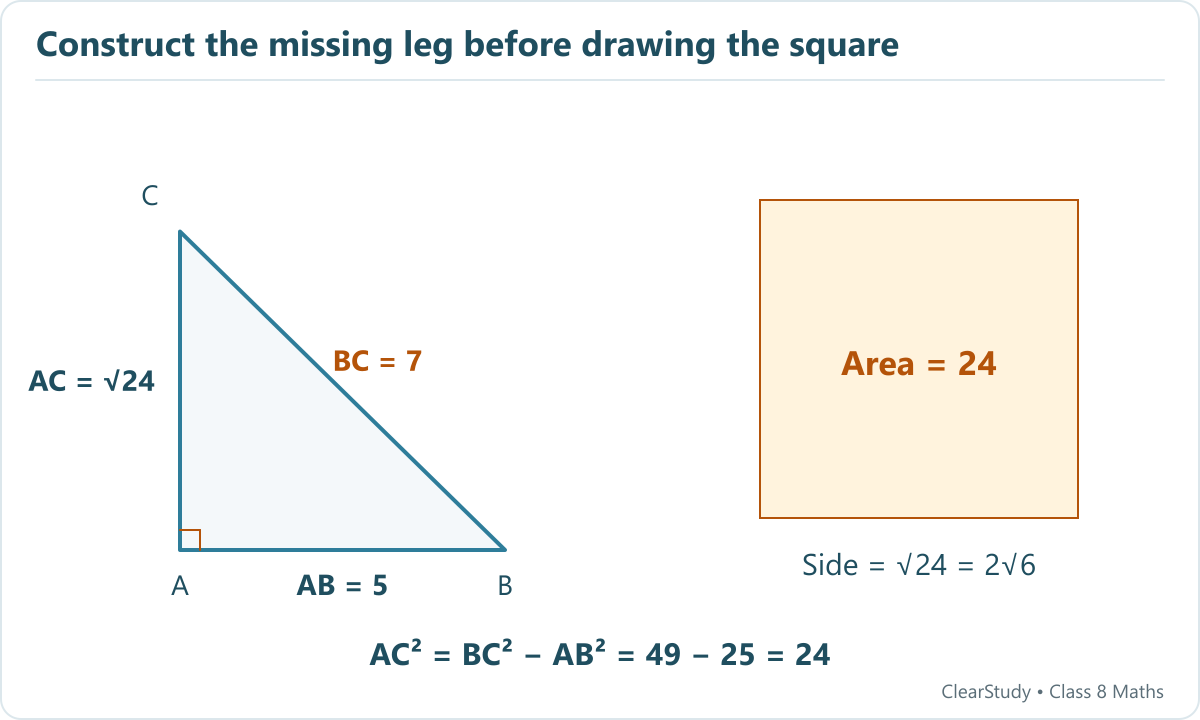
7. Construct a square whose area is equal to the difference of the areas of squares of sidelengths 5 units and 7 units.
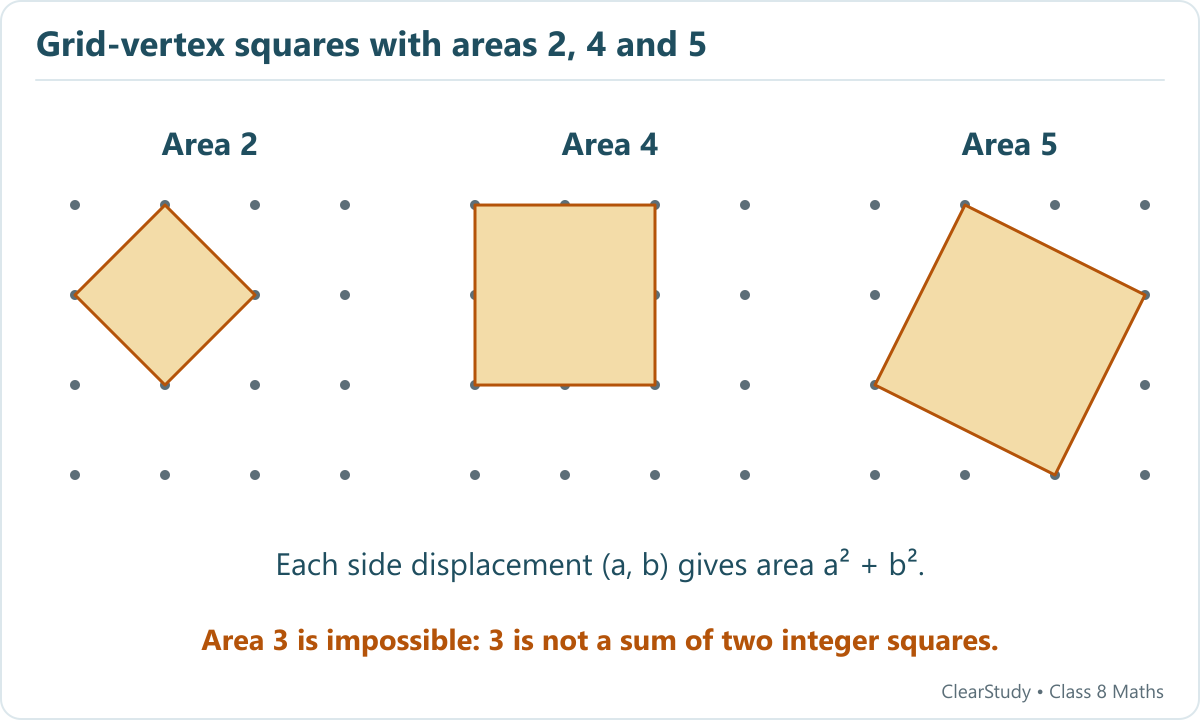
8. (i) Using the dots of a grid as the vertices, can you create a square that has an area of (a) 2 sq. units, (b) 3 sq. units, (c) 4 sq. units, and (d) 5 sq. units? (ii) Suppose the grid extends indefinitely. What are the possible integer-valued areas of squares you can create in this manner?
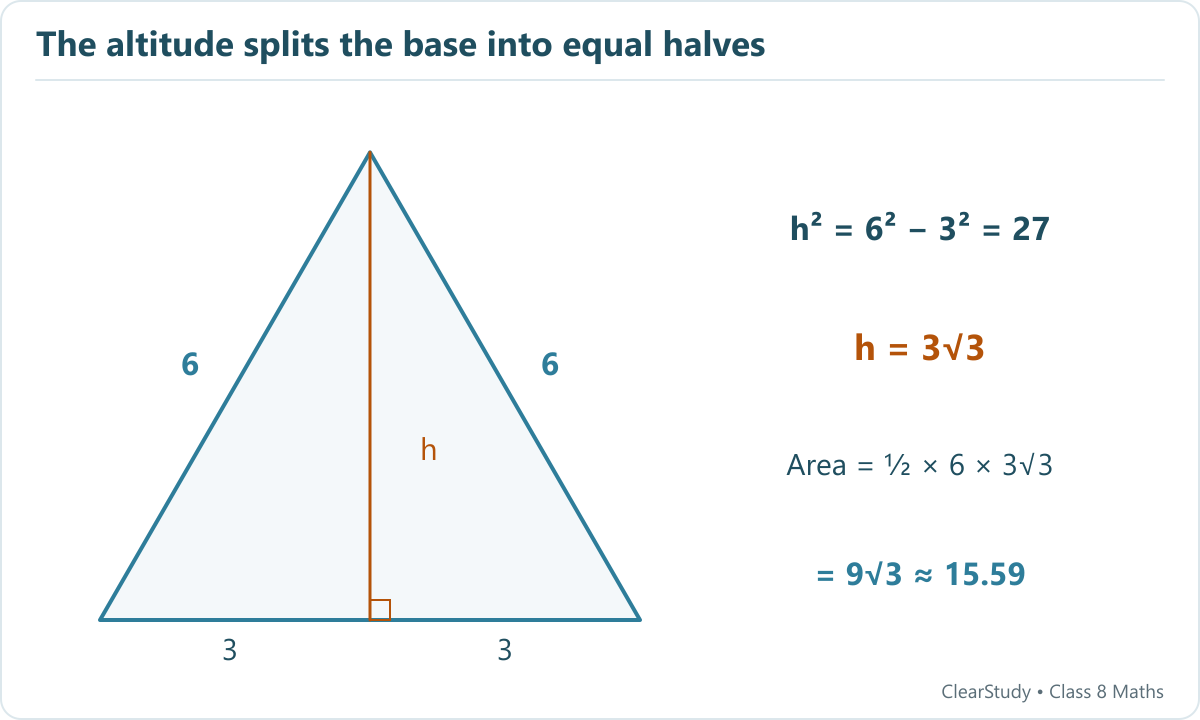
9. Find the area of an equilateral triangle with sidelength 6 units. [Hint: Show that an altitude bisects the opposite side. Use this to find the height.]
Math Talk & Try This Answers
Five scaled versions of each primitive triple (page 49)
| Original | ×2 | ×3 | ×4 | ×5 | ×6 |
|---|---|---|---|---|---|
| 3, 4, 5 | 6, 8, 10 | 9, 12, 15 | 12, 16, 20 | 15, 20, 25 | 18, 24, 30 |
| 5, 12, 13 | 10, 24, 26 | 15, 36, 39 | 20, 48, 52 | 25, 60, 65 | 30, 72, 78 |
| 8, 15, 17 | 16, 30, 34 | 24, 45, 51 | 32, 60, 68 | 40, 75, 85 | 48, 90, 102 |
These scaled triples are not primitive: each has the common factor k > 1. Conversely, dividing a triple by a common factor f gives another integer triple, since (a/f)² + (b/f)² = (c/f)². Divide by the greatest common factor to obtain a primitive triple.
Why the combining construction makes a square (pages 42–46)
The four right triangles are congruent, so their hypotenuses are equal. Their acute angles are x and 90° − x. Each angle of the proposed square is 180° − x − (90° − x) = 90°. Thus its four equal sides form a square. In the textbook rearrangement, triangles T and U replace congruent triangles W and X while region V is shared. Therefore area(T + U + V) = area(W + X + V) = a² + b² = c².
The lotus problem (page 52)
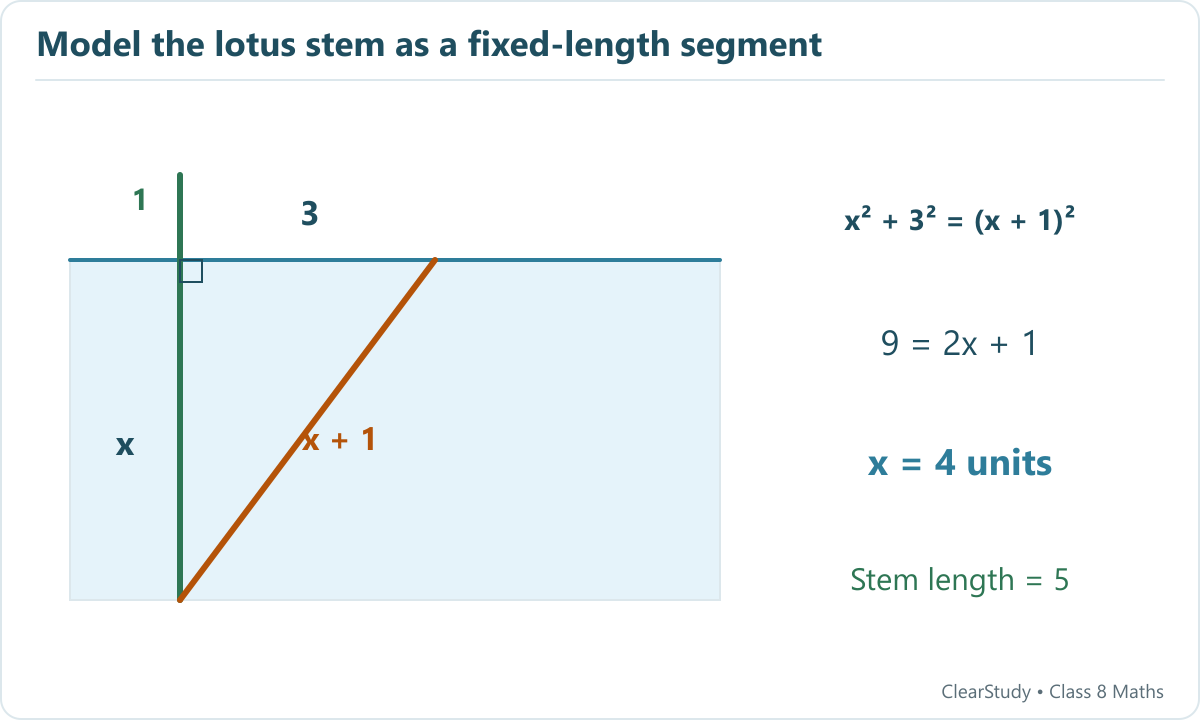
Let the depth be x. The original stem is x + 1 units long. When its tip reaches the water 3 units away, the model gives a right triangle with legs x and 3 and hypotenuse x + 1. Hence x² + 9 = (x + 1)², giving 9 = 2x + 1 and x = 4 units. The unchanged stem length is 5 units.
Find the Colours! (page 54)
Open the box labelled RED. Its contents must be blue or green because every label is wrong. If it contains blue, the GREEN-labelled box must contain red and the BLUE-labelled box green. If it contains green, the BLUE-labelled box must contain red and the GREEN-labelled box blue. One opened box determines all three contents.
Common Mistakes to Avoid
Watch out for these
- Doubling the side to double the area — that multiplies the area by 4, not 2. To double area, build on the diagonal.
- Writing √(a2 + b2) = a + b. The square root of a sum is not the sum of the roots; you must add the squares first, then take the root.
- Adding when you should subtract: to find a leg, use leg = √(c2 − b2); only the hypotenuse uses c = √(a2 + b2).
- Treating √2 as a fraction or a terminating decimal — it is non-terminating and non-repeating (irrational).
- For a rhombus, using the full diagonals as legs. Use half of each diagonal, since the diagonals bisect each other.
- Calling a triple primitive without checking the common factor — (6, 8, 10) and (9, 12, 15) are not primitive.
- Leaving a surd un-simplified or giving wrong decimal bounds — check that the bound squared brackets the number (e.g. 8.42 < 72 < 8.52).
Practice MCQs & Assertion–Reason
1. In a right triangle, the side opposite the right angle is called the:
(a) base (b) altitude (c) hypotenuse (d) median
2. The Baudhayana-Pythagoras Theorem states that for a right triangle with hypotenuse c:
(a) a + b = c (b) a2 + b2 = c2 (c) a2 − b2 = c2 (d) a2 + b2 = 2c2
3. The hypotenuse of an isosceles right triangle with equal sides 5 is:
(a) 10 (b) √10 (c) 5√2 (d) 25
4. The diagonal of a square of side 1 unit has length:
(a) 1 (b) √2 (c) 2 (d) ½
5. Which of the following is a Baudhayana (Pythagorean) triple?
(a) (2, 3, 4) (b) (5, 12, 13) (c) (4, 5, 6) (d) (6, 7, 8)
6. A square built on the diagonal of a given square has area that is … the original:
(a) the same as (b) double (c) four times (d) half
7. The third side of a right triangle with hypotenuse 17 and one leg 8 is:
(a) 9 (b) 12 (c) 15 (d) 25
8. Which triple is primitive?
(a) (6, 8, 10) (b) (9, 12, 15) (c) (8, 15, 17) (d) (12, 16, 20)
9. The number √2 lies between:
(a) 1.313 and 1.314 (b) 1.414 and 1.415 (c) 1.515 and 1.516 (d) 2 and 3
10. The famous statement “an + bn = cn has no positive integer solution for integer n > 2”, proven in 1994, is:
(a) Euclid’s Theorem (b) Baudhayana’s Theorem (c) Fermat’s Last Theorem (d) the Midpoint Theorem
For each Assertion–Reason question, choose: (A) Both Assertion and Reason are true and the Reason is the correct explanation of the Assertion; (B) Both are true but the Reason is not the correct explanation; (C) Assertion is true but Reason is false; (D) Assertion is false but Reason is true.
A-R 1. Assertion: In any right triangle, the hypotenuse is the longest side.
Reason: Since c2 = a2 + b2, c2 is greater than both a2 and b2.
A-R 2. Assertion: √2 cannot be written as a fraction m/n of two counting numbers.
Reason: In a perfect square, each prime factor occurs an even number of times.
A-R 3. Assertion: (6, 8, 10) is a primitive Baudhayana triple.
Reason: (6, 8, 10) satisfies 62 + 82 = 102.
A-R 4. Assertion: A square built on the diagonal of a square has double the area of the original.
Reason: The original square is made of 2 congruent triangles and the new one of 4 such congruent triangles.
A-R 5. Assertion: A grid (lattice) square of area 3 sq. units can be drawn with its vertices on dots.
Reason: The area of a lattice square is always a2 + b2 for whole numbers a and b.
Quick Revision Summary
- The Baudhayana-Pythagoras Theorem: for a right triangle, a2 + b2 = c2, where c is the hypotenuse (the longest side).
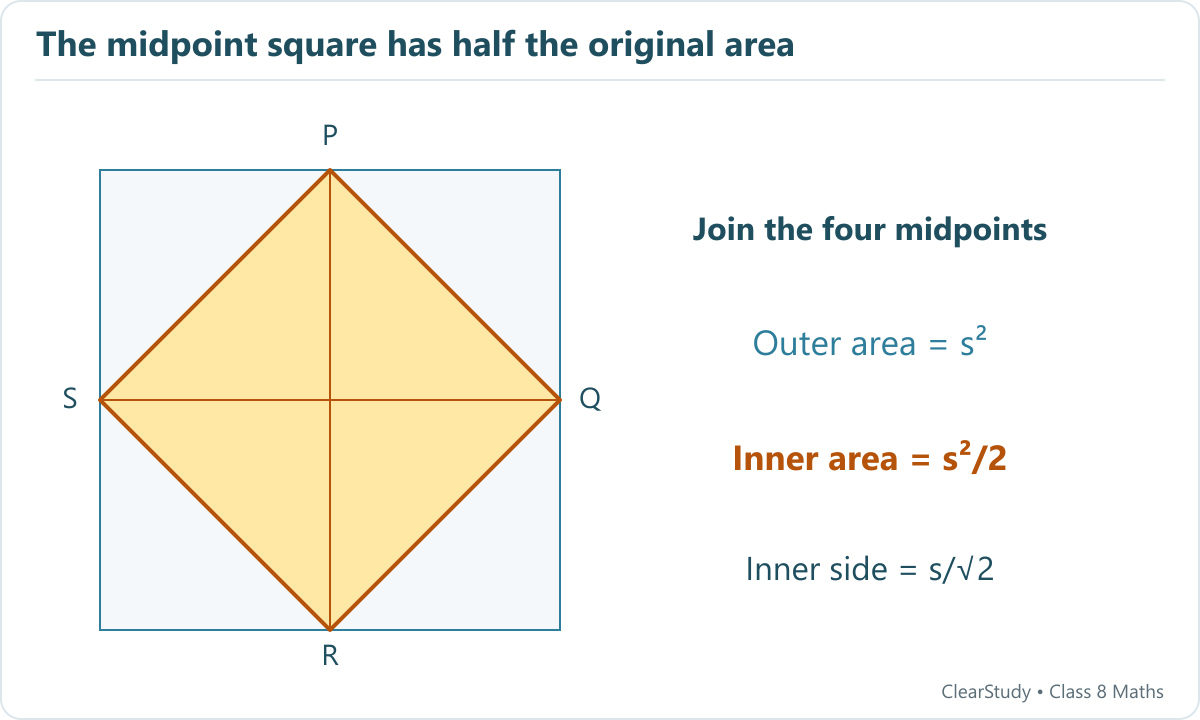
- Building a square on the diagonal doubles a square’s area; the inside tilted square through the midpoints halves it.
- Isosceles right triangle: c2 = 2a2, so c = a√2; the diagonal of a square of side s is s√2.
- √2 lies between 1.414 and 1.415; it is non-terminating and cannot be written as a fraction (irrational).
- Baudhayana (Pythagorean) triples: integers (a, b, c) with a2 + b2 = c2, e.g. (3, 4, 5), (5, 12, 13), (8, 15, 17). If (a, b, c) is a triple, so is (ka, kb, kc).
- A primitive triple has no common factor > 1; every triple is primitive or a scaled version of a primitive triple.
- Fermat’s Last Theorem: an + bn = cn has no positive-integer solution for integer n > 2 (proven by Andrew Wiles, 1994).
How to score full marks in this chapter
Always identify the hypotenuse first (it is opposite the right angle) and write a2 + b2 = c2 before substituting. Keep answers in surd form (e.g. √74, 5√2) unless a decimal or bound is asked, and when bounds are needed, show the two squares that bracket the number (n2 < N < (n+1)2). For rhombus and equilateral-triangle problems, draw the right triangle using half-diagonals or the bisected base first.
Frequently Asked Questions
What is Class 8 Maths Ganita Prakash Chapter 9 about?
It is The Baudhayana-Pythagoras Theorem — Chapter 2 of Ganita Prakash Part II (the 9th chapter of the Class 8 course). It covers doubling/halving a square, the hypotenuse of an isosceles right triangle, √2, the theorem a2 + b2 = c2, Baudhayana (Pythagorean) triples and real-life applications.
What is the Baudhayana-Pythagoras Theorem?
For a right-angled triangle with legs a and b and hypotenuse c, a2 + b2 = c2. The textbook discusses its statement in Baudhayana’s Śulba-Sūtra (dated there to c. 800 BCE); it is also called the Pythagorean Theorem.
What is a Baudhayana (Pythagorean) triple?
A set of three positive integers (a, b, c) with a2 + b2 = c2, such as (3, 4, 5), (5, 12, 13) and (8, 15, 17). Scaling any triple by a positive integer gives another triple, so there are infinitely many.
Are these Class 8 Maths Ganita Prakash Chapter 9 solutions free?
Yes. All solutions are free and follow the official NCERT Ganita Prakash Part II textbook for 2026–27, with every calculation verified.
Textbook reference: NCERT Ganita Prakash, Chapter 9 (official PDF). ClearStudy diagrams and worked explanations are original teaching aids.