
Class 8 Maths Ganita Prakash Chapter 13 Solutions (NCERT 2026–27) – Algebra Play
These Class 8 Maths Ganita Prakash Chapter 13 solutions cover Algebra Play from the new NCF-2023 textbook (2026–27). This is Chapter 6 of Ganita Prakash Part II (the 13th chapter of the Class 8 course). Explore number tricks, completed pyramids, calendar and shape grids, divisibility proofs and word problems with worked explanations and original diagrams.
- Chapter overview
- Key concepts & ideas
- Important formulas & relations
- 6.2 ‘Think of a Number’ tricks (Math Talk)
- 6.3 Number Pyramids — Figure it Out
- 6.4 Fun with Grids (Math Talk)
- 6.5 The Largest Product — Figure it Out
- 6.6 Decoding Divisibility Tricks — Figure it Out
- Common mistakes to avoid
- Practice MCQs & Assertion–Reason
- Quick revision summary
- FAQs
Chapter 13 Overview
Chapter 6 of Ganita Prakash Part II, Algebra Play, shows how algebra explains why number tricks and puzzles always work. By letting a letter-number stand for the “unknown” starting value, you can model a “Think of a Number” trick, a calendar/date trick, a number pyramid, an algebra grid, a digit-arrangement problem or a divisibility puzzle — and then prove what happens for every input. The chapter also revisits the Virahāṅka–Fibonacci sequence, builds and solves simple linear equations, and uses generalisation (writing the top of a pyramid in terms of the bottom row) to spot patterns. The solutions below show the equations, calculations and checks.
Key Concepts & Ideas
Modelling with a letter-number: represent the unknown starting value by a letter (say x). Carry out each step of the trick on the expression to see the guaranteed result.
Place value in algebra: a two-digit number with tens digit a and units digit b equals 10a + b; a three-digit number abc equals 100a + 10b + c.
Number pyramid rule: every cell is the sum of the two cells directly below it; the bottom row determines the whole pyramid.
Forming & solving simple equations: set up a linear equation from the situation, then isolate the unknown by doing the same operation to both sides.
Generalising patterns: replace the bottom-row numbers with letters to find a formula for the top cell, then read off the coefficients (the binomial pattern 1, 2, 1 / 1, 3, 3, 1).
Virahāṅka–Fibonacci sequence: 1, 2, 3, 5, 8, 13, 21, … where each term is the sum of the two before it.
Important Formulas & Relations
Here the digit strings ab, abc and abcabc denote place-value numerals, not products of letters. In ordinary algebra, ab means a × b. A leading zero after reversing or cycling is read by its numerical value; the divisibility identities still hold.
Two-digit number: ab = 10a + b • reversed: ba = 10b + a
Difference of a 2-digit number and its reverse: (10a + b) − (10b + a) = 9(a − b) → divisible by 9
Sum of a 2-digit number and its reverse: (10a + b) + (10b + a) = 11(a + b) → divisible by 11
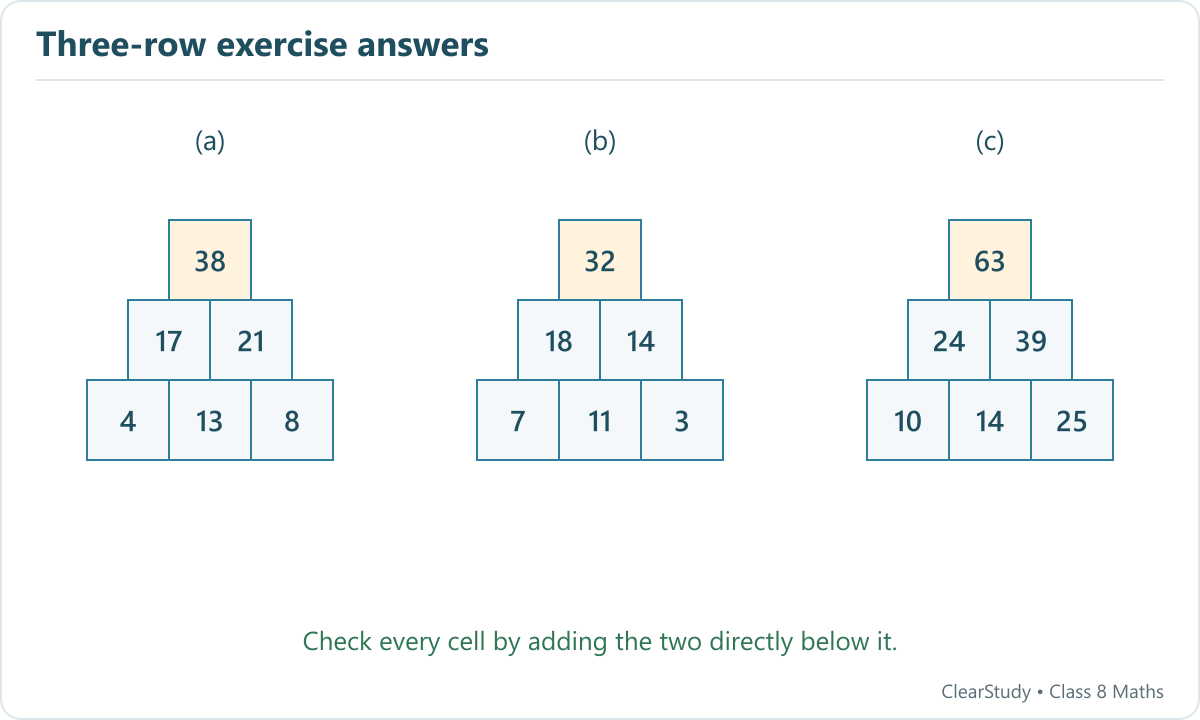
3-row pyramid with bottom a, b, c: top = a + 2b + c
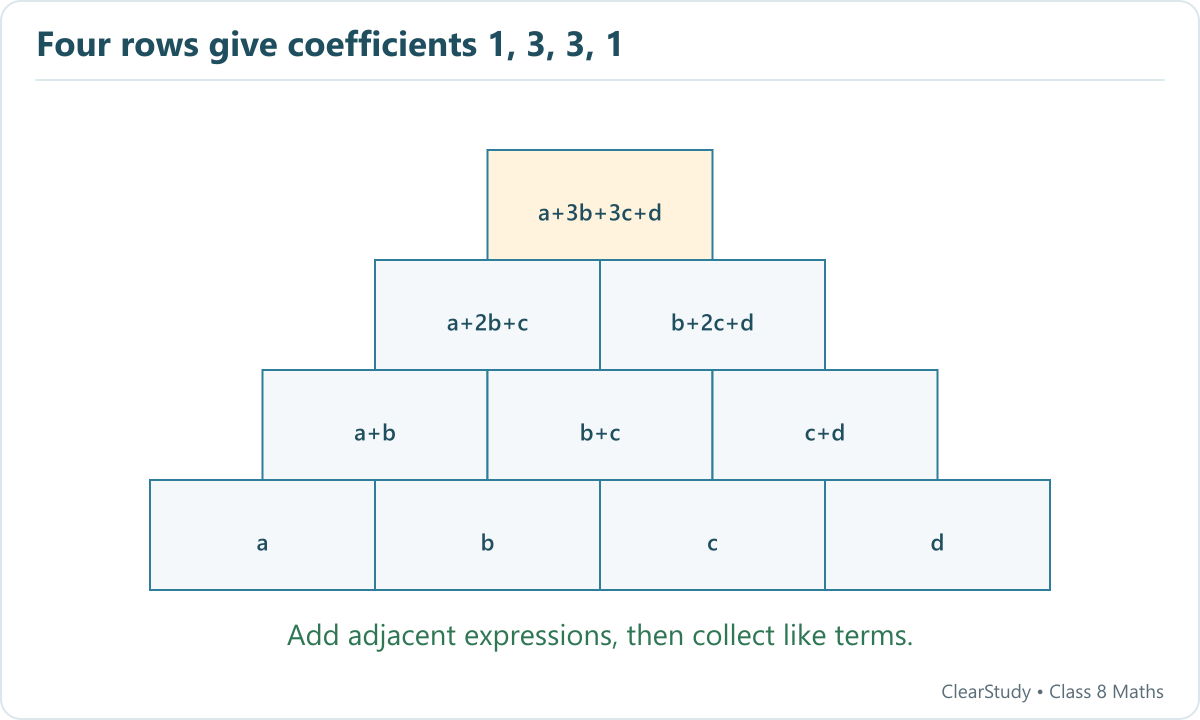
4-row pyramid with bottom a, b, c, d: top = a + 3b + 3c + d
2 × 2 calendar grid with top-left a: numbers are a, a+1, a+7, a+8; sum = 4a + 16
6.2 Thinking about ‘Think of a Number’ Tricks (Math Talk)
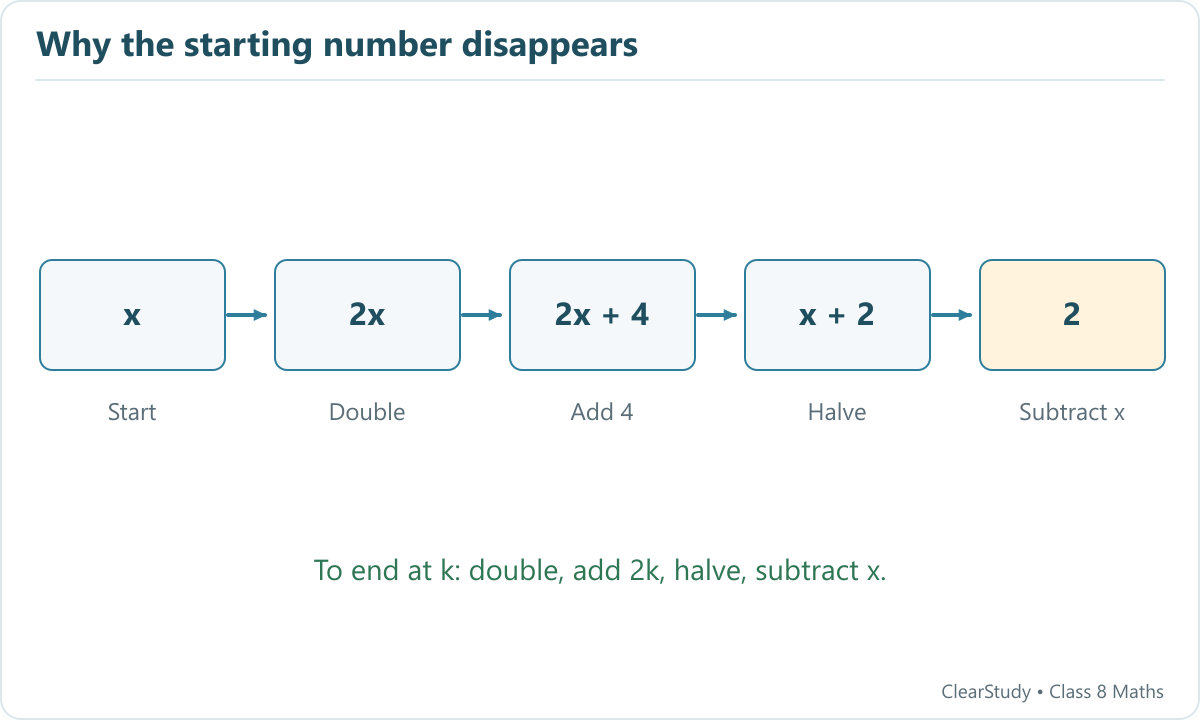
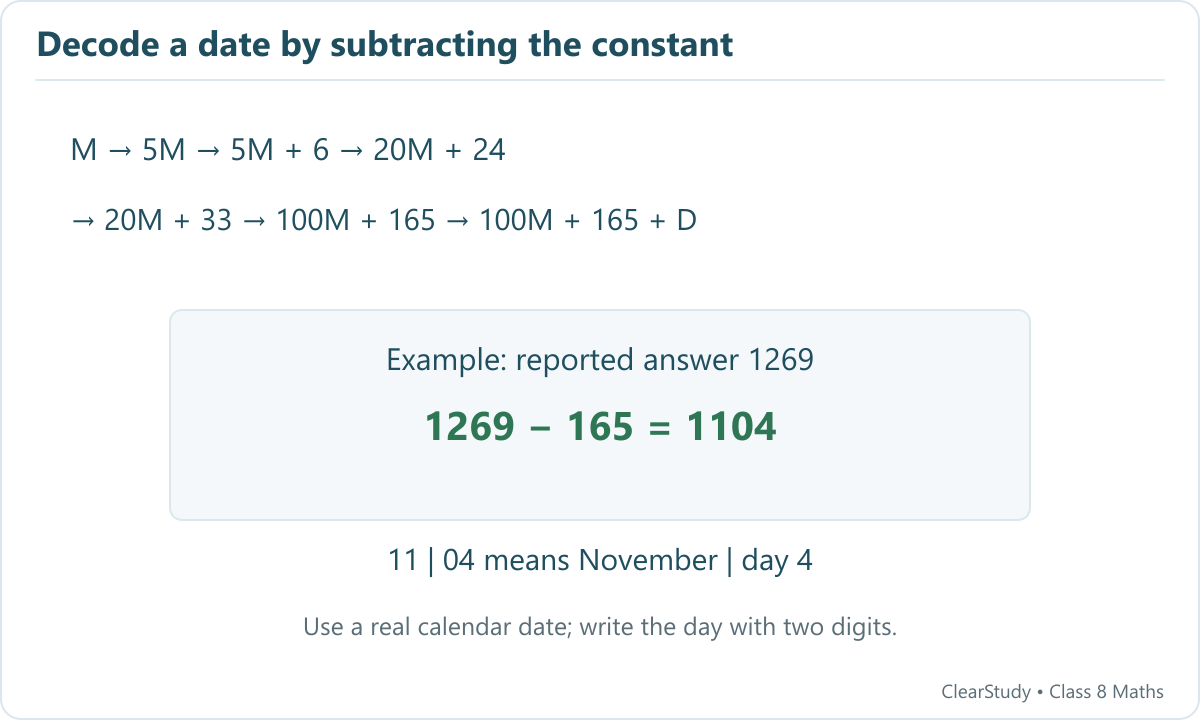
The date trick: think of a date as month M and day D; multiply M by 5, add 6, multiply by 4, add 9, multiply by 5, then add the day D. This gives 100M + 165 + D, so subtracting 165 from the final answer leaves a number whose last two digits are D and whose leading digits are M.
6.3 Number Pyramids — Figure it Out
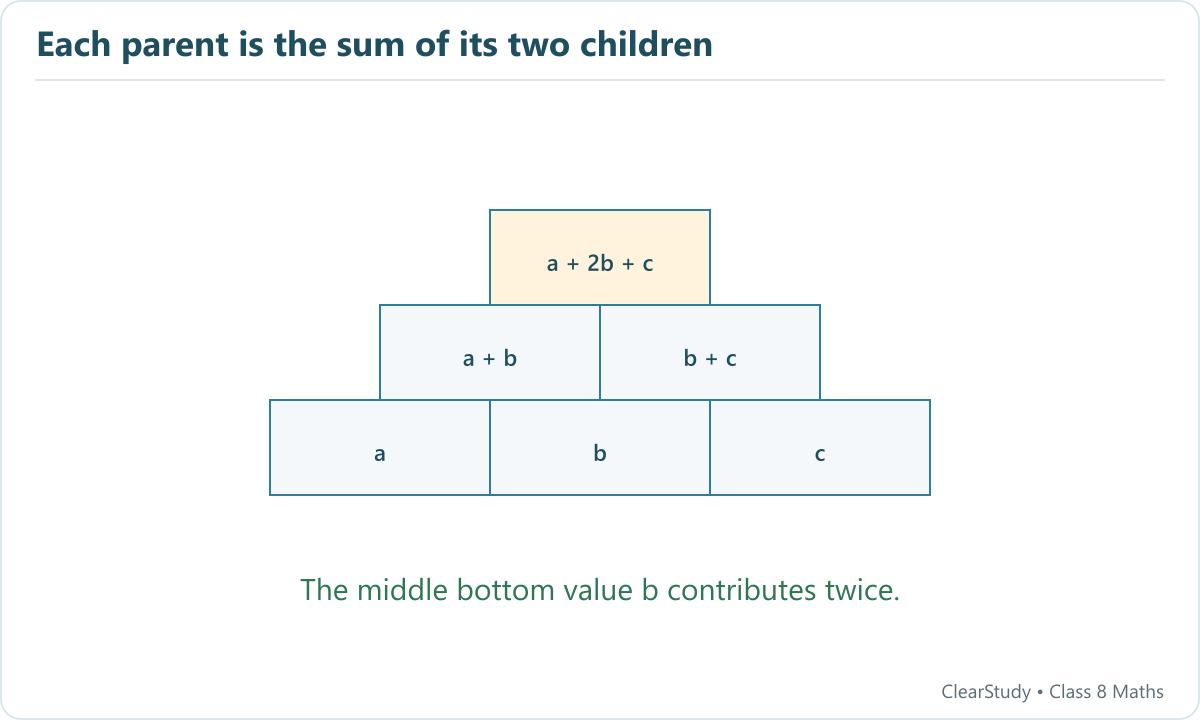
In a number pyramid, each number is the sum of the two numbers directly below it. For a 3-row pyramid with bottom row a, b, c, the middle row is (a + b), (b + c) and the top is (a + b) + (b + c) = a + 2b + c.
Complete the introductory pyramids (textbook pages 138–139)
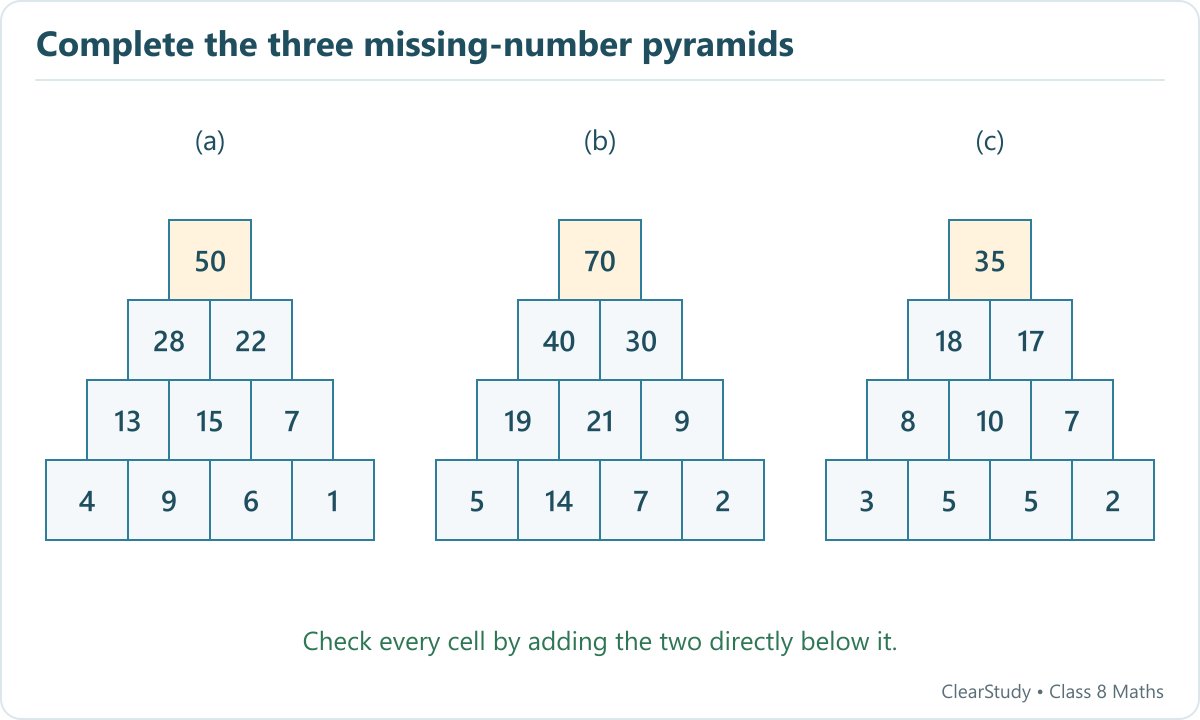
Add neighbouring cells to work upwards; subtract a known child from its parent to work backwards.
- Bottom 6, 2: top 8.
- Bottom 3, 4, 3: next row 7, 7; top 14.
- Bottom 5, 4, 5, 0: rows 9, 9, 5; then 18, 14; top 32.
- Backward examples: bottom 1, 3, 3 gives 4, 6 and top 10; bottom 12, 20, 8 gives 32, 28 and top 60.
The three partially filled four-row pyramids on page 139 have the completed values below.
1. Without building the entire pyramid, find the number in the topmost row given the bottom row in each of these cases. (a) 4 13 8 (b) 7 11 3 (c) 10 14 25
2. Write an expression for the topmost row of a pyramid with 4 rows in terms of the values in the bottom row.
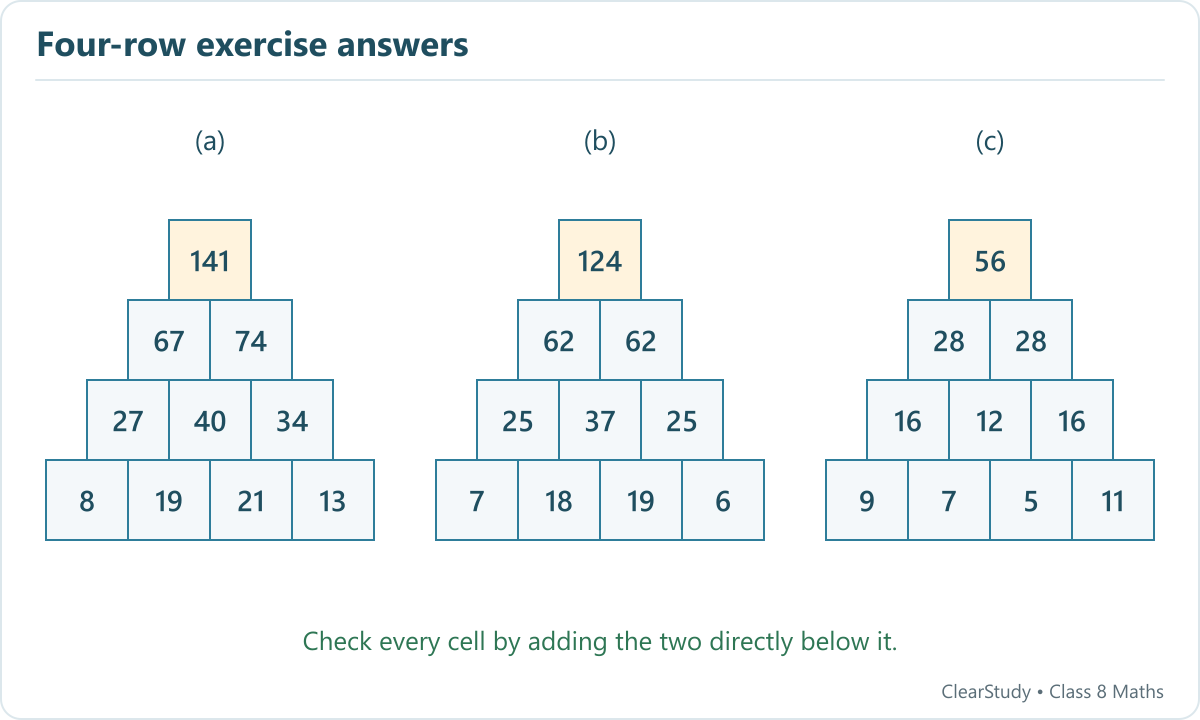
3. Without building the entire pyramid, find the number in the topmost row given the bottom row in each of these cases. (a) 8 19 21 13 (b) 7 18 19 6 (c) 9 7 5 11
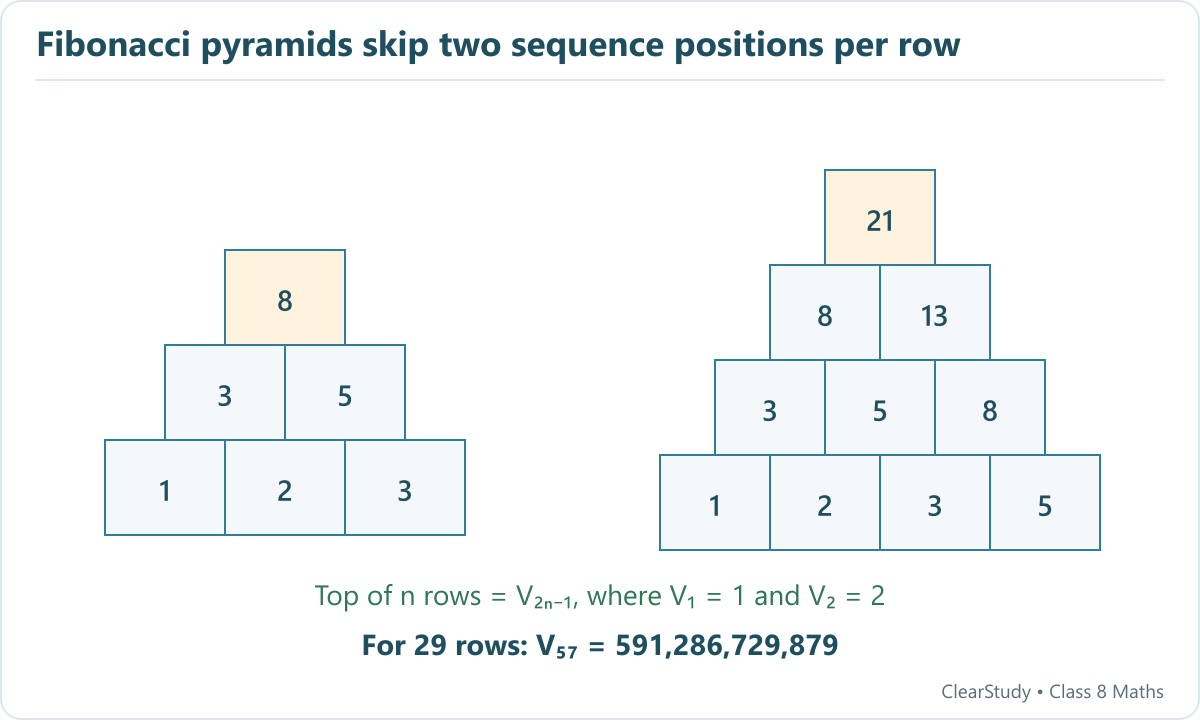
4. If the first three Virahāṅka–Fibonacci numbers are written in the bottom row of a number pyramid with three rows, fill in the rest of the pyramid. What numbers appear in the grid? What is the number at the top? Are they all Virahāṅka–Fibonacci numbers?
5. What can you say about the numbers in the pyramid and the number at the top in the following cases? (i) The first four Virahāṅka–Fibonacci numbers are written in the bottom row of a four row pyramid. (ii) The first 29 Virahāṅka–Fibonacci numbers are written in the bottom row of a 29 row pyramid.
6. If the bottom row of an n row pyramid contains the first n Virahāṅka–Fibonacci numbers, what can we say about the numbers in the pyramid? What can we say about the number at the top?
6.4 Fun with Grids (Math Talk)
Calendar magic: in a 2 × 2 grid on a calendar, if a is the top-left number the others are a + 1, a + 7 and a + 8, so the four-number sum is 4a + 16. From the sum you can recover a, and hence all four numbers.
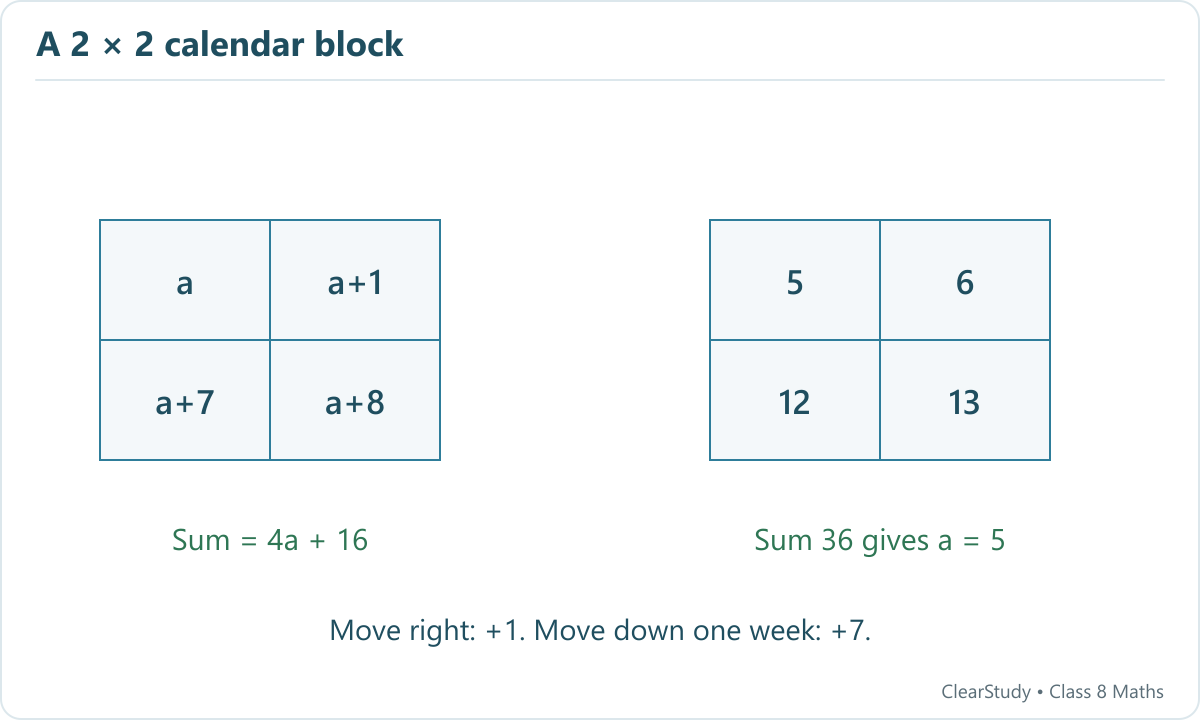
Worked calendar example: if the 2 × 2 sum is 36, a=(36−16)/4=5. The entries are 5, 6, 12, 13. For your own trick, a complete 3 × 3 calendar block has sum 9a+72=9(a+8), so divide its sum by 9 to find its centre. Use complete blocks within one month, without wrapping across the end of a week.
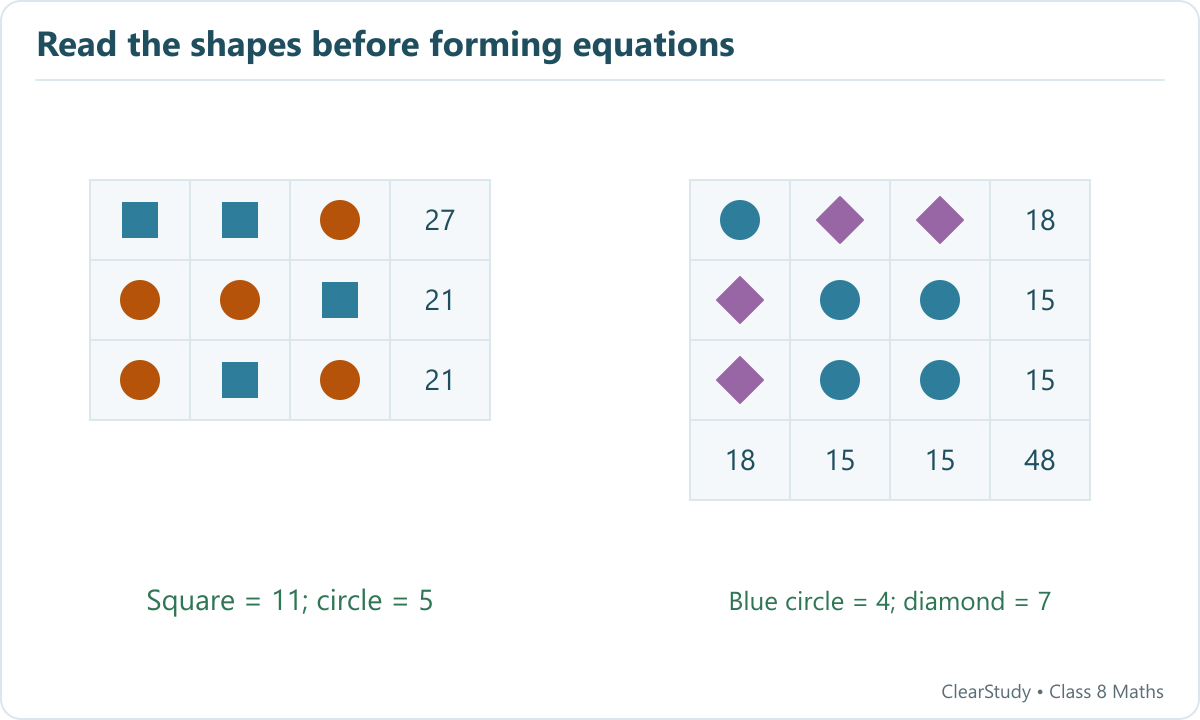
Grid A: The first row contains two squares and one circle. Let square=S and circle=C. Then 2S+C=27 and S+2C=21. Doubling the second equation and subtracting the first gives 3C=15, so C=5 and S=11. The last row totals 5+11+5=21. Check the first row: 11+11+5=27.
Grid B: Let blue circle=B and diamond=D. B+2D=18 and 2B+D=15 give B=4 and D=7. Row totals are 18, 15, 15. Column totals are also 18, 15, 15, and the bottom-right grand total is 48.
6.5 The Largest Product — Figure it Out
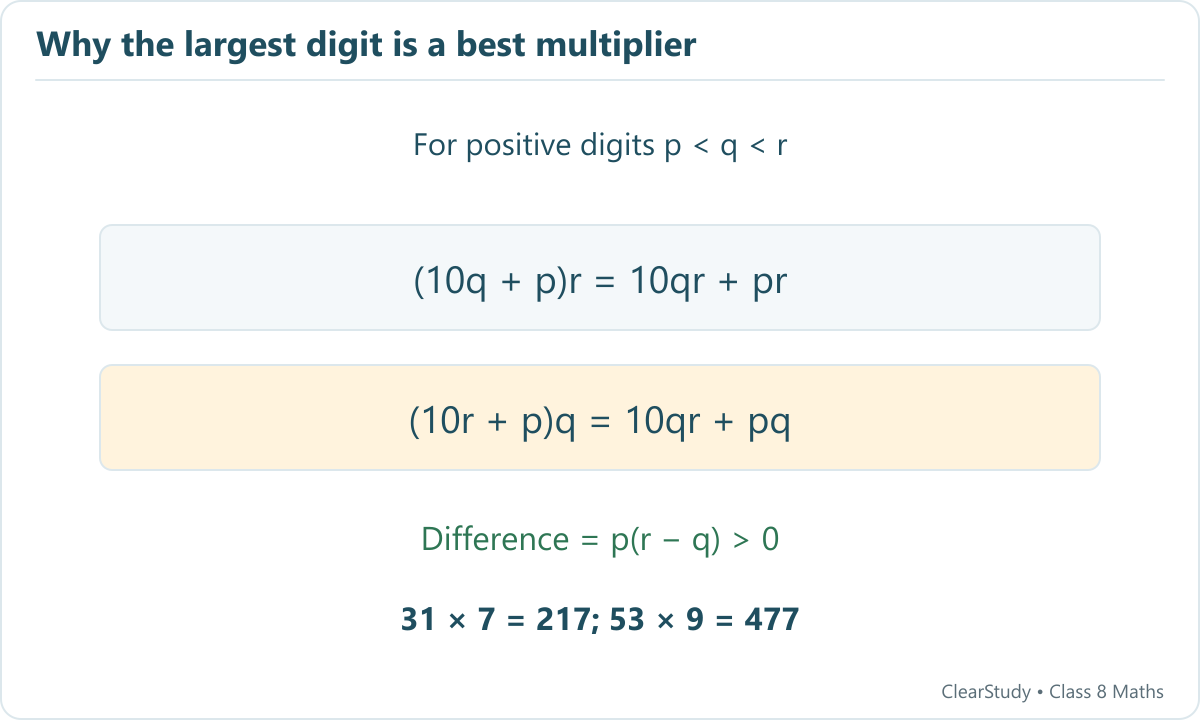
From the chapter: to get the largest product when filling a 2-digit × 1-digit form, use the largest digit as the single multiplier, and arrange the other two digits in decreasing order to form the 2-digit multiplicand.
1. Fill the digits 1, 3, and 7 in ( )( ) × ( ) to make the largest product possible.
2. Fill the digits 3, 5, and 9 in ( )( ) × ( ) to make the largest product possible.
Why the largest-product rule works
For distinct positive digits p<q<r, choose the greater possible two-digit number for each multiplier. The best candidates are (10q+p)r, (10r+p)q and (10r+q)p. The first exceeds the second by p(r−q)>0; the second exceeds the third by 10r(q−p)>0. Thus the first is greatest. A zero digit can produce a tie: 30 × 7 = 70 × 3 = 210.
6.6 Decoding Divisibility Tricks — Figure it Out
Trick: choose a 2-digit number of different digits, reverse the digits, find the difference, and divide by 9 — there is no remainder. Writing the number as 10a + b and its reverse as 10b + a, the difference is 9(b − a) (when b > a), which is divisible by 9.
1. In the trick given above, what is the quotient when you divide by 9? Is there a relationship between the two numbers and the quotient?
2. In the trick given above, instead of finding the difference of the two 2-digit numbers, find their sum. What will happen? For example, 31 + 13 = 44, 28 + 82 = 110, 12 + 21 = 33. Observe that all these numbers are divisible by 11. Is this always true? Can we justify this claim using algebra?
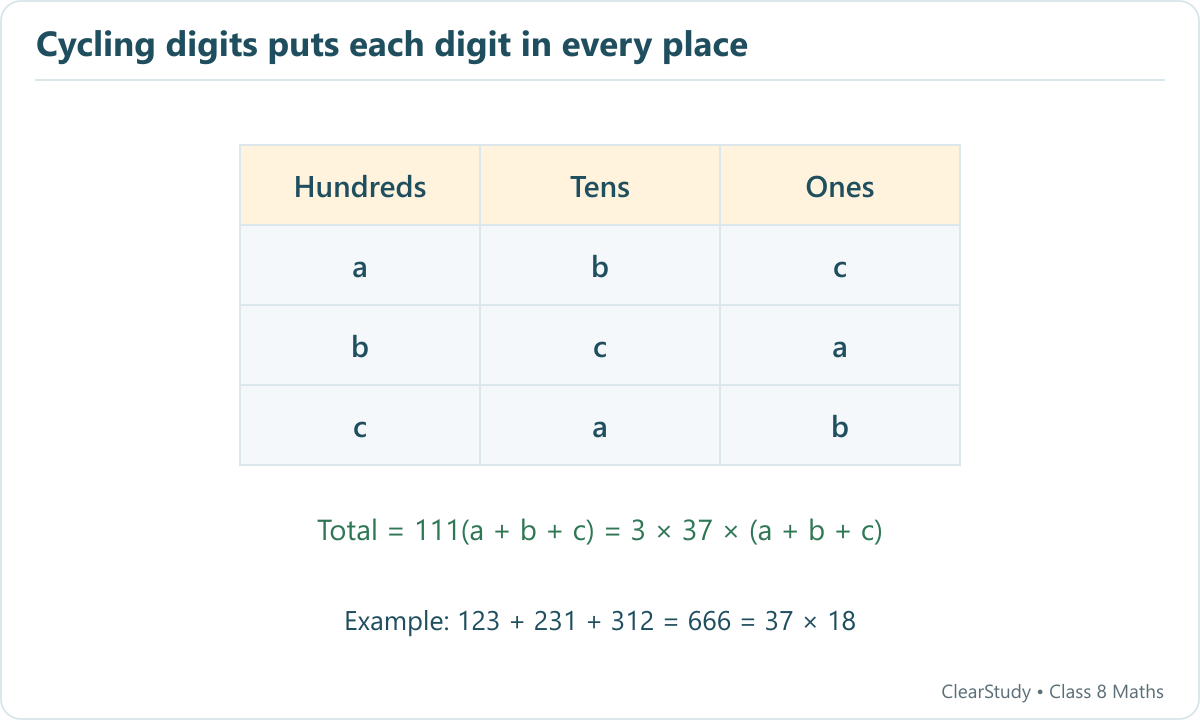
3. Consider any 3-digit number, say abc (100a + 10b + c). Make two other 3-digit numbers from these digits by cycling these digits around, yielding bca and cab. Now add the three numbers. Using algebra, justify that the sum is always divisible by 37. Will it also always be divisible by 3?
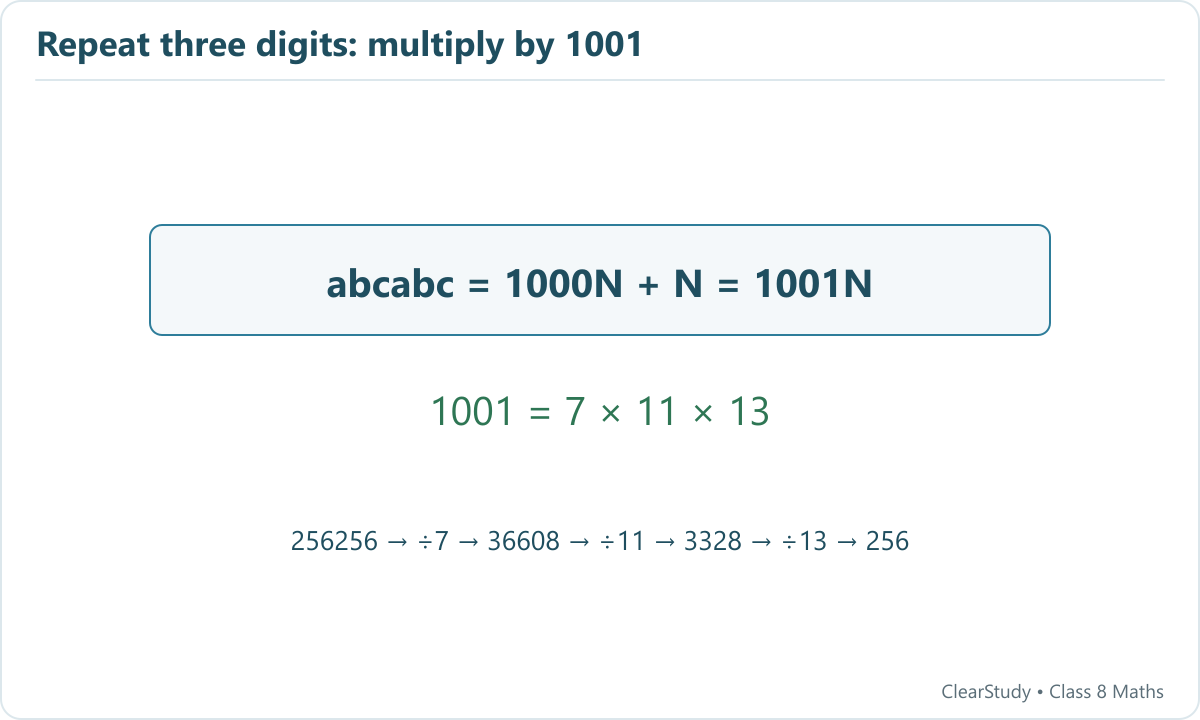
4. Consider any 3-digit number, say abc. Make it a 6-digit number by repeating the digits, that is abcabc. Divide this number by 7, then by 11, and finally by 13. What do you get? Try this with other numbers. Figure out why it works.
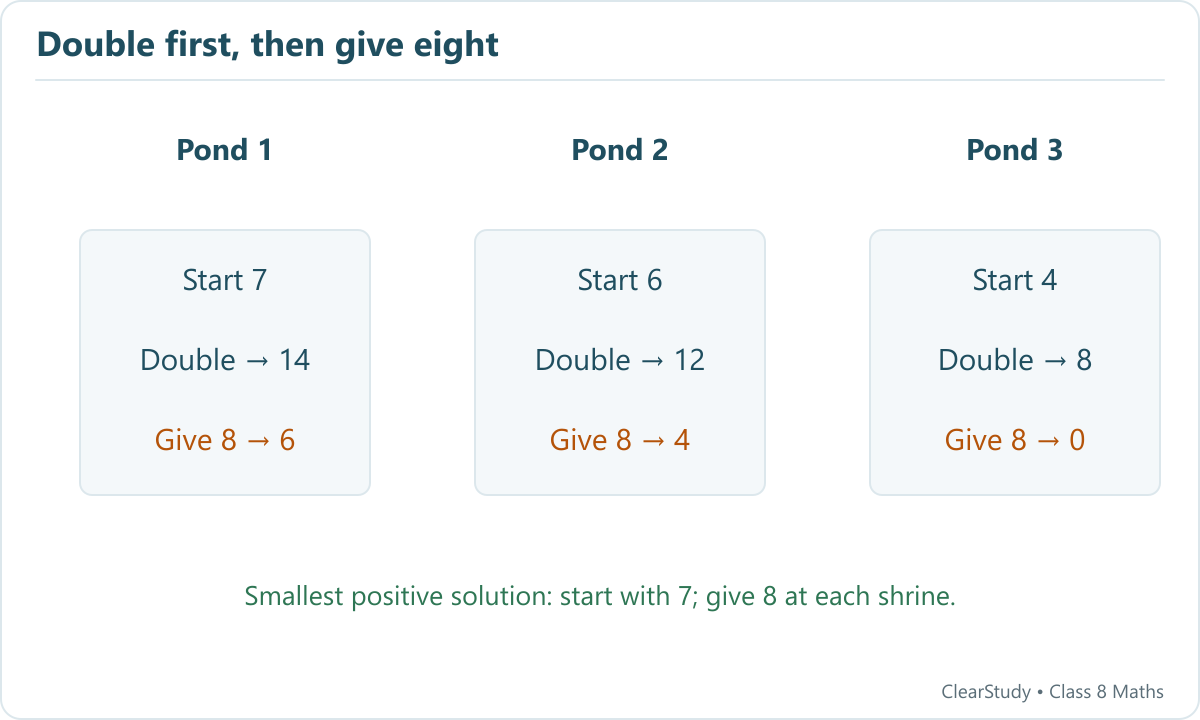
5. There are 3 shrines, each with a magical pond in the front. If anyone dips flowers into these magical ponds, the number of flowers doubles. A person dips all his flowers in the first pond and then places some flowers in shrine 1. Next, he dips the remaining flowers in the second pond and places some flowers in shrine 2. Finally, he dips the remaining flowers in the third pond and then places them all in shrine 3. If he placed an equal number of flowers in each shrine, how many flowers did he start with? How many flowers did he place in each shrine?
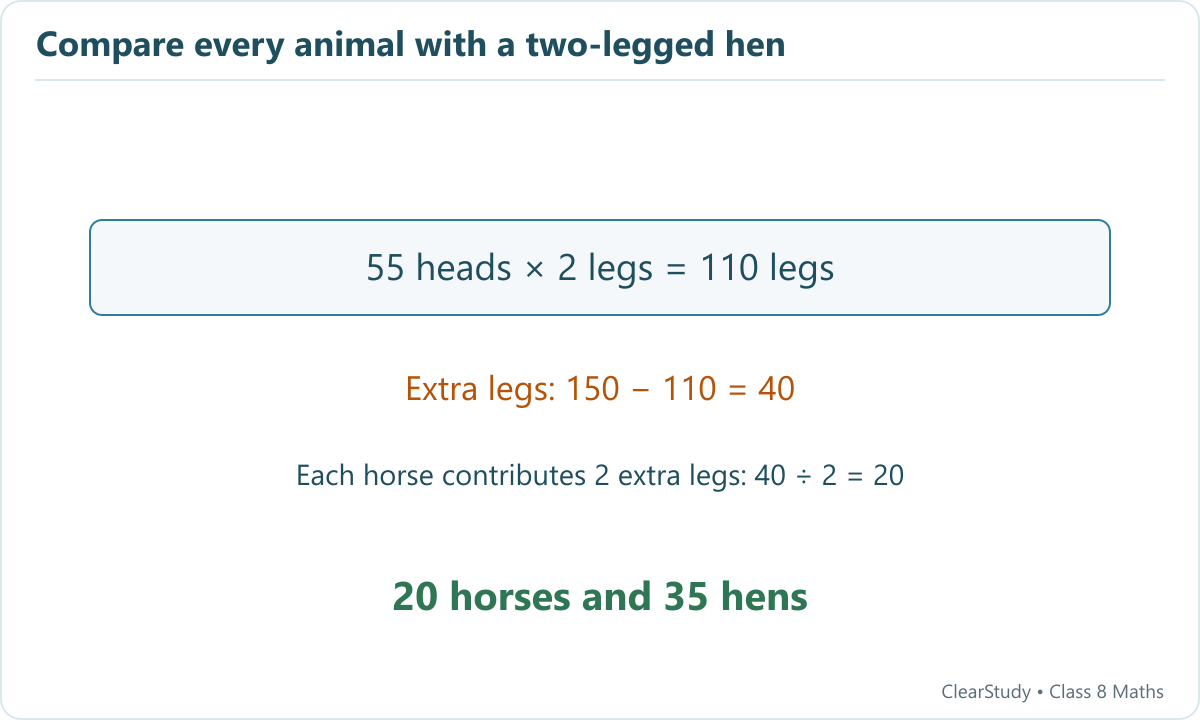
6. A farm has some horses and hens. The total number of heads of these animals is 55 and the total number of legs is 150. How many horses and how many hens are on the farm? Can you solve this without letter-numbers?
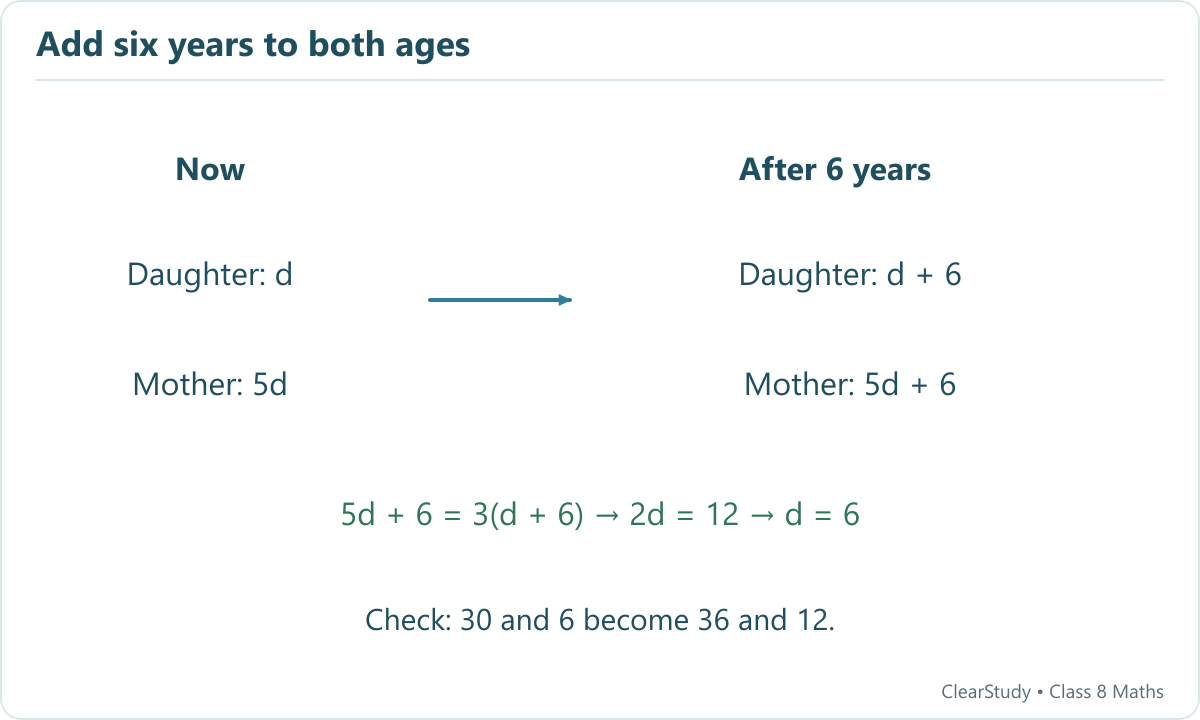
7. A mother is 5 times her daughter’s age. In 6 years’ time, the mother will be 3 times her daughter’s age. How old is the daughter now?
8. Two friends, Gauri and Naina, are cowherds. Gauri says to Naina, “You have twice as many cows as I do”. Naina says, “That’s true, but if I gave you three of my cows, we would each have the same number of cows”. How many cows do Gauri and Naina have?
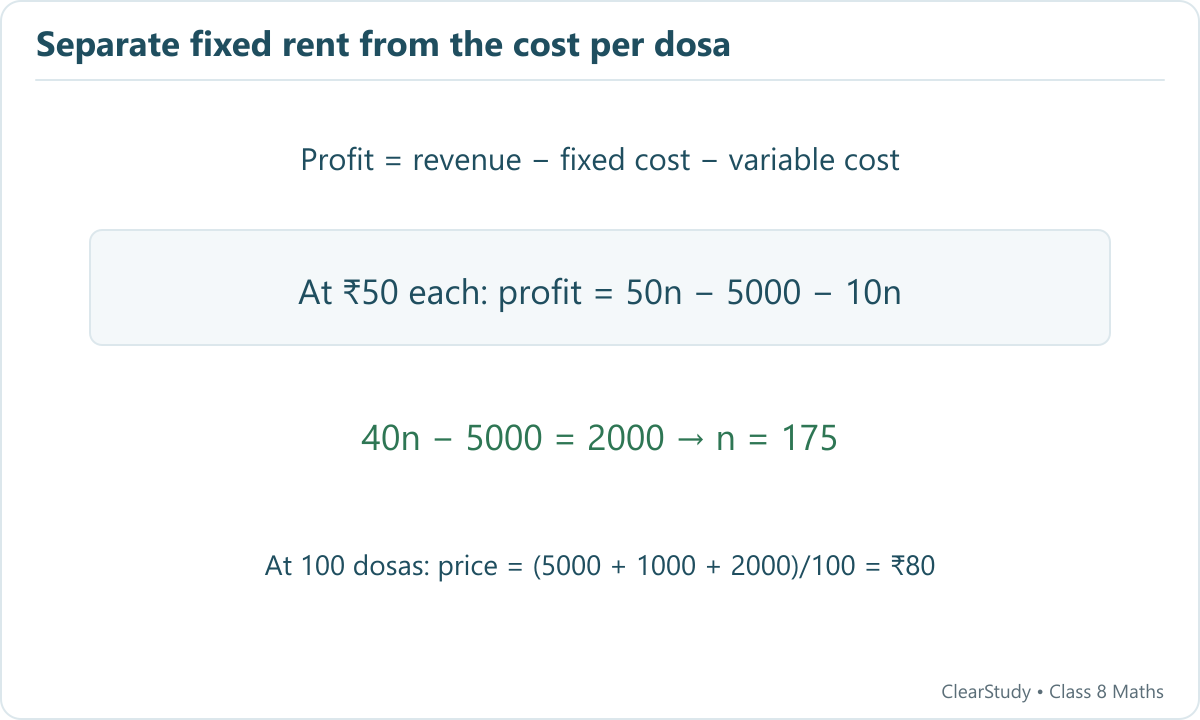
9. I run a small dosa cart and my expenses are: rent for the dosa cart is ₹5000 per day; the cost of making one dosa is ₹10. (i) If I can sell 100 dosas a day, what should be the selling price of my dosa to make a profit of ₹2000? (ii) If my customers are willing to pay only ₹50 for a dosa, how many dosas should I aim to sell in a day to make a profit of ₹2000?
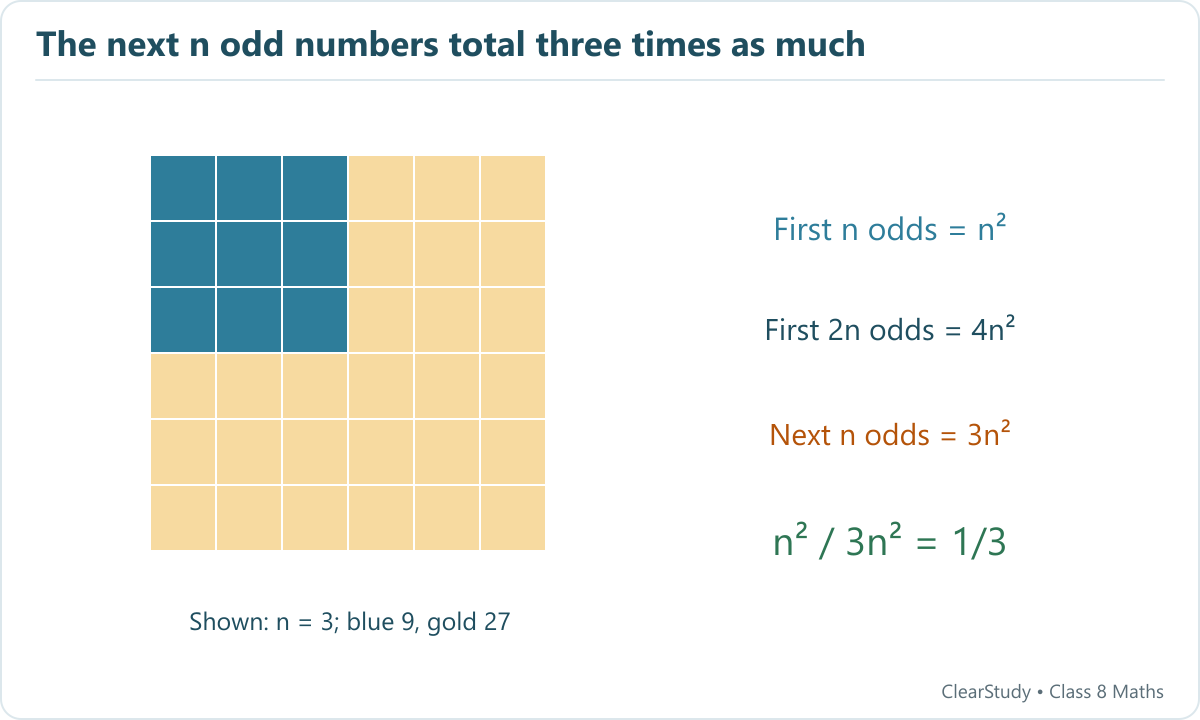
10. Evaluate the following sequence of fractions: (1/3), (1 + 3)/(5 + 7), (1 + 3 + 5)/(7 + 9 + 11). What do you observe? Can you explain why this happens?
11. Karim and the Genie. Each time Karim goes around the tree his coins double, and he must give the genie 8 coins. After the third round he is left with exactly 8 coins, the amount he owes, leaving him with nothing. (i) How many coins did Karim initially have? (ii) For what cost per round should Karim agree to the deal, if he wants to increase the number of coins he has? (iii) Through its magical powers, the genie knows the number of coins that Karim has. How should the genie set the cost per round so that it gets all of Karim’s coins?
Common Mistakes to Avoid
Watch out for these
- Writing a two-digit number as a × b instead of 10a + b when setting up a divisibility proof.
- In a 3-row pyramid, forgetting that the middle term is doubled — the top is a + 2b + c, not a + b + c.
- Mixing up the 4-row coefficients; they are 1, 3, 3, 1 (not 1, 2, 2, 1).
- In the “equal flowers” and Karim problems, forgetting to double first, then subtract (order of operations matters).
- In word problems, not doing the same operation to both sides of the equation, or losing a sign while transposing.
- Forgetting to verify by substituting the answer back into the original statement (heads & legs, ages, cows).
- Assuming the largest digit goes in the multiplicand — for the largest product the largest digit is the single multiplier.
Practice MCQs & Assertion–Reason
1. A two-digit number with tens digit a and units digit b is written in algebra as:
(a) a + b (b) ab (c) 10a + b (d) 10b + a
2. For a 3-row number pyramid with bottom row a, b, c, the top number is:
(a) a + b + c (b) a + 2b + c (c) 2a + b + 2c (d) a + 3b + c
3. The top number of a 3-row pyramid with bottom row 4, 13, 8 is:
(a) 25 (b) 34 (c) 38 (d) 42
4. The difference between a 2-digit number and the number formed by reversing its digits is always divisible by:
(a) 7 (b) 9 (c) 11 (d) 13
5. The sum of a 2-digit number and its reverse equals 11(a + b), so it is always divisible by:
(a) 9 (b) 10 (c) 11 (d) 37
6. Using the digits 1, 3 and 7 once each in ( )( ) × ( ), the largest product is:
(a) 213 (b) 217 (c) 91 (d) 73
7. The 6-digit number abcabc is always equal to abc multiplied by:
(a) 111 (b) 1001 (c) 1010 (d) 1111
8. A farm has 55 heads and 150 legs of horses and hens. The number of horses is:
(a) 15 (b) 20 (c) 25 (d) 35
9. A mother is 5 times her daughter’s age; in 6 years she will be 3 times as old. The daughter’s present age is:
(a) 5 (b) 6 (c) 8 (d) 10
10. The value of (1 + 3 + 5)/(7 + 9 + 11) is:
(a) 1/2 (b) 1/3 (c) 2/3 (d) 1/4
For each Assertion–Reason question, choose: (A) Both Assertion and Reason are true and the Reason is the correct explanation of the Assertion; (B) Both are true but the Reason is not the correct explanation; (C) Assertion is true but Reason is false; (D) Assertion is false but Reason is true.
A-R 1. Assertion: The sum of any 2-digit number and the number obtained by reversing its digits is divisible by 11.
Reason: (10a + b) + (10b + a) = 11(a + b).
A-R 2. Assertion: When you subtract a 2-digit number from its reverse and divide by 9, the quotient equals the difference of the two digits.
Reason: The difference (10b + a) − (10a + b) equals 9(b − a).
A-R 3. Assertion: The number abcabc is always divisible by 7, 11 and 13.
Reason: abcabc = abc × 1001 and 1001 = 7 × 11 × 13.
A-R 4. Assertion: In a 3-row number pyramid the middle bottom number is added twice to get the top.
Reason: The top equals a + b + c for a bottom row a, b, c.
A-R 5. Assertion: To make the largest product with three distinct positive digits in the form (two-digit) × (one-digit), the largest digit should be the one-digit multiplier.
Reason: Expanding the products shows the leading terms match and the larger second term comes from using the largest digit as the multiplier.
Quick Revision Summary
- Algebra explains why number tricks work: model the unknown by a letter and simplify — if the letter cancels, the result is fixed for every input.
- A 2-digit number is 10a + b; a 3-digit number is 100a + 10b + c. Reverse, cycle or repeat the digits and simplify to expose divisibility.
- Difference of a number and its reverse = 9(a − b) → divisible by 9; sum = 11(a + b) → divisible by 11.
- For abc + bca + cab = 111(a + b + c) = 3 × 37 × (a + b + c); and abcabc = abc × 7 × 11 × 13.
- Number pyramid: top of 3 rows = a + 2b + c; top of 4 rows = a + 3b + 3c + d (binomial coefficients 1,2,1 and 1,3,3,1).
- If the bottom row holds consecutive Virahāṅka–Fibonacci numbers, every entry — including the top — is also a Virahāṅka–Fibonacci number.
- For the largest product, use the biggest digit as the multiplier and the rest in decreasing order as the multiplicand.
- Word problems (heads & legs, ages, cows, dosa cart, flowers, Karim) become simple linear equations — always substitute the answer back to check.
How to score full marks in this chapter
For every “trick” question, first define the letter-number (e.g. “let the number be 10a + b”), then show each algebraic step so the cancellation or factor is visible. In word problems, write the two relations clearly, solve neatly, and finish with a one-line verification. Keep fractions reduced (4/12 = 1/3) and state the rule you are using (pyramid rule, place value, sum of odd numbers = n2) before you compute.
Frequently Asked Questions
What is Class 8 Maths Ganita Prakash Chapter 13 about?
Chapter 13 (Chapter 6 of Part II), Algebra Play, uses algebra to explain why number tricks, calendar/date tricks, number pyramids, algebra grids, the largest-product puzzle and divisibility tricks always work. You model an unknown with a letter, simplify, and prove the result for every input.
Why is this called Chapter 13 if the book says Chapter 6?
It is Chapter 6 of Ganita Prakash Part II, but it is the 13th chapter of the full Class 8 course (Part I and Part II combined), which is how ClearStudy numbers it for easy navigation.
Why is the sum of a 2-digit number and its reverse divisible by 11?
If the number is 10a + b, its reverse is 10b + a. Their sum is 11a + 11b = 11(a + b), which is always a multiple of 11.
Are these Class 8 Maths Ganita Prakash Chapter 13 solutions free?
Yes. All solutions are free and follow the official NCERT Ganita Prakash (Part II) textbook for 2026–27, with worked explanations and original teaching diagrams.
Textbook reference: NCERT Ganita Prakash, Chapter 13 (official PDF). ClearStudy diagrams and worked explanations are original teaching aids.