Class 8 Maths Ganita Prakash Chapter 3 Solutions (NCERT 2026–27) – A Story of Numbers
These Class 8 Maths Ganita Prakash Chapter 3 solutions cover A Story of Numbers from the new NCF-2023 textbook (2026–27). Use the page-wise worked answers and original diagrams below to read Roman, Egyptian, Babylonian, Mayan and Chinese numerals, understand regrouping, and practise place value.
Class: 8Subject: MathematicsBook: Ganita Prakash (Part I)Chapter: 3Exercises: Figure it Out (3.1–3.4)Session: 2026–27
Chapter 3 of Ganita Prakash, A Story of Numbers, traces how humans learned to count and write numbers, from the Stone Age to the modern day. Through Reema’s curiosity about a strange piece of writing, the chapter walks through the mechanism of counting (sticks, sounds and symbols, one-to-one mapping), early systems built on body parts, tally marks and counting in twos, the Roman numerals with their landmark numbers, the Egyptian base-10 system and the general idea of a base-n number system, and finally place value systems — Mesopotamian (Babylonian), Mayan and Chinese — leading to the Hindu (Indian) number system and the revolutionary idea of zero. The solutions below organise the numeral exercises and discussion activities by textbook page.
Key Concepts & Definitions
Number system: a standard sequence of objects, names or written symbols with a fixed order, used to count by one-to-one mapping.
Numerals: the symbols used to represent numbers in a written number system (e.g. 0, 1, 5, 36, 193).
One-to-one mapping: matching each object to be counted with exactly one item of the standard sequence (e.g. one cow → one stick), with no two objects mapped to the same item.
Landmark numbers: easily recognised reference numbers that get their own symbol and are used as anchors to build other numbers (e.g. Roman I, V, X, L, C, D, M).
Base-n number system: a system whose landmark numbers are the powers of n — the first landmark number is 1, and every next landmark number is n times the current one.
Decimal (base-10) system: a base-n system with n = 10, e.g. the Egyptian and Hindu systems.
Place value / positional system: a system that uses the position of a digit or group to decide its place value. In a fixed-base system these places are powers of the base; some historical arrangements use mixed place values. Used by the Mesopotamians, Mayans, Chinese and Indians.
Zero (0): the placeholder showing “nothingness” that makes a place value system unambiguous; in the Hindu system 0 is also a number in its own right.
Important Facts & Landmark Numbers
Roman landmark numbers: I = 1, V = 5, X = 10, L = 50, C = 100, D = 500, M = 1,000.
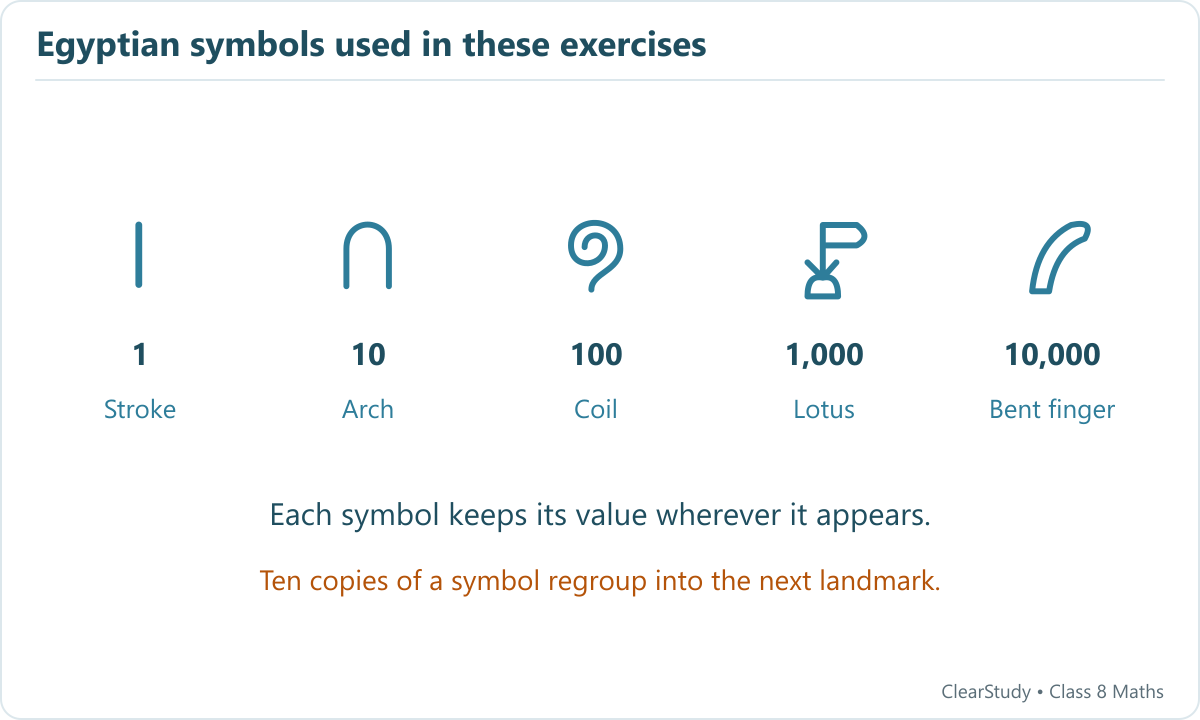
Egyptian (base-10) landmark numbers: 1, 10, 102 = 100, 103 = 1000, …, up to 107 (a crore), each with its own symbol.
Base-n landmark numbers (general):n0 = 1, n, n2, n3, … (the powers of n).
Mesopotamian (sexagesimal, base-60): 1, 60, 602 = 3600, 603 = 216000, … (1 hour = 60 min, 1 min = 60 s come from this).
Mayan arrangement used in this chapter: 1, 20, 20×18 = 360, 202×18 = 7200, 203×18 = 144000.
Product of landmark numbers in a base-n system: always another landmark number (e.g. 10a × 10b = 10a+b) — which is why multiplication is easy in a base system.
Figure it Out (Page 54)
1. Suppose you are using the number system that uses sticks to represent numbers, as in Method 1. Without using either the number names or the numerals of the Hindu number system, give a method for adding, subtracting, multiplying and dividing two numbers or two collections of sticks.
SOLUTIONRepresent each number by a collection of sticks (one stick per object), then:Addition: push both collections of sticks together into one pile — the combined pile is the sum.Subtraction: from the larger collection, remove (pair off) as many sticks as there are in the smaller collection; the sticks left over are the difference.Multiplication: make as many equal groups as the first number, each group having as many sticks as the second number, then combine all the groups into one pile.Division: from the given pile, repeatedly take out groups each of the divisor’s size; the number of complete groups is the quotient and the leftover sticks are the remainder.
2. One way of extending the number system in Method 2 is by using strings with more than one letter—for example, we could use ‘aa’ for 27. How can you extend this system to represent all the numbers? There are many ways of doing it!
SOLUTIONThe alphabet gives only 26 single letters (a–z = 1–26). To go further, keep adding more letters to each string in order.One way: a, b, c, …, z (1–26), then aa, bb, cc, …, zz (27–52), then aaa, bbb, ccc, …, zzz (53–78), and so on — each round adds one more repeated letter, so every number gets a name.(Any consistent rule that never runs out of new strings is acceptable, e.g. a, b, …, z, aa, ab, ac, … like spreadsheet column names.)
3. Try making your own number system.
SOLUTIONThis is an open activity. A simple example using shapes as a base-3 system:Pick three symbols, say △ = 1, □ = 2, ◯ = 0, and group in threes (landmark numbers 1, 3, 9, 27, …).Then read positions like place value: for example, △◯△ would mean (1)×9 + (0)×3 + (1)×1 = 10. Any clear, consistent rule is correct.
Figure it Out (Page 59)
1. Represent the following numbers in the Roman system.
(i) 1222 (ii) 2999 (iii) 302 (iv) 715
1. Why might a community use different counting words for different kinds of objects?
SOLUTIONOne possible explanation is that objects are counted in different useful groups, such as pairs or bundles. Different words could identify both the quantity and the kind of object or grouping. This is an open discussion question; a well-explained suggestion is acceptable.
2. Consider the extension of the Gumulgal number system beyond 6 in the same way of counting by 2s. Come up with ways of performing the different arithmetic operations (+, –, ×, ÷) for numbers occurring in this system, without using Hindu numerals. Use this to evaluate the following:
(i) (ukasar-ukasar-ukasar-ukasar-urapon) + (ukasar-ukasar-ukasar-urapon)(ii) (ukasar-ukasar-ukasar-ukasar-urapon) – (ukasar-ukasar-ukasar)(iii) (ukasar-ukasar-ukasar-ukasar-urapon) × (ukasar-ukasar)(iv) (ukasar-ukasar-ukasar-ukasar-ukasar-ukasar-ukasar-ukasar) ÷ (ukasar-ukasar)
SOLUTIONWord rule: a pair of urapon becomes ukasar. Join word collections to add; cancel matching words to subtract. For multiplication, copy the first collection once for each urapon represented by the second. For division, remove equal divisor-sized groups and record urapon for each group.(i) Join the collections and replace the pair of urapon by ukasar: ukasar-ukasar-ukasar-ukasar-ukasar-ukasar-ukasar-ukasar.(ii) Cancel ukasar-ukasar-ukasar from the first collection. The answer is ukasar-urapon.(iii) Each ukasar in the multiplier means a pair of copies. Thus ukasar-ukasar means a pair of pairs of copies of the first collection. Combine them and regroup the urapon pairs. The result is ukasar-ukasar-ukasar-ukasar-ukasar-ukasar-ukasar-ukasar-ukasar-ukasar-ukasar-ukasar-ukasar-ukasar-ukasar-ukasar-ukasar-ukasar.(iv) Separate the dividend into groups, each reading ukasar-ukasar. Recording urapon for each group gives urapon-urapon-urapon-urapon, which regroups to ukasar-ukasar.Optional decimal check, after the word-only method: 9 + 7 = 16; 9 − 6 = 3; 9 × 4 = 36; 16 ÷ 4 = 4.
3. Identify the features of the Hindu number system that make it efficient when compared to the Roman number system.
SOLUTIONThe Hindu number system (0, 1, 2, …, 9) is far more efficient than the Roman system (I, V, X, L, C, D, M):
Hindu Number System
Roman Numerals
Place value system — a symbol’s value depends on its position
Fixed value — each symbol always means the same amount
Has a symbol and number for zero (0)
No symbol for zero
Easy to add, subtract, multiply and divide
Calculation (especially × and ÷) is extremely difficult
Only 10 digits represent all numbers, however large
Needs new symbols for larger and larger numbers
4. Revisit and improve your own number system.
SOLUTIONKeep a clear order, a rule that extends to arbitrarily large whole numbers, and a consistent grouping rule. For the base-3 example above, use three digits for 0, 1 and 2, with place values 1, 3, 9, 27 and so on. Include a zero digit so that empty places are unambiguous. Explain how addition regroups three ones into one three. Other coherent designs are acceptable.
Figure it Out (Page 62)
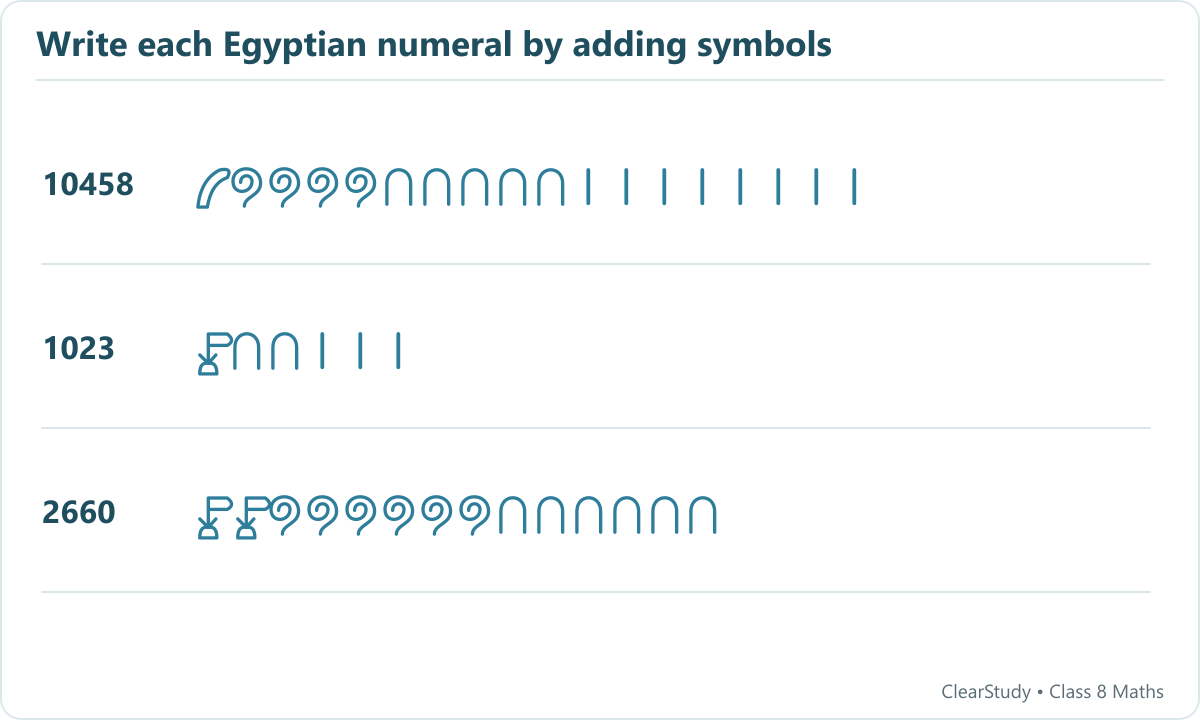
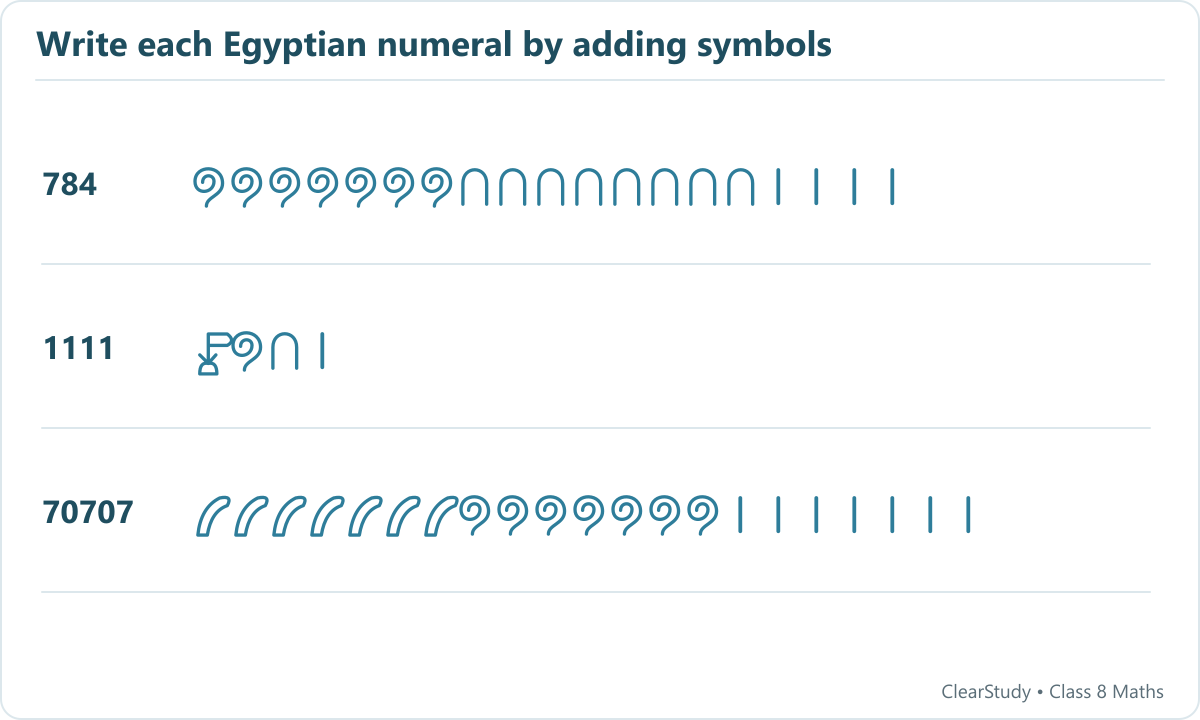
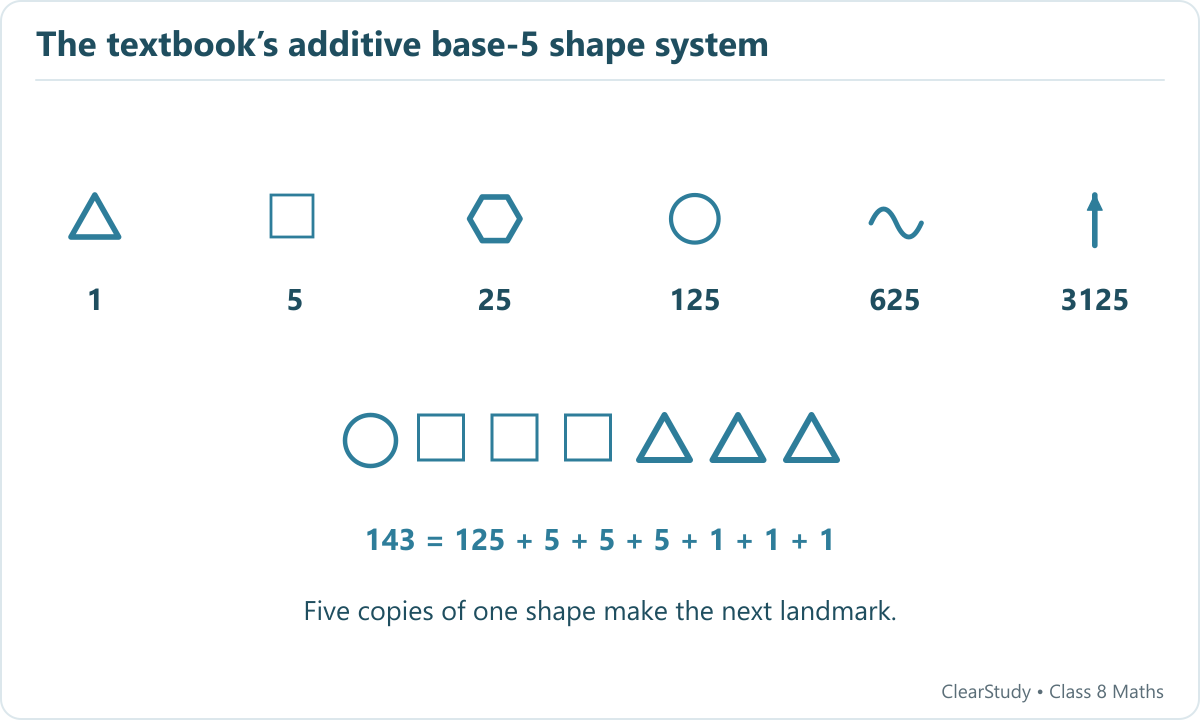
These original, simplified drawings show the textbook’s additive symbols. They are not place-value digits.
1. Represent the following numbers in the Egyptian system: 10458, 1023, 2660, 784, 1111, 70707.
SOLUTIONGroup each number into powers of 10 (each power has its own Egyptian symbol; you write a symbol as many times as that power occurs):10458 = 10000 + 400 + 50 + 8 = one 104, four 100s, five 10s, eight 1s.1023 = 1000 + 20 + 3 = one 1000, two 10s, three 1s.2660 = 2000 + 600 + 60 = two 1000s, six 100s, six 10s.784 = 700 + 80 + 4 = seven 100s, eight 10s, four 1s.1111 = 1000 + 100 + 10 + 1 = one 1000, one 100, one 10, one 1.70707 = 70000 + 700 + 7 = seven 104, seven 100s, seven 1s.
Read each group with the symbol key above. Empty decimal places contribute no symbols.Read each group with the symbol key above. Empty decimal places contribute no symbols.
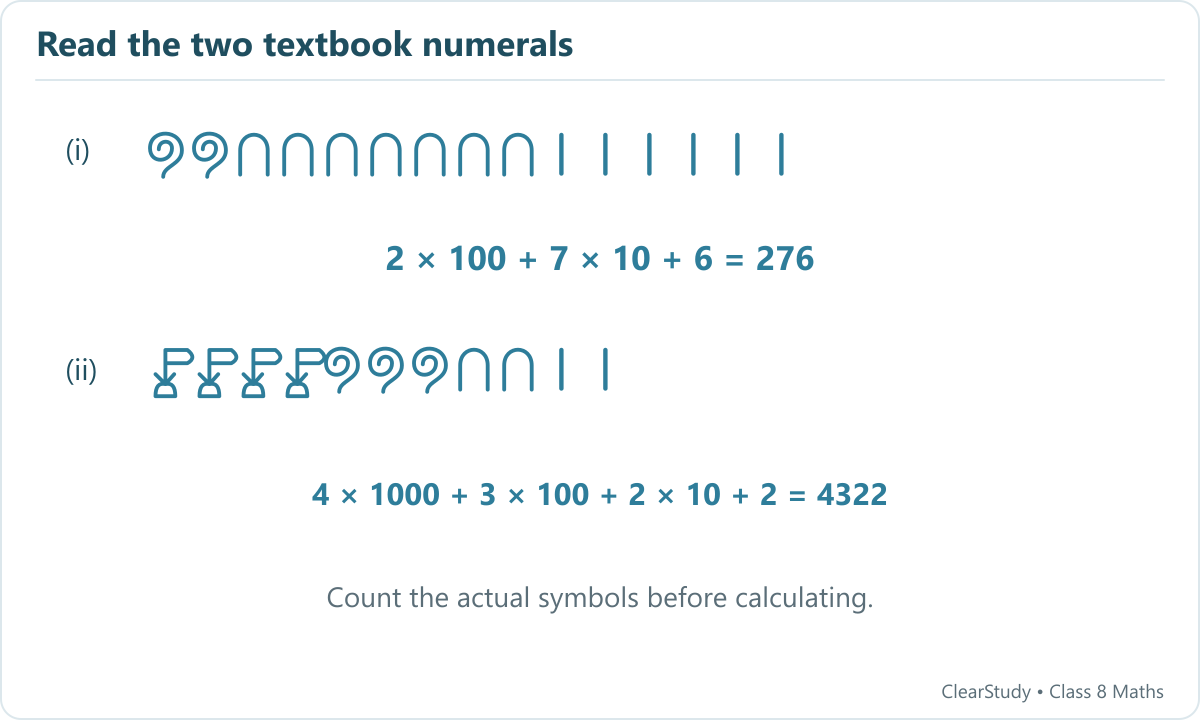
2. What numbers do these numerals stand for?
(i) two “100” symbols, seven “10” symbols and six “1” symbols(ii) four “1000” symbols, three “100” symbols, two “10” symbols and two “1” symbols
Page 62, Question 2: the first numeral has seven tens and six ones; the second includes two ones.
Figure it Out (Page 63)
This additive shape system differs from positional base-5 digits such as 100₅.
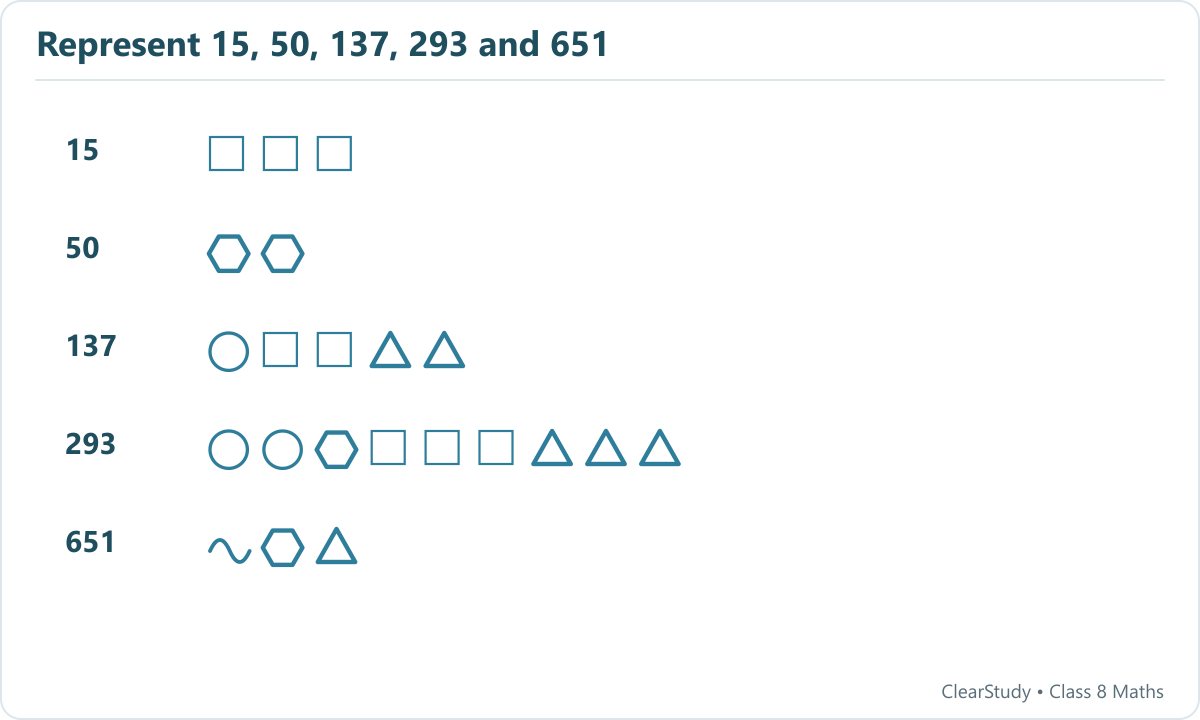
1. Write the following numbers in the above base-5 system using the symbols in Table 2: 15, 50, 137, 293, 651.
SOLUTIONBase-5 landmark numbers are 1, 5, 25, 125, 625. Group each number using as many of the largest landmark numbers as possible:(i) 15 = 5 + 5 + 5 = three 5s (i.e. three “5” symbols).(ii) 50 = 25 + 25 = two 25s.(iii) 137 = 125 + 5 + 5 + 1 + 1 = one 125, two 5s, two 1s.(iv) 293 = 125 + 125 + 25 + 5 + 5 + 5 + 1 + 1 + 1 = two 125s, one 25, three 5s, three 1s.(v) 651 = 625 + 25 + 1 = one 625, one 25, one 1.
Use the largest landmarks first, then check by adding their values.
2. Is there a number that cannot be represented in our base-5 system above? Why or why not?
SOLUTIONYes — zero (0) cannot be represented, because this system has no symbol for 0; it only has symbols for the landmark numbers 1, 5, 25, …. Every other positive whole number can be represented.
3. Compute the landmark numbers of a base-7 system. In general, what are the landmark numbers of a base-n system?
SOLUTIONBase-7: 70 = 1, 71 = 7, 72 = 49, 73 = 343, 74 = 2401, … So the landmark numbers are 1, 7, 49, 343, 2401, …In general, the landmark numbers of a base-n system are the powers of n: n0 = 1, n1, n2, n3, …
Figure it Out (Page 65)
1. Add the following Egyptian numerals.
(i) (nine 1000s, six 100s, eight 1s) + (five 100s, seven 1s)(ii) (one 103, eight 10s) + (four 10s, six 1s)
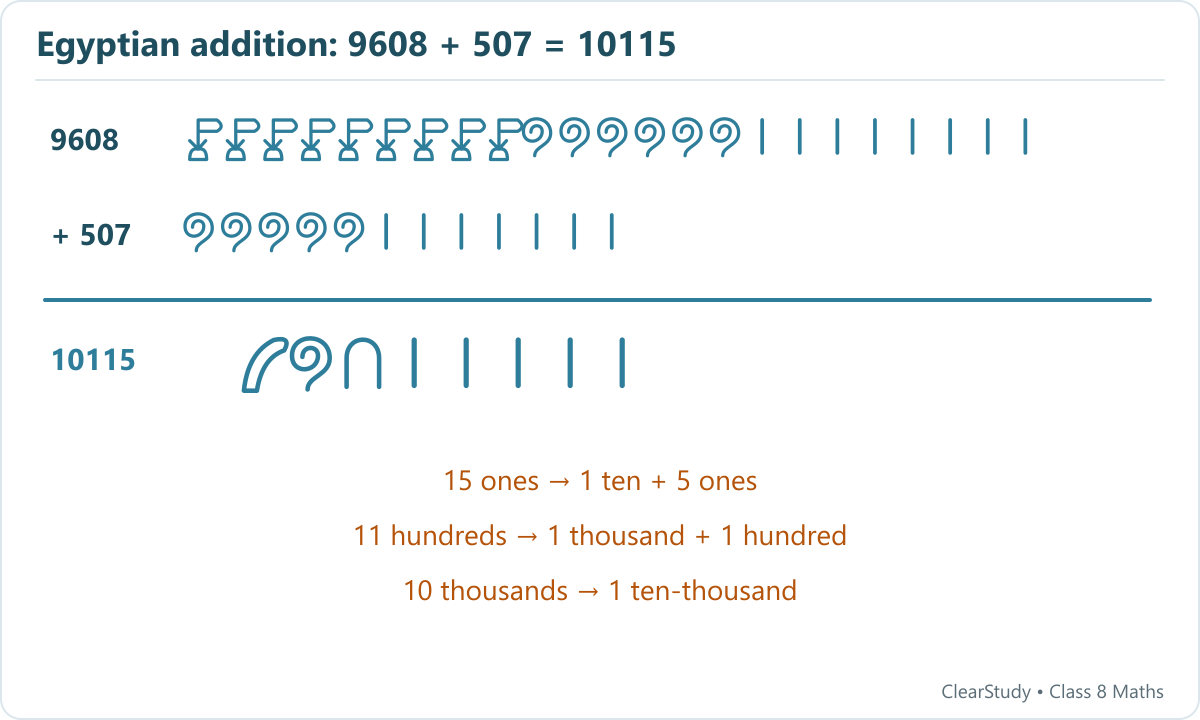
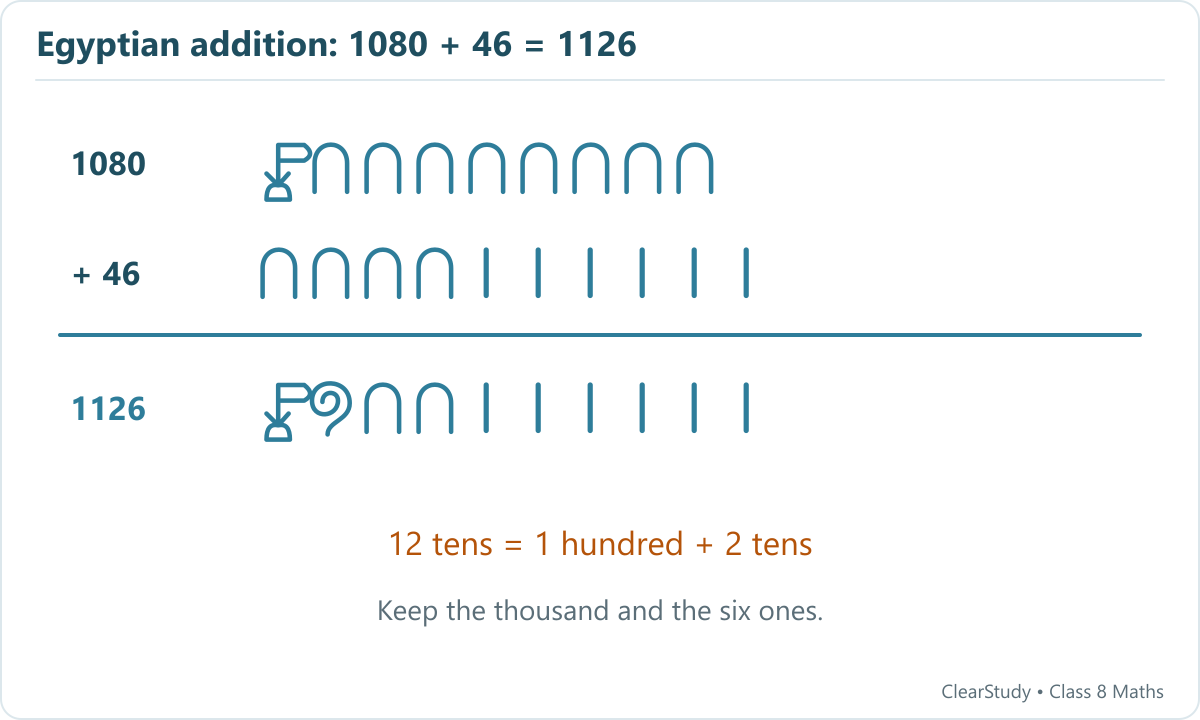
SOLUTIONCombine like symbols, then exchange every ten copies for the next landmark symbol.(i) Ones: 8 + 7 = 15, giving one ten and five ones. Hundreds: 6 + 5 = 11, giving one thousand and one hundred. Thousands: 9 + 1 = 10, giving one ten-thousand.Result: one 10000, one 100, one 10 and five 1s. 9608 + 507 = 10115.(ii) Tens: 8 + 4 = 12, giving one hundred and two tens. Retain the thousand and six ones. 1080 + 46 = 1126.
Page 65, Question 1(i): regroup ones, hundreds and thousands.Page 65, Question 1(ii): regroup twelve tens into one hundred and two tens.
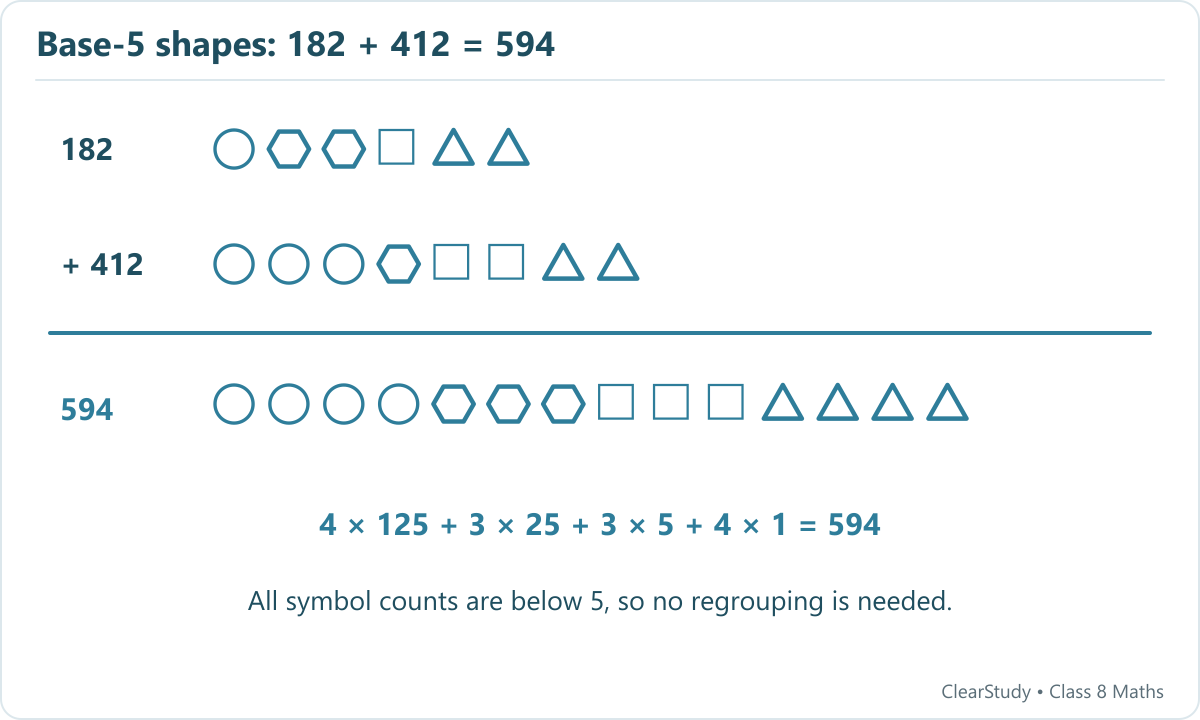
2. Add the following numerals that are in the base-5 system that we created (remember, in this system 5 times a landmark number gives the next one): (one 125, two 25s, one 5, two 1s) + (three 125s, one 25, two 5s, two 1s).
SOLUTIONFirst numeral: 125 + 2 × 25 + 5 + 2 = 182. Second numeral: 3 × 125 + 25 + 2 × 5 + 2 = 412.Combine the shapes: four circles, three hexagons, three squares and four triangles.Their value is 4 × 125 + 3 × 25 + 3 × 5 + 4 = 500 + 75 + 15 + 4 = 594.All counts are below five, so this particular addition needs no regrouping. In general, five identical symbols are exchanged for the next landmark.
Page 65, Question 2: add matching symbols. The two addends are 182 and 412 in decimal.
Figure it Out (Page 69–70)
1. Can there be a number whose representation in Egyptian numerals has one of the symbols occurring 10 or more times? Why not?
SOLUTIONNot in fully regrouped form, provided the next landmark symbol is available. Ten copies of a landmark are exchanged for one copy of the next: ten ones become one ten, for example.An unregrouped sum can temporarily contain ten or more identical symbols. Regrouping gives the standard compact form, with at most nine of each symbol below the highest available landmark.
2. Create your own number system of base 4, and represent numbers from 1 to 16.
Rule: four 1s (∟) regroup into one 4 (△); four 4s regroup into one 16 (□). Any consistent base-4 scheme is correct.
3. Give a simple rule to multiply a given number by 5 in the base-5 system that we created.
SOLUTIONIn a base-5 system, the landmark numbers are powers of 5, so multiplying any landmark number by 5 gives the next landmark number (1→5→25→125→…).Rule: to multiply a number by 5, simply replace every symbol by the next-higher landmark symbol (each 1 becomes a 5, each 5 becomes a 25, each 25 becomes a 125, and so on). No regrouping is needed.This is just like “adding a zero” (a left shift) when we multiply by 10 in our decimal system.
Figure it Out (Page 73)
1. Represent the following numbers in the Mesopotamian system.
(i) 63 (ii) 132 (iii) 200 (iv) 60 (v) 3605
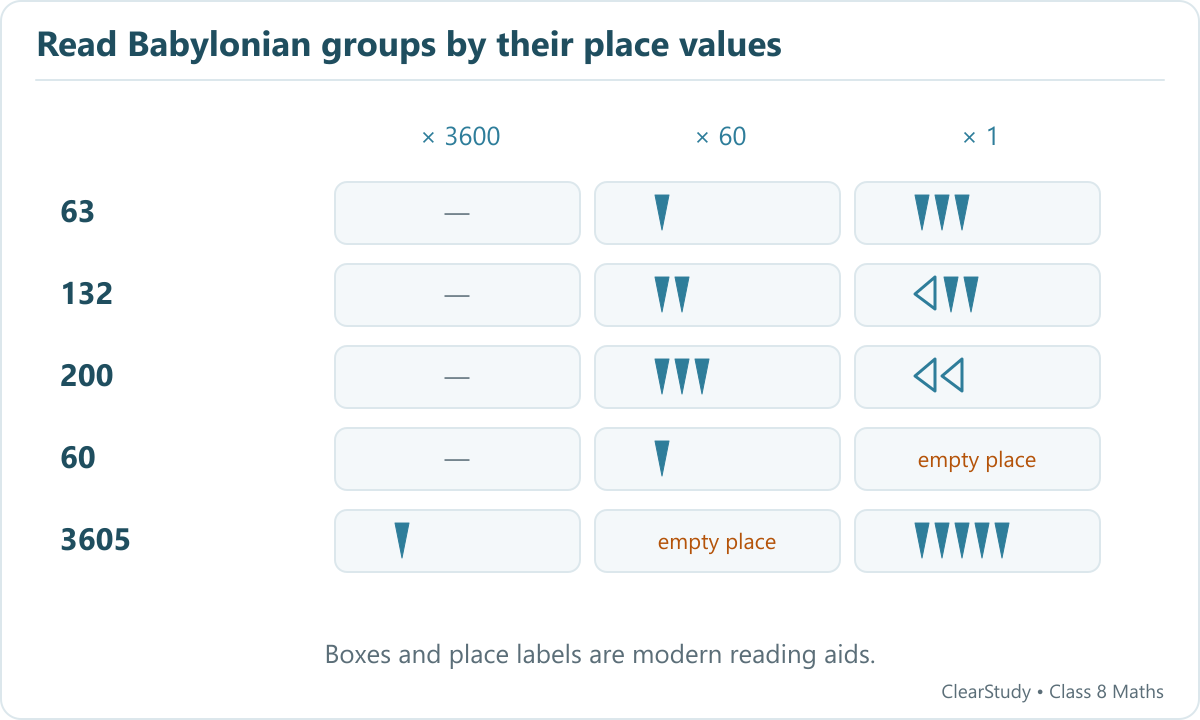
SOLUTIONThe Mesopotamian system is base-60 (landmark numbers 1, 60, 3600, …), using one symbol for 1 and one for 10. Group each number into powers of 60, then write each group with the 1- and 10-symbols:(i) 63 = (1)×60 + 3 ⇒ one 60, then three 1s.(ii) 132 = (2)×60 + 12 = (2)×60 + 10 + 2 ⇒ two 60s, then one 10 and two 1s.(iii) 200 = (3)×60 + 20 ⇒ three 60s, then two 10s.(iv) 60 = (1)×60 ⇒ one 60 (and a blank in the 1s place).(v) 3605 = (1)×3600 + 5 ⇒ one 3600, a blank in the 60s place, then five 1s.Check: (i) 60+3 = 63; (ii) 120+12 = 132; (iii) 180+20 = 200; (v) 3600+5 = 3605. ✓
The empty-place labels explain the values; they are not ancient numeral symbols. Without spacing or context, some historical numerals are ambiguous.
Figure it Out (Page 76)
Represent the following numbers using the Mayan system.
(i) 77 (ii) 100 (iii) 361 (iv) 721
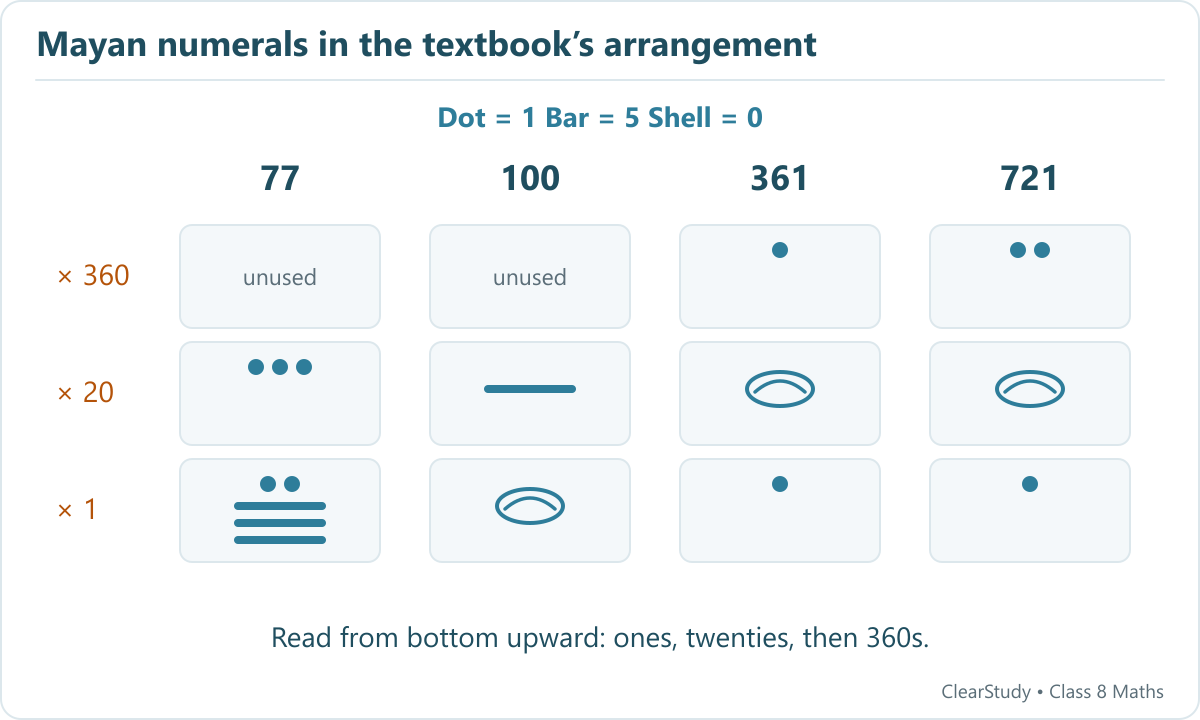
SOLUTIONThe Mayan arrangement used in this chapter has place values 1, 20, 360, 7200, … (written one below the other, lowest = 1s). A dot = 1, a bar = 5, a shell = 0 are used to record a value in each position, including a shell for zero.(i) 77 = (3)×20 + (17)×1 ⇒ position-20: 3; position-1: 17.(ii) 100 = (5)×20 + (0)×1 ⇒ position-20: 5; position-1: 0 (shell).(iii) 361 = (1)×360 + (0)×20 + (1)×1 ⇒ position-360: 1; position-20: 0 (shell); position-1: 1.(iv) 721 = (2)×360 + (0)×20 + (1)×1 ⇒ position-360: 2; position-20: 0 (shell); position-1: 1.Check: (i) 60+17 = 77; (ii) 100; (iii) 360+0+1 = 361; (iv) 720+0+1 = 721. ✓
The chapter uses the 1, 20, 360, 7200 arrangement. Do not replace 360 by 400 in these questions.
Figure it Out (Page 80)
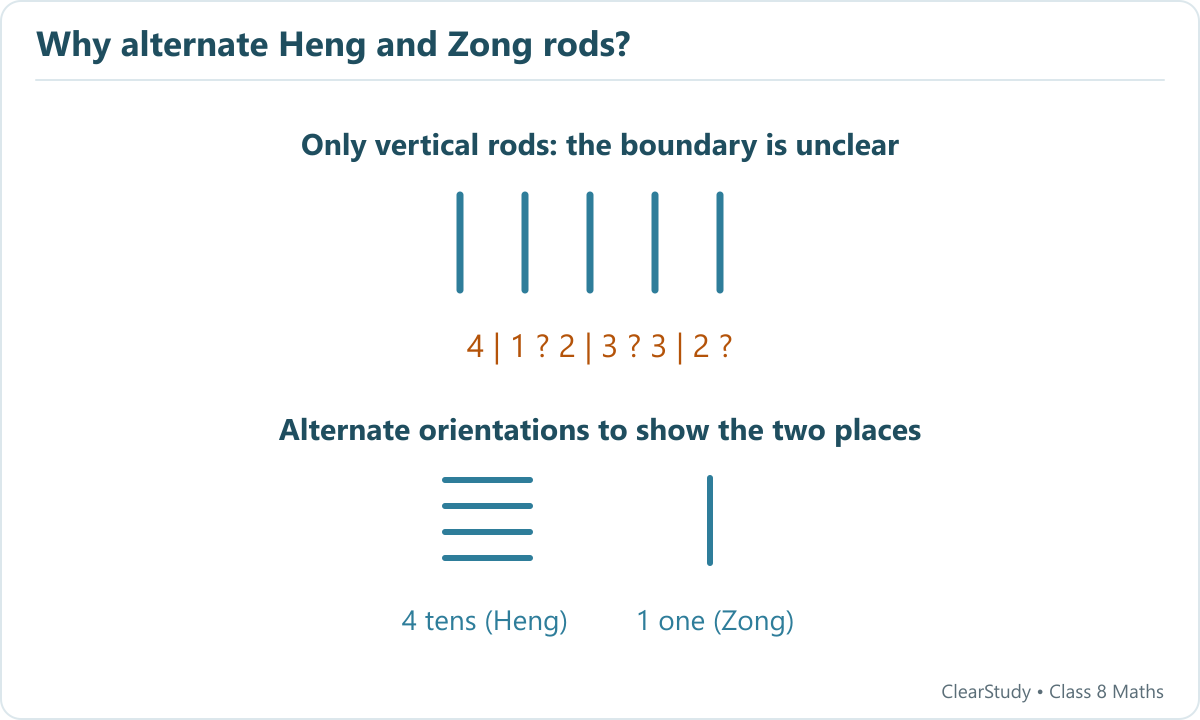
1. Why do you think the Chinese alternated between the Zong and Heng symbols? If only the Zong symbols were to be used, how would 41 be represented? Could this numeral be interpreted in any other way if there is no significant space between two successive positions?
SOLUTIONThe Chinese alternated between Zong (vertical) and Heng (horizontal) rod numerals so that neighbouring place values look different, making it easy to tell where one position ends and the next begins.If only Zong symbols were used, 41 = (4)×10 + 1 would be written as four vertical rods then one vertical rod — i.e. five identical-looking vertical rods in a row.With no clear space between positions, this could be misread as 23, 32 or even 122 — which is exactly why the Zong/Heng alternation (or a clear gap) is needed.
2. Form a base-2 place value system using ‘ukasar’ and ‘urapon’ as the digits. Compare this system with that of the Gumulgal’s.
SOLUTIONA base-2 place value system needs two digits, one for 0 and one for 1. For this newly invented system, deliberately reassign the words: urapon (ur) = 0 and ukasar (uk) = 1. Their original Gumulgal meanings were 1 and 2 respectively; place values are 20, 21, 22, …
Number
Base-2 (ur = 0, uk = 1)
Gumulgal system
1
uk
ur
2
uk ur
uk
3
uk uk
uk-ur
4
uk ur ur
uk-uk
5
uk ur uk
uk-uk-ur
6
uk uk ur
uk-uk-uk
7
uk uk uk
uk-uk-uk-ur
8
uk ur ur ur
uk-uk-uk-uk
Comparison: both use only two basic words, but the base-2 system is a place value system (position matters and it has a 0), whereas the Gumulgal system just counts in 2s by repetition (no place value, no zero). The place value system stays short for large numbers; the Gumulgal one grows longer and longer.
3. Where in your daily lives, and in which professions, do the Hindu numerals, and 0, play an important role? How might our lives have been different if our number system and 0 hadn’t been invented or conceived of?
SOLUTIONHindu numerals and 0 are used everywhere — money and shopping, telling time, phone numbers, measuring, banking, and in professions such as engineering, accounting, banking, science, medicine, computer programming (binary uses 0 and 1) and architecture.Without an efficient number system and zero, calculations would be slow and clumsy (like the Roman system), and modern science, technology and computers — which depend on 0 and place value — would have been extremely hard to develop.
4. The ancient Indians likely used base 10 for the Hindu number system because humans have 10 fingers, and so we can use our fingers to count. But what if we had only 8 fingers? How would we be writing numbers then? What would the Hindu numerals look like if we were using base 8 instead? Base 5? Try writing the base-10 Hindu numeral 25 as base-8 and base-5 Hindu numerals, respectively. Can you write it in base-2?
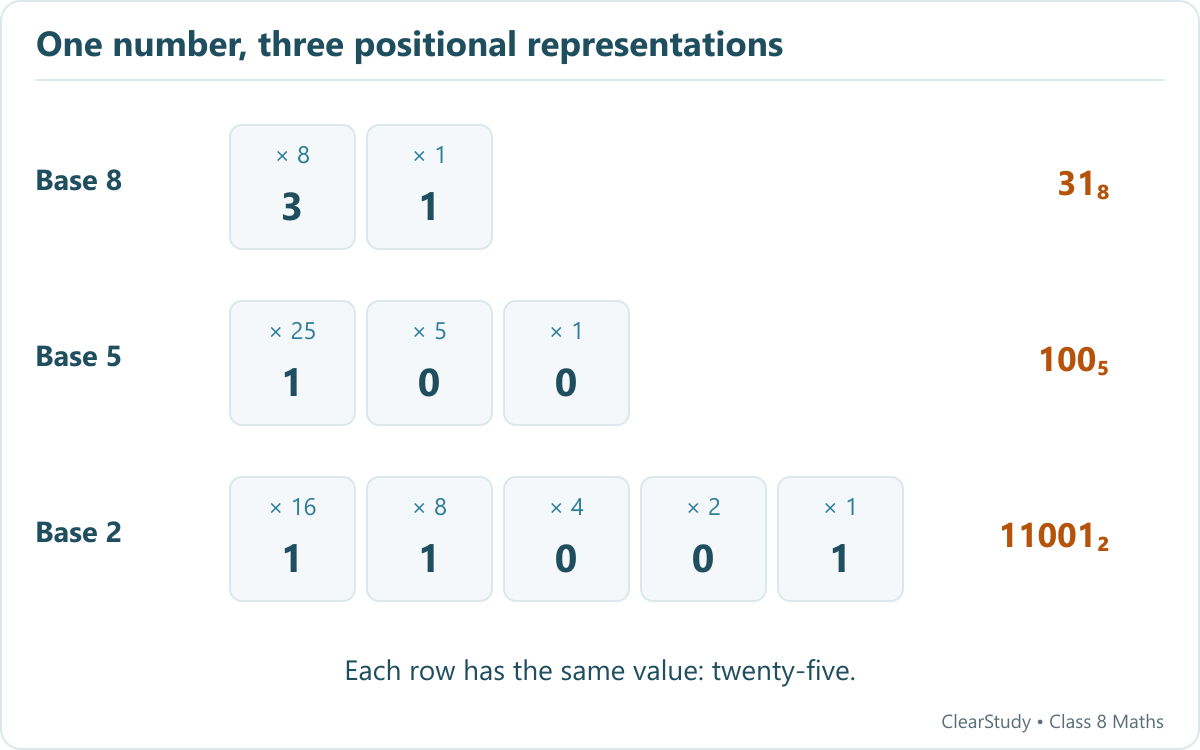
SOLUTIONWith 8 fingers we would probably use a base-8 system, with digits 0–7 and place values 80, 81, 82, … A base-5 system would use digits 0–4 and place values 50, 51, 52, …Base-8: 25 = (3)×8 + (1)×1, so 25 = 31 in base 8.Base-5: 25 = (1)×52 + (0)×5 + (0)×1, so 25 = 100 in base 5.Base-2: 25 = 16 + 8 + 1 = (1)×24 + (1)×23 + (0)×22 + (0)×21 + (1)×20, so 25 = 11001 in base 2.Check: 11001 = 16 + 8 + 0 + 0 + 1 = 25. ✓
A zero digit preserves an empty position. Always state the base when writing a numeral.
Math Talk & Try This Boxes
Math Talk — Counting with sticks (Page 51)How will you use such sticks to answer Q2 (do we have fewer cows than our neighbour?) and Q3 (how many more cows do we need?)Answer.Q2: Pair off your sticks one-to-one with your neighbour’s sticks. If your sticks run out first, you have fewer cows. Q3: The number of your neighbour’s sticks left unpaired is exactly how many more cows you need.
Math Talk — Letters as numbers (Page 53)How many numbers can you represent using the sounds of the letters of your language?Answer. Only as many as the number of letters — e.g. English has 26 letters, so single letters represent just 1 to 26. (Hindi/Devanagari has more letters, so a few more, but it is still limited.) This is the limitation that pushes us towards systems that can go on forever.
Math Talk — Extending Method 3 (Page 53)Do you see a way of extending this method (the Roman-style symbols I, II, III, …) to represent bigger numbers?Answer. Yes — by introducing new symbols for larger landmark numbers (V = 5, X = 10, L = 50, C = 100, …) and combining them, just as the Roman system does. This avoids writing huge strings of I’s.
Math Talk — Grouping at a glance (Page 57)Up to what group size could you immediately see the number of objects without counting?Answer. Most people can instantly recognise groups of up to about 4 objects; from 5 or more we usually need to count. This human limit is one reason number systems group in small sizes (like 5s) and give them new symbols.
Math Talk — Counting only by 5s (Page 58)What could be the difficulties with a system that counts only in a single group size? How would you represent 1345 in a system that counts only by 5s?Answer. Using only one group size, large numbers need very many symbols and become hard to read and compute with. To write 1345 by 5s you would need 269 fives (269×5 = 1345) — far too long. This shows why we need a sequence of landmark numbers (a base), not just one group size.
Try This — Roman addition (Page 60)Do it yourself: (b) LXXXVII + LXXVIII.Answer. LXXXVII = 87 and LXXVIII = 78, so the sum = 165 = 100 + 50 + 10 + 5 = CLXV. (Working with the symbols: collect the Ls, Xs, Vs and Is, regroup — two Ls = C, the Vs and Is regroup — to get CLXV.)
Try This / Math Talk — Roman products (Page 60)Find the products of the landmark numbers: V × L, L × D, V × D, VII × IX.Answer. V × L = 5 × 50 = 250 = CCL. L × D = 50 × 500 = 25000 = twenty-five M’s (MMM…M, 25 times) in the textbook’s extended additive convention, rather than standard modern Roman notation. V × D = 5 × 500 = 2500 = MMD. VII × IX = 7 × 9 = 63 = LXIII. (These show why Roman multiplication is awkward.)
Math Talk — Products in base-n (Pages 66–68)What is any landmark number × 10 (and × 102) in the Egyptian system? Does the “product of two landmark numbers is a landmark number” rule hold in the base-5 system, and in any base?Answer. Multiplying a landmark number (a power of 10) by 10 gives the next landmark number (10a × 10 = 10a+1); multiplying by 102 raises the power by 2, and so on. So the product of any two landmark numbers is again a landmark number. Yes, this holds in the base-5 system and in any base-n system, because na × nb = na+b — which is exactly why multiplication is easy in a base system.
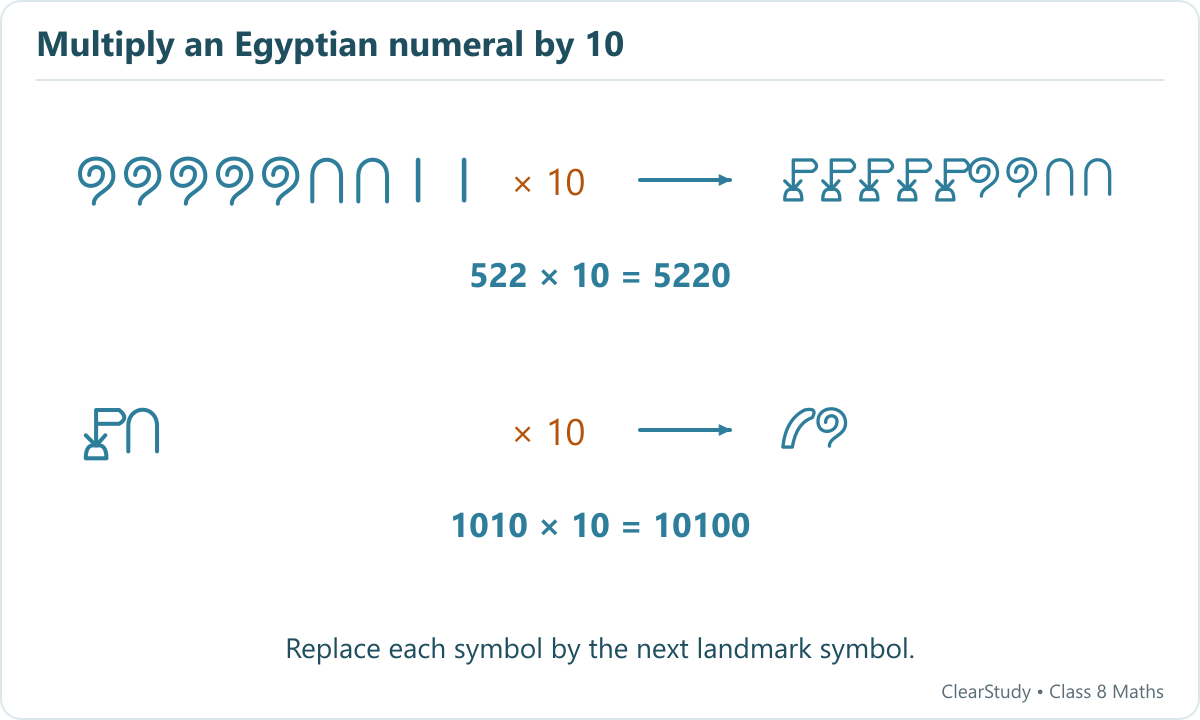
Page 68: multiplication by 10 advances every symbol one landmark.
Math Talk — Different counts for different objects (Page 60)A group of indigenous people in a Pacific island use different sequences of number names to count different objects. Why do you think they do this?Answer. Different objects (e.g. people, animals, long objects, round objects) were counted using different “counting words” that suited the kind of thing being counted — a cultural way of keeping track of what was being counted, not just how many. (Accept reasonable explanations.)
Math Talk — The Mesopotamian 3600 (Page 73)Look at the representation of 60. What will be the representation for 3,600?Answer. In the compact Mesopotamian system, 3600 = 602 was written with the same single “1” symbol as 1 and 60 — only its position (the third place from the right) told you it meant 3600. This sameness is exactly the defect that made their numerals ambiguous before the placeholder (zero) idea.
SOLUTIONPage 66, ×10: 10 × 10 = 100; 100 × 10 = 1000; 1000 × 10 = 10000; 10000 × 10 = 100000.Page 66, ×100: 10 × 100 = 1000; 100 × 100 = 10000; 1000 × 100 = 100000; 10000 × 100 = 1000000.Page 67, landmark products: 10 × 100000 = 1000000; 100 × 1000 = 100000; 1000 × 1000 = 1000000; 10000 × 1000000 = 10¹⁰. The final answer needs a landmark beyond the displayed symbol table.Page 68: (500 + 20 + 2) × 10 = 5220; (1000 + 10) × 10 = 10100. Replace every symbol by its next landmark symbol, as illustrated above.
Abacus addition (Page 69)
SOLUTIONFor 2907 + 43, begin with two counters on the thousands line, nine on hundreds, none on tens and seven on ones. Add four tens and three ones. Exchange ten ones for one ten: the final lines contain two thousands, nine hundreds, five tens and no ones. Thus 2907 + 43 = 2950.
Common Mistakes to Avoid
Watch out for these
Leaving ten or more identical Egyptian symbols in an unregrouped answer when the next landmark symbol is available.
Confusing landmark numbers with base: in a base-n system the landmark numbers must be the powers of n (1, n, n2, …).
Using 400 for the third place in the Mayan arrangement shown in this chapter: its first places are 1, 20 and 360.
Writing Roman numerals carelessly — e.g. 2999 is MMCMXCIX, not MM999 or IMMM; use the subtractive forms CM, XC, IX.
Reading a Mesopotamian or Chinese numeral wrongly when a blank place (zero) is missing — without a placeholder, 122, 23 and 32 can look alike.
Thinking 0 is “just nothing” — in the Hindu system 0 is both a placeholder and a number you can compute with.
Mixing up which Chinese symbols are Zong (vertical, for 1s, 100s, …) and Heng (horizontal, for 10s, 1000s, …).
Practice MCQs & Assertion–Reason
1. The symbols used to write numbers in a written number system are called:
(a) digits only (b) numerals (c) tallies (d) bases
2. The Roman numeral for 2999 is:
(a) MMCMXCIX (b) MMIM (c) MMCMIC (d) MMMCMXC
3. The landmark numbers of a base-n number system are:
(a) multiples of n (b) the powers of n (c) only 1 and n (d) n and 10
4. The Egyptian number system is a:
(a) base-5 system (b) base-20 system (c) base-10 (decimal) system (d) base-60 system
5. The Mesopotamian (Babylonian) system was a:
(a) base-10 system (b) base-20 system (c) base-60 (sexagesimal) system (d) base-2 system
6. In base 8, the number 25 (base 10) is written as:
(a) 25 (b) 31 (c) 100 (d) 41
7. The third place value of the Mayan arrangement in this chapter is:
(a) 400 (b) 360 (c) 100 (d) 8000
8. A number system that uses the position of a symbol to decide its value is called a:
(a) tally system (b) place value (positional) system (c) body-part system (d) Roman system
9. The base-5 representation of 25 (base 10) is:
(a) 25 (b) 50 (c) 100 (d) 31
10. The use of 0 as a number in its own right was codified in 628 CE by:
For each Assertion–Reason question, choose: (A) Both Assertion and Reason are true and the Reason is the correct explanation of the Assertion; (B) Both are true but the Reason is not the correct explanation; (C) Assertion is true but Reason is false; (D) Assertion is false but Reason is true.
A-R 1. Assertion: In a fully regrouped Egyptian numeral, a symbol below the highest available landmark occurs at most nine times.
Reason: Ten copies of any power of 10 equal one copy of the next power of 10.
A-R 2. Assertion: The Mayan arrangement with places 1, 20, 360 and 7200 is a pure base-20 system.
Reason: Its landmark numbers are 1, 20, 360, 7200, …, where the third is 360 instead of 400.
A-R 3. Assertion: A place value system needs a placeholder symbol like 0 to be unambiguous.
Reason: A blank space alone can be misread, making different numbers look the same.
A-R 4. Assertion: Multiplication is easier in a base-n system than in the Roman system.
Reason: In a base system the product of two landmark numbers is again a landmark number.
A-R 5. Assertion: The Hindu number system originated in India around 2000 years ago.
Reason: The Roman numerals were invented in India and later carried to Europe.
Answer key: 1-(A), 2-(D), 3-(A), 4-(A), 5-(C).
Quick Revision Summary
A number system is a fixed-order sequence of objects, names or symbols; we count by one-to-one mapping. Its written symbols are numerals.
Early ideas: counting with sticks/tally marks, with body parts (Papua New Guinea), and counting in 2s (Gumulgal).
Landmark numbers are reference numbers with their own symbols (Roman I, V, X, L, C, D, M).
A base-n system has landmark numbers that are the powers of n; the Egyptian and Hindu systems are base-10 (decimal).
In a base system the product of two landmark numbers is a landmark number, which makes multiplication easy.
Place value (positional) systems use a symbol’s position to fix its value — Mesopotamian (base-60), Mayan (almost base-20), Chinese (base-10), Indian (base-10).
The Hindu number system with the digit 0 (placeholder and number) lets us write all numbers unambiguously with just 10 symbols — one of history’s greatest inventions.
How to score full marks in this chapter
For every numeral question, first write the number as a sum of the system’s landmark numbers (e.g. 2999 = MM + CM + XC + IX), then convert — and always check by converting back to base 10. State the base before you start, regroup carefully (ten 1s → one 10 in base 10; five in base 5; sixty in base 60), and remember to write a 0/placeholder for any empty position in a place value system.
Frequently Asked Questions
What is Class 8 Maths Ganita Prakash Chapter 3 about?
Chapter 3, A Story of Numbers, tells how counting and number-writing evolved — from sticks, tally marks and body parts to the Roman, Egyptian, Mesopotamian, Mayan, Chinese and finally the Hindu (Indian) number system — and explains landmark numbers, the idea of a base, place value and the role of zero.
What is a base-n number system?
A base-n system is one whose landmark numbers are the powers of n: the first landmark number is 1, and every next landmark number is n times the current one (1, n, n2, n3, …). The Egyptian and Hindu systems are base-10.
How many exercises does Chapter 3 have?
The chapter has several “Figure it Out” sets (on pages 54, 59, 60–61, 62, 63, 65, 69–70, 73, 76 and 80) plus Math Talk and Try This activities. Use the page-wise headings and worked examples above.
Are these Class 8 Maths Ganita Prakash Chapter 3 solutions free?
Yes. All solutions are free and follow the official NCERT Ganita Prakash (Part I) textbook for 2026–27.