
Class 8 Maths Ganita Prakash Chapter 2 Solutions (NCERT 2026–27) – Power Play
These Class 8 Maths Ganita Prakash Chapter 2 solutions cover Power Play from the new NCF-2023 textbook (Part I, 2026–27). Every “Figure it Out” exercise, Math Talk and Try This box is solved step by step, with verified answers for the laws of exponents, powers of 10 and scientific notation so you can master the whole chapter quickly.
Chapter 2 Overview
Chapter 2 of Ganita Prakash, Power Play, uses playful situations — folding a sheet of paper, doubling lotuses in a magical pond, counting combinations of dresses and caps, and unlocking number-pad locks — to build the idea of exponents. You learn that na means n multiplied by itself a times, develop all the laws of exponents (product, quotient, power of a power, products and quotients with the same exponent, the zero exponent and negative exponents), and then apply them to powers of 10, the expanded form of decimals, and scientific (standard) notation for very large numbers. The chapter ends by comparing linear growth with exponential growth and getting a feel for huge quantities. Use the contents to jump to the exercises, in-text questions or additional activities.
Key Concepts & Definitions
Exponential form: na means n × n × … × n (n multiplied by itself a times). Here n is the base and a is the exponent (power). e.g. 54 = 5 × 5 × 5 × 5 = 625.
Exponential / multiplicative growth: a quantity that keeps doubling (or tripling) grows by a fixed factor each step — far faster than linear growth, which adds a fixed amount each step.
Zero exponent: n0 = 1 for any n ≠ 0.
Negative exponent: n−a = 1/na and na = 1/n−a (n ≠ 0).
Powers of 10: place value in our number system is built on powers of 10; decimals use negative powers, e.g. 10−1 = 1/10.
Scientific (standard) form: a positive number written as x × 10y, where 1 ≤ x < 10 (the coefficient) and y is an integer (the exponent).
Important Formulas (Laws of Exponents)
Product law: na × nb = na+b
Quotient law: na ÷ nb = na−b (n ≠ 0)
Power of a power: (na)b = (nb)a = na×b
Same exponent, product: ma × na = (m × n)a
Same exponent, quotient: ma ÷ na = (m ÷ n)a (n ≠ 0)
Zero & negative powers: n0 = 1 (n ≠ 0); n−a = 1/na (n ≠ 0)
Scientific notation: any positive number = x × 10y, with 1 ≤ x < 10 and y an integer.
Class 8 Maths Ganita Prakash Chapter 2 Solutions — Figure it Out (Set 1)
This first “Figure it Out” set appears in Section 2.2 (Exponential Notation and Operations).
1. Express the following in exponential form: (i) 6 × 6 × 6 × 6 (ii) y × y (iii) b × b × b × b (iv) 5 × 5 × 7 × 7 × 7 (v) 2 × 2 × a × a (vi) a × a × a × c × c × c × c × d
2. Express each of the following as a product of powers of their prime factors in exponential form. (i) 648 (ii) 405 (iii) 540 (iv) 3600
3. Write the numerical value of each of the following: (i) 2 × 10³ (ii) 72 × 23 (iii) 3 × 44 (iv) (−3)2 × (−5)2 (v) 32 × 104 (vi) (−2)5 × (−10)6
Class 8 Maths Ganita Prakash Chapter 2 Solutions — Figure it Out (Set 2)
This is the main end-of-chapter “Figure it Out” exercise (Q1–Q14).
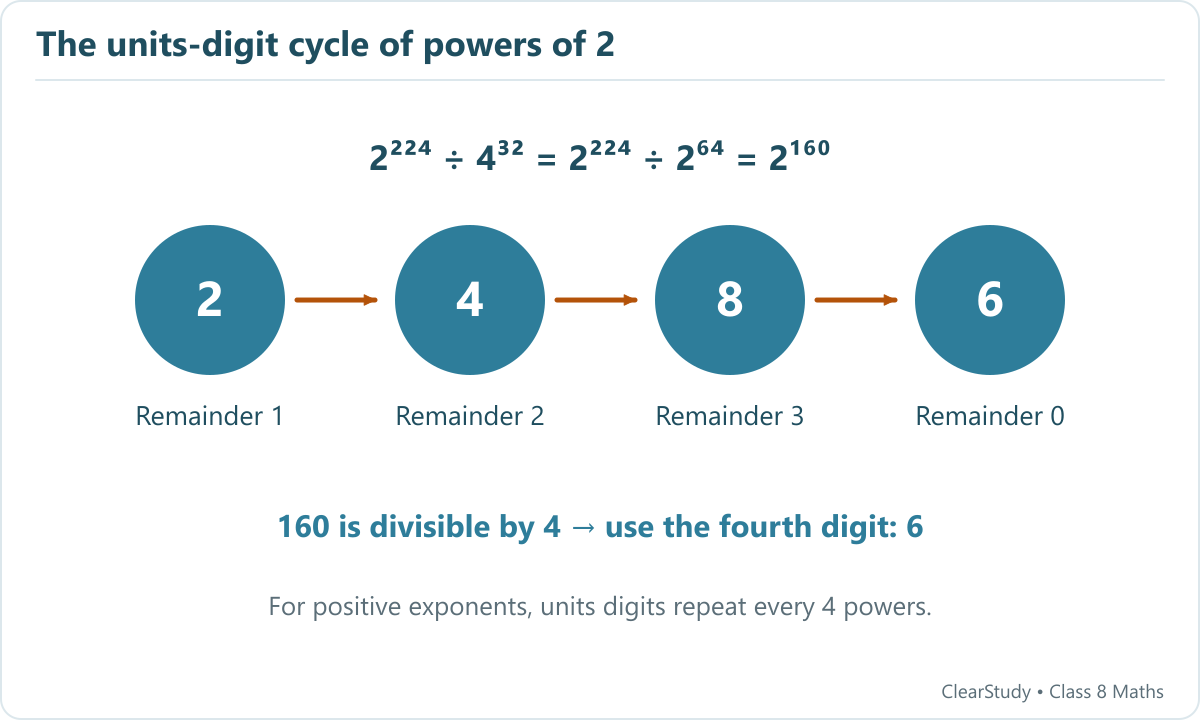
1. Find out the units digit in the value of 2224 ÷ 432? [Hint: 4 = 22]
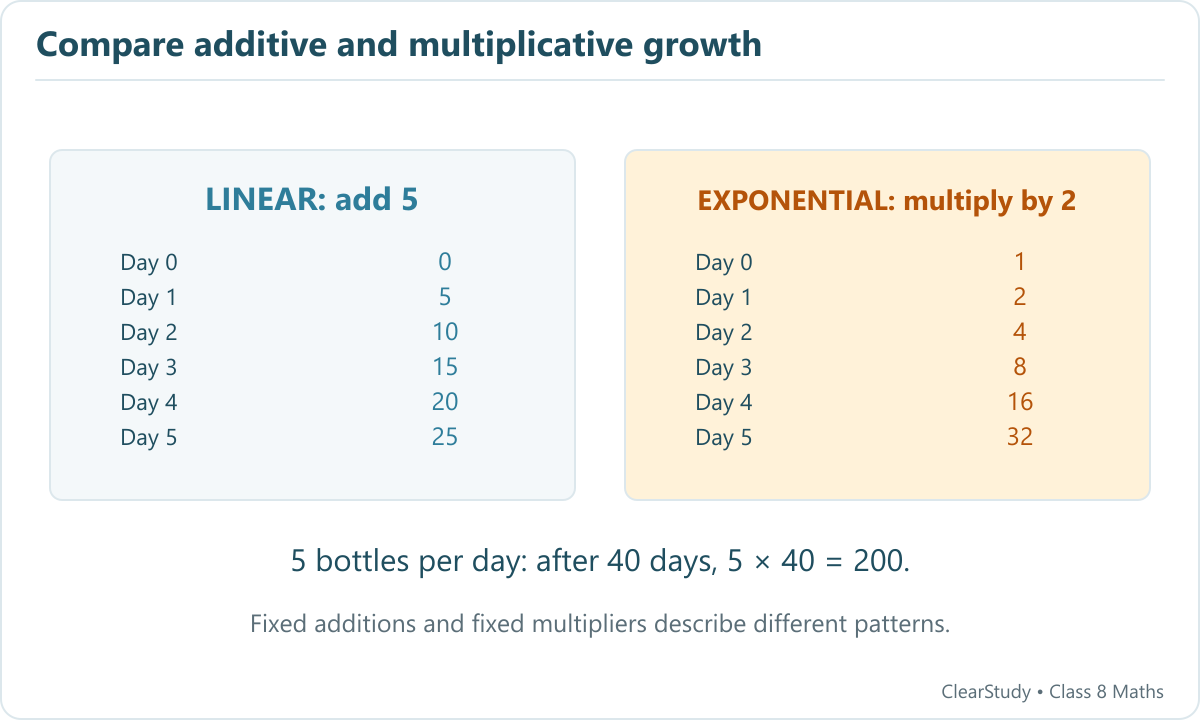
2. There are 5 bottles in a container. Every day, a new container is brought in. How many bottles would be there after 40 days?
3. Write the given number as the product of two or more powers in three different ways. The powers can be any integers. (i) 643 (ii) 1928 (iii) 32−5
4. Examine each statement below and find out if it is ‘Always True’, ‘Only Sometimes True’, or ‘Never True’. Explain your reasoning. (i) Cube numbers are also square numbers. (ii) Fourth powers are also square numbers. (iii) The fifth power of a number is divisible by the cube of that number. (iv) The product of two cube numbers is a cube number. (v) q46 is both a 4th power and a 6th power (q is a prime number).
5. Simplify and write these in the exponential form. (i) 10−2 × 10⁻⁵ (ii) 57 ÷ 54 (iii) 9−7 ÷ 94 (iv) (13−2)−3 (v) m5n12(mn)9
6. If 122 = 144 what is (i) (1.2)2 (ii) (0.12)2 (iii) (0.012)2 (iv) 1202
7. Circle the numbers that are the same— 24 × 36 64 × 32 610 182 × 62 624
8. Identify the greater number in each of the following— (i) 43 or 34 (ii) 28 or 82 (iii) 1002 or 2100
9. A dairy plans to produce 8.5 billion packets of milk in a year. They want a unique ID (identifier) code for each packet. If they choose to use the digits 0–9, how many digits should the code consist of?
10. 64 is a square number (82) and a cube number (43). Are there other numbers that are both squares and cubes? Is there a way to describe such numbers in general?
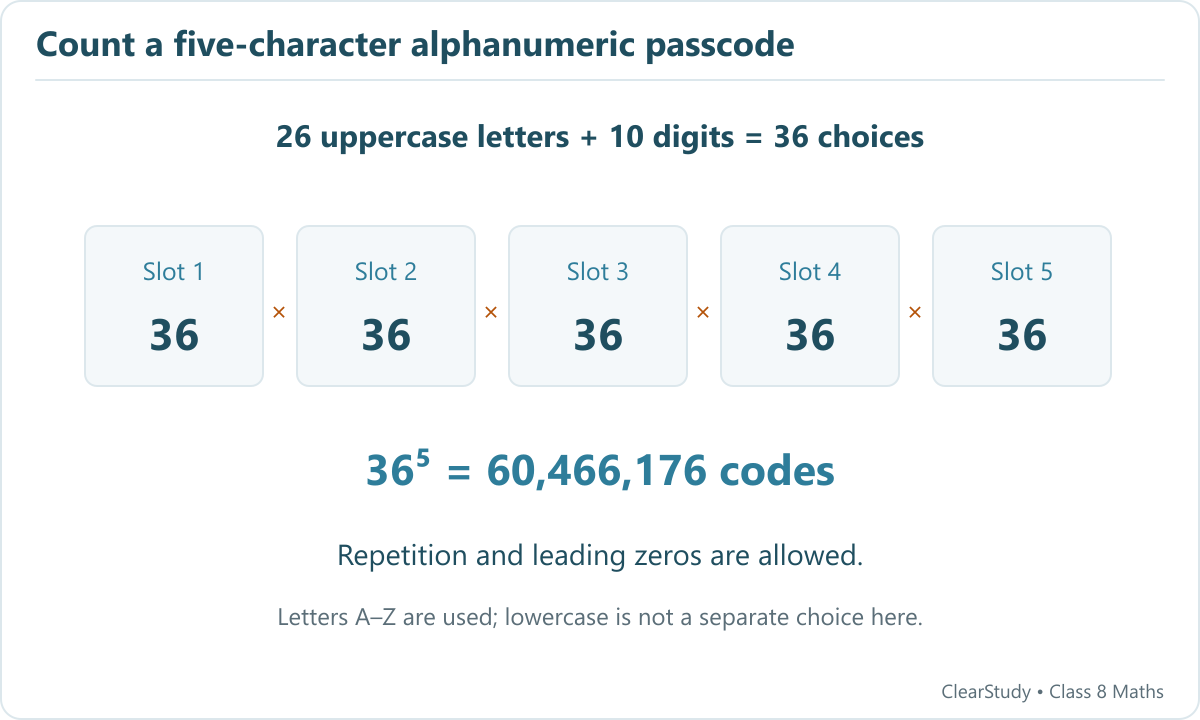
11. A digital locker has an alphanumeric (it can have both digits and letters) passcode of length 5. Some example codes are G89P0, 38098, BRJKW, and 003AZ. How many such codes are possible?
12. The worldwide population of sheep (2024) is about 109, and that of goats is also about the same. What is the total population of sheep and goats? (i) 209 (ii) 1011 (iii) 1010 (iv) 1018 (v) 2 × 10⁹ (vi) 109 + 109
13. Calculate and write the answer in scientific notation: (i) If each person in the world had 30 pieces of clothing, find the total number of pieces of clothing. (ii) There are about 100 million bee colonies in the world. Find the number of honeybees if each colony has about 50,000 bees. (iii) The human body has about 38 trillion bacterial cells. Find the bacterial population residing in all humans in the world. (iv) Total time spent eating in a lifetime in seconds.
14. What was the date 1 arab/1 billion seconds ago?
Math Talk & Try This — In-text Answers
These are the “?”, Math Talk and Try This prompts inside the chapter, in order of appearance.
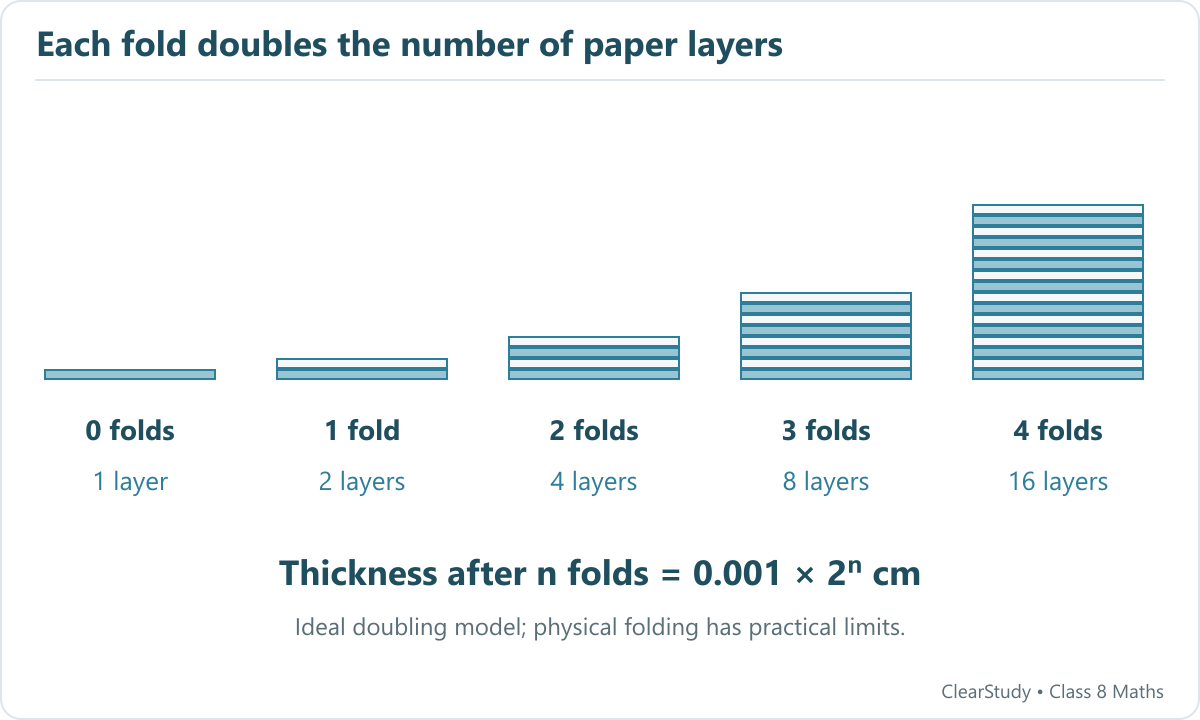
Which expression describes the thickness of a sheet of paper after it is folded 10 times? The initial thickness is the letter-number v. (i) 10v (ii) 10 + v (iii) 2 × 10 × v (iv) 210 (v) 210v (vi) 102v
What is (−1)5? Is it positive or negative? What about (−1)56? Is (−2)4 = 16? Verify.
Express the number 32400 as a product of its prime factors and represent the prime factors in their exponential form.
Math Talk: 37 can also be written as 32 × 35. Can you reason out why? Use the product law to compute (i) 29 (ii) 57 (iii) 46.
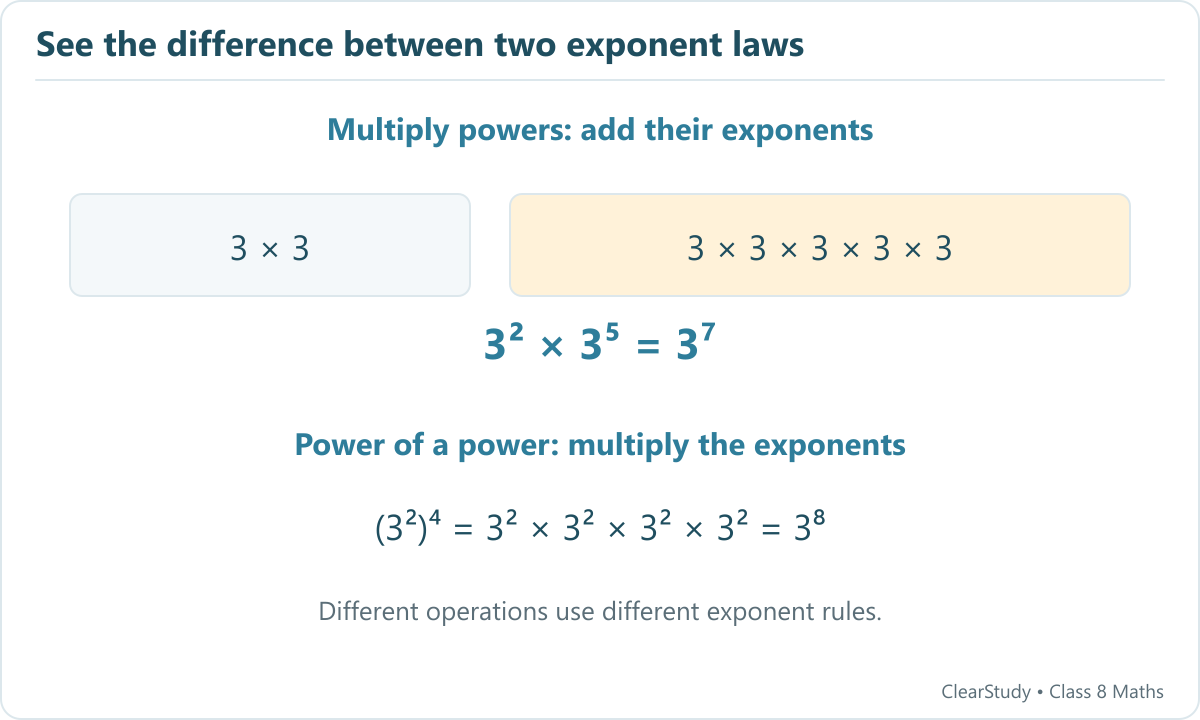
Write the following expressions as a power of a power in at least two different ways: (i) 86 (ii) 715 (iii) 914 (iv) 58.
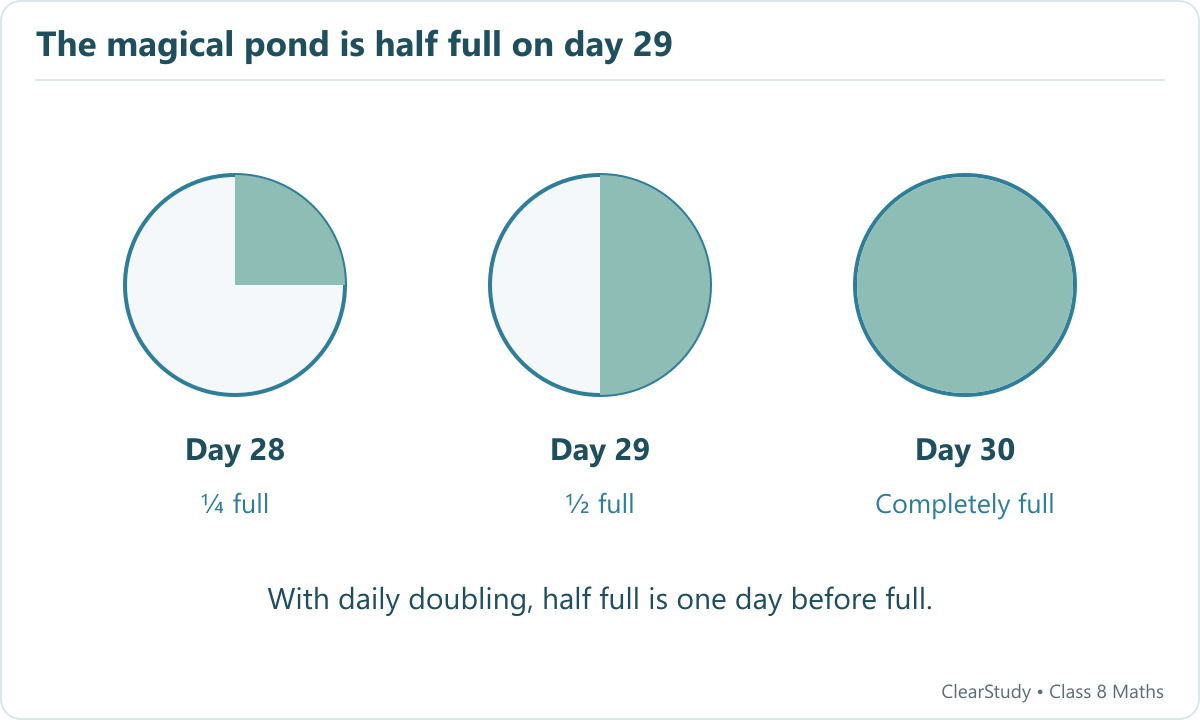
Magical Pond: Write the number of lotuses (in exponential form) when the pond was (i) fully covered (ii) half covered.
Use ma × na = (mn)a to compute 25 × 55. Simplify 104/54 and write it in exponential form.
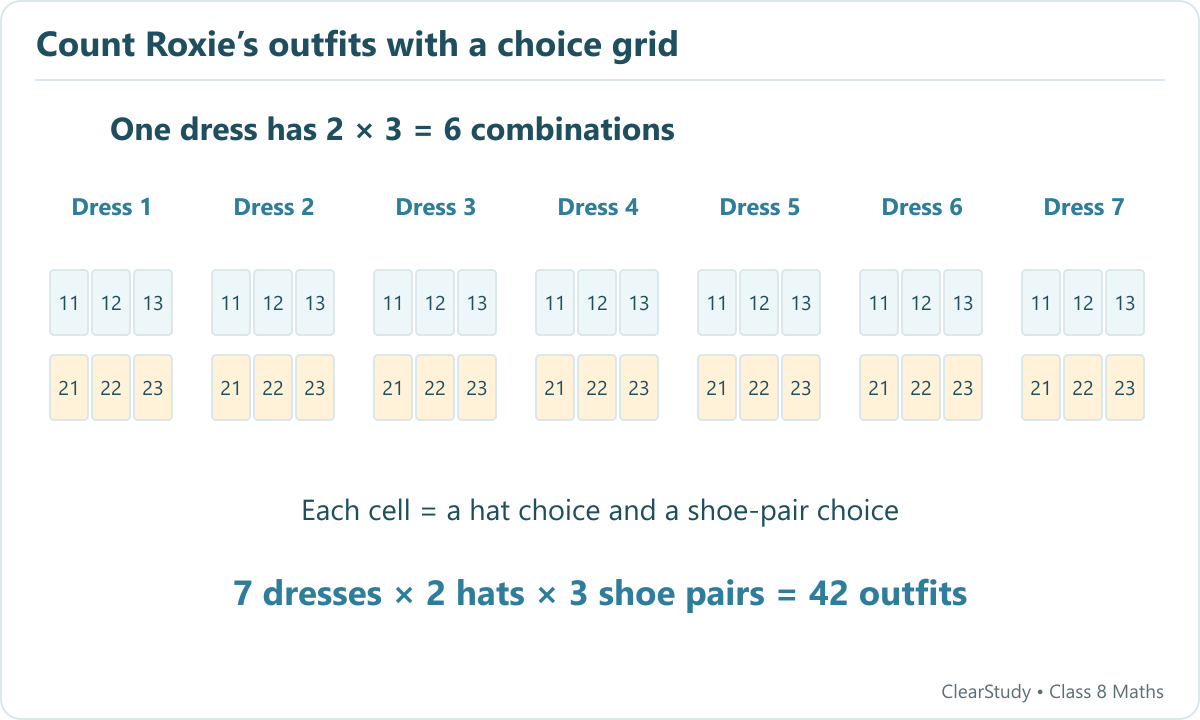
How Many Combinations: Roxie has 7 dresses, 2 hats, and 3 pairs of shoes. How many different ways can Roxie dress up? A 6-slot lock with letters A–Z: how many passwords are possible? What is 2100 ÷ 225 in powers of 2?
Math Talk (2.3): Why can’t n be 0 in na ÷ nb? Can a and b be any integers in the laws? How many times larger than 4−2 is 42?
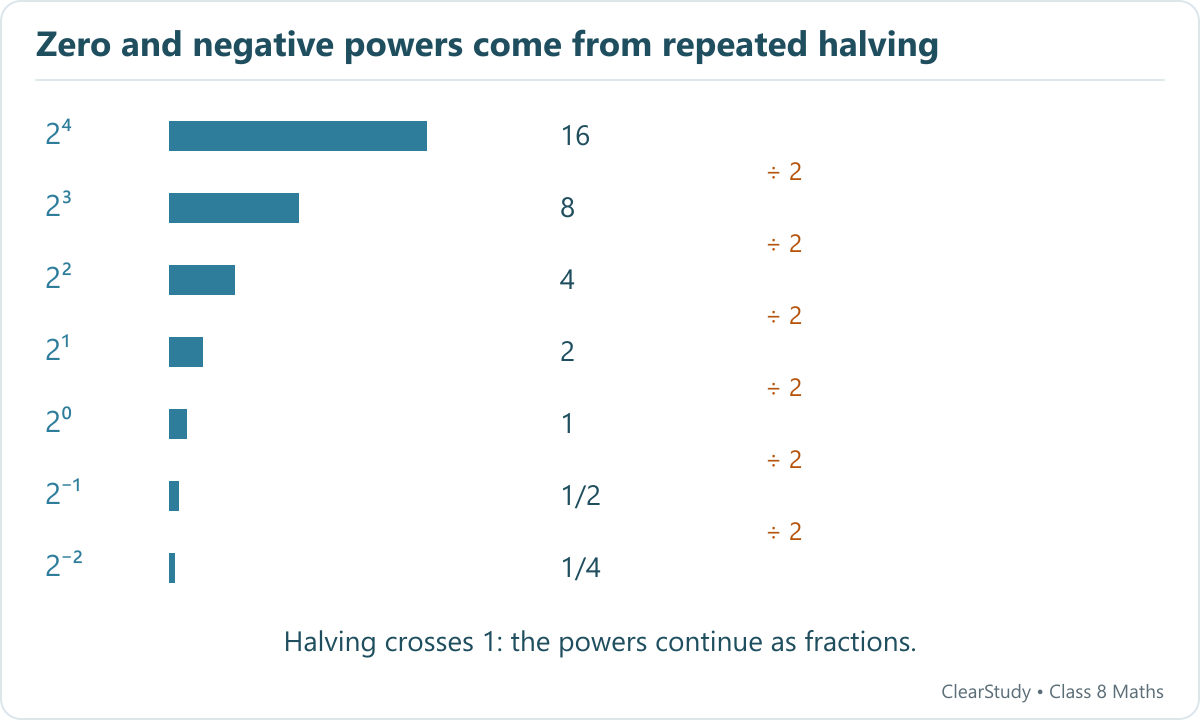
Write equivalent forms of: (i) 2−4 (ii) 10−5 (iii) (−7)−2 (iv) (−5)−3 (v) 10−100. Then simplify: (i) 2−4 × 27 (ii) 32 × 3−5 × 36 (iii) p3 × p−10 (iv) 24 × (−4)−2 (v) 8p × 8q.
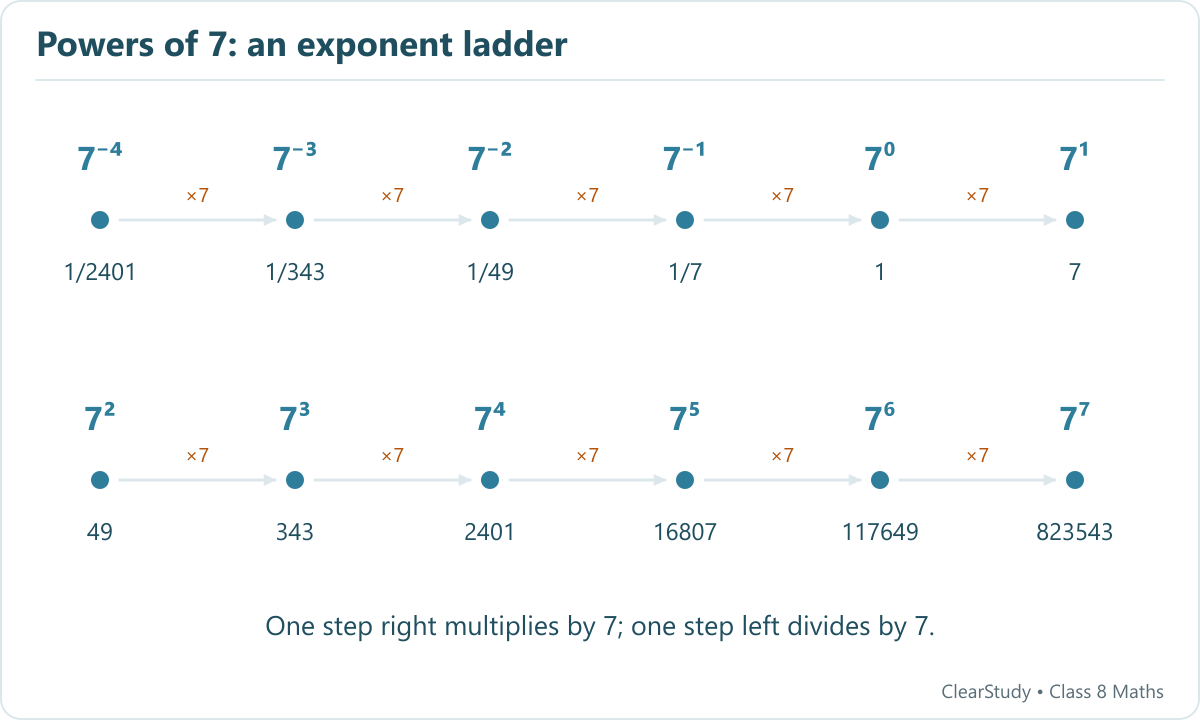
Power line for 7: evaluate 2,401 × 49; 493; 343 × 2,401; 16,807/49; 7/343; 16,807/8,23,543; 1,17,649 × (1/343); (1/343) × (1/343).
Powers of 10: Write 172, 5642 and 6374 using powers of 10.
Scientific Notation: Which of the three distances is smallest? Express in standard form: (i) 59,853 (ii) 65,950 (iii) 34,30,000 (iv) 70,04,00,00,000.
Try This (p.38): (i) ants per human (ii) number of starling flocks of 10,000 birds (iii) total leaves if each tree has 104 leaves (iv) sheets of paper to reach the Moon.
Try This (p.42): (i) seconds to count all stars one per second (ii) time to drink all water on Earth at one 200 ml glass per 10 s. If you have lived for a million seconds, how old are you?
Additional textbook activities and visual solutions
Complete the folding tables (pages 19–21)
Assume the paper starts at 0.001 cm and each fold doubles its thickness. Actual paper cannot be folded indefinitely; this is an ideal mathematical model. Two additional folds multiply thickness by 4, three by 8, and ten by 1024.
| Fold | Thickness (approximately) | Fold | Thickness (approximately) |
|---|---|---|---|
| 18 | 0.002621 km | 32 | 42.95 km |
| 19 | 0.005243 km | 33 | 85.899 km |
| 20 | 0.010486 km | 34 | 171.799 km |
| 21 | 0.020972 km | 35 | 343.597 km |
| 22 | 0.041943 km | 36 | 687.195 km |
| 23 | 0.083886 km | 37 | 1,374.39 km |
| 24 | 0.167772 km | 38 | 2,748.779 km |
| 25 | 0.335544 km | 39 | 5,497.558 km |
| 26 | 0.671089 km | 40 | 10,995.116 km |
| 27 | 1.342177 km | 41 | 21,990.233 km |
| 28 | 2.684355 km | 42 | 43,980.465 km |
| 29 | 5.368709 km | 43 | 87,960.93 km |
| 30 | 10.737418 km | 44 | 1,75,921.86 km |
| 31 | 21.474836 km | 45 | 3,51,843.721 km |
Useful conversions: fold 18 = 262.144 cm; fold 19 = 524.288 cm; fold 20 = 10.48576 m; fold 26 ≈ 671.089 m; fold 30 ≈ 10.737 km; fold 45 ≈ 351,843.721 km; fold 46 ≈ 703,687.442 km. The ideal stack exceeds the chapter’s Earth–Moon distance of 384,400 km at fold 46.
The Stones that Shine (pages 23–24)
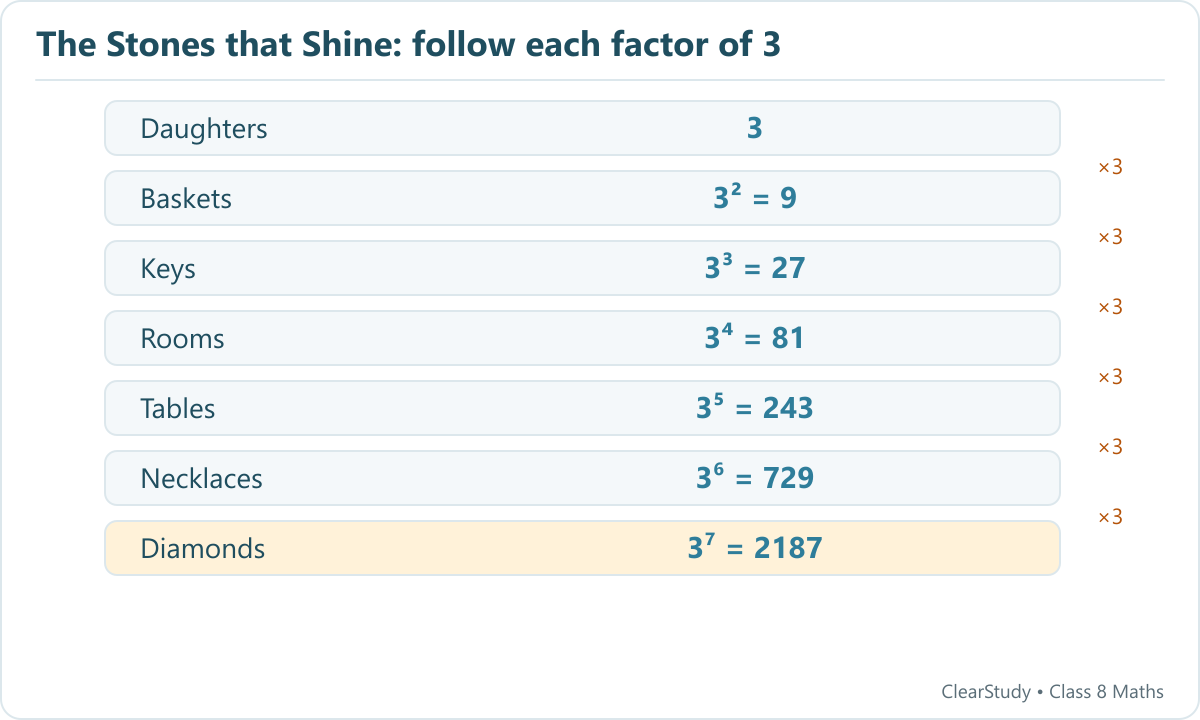
Multiply once for each level in the story: 3 daughters × 3 baskets × 3 keys × 3 rooms × 3 tables × 3 necklaces × 3 diamonds = 3⁷ = 2187 diamonds. There are 3⁴ = 81 rooms, each ultimately providing 3³ = 27 diamonds. Also, p⁴ × p⁶ = p¹⁰ and 2¹⁰ = (2⁵)² = 32 × 32 = 1024.
Transfer between doubling and tripling ponds (page 25)
Four days of doubling give 2⁴ = 16 lotuses. Four more days of tripling give 16 × 3⁴ = 16 × 81 = 1296. Reversing the ponds gives 3⁴ × 2⁴, the same result. The common exponent lets us write the product as (2 × 3)⁴ = 6⁴.
Locks and real-world codes (pages 26–27)
Estu’s 4 dresses and 3 caps make 12 outfits. A five-digit lock, allowing repetition and leading zeros, has 10⁵ = 100,000 codes, from 00000 to 99999. A six-slot lock using A–Z has 26⁶ = 308,915,776 possible codes.
For the open investigation about postal, mobile and vehicle codes, first record the actual rules: which positions allow letters or digits, whether the first position is restricted, and which combinations are reserved. Multiply the allowed choices only when each choice is independent. The number of mathematically possible strings may exceed the number actually assigned. Record the official source and date when researching a real code system.
Expand a decimal with powers of 10 (page 30)
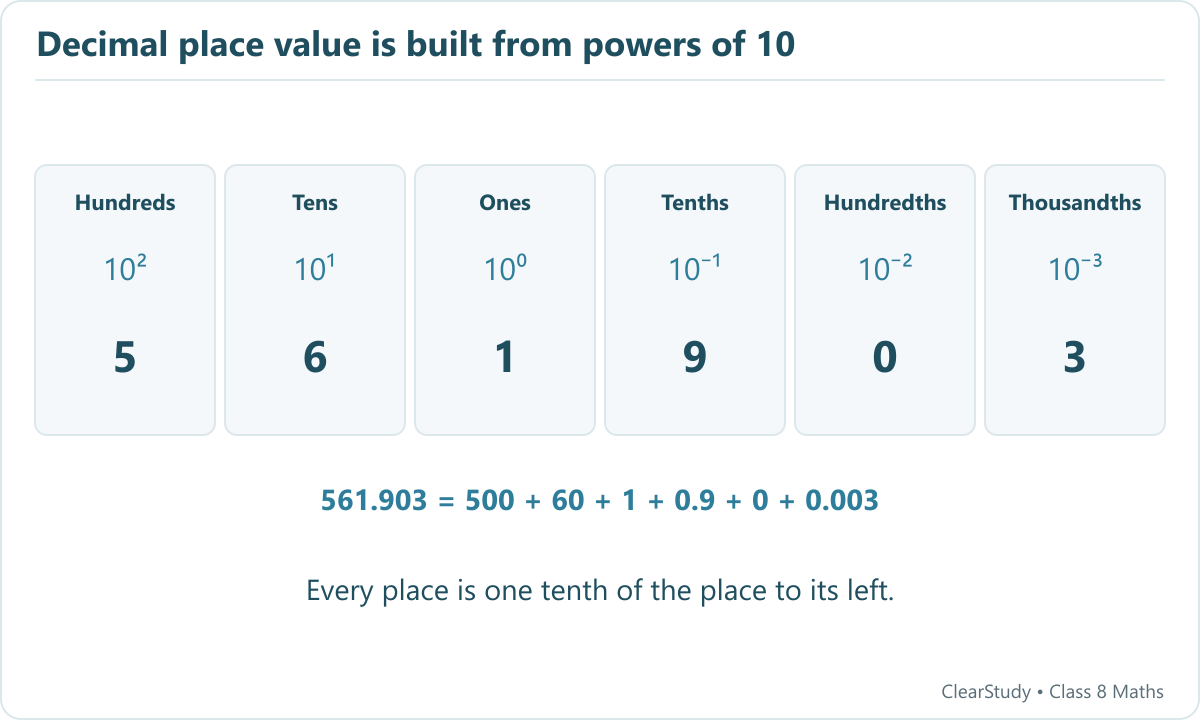
561.903 = 5 × 10² + 6 × 10¹ + 1 × 10⁰ + 9 × 10⁻¹ + 0 × 10−2 + 3 × 10⁻³.
Large-number notation and the distance diagram (pages 31–32)
The chapter’s three large-number facts become 3 × 10²⁰ m, 1 × 10¹¹ stars and 5.976 × 10²⁴ kg. These are the textbook’s example estimates, not freshly measured figures.
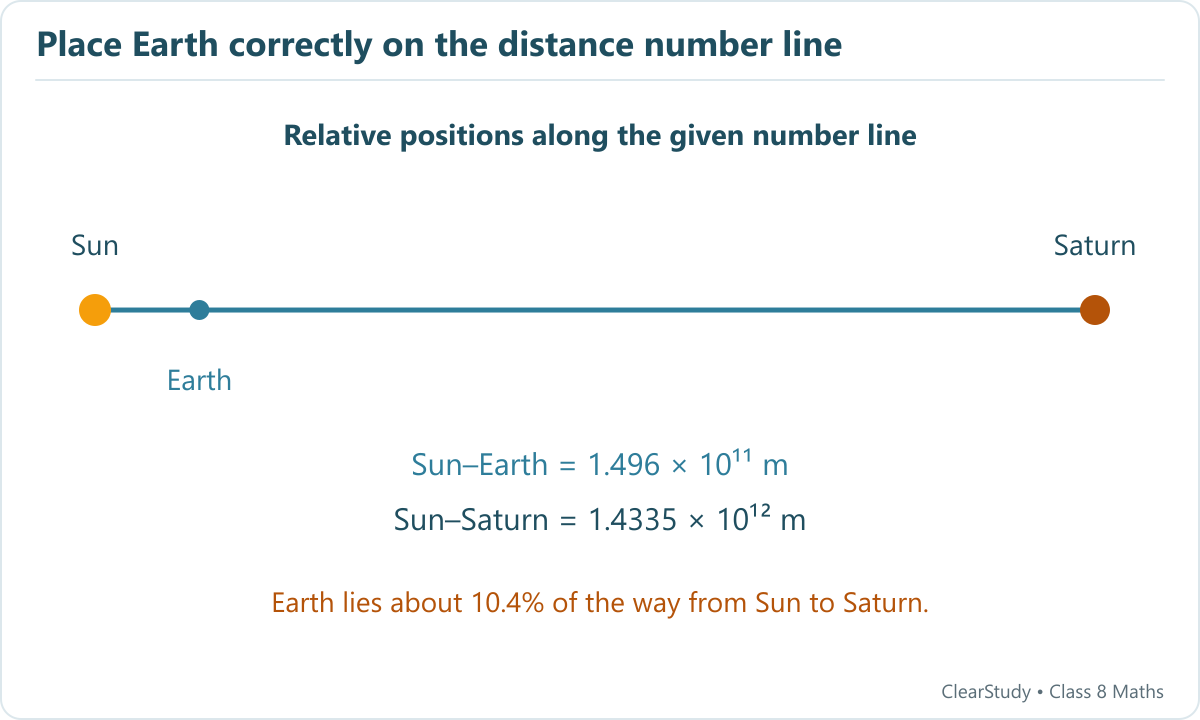
On the Sun–Saturn line, Earth belongs about 10.4% of the distance from the Sun, since (1.496 × 10¹¹)/(1.4335 × 10¹²) ≈ 0.1044. The diagram above uses that ratio. An approximate age such as 70 million years does not justify claiming precision to 15 extra years: the original estimate was rounded.
Thought experiments: state your assumptions (pages 33–35)
These problems accept different reasonable estimates. The following are sample assumptions for calculation, not current prices, standard body weights or universal coin weights.
| Question | Assumptions and calculation |
|---|---|
| Donation value | 45 kg of jaggery at ₹70/kg: 45 × 70 = ₹3150. 50 kg of wheat at ₹50/kg: 50 × 50 = ₹2500. |
| ₹1 coins matching 45 kg | Assume the particular coin weighs 4 g. 45,000/4 = 11,250 coins, worth ₹11,250. Measure the coin used if doing this activity. |
| ₹5 coins or ₹10 notes matching 45 kg | Assume 6 g per ₹5 coin: 45,000/6 = 7,500 coins, worth ₹37,500. Assume 1 g per ₹10 note: 45,000 notes, worth ₹450,000. |
| Notebooks matching an adult’s weight | Assume 60 kg and 0.2 kg per notebook: 60/0.2 = 300 notebooks; one each could benefit 300 students. |
| Grain matching an adult’s weight | Assume 60 kg of grain and 0.1 kg per serving: 60/0.1 = 600 grain servings. This estimates the grain component, not a complete meal. |
| 400 km walking journey | Assume 5 km/h for 8 hours/day: 40 km/day, so 400/40 = 10 walking days. Rest days would add time. |
| Non-stop lifetime walk around Earth | For the hypothetical model, assume 70 years at 5 km/h, using 365 days/year: 5 × 24 × 365 × 70 = 3,066,000 km; divide by 40,000 to get about 76.65 circuits. This is not physically feasible. |
For a ladder to the Moon with 20 cm step spacing: 384,400 km = 3.844 × 10¹⁰ cm, so the model needs 1.922 × 10⁹ step intervals. Adding the same distance each step is linear growth; doubling paper thickness is exponential growth. Adding ₹10 to savings daily is another linear example; an ideal population doubling every generation is exponential.
Fill the large-number blanks (pages 37–42)
Using the chapter’s estimates: 1.3 billion starlings = 1.3 × 10⁹; 110 trillion mosquitoes = 1.1 × 10¹⁴. Humans per African elephant ≈ (8 × 10⁹)/(4 × 10⁵) = 2 × 10⁴ = 20,000.
Using 365 days per year, 15 million years ≈ 15 × 10⁶ × 31,536,000 = 4.7304 × 10¹⁴ seconds (about 4.7 × 10¹⁴). Similarly, 470 million years ≈ 1.482192 × 10¹⁶ seconds (about 1.5 × 10¹⁶).
Examples of time scales: a one-day school trip lasts 8.64 × 10⁴ seconds, of order 10⁵; a 12-day holiday lasts 1.0368 × 10⁶ seconds, of order 10⁶.
Age in days, hours and seconds (page 39)
Roxie’s 4,840 days equal 4,840 × 24 = 116,160 hours. To find the birthday of someone aged 4,070 days, subtract 4,070 calendar days from the reference date. For example, 4 October 2026 − 4,070 days = 13 August 2015. A million seconds is exactly 11 days, 13 hours, 46 minutes and 40 seconds.
The unexplained age “69,70,710” needs a unit. If it means minutes, it is 6,970,710/(60 × 24 × 365) ≈ 13.26 years, a plausible interpretation for the character. If it means seconds, it is only about 80.68 days. The number alone is insufficient.
Names of large numbers (page 43)
| Name | Power of ten |
|---|---|
| Lakh | 10⁵ |
| Million | 10⁶ |
| Crore | 10⁷ |
| Arab / billion | 10⁹ |
| Kharab | 10¹¹ |
| Trillion | 10¹² |
| Neel | 10¹³ |
| Padma / quadrillion | 10¹⁵ |
| Shankh | 10¹⁷ |
| Maha shankh | 10¹⁹ |
In the short-scale international sequence, million is 1000², billion is 1000³, trillion is 1000⁴, and so on. For n = 1, 2, 3, … the corresponding “-illion” value is 103(n+1). A googol is 10¹⁰⁰ and a googolplex is 10(10¹⁰⁰).
Tremendous in Ten! (page 47)
Round 1: Roxie’s 10¹³ exceeds Estu’s 999999², which is less than (10⁶)² = 10¹².
Round 2: Roxie writes 4 × 10¹⁰⁰⁰. Estu writes 9000 × 101000000 = 9 × 101000003, which is far greater. Compare the exponent first.
For your own rounds, agree on allowed digits, operations, parentheses and whether exponent towers are permitted. Under a ten-second writing limit there is no single largest possible answer independent of those rules. Compare legal expressions by place value, grouping factors and exponent laws.
Common Mistakes to Avoid
Watch out for these
- Confusing an with a × n — 210 = 1024, but 2 × 10 = 20. Repeated multiplication, not multiplication by the exponent.
- Adding exponents when adding powers: 109 + 109 = 2 × 10⁹, not 1018. Exponents add only when powers are multiplied.
- Sign of negative bases: an even power is positive, an odd power is negative. e.g. (−1)56 = +1, (−1)5 = −1.
- Negative exponent does not make a number negative: 2−4 = 1/24 = 1/16, a positive fraction.
- Scientific form needs the coefficient between 1 and 10: write 5900 = 5.9 × 10³, not 59 × 102.
- For powers of a power, multiply the exponents: (13−2)−3 = 136, not 13−5.
Practice MCQs & Assertion–Reason
1. In 54 = 625, the number 4 is called the:
(a) base (b) exponent (c) coefficient (d) product
2. 23 × 25 equals:
(a) 28 (b) 215 (c) 48 (d) 22
3. The value of 70 is:
(a) 0 (b) 7 (c) 1 (d) undefined
4. (32)4 is equal to:
(a) 36 (b) 38 (c) 98 (d) 316
5. 2−3 is the same as:
(a) −8 (b) −6 (c) 1/8 (d) 1/6
6. The number 3.081 × 10⁸ in usual form is:
(a) 30810000 (b) 308100000 (c) 3081000000 (d) 30810
7. 109 ÷ 104 equals:
(a) 1013 (b) 1036 (c) 105 (d) 15
8. 25 × 55 equals:
(a) 105 (b) 1010 (c) 1025 (d) 75
9. Which of these is the greatest?
(a) 43 (b) 34 (c) 25 (d) 52
10. The standard (scientific) form of 34,30,000 is:
(a) 3.43 × 10⁵ (b) 34.3 × 10⁵ (c) 3.43 × 10⁶ (d) 0.343 × 10⁷
For each Assertion–Reason question, choose: (A) Both Assertion and Reason are true and the Reason is the correct explanation of the Assertion; (B) Both are true but the Reason is not the correct explanation; (C) Assertion is true but Reason is false; (D) Assertion is false but Reason is true.
A-R 1. Assertion: 20 = 1.
Reason: For any non-zero base x, xa ÷ xa = x0 = 1.
A-R 2. Assertion: 109 + 109 = 1018.
Reason: When two powers with the same non-zero base are multiplied, their exponents are added.
A-R 3. Assertion: 5−2 = 1/25.
Reason: For n ≠ 0, n−a = 1/na.
A-R 4. Assertion: (−2)4 = 16.
Reason: (−2)4 = [(−2) × (−2)] × [(−2) × (−2)] = 4 × 4 = 16.
A-R 5. Assertion: 5900 written in scientific form is 59 × 102.
Reason: In scientific form x × 10y, the coefficient x must satisfy 1 ≤ x < 10.
Quick Revision Summary
- na means n multiplied by itself a times; base = n, exponent = a.
- Exponential (multiplicative) growth is far faster than linear (additive) growth.
- Product law: na × nb = na+b; Quotient law: na ÷ nb = na−b (n ≠ 0).
- Power of a power: (na)b = (nb)a = na×b.
- Same exponent: ma × na = (mn)a; ma ÷ na = (m/n)a.
- n0 = 1 (n ≠ 0); n−a = 1/na (n ≠ 0).
- Scientific form: x × 10y with 1 ≤ x < 10 and y an integer; e.g. 308100000 = 3.081 × 10⁸.
How to score full marks in this chapter
Quote the law you are using before each step (product, quotient, power of a power, etc.), and never “add” exponents when you are adding numbers. Keep answers in exponential form unless a numerical value is asked, write scientific notation with the coefficient between 1 and 10, and double-check the sign of negative bases (even power → positive, odd power → negative). For estimation questions, state your assumptions clearly — reasonable assumptions earn marks.
Frequently Asked Questions
What is Class 8 Maths Ganita Prakash Chapter 2 Power Play about?
Power Play introduces exponents through fun situations (paper folding, doubling lotuses, combination locks). It builds all the laws of exponents, the zero and negative exponents, powers of 10, expanded form of decimals, and scientific (standard) notation, and compares linear with exponential growth.
What are the laws of exponents covered in this chapter?
na × nb = na+b; na ÷ nb = na−b; (na)b = na×b; ma × na = (mn)a; ma ÷ na = (m/n)a; n0 = 1 and n−a = 1/na (all for non-zero bases).
How do you write a number in scientific notation?
Write it as x × 10y, where the coefficient x is at least 1 but less than 10 and y is an integer. For example, 34,30,000 = 3.43 × 10⁶ and 308100000 = 3.081 × 10⁸.
Are these Class 8 Maths Ganita Prakash Chapter 2 solutions free?
Yes. All ClearStudy NCERT Solutions for Class 8 Maths Ganita Prakash Chapter 2 (Power Play) are free and follow the official NCERT textbook for 2026–27.
Textbook reference: NCERT Ganita Prakash, Chapter 2 (official PDF). ClearStudy diagrams and worked explanations are original teaching aids.