
Class 8 Maths Ganita Prakash Chapter 1 Solutions (NCERT 2026–27) – A Square and A Cube
These Class 8 Maths Ganita Prakash Chapter 1 solutions cover A Square and A Cube from the new NCF-2023 textbook (Reprint 2026–27). Every Figure it Out question is solved step by step, with worked square roots, cube roots, prime factorisations and number patterns, so you can master the chapter and revise it quickly.
- Chapter overview
- Key concepts & definitions
- Important formulas & patterns
- Figure it Out (Square Numbers & Square Roots)
- Math Talk & Try This (answered)
- Figure it Out (Cube Numbers & Cube Roots)
- Textbook activities and diagrams
- Square Pairs puzzles
- Common mistakes to avoid
- Practice MCQs & Assertion–Reason
- Quick revision summary
- FAQs
Chapter 1 Overview
Chapter 1 of Ganita Prakash, A Square and A Cube, opens with Queen Ratnamanjuri’s locker puzzle and uses it to discover why only square numbers have an odd number of factors. From there it builds the ideas of perfect squares (their units digits, the link with consecutive odd numbers, triangular numbers and parity), square roots (by estimation and prime factorisation), perfect cubes and cube roots, the famous taxicab number 1729, and a pinch of history of the Sanskrit words varga, ghana and mula. The Class 8 Maths Ganita Prakash Chapter 1 solutions below work through every Figure it Out, Math Talk and Try This question step by step.
Key Concepts & Definitions
Square number: a number that can be written as the product of a number with itself, e.g. 1, 4, 9, 16, 25, … In general n × n = n2.
Perfect square: the square of a natural number. Every perfect square ends in 0, 1, 4, 5, 6 or 9 (never 2, 3, 7 or 8) and has an even number of zeros at the end.
Square root: the inverse of squaring — if y = x2, then x is a square root of y. The symbol √y means the principal, non-negative square root. For example, √49 = 7, while the equation x2 = 49 has solutions x = 7 and x = −7. Also, √0 = 0 and √(x2) = |x|.
Cube number / perfect cube: a number obtained by multiplying a number by itself three times, e.g. 1, 8, 27, 64, … In general n × n × n = n3.
Cube root: the inverse of cubing — if y = x3, then x is the cube root of y, written 3√y, e.g. 3√8 = 2.
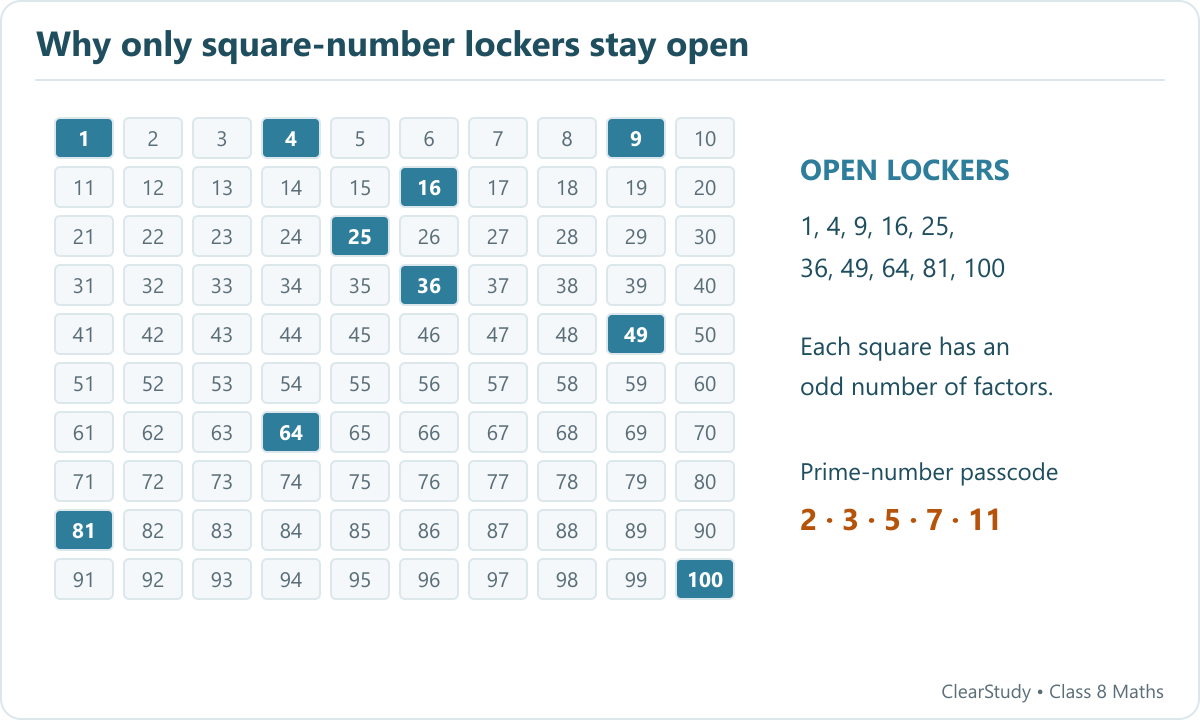
Odd-factor fact: among positive integers, only square numbers have an odd number of factors, because one factor pairs with itself.
Taxicab number: a number expressible as a sum of two positive cubes in two different ways; the smallest is 1729 = 13 + 123 = 93 + 103 (the Hardy–Ramanujan number).
Important Formulas & Patterns (Chapter 1)
Square & cube: n2 = n × n • n3 = n × n × n.
Square as a sum of odd numbers: n2 = 1 + 3 + 5 + … + (2n − 1). The k-th odd number is 2k − 1.
Step from one square to the next: (n + 1)2 = n2 + (2n + 1).
Numbers between two squares: between n2 and (n + 1)2 there are exactly 2n whole numbers.
Square root by prime factorisation: split prime factors into two identical groups; the product of one group is √n.
Cube root by prime factorisation: split prime factors into three identical groups; the product of one group is 3√n.
Cubes as a sum of odd numbers: 13 = 1, 23 = 3 + 5, 33 = 7 + 9 + 11, … (consecutive odd numbers).
Figure it Out — Square Numbers & Square Roots (Page 10–11)
1. Which of the following numbers are not perfect squares? (i) 2032 (ii) 2048 (iii) 1027 (iv) 1089
2. Which one among 642, 1082, 2922, 362 has last digit 4?
3. Given 1252 = 15625, what is the value of 1262? (i) 15625 + 126 (ii) 15625 + 262 (iii) 15625 + 253 (iv) 15625 + 251 (v) 15625 + 512
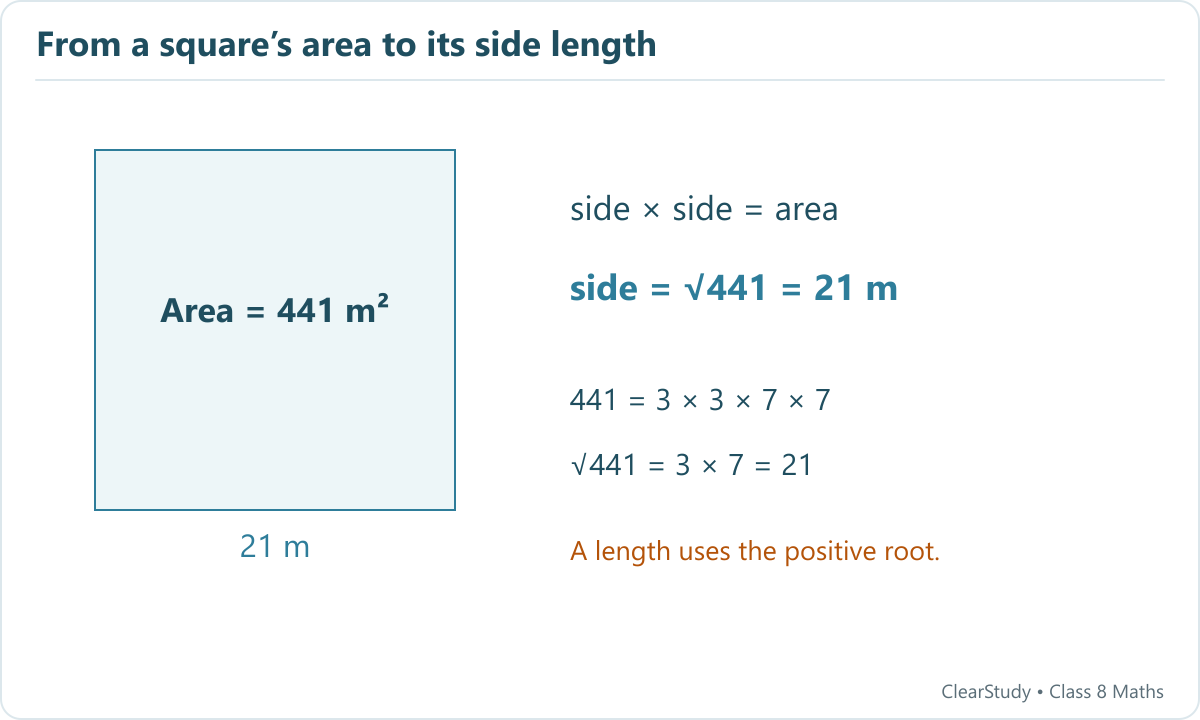
4. Find the length of the side of a square whose area is 441 m2.
5. Find the smallest square number that is divisible by each of the following numbers: 4, 9, and 10.
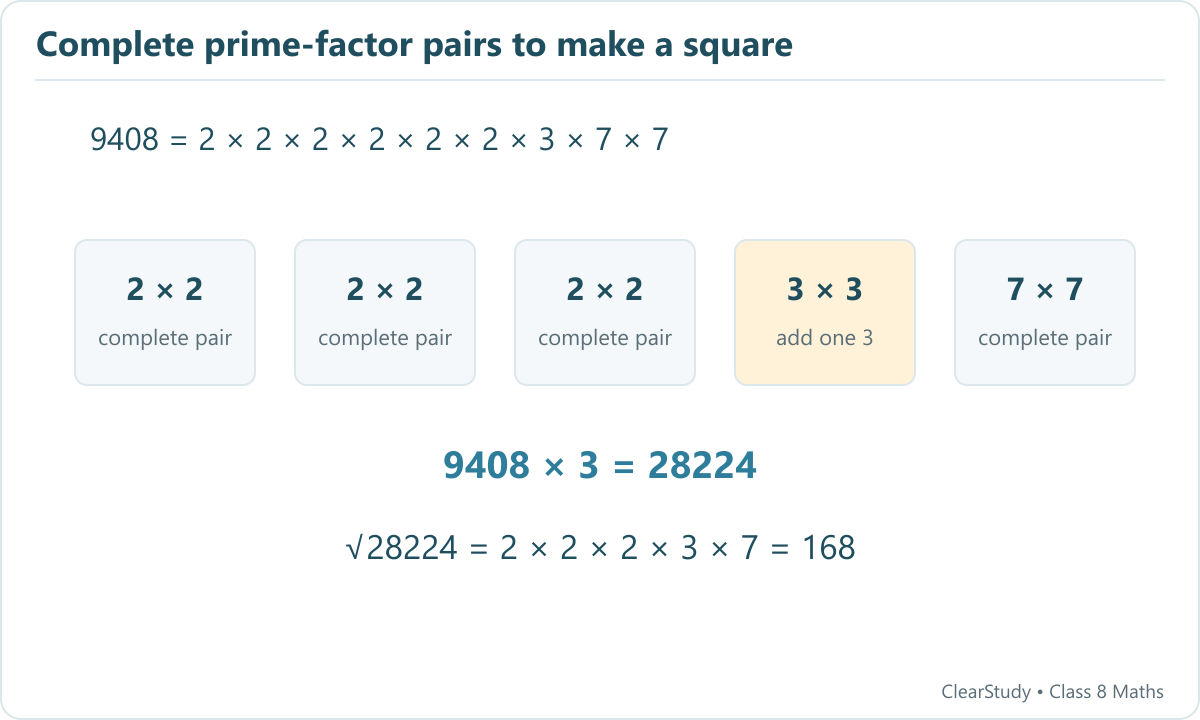
6. Find the smallest number by which 9408 must be multiplied so that the product is a perfect square. Find the square root of the product.
7. How many numbers lie between the squares of the following numbers? (i) 16 and 17 (ii) 99 and 100
8. In the following pattern, fill in the missing numbers: 12 + 22 + 22 = 32 22 + 32 + 62 = 72 32 + 42 + 122 = 132 42 + 52 + 202 = (___)2 92 + 102 + (___)2 = (___)2
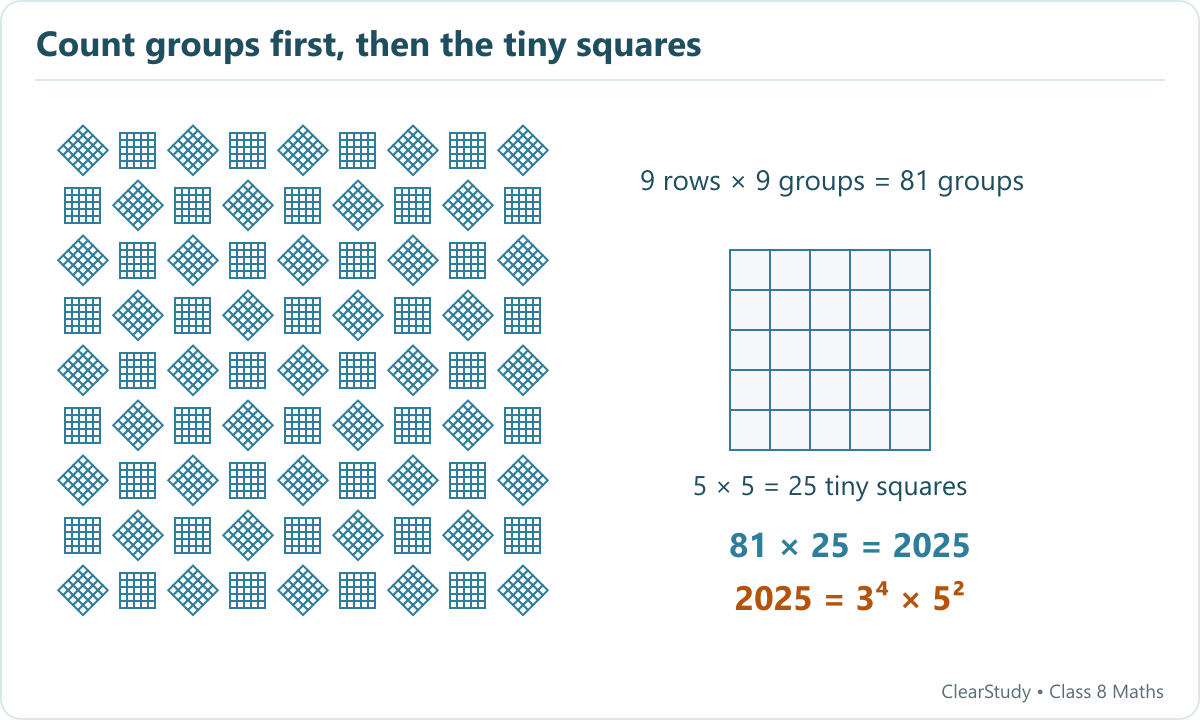
9. How many tiny squares are there in the picture? Write the prime factorisation of the number of tiny squares.
Math Talk & Try This — Answered
These are the in-text reflective and short tasks in the chapter; the determinate ones are answered, the open ones are guided.
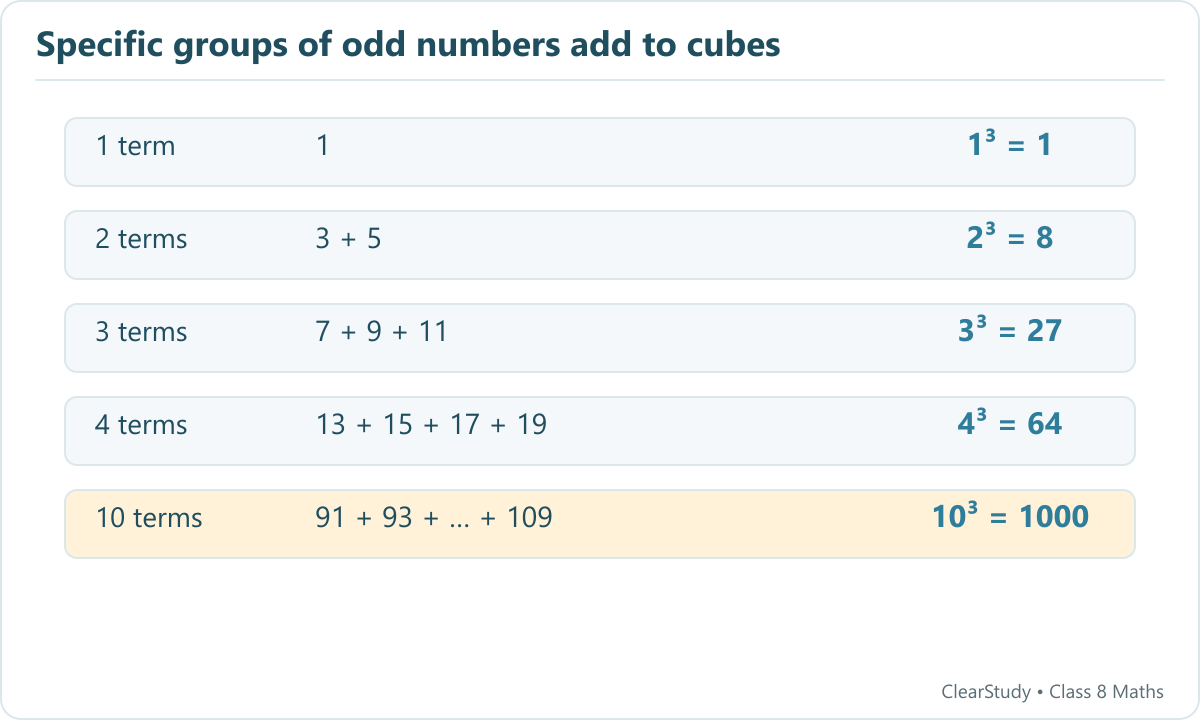
13832 = 23 + 243 = 183 + 203, because 8 + 13824 = 5832 + 8000 = 13832. The chapter’s first example is 1729 = 13 + 123 = 93 + 103.
Figure it Out — Cube Numbers & Cube Roots (Page 16–17)
1. Find the cube roots of 27000 and 10648.
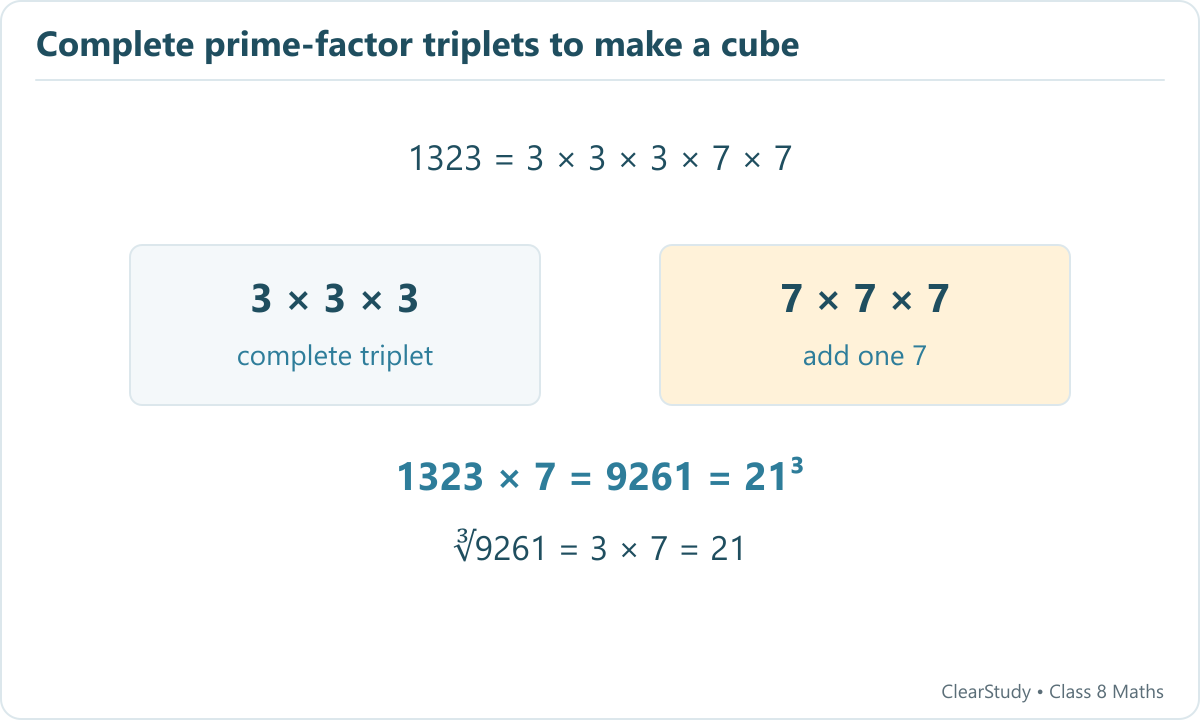
2. What number will you multiply by 1323 to make it a cube number?
3. State true or false. Explain your reasoning. (i) The cube of any odd number is even. (ii) There is no perfect cube that ends with 8. (iii) The cube of a 2-digit number may be a 3-digit number. (iv) The cube of a 2-digit number may have seven or more digits. (v) Cube numbers have an odd number of factors.
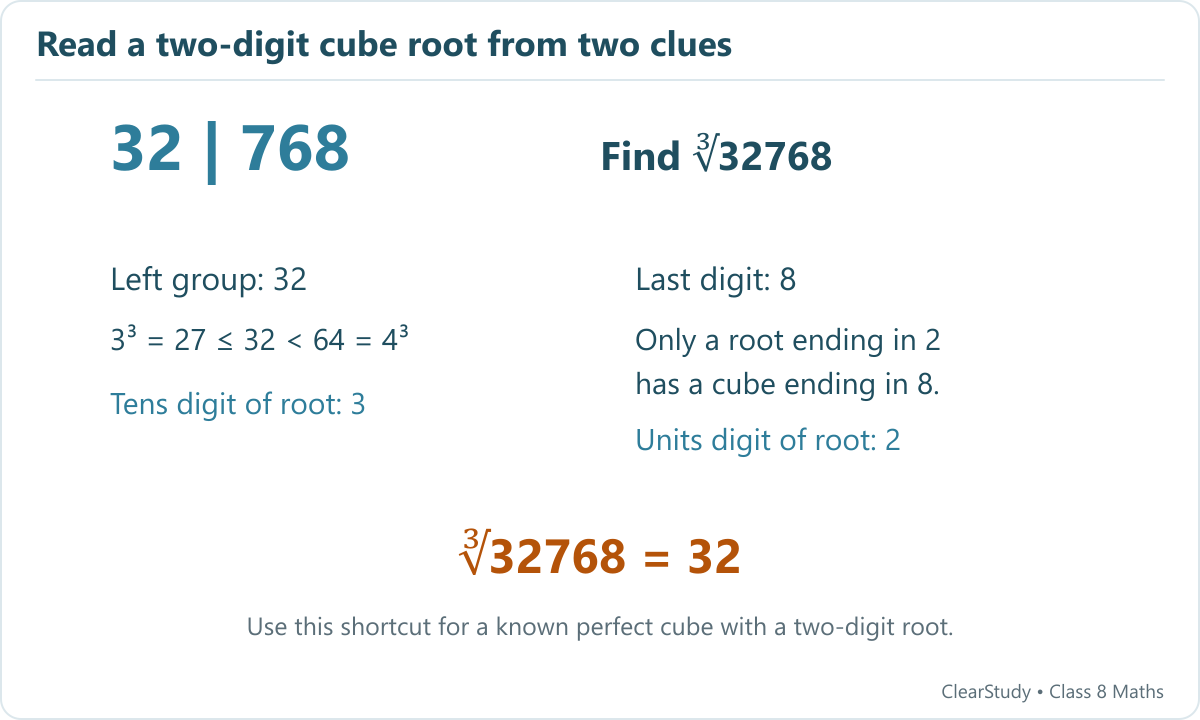
4. You are told that 1331 is a perfect cube. Can you guess without factorisation what its cube root is? Similarly, guess the cube roots of 4913, 12167, and 32768.
5. Which of the following is the greatest? Explain your reasoning. (i) 673 − 663 (ii) 433 − 423 (iii) 672 − 662 (iv) 432 − 422
Textbook activities and visual explanations
Locker puzzle and passcode (pages 1–3)
Locker n is toggled once for each positive factor of n. Most factors occur in distinct pairs, but a square has one unpaired middle factor. Thus the open lockers are 1, 4, 9, 16, 25, 36, 49, 64, 81 and 100. The first five lockers toggled exactly twice are the first five primes, giving the passcode 2–3–5–7–11.
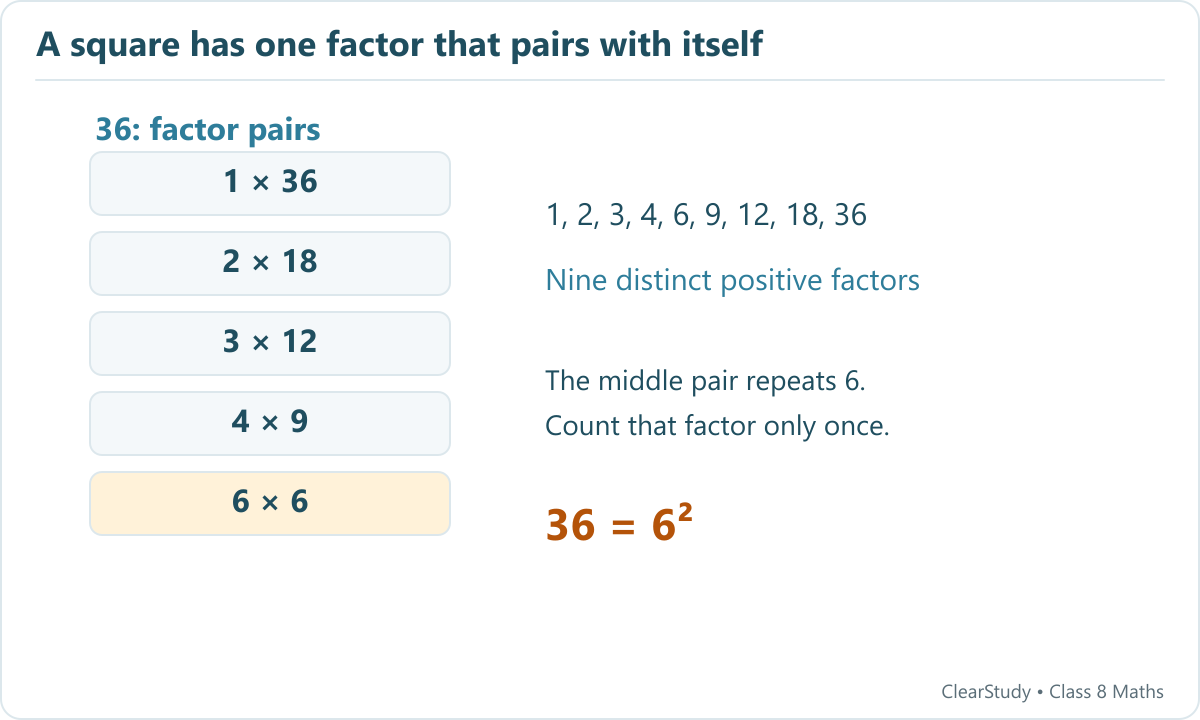
For 36, the pairs are 1 × 36, 2 × 18, 3 × 12, 4 × 9 and 6 × 6. Its nine distinct positive factors are 1, 2, 3, 4, 6, 9, 12, 18 and 36.
Square table and last-digit patterns (pages 3–5)
| n | n² | n | n² | n | n² |
|---|---|---|---|---|---|
| 1 | 1 | 11 | 121 | 21 | 441 |
| 2 | 4 | 12 | 144 | 22 | 484 |
| 3 | 9 | 13 | 169 | 23 | 529 |
| 4 | 16 | 14 | 196 | 24 | 576 |
| 5 | 25 | 15 | 225 | 25 | 625 |
| 6 | 36 | 16 | 256 | 26 | 676 |
| 7 | 49 | 17 | 289 | 27 | 729 |
| 8 | 64 | 18 | 324 | 28 | 784 |
| 9 | 81 | 19 | 361 | 29 | 841 |
| 10 | 100 | 20 | 400 | 30 | 900 |
The next squares ending in 1 after 29² are 31² = 961 and 39² = 1521. Bases ending in 0, 1, 2, 3, 4, 5, 6, 7, 8, 9 produce square last digits 0, 1, 4, 9, 6, 5, 6, 9, 4, 1 respectively.
Squaring also works for non-integers: a square of side 3/5 has area 9/25 square units; side 2.5 gives area 6.25 square units. These are squares of numbers, but not perfect squares of integers.
Odd-number layers and subtraction (pages 5–6)
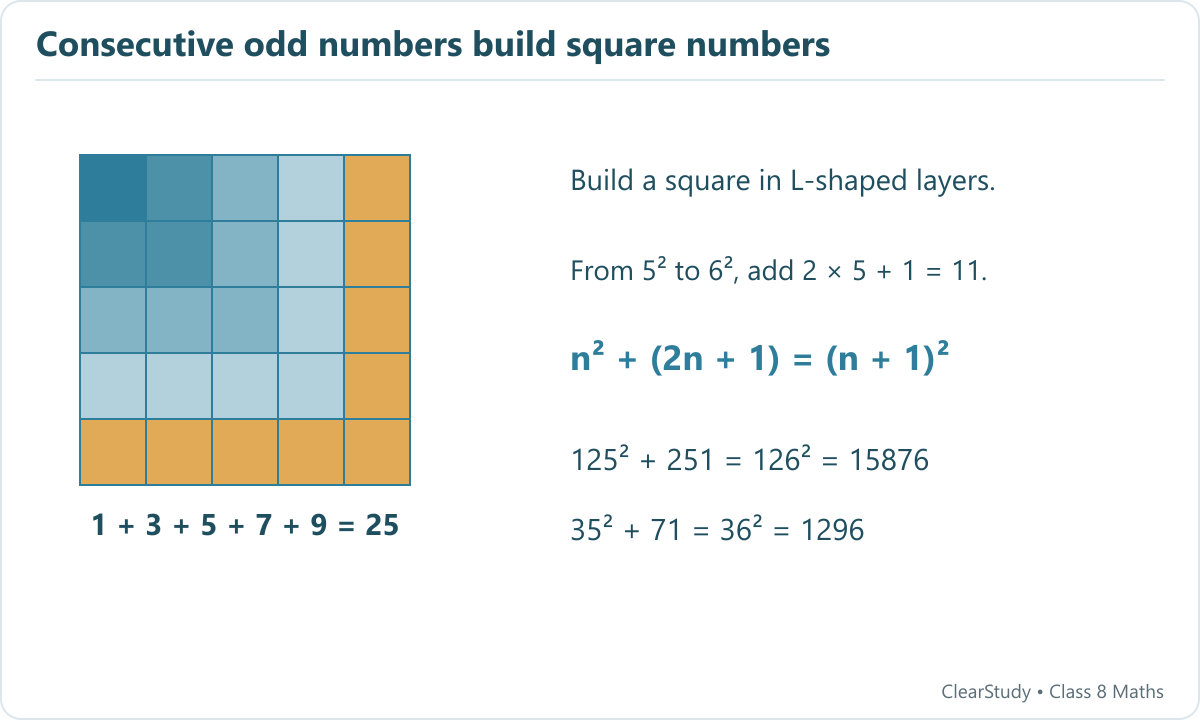
The nth positive odd number is 2n − 1. Thus 36² = 35² + 71 = 1225 + 71 = 1296. Subtracting 1, 3, 5, 7, 9 from 25 reaches zero in five steps, so √25 = 5. Starting from 38 instead gives 37, 34, 29, 22, 13, 2, −11; crossing zero shows that 38 is not a perfect square.
Square counts in blocks of 100 (page 7)
| Inclusive interval | Square bases | Number of squares |
|---|---|---|
| 1–100 | 1–10 | 10 |
| 101–200 | 11–14 | 4 |
| 201–300 | 15–17 | 3 |
| 301–400 | 18–20 | 3 |
| 401–500 | 21–22 | 2 |
| 501–600 | 23–24 | 2 |
| 601–700 | 25–26 | 2 |
| 701–800 | 27–28 | 2 |
| 801–900 | 29–30 | 2 |
| 901–1000 | 31 | 1 |
The largest square less than 1000 is 31² = 961; the next is 32² = 1024.
Triangular numbers (page 7)
The pattern continues with 10 + 15 = 25 = 5². In general, n(n − 1)/2 + n(n + 1)/2 = n².
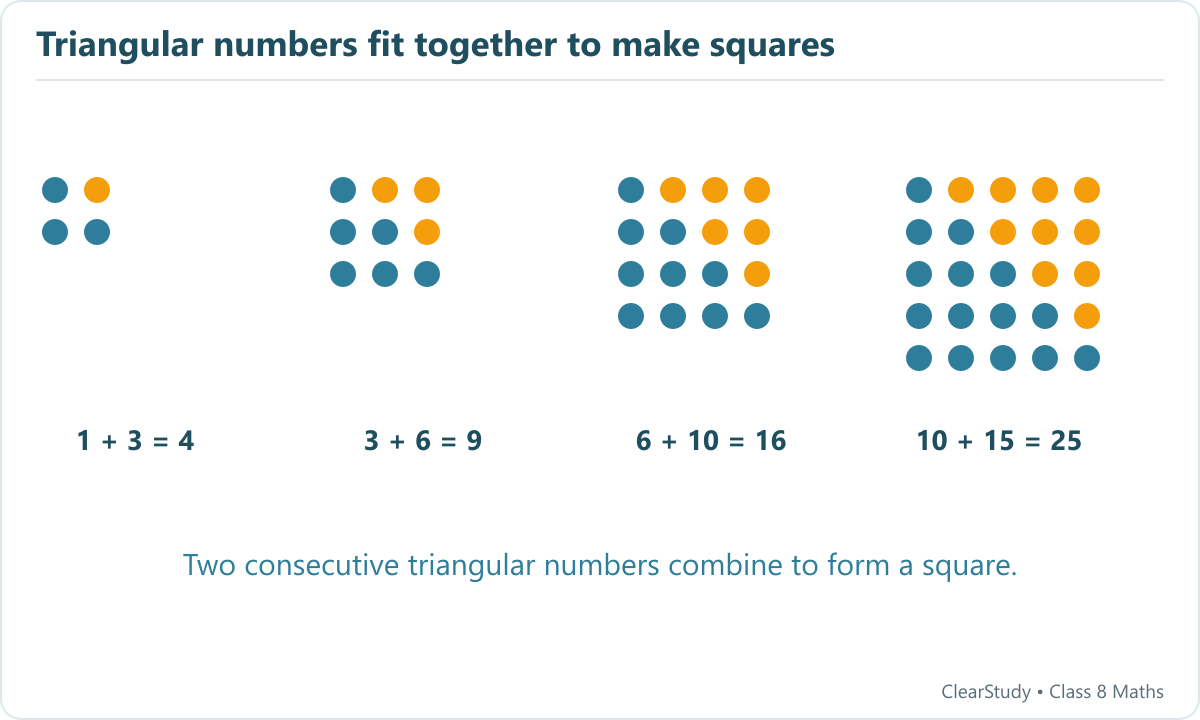
Square roots and estimation (pages 7–10)
A square of area 49 cm² has side 7 cm. Also, √64 = 8; the two solutions of x² = 64 are ±8. Since 729 = 27², subtracting the first 27 odd numbers (1 through 53) from 729 reaches zero, so √729 = 27.
1156 = 2² × 17² = 34², so it is a perfect square. In 2800 = 2⁴ × 5² × 7, the factor 7 is unpaired, so 2800 is not a perfect square. For √1936, first locate it between 40 and 50; its last digit is 4 or 6. Since 45² = 2025 exceeds 1936, test 44: 44² = 1936.
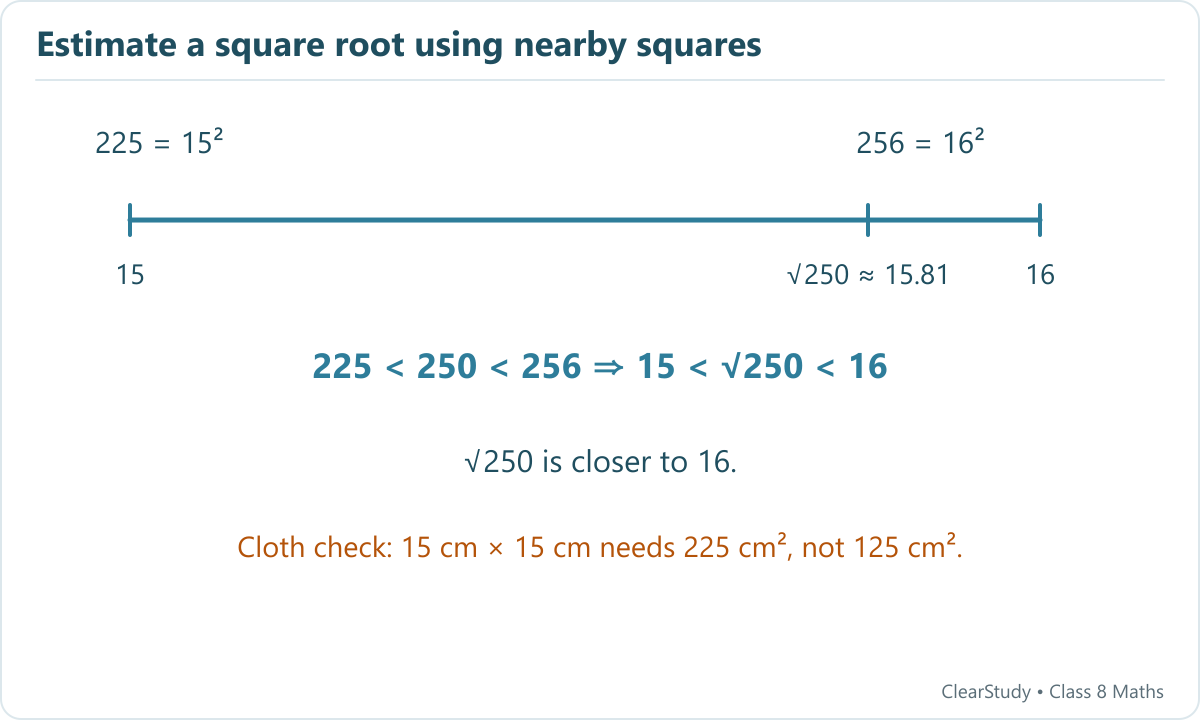
Akhil’s cloth has area 125 cm². A 15 cm square needs 225 cm², so it cannot be cut from this cloth. Since 11² = 121 ≤ 125 < 144 = 12², the largest permitted integer side is 11 cm.
Unit cubes and the cube table (pages 11–13)
| n | n³ | n | n³ |
|---|---|---|---|
| 1 | 1 | 11 | 1331 |
| 2 | 8 | 12 | 1728 |
| 3 | 27 | 13 | 2197 |
| 4 | 64 | 14 | 2744 |
| 5 | 125 | 15 | 3375 |
| 6 | 216 | 16 | 4096 |
| 7 | 343 | 17 | 4913 |
| 8 | 512 | 18 | 5832 |
| 9 | 729 | 19 | 6859 |
| 10 | 1000 | 20 | 8000 |
Positive one-digit cubes: 1, 8 (2 numbers). Two-digit cubes: 27, 64 (2). Three-digit cubes: 125, 216, 343, 512, 729 (5). The cube of an odd integer is odd, and the cube of an even integer is even. Every units digit from 0 to 9 can occur in a cube.
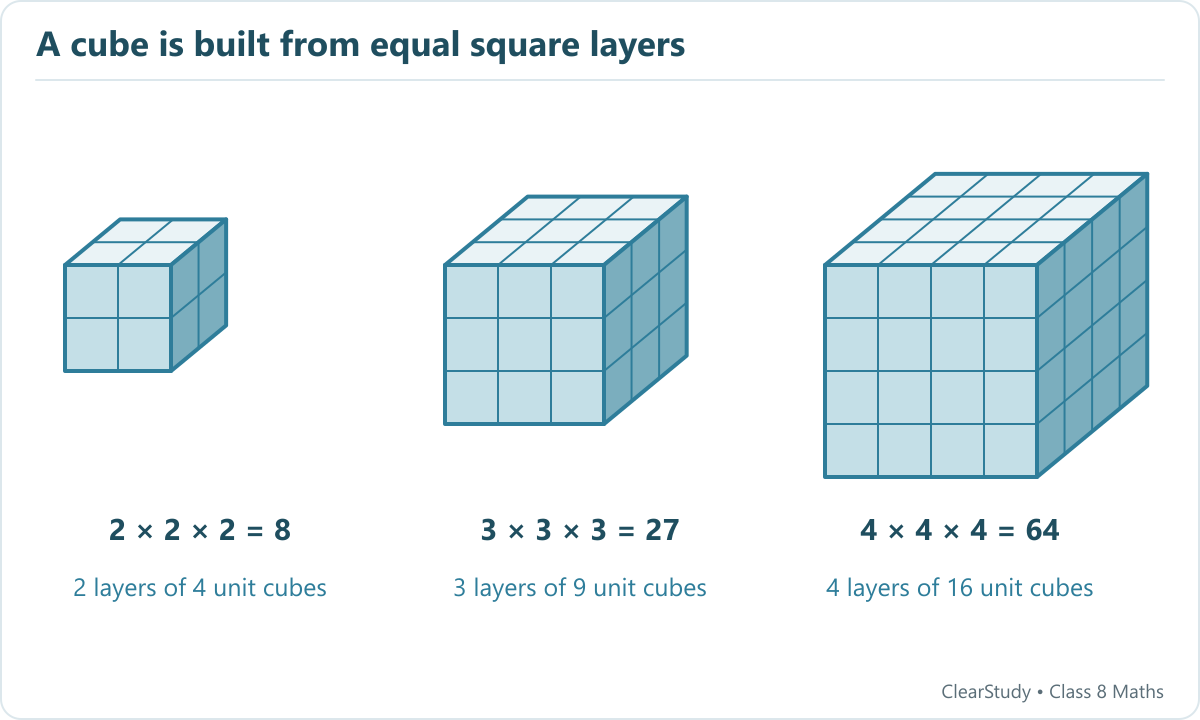
A cube of side 4 units contains 64 unit cubes. Negative and fractional numbers can also be cubed: (−6)³ = −216; (4/6)³ = (2/3)³ = 8/27.
Successive differences (page 15)
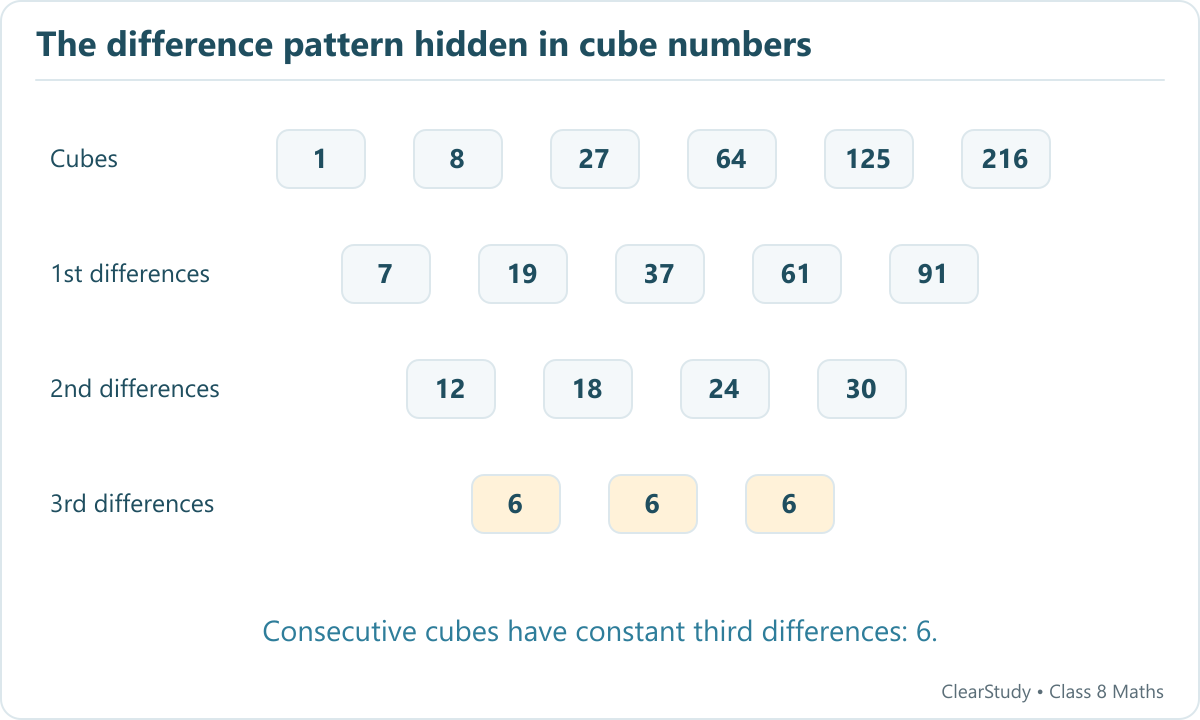
Consecutive squares have constant second difference 2. Consecutive cubes have constant third difference 6, after first differences 7, 19, 37, 61, 91 and second differences 12, 18, 24, 30.
Square Pairs! (page 18)
Arrange 1–17 in a row
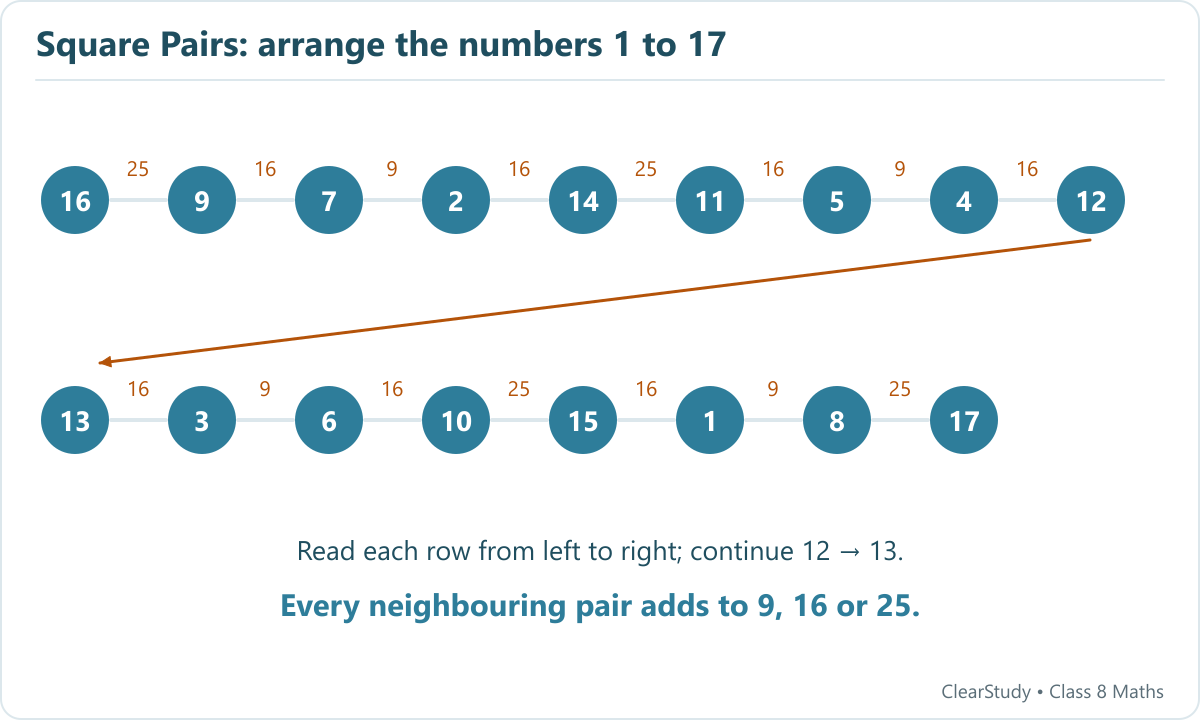
A valid order is 16, 9, 7, 2, 14, 11, 5, 4, 12, 13, 3, 6, 10, 15, 1, 8, 17. Reverse it for the same row in the opposite direction.
There is only one row up to reversal. The numbers 16 and 17 must be endpoints: their only partners are 9 and 8. The degree-two partner constraints force 17–8–1–15–10–6–3–13–12–4–5–11–14–2–7–9–16. Every number other than 1 and 3 has at most two possible partners, so both partners of each non-endpoint are forced. This gives the displayed full chain; 1 and 3 already have two neighbours in it, so the optional link 1–3 cannot be used.
Arrange 1–32 in a circle
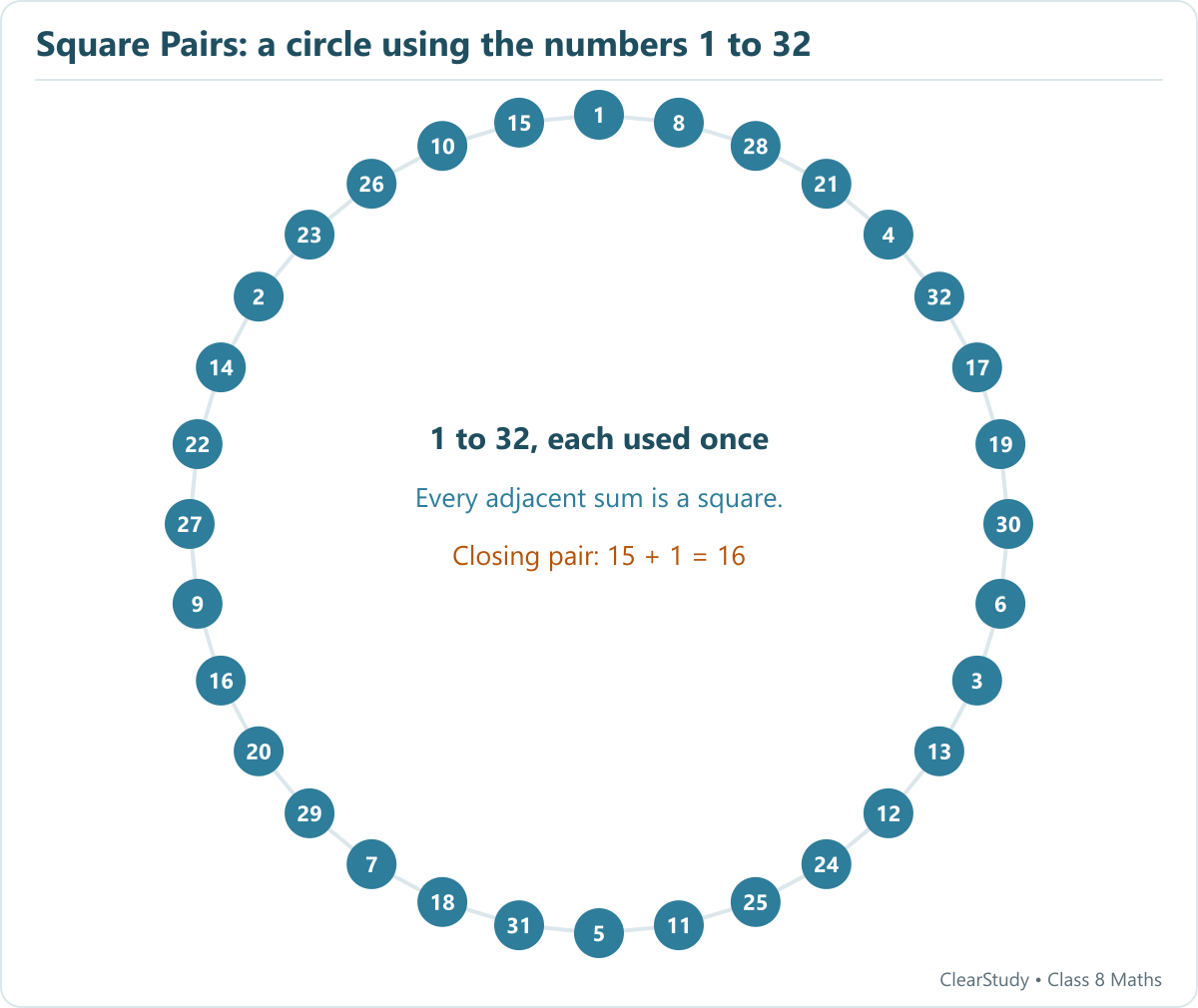
One clockwise order is 1, 8, 28, 21, 4, 32, 17, 19, 30, 6, 3, 13, 12, 24, 25, 11, 5, 31, 18, 7, 29, 20, 16, 9, 27, 22, 14, 2, 23, 26, 10, 15, returning to 1. Check neighbouring sums: 9, 36, 49, 25, 36, 49, 36, 49, 36, 9, 16, 25, 36, 49, 36, 16, 36, 49, 25, 36, 49, 36, 25, 36, 49, 36, 16, 25, 49, 36, 25, 16. Each is a perfect square, including the closing sum 15 + 1 = 16.
Common Mistakes to Avoid
Watch out for these
- Thinking a units digit of 0, 1, 4, 5, 6 or 9 proves a number is a square — it only tells you when a number is not a square (e.g. 26 ends in 6 but is not a square).
- For the smallest-multiplier questions, forgetting to prime factorise first — supply only the primes needed to complete pairs (squares) or triplets (cubes).
- Mixing up the tests: two identical groups for a square root, three identical groups for a cube root.
- Saying every cube has an odd number of factors. A positive cube has an odd factor count only if it is also a square, as 64 is.
- Assuming a cube can end in any even count of zeros; a perfect cube’s trailing zeros are always a multiple of 3.
- In “numbers between squares”, counting the endpoints — the count strictly between n2 and (n + 1)2 is 2n.
Practice MCQs & Assertion–Reason
1. Which of these is a perfect square?
(a) 1024 (b) 1027 (c) 2048 (d) 2032
2. A perfect square can never end in:
(a) 4 (b) 6 (c) 7 (d) 9
3. How many numbers lie between 202 and 212?
(a) 20 (b) 40 (c) 41 (d) 21
4. The square root of 1296 is:
(a) 34 (b) 36 (c) 38 (d) 46
5. Using 1252 = 15625, the value of 1242 is:
(a) 15625 − 249 (b) 15625 − 124 (c) 15625 + 249 (d) 15625 − 250
6. Which number has an odd number of factors?
(a) 12 (b) 18 (c) 36 (d) 40
7. The cube root of 1728 is:
(a) 8 (b) 12 (c) 14 (d) 18
8. The smallest number that 1323 must be multiplied by to become a perfect cube is:
(a) 3 (b) 7 (c) 9 (d) 21
9. The smallest taxicab number (Hardy–Ramanujan number) is:
(a) 1024 (b) 1331 (c) 1728 (d) 1729
10. The number of trailing zeros in a perfect cube is always:
(a) odd (b) a multiple of 2 (c) a multiple of 3 (d) exactly 2
For each Assertion–Reason question, choose: (A) Both Assertion and Reason are true and the Reason is the correct explanation of the Assertion; (B) Both are true but the Reason is not the correct explanation; (C) Assertion is true but Reason is false; (D) Assertion is false but Reason is true.
A-R 1. Assertion: 2048 is not a perfect square.
Reason: A perfect square cannot end in the digit 8.
A-R 2. Assertion: Only square numbers have an odd number of factors.
Reason: In a square, one factor pairs with itself, leaving an odd factor count.
A-R 3. Assertion: The cube of every odd number is even.
Reason: The product of three odd numbers is odd.
A-R 4. Assertion: 1729 = 13 + 123 = 93 + 103.
Reason: 1729 is the smallest number expressible as a sum of two positive cubes in two different ways.
A-R 5. Assertion: The smallest positive integer multiplier that makes 1323 a perfect cube is 7.
Reason: 1323 = 33 × 72, and the factor 7 needs one more to form a triplet.
Quick Revision Summary
- A square number is n × n = n2; squares of natural numbers are perfect squares.
- Perfect squares end only in 0, 1, 4, 5, 6 or 9, and have an even number of trailing zeros.
- Only square numbers have an odd number of factors (one factor pairs with itself).
- Every square is the sum of consecutive odd numbers from 1; (n + 1)2 = n2 + (2n + 1).
- Between n2 and (n + 1)2 there are exactly 2n numbers.
- Square root: split prime factors into two identical groups; cube root: split into three identical groups.
- A cube number is n3; its trailing-zero count is a multiple of 3; 1729 is the smallest taxicab number.
How to score full marks in this chapter
Always prime factorise before answering smallest-multiplier and root questions, and write the factors in pairs (for squares) or triplets (for cubes). For “is it a square/cube” checks, state the units-digit or trailing-zero rule you are using. Use (n + 1)2 = n2 + 2n + 1 and the identity a3 − b3 = (a − b)(a2 + ab + b2) to avoid long multiplication, and keep your working tidy so each step earns its mark.
Frequently Asked Questions
What is Class 8 Maths Ganita Prakash Chapter 1 about?
Chapter 1, A Square and A Cube, covers square numbers and their properties, square roots, perfect cubes and cube roots, finding roots by estimation and prime factorisation, number patterns (odd numbers, triangular numbers) and the famous taxicab number 1729.
How many Figure it Out exercises are there in Chapter 1?
There are two main “Figure it Out” sets — one on square numbers and square roots (pages 10–11) and one on cube numbers and cube roots (pages 16–17) — plus several Math Talk and Try This tasks, with worked explanations on this page.
Why do only square numbers have an odd number of factors?
Factors usually come in partner pairs whose product is the number. For a perfect square, one factor is the square root, which pairs with itself, so it is counted once — making the total number of factors odd.
Are these Class 8 Maths Ganita Prakash Chapter 1 solutions free?
Yes. All solutions are free and follow the official NCERT Ganita Prakash (Part I) textbook for the 2026–27 session, with worked answers checked against the textbook and mathematical calculations.
Textbook reference: NCERT Ganita Prakash, Chapter 1 (official PDF). ClearStudy diagrams and worked explanations are original teaching aids.