
Class 8 Maths Ganita Prakash Chapter 5 Solutions (NCERT 2026–27) – Number Play
These Class 8 Maths Ganita Prakash Chapter 5 solutions cover Number Play from the new NCF-2023 textbook (Part I, 2026–27). Every “Figure it Out” exercise is solved step by step — parity, sums of consecutive numbers, divisibility shortcuts for 3, 9 and 11, digital roots and cryptarithms — so you can master each idea and revise the whole chapter quickly.
- Chapter overview
- Key concepts & definitions
- Important facts & divisibility rules
- Figure it Out (Page 122) — Q1–Q8
- Figure it Out (Page 126) — Q1–Q4
- Figure it Out (Page 131, Digital Roots) — Q1–Q4
- Figure it Out (Page 132, Digits in Disguise) — Q1–Q16
- Math Talk, divisibility tables and extra puzzles
- Common mistakes to avoid
- Practice MCQs & Assertion–Reason
- Quick revision summary
- FAQs
Chapter 5 Overview
Chapter 5 of Ganita Prakash, Number Play, is an exploration of how numbers behave under the operations of addition, subtraction and multiplication. It begins with sums of consecutive numbers and the idea of parity (odd/even), then builds up powerful divisibility properties — if a number is divisible by another, its multiples and factors behave predictably, and the sum or difference of two multiples of a number is again a multiple. The chapter develops and proves the divisibility shortcuts for 3, 9 and 11 using place value and visualisation, introduces digital roots, and ends with cryptarithms (digit puzzles). The emphasis throughout is on reasoning — understanding “why” a rule works using algebra, examples and counterexamples. The Class 8 Maths Ganita Prakash Chapter 5 solutions below work through every “Figure it Out” question with verified, exam-ready steps.
Key Concepts & Definitions
Parity: whether a number is even (a multiple of 2) or odd. Negative even numbers (−2, −4, …) are also even.
Consecutive numbers: whole numbers that follow one another, e.g. n, n+1, n+2, …
Multiple & factor: if a = b × k, then a is a multiple of b, and b is a factor of a.
Remainder form: a number leaving remainder r on division by m is written as mk + r (e.g. 5k + 3 for remainder 3 mod 5).
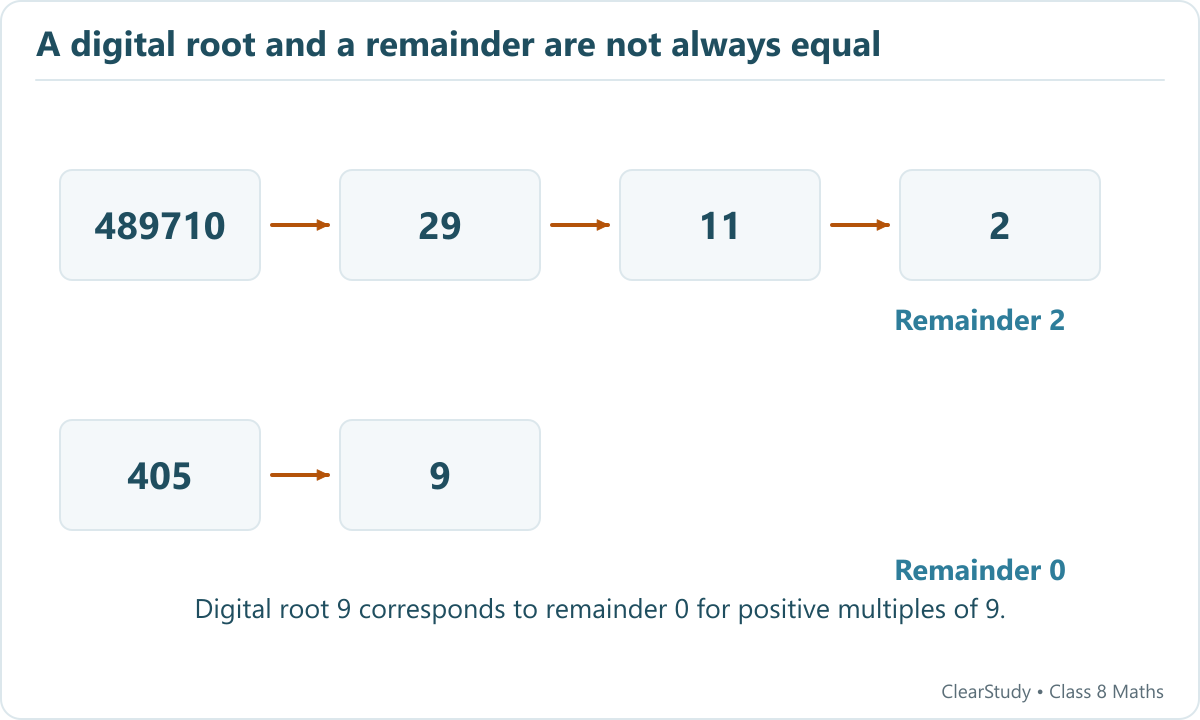
Digital root: the single digit obtained by repeatedly adding the digits of a number; for a positive whole number, roots 1–8 equal the remainder on division by 9, while root 9 means remainder 0. The digital root of 0 is 0.
Cryptarithm: a puzzle where each letter stands for one digit, each digit by at most one letter, and a leading digit is never 0.
Important Facts & Divisibility Rules (Chapter 5)
Parity of sums/differences: odd ± odd = even, even ± even = even, odd ± even = odd. So a ± b always have the same parity.
If a divides M and a divides N, then a divides (M + N) and (M − N).
If A is divisible by k, then all multiples of A are divisible by k, and A is divisible by every factor of k.
If A is divisible by k and by m, then A is divisible by LCM(k, m).
Divisibility by 9 / 3: a number is divisible by 9 (or 3) if and only if the sum of its digits is divisible by 9 (or 3). For a positive number, digital root 9 means remainder 0; other digital roots equal the remainder.
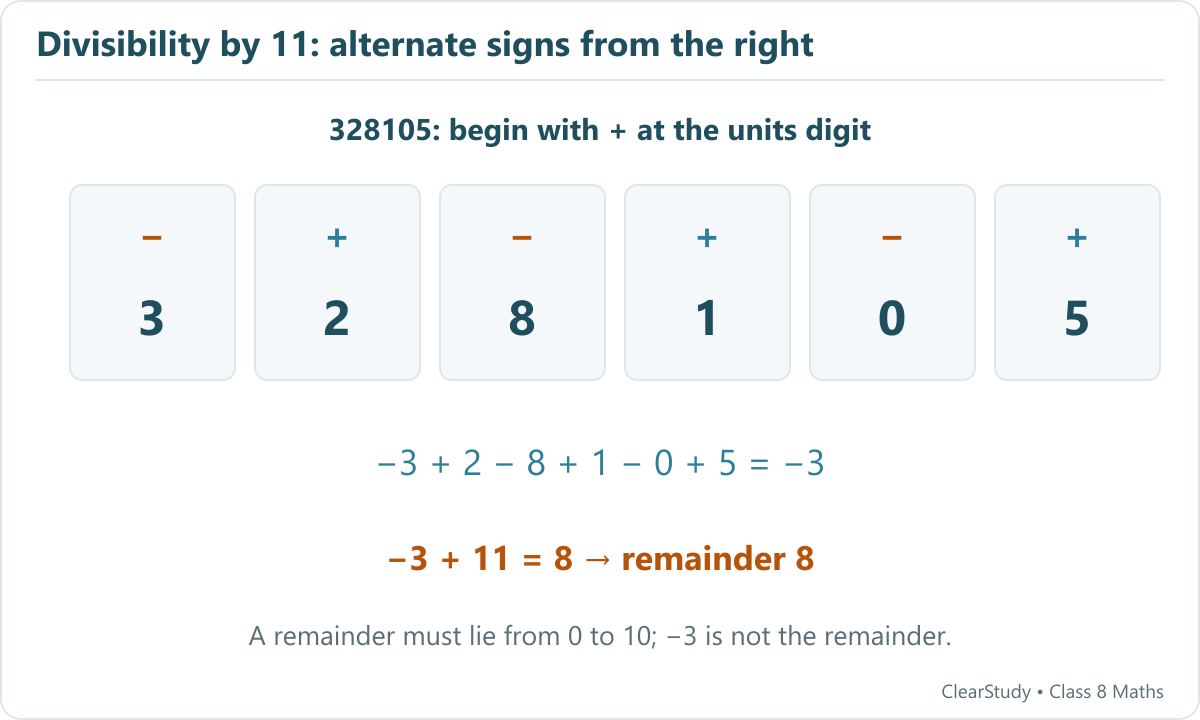
Divisibility by 11: form the alternating sum of digits starting with a plus at the units place (+, −, +, −, … when moving left); the number is divisible by 11 if this result is 0 or a multiple of 11.
Figure it Out (Page 122) — Class 8 Maths Ganita Prakash Chapter 5 Solutions
1. The sum of four consecutive numbers is 34. What are these numbers?
2. Suppose p is the greatest of five consecutive numbers. Describe the other four numbers in terms of p.
3. For each statement below, determine whether it is always true, sometimes true, or never true. Explain your answer. Mention examples and non-examples as appropriate. Justify your claim using algebra. (i) The sum of two even numbers is a multiple of 3. (ii) If a number is not divisible by 18, then it is also not divisible by 9. (iii) If two numbers are not divisible by 6, then their sum is not divisible by 6. (iv) The sum of a multiple of 6 and a multiple of 9 is a multiple of 3. (v) The sum of a multiple of 6 and a multiple of 3 is a multiple of 9.
4. Find a few numbers that leave a remainder of 2 when divided by 3 and a remainder of 2 when divided by 4. Write an algebraic expression to describe all such numbers.
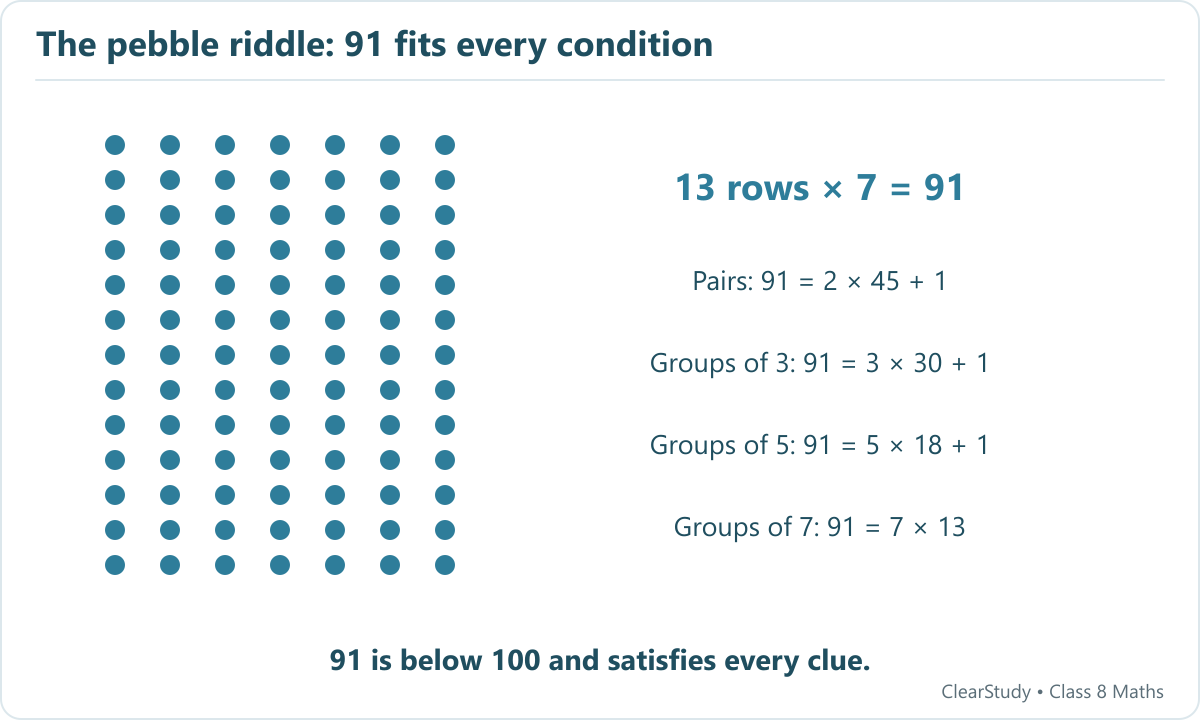
5. “I hold some pebbles, not too many,
When I group them in 3’s, one stays with me.
Try pairing them up — it simply won’t do,
A stubborn odd pebble remains in my view.
Group them by 5, yet one’s still around,
But grouping by seven, perfection is found.
More than one hundred would be far too bold,
Can you tell me the number of pebbles I hold?”
6. Tathagat has written several numbers that leave a remainder of 2 when divided by 6. He claims, “If you add any three such numbers, the sum will always be a multiple of 6.” Is Tathagat’s claim true?
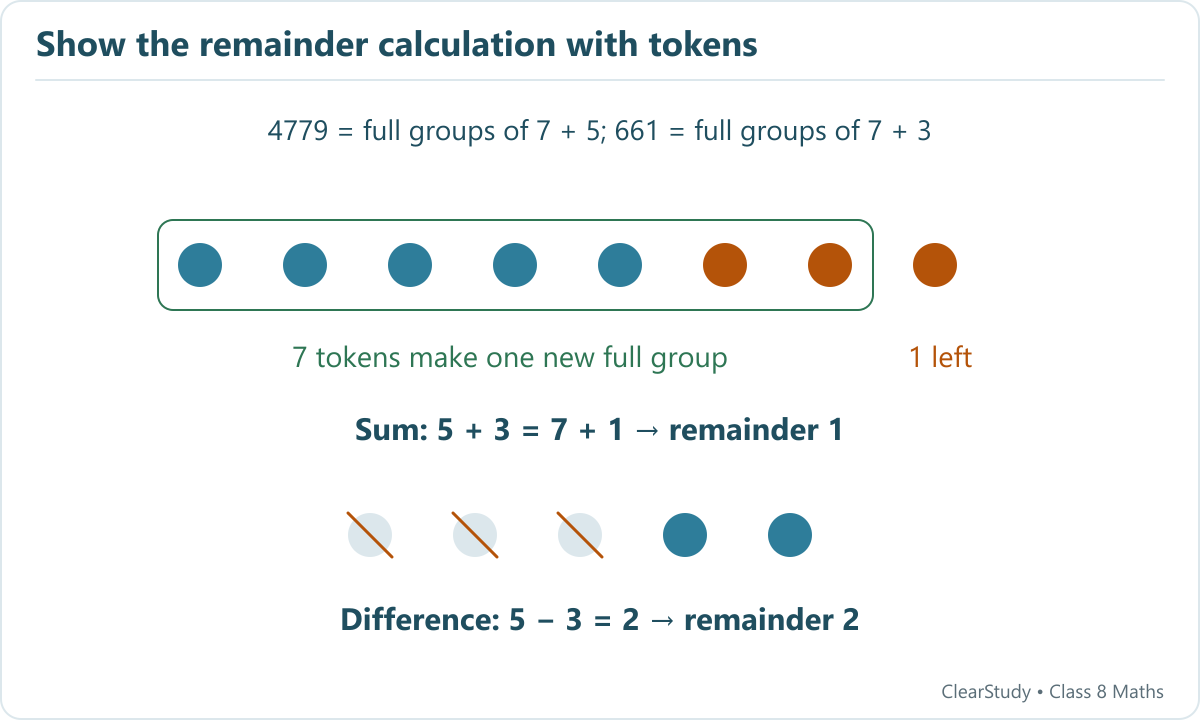
7. When divided by 7, the number 661 leaves a remainder of 3, and 4779 leaves a remainder of 5. Without calculating, can you say what remainders the following expressions will leave when divided by 7? Show the solution both algebraically and visually. (i) 4779 + 661 (ii) 4779 − 661
8. Find a number that leaves a remainder of 2 when divided by 3, a remainder of 3 when divided by 4, and a remainder of 4 when divided by 5. What is the smallest such number? Can you give a simple explanation of why it is the smallest?
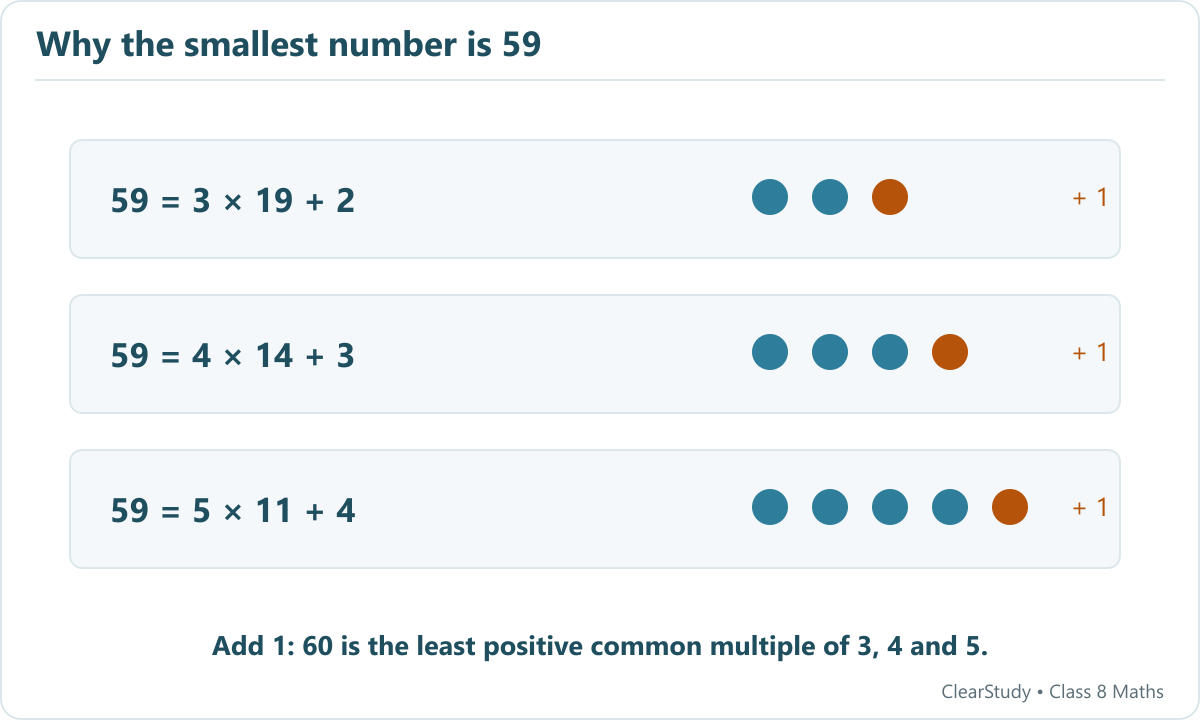
Figure it Out (Page 126) — Divisibility by 9
1. Find, without dividing, whether the following numbers are divisible by 9. (i) 123 (ii) 405 (iii) 8888 (iv) 93547 (v) 358095
2. Find the smallest multiple of 9 with no odd digits.
3. Find the multiple of 9 that is closest to the number 6000.
4. How many multiples of 9 are there between the numbers 4300 and 4400?
Figure it Out (Page 131, Digital Roots) — Solutions
1. The digital root of an 8-digit number is 5. What will be the digital root of 10 more than that number?
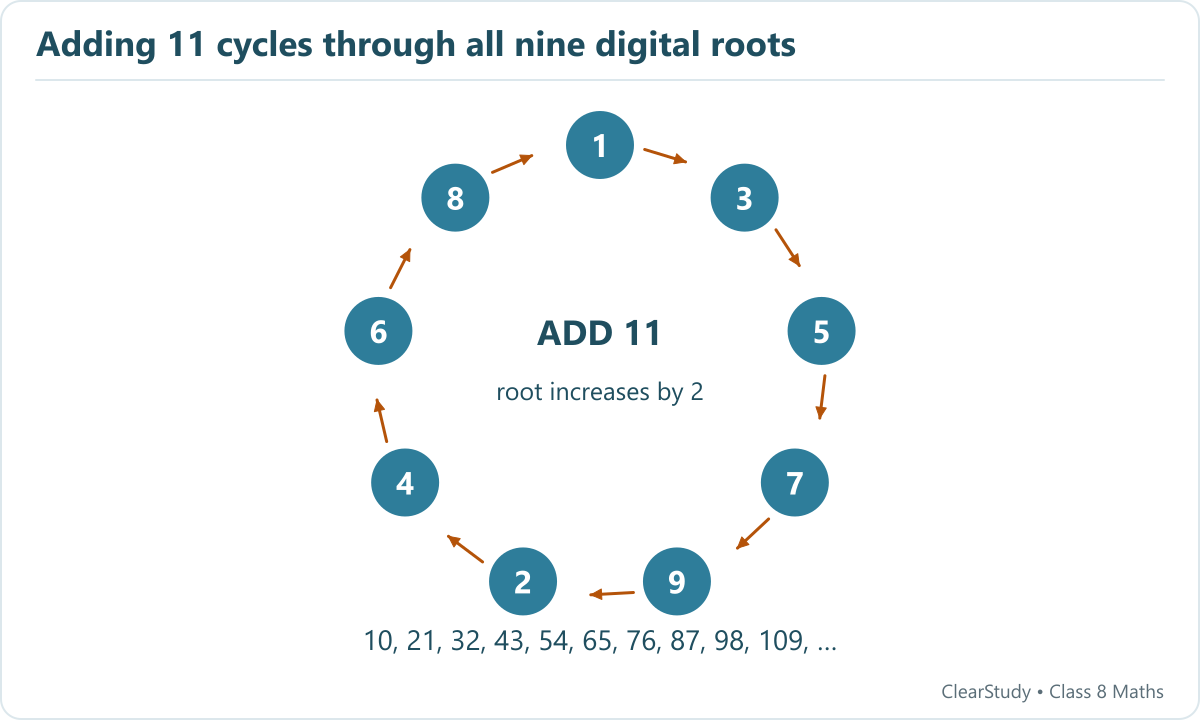
2. Write any number. Generate a sequence of numbers by repeatedly adding 11. What would be the digital roots of this sequence of numbers? Share your observations.
3. What will be the digital root of the number 9a + 36b + 13?
4. Make conjectures by examining if there are any patterns or relations between (i) the parity of a number and its digital root. (ii) the digital root of a number and the remainder obtained when the number is divided by 3 or 9.
Figure it Out (Page 132, Digits in Disguise) — Solutions
1. If 31z5 is a multiple of 9, where z is a digit, what is the value of z? Explain why there are two answers to this problem.
2. “I take a number that leaves a remainder of 8 when divided by 12. I take another number which is 4 short of a multiple of 12. Their sum will always be a multiple of 8”, claims Snehal. Examine his claim and justify your conclusion.
3. When is the sum of two multiples of 3, a multiple of 6 and when is it not? Explain the different possible cases, and generalise the pattern.
4. Sreelatha says, “I have a number that is divisible by 9. If I reverse its digits, it will still be divisible by 9”. (i) Examine if her conjecture is true for any multiple of 9. (ii) Are any other digit shuffles possible such that the number formed is still a multiple of 9?
5. If 48a23b is a multiple of 18, list all possible pairs of values for a and b.
6. If 3p7q8 is divisible by 44, list all possible pairs of values for p and q.
7. Find three consecutive numbers such that the first number is a multiple of 2, the second number is a multiple of 3, and the third number is a multiple of 4. Are there more such numbers? How often do they occur?
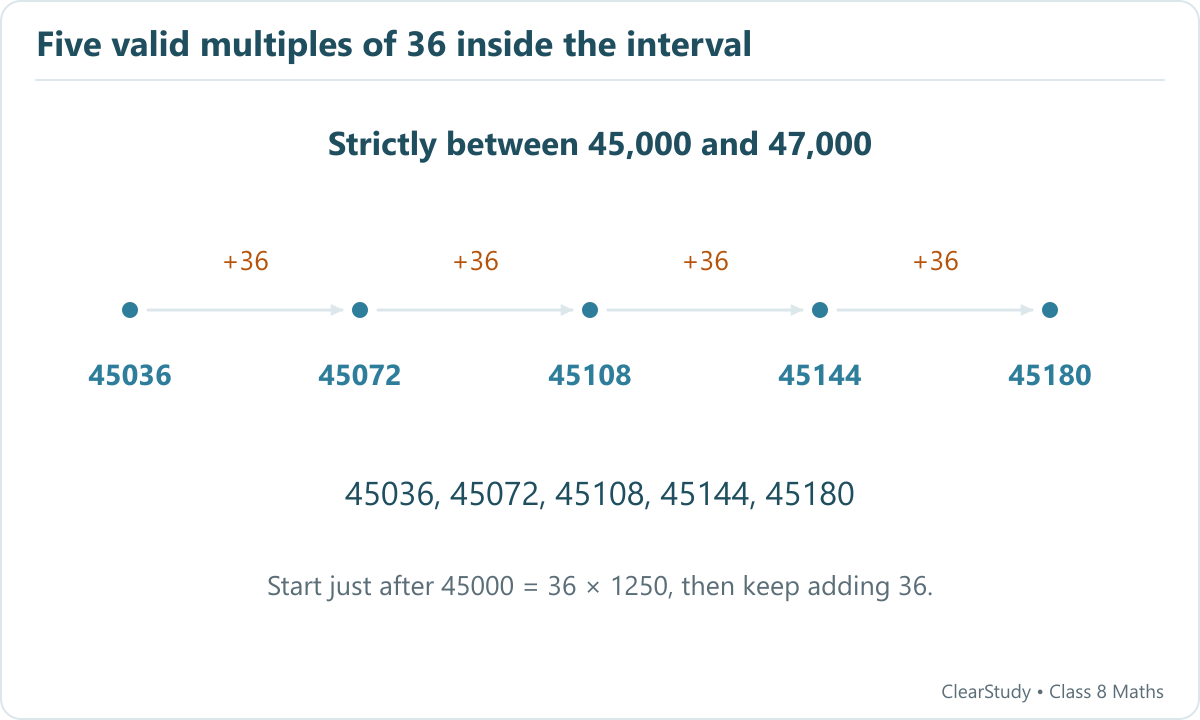
8. Write five multiples of 36 between 45,000 and 47,000. Share your approach with the class.
9. The middle number in the sequence of 5 consecutive even numbers is 5p. Express the other four numbers in sequence in terms of p.
10. Write a 6-digit number that is divisible by 15, such that when the digits are reversed, it is divisible by 6.
11. Deepak claims, “There are some multiples of 11 which, when doubled, are still multiples of 11. But other multiples of 11 don’t remain multiples of 11 when doubled”. Examine if his conjecture is true; explain your conclusion.
12. Determine whether the statements below are ‘Always True’, ‘Sometimes True’, or ‘Never True’. Explain your reasoning. (i) The product of a multiple of 6 and a multiple of 3 is a multiple of 9. (ii) The sum of three consecutive even numbers will be divisible by 6. (iii) If abcdef is a multiple of 6, then badcef will be a multiple of 6. (iv) 8 (7b – 3) – 4 (11b + 1) is a multiple of 12.
13. Choose any 3 numbers. When is their sum divisible by 3? Explore all possible cases and generalise.
14. Is the product of two consecutive integers always multiple of 2? Why? What about the product of three consecutive integers? Is it always a multiple of 6? Why or why not? What can you say about the product of 4 consecutive integers? What about the product of five consecutive integers?
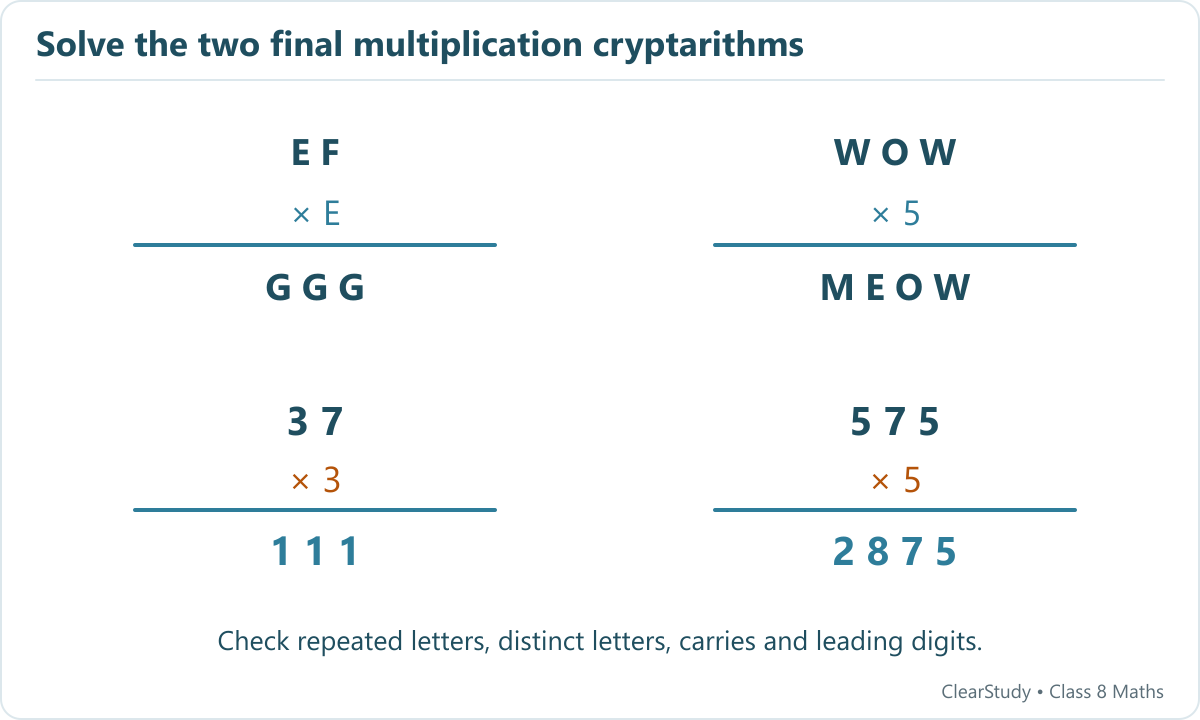
15. Solve the cryptarithms — (i) EF × E = GGG (ii) WOW × 5 = MEOW
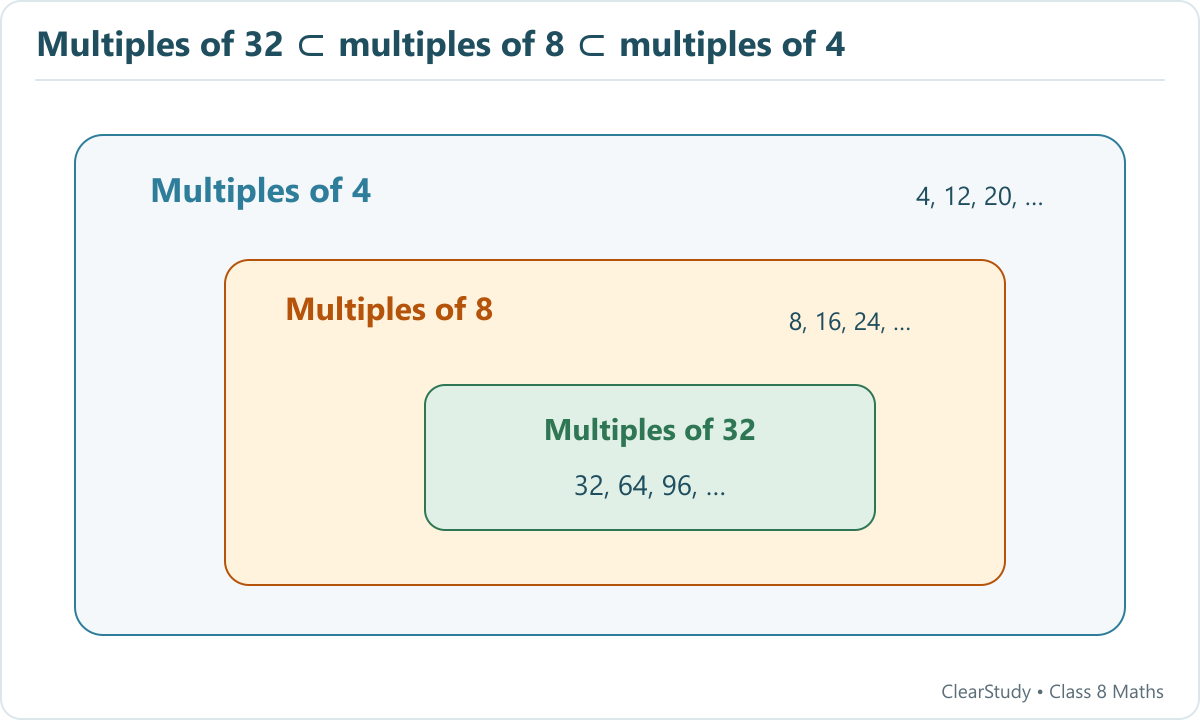
16. Which of the following Venn diagrams captures the relationship between the multiples of 4, 8, and 32?
Math Talk, divisibility tables and extra puzzles
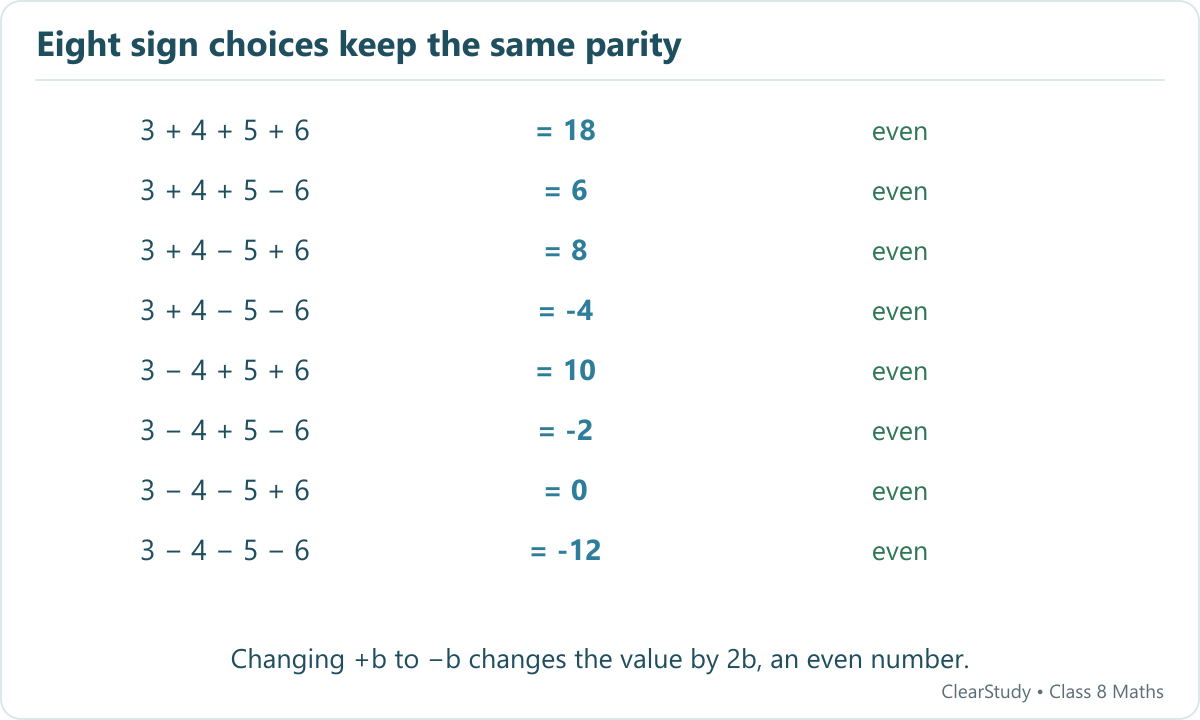
Consecutive sums and parity (Pages 112–115)
Breaking Even and pairs that make fours (Pages 115–118)
Remainder forms and divisibility proofs (Pages 121–127)
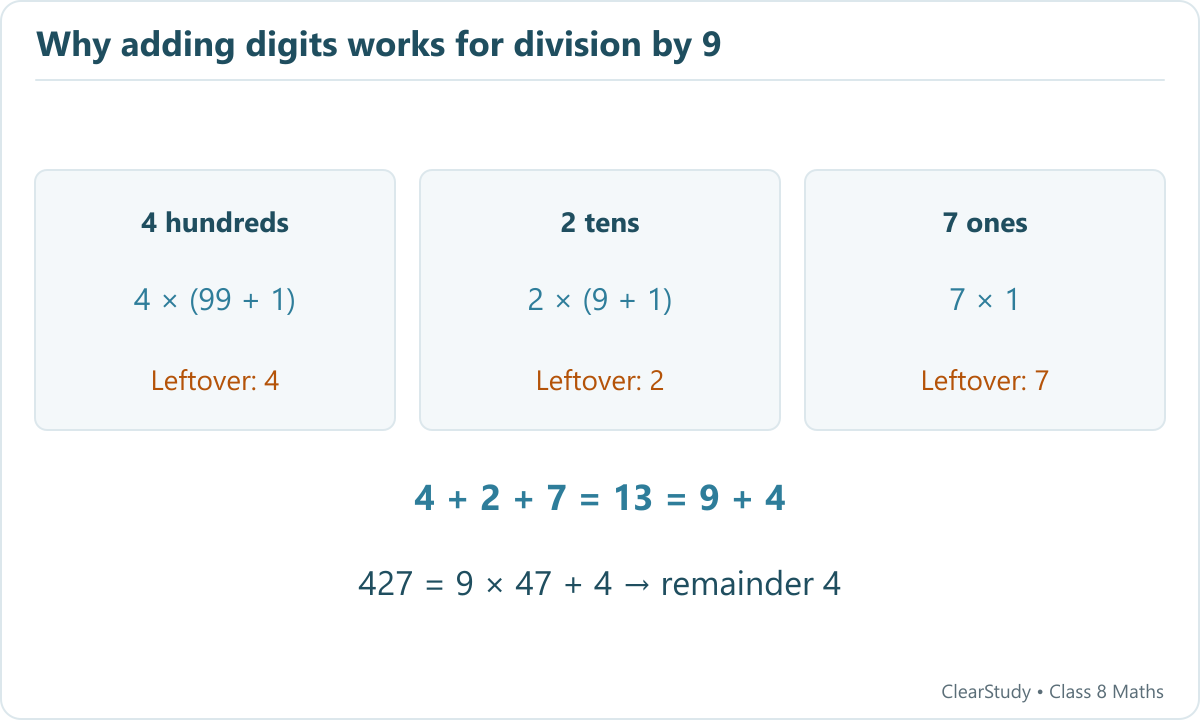
Division by 11 and the completed table (Pages 128–129)
| Number | Alternating sum | Remainder ÷11 |
|---|---|---|
| 158 | 8 − 5 + 1 = 4 | 4 |
| 841 | 1 − 4 + 8 = 5 | 5 |
| 481 | 1 − 8 + 4 = −3 | 8 |
| 5529 | 9 − 2 + 5 − 5 = 7 | 7 |
| 90904 | 4 − 0 + 9 − 0 + 9 = 22 | 0 |
| 857076 | 6 − 7 + 0 − 7 + 5 − 8 = −11 | 0 |
| Number | ÷2 | ÷3 | ÷4 | ÷5 | ÷6 | ÷8 | ÷9 | ÷10 | ÷11 |
|---|---|---|---|---|---|---|---|---|---|
| 128 | Yes | No | Yes | No | No | Yes | No | No | No |
| 990 | Yes | Yes | No | Yes | Yes | No | Yes | Yes | Yes |
| 1586 | Yes | No | No | No | No | No | No | No | No |
| 275 | No | No | No | Yes | No | No | No | No | Yes |
| 6686 | Yes | No | No | No | No | No | No | No | No |
| 639210 | Yes | Yes | No | Yes | Yes | No | No | Yes | Yes |
| 429714 | Yes | Yes | No | No | Yes | No | Yes | No | No |
| 2856 | Yes | Yes | Yes | No | Yes | Yes | No | No | No |
| 3060 | Yes | Yes | Yes | Yes | Yes | No | Yes | Yes | No |
| 406839 | No | Yes | No | No | No | No | No | No | No |
In particular, 128 is divisible by 4: 128 = 4 × 32. Use the arithmetic when a prefilled textbook cell is inconsistent.
Combining divisibility tests (Pages 129–130)
Digital-root explorations (Page 130)
Additional cryptarithms (Pages 131–132)
| Puzzle | Valid numerical solution(s) |
|---|---|
| A1 + 1B = B0 | 71 + 19 = 90 |
| AB + 37 = 6A | 25 + 37 = 62 |
| ON + ON + ON = PO | 17 + 17 + 17 = 51; 24 + 24 + 24 = 72; 31 + 31 + 31 = 93 |
| QR + QR + QR = PRR | 85 + 85 + 85 = 255 |
| PQ × 8 = RS | 12 × 8 = 96 |
| GH × H = 9K | 24 × 4 = 96 (from the listed options) |
| BYE × 6 = RAY | 105 × 6 = 630 |
| UT × 3 = PUT | 50 × 3 = 150 |
| AB × 5 = BC | 19 × 5 = 95 |
| L2N × 2 = 2NP | 124 × 2 = 248; 125 × 2 = 250 |
| XY × 4 = ZX | 23 × 4 = 92 |
| PP × QQ = PRP | 22 × 11 = 242; 33 × 11 = 363; 44 × 11 = 484 |
| JK × 6 = KKK | 74 × 6 = 444 |
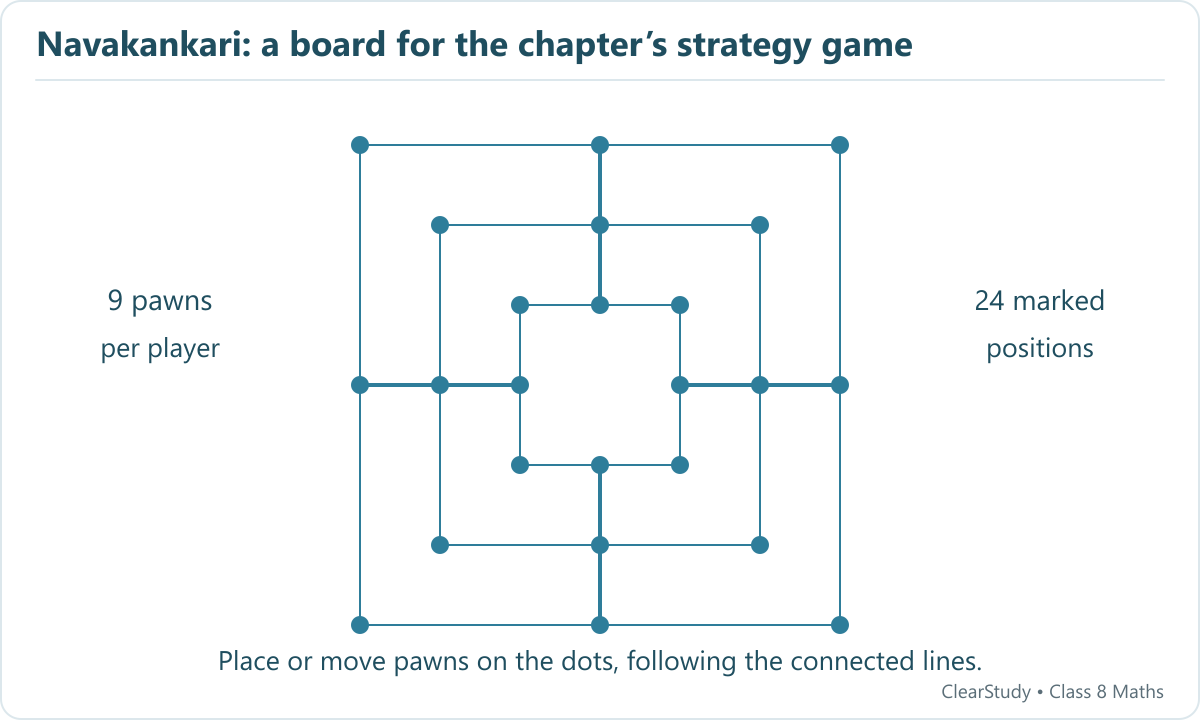
Navakankari (Page 135)
Use the board below for the textbook’s two-player game. Each player starts with nine pawns and takes turns placing them on empty marked points. After placement, move a pawn to an adjacent empty point along a line. Forming a horizontal or vertical line of three allows a capture under the textbook’s rule: remove an opposing pawn that is outside an opposing line of three. A player wins when the opponent has fewer than three pawns or cannot move. Discuss the counting and planning used in choosing moves.
Common Mistakes to Avoid
Watch out for these
- Confusing “always / sometimes / never true” — one counterexample is enough to rule out “always,” but you need a general (algebraic) argument to prove “always.”
- For divisibility by 9 or 3, testing the units digit instead of the digit-sum.
- In the rule for 11, forgetting that the alternating sum can be 0 or any multiple of 11 (not just 0).
- Thinking divisibility by a × b follows from divisibility by a and b when they share factors (e.g. 4 and 6 do not test 24; use 3 and 8 instead).
- Writing the digital root as the divisor when the number is a multiple of 9 — the digital root is 9 but the remainder is 0.
- Allowing a leading 0 or letting two different letters equal the same digit in a cryptarithm.
Practice MCQs & Assertion–Reason
1. The sum of two odd numbers is always:
(a) odd (b) even (c) a multiple of 3 (d) prime
2. A number is divisible by 9 if and only if:
(a) its units digit is 9 (b) its last two digits are divisible by 9 (c) the sum of its digits is divisible by 9 (d) it is even
3. The digital root of 489710 is:
(a) 2 (b) 5 (c) 9 (d) 11
4. Which number is divisible by 11?
(a) 158 (b) 481 (c) 90904 (d) 841
5. The remainder when 7309 is divided by 9 is:
(a) 0 (b) 1 (c) 7 (d) 9
6. Numbers that leave remainder 3 when divided by 5 are of the form:
(a) 3k + 5 (b) 5k + 3 (c) 5k − 3 (d) 3k
7. The product of any three consecutive integers is always a multiple of:
(a) 5 (b) 4 (c) 6 (d) 9
8. If 31z5 is a multiple of 9, the possible values of z are:
(a) 0 only (b) 9 only (c) 0 or 9 (d) 3 or 6
9. To check divisibility by 24, it is enough to check divisibility by:
(a) 4 and 6 (b) 3 and 8 (c) 2 and 12 (d) 6 and 12
10. The smallest number leaving remainders 2, 3, 4 when divided by 3, 4, 5 respectively is:
(a) 58 (b) 59 (c) 60 (d) 61
For each Assertion–Reason question, choose: (A) Both Assertion and Reason are true and the Reason is the correct explanation of the Assertion; (B) Both are true but the Reason is not the correct explanation; (C) Assertion is true but Reason is false; (D) Assertion is false but Reason is true.
A-R 1. Assertion: The number 405 is divisible by 9.
Reason: A number is divisible by 9 if the sum of its digits is divisible by 9.
A-R 2. Assertion: Doubling any multiple of 11 gives a multiple of 11.
Reason: If n = 11k, then 2n = 11(2k).
A-R 3. Assertion: A number divisible by both 4 and 6 must be divisible by 24.
Reason: A number divisible by both 4 and 6 must be divisible by LCM(4, 6) = 12.
A-R 4. Assertion: The digital root of every positive multiple of 9 is 9.
Reason: The remainder of any multiple of 9 on division by 9 is 0.
A-R 5. Assertion: The sum of three consecutive even numbers is always divisible by 6.
Reason: Three consecutive even numbers can be written as 2k, 2k+2, 2k+4, whose sum is 6(k+1).
Quick Revision Summary
- Any combination a ± b ± c ± d of four numbers has a fixed parity, because a ± b always have the same parity.
- If a divides M and N, it divides M + N and M − N; multiples of A stay divisible by A’s factors.
- If A is divisible by k and m, then A is divisible by LCM(k, m).
- Divisibility by 9 / 3 → test the digit-sum; digital root 9 means remainder 0; other positive digital roots equal the remainder.
- Divisibility by 11 → alternating sum of digits is 0 or a multiple of 11.
- Products of consecutive integers: 2 of them → multiple of 2; 3 → of 6; 4 → of 24; 5 → of 120.
- Cryptarithms are solved by reasoning about leading digits, units digits and carrying.
How to score full marks in this chapter
For “always / sometimes / never” questions, always back “always true” with an algebraic proof and disprove with a clear counterexample. Show the digit-sum (for 3 and 9) or the alternating sum (for 11) explicitly. In word/remainder problems, convert each condition into mk + r form and use the LCM. For cryptarithms, state the constraint you used (range of the leading digit, units-digit match) before guessing.
Frequently Asked Questions
What is Class 8 Maths Ganita Prakash Chapter 5 about?
Chapter 5, Number Play, explores parity (odd/even), sums of consecutive numbers, divisibility properties, the divisibility shortcuts for 3, 9 and 11 (with reasons), digital roots, and cryptarithms — with a strong focus on understanding why each rule works.
How many Figure it Out exercises are in Ganita Prakash Chapter 5?
There are four “Figure it Out” sets: on page 122 (8 questions), page 126 (4 questions), page 131 in Digital Roots (4 questions) and page 132 in Digits in Disguise (16 questions) — 32 questions in all, every one solved on this page.
What is the divisibility rule for 11 used in this chapter?
Place alternating + and − signs before the digits starting from the units place and add them up. If the result is 0 or a multiple of 11, the number is divisible by 11; otherwise reduce the signed sum modulo 11 to obtain a remainder from 0 to 10.
Are these Class 8 Maths Ganita Prakash Chapter 5 solutions free?
Yes. All solutions are free and follow the official NCERT Ganita Prakash (Part I) textbook for 2026–27.
Textbook reference: NCERT Ganita Prakash, Chapter 5 (official PDF). ClearStudy diagrams and worked explanations are original teaching aids.