
Class 8 Science Curiosity Chapter 1 Solutions (NCERT 2026–27) – Exploring the Investigative World of Science
These Class 8 Science Curiosity Chapter 1 solutions cover Exploring the Investigative World of Science from the new NCF-2023 textbook (2026–27). Chapter 1 is the year’s opening chapter: it teaches you how to think and work like a scientist through careful observation, focused questions and simple experiments, rather than presenting a single science topic.
Note: Chapter 1 of Curiosity is an introductory chapter and does not have an end-of-chapter “Keep the curiosity alive” exercise. Its questions are the first-page “Probe and ponder” prompts and the in-text investigation activities, all reproduced and answered below.
Class 8 Science Curiosity Chapter 1 Solutions – Overview
Chapter 1 of Curiosity, Exploring the Investigative World of Science, sets the tone for Grade 8 science. It reminds us that in Grade 6 science began with wonder and simple “Why?” and “How?” questions, and in Grade 7 we saw that science keeps evolving. Now we enter the investigative world, where we learn not just new facts but how to find new facts. Using the everyday example of a puri puffing in hot oil, the chapter shows the idea of systematic investigation: asking a focused question, deciding what to change/control and what to observe/measure, changing only one thing at a time, and keeping careful notes. The root-and-kite page symbols capture its big idea — stay grounded in real observation while letting ideas soar.
Key Concepts & Definitions
Investigation: a systematic way of studying the world — far more than just looking at something. It means asking focused questions, designing simple experiments, and using observations to improve our understanding.
Scientific question: a clear, testable question such as “What different things change the way a puri puffs up when fried?” that can be answered by experiment.
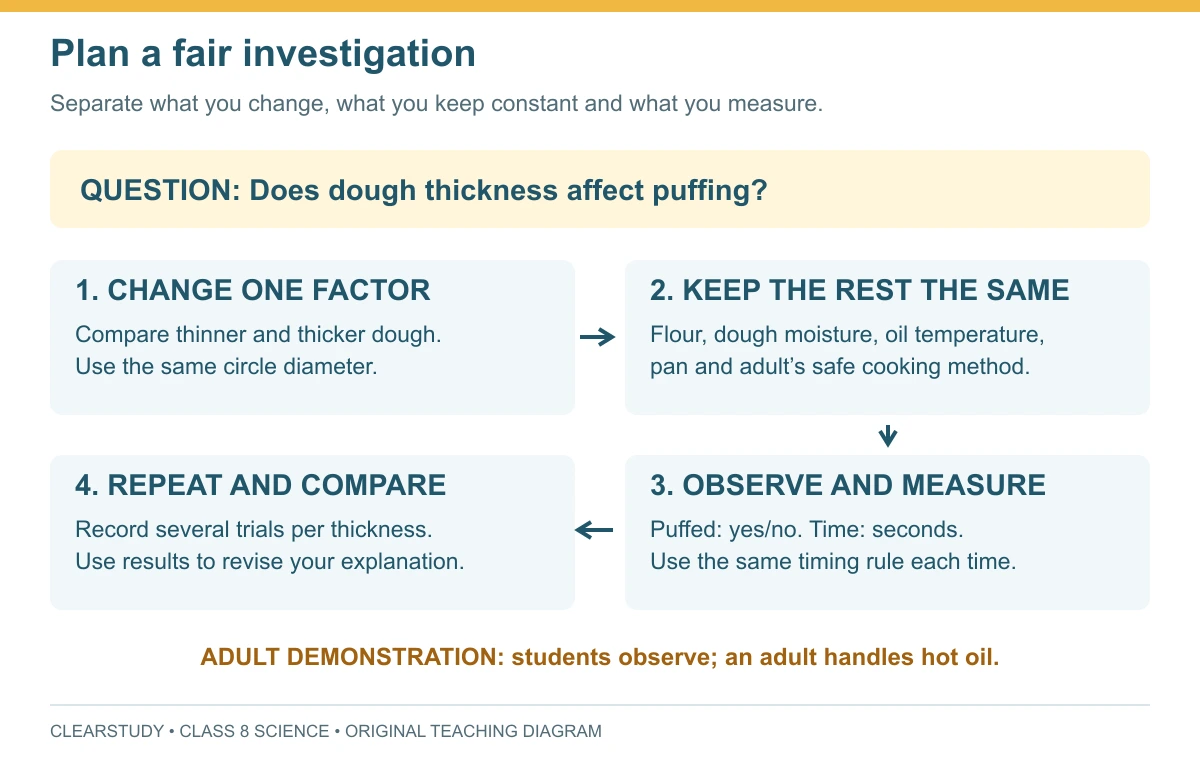
Factor changed (independent variable): the one factor we deliberately vary, such as dough thickness.
Conditions kept the same (controlled variables): the other factors, such as flour type, dough-circle diameter and oil temperature in a thickness investigation.
Things we observe / measure: what we record to see if a change mattered — either yes/no observations (did the puri puff up?) or a number (how many seconds to puff up).
Fair test (change one thing at a time): to find the effect of one factor, change only that factor while keeping all other conditions the same.
Keeping notes: recording everything you see and sense — did the oil splatter, smell or smoke? — because good records lead to new questions.
“Probe and Ponder” Questions — Answers
These first-page prompts are invitations to spark curiosity, not exam questions; the answers below are model explanations a young scientist could give.
1. Why is one side of a puri thinner than the other?
2. Are there more grains of sand on all the beaches and deserts of the world, or more stars in our galaxy?
3. Right from Grade 6, we’ve observed the incredible diversity of plants and animals around us. From the different shapes of leaves to the many kinds of insects—why has nature created such a vast variety?
4. Is there such a question that makes you curious about the world? Write it here!
Investigating Like a Scientist — The Puri Example
Observe safely
Frying is an adult demonstration. A responsible adult must handle the stove, oil and utensils; students observe from a safe distance and record results. Do not deliberately overheat oil until it smokes, add water to hot oil, or drop dough in a way that causes splashing. A paper-plane investigation is a safer hands-on alternative.
The chapter uses the kitchen question “Why is one side of a puri thinner than the other?” to demonstrate systematic investigation. The activity-style questions woven into the text are answered below.
Q. What are the different things that may change the way a puri puffs up when fried?
Q. What can we observe or measure to see if these changes made any difference?
Q. Why should we change only one thing at a time while keeping the other conditions the same?
Q. After one round of experiments, what further questions might a young scientist ask?
Common Misconceptions to Avoid
Watch out for these
- Thinking science only happens in a fancy laboratory — even your kitchen is a great place to observe, ask questions and experiment.
- Believing investigation means “just looking” — real investigation also means asking focused questions and testing them.
- Changing many things at once in an experiment — then you cannot tell which change caused the result.
- Thinking observations must always be numbers — useful data can also be simple yes/no observations or sensory notes.
- Assuming everyday things are fully explained — even the puffing of a puri is not yet completely understood by scientists.
- Forgetting to keep notes — records of what you see and sense are what let you compare results and ask new questions.
Extra Practice Questions
These questions and MCQs are ClearStudy practice, separate from the NCERT exercise.
Very Short Answer Type Questions
Q1. What does “investigation” mean in science?
Q2. Give one example of a factor you could change while investigating why a puri puffs up.
Q3. Name one quantity you could measure in this experiment.
Short Answer Type Questions
Q1. Why is it important to change only one variable at a time in an experiment?
Q2. The chapter uses a root and a kite as page symbols. What do they stand for?
Long Answer Type Question
Q1. Describe how you would investigate the question “Does oil temperature affect how quickly a puri puffs up?” like a scientist.
MCQs & Assertion–Reason
1. In Grade 8 science, we mainly learn to:
(a) memorise more facts (b) find out how to discover new facts (c) avoid asking questions (d) copy answers
2. “Investigation” in science means:
(a) only looking at something (b) guessing the answer (c) asking focused questions and testing them (d) reading without observing
3. While studying why a puri puffs up, which of these is a factor you can control?
(a) the time it takes to puff (b) the thickness of the dough (c) whether it smells (d) whether it puffed (yes/no)
4. Which of these is something you would observe or measure?
(a) the type of flour (b) the oil temperature you set (c) the time in seconds to puff up (d) the size of the dough circle
5. To make a fair test, in one experiment you should change:
(a) many things together (b) only one thing at a time (c) nothing at all (d) the observer
6. According to the chapter, doing simple experiments needs:
(a) a fancy laboratory (b) expensive instruments (c) only curiosity and careful observation (d) a computer
7. The puffing of a puri is said to be:
(a) fully understood by scientists (b) not completely understood even today (c) impossible to study (d) unimportant
8. The root symbol on the pages of the book stands for:
(a) curiosity taking flight (b) a solid foundation of knowledge (c) speed (d) measurement
9. The kite symbol on the pages reminds us that:
(a) we should never change ideas (b) curiosity must take flight to explore the unknown (c) science is boring (d) only facts matter
10. While experimenting, keeping notes of splatter, smell and smoke is useful because:
(a) it wastes time (b) it has no value (c) good records help compare results and raise new questions (d) it replaces the experiment
For each Assertion–Reason question, choose: (A) Both true and the Reason correctly explains the Assertion; (B) Both true but the Reason is not the correct explanation; (C) Assertion true, Reason false; (D) Assertion false, Reason true.
A-R 1. Assertion: Science can be done even in an ordinary kitchen.
Reason: Many simple investigations can use familiar materials with careful observation and appropriate safety precautions; a fancy laboratory is not always needed.
A-R 2. Assertion: In a good experiment we change only one factor at a time.
Reason: Keeping other conditions the same makes the test fair so the result can be linked to that one factor.
A-R 3. Assertion: Investigation in science means simply looking at things.
Reason: Investigation also means asking focused questions, experimenting and explaining what we observe.
A-R 4. Assertion: The puffing of a puri is completely understood by scientists.
Reason: Even simple everyday observations can still be open scientific puzzles.
A-R 5. Assertion: Keeping careful notes during an experiment is a good practice.
Reason: Records of what we see and sense help us compare results and think of new questions.
Quick Revision Summary
- Grade 8 science is about learning how to find new facts, not just learning more facts.
- Investigation = asking focused questions, doing simple experiments and using observations to improve understanding.
- Plan an experiment by deciding what to change/control and what to observe/measure (yes/no or a number).
- Make a fair test by changing only one thing at a time and keeping the rest the same.
- Keep notes of everything you see and sense; good records lead to new questions.
- The root (solid foundation) and the kite (soaring curiosity) symbolise the spirit of the book; even a puffing puri is still not fully understood.
Real-life Applications
The investigative habit works far beyond the kitchen. A cook tests “change one thing at a time” when adjusting oil temperature or dough; a gardener does the same when checking why one plant grows better than another; and a student improving a science-fair project changes a single variable per trial. The same steps — ask a question, control variables, observe and measure, keep notes — are part of how engineers improve machines and researchers study environmental changes. Professional investigations may also need specialised methods, many variables, ethical review or long-term observations. Learning this method in Chapter 1 prepares you to investigate every later topic in Curiosity.
How to write a clear answer
Clearly separate the things you control (e.g. dough thickness, oil temperature, flour type) from the things you observe or measure (puffed yes/no, time in seconds). For any “design an experiment” answer, always state your scientific question, name the one variable you change, list what you keep the same to make it a fair test, and mention keeping notes. Use the textbook’s own examples — the puri, the root and the kite — to show you have read the chapter.
Frequently Asked Questions
What is Class 8 Science Curiosity Chapter 1 about?
Chapter 1, Exploring the Investigative World of Science, teaches how to think and work like a scientist — asking focused questions, designing simple experiments, deciding what to change and what to observe, making fair tests and keeping notes — using the everyday example of why a puri puffs up in hot oil.
Does Chapter 1 of Curiosity have an exercise?
No. It is an introductory chapter, so instead of an end-of-chapter exercise it has the first-page “Probe and ponder” questions and in-text investigation activities, all answered on this page.
Why is one side of a puri thinner than the other?
Steam formed from water in the dough helps a puri puff up. Differences in heating, stretching and setting of its two layers are possible contributors to unequal thickness. NCERT presents this as a question for investigation, not a complete explanation.
Are these Class 8 Science Curiosity Chapter 1 solutions free?
Yes. All solutions are free and follow the official NCERT Curiosity textbook for 2026–27.