
Class 8 Science Curiosity Chapter 13 Solutions (NCERT 2026–27) – Our Home: Earth, a Unique Life Sustaining Planet
These Class 8 Science Curiosity Chapter 13 solutions cover Our Home: Earth, a Unique Life Sustaining Planet from the new NCF-2023 textbook (2026–27), with every “Keep the curiosity alive” question answered step by step.
Class 8 Science Curiosity Chapter 13 Solutions – Overview
Chapter 13 of Curiosity, Our Home: Earth, a Unique Life Sustaining Planet, is the concluding chapter of the Grade 8 book. It explains why Earth is the only known planet that supports life: its position in the habitable (Goldilocks) zone where water stays liquid, its right size to hold an atmosphere by gravity, the protective ozone layer, and the Earth’s magnetic field that helps deflect charged particles from space. It then shows how the atmosphere, hydrosphere, geosphere and biosphere interact to sustain life, how reproduction (asexual and sexual) keeps life going, and how the triple planetary crisis—climate change, biodiversity loss and pollution—threatens this delicate balance. These Class 8 Science Curiosity Chapter 13 solutions answer every textbook question step by step.
Key Concepts & Definitions
Habitable zone (Goldilocks zone): the range of distances from a star where surface liquid water could exist on a planet with suitable atmospheric conditions. Being in this zone does not guarantee water or life. Earth lies in the Sun’s habitable zone.
Greenhouse effect: gases like carbon dioxide trap heat radiated by the warmed Earth, keeping it warm enough for liquid water. A mild greenhouse effect is helpful; too much (as on Venus) makes a planet too hot.
Crust & geosphere: the crust is Earth’s outermost solid layer. The geosphere includes the solid Earth, not just its surface. Life also occurs in water, soil and parts of the atmosphere; it is not restricted to the crust.
The four spheres: atmosphere (air), hydrosphere (water), geosphere (solid Earth), biosphere (all living things and their habitats) — they interact to sustain life.
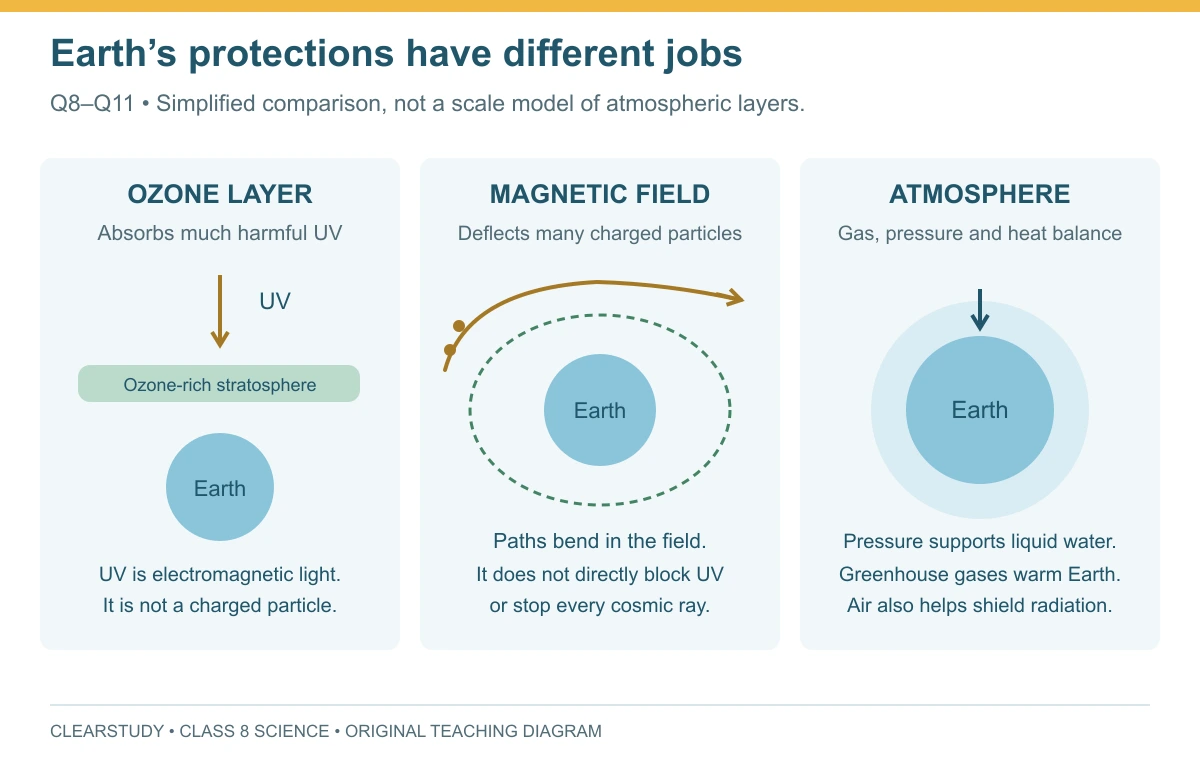
Ozone layer: the ozone-rich region of the stratosphere. Ozone (O₃) absorbs much of the Sun’s harmful ultraviolet radiation; it is not the same protection as a magnetic field.
Magnetic field: generated mainly by moving, electrically conducting fluid in the outer core. It changes the paths of many charged particles from space; the atmosphere also provides essential radiation shielding.
Reproduction: allows life to continue across generations. Asexual — one parent without gamete fusion; offspring are generally genetically very similar, though mutations can occur. Sexual — fusion of gametes, usually from two parents, combines genetic information. Self-fertilisation can involve one individual.
Triple planetary crisis: climate change, biodiversity loss and pollution — the biggest threats to life on Earth.
“Probe and Ponder” & Activity — Answers
What do you think Earth would look like if there were no life on it at all?
Life on Earth has survived for billions of years. What allows it to keep going despite major changes and disasters?
Why don’t dogs lay eggs? Or hens give birth to live chicks?
If a spaceship carried soil and water to Mars, could plants start growing there?
Activity 13.1: List some features of the Earth that we often take for granted, but are interesting and important to us.
Class 8 Science Curiosity Chapter 13 Solutions — Keep the Curiosity Alive
1. What is one major reason Mars cannot currently support life like Earth? (i) It has too many volcanoes.(ii) It is too close to the Sun.(iii) It lacks a thick atmosphere and liquid water.(iv) Its magnetic field is too strong.
2. Which of these is an example of geodiversity? (i) Variety of bird chirping in a forest.(ii) Different landforms like mountains, valleys, and deserts.(iii) Changing weather during monsoons.(iv) Number of different types of fish in a pond.
3. If the Earth were smaller with the same density, what might happen to its atmosphere? (i) It would become thicker and hotter.(ii) It would escape into space due to weaker gravity.(iii) It would become frozen.(iv) It would cause stronger winds.
4. In sexual reproduction, why are offspring different from their parents? (i) They grow in different climates.(ii) They eat different food.(iii) They acquire new instructions after birth.(iv) They get mixed instructions (genes) from both parents.
5. You notice tiny green plants growing in cracks on your school wall after the monsoon. Where do you think the seeds came from? What conditions helped these plants grow there?
6. A city has recently cut down a large patch of forest to build new roads and buildings. Discuss the possible effects this could have on the local climate and biodiversity? How might this affect water availability or quality in the area?
7. A friend says, “The Earth has always had climate changes in the past, so today’s global warming is nothing new.” How would you respond using what you’ve learnt in this and other chapters of your science book?
8. Imagine Earth’s magnetic field suddenly disappeared. What kinds of problems could arise for life on Earth? Explain.
9. You are tasked with designing a new settlement for humans on Mars. Name three things you would need to recreate from Earth to support human life there. Which of these do you think is the hardest to replicate, and why?
10. In a village, the temperature has been increasing and rainfall has become unpredictable over the past few years. What could be causing this change? Suggest two ways the village could adapt to these new conditions.
11. If there were no atmosphere on the Earth, would it affect life, temperature, and water on the planet? Explain.
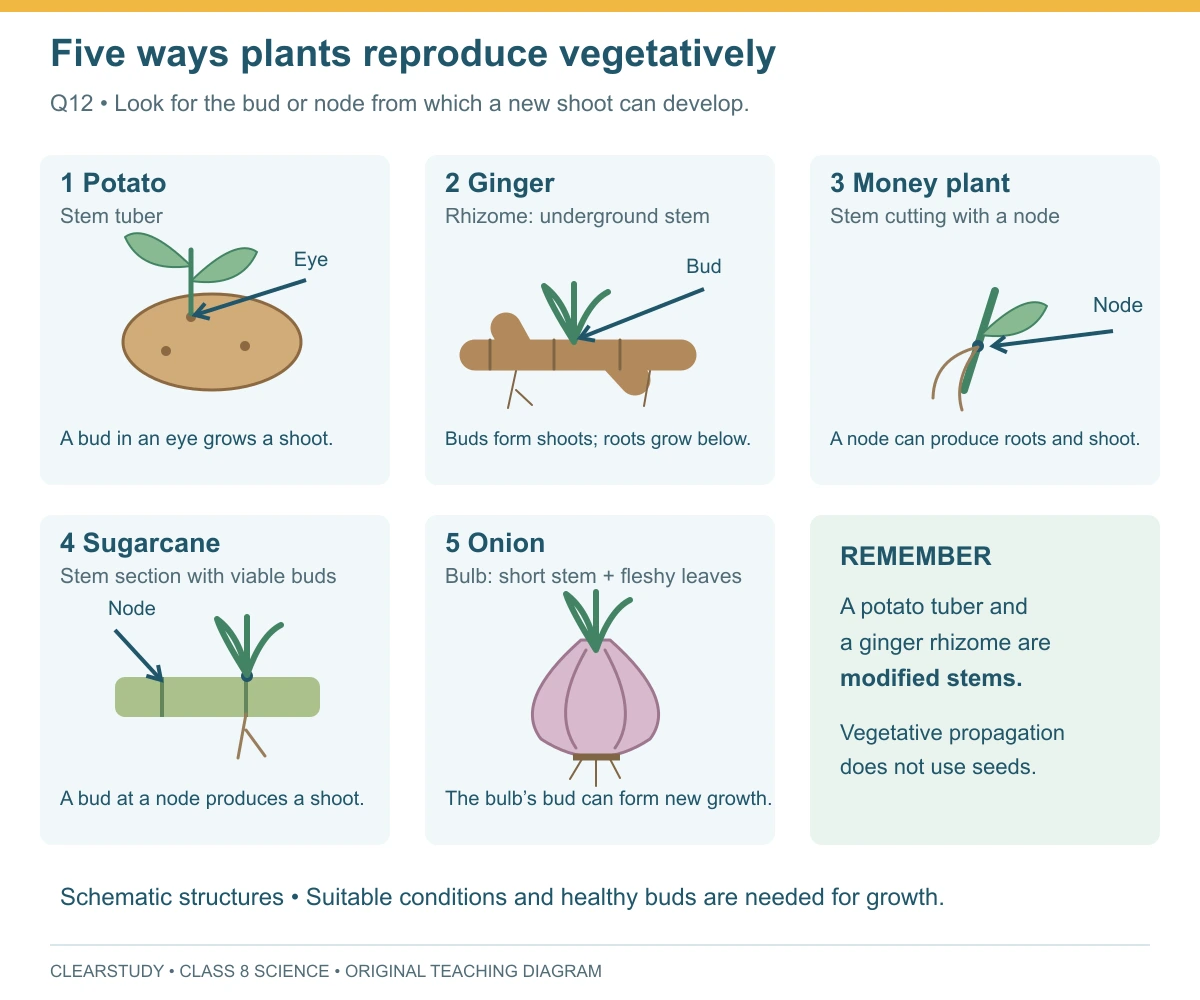
12. Discuss five examples of vegetative propagation.
- Potato: buds in the “eyes” of a stem tuber grow into shoots. A suitable piece must contain a bud.
- Ginger: buds on its horizontal underground stem, the rhizome, form new shoots and roots.
- Money plant: a stem cutting containing a node can develop roots and a new shoot in water or a suitable moist medium.
- Sugarcane: stem pieces containing viable buds at nodes can establish new plants.
- Onion: buds in a bulb can grow; daughter bulbs can separate to form new plants. A bulb has a short stem surrounded by fleshy storage leaves.
Common Misconceptions to Avoid
Watch out for these
- Thinking the hottest planet is the closest one — Venus is hotter than Mercury because its thick carbon-dioxide atmosphere traps heat (greenhouse effect).
- Believing the greenhouse effect is always bad — a mild greenhouse effect keeps Earth warm enough for liquid water; only excess greenhouse gases cause harmful global warming.
- Confusing the planet’s greenhouse effect with a plant greenhouse — the planet’s effect works by gases absorbing radiation, not just by trapping warm air behind glass.
- Assuming every planet in the habitable zone must support life — the zone indicates possible surface liquid water under suitable conditions; atmosphere and other planetary properties still matter.
- Mixing up the four spheres — geosphere (solid), hydrosphere (water), atmosphere (air), biosphere (life).
- Thinking asexual reproduction can never produce variation — mutations can introduce differences; sexual reproduction also reshuffles genetic information.
Extra Practice Questions
These questions and MCQs are ClearStudy practice, separate from the NCERT exercise.
Very Short Answer Type Questions
Q1. What is the other name for the habitable zone?
Q2. Name the layer of the atmosphere that blocks harmful UV rays.
Q3. What are the three challenges together called the “triple planetary crisis”?
Short Answer Type Questions
Q1. Why is liquid water important for Earth being a unique planet?
Q2. Name the four spheres of the Earth system and what each consists of.
Long Answer Type Question
Q1. Explain the main factors that make the Earth suitable for life to exist.
MCQs & Assertion–Reason
1. The range of distances from a star where water can stay liquid is called the:
(a) ozone zone (b) habitable (Goldilocks) zone (c) magnetic zone (d) greenhouse zone
2. Earth is called the “Blue Planet” mainly because:
(a) the sky looks blue (b) it is cold (c) most of its surface is covered with water (d) it has a blue core
3. The hottest planet in the solar system is Venus because:
(a) it is closest to the Sun (b) its thick atmosphere traps heat (c) it has no atmosphere (d) it has a strong magnetic field
4. The solid part of the Earth — rocks, soil and minerals — is called the:
(a) hydrosphere (b) atmosphere (c) geosphere (d) biosphere
5. The Earth’s magnetic field protects us by deflecting:
(a) sunlight (b) rainwater (c) cosmic rays and the solar wind (d) clouds
6. The ozone layer is important because it:
(a) provides oxygen to breathe (b) blocks harmful ultraviolet rays (c) makes rain (d) creates gravity
7. Growing a new plant from a stem cutting of money plant is an example of:
(a) sexual reproduction (b) pollination (c) vegetative propagation (d) fertilisation
8. In flowering plants, the male gametes are present in the:
(a) ovule (b) pollen grains (anther) (c) root (d) fruit
9. The triple planetary crisis includes climate change, pollution and:
(a) earthquakes (b) biodiversity loss (c) volcanoes (d) tides
10. On Mars, compared with Earth, the atmosphere is:
(a) much thicker (b) about 100 times thinner (c) exactly the same (d) made mostly of oxygen
For each Assertion–Reason question, choose: (A) Both true and the Reason correctly explains the Assertion; (B) Both true but the Reason is not the correct explanation; (C) Assertion true, Reason false; (D) Assertion false, Reason true.
A-R 1. Assertion: Earth lies in the habitable zone of the Sun.
Reason: At Earth’s distance from the Sun, the temperature allows water to remain in liquid form.
A-R 2. Assertion: Venus is hotter than Mercury even though Mercury is closer to the Sun.
Reason: Venus has a thick carbon-dioxide atmosphere that traps heat through the greenhouse effect.
A-R 3. Assertion: A smaller planet of the same density tends to retain atmospheric gases less easily, other factors being comparable.
Reason: A smaller planet has stronger gravity that pulls the atmosphere inward.
A-R 4. Assertion: Asexual reproduction produces offspring with great variation from the parent.
Reason: Asexual reproduction usually produces genetically similar offspring from one parent, although mutations may occur.
A-R 5. Assertion: The Earth’s magnetic field helps protect life on the planet.
Reason: It deflects harmful cosmic rays and the solar wind away from the Earth.
Quick Revision Summary
- Earth is a unique planet because it supports life; it lies in the habitable (Goldilocks) zone where water stays liquid.
- Gravity helps retain the atmosphere. Earth’s axial tilt causes seasons, so temperatures vary during the year.
- The ozone layer blocks harmful UV rays; the magnetic field shields Earth from cosmic rays and the solar wind.
- The atmosphere, hydrosphere, geosphere and biosphere interact and together sustain life.
- Reproduction continues lineages: asexual offspring are usually genetically similar; sexual reproduction combines gametes and reshuffles genetic information.
- Climate change, biodiversity loss and pollution form the triple planetary crisis; balance must be protected.
Real-life Applications
Understanding Earth’s habitable conditions guides real choices: rainwater harvesting and tree planting help villages cope with rising temperatures and uncertain rains; using clean energy like solar and wind cuts greenhouse gases; reusing, repairing and recycling reduce pollution and waste. Knowing about the ozone layer led the world to the Montreal Protocol to phase out CFCs, while the Paris Agreement targets limiting global warming. Space missions like India’s Mangalyaan study whether other planets could ever support life.
How to write a clear answer
Learn the four factors that make Earth habitable (position, size, ozone layer, magnetic field) and the four spheres with one line each. Remember why Venus is the hottest planet (greenhouse effect, not distance). For reproduction questions, clearly contrast asexual (one parent, usually genetically similar) with sexual (gamete fusion, usually two parents, reshuffled genes), and keep five vegetative-propagation examples ready (potato, ginger, money plant, sugarcane, onion).
Frequently Asked Questions
What is Class 8 Science Curiosity Chapter 13 about?
It explains why Earth is a unique, life-sustaining planet — its position in the habitable (Goldilocks) zone, its right size and atmosphere, the ozone layer and magnetic field, how its four spheres sustain life, how reproduction continues life, and the threats of the triple planetary crisis.
What is the habitable zone or Goldilocks zone?
It is the range of distances from a star where surface liquid water could exist on a planet with a suitable atmosphere. Being in the zone does not guarantee water or life. Earth lies in this zone around the Sun.
How many questions are in the “Keep the curiosity alive” exercise of Chapter 13?
There are 12 questions, all solved on this page along with the “Probe and ponder” prompts and the activity.
Are these Class 8 Science Curiosity Chapter 13 solutions free?
Yes. All solutions are free and follow the official NCERT Curiosity textbook for 2026–27.