
Class 8 Science Curiosity Chapter 4 Solutions (NCERT 2026–27) – Electricity: Magnetic and Heating Effects
These Class 8 Science Curiosity Chapter 4 solutions cover Electricity: Magnetic and Heating Effects from the new NCF-2023 textbook (2026–27), with every “Keep the curiosity alive” question answered step by step.
Class 8 Science Curiosity Chapter 4 Solutions – Overview
Chapter 4 of Curiosity, Electricity: Magnetic and Heating Effects, shows that an electric current does far more than light a lamp. A current flowing through a wire produces a magnetic field around it — the magnetic effect of electric current, first observed by Oersted. A current-carrying coil with an iron core becomes an electromagnet with two poles, used in lifting cranes and many devices. A current also heats a conductor because of its resistance — the heating effect that runs heaters, irons and kettles. Finally, the chapter explains how cells and batteries (Voltaic cells, dry cells, rechargeable batteries) generate electricity from chemical reactions. These Class 8 Science Curiosity Chapter 4 solutions answer every textbook question step by step.
Key Concepts & Definitions
Magnetic effect of electric current: when current flows through a conductor it produces a magnetic field around it; the field disappears when the current stops (Oersted’s discovery, 1820).
Magnetic field: the region around a magnet or current-carrying wire where its magnetic effect can be felt, e.g. by the deflection of a compass needle.
Electromagnet: a current-carrying coil that behaves as a magnet. An iron core (nail) makes it much stronger. It has two poles (N and S); its strength can be increased by raising the current or the number of turns, and its poles reverse if the current direction is reversed.
Heating effect of electric current: a conductor gets heated when current flows through it, because its resistance converts some electrical energy into heat. Heat depends on the material, thickness, length of the wire and the duration of current. Nichrome (a high-resistance wire) is used as the heating element in heaters, irons and kettles.
Cell / battery: a device that generates electric current from chemical reactions. A Voltaic (Galvanic) cell has two different metal electrodes dipped in an electrolyte. An ordinary zinc-carbon dry cell uses a moist paste electrolyte and is single-use. A paste electrolyte alone does not determine whether a cell is rechargeable. Rechargeable batteries (e.g. Li-ion) can be charged and reused many times.
“Probe and Ponder” & Activity Answers
If we don’t have an electric lamp while making an electric circuit with an electric cell, is there any other way through which we can find out if current is flowing in the circuit?
Is it possible to make temporary magnets? How can these be made?
We can generate heat by burning fossil fuels and wood; but how is heat generated in various electrical appliances?
How do we know if a cell or a battery is dead? Can all cells and batteries be recharged?
Activity 4.1 / 4.2: What do you observe when current flows through a wire (with a compass below it) and when an insulated coil is wound on an iron nail and connected to a cell?
Think like a scientist: Repeat Activity 4.3 with 2 and 4 cells (same coil), and with 2 cells but a different number of turns. What do you observe?
Class 8 Science Curiosity Chapter 4 Solutions — Keep the Curiosity Alive
1. Fill in the blanks: (i) The solution used in a Voltaic cell is called ________.(ii) A current carrying coil behaves like a _______ .
2. Choose the correct option: (i) Dry cells are less portable compared to Voltaic cells. (True/False)(ii) A coil becomes an electromagnet only when electric current flows through it. (True/False)(iii) An electromagnet, using a single cell, attracts more iron paper clips than the same electromagnet with a battery of 2 cells. (True/False)
3. An electric current flows through a nichrome wire for a short time. (i) The wire becomes warm.(ii) A magnetic compass placed below the wire is deflected. Choose the correct option:(a) Only (i) is correct (b) Only (ii) is correct (c) Both (i) and (ii) are correct (d) Both (i) and (ii) are not correct
4. Match the items in Column A with those in Column B. Column A: (i) Voltaic cell (ii) Electric iron (iii) Nichrome wire (iv) Electromagnet Column B: (a) Best suited for electric heater (b) Works on magnetic effect of electric current (c) Works on heating effect of electric current (d) Generates electricity by chemical reactions
| Column A | Column B |
|---|---|
| (i) Voltaic cell | (d) Generates electricity by chemical reactions |
| (ii) Electric iron | (c) Works on heating effect of electric current |
| (iii) Nichrome wire | (a) Best suited for electric heater |
| (iv) Electromagnet | (b) Works on magnetic effect of electric current |
5. Nichrome wire is commonly used in electrical heating devices because it (i) is a good conductor of electricity.(ii) generates more heat for a given current.(iii) is cheaper than copper.(iv) is an insulator of electricity.
6. Electric heating devices (like an electric heater or a stove) are often considered more convenient than traditional heating methods (like burning firewood or charcoal). Give reason(s) to support this statement considering societal impact.
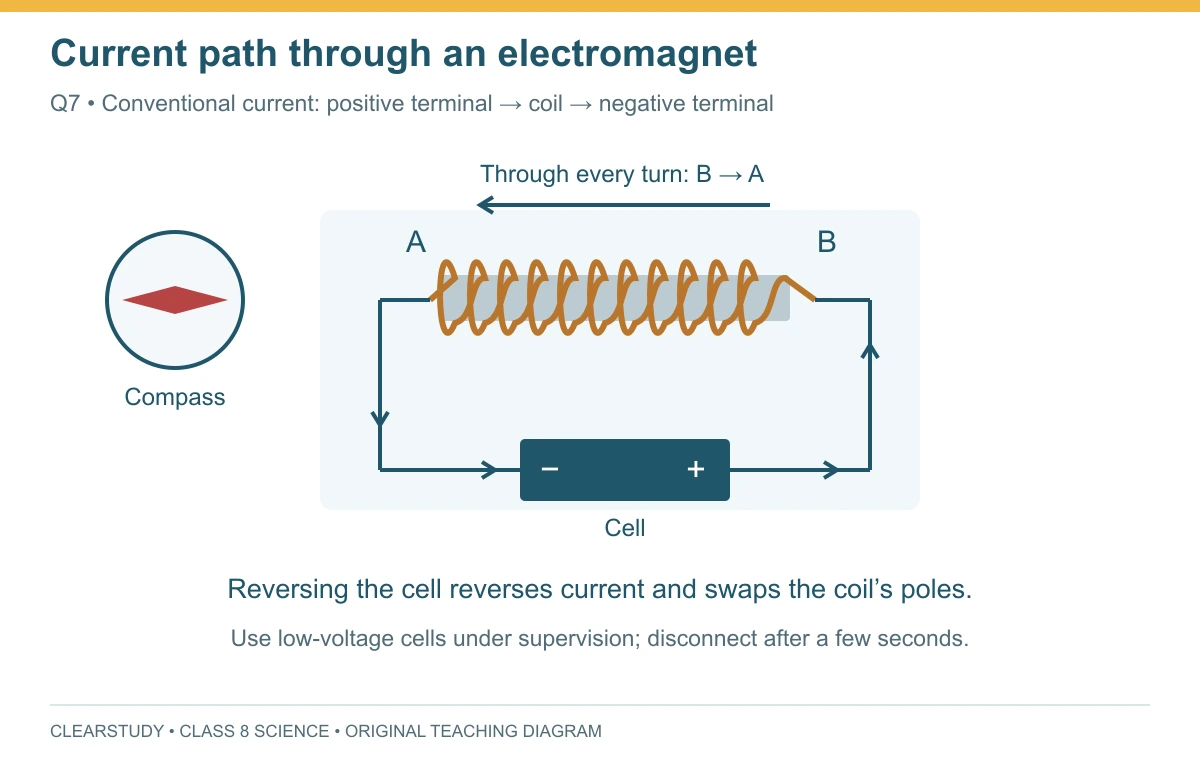
7. Look at the Fig. 4.4a. If the compass placed near the coil deflects: (i) Draw an arrow on the diagram to show the path of the electric current. (ii) Explain why the compass needle moves when current flows. (iii) Predict what would happen to the deflection if you reverse the battery terminals.
8. Suppose Sumana forgets to move the switch of her lifting electromagnet model to OFF position (in introduction story). After some time, the iron nail no longer picks up the iron paper clips, but the wire wrapped around the iron nail is still warm. Why did the lifting electromagnet stop lifting the clips? Give possible reasons.
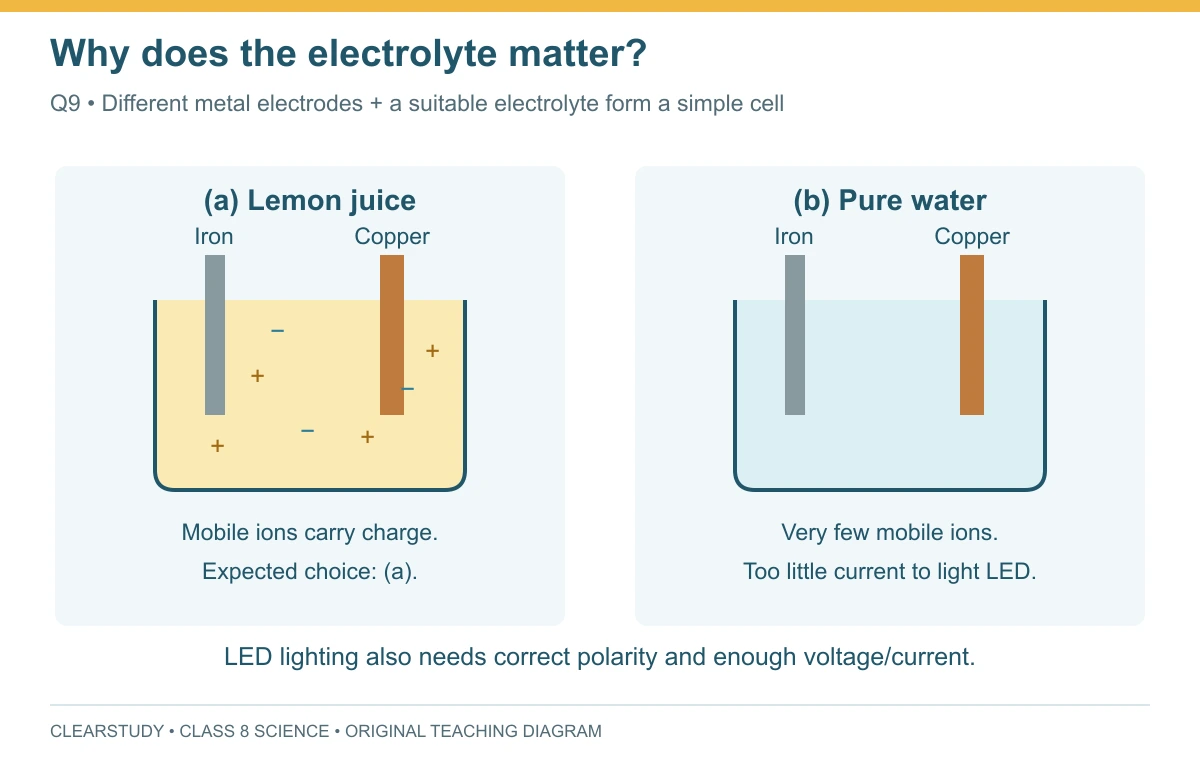
9. In Fig. 4.12, in which case the LED will glow when the switch is closed? [(a) Iron nail and copper strip in lemon juice; (b) Iron nail and copper strip in pure water]
10. Neha keeps the coil exactly the same as in Activity 4.4 but slides the iron nail out, leaving only the coiled wire. Will the coil still deflect the compass? If yes, will the deflection be more or less than before?
11. We have four coils, of similar shape and size, made up from iron, copper, aluminium, and nichrome as shown in Fig. 4.13. When current is passed through the coils, compass needles placed near the coils will show deflection. (i) Only in circuit (a)(ii) Only in circuits (a) and (b)(iii) Only in circuits (a), (b), and (c)(iv) In all four circuits
Common Misconceptions to Avoid
Watch out for these
- Thinking an electromagnet is a permanent magnet — it is a temporary magnet that works only while current flows.
- Believing the iron core creates the magnetism — the current creates the field; the iron nail only strengthens it.
- Confusing the heating effect with the magnetic effect — a current produces both at the same time.
- Assuming nichrome is used because it conducts best — it is used because of its high resistance (more heat for a given current), not low resistance.
- Thinking pure water conducts electricity well — it is a poor conductor; an electrolyte (acid/salt solution) is needed in a cell.
- Believing all cells can be recharged — ordinary dry cells are single-use; only rechargeable batteries can be reused.
Extra Practice Questions
These questions and MCQs are ClearStudy practice, separate from the NCERT exercise.
Very Short Answer Type Questions
Q1. Who discovered the link between electricity and magnetism?
Q2. Name the metal wire commonly used as a heating element.
Q3. What is the liquid in a Voltaic cell called?
Short Answer Type Questions
Q1. State two ways to increase the strength of an electromagnet.
Q2. Why does a nichrome wire become hot when current passes through it, while the connecting copper wires stay cool?
Long Answer Type Question
Q1. Describe how you would make a simple electromagnet and explain three ways its magnetic strength and polarity can be changed.
MCQs & Assertion–Reason
1. When current flows through a wire, the region around it where its magnetic effect is felt is called the:
(a) electric field (b) magnetic field (c) gravitational field (d) heating zone
2. The scientist who discovered that electricity and magnetism are linked was:
(a) Volta (b) Galvani (c) Oersted (d) Newton
3. A current-carrying coil that behaves as a magnet is called a/an:
(a) electrolyte (b) electromagnet (c) bar magnet (d) compass
4. The magnetic effect of an electromagnet can be made stronger by:
(a) decreasing the current (b) reducing the turns (c) increasing the current or number of turns (d) removing the iron core
5. Heat is produced in a wire carrying current because of the wire’s:
(a) magnetism (b) resistance (c) colour (d) shape only
6. Which wire is most suitable as a heating element?
(a) copper (b) aluminium (c) nichrome (d) silver
7. The poles of an electromagnet can be reversed by:
(a) adding more clips (b) reversing the direction of the current (c) using a longer nail (d) switching it off
8. In a Voltaic cell, electricity is produced by:
(a) burning fuel (b) a chemical reaction between the electrodes and electrolyte (c) sunlight (d) friction
9. A dry cell is called “dry” because its electrolyte is:
(a) a liquid acid (b) pure water (c) a thick moist paste (d) a gas
10. Which of the following can be charged and used many times?
(a) an ordinary dry cell (b) a rechargeable (Li-ion) battery (c) a dead Voltaic cell (d) a candle
For each Assertion–Reason question, choose: (A) Both true and the Reason correctly explains the Assertion; (B) Both true but the Reason is not the correct explanation; (C) Assertion true, Reason false; (D) Assertion false, Reason true.
A-R 1. Assertion: A compass needle deflects when current flows through a nearby wire.
Reason: A current-carrying wire produces a magnetic field around it.
A-R 2. Assertion: Inserting an iron nail into a current-carrying coil makes the electromagnet stronger.
Reason: The iron core concentrates the magnetic field of the coil.
A-R 3. Assertion: Nichrome wire is used in electric heaters.
Reason: Nichrome has a very low resistance and stays cool.
A-R 4. Assertion: An ordinary zinc-carbon dry cell can be safely recharged and reused many times.
Reason: Rechargeable batteries store energy chemically through reactions that can be reversed during charging.
A-R 5. Assertion: Pure water is a good electrolyte for a Voltaic cell.
Reason: An electrolyte such as lemon juice or salt solution helps conduct electricity in a cell.
Quick Revision Summary
- When electric current flows through a conductor, it produces a magnetic field around it — the magnetic effect of electric current; it disappears when the current stops.
- A current-carrying coil that behaves as a magnet is an electromagnet; an iron core makes it stronger; it has N and S poles.
- Generation of heat in conductors due to the flow of electric current is the heating effect of electric current.
- A cell or battery generates current because of chemical reactions inside it (Voltaic cell, dry cell).
- Rechargeable batteries can be recharged and reused multiple times.
Real-life Applications
The magnetic effect runs lifting electromagnets on cranes in scrap yards and factories, plus electric bells, motors, fans and loudspeakers. The heating effect powers electric heaters, stoves, kettles, irons, immersion rods and hair dryers, and is used in industrial furnaces to melt and recycle scrap steel. Cells and batteries provide portable power for torches, watches, mobile phones, laptops, inverters and electric vehicles — with rechargeable Li-ion batteries reducing waste. Knowing the heating effect also explains why correctly rated wires, plugs and sockets are needed to prevent overheating and fires.
How to write a clear answer
Always state that a current produces both a magnetic and a heating effect. Remember the three ways to strengthen an electromagnet (more current, more turns, iron core) and that reversing the current reverses the poles. For heating questions, link it to resistance and why nichrome (high resistance) is the heating element. For cell questions, name the electrolyte and remember that pure water does not work.
Frequently Asked Questions
What is Class 8 Science Curiosity Chapter 4 about?
It covers the magnetic effect of electric current (electromagnets and Oersted’s discovery), the heating effect of electric current (heating elements like nichrome), and how cells and batteries — Voltaic cells, dry cells and rechargeable batteries — generate electricity from chemical reactions.
What is an electromagnet and how can it be made stronger?
An electromagnet is a current-carrying coil that behaves as a magnet only while current flows. It can be made stronger by increasing the current (more cells), increasing the number of turns at the same current, or adding an iron core.
Why is nichrome wire used in electric heaters?
Nichrome has a high resistance, so for a given current it converts more electrical energy into heat than copper. This makes it ideal as the heating element in heaters, irons and kettles.
Are these Class 8 Science Curiosity Chapter 4 solutions free?
Yes. All solutions are free and follow the official NCERT Curiosity textbook for 2026–27, with every “Keep the curiosity alive” question solved step by step.