
Class 8 Science Curiosity Chapter 5 Solutions (NCERT 2026–27) – Exploring Forces
These Class 8 Science Curiosity Chapter 5 solutions cover Exploring Forces from the new NCF-2023 textbook (2026–27), with the “Probe and ponder” prompts, in-text activities and every “Keep the curiosity alive” exercise question answered step by step.
Class 8 Science Curiosity Chapter 5 Solutions – Overview
Chapter 5 of Curiosity, Exploring Forces, introduces force as a push or pull resulting from the interaction of two or more objects, measured in the SI unit newton (N). It shows how a force can make an object move, change its speed or direction of motion, or change its shape. The chapter then classifies forces into contact forces (muscular force and friction) and non-contact forces (magnetic, electrostatic and gravitational force), explains weight and its measurement with a spring balance, distinguishes weight from mass, and ends with buoyant force (upthrust) and the ideas of floating and sinking. These Class 8 Science Curiosity Chapter 5 solutions answer every textbook question step by step.
Key Concepts & Definitions
Force: a push or pull on an object resulting from the object’s interaction with another object. The SI unit of force is the newton (N); at least two objects must interact for a force to come into play.
Effects of force: a force may make an object move from rest, change its speed, change its direction of motion, change its shape, or cause some or all of these.
Contact forces: act only when two objects are in physical contact — e.g. muscular force (from the action of muscles) and friction.
Friction: the force that comes into play when an object moves or tries to move over another surface; it opposes relative sliding, or the tendency to slide, between the contacting surfaces. In the classroom examples, rougher surfaces usually give more friction.
Non-contact forces: act even without contact — magnetic force (between magnets/magnetic materials), electrostatic force (between charged bodies) and gravitational force (Earth’s pull, always attractive).
Weight: the force with which the Earth pulls an object towards itself; measured in newton (N) with a spring balance. Mass is the amount of matter (in g or kg) and stays the same everywhere, but weight can change from place to place.
Buoyant force (upthrust): the upward force a liquid applies on an object. If gravity > buoyant force the object sinks; if the two are equal it floats.
“Probe and ponder” & In-text Questions — Answers
Why does it feel harder to pedal a bicycle when going uphill than on flat ground?
Why is it easier to slip on a wet surface?
Why do we feel ‘light’ or like we are ‘floating’ just after our swing reaches its highest point and begins to come down?
Activity 5.1 (Let us explore): Did you move the box in any other way than shown in Fig. 5.1?
Activity 5.2 (Let us analyse): Does a force cause a moving object to stop? Can it change speed, or direction of motion, or change the shape of an object?
Activity 5.3 (Let us investigate): When you gently push the object, does it stop after travelling some distance? Is there a force acting on it which brings it to rest? Does it stop again when pushed in the opposite direction?
Activity 5.4 (Let us explore): Does the object stop at the same distance on all surfaces (glass, cloth, wood, ceramic tile, sand)?
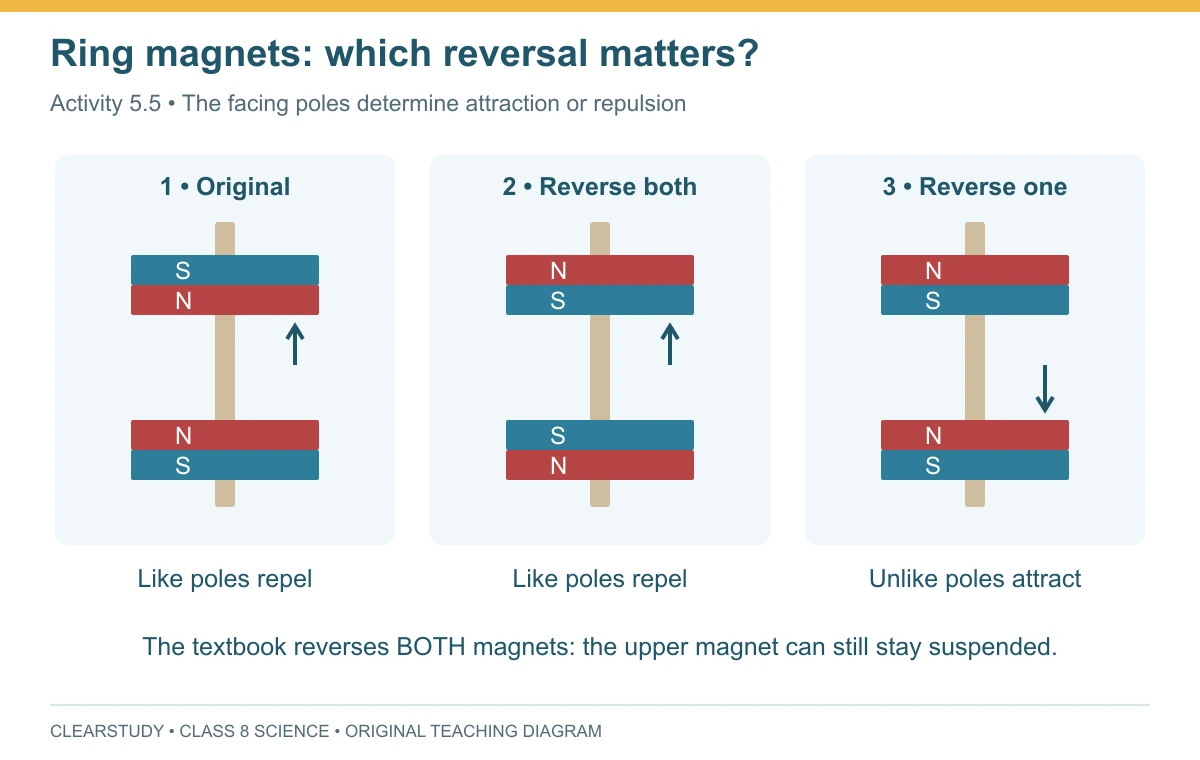
Activity 5.5 (Let us test): Does the second ring magnet stay floating? Do you feel a force when you push it down? Does it still float when the poles of both magnets are reversed?
Activity 5.6 (Let us experiment): On bringing the rubbed plastic scale/straw near small pieces of paper, do you notice something surprising? Why does it happen?
Activity 5.7 (Let us experiment): What do you observe when the two rubbed balloons are released, and when the woollen cloth is brought near a rubbed balloon? What do we infer?
Activity 5.8 (Let us observe): Take a ball and throw it vertically upwards. Does it come down? When thrown harder, does it still fall back?
Activity 5.9 (Let us explore): When different objects are hung from a spring, is the stretch caused by each object the same?
Activity 5.10 (Let us observe): Looking at the spring balance in Fig. 5.13, what is the maximum weight it can measure?
Activity 5.11 (Let us calculate): Find the smallest value of weight the spring balance can measure (weight between two bigger marks = 1 N; 5 divisions between them).
Activity 5.13 (Let us investigate): When you push an empty closed bottle into water, do you feel an upward push? Does it bounce up when released?
Class 8 Science Curiosity Chapter 5 Solutions — Keep the curiosity alive
1. Match items in Column A with the items in Column B.
| Column A (Type of force) | Column B (Example) |
|---|---|
| (i) Muscular force | (b) A child lifting a school bag |
| (ii) Magnetic force | (e) A compass needle pointing North |
| (iii) Frictional force | (a) A cricket ball stopping on its own just before touching the boundary line |
| (iv) Gravitational force | (c) A fruit falling from a tree |
| (v) Electrostatic force | (d) Balloon rubbed on woollen cloth attracting hair strands |
2. State whether the following statements are True or False. (i) A force is always required to change the speed of motion of an object.(ii) Due to friction, the speed of the ball rolling on a flat ground increases.(iii) There is no force between two charged objects placed at a small distance apart.
3. Two balloons rubbed with a woollen cloth are brought near each other. What would happen and why?
4. When you drop a coin in a glass of water, it sinks, but when you place a bigger wooden block in water, it floats. Explain.
5. If a ball is thrown upwards, it slows down, stops momentarily, and then falls back to the ground. Name the forces acting on the ball and specify their directions. (i) During its upward motion(ii) During its downward motion(iii) At its topmost position
| Stage | Gravity | Air resistance |
|---|---|---|
| Moving upwards | Downwards | Downwards |
| Moving downwards | Downwards | Upwards |
| Topmost instant | Downwards, still non-zero | Zero at that instant in still air because speed is zero |
6. A ball is released from the point P and moves along an inclined plane and then along a horizontal surface as shown in the Fig. 5.16. It comes to stop at the point A on the horizontal surface. Think of a way so that when the ball is released from the same point P, it stops (i) before the point A (ii) after crossing the point A.
7. Why do we sometimes slip on smooth surfaces like ice or polished floors? Explain.
8. Is any force being applied to an object in a non-uniform motion?
9. The weight of an object on the Moon becomes one-sixth of its weight on the Earth. What causes this change? Does the mass of the object also become one-sixth of its mass on the Earth?
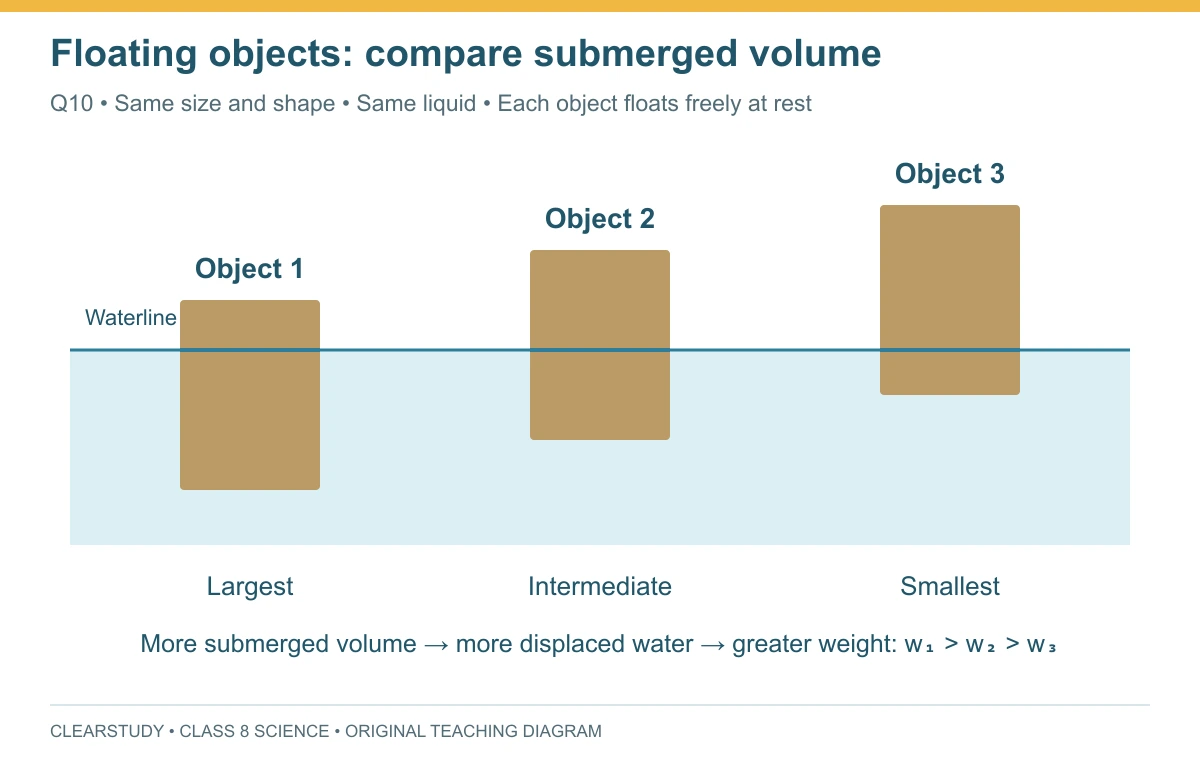
10. Three objects 1, 2, and 3 of the same size and shape but made of different materials are placed in the water. They dip to different depths as shown in Fig. 5.17. If the weights of the three objects 1, 2, and 3 are w1, w2, and w3, respectively, then (i) w1 = w2 = w3(ii) w1 > w2 > w3(iii) w2 > w3 > w1(iv) w3 > w1 > w2
Common Misconceptions to Avoid
Watch out for these
- Thinking a force needs only one object — a force always arises from the interaction of at least two objects.
- Believing friction can only slow objects down — friction opposes relative slipping at a contact. Static friction can push a person forward while walking or accelerate a box on a moving conveyor.
- Treating weight and mass as the same — weight is a force (in N) that changes with gravity; mass (in g/kg) is the matter and stays constant.
- Assuming gravity can repel — gravitational force is always attractive, unlike magnetic and electrostatic forces.
- Confusing “non-contact” with “no force” — magnetic, electrostatic and gravitational forces act even without touching.
- Saying smooth surfaces have no friction at all — they have less friction, not zero, which is why we still slip rather than glide forever.
Extra Practice Questions
These questions and MCQs are ClearStudy practice, separate from the NCERT exercise.
Very Short Answer Type Questions
Q1. What is the SI unit of force?
Q2. Name one contact force and one non-contact force.
Q3. In which direction does friction always act?
Short Answer Type Questions
Q1. Differentiate between contact and non-contact forces with one example each.
Q2. State four effects that a force can produce on an object.
Long Answer Type Question
Q1. Explain how a spring balance is used to measure the weight of an object, and why it reads weight in newton.
MCQs & Assertion–Reason
1. The SI unit of force is the:
(a) kilogram (b) newton (c) joule (d) watt
2. Which of the following is a non-contact force?
(a) muscular force (b) friction (c) gravitational force (d) push of a hand
3. For a box sliding on a stationary horizontal floor, friction on the box acts:
(a) in the direction of motion (b) opposite to the motion (c) upward (d) downward
4. The force with which the Earth pulls an object towards itself is called its:
(a) mass (b) weight (c) friction (d) upthrust
5. Which device is used to measure weight?
(a) thermometer (b) beam balance (c) spring balance (d) measuring tape
6. Two like charges placed near each other will:
(a) attract (b) repel (c) stay still (d) become neutral
7. Gravitational force is always:
(a) attractive (b) repulsive (c) zero (d) sometimes attractive, sometimes repulsive
8. The upward force applied by a liquid on an object is called:
(a) friction (b) muscular force (c) buoyant force (d) magnetic force
9. The smallest weight read by a spring balance with 1 N between big marks and 5 divisions between them is:
(a) 0.5 N (b) 0.2 N (c) 1 N (d) 5 N
10. When an object is taken from the Earth to the Moon, its:
(a) mass increases (b) weight stays the same (c) mass stays the same but weight decreases (d) both mass and weight become one-sixth
For each Assertion–Reason question, choose: (A) Both true and the Reason correctly explains the Assertion; (B) Both true but the Reason is not the correct explanation; (C) Assertion true, Reason false; (D) Assertion false, Reason true.
A-R 1. Assertion: Friction on a box sliding across a stationary floor opposes its motion.
Reason: Interactions between the contacting surfaces resist their relative sliding.
A-R 2. Assertion: The weight of an object is different on the Earth and the Moon.
Reason: The mass of an object changes from the Earth to the Moon.
A-R 3. Assertion: Gravitational force is a non-contact force.
Reason: The Earth attracts objects towards itself even without touching them.
A-R 4. Assertion: Two unlike charges attract each other.
Reason: Like charges repel and unlike charges attract.
A-R 5. Assertion: A wooden block floats on water while a coin sinks.
Reason: The buoyant force balances the weight of the block but not that of the coin.
Quick Revision Summary
- A force is a push or pull resulting from the interaction of two objects; its SI unit is the newton (N).
- A force can change an object’s speed, direction of motion or shape, or make it move from rest.
- Contact forces (act on touching): muscular force and friction; friction opposes relative slipping between surfaces and is often greater on rough surfaces.
- Non-contact forces (act from a distance): magnetic, gravitational and electrostatic forces.
- The force exerted by a magnet is magnetic force; by a charged body, electrostatic force; by the Earth, gravitational force (always attractive).
- Weight = the Earth’s pull on an object (in N), measured by a spring balance; mass (in g/kg) stays constant but weight can vary from place to place.
- A liquid exerts an upward buoyant force (upthrust); if it equals the weight the object floats, if less the object sinks.
Real-life Applications
Forces are everywhere in daily life. Friction lets us walk, write and apply brakes, which is why tyres and shoe soles are made rough and roads are not too smooth. We reduce harmful friction with oil, grease and ball bearings, and streamline aeroplanes, ships and high-speed trains to cut down air and water friction. Gravity holds us and our belongings on the ground and brings thrown objects back down; the buoyant force lets ships and wooden boats float. Magnetic force runs compasses, fridge magnets and electric motors, while electrostatic force explains a comb attracting hair and dust sticking to a charged TV screen.
How to write a clear answer
Learn the definition of force and the four effects it can produce, and clearly classify forces as contact (muscular, friction) or non-contact (magnetic, electrostatic, gravitational). Always state the direction of a force in answers (e.g. gravity acts downward, friction opposes relative slipping). Practise the spring-balance least-count calculation (1 N ÷ 5 = 0.2 N) and never mix up weight (force, in N) with mass (matter, in kg).
Frequently Asked Questions
What is Class 8 Science Curiosity Chapter 5 about?
Chapter 5, Exploring Forces, is about force as a push or pull from the interaction of objects, its effects, contact forces (muscular force, friction), non-contact forces (magnetic, electrostatic, gravitational), weight and its measurement with a spring balance, and buoyant force (floating and sinking).
What is the difference between contact and non-contact forces?
Contact forces act only when two objects physically touch (e.g. friction and muscular force), while non-contact forces act even from a distance without touching (e.g. magnetic, electrostatic and gravitational forces).
How many questions are in the “Keep the curiosity alive” exercise of Chapter 5?
There are 10 questions, all solved step by step on this page along with the “Probe and ponder” prompts and the in-text activity questions.
Are these Class 8 Science Curiosity Chapter 5 solutions free?
Yes. All solutions are free and follow the official NCERT Curiosity textbook for 2026–27.