
Class 8 Science Curiosity Chapter 6 Solutions (NCERT 2026–27) – Pressure, Winds, Storms, and Cyclones
These Class 8 Science Curiosity Chapter 6 solutions cover Pressure, Winds, Storms, and Cyclones from the new NCF-2023 textbook (2026–27), with every “Keep the curiosity alive” question solved step by step.
Class 8 Science Curiosity Chapter 6 Solutions – Overview
Chapter 6 of Curiosity, Pressure, Winds, Storms, and Cyclones, builds from the idea that pressure is force per unit area (SI unit pascal, Pa). It shows that liquids exert pressure in all directions and that pressure increases with the height of a liquid column, which is why overhead tanks are placed at a height. It then introduces atmospheric pressure — the pressure of the air around us — and shows that winds form because air moves from a high-pressure region to a low-pressure region. High-speed winds lower air pressure (which can blow off roofs). The chapter ends with how warm, moist air builds thunderstorms and lightning and how cyclones form over warm oceans. These Class 8 Science Curiosity Chapter 6 solutions answer every textbook question step by step.
Key Concepts & Definitions
Pressure: force acting per unit area, Pressure = Force ÷ Area. SI unit = newton/metre² (N/m²), also called the pascal (Pa). A smaller area gives higher pressure for the same force.
Liquid pressure: liquids exert pressure at the bottom and on the side walls — in all directions. The pressure increases with the height of the liquid column, not its diameter or total weight.
Atmospheric pressure: the pressure exerted by the envelope of air (atmosphere) around the Earth. Practical units are the millibar (mb) and hectopascal (hPa), each equal to 100 Pa.
Wind: moving air. Pressure differences drive air from higher towards lower pressure. Earth’s rotation, friction and the distance over which pressure changes also affect real wind direction and speed.
High-speed winds: fast-moving air is accompanied by reduced (lower) air pressure, which is why high winds can lift weak roofs.
Thunderstorm: a storm (strong winds with rain) accompanied by lightning and thunder, caused by charge separation in clouds. Cyclone: a spinning system of clouds, winds and rain with a very low-pressure eye at its centre, formed over warm ocean water.
“Probe and Ponder” & In-text Questions — Answers
Why are winds stronger on some days than on others?
Why are water tanks usually placed at a height?
Can air pressure really crush us?
What causes storms and cyclones? If the Earth stopped rotating, would cyclones still form?
Suppose you are living on the second floor of a three-storeyed building and an overhead water tank is placed on the top floor. Will you or your friend on the first floor receive a more powerful stream of tap water? Give reasons.
Table 6.1 — Explain how pressure influences each activity: driving an iron nail (by the head vs. the pointed end) and cutting an apple (sharp edge vs. blunt edge).
Activity 6.1 & 6.2: Do liquids also exert pressure, and do they exert it on the walls of the container?
Activity 6.3 & 6.4: Does air exert pressure, and how large is atmospheric pressure?
Activity 6.5: Does the difference in air pressure cause winds to form?
Activity 6.6: What happens when you blow air into the narrow space between two hanging balloons?
Class 8 Science Curiosity Chapter 6 Solutions — Keep the Curiosity Alive
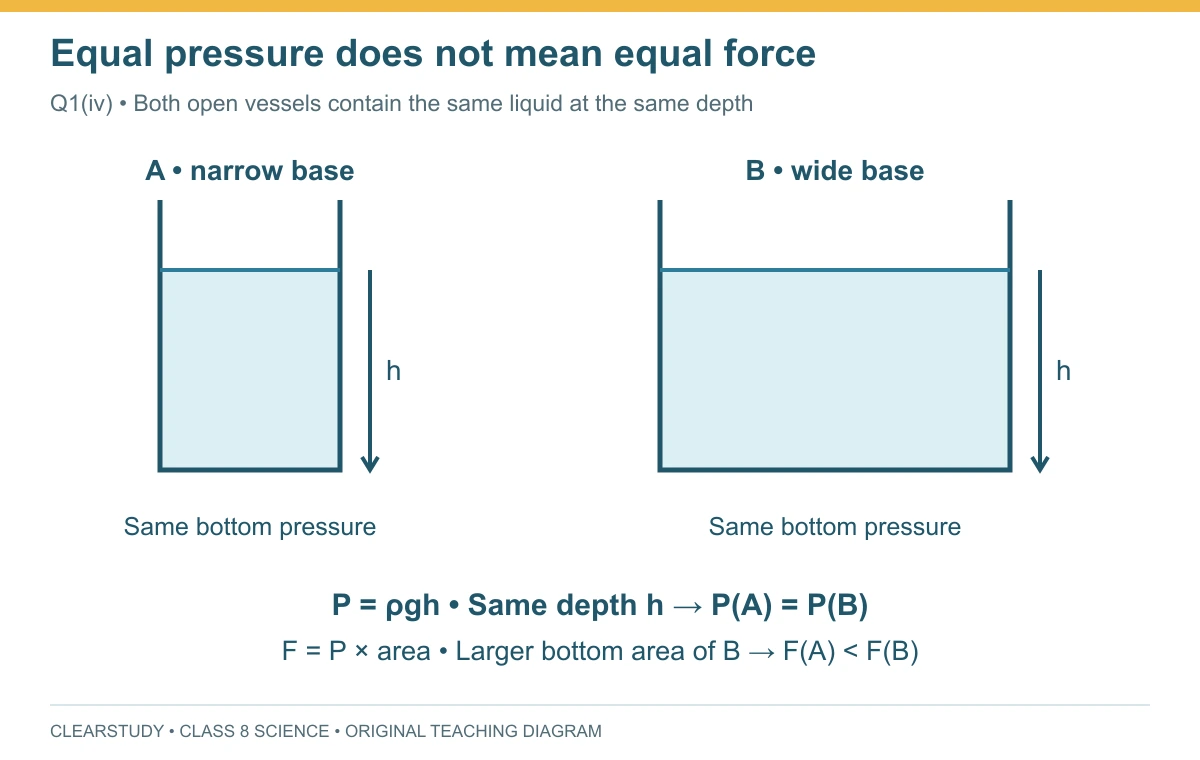
1. Choose the correct statement. (i) Look at Fig. 6.21 carefully. Vessel R is filled with water. When pouring of water is stopped, the level of water will be ____________________. (a) the highest in vessel P (b) the highest in vessel Q (c) the highest in vessel R (d) equal in all three vessels (ii) A rubber sucker (M) is pressed on a flat smooth surface and an identical sucker (N) is pressed on a rough surface: (a) Both M and N will stick to their surfaces. (b) Both M and N will not stick to their surfaces. (c) M will stick but N will not stick. (d) M will not stick but N will stick. (iii) A water tank is placed on the roof of a building at a height ‘H’. To get water with more pressure on the ground floor, one has to (a) increase the height ‘H’ at which the tank is placed. (b) decrease the height ‘H’ at which the tank is placed. (c) replace the tank with another tank of the same height that can hold more water. (d) replace the tank with another tank of the same height that can hold less water. (iv) Two vessels, A and B contain water up to the same level as shown in Fig. 6.22. PA and PB is the pressure at the bottom of the vessels. FA and FB is the force exerted by the water at the bottom of the vessels A and B. (a) PA = PB, FA = FB (b) PA = PB, FA < FB (c) PA < PB, FA = FB (d) PA > PB, FA > FB
2. State whether the following statements are True [T] or False [F]. (i) Air flows from a region of higher pressure to a region of lower pressure. [ ] (ii) Liquids exert pressure only at the bottom of a container. [ ] (iii) Weather is stormy at the eye of a cyclone. [ ] (iv) During a thunderstorm, it is safer to be in a car. [ ]
3. Fig. 6.23a shows a boy lying horizontally, and Fig. 6.23b shows the boy standing vertically on a loose sand bed. In which case does the boy sink more in sand? Give reasons.
4. An elephant stands on four feet. If the area covered by one foot is 0.25 m², calculate the pressure exerted by the elephant on the ground if its weight is 20000 N.
5. There are two boats, A and B. Boat A has a base area of 7 m², and 5 persons are seated in it. Boat B has a base area of 3.5 m², and 3 persons are seating in it. If each person has a weight of 700 N, find out which boat will experience more pressure on its base and by how much?
6. Would lightning occur if air and clouds were good conductors of electricity? Give reasons for your answer.
7. What will happen to the two identical balloons A and B as shown in Fig. 6.24 when water is filled into the bottle up to a certain height. Will both the balloons bulge? If yes, will they bulge equally? Explain your answer.
8. Explain how a storm becomes a cyclone.
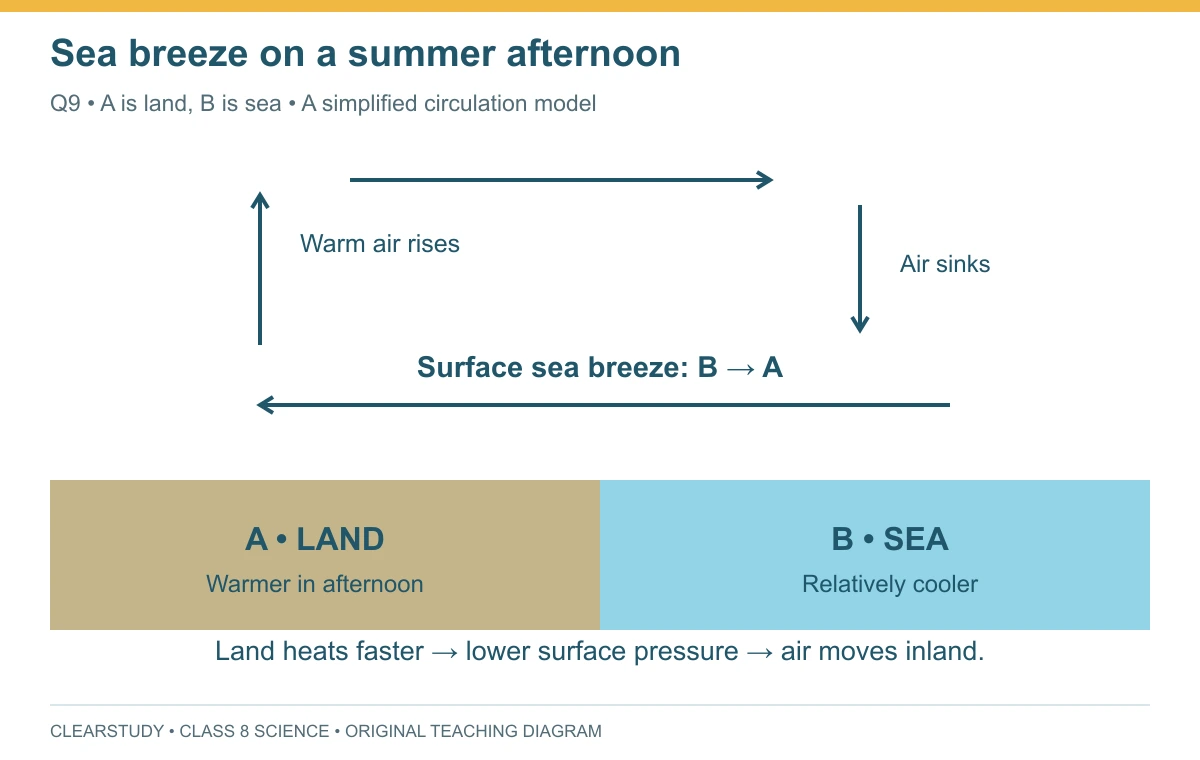
9. Fig. 6.25 shows trees along the sea coast in a summer afternoon. Identify which side is land—A or B. Explain your answer.
10. Describe an activity to show that air flows from a region of high pressure to a region of low pressure.
11. What is a thunderstorm? Explain the process of its formation.
12. Explain the process that causes lightning.
13. Explain why holes are made in banners and hoardings.
Common Misconceptions to Avoid
Watch out for these
- Thinking liquids press only at the bottom — they exert pressure on the side walls too, in all directions.
- Believing liquid pressure depends on the amount or weight of water — it depends on the height of the column, not the diameter or volume.
- Confusing high-speed winds with high pressure — fast-moving air actually has lower pressure.
- Saying the eye of a cyclone is the most dangerous part — the eye is calm; the worst winds and rain surround it.
- Opening doors or windows to equalise storm pressure — keep them closed and secured. Wind entering a building can increase internal pressure and structural damage.
- Thinking crouching outdoors makes lightning safe — seek a substantial building or enclosed metal-roofed vehicle with windows closed. No outdoor location is safe during a thunderstorm; avoid trees and do not lie flat.
Extra Practice Questions
These questions and MCQs are ClearStudy practice, separate from the NCERT exercise.
Very Short Answer Type Questions
Q1. What is the SI unit of pressure?
Q2. In which direction does wind blow with respect to air pressure?
Q3. What is the calm, low-pressure centre of a cyclone called?
Short Answer Type Questions
Q1. Why does a bag with broad straps feel more comfortable than one with narrow straps of the same weight?
Q2. Should doors and windows be opened to equalise pressure during a storm?
Lightning safety: National Weather Service myths and facts explains that crouching is not safe shelter. Go indoors when thunder is heard.
Long Answer Type Question
Q1. Describe how a cyclone forms, names its key parts, and explain why it is dangerous and how we can stay safe.
MCQs & Assertion–Reason
1. Pressure is defined as:
(a) force × area (b) force per unit area (c) area per unit force (d) force × volume
2. The SI unit of pressure is the:
(a) newton (b) joule (c) pascal (d) watt
3. The pressure exerted by a liquid at the bottom of a vessel depends on the:
(a) shape of the vessel (b) height of the liquid column (c) colour of the liquid (d) width of the vessel
4. The pressure exerted by the air around us is called:
(a) liquid pressure (b) wind pressure (c) atmospheric pressure (d) low pressure
5. Wind blows from a region of:
(a) low pressure to high pressure (b) high pressure to low pressure (c) cold to hot only (d) high to high pressure
6. High-speed winds are accompanied by:
(a) higher air pressure (b) reduced air pressure (c) no change in pressure (d) zero pressure
7. A rubber sucker sticks to a smooth surface because of:
(a) glue (b) gravity (c) atmospheric pressure (d) magnetism
8. A storm accompanied by lightning and thunder is called a:
(a) cyclone (b) thunderstorm (c) breeze (d) hailstorm
9. The calm, low-pressure centre of a cyclone is called the:
(a) eye (b) tail (c) edge (d) front
10. The device that protects tall buildings from lightning is the:
(a) sucker (b) barometer (c) lightning conductor (d) wind vane
For each Assertion–Reason question, choose: (A) Both true and the Reason correctly explains the Assertion; (B) Both true but the Reason is not the correct explanation; (C) Assertion true, Reason false; (D) Assertion false, Reason true.
A-R 1. Assertion: It is easier to cut an apple with the sharp edge of a knife than with its blunt edge.
Reason: A smaller area of contact produces greater pressure for the same force.
A-R 2. Assertion: Overhead water tanks are placed at a height.
Reason: Liquid pressure increases with the height of the liquid column.
A-R 3. Assertion: We are not crushed by the large force of atmospheric pressure.
Reason: The pressure of fluids and gases inside our body balances the atmospheric pressure outside.
A-R 4. Assertion: High-speed winds are accompanied by an increase in air pressure.
Reason: A pressure difference drives air from a higher-pressure region towards a lower-pressure region.
A-R 5. Assertion: The weather at the eye of a cyclone is calm.
Reason: The eye is the region of lowest pressure at the centre of the cyclone.
Quick Revision Summary
- Pressure is force per unit area; its SI unit is newton/metre² (N/m²), also called pascal (Pa).
- Liquids and gases exert pressure on the walls of a container, in all directions.
- The pressure exerted by the air around us is the atmospheric pressure.
- Differences in air pressure cause winds to blow; air moves from high to low pressure.
- Warm air rises, creating a low-pressure area; cooler high-pressure air moves in to take its place.
- Thunderstorms need moisture and strong winds; up-and-down winds charge the clouds, and a sufficiently strong electric field breaks down air insulation, producing a rapid electrical discharge called lightning.
- Lightning conductors protect buildings, and the IMD monitors cyclones and thunderstorms in India.
Real-life Applications
Pressure ideas appear everywhere: school bags and bucket handles are made broad to lower pressure on the body, while knives, nails and pins are sharp to raise it. Overhead tanks are placed high for strong tap flow, dams are built with broad bases to withstand water pressure near the bottom, and rubber suckers and straws work because of atmospheric pressure. Understanding winds explains sea and land breezes, why holes are cut in banners and hoardings, why roofs need anchoring, and why the India Meteorological Department’s cyclone tracking and shelters save lives in coastal areas.
How to write a clear answer
Always write the formula Pressure = Force ÷ Area, and for numericals show the units at every step (the elephant problem gives 20000 Pa; Boat B exerts 100 N/m² more than Boat A). Remember three key rules: liquid pressure depends on height, wind blows high→low pressure, and high-speed winds mean lower pressure. For storm and lightning questions, explain the steps in order — rising warm air, condensation, charge separation, discharge.
Frequently Asked Questions
What is Class 8 Science Curiosity Chapter 6 about?
It is about pressure (force per unit area), liquid and atmospheric pressure, how differences in air pressure cause winds, and how thunderstorms, lightning and cyclones form, along with safety measures.
Why do high-speed winds blow off roofs?
Fast wind around a building can create pressure differences that lift a weak roof. Opening doors or windows can let wind enter and increase damage; keep them secured, stay away from glass and follow official evacuation advice.
How many questions are in the “Keep the curiosity alive” exercise of Chapter 6?
There are 13 questions, all solved on this page, along with the “Probe and ponder” prompts and the in-text activity questions.
Are these Class 8 Science Curiosity Chapter 6 solutions free?
Yes. All solutions are free and follow the official NCERT Curiosity textbook for 2026–27.