
Class 8 Science Curiosity Chapter 7 Solutions (NCERT 2026–27) – Particulate Nature of Matter
These Class 8 Science Curiosity Chapter 7 solutions cover Particulate Nature of Matter from the new NCF-2023 textbook (2026–27), with every in-text activity and the complete “Keep the curiosity alive” exercise solved step by step.
Class 8 Science Curiosity Chapter 7 Solutions – Overview
Chapter 7 of Curiosity, Particulate Nature of Matter, explains that all matter is made up of an extremely large number of very small constituent particles that cannot be seen even under an ordinary microscope. These particles are held together by interparticle attractions, and there are tiny gaps between them called interparticle spaces. The chapter shows how the strength of these attractions and the size of these spaces decide the three states of matter — solid, liquid and gas — and their properties of shape, volume and compressibility. It introduces melting point and boiling point, explains how heat (thermal energy) drives changes of state, and uses diffusion of sugar, potassium permanganate and fragrance to demonstrate the constant motion of particles.
Key Concepts & Definitions
Constituent particle: the basic unit that makes up a larger piece of a substance or material. A grain of chalk, sand or sugar is itself made up of millions and millions of these particles.
Interparticle attractions: attractive forces that hold the constituent particles together. They are strongest in solids, slightly weaker in liquids and negligible in gases; they weaken sharply as interparticle distance increases.
Interparticle spaces: the empty gaps between constituent particles. Usually small in solids and liquids, and much larger in gases. Ice is an exception to the usual solid–liquid spacing order. (Sugar dissolving in water fills these spaces, so the solution’s volume is less than water + sugar.)
Melting point: the minimum temperature at which a solid melts to become a liquid at atmospheric pressure (e.g. ice 0 °C, urea 133 °C, iron 1538 °C).
Boiling point: the temperature at which a liquid boils and turns into vapour at atmospheric pressure; vapour forms throughout the liquid (bubbles), unlike slow surface evaporation.
Fluids: liquids and gases — they flow and do not have a fixed shape. Temperature, pressure and the nature of the substance determine its physical state; changing thermal energy can cause a change of state.
In-text & Activity Questions Answered
Probe and ponder: Why is it possible to pile up stones or sand, but not a liquid like water?
Probe and ponder: Why does water take the shape of folded hands but lose that shape when released?
Probe and ponder: We cannot see air, so how does it add weight to an inflated balloon?
Probe and ponder: Is the air we breathe today the same that existed thousands of years ago?
Activity 7.1 (Let us explore): On grinding a stick of chalk into fine powder, what do you observe — is every speck still composed of the same substance, or has it changed?
Activity 7.2 (Let us perform): After dissolving sugar in water, does the top layer taste sweet, and can you see any sugar particles?
But where did the sugar go (after it dissolved)?
Activity 7.3 (Let us find out): In which of the solid objects (iron nail, rock salt, stone, wood, key, aluminium) are the particles strongly held together, and why do solids have a definite shape and volume?
Activity 7.4 (Let us try and find out): When the same water is poured into containers A, B and C of different shapes, what happens to its shape and its level (volume)?
Are you able to move your finger through the water (Fig. 7.6)?
Activity 7.5 (Let us investigate): When Gas Jar B is placed over Gas Jar A filled with smoke and the plate is removed, what do you observe about the smoke?
Activity 7.6 (Let us experiment): When you push the syringe plunger inward with the open end closed, what happens to the air, and what about water?
Activity 7.7 (Let us observe): When sugar is added to water and dissolved, what difference do you observe in the water levels A, B and C, and what does it tell you?
Sugar and sand are both solids. Why does sugar dissolve in water but sand does not?
Activity 7.8 (Let us experiment): On putting a few grains of potassium permanganate in water without stirring, what do you observe and why?
Think like a scientist: A grain of potassium permanganate is dropped into hot water, room-temperature water and ice-cold water. What do you observe?
Activity 7.9 (Let us find out): On lighting an incense stick in one corner of the room, do you notice the fragrance from a distance, and why?
Class 8 Science Curiosity Chapter 7 Solutions — Keep the Curiosity Alive
1. Choose the correct option. The primary difference between solids and liquids is that the constituent particles are: (i) closely packed in solids, while they are stationary in liquids. (ii) far apart in solids and have fixed position in liquids. (iii) always moving in solids and have fixed position in liquids. (iv) closely packed in solids and move past each other in liquids.
2. Which of the following statements are true? Correct the false statements. (i) Melting ice into water is an example of the transformation of a solid into a liquid. (ii) Melting process involves a decrease in interparticle attractions during the transformation. (iii) Solids have a fixed shape and a fixed volume. (iv) The interparticle interactions in solids are very strong, and the interparticle spaces are very small.
2 (continued). State whether true or false; correct the false statements. (v) When we heat camphor in one corner of a room, the fragrance reaches all corners of the room. (vi) On heating, we are adding energy to the camphor, and the energy is released as a smell.
3. Choose the correct answer with justification. If we could remove all the constituent particles from a chair, what would happen? (i) Nothing will change. (ii) The chair will weigh less due to lost particles. (iii) Nothing of the chair will remain.
4. Why do gases mix easily, while solids do not?
5. When spilled on the table, milk in a glass tumbler, flows and spreads out, but the glass tumbler stays in the same shape. Justify this statement.
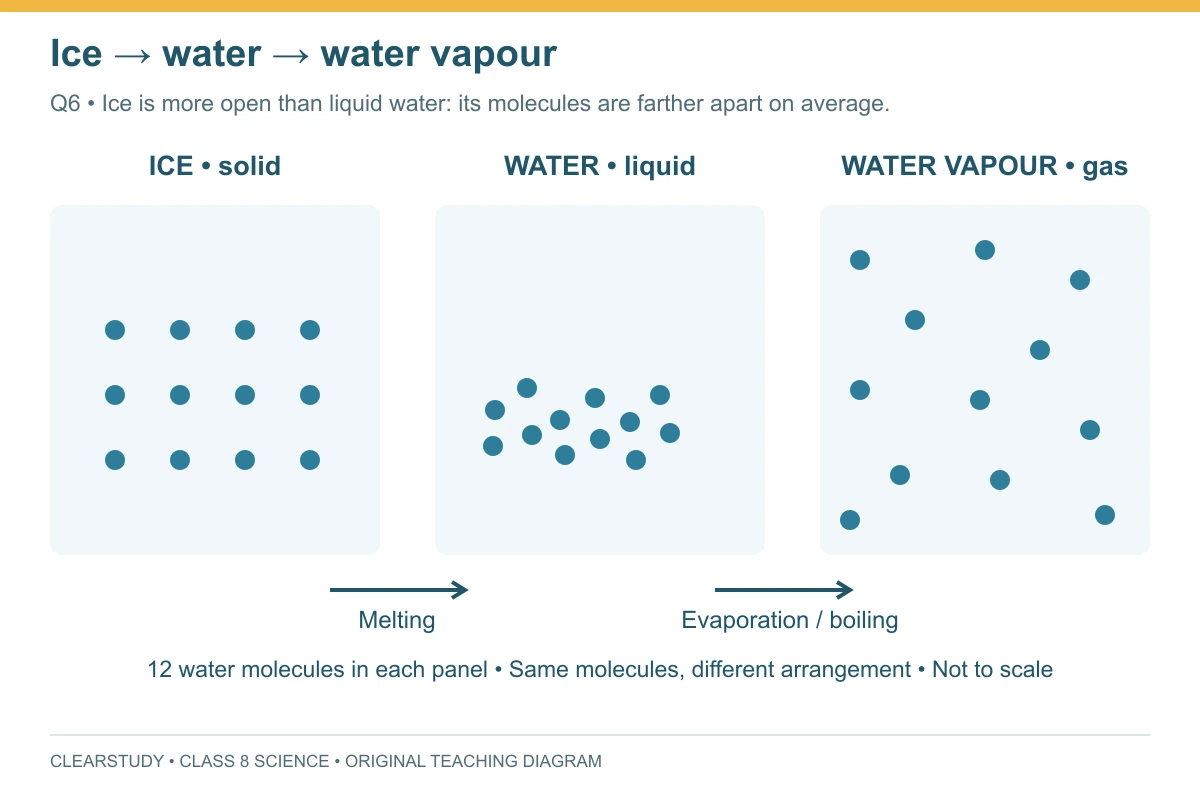
6. Represent diagrammatically the changes in the arrangement of particles as ice melts and transforms into water vapour.
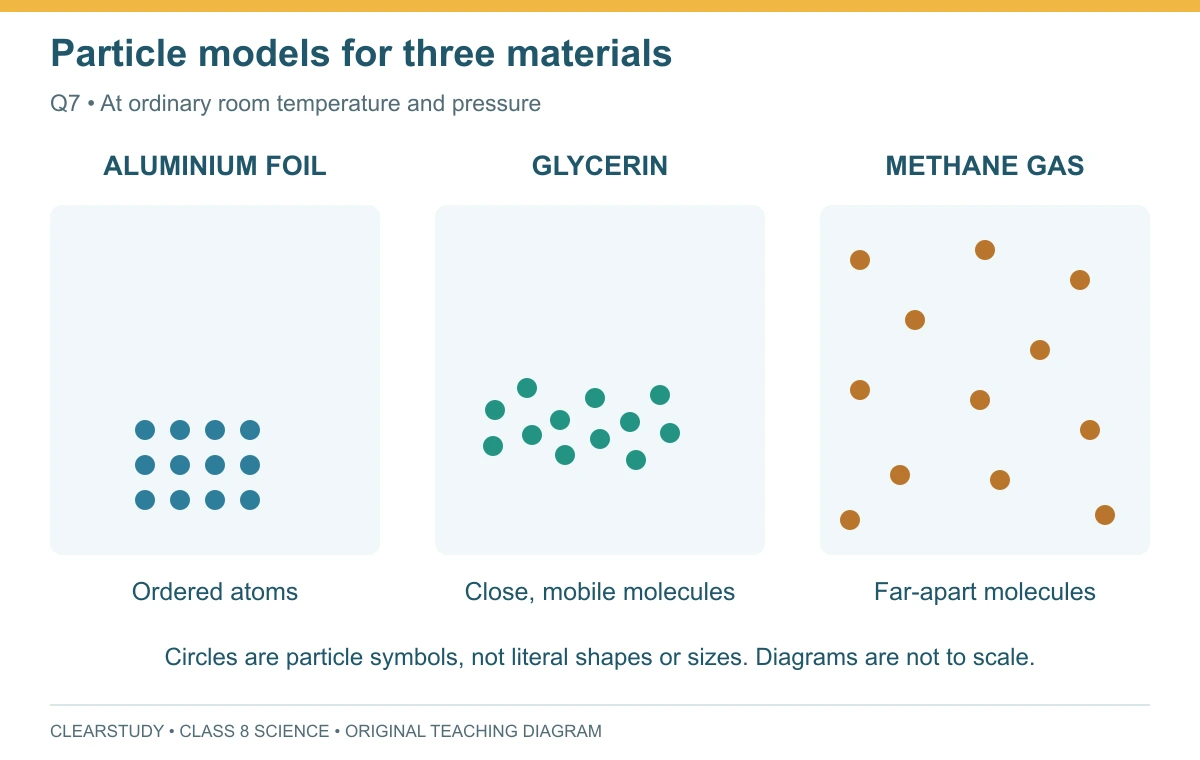
7. Draw a picture representing particles present in the following: (i) Aluminium foil (ii) Glycerin (iii) Methane gas
8. Observe Fig. 7.16a which shows the image of a candle that was just extinguished after burning for some time. Identify the different states of wax in the figure and match them with Fig. 7.16b showing the arrangement of particles.
9. Why does the water in the ocean taste salty, even though the salt is not visible? Explain.
10. Grains of rice and rice flour take the shape of the container when placed in different jars. Are they solids or liquids? Explain.
Common Misconceptions to Avoid
Watch out for these
- Thinking the interparticle spaces are “filled with air” — in fact they contain nothing at all.
- Believing dissolved sugar or salt has disappeared — the particles are only too small to see and have moved into the spaces between water particles.
- Confusing evaporation with boiling — evaporation is slow, occurs only at the surface and at all temperatures; boiling is fast, occurs throughout the liquid and only at the boiling point.
- Assuming melting increases interparticle attractions — melting lets particles escape their fixed arrangement; ice is an exception to the usual expansion on melting.
- Calling rice grains or flour a liquid because they flow — they are free-flowing solids; each grain keeps its shape.
- Forgetting that ice is an exception — its particles are farther apart than those in liquid water.
Extra Practice Questions
These questions and MCQs are ClearStudy practice, separate from the NCERT exercise.
Very Short Answer Type Questions
Q1. What name is given to the basic unit that makes up a larger piece of a substance?
Q2. Name the ancient Indian philosopher who first spoke of the “Parmanu” (atom).
Q3. Which state of matter is the most easily compressed?
Short Answer Type Questions
Q1. Why are liquids and gases together called fluids?
Q2. Arrange solids, liquids and gases in increasing order of interparticle spacing and interparticle attraction.
Long Answer Type Question
Q1. Explain how the thermal energy of particles decides whether a substance is a solid, a liquid or a gas.
MCQs & Assertion–Reason
1. Matter is composed of:
(a) a single solid block (b) a large number of extremely small particles (c) only air (d) only water
2. The empty gaps between the constituent particles of matter are called:
(a) interparticle attractions (b) interparticle spaces (c) melting points (d) molecules
3. In which state are the interparticle attractions the strongest?
(a) solid (b) liquid (c) gas (d) vapour
4. The minimum temperature at which a solid melts into a liquid at atmospheric pressure is its:
(a) boiling point (b) melting point (c) freezing (d) diffusion point
5. The melting point of iron is:
(a) 0 °C (b) 100 °C (c) 133 °C (d) 1538 °C
6. Spreading of potassium permanganate colour throughout water is an example of:
(a) melting (b) diffusion (c) condensation (d) freezing
7. Which of the following has neither a fixed shape nor a fixed volume?
(a) iron nail (b) water (c) air (d) rock salt
8. A gas can be compressed easily because:
(a) its particles are tightly packed (b) it has very large interparticle spaces (c) it has strong attractions (d) it has no particles
9. Liquids and gases are together classified as:
(a) solids (b) fluids (c) crystals (d) metals
10. Diffusion of a coloured substance in water is fastest in:
(a) ice-cold water (b) water at room temperature (c) hot water (d) it is the same in all
For each Assertion–Reason question, choose: (A) Both true and the Reason correctly explains the Assertion; (B) Both true but the Reason is not the correct explanation; (C) Assertion true, Reason false; (D) Assertion false, Reason true.
A-R 1. Assertion: Solids have a definite shape and a definite volume.
Reason: In solids the particles are tightly packed and held in fixed positions by strong interparticle attractions.
A-R 2. Assertion: Gases do not have a fixed volume.
Reason: The interparticle attractions in gases are negligible, so the particles move freely and occupy all the available space.
A-R 3. Assertion: Dissolved sugar disappears completely from water.
Reason: Sugar breaks up into extremely small particles that occupy the interparticle spaces of water.
A-R 4. Assertion: A liquid can be compressed as easily as a gas.
Reason: Liquid particles are much closer together than gas particles.
A-R 5. Assertion: Potassium permanganate spreads faster in hot water than in cold water.
Reason: Particles move faster when their thermal energy increases.
Quick Revision Summary
- Matter is composed of extremely small particles that cannot be seen even through an ordinary microscope.
- These particles are held together by interparticle forces of attraction, with empty interparticle spaces between them.
- Interparticle attractions are strongest in solids, weaker in liquids and weakest (negligible) in gases.
- Solids: fixed shape and volume; particles mainly vibrate about positions. Usually closely packed, but ice has an open structure.
- Liquids: definite volume but no fixed shape, slightly weaker attractions, particles move within a limited space (fluids).
- Gases: no fixed shape or volume, negligible attractions, maximum spacing, particles move freely (fluids; easily compressed).
- Heat (thermal energy) drives changes of state: solid →(melting point) liquid →(boiling point) gas.
Real-life Applications
The particulate nature of matter is at work all around us. The fragrance of incense, perfume or food spreading across a room shows diffusion of gas particles. Soap cleans oily clothes because soap particles surround the oil particles — one end clinging to the oil and the other to water — lifting the dirt away. Sugar and salt dissolving unseen explain sweet tea and salty sea water. Compressed gas in syringes, balloons and tyres relies on the large interparticle spaces in gases, while the incompressibility of liquids is used in hydraulic brakes. Melting and boiling points help us choose metals for tools and explain why ice melts and water boils.
How to write a clear answer
Memorise the three states in a comparison table (spacing, attraction, shape, volume, movement) and quote the melting points of ice (0 °C), urea (133 °C) and iron (1538 °C). Always explain observations in terms of interparticle attractions and spaces. For diagram questions, neatly show particles closely packed (solid), loosely packed (liquid) and far apart (gas), and define melting point and boiling point in the exact textbook words.
Frequently Asked Questions
What is Class 8 Science Curiosity Chapter 7 about?
Chapter 7, Particulate Nature of Matter, explains that all matter is made of extremely small constituent particles held together by interparticle attractions, with interparticle spaces between them. It shows how these decide the solid, liquid and gas states, and covers melting point, boiling point, diffusion and changes of state.
What is the difference between interparticle attraction and interparticle space?
Interparticle attraction is the force between particles, while interparticle space describes their separation. Gas particles are usually much farther apart than those in solids or liquids. Ice has a more open structure than liquid water. Temperature, pressure and the substance also determine its state.
How many questions are in the “Keep the curiosity alive” exercise of Chapter 7?
There are 10 main questions (with several sub-parts), all solved on this page along with every “Probe and ponder”, activity and “Think like a scientist” question.
Are these Class 8 Science Curiosity Chapter 7 solutions free?
Yes. All ClearStudy NCERT Solutions for Class 8 Science Curiosity are free and follow the official NCERT textbook for 2026–27.