
Class 8 Science Curiosity Chapter 8 Solutions (NCERT 2026–27) – Nature of Matter: Elements, Compounds, and Mixtures
These Class 8 Science Curiosity Chapter 8 solutions cover Nature of Matter: Elements, Compounds, and Mixtures from the new NCF-2023 textbook (2026–27), with every textbook question answered step by step.
Class 8 Science Curiosity Chapter 8 Solutions – Overview
Chapter 8 of Curiosity, Nature of Matter: Elements, Compounds, and Mixtures, explains how the matter around us is organised. It begins with mixtures (uniform and non-uniform) and their components, distinguishes the everyday meaning of “pure” from the scientific one, and defines a pure substance. It then separates pure substances into elements (the simplest substances, made of atoms; classified into metals and non-metals) and compounds (elements combined chemically in a fixed ratio, with new properties). Through activities such as the electrolysis of water and heating an iron–sulfur mixture, the chapter shows the difference between mixtures and compounds, and ends with minerals and the everyday uses of elements, compounds, and mixtures. These Class 8 Science Curiosity Chapter 8 solutions answer every textbook question step by step.
Key Concepts & Definitions
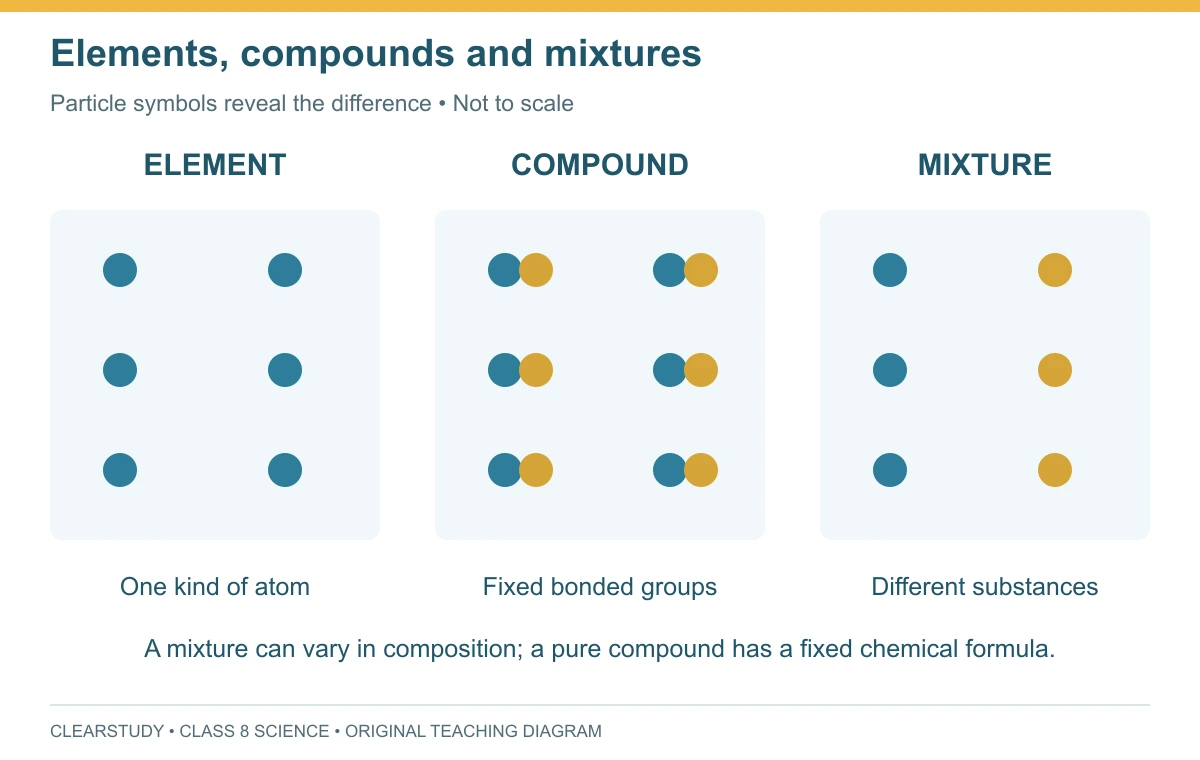
Mixture: two or more substances mixed together where each substance retains its own properties and the components do not react chemically. The individual substances are its components.
Uniform (homogeneous) mixture: components are evenly distributed and cannot be seen separately (e.g. sugar in water, air). Non-uniform (heterogeneous) mixture: components are visible with the naked eye or a magnifier (e.g. sprout salad, sand in water).
Pure substance: matter made of the same type of particles that cannot be separated into other kinds of matter by any physical process. It can be an element or a compound.
Element: the simplest substance, made of one kind of atom, that cannot be broken down into simpler substances by chemical reactions (e.g. hydrogen, oxygen, gold, iron, sulfur). Elements are classified into metals and non-metals (with a few metalloids such as silicon and boron).
Compound: formed when different elements combine chemically in a fixed ratio to give a new substance with properties different from its constituent elements (e.g. water = hydrogen + oxygen in 2:1 atom ratio; sodium chloride = sodium + chlorine in 1:1 ratio).
Alloy: a metallic material containing two or more elements, at least one a metal (e.g. brass = copper + zinc; bronze = copper + tin; steel includes iron and carbon). Common alloys are treated as uniform mixtures in this chapter, though real alloys can contain multiple microscopic phases. Stainless steels contain chromium, and many grades also contain nickel. Mineral: a natural solid substance with a fixed chemical composition; most are compounds, but a few (native minerals) are pure elements.
In-text & Activity Questions — Answers
Probe and ponder
Which of the entities in the picture above consist of matter, and which of them do not?
How can elements be combined to form a compound?
How could the discovery of a compound that absorbs carbon dioxide from the air contribute to solving environmental challenges?
Activity 8.1 — Testing carbon dioxide in air
On adding calcium oxide (quick lime) to water and then leaving the colourless lime water in a petri dish — what do you observe? Does it turn milky? Can you explain why the solution has turned milky?
Activity 8.2 — Dust particles in air
After placing a clean black sheet of paper near an open window for a few hours — what do you observe?
Table 8.1 — Complete the third column (Uniform or non-uniform)
| S.No. | Mixture-type | Examples | Uniform / non-uniform |
|---|---|---|---|
| 1. | Gas and gas | Air | Uniform |
| 2. | Gas and liquid | Aerated water (soda water); Oxygen dissolved in water | Uniform; Uniform |
| 3. | Solid and gas | Carbon particles in air | Non-uniform |
| 4. | Liquid and liquid | Acetic acid in water (vinegar); Oil and water | Uniform; Non-uniform |
| 5. | Solid and liquid | Sand and water; Seawater | Non-uniform; Uniform |
| 6. | Solid and solid | Baking powder (baking soda and tartaric acid); Alloys | Non-uniform; Uniform |
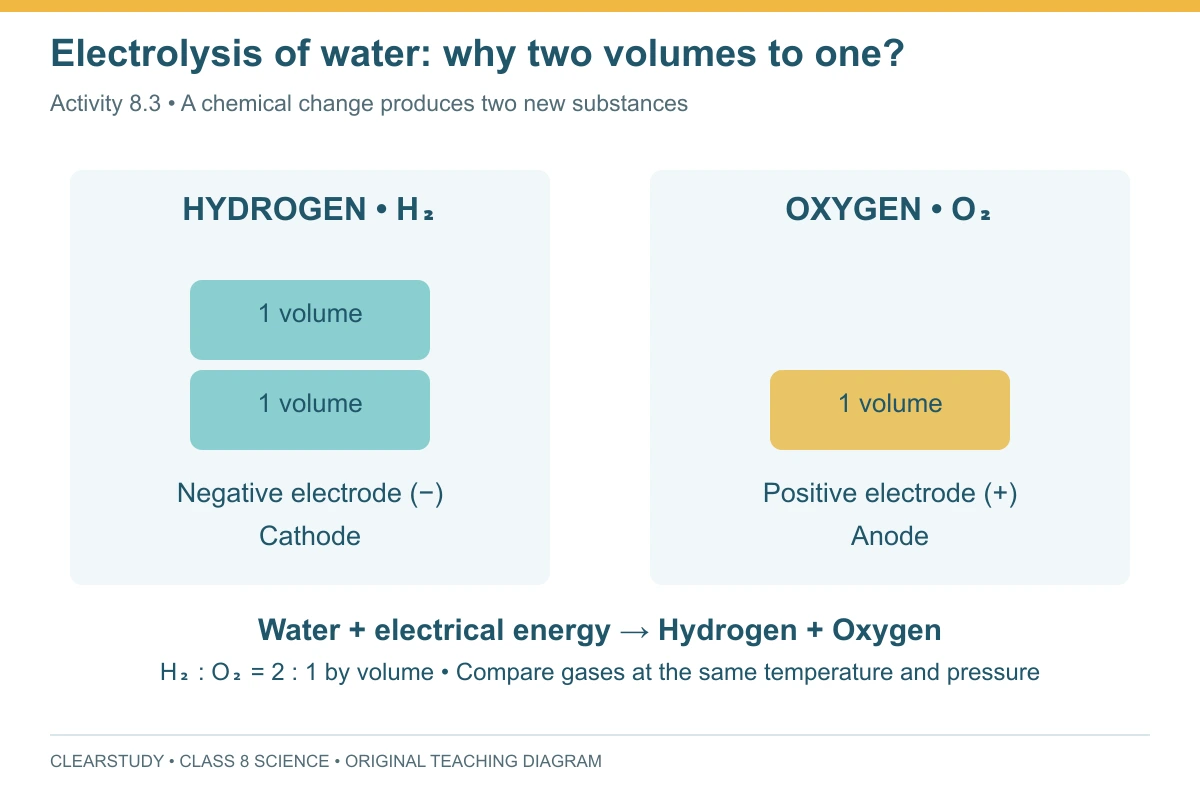
Activity 8.3 — Passing electricity through water
Is the volume of the gas collected the same in both the test tubes? On testing with a burning candle, what happens in each case and which gas is present in each test tube? Can these collected gases be water vapour?
Activity 8.4 — Heating sugar
On heating a teaspoon of sugar in a boiling tube — what do you observe? Can you predict what is left behind?
Activity 8.5 — Iron and sulfur (Samples A and B)
Compare Sample A (the mixture of iron filings and sulfur) and Sample B (the black mass formed on heating). Record appearance, magnet test and gas test; and categorise the substances as mixtures, compounds or elements.
| Experiment | Sample A (mixture) | Sample B (compound) |
|---|---|---|
| Appearance (colour, texture) | Black and yellow particles seen separately; non-uniform | Uniform black mass; same colour and texture throughout |
| Magnet test | Iron filings are attracted to the magnet (can be separated) | Not attracted by the magnet |
| Gas test with dilute HCl | Colourless, odourless gas that burns with a ‘pop’ (hydrogen); sulfur is left as a yellow solid | Hydrogen sulfide, a toxic colourless gas; its known rotten-egg odour must never be tested by sniffing |
Laboratory safety: heating sulfur mixtures, handling acids and generating gases require a trained teacher and appropriate laboratory controls. Do not make or sniff hydrogen sulfide at home. Its smell is not a reliable warning of exposure (CDC/NIOSH chemical guidance).
A step further — classifying everyday materials
According to science, how would you classify milk, packed fruit juice, baking soda, sugar, and soil — as mixtures or pure substances?
Class 8 Science Curiosity Chapter 8 Solutions — Keep the Curiosity Alive
1. Consider the following reaction where two substances, A and B, combine to form a product C: A + B → C. Assume that A and B cannot be broken down into simpler substances by chemical reactions. Based on this information, which of the following statements is correct? (i) A, B, and C are all compounds and only C has a fixed composition. (ii) C is a compound, and A and B have a fixed composition. (iii) A and B are compounds, and C has a fixed composition. (iv) A and B are elements, C is a compound, and has a fixed composition.
2. Assertion: Air is a mixture. Reason: A mixture is formed when two or more substances are mixed, without undergoing any chemical change. (i) Both Assertion and Reason are true and Reason is the correct explanation for Assertion. (ii) Both Assertion and Reason are true, but Reason is not the correct explanation for Assertion. (iii) Assertion is true, but Reason is false. (iv) Assertion is false, but Reason is true.
3. Water, a compound, has different properties compared to those of the elements oxygen and hydrogen from which it is formed. Justify this statement.
4. In which of the following cases are all the examples correctly matched? Give reasons in support of your answers. (i) Elements — water, nitrogen, iron, air. (ii) Uniform mixtures — minerals, seawater, bronze, air. (iii) Pure substances — carbon dioxide, iron, oxygen, sugar. (iv) Non-uniform mixtures — air, sand, brass, muddy water.
5. Iron reacts with moist air to form iron oxide, and magnesium burns in oxygen to form magnesium oxide. Classify all the substances involved in the above reactions as elements, compounds or mixtures, with justification.
6. Classify the following as elements, compounds, or mixtures in Table 8.3: Carbon dioxide, sand, seawater, magnesium oxide, muddy water, aluminium, gold, oxygen, rust, iron sulfide, glucose, air, water, fruit juice, nitrogen, sodium chloride, sulfur, hydrogen, baking soda. Identify the pure substances among these.
| Elements | Compounds | Mixtures |
|---|---|---|
| Aluminium, gold, oxygen, nitrogen, sulfur, hydrogen | Carbon dioxide, magnesium oxide, rust, iron sulfide, glucose, water, sodium chloride, baking soda | Sand, seawater, muddy water, air, fruit juice |
7. What new substance is formed when a mixture of iron filings and sulfur powder is heated, and how is it different from the original mixture? Also, write the word equation for the reaction.
8. Is it possible for a substance to be classified as both an element and a compound? Explain why or why not.
9. How would our daily lives be changed if water were not a compound but a mixture of hydrogen and oxygen?
10. Analyse Fig. 8.24. Identify Gas A. Also, write the word equation of the chemical reaction.
11. Write the names of any two compounds made only from non-metals, and also mention two uses of each of them.
12. How can gold be classified as both a mineral and a metal?
Common Misconceptions to Avoid
Watch out for these
- Thinking the everyday meaning of “pure” (unadulterated) is the same as the scientific one — scientifically, pure milk or pure ghee is still a mixture.
- Confusing a mixture with a compound — in a mixture components keep their properties and can be separated physically; in a compound the elements join chemically in a fixed ratio and gain new properties.
- Assuming all mixtures are non-uniform — air, seawater and alloys (brass, bronze, stainless steel) are uniform mixtures.
- Believing water can “burn” because it contains hydrogen and oxygen — water is a compound with its own properties and is not a flammable fuel; this does not make it suitable for every type of fire.
- Calling every element a metal — many elements (oxygen, hydrogen, carbon, sulfur) are non-metals, and a few (silicon, boron) are metalloids.
- Thinking minerals are always pure elements — most minerals are compounds; only a few native minerals (gold, silver, copper, sulfur) are elements.
Extra Practice Questions
These questions and MCQs are ClearStudy practice, separate from the NCERT exercise.
Very Short Answer Type Questions
Q1. In what ratio (by number of atoms) are hydrogen and oxygen present in water?
Q2. Name one liquid metal and one liquid non-metal at room temperature.
Q3. What is an alloy? Give one example.
Short Answer Type Questions
Q1. Differentiate between a uniform and a non-uniform mixture with one example each.
Q2. How would you show experimentally that air contains carbon dioxide?
Long Answer Type Question
Q1. Compare an element, a compound and a mixture on the basis of composition, separation and properties, giving one example of each.
MCQs & Assertion–Reason
1. Which of the following is a uniform mixture?
(a) sand and water (b) sprout salad (c) air (d) oil and water
2. A pure substance that cannot be broken down into simpler substances is called a/an:
(a) mixture (b) element (c) compound (d) solution
3. The ratio of hydrogen atoms to oxygen atoms in water is:
(a) 1:1 (b) 1:2 (c) 2:1 (d) 3:1
4. Brass is an alloy of:
(a) copper and tin (b) copper and zinc (c) iron and carbon (d) iron and nickel
5. When iron filings and sulfur powder are strongly heated, the substance formed is:
(a) iron oxide (b) iron chloride (c) iron sulfide (d) iron sulfate
6. Which gas turns lime water milky?
(a) oxygen (b) hydrogen (c) nitrogen (d) carbon dioxide
7. Which of the following is a compound?
(a) gold (b) air (c) sodium chloride (d) brass
8. The two elements that are liquid at room temperature are:
(a) mercury and bromine (b) gallium and caesium (c) sodium and chlorine (d) silicon and boron
9. On passing electricity through acidified water, the gas collected in larger volume is:
(a) oxygen (b) hydrogen (c) nitrogen (d) carbon dioxide
10. A mineral that occurs as a pure element rather than a compound is called a:
(a) native mineral (b) compound mineral (c) metalloid (d) alloy
For each Assertion–Reason question, choose: (A) Both true and the Reason correctly explains the Assertion; (B) Both true but the Reason is not the correct explanation; (C) Assertion true, Reason false; (D) Assertion false, Reason true.
A-R 1. Assertion: Water is a compound.
Reason: Hydrogen and oxygen are combined chemically in a fixed ratio in water and cannot be separated by physical means.
A-R 2. Assertion: The components of a mixture retain their own properties.
Reason: The components of a mixture do not react chemically with each other.
A-R 3. Assertion: Iron sulfide is attracted by a magnet.
Reason: Iron sulfide is a compound with properties different from iron and sulfur.
A-R 4. Assertion: All minerals are pure elements.
Reason: Minerals are natural solid substances with a fixed chemical composition.
A-R 5. Assertion: An element cannot be broken down into simpler substances by chemical reactions.
Reason: An element contains atoms with the same number of protons; chemical reactions do not change that identity.
Quick Revision Summary
- A mixture has two or more substances mixed together; the components keep their own properties and do not react chemically.
- Mixtures are uniform (evenly distributed, e.g. air, seawater) or non-uniform (components visible, e.g. sprout salad, sand in water).
- A pure substance is made of the same type of particles and can be an element or a compound.
- Elements are the simplest substances, made of atoms of the same element; they are classified into metals and non-metals (118 known; only mercury and bromine are liquid at room temperature).
- Compounds form when elements combine chemically in a fixed ratio (water = H:O 2:1; sodium chloride = Na:Cl 1:1) and have new properties.
- Alloys (brass, bronze, stainless steel) contain a metal and one or more other elements and are treated as uniform mixtures in this chapter; minerals are natural solids, mostly compounds but sometimes native elements like gold.
Real-life Applications
The idea of elements, compounds and mixtures is everywhere around us. The air we breathe is a mixture of gases, and water is a compound essential for life. Elements like iron and aluminium build bridges, buildings and vehicles, while chemists combine elements to make life-saving medicines, vaccines and fertilisers. Engineers design useful materials such as stainless steel, which is stronger and more rust-resistant than pure iron, and wonder materials like graphene aerogel that can soak up oil spills. Even traditional crafts such as Dhokra art use alloys of brass and bronze, and everyday products like cement and talcum powder come from minerals.
How to write a clear answer
Be able to tell a mixture from a compound at a glance: mixtures can be separated physically and keep their properties; compounds need chemical change and have new properties. Memorise key examples — water (H:O = 2:1) and sodium chloride (Na:Cl = 1:1) as compounds, air and seawater as uniform mixtures, and alloys as mixtures of metals. For activity questions, always name the gas tests (pop sound = hydrogen, glowing splint = oxygen, lime water turns milky = carbon dioxide, hydrogen sulfide is toxic and must not be identified by sniffing) and write the word equations neatly.
Frequently Asked Questions
What is Class 8 Science Curiosity Chapter 8 about?
Chapter 8, Nature of Matter: Elements, Compounds, and Mixtures, explains mixtures (uniform and non-uniform), pure substances, elements (metals and non-metals), compounds, alloys and minerals, and how to tell them apart through simple activities.
What is the difference between a compound and a mixture?
In a mixture, substances are simply mixed, keep their own properties and can be separated by physical methods. In a compound, elements are combined chemically in a fixed ratio, form a new substance with different properties, and can be separated only by chemical means.
How many questions are in the “Keep the curiosity alive” exercise of Chapter 8?
There are 12 exercise questions, all solved on this page along with the activity and in-text questions.
Are these Class 8 Science Curiosity Chapter 8 solutions free?
Yes. All ClearStudy NCERT Solutions for Class 8 Science Curiosity are free and follow the official NCERT textbook for 2026–27.