
Class 8 Social Science Chapter 1 Solutions – Natural Resources and Their Use
These Class 8 Social Science Chapter 1 solutions cover Natural Resources and Their Use from Exploring Society: India and Beyond (Part I), the NCERT textbook first published in July 2025 and reprinted for 2026–27. The chapter belongs to the theme India and the World: Land and the People and explains when Nature becomes a resource, how natural resources are categorised, why their uneven distribution shapes settlements and conflicts, and why the responsible, sustainable use of renewable and non-renewable resources matters. Below you get step-by-step answers to all Questions and activities, clear notes on key terms, extra practice, MCQs, Assertion–Reason and FAQs.
Class 8 Social Science Chapter 1 Solutions: Overview
Chapter 1, Natural Resources and Their Use, explains that an element of Nature becomes a resource only when humans use it — and only if it is technologically accessible, economically feasible and culturally acceptable to extract. Natural resources can be categorised by use (resources essential for life, for materials and for energy) or by whether they are renewable (sunlight, wind, flowing water, forests) or non-renewable (coal, petroleum, metals). The chapter shows how Nature works in cycles of restoration and regeneration, how the uneven distribution of resources shapes settlements, trade and even conflicts (Kaveri water sharing, the ‘resource curse’), and how overexploitation — the Punjab groundwater crisis, polluting cement production — harms the future. It ends with the idea of stewardship: using Nature’s gifts wisely so they last for coming generations.
Key Concepts & Terms
Natural resources: materials and substances that occur in Nature and are valuable to humans — from obvious ones like water, air and soil to coal, petroleum, metal ores and timber.
When Nature becomes a resource: an element of Nature becomes a resource only when it is technologically accessible, its exploitation is economically feasible and it is culturally acceptable to use. (Here ‘exploitation’ simply means the extraction, utilisation and consumption of natural resources.)
Categories by use: resources essential for life (air, water, food/soil), resources for materials (wood, marble, gold), and resources for energy (coal, water, petroleum, natural gas, sunlight, wind).
Renewable resources: resources that Nature can replenish over time if used sustainably — sunlight, wind, flowing water, and timber from forests — with forests and water supplies requiring protection of their natural regeneration and recharge. Solar and wind energy are continuously supplied natural flows.
Non-renewable resources: resources created over very long periods that cannot be replenished at the rate we use them — fossil fuels (coal, petroleum) and minerals/metals like iron, copper and gold.
Restoration and regeneration: restoration returns something degraded to its healthy state (a cut heals, a forest recovers after a wildfire); regeneration goes further, creating new life and the conditions for thriving.
Ecosystem functions & services: Nature’s inherent ways of working (a forest filters water, prevents soil erosion, gives habitat) are ecosystem functions; when humans benefit from them (clean water, protected farmland, pollinated crops) they are ecosystem services.
Natural resource curse (paradox of plenty): having abundant natural resources does not guarantee prosperity; regions may grow slowly if they cannot develop industries to convert resources into higher-value products.
Stewardship: respecting Nature and using resources so renewables can regenerate and non-renewables last, acting for the wellbeing of all — the idea the Bhagavad Gītā calls lokasangraha.
Other key terms: Biodiversity loss (the decline in the variety of life on Earth), over-exploited (withdrawing a resource faster than its replenishment; groundwater assessments usually classify blocks or other assessment units), and the International Solar Alliance (launched by India and France in 2015 to harness solar power).
The Big Questions: Natural Resources and Their Use
How are natural resources categorised?
By their use: essentials for life, materials and energy; and by renewal: renewable resources and non-renewable stocks. A resource may have more than one use.
How does resource distribution affect life?
It influences settlements, livelihoods, industries and trade. Regions exchange what they lack, and shared rivers need agreements. Technology, skills and governance also matter; resources alone do not determine prosperity.
What happens when resources are overused?
Supplies can decline, habitats and soil can be damaged, pollution can rise and communities may lose access. Use within regeneration limits, pollution controls and fair planning reduce these risks.
Think About It and Let’s Explore: Activity Guidance
The following are model approaches to the in-text prompts. Research and observation tasks need your own evidence; do not copy invented survey results.
| Textbook prompt | How to answer |
|---|---|
| Trace everyday things to Nature (p. 3) | A cotton shirt comes from cotton plants; a steel spoon uses iron ore; a wooden desk comes from trees; plastic commonly uses petroleum-derived feedstocks. Trace both the material and energy inputs. |
| Suggest categories (p. 4) | State the criterion first: use, renewability or origin. Explain that water can fit both life and energy categories. |
| Actions that disrupt regeneration (p. 7) | Observe tree clearing, excessive pumping, polluted drains or exposed soil. Match each problem with a remedy, such as native restoration, lower withdrawal or waste treatment. |
| Local renewable-resource study (p. 8) | Select a pond, woodland or other resource with your teacher. Compare dated records, photos and reliable observations; record sources, changes, possible causes and practical action. Do not infer a long-term trend from one visit. |
| Daily non-renewables and substitutes (p. 8) | Examples: LPG, petrol, coal-generated electricity and metal utensils. Consider suitable solar or wind electricity and public transport, and repair/recycle metals. A mineral does not have to be replaced by a renewable material in every application. |
| Read the resource-distribution map (p. 9) | Use Fig. 1.11 and its legend to identify regions with coal, oil, iron ore or bauxite. These are selected deposits, not proof of resources in every part of a state. |
| Map two resources and their uses (p. 10) | Example: coal in Jharkhand/Odisha supports energy and industry; oil in Assam/Gujarat supports refining and fuels. Mark verified locations on an outline map with a legend and sources; discuss extraction impacts and community needs. |
| International resource-sharing conflict (p. 10) | Research a shared river basin, such as the Nile, using dated reliable sources. Identify countries, water uses and the differing concerns, then discuss cooperation. Avoid assuming every shared river is in conflict. |
| Inputs needed to use resources (p. 11) | Knowledge, skills, technology, finance, energy, transport, planning and accountable governance are needed. Environmental protection and community participation help resources yield lasting benefits. |
Connect resource conservation with the choices studied in Chapter 7: Factors of Production.
“Questions and activities” — Full Solutions
All questions below are reproduced verbatim from the NCERT textbook’s end-of-chapter Questions and activities section. Answers are original, written in exam-ready style.
1. What can make what is today a renewable resource non-renewable tomorrow? Describe some actions that can prevent this from happening.
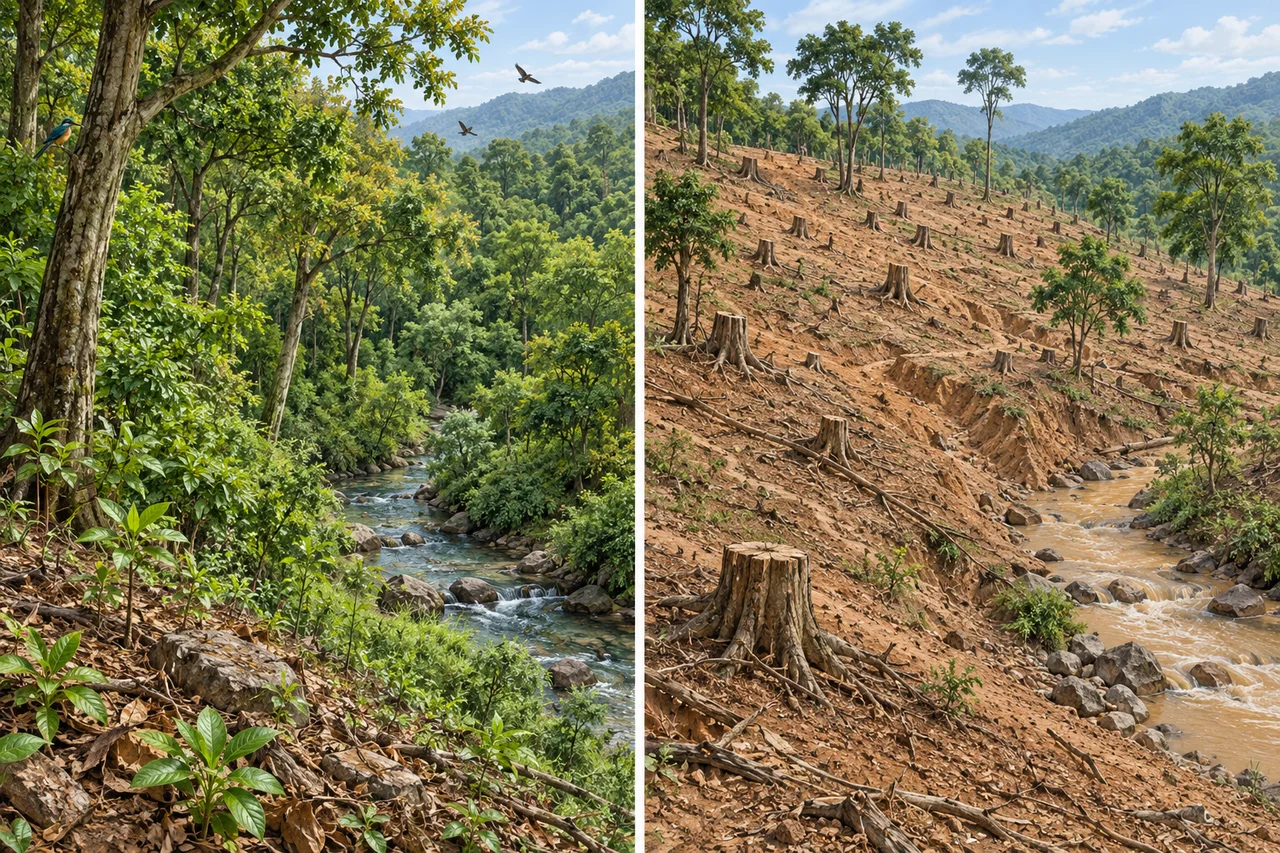
2. Name five ecosystem functions that serve humans.
3. What are renewable resources? How are they different from non-renewable ones? What can people do to ensure that renewable resources continue to be available for our use and that of future generations? Give two examples.
4. Identify cultural practices in your home and neighbourhood that point to mindfulness in the use of natural resources.
5. What are some considerations to keep in mind in the production of goods for our current use?
Extra Practice Questions
These questions and MCQs are ClearStudy practice, separate from the NCERT exercise.
Short Answer Type Questions
Q1. When does an element of Nature become a ‘resource’?
Q2. State the three conditions necessary for an entity to be called a resource.
Q3. What is meant by the ‘natural resource curse’?
Q4. Why is coal use a matter of concern in India?
Q5. How does the uneven distribution of natural resources affect human life?
Long Answer Type Questions
Q1. Explain, with an example, how natural resources are categorised on the basis of their use.
Q2. Describe the Punjab groundwater crisis and the lessons it teaches about resource use.
Q3. What is meant by stewardship of natural resources, and why is it important?
MCQs & Assertion–Reason
1. An element of Nature becomes a ‘resource’ when:
(a) it exists in the environment (b) humans use it and it is accessible, feasible and acceptable to use (c) it is rare (d) it is found underground
2. Which of the following is a non-renewable resource?
(a) Sunlight (b) Wind (c) Petroleum (d) Flowing water
3. Which of these is a renewable resource as long as it is used sustainably?
(a) Coal (b) Iron ore (c) Gold (d) Timber from forests
4. The process of returning something degraded to its original healthy state is called:
(a) regeneration (b) restoration (c) exploitation (d) distribution
5. Clean water, protected farmland and pollinated crops that humans receive from a forest are examples of:
(a) ecosystem services (b) non-renewable resources (c) the resource curse (d) biodiversity loss
6. The sharing of which river’s water among Karnataka, Tamil Nadu, Kerala and Puducherry is given as an example of resource-related tension?
(a) Ganga (b) Brahmaputra (c) Kaveri (d) Yamuna
7. When a region rich in natural resources still grows slowly, economists call it the:
(a) demographic dividend (b) natural resource curse (c) Green Revolution (d) water tower effect
8. What does groundwater overexploitation mean?
(a) Extraction is below replenishment (b) Only surface water is used (c) Withdrawals exceed sustainable replenishment (d) All water is pure
9. The International Solar Alliance was launched by India along with which country in 2015?
(a) Japan (b) France (c) Germany (d) the USA
10. In 2016, which Indian state became a 100 per cent organic state?
(a) Punjab (b) Kerala (c) Sikkim (d) Rajasthan
For each Assertion–Reason question, choose: (A) Both true and the Reason correctly explains the Assertion; (B) Both true but the Reason is not the correct explanation; (C) Assertion true, Reason false; (D) Assertion false, Reason true.
A-R 1. Assertion: A renewable resource can become non-renewable in practice.
Reason: If we use a renewable resource faster than Nature can replenish it, the resource gets depleted.
A-R 2. Assertion: Coal is a renewable resource.
Reason: Coal is a fossil fuel formed over millions of years and cannot be replenished at the rate we use it.
A-R 3. Assertion: Having abundant natural resources always guarantees that a country becomes rich.
Reason: Economies sometimes fail to develop industries that convert resources into higher-value products.
A-R 4. Assertion: The uneven distribution of natural resources can lead to conflicts.
Reason: Nature does not pay attention to political boundaries, and competing demands over shared resources can cause tensions unless managed through cooperation.
A-R 5. Assertion: We should use natural resources as stewards.
Reason: Irresponsible use of natural resources has led to pollution, biodiversity loss and climate change.
Exam Tips & Common Mistakes
How to write a clear answer
Learn the three conditions for an entity to be a resource (technologically accessible, economically feasible, culturally acceptable) and both ways of categorising resources (by use, and renewable vs non-renewable). For comparison questions, give a clear two-sided structure with an example each. Always link overuse to the idea that a renewable resource becomes non-renewable if used faster than it regenerates. Use the textbook’s own examples — Kaveri water sharing, the Punjab groundwater caselet, Sikkim organic farming, the cement industry, the International Solar Alliance and Bhadla Solar Park — to show you have studied the chapter.
Common mistakes to avoid
- Calling renewable resources “unlimited” — they renew only if used within their rate of regeneration.
- Confusing renewable (sunlight, wind, water, timber) with non-renewable (coal, petroleum, metals).
- Mixing up restoration (returning to a healthy state) with regeneration (creating new life).
- Confusing ecosystem functions (Nature’s processes) with ecosystem services (the benefits humans receive).
- Thinking abundant resources automatically make a country rich — this ignores the ‘resource curse’.
- Leaving observation/activity questions (Q4) blank — write your own examples from home and neighbourhood.
Frequently Asked Questions
What is Chapter 1 of Class 8 Social Science Exploring Society about?
Chapter 1, Natural Resources and Their Use, explains when Nature becomes a resource, how resources are categorised (by use, and as renewable or non-renewable), how their uneven distribution affects settlements and conflicts, and why responsible, sustainable use and stewardship of resources matter for future generations.
What is the difference between renewable and non-renewable resources?
Renewable resources are replenished by natural processes, or supplied as ongoing energy flows such as sunlight and wind. Water and forests need protection from overuse and pollution. Non-renewable fuels and mineral deposits are not replaced on a human timescale; metals can often be recycled, although their deposits remain finite.
What is the exercise heading for Chapter 1 of Exploring Society?
The end-of-chapter exercise in Exploring Society: India and Beyond Chapter 1 is headed Questions and activities and contains 5 numbered questions, all answered step by step on this page.
Textbook reference: NCERT Chapter 1, Exploring Society: India and Beyond, Grade 8, Part I (2026–27 reprint). Answers and illustrations on this page are original ClearStudy learning aids. Reviewed 10 October 2026.