
Class 8 Social Science Chapter 2 Solutions – Reshaping India’s Political Map
These Class 8 Social Science Chapter 2 solutions cover Reshaping India’s Political Map from Exploring Society: India and Beyond (Part I), the NCERT textbook first published in July 2025 and reprinted for 2026–27. This ‘Tapestry of the Past’ chapter traces the later medieval period (roughly the 13th to 17th centuries) — the rise and fall of the Delhi Sultanate, the Vijayanagara Empire, the Mughals, and the resistance offered by the Rajputs, Ahoms, Sikhs and many regional kingdoms. Below you get step-by-step answers to all Questions and activities, clear notes on key terms, extra practice, MCQs, Assertion–Reason and FAQs.
Class 8 Social Science Chapter 2 Solutions: Overview
Chapter 2, Reshaping India’s Political Map, covers the later ‘medieval’ period of Indian history, roughly the 11th to 17th centuries. From the early 11th century, invasions from beyond the Hindu Kush reshaped India’s political boundaries. The chapter follows the Delhi Sultanate (Mamluks, Khiljis, Tughlaqs, Sayyids and Lodis) and its constant instability and violent successions, alongside the resistance of the Eastern Gangas, Hoysalas, Musunuri Nayakas and Rana Kumbha. It then traces the Vijayanagara Empire under Krishnadevaraya and the sack of its capital after the Battle of Talikota (1565), followed by a period of continued rule from other centres, the rise of the Mughals from Babur to Aurangzeb, and the determined resistance of the Rajputs, Ahoms and Sikhs. It closes by examining the administration of the Sultanate and the Mughals (the iqta and mansabdari systems) and the economic and social life of ordinary people.
Key Concepts & Terms
Medieval period: literally ‘between two ages’. Borrowed from European history, here it simply means the period in India from about the 11th to the 17th centuries.
Sultanate: a territory ruled by a ‘Sultan’, a title adopted by some Muslim rulers. The Delhi Sultanate (1206–1526) saw five successive Turkic-Afghan dynasties — the Mamluks (Slave dynasty), Khiljis (Khaljis), Tughlaqs, Sayyids and Lodis.
Iconoclasm: the rejection or destruction of icons or religious images considered idolatrous; this period saw many such attacks on Buddhist, Jain and Hindu temple images.
Jizya: a tax imposed by some sultans on non-Muslim subjects in return for protection and exemption from military service. Akbar abolished it; Aurangzeb later reimposed it.
Iqta system: a Sultanate arrangement in which territories were assigned to nobles (iqtadars) to collect taxes for the Sultan’s treasury, chiefly to maintain the army. The posts were not hereditary.
Mansabdari system: officers (mansabdars) held a rank (mansab) that determined status, pay and military responsibilities. Many received the right to collect revenue from an assigned jagir; this did not mean ownership of the land, and some were paid in cash.
Sulh-i-kul: Akbar’s doctrine of ‘peace with all’ or tolerance of all faiths, promoted through interfaith dialogue and the appointment of Hindu officials.
Jauhar: mass self-immolation by women in some besieged Rajput forts when capture and enslavement were feared. Discuss this tragic wartime practice in its historical context; it is not a model for conduct today.
Guerrilla warfare: a style of fighting in which small groups, using their knowledge of the terrain, carry out surprise attacks and ambushes to defeat larger armies — used by Maharana Pratap and the Ahoms.
Other key terms: Turkic (peoples and cultures of Central Asia stretching to Turkey and Siberia), Infidel (someone who does not share a given faith), Token currency (Muhammad bin Tughlaq’s copper coins valued as silver/gold), Paik system (Ahom system of compulsory labour/military service for land rights), Khalsa (the martial brotherhood founded by Guru Gobind Singh in 1699), Hundi (a written instruction to make a payment — a precursor to banking), and Ik Onkar (Guru Nanak’s message of the oneness of God).
The Big Questions
How did invasions and new dynasties reshape the map?
The Delhi Sultanate and Mughal Empire expanded and contracted while states such as Vijayanagara, Mewar and the Ahom kingdom resisted, allied or rebuilt. Their boundaries changed through conquest, succession, rebellion and diplomacy.
How did society and the economy respond?
Communities defended or rebuilt settlements, adapted their traditions and sustained farming, crafts and trade. Merchant networks, hundis and temple-based institutions supported activity across changing political borders, although wars and taxes could cause great hardship.
What was the impact on people?
People experienced unequal effects: some gained patronage or trading opportunities, while cultivators, artisans and displaced communities faced taxes, violence and famine. Cultural creativity continued alongside conflict. Do not assign responsibility for past rulers’ actions to communities living today.
Think About It and Let’s Explore: Activity Guidance
These are model approaches to the textbook’s in-text prompts. Use your own observations and research where required; imagined examples are not historical documents or actual survey findings.
| Textbook prompt | Model explanation or approach |
|---|---|
| Ala-ud-din’s “second Alexander” coin (p. 26) | The title projected ambitions of conquest and prestige. A coin’s inscription reveals how a ruler wanted to be seen; it does not prove that his career matched Alexander’s. |
| Resources needed for an army (p. 26) | Food, wages, weapons, armour, horses, elephants, fodder, transport, roads, camps and skilled workers all required revenue and organisation. Warfare also disrupted the resources of civilians. |
| Why use the word “image”? (p. 28) | It is a neutral English term for a religious representation. Explain beliefs respectfully without adopting a historically hostile label as your own judgement. |
| Bringing together many chieftains (p. 29) | Different interests, leadership claims, distances and resources made coordination difficult. A shared threat could encourage a confederacy, but cooperation still required negotiation. |
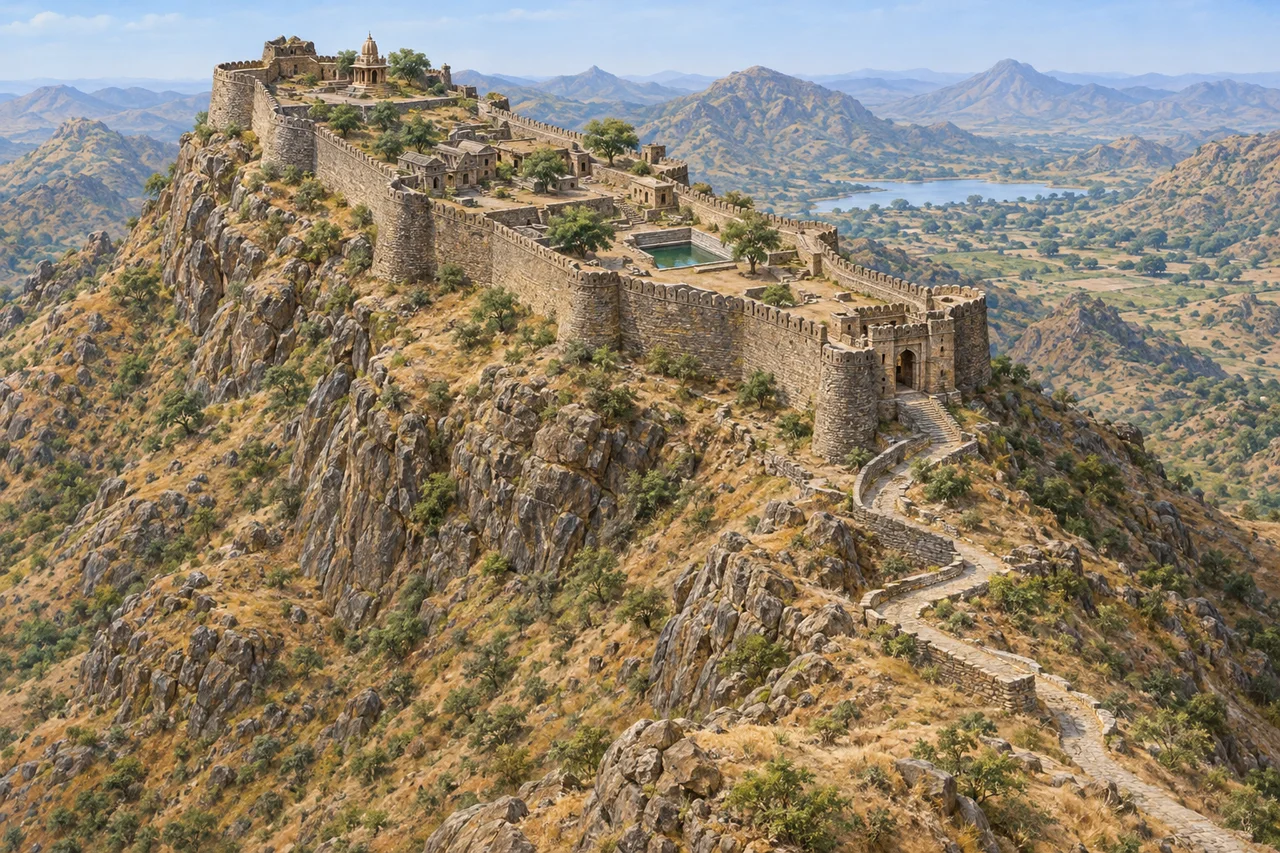
| Hill-fort locations: advantages and limitations (p. 31) | Steep slopes and restricted approaches help defence and observation. Carrying supplies uphill is difficult, and siege resistance depends on stored food, water and secure routes. See the illustration below. |
| Meaning of pati in royal titles (p. 32) | Narapati: lord of people/men; Ashwapati: lord of horses; Chhatrapati: lord of the royal umbrella, a symbol of sovereign authority. Gajapati means lord of elephants. These are titles, not literal statements of ownership of every person or animal. |
| Vitthala temple relief (p. 35) | Observe Fig. 2.14 directly: identify human figures, animals, weapons and activities that are visible. Separate observation from inference about warfare, processions or social life. Do not invent invisible details. |
| Babur’s impressions (p. 37) | His memoir combines admiration for wealth, artisans and climate with personal dislikes and nostalgia. Compare his viewpoint with other sources; one ruler’s memoir cannot represent all experiences. |
| Akbar’s varied strategies (p. 40) | Alliances and inclusion could secure cooperation more cheaply than continuous war in a diverse empire. Earlier rulers also negotiated; Akbar’s reign still included conquest. |
| Compare Figs. 2.3, 2.12 and 2.16 (p. 41) | Read each legend and date. Compare Sultanate reach, Deccan states, Mughal expansion and regional powers. These maps include different dates, so do not assume that every coloured region existed simultaneously. |
| Compare average lengths of reign (p. 43) | The chapter’s averages suggest different succession patterns, but depend on which rulers are counted. A longer reign can aid continuity; it does not automatically prove good government or peace. |
| Aurangzeb’s final letters (p. 45) | They express loneliness, uncertainty and regret. They help discuss a ruler’s self-reflection, but do not by themselves prove every cause of political decline. |
| Studying historical atrocities (p. 45) | Respect victims and examine evidence and context. Individuals today are not responsible for acts by rulers centuries ago, as the textbook’s note on p. 20 explains. |
| Effects of the paik system (p. 48) | Service helped supply labour and troops and supported infrastructure. Duties also reduced household labour time and imposed obligations. Discuss both state benefits and people’s burdens. |
| Ahom use of terrain (p. 49) | River channels aided boat movement and defence; forests and hills offered cover and made outsiders’ supply and movement harder. Local knowledge was important at Saraighat. |
| Guru Tegh Bahadur, the Gurus and Khalsa (p. 52) | The chapter connects their resistance to freedom of conscience, justice, equality, courage and service. Relate these values to opposing discrimination and helping others today, without claiming every historical decision had a single motive. |
“Questions and activities” — Full Solutions
All questions below are reproduced verbatim from the NCERT textbook’s end-of-chapter Questions and activities section. Answers are original, written in exam-ready style.
1. Compare the political strategies of the Delhi Sultanate and the Mughals. What similarities and differences existed between them?
2. Why did kingdoms like the Vijayanagara Empire and the Ahom Kingdom manage to resist conquest for a longer time compared to others? What geographical, military, and social factors contributed to their success?
3. Imagine you are a scholar in the court of Akbar or Krishnadevaraya. Write a letter to a friend describing the politics, trade, culture, and society you are witnessing.
4. How come Akbar, a ruthless conqueror in his young days, grew tolerant and benevolent after some years? What could have led to such a change?
5. What might have happened if the Vijayanagara Empire had won the Battle of Talikota? Imagine and describe how it could have changed the political and cultural history of south India.
6. Many values promoted by early Sikhism, including equality, seva, and justice, remain relevant today. Select one of these values and discuss how it remains relevant in contemporary society.
7. Imagine you are a trader in a port city (Surat, Calicut or Hooghly). Describe the scenes you see as regards goods, people you trade with, movement of ships, etc.
Extra Practice Questions
These questions and MCQs are ClearStudy practice, separate from the NCERT exercise.
Short Answer Type Questions
Q1. Name the five dynasties that ruled the Delhi Sultanate.
Q2. What was the iqta system?
Q3. Who was Krishnadevaraya?
Q4. What was the Battle of Saraighat and why is it important?
Q5. What was the mansabdari system introduced by Akbar?
Long Answer Type Questions
Q1. Describe the rise and fall of the Delhi Sultanate.
Q2. How did various Indian kingdoms and communities resist the Delhi Sultanate and the Mughals?
Q3. Describe the economic life and the role of temples and trade in India during this period.
MCQs & Assertion–Reason
1. The Delhi Sultanate was formed after the defeat in 1192 of which king?
(a) Rana Sanga (b) Prithviraj Chauhan (c) Ibrahim Lodi (d) Narasimhadeva I
2. Which ruler shifted the capital from Delhi to Daulatabad and introduced token currency?
(a) Ala-ud-din Khilji (b) Babur (c) Muhammad bin Tughlaq (d) Timur
3. The First Battle of Panipat (1526) was won by:
(a) Akbar (b) Babur (c) Humayun (d) Sher Shah Suri
4. Vijayanagara’s capital was sacked after its defeat in which battle in 1565?
(a) Battle of Haldighati (b) Battle of Khanwa (c) Battle of Talikota (d) Battle of Saraighat
5. Who founded the Khalsa in 1699?
(a) Guru Nanak (b) Guru Arjan (c) Guru Tegh Bahadur (d) Guru Gobind Singh
6. The Ahom commander who defeated the Mughals at the Battle of Saraighat (1671) was:
(a) Lachit Borphukan (b) Durga Das Rathore (c) Maharana Pratap (d) Rana Kumbha
7. Akbar’s doctrine of ‘peace with all’ or tolerance of all faiths was called:
(a) jizya (b) sulh-i-kul (c) iqta (d) mansab
8. The tax imposed by some sultans on non-Muslim subjects was the:
(a) hundi (b) dana (c) jizya (d) paik
9. Which ruler built the Konark Sun temple, partly associated in the chapter with his victories?
(a) Krishnadevaraya (b) Narasimhadeva I (c) Rana Kumbha (d) Harihara
10. Under which Mughal emperor did the empire reach its greatest territorial expansion?
(a) Babur (b) Akbar (c) Shah Jahan (d) Aurangzeb
For each Assertion–Reason question, choose: (A) Both true and the Reason correctly explains the Assertion; (B) Both true but the Reason is not the correct explanation; (C) Assertion true, Reason false; (D) Assertion false, Reason true.
A-R 1. Assertion: A Delhi sultan’s average reign was hardly more than nine years.
Reason: Successions were often violent, with almost two sultans out of three seizing power by eliminating their predecessor.
A-R 2. Assertion: Akbar abolished the jizya tax on non-Muslims.
Reason: Akbar promoted the doctrine of sulh-i-kul and sought to win the support of people of all faiths.
A-R 3. Assertion: The Ahoms were able to preserve their independence against the Mughals.
Reason: They used their knowledge of the terrain and guerrilla tactics, as shown at the Battle of Saraighat.
A-R 4. Assertion: Aurangzeb continued Akbar’s policy of religious tolerance.
Reason: Aurangzeb reimposed the jizya, banned practices he regarded as un-Islamic, and ordered the destruction of several temples.
A-R 5. Assertion: The hundi system made merchants less vulnerable to plunder.
Reason: A hundi was a written instruction to make a payment, allowing money to be transferred across borders without carrying currency.
Exam Tips & Common Mistakes
How to write a clear answer
Memorise the order of the five Sultanate dynasties (Mamluks → Khiljis → Tughlaqs → Sayyids → Lodis) and the key dates — 1206 (Delhi Sultanate), 1336 (Vijayanagara), 1526 (First Panipat / Mughals), 1565 (Talikota), 1671 (Saraighat), 1699 (Khalsa). For comparison questions (Q1), use a two-sided structure (similarities, then differences). Always link a ruler to one concrete achievement or example — Akbar & sulh-i-kul, Krishnadevaraya & Amuktamalyada, Lachit Borphukan & Saraighat, Maharana Pratap & Haldighati. For activity and ‘imagine’ questions, give a clear, well-organised, reasoned answer.
Common mistakes to avoid
- Confusing the First Battle of Panipat (1526, Babur) with the Second Battle of Panipat (1556, Akbar vs Hemu).
- Mixing up the Battle of Talikota (defeat and sack of Vijayanagara’s capital) with the Battle of Saraighat (Ahom victory) or Haldighati (Maharana Pratap).
- Saying Akbar was always tolerant or later stopped warfare; his record includes both violence and policies of tolerance.
- Reversing Akbar and Aurangzeb on the jizya — Akbar abolished it; Aurangzeb reimposed it.
- Confusing the iqta system (Sultanate) with the mansabdari system (Mughal/Akbar).
- Leaving creative or activity questions (Q3, Q5, Q6, Q7) blank — write your own reasoned response.
Frequently Asked Questions
What is Chapter 2 of Class 8 Social Science Exploring Society about?
Chapter 2, Reshaping India’s Political Map, covers the later medieval period (about the 11th to 17th centuries). It traces the rise and fall of the Delhi Sultanate, the Vijayanagara Empire and the Mughals, the resistance of the Rajputs, Ahoms and Sikhs, and the administration and economic life of the time.
Which dynasties ruled the Delhi Sultanate?
Five successive Turkic-Afghan dynasties ruled the Delhi Sultanate: the Mamluks (or ‘Slave dynasty’), the Khiljis (Khaljis), the Tughlaqs, the Sayyids and the Lodis. It lasted from 1206 until Babur defeated Ibrahim Lodi at the First Battle of Panipat in 1526.
What is the exercise heading for Chapter 2 of Exploring Society?
The end-of-chapter exercise in Exploring Society: India and Beyond Chapter 2 is headed Questions and activities and contains 7 numbered questions, all answered step by step on this page.
Continue the history of changing political power in Chapter 3: The Rise of the Marathas.
Textbook reference: NCERT Chapter 2, Exploring Society: India and Beyond, Grade 8, Part I (2026–27 reprint). Answers and illustrations on this page are original ClearStudy learning aids. Reviewed 10 October 2026.