
Class 8 Social Science Chapter 3 Solutions – The Rise of the Marathas
These Class 8 Social Science Chapter 3 solutions cover The Rise of the Marathas from Exploring Society: India and Beyond (Part I), the NCERT textbook first published in July 2025 and reprinted for 2026–27. The chapter belongs to the theme Tapestry of the Past and traces how the Marathas, under Chhatrapati Shivaji Maharaj, rose from the Deccan to build the largest pan-Indian power before the British takeover — their ideal of Swarājya, their forts and navy, their administration, and their cultural revival. Below you get step-by-step answers to all Questions and activities, clear notes on key terms, extra practice, MCQs, Assertion–Reason and FAQs.
Class 8 Social Science Chapter 3 Solutions: Overview
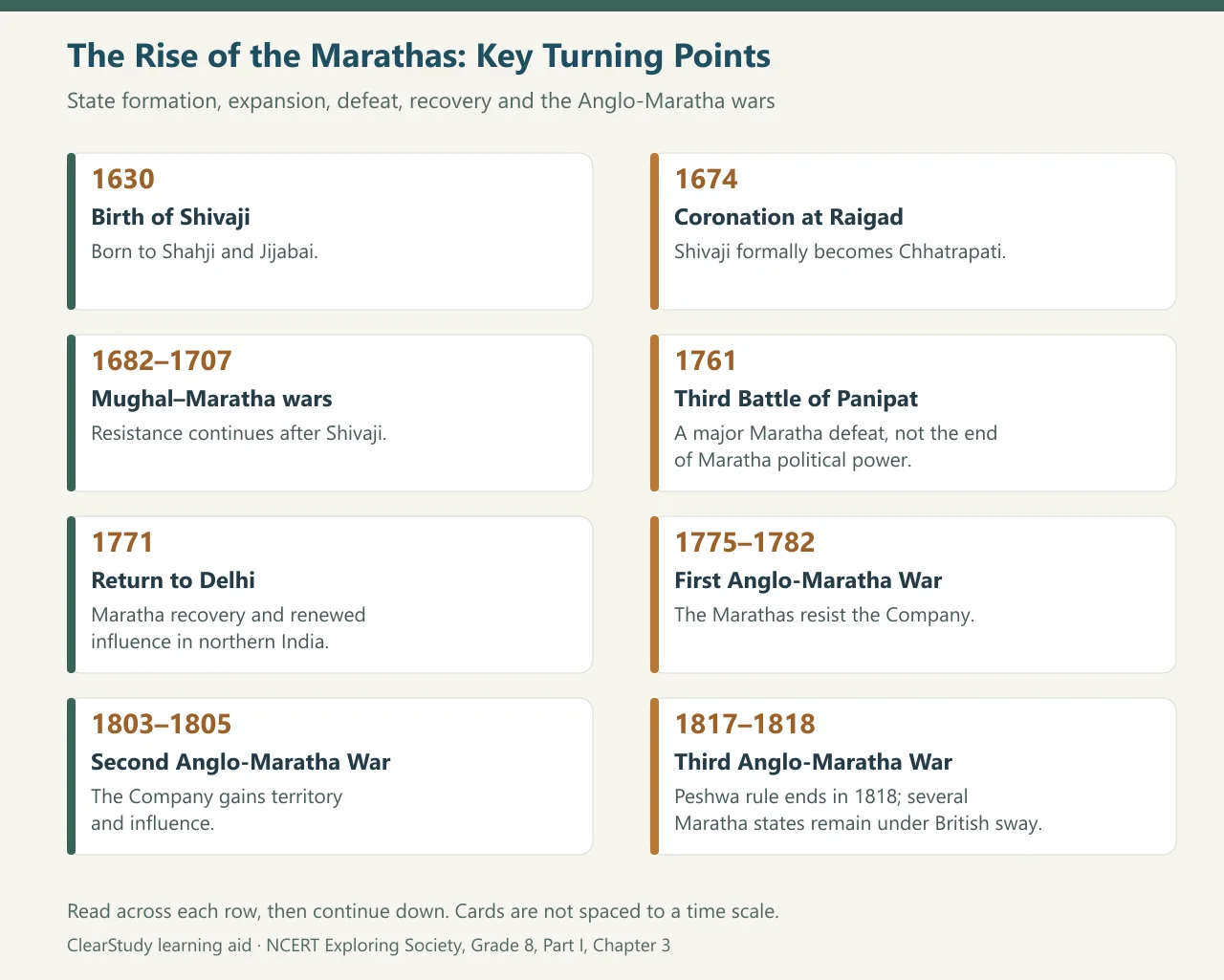
Chapter 3, The Rise of the Marathas, tells the story of a people native to the Deccan plateau (present-day Maharashtra) who, strengthened by the bhakti tradition and Marathi literary culture, grew into a powerful political force. Born in 1630, Chhatrapati Shivaji Maharaj united the Marathas, captured and built forts, used guerrilla warfare, killed Afzal Khan, raided Shaista Khan, sacked Surat and famously escaped from Agra. Crowned at Raigad in 1674, he pursued the ideal of Swarājya (self-rule), founded a navy and built a relatively centralised administration with an aṣhṭa pradhāna maṇḍala. After his death the Marathas decentralised under the Peshwas, expanded across India, suffered defeat at Panipat (1761), recovered, and finally lost power to the British in the three Anglo-Maratha wars (1775–1818). The chapter also highlights Maratha women like Tarabai and Ahilyabai Holkar and the cultural flowering at Thanjavur.
Key Concepts & Terms
Marathas: a group of people native to the Deccan plateau, especially present-day Maharashtra, identified with the Marathi language, which has had a rich literary history since the 12th century.
Bhakti: devotion to the divine or a particular deity. Between the 7th and 17th centuries, saints across India chose the path of bhakti over external ritualism and composed devotional songs in the people’s languages, giving Maratha society a strong cultural foundation.
Swarājya: Chhatrapati Shivaji’s vision of a sovereign, self-ruled kingdom, extending to political, economic and cultural independence.
Guerrilla warfare: a tactic that uses small groups of fighters with speed, surprise and knowledge of the terrain to defeat much larger armies.
Jagir: an assignment of revenue from an area, usually connected with service to a ruler. The holder’s right to collect revenue should not be confused with unrestricted ownership of the land.
Aṣhṭa pradhāna maṇḍala: Chhatrapati Shivaji’s council of eight ministers (such as the Peśhwā/Pradhān, Amātya, Sumant, Senāpatī and Nyāyādhīsh) that assisted him in administration.
Chauth and sardeshmukhi: taxes levied by the Marathas on provinces not directly under them — chauth was 25 per cent and sardeshmukhi an additional 10 per cent — in return for protection and non-interference.
Peshwa: a Persian term for ‘prime minister’. In the decentralised later Maratha state the Peshwa (e.g. Bajirao I and Nanasaheb) wielded great power, even over the Chhatrapati.
Other key terms: Dakṣhiṇa-digvijaya (Chhatrapati Shivaji’s conquest of the South), cartaz (Portuguese naval trade passes; other powers also asserted control over sea trade), panchāyat (the local body that delivered justice), and Moḍī script (a cursive form of Devanagari used by the Marathas for correspondence).
The Big Questions
Who were the Marathas and how did they expand?
They arose from the Marathi-speaking Deccan. Shivaji built a regional state through forts, military mobility, coastal defence and administration. Successors sustained resistance; Peshwas and regional chiefs expanded influence as Mughal power weakened.
What were the main features of governance?
Shivaji’s government sought stronger central control and used a council of ministers and revenue systems. Later power became more decentralised under influential Peshwas and regional houses. Administrative arrangements changed over time.
What legacy did they leave?
They challenged Mughal and European power, strengthened traditions of self-rule and supported public works, literature and arts. Their legacy includes both achievements and the hardships of war.
Think About It and Let’s Explore: Activity Guidance
These are model approaches to the textbook’s in-text prompts. Use your own observations and research where required; imagined examples are not historical documents or actual survey findings.
| Textbook prompt | Model explanation or approach |
|---|---|
| Bhakti saint research (p. 63) | Bhakti means devotion. Choose a saint such as Tukaram, identify region, language and teachings, and cite a reliable biography and the poem’s source. Summarise the message rather than copying an entire modern translation. |
| Three questions for Shivaji (p. 65) | Ask how he balanced forts and navy; how he financed government without overburdening subjects; and how he chose officials. Explain why each question helps understand governance. Any imagined response must be labelled as such. |
| Guerrilla warfare beyond India (p. 66) | Research one case, such as resistance in the Iberian Peninsula during the Napoleonic wars. Discuss how mountains, local knowledge and short attacks affected larger forces. It is a historical comparison, not a guide to violence. |
| Stage an event as a play (p. 69) | A coronation or discussion about protecting villagers can be staged without graphic violence. Use dated facts, assign roles and distinguish invented dialogue from documented statements. |
| Shivaji’s letter about trees (p. 72) | It shows concern for people’s labour, livelihoods and attachment to fruit trees, and opposes coercion. Link navy timber needs with the limits placed on acquiring resources. |
| Bharatanatyam and Thanjavur (p. 79) | The chapter links court patronage with music and dance. Research the roles of Thanjavur’s artists and patrons, while recognising earlier performance traditions and later reform. Avoid saying that the Marathas invented the entire dance form. |
“Questions and activities” — Full Solutions
All questions below are reproduced verbatim from the NCERT textbook’s end-of-chapter Questions and activities section. Answers are original, written in exam-ready style.
1. Analyse how geography (particularly mountains and coastlines) guided Maratha military strategy and state formation.
2. Imagine you are creating a short biography of a Maratha leader for younger students. Choose one personality (Kanhoji Angre, Bajirao I, Mahadji Shinde, Ahilyabai Holkar or Tarabai) and write 3-4 paragraphs highlighting what makes them inspirational. Include at least one challenge they overcame.
Model biography: Ahilyabai Holkar
Ahilyabai Holkar became the ruler of the Holkar state in central India in 1767 and ruled until 1795, about 28 years. The textbook rounds this to roughly thirty years. Her administration is associated with the welfare of her subjects and the town of Maheshwar.
She faced major personal losses, including the deaths of her husband and son. She took on the responsibilities of government and worked with experienced officials and military leaders. Her example shows leadership through sustained responsibility after difficult setbacks.
She supported roads, wells, ghats and religious institutions in many regions and encouraged Maheshwar’s weaving tradition. These activities linked public facilities, craftsmanship and patronage.
For younger students, her inspiring qualities are perseverance, thoughtful administration and service. This is a summary based on NCERT and the Government of India’s biographical note, not an invented first-person account.
3. If you could visit one Maratha fort today (such as Raigad, Sindhudurg, Gingee, or Pratapgad), which would you choose and why? Research its history, architecture, and strategic importance. Present your findings as a digital presentation or a poster in class.
4. The chapter states, “The British took India from the Marathas more than from the Mughals or any other power.” What do you think this means? What evidence from the chapter supports this idea?
5. Compare how Chhatrapati Shivaji and later Marathas treated religious places and people of different faiths. What evidence from the chapter shows their approach to religious diversity?
6. The chapter describes how forts were ‘the core of the state’ for Marathas. Why were they so important? How did they help the Marathas survive against larger enemies?
7. You have been appointed as the chief designer for Maratha coins. Design a coin that represents Maratha achievements and values. Explain the symbols you chose.
8. After this introduction to the Maratha period, what do you think was their most important contribution to Indian history? Write a paragraph supporting your opinion with examples from the chapter. Then share and discuss your ideas with classmates.
Extra Practice Questions
These questions and MCQs are ClearStudy practice, separate from the NCERT exercise.
Short Answer Type Questions
Q1. Who were the Marathas?
Q2. What was ‘Swarājya’?
Q3. What is guerrilla warfare and why did the Marathas use it?
Q4. Why was the founding of the Maratha navy a revolutionary step?
Q5. What were chauth and sardeshmukhi?
Long Answer Type Questions
Q1. Describe the main features of Chhatrapati Shivaji’s civilian and military administration.
Q2. Trace the rise and fall of the Marathas as a pan-Indian power.
Q3. Discuss the cultural contributions of the Marathas, including the role of Maratha women and Thanjavur.
MCQs & Assertion–Reason
1. The Marathas are a group of people native to which region?
(a) the Gangetic plains (b) the Deccan plateau (present-day Maharashtra) (c) Bengal (d) Punjab
2. Chhatrapati Shivaji was born in the year:
(a) 1646 (b) 1657 (c) 1630 (d) 1674
3. Chhatrapati Shivaji’s coronation took place in 1674 at:
(a) Pune (b) Raigad (c) Purandar (d) Sindhudurg
4. The military tactic of using small groups with speed, surprise and knowledge of terrain is called:
(a) naval blockade (b) guerrilla warfare (c) siege warfare (d) cavalry charge
5. Chhatrapati Shivaji’s vision of a sovereign kingdom was called:
(a) Swarājya (b) jāgīr (c) chauth (d) cartaz
6. The council of eight ministers that assisted Chhatrapati Shivaji was the:
(a) panchāyat (b) aṣhṭa pradhāna maṇḍala (c) Peshwa council (d) kotwāl
7. The tax called ‘chauth’ levied by the Marathas was at the rate of:
(a) 10 per cent (b) 25 per cent (c) 35 per cent (d) 50 per cent
8. The Persian term for ‘prime minister’ used in the later Maratha state was:
(a) Senāpatī (b) Amātya (c) Peshwa (d) Sumant
9. The Marathas suffered a disastrous defeat in 1761 at the Battle of:
(a) Panipat (b) Purandar (c) Pratapgad (d) Surat
10. Which Maratha queen is described as the architect of the northward Maratha expansion?
(a) Jijabai (b) Ahilyabai Holkar (c) Tarabai (d) Mastani
For each Assertion–Reason question, choose: (A) Both true and the Reason correctly explains the Assertion; (B) Both true but the Reason is not the correct explanation; (C) Assertion true, Reason false; (D) Assertion false, Reason true.
A-R 1. Assertion: Forts were extremely important to Maratha power.
Reason: Forts controlled important routes, sheltered the army and helped the Marathas survive decades of onslaught.
A-R 2. Assertion: Building a navy was a revolutionary step for Chhatrapati Shivaji.
Reason: At the time, even the Bijapur Sultanate and the Mughals had little or no full-time naval force.
A-R 3. Assertion: The British took India effectively from the Mughals rather than the Marathas.
Reason: In the latter half of the 18th century the chief rivals of the British in India were the Marathas.
A-R 4. Assertion: Chhatrapati Shivaji respected other religions while upholding his own.
Reason: While sacking Surat he avoided attacking religious places and spared the house of a charitable man.
A-R 5. Assertion: After Chhatrapati Shivaji, the Maratha state became more decentralised.
Reason: Regional chiefs and the Peshwa came to wield greater power, sometimes even over the Chhatrapati.
Exam Tips & Common Mistakes
How to write a clear answer
Remember the key dates — 1630 (birth), 1674 (coronation at Raigad), 1761 (Panipat), 1775–1818 (Anglo-Maratha wars). Always link geography to strategy (mountains → forts and guerrilla war; coastline → navy). Use the textbook’s own evidence — the Ādnyāpatra on forts, the sparing of Surat’s religious places, the recapture of Delhi in 1771 — to back up your answers. For the activity questions (2, 3, 7, 8) give a clear, reasoned response with named examples; do not leave them blank.
Common mistakes to avoid
- Confusing the dates — Chhatrapati Shivaji was born in 1630 and crowned in 1674, not the other way round.
- Mixing up the taxes — chauth was 25 per cent, sardeshmukhi an extra 10 per cent.
- Calling the Peshwa a king — Peshwa means ‘prime minister’ (a Persian term).
- Saying the British defeated only one Indian power; the chapter stresses the Marathas’ major role, alongside other opponents.
- Writing that Chhatrapati Shivaji attacked religious places at Surat — he was careful not to.
- Leaving activity-based questions blank instead of giving your own reasoned answer.
Frequently Asked Questions
Who was Chhatrapati Shivaji and why is he important in Class 8 Chapter 3?
Chhatrapati Shivaji (born 1630) was the founder of the Maratha kingdom. He united the Marathas, captured and built forts, used guerrilla warfare, founded a navy and pursued the ideal of Swarājya (self-rule). Crowned at Raigad in 1674, he built a relatively centralised administration and inspired generations of Indians, making him the central figure of the chapter.
What were chauth and sardeshmukhi?
Chauth was 25% and sardeshmukhi an additional 10% of an assessed revenue amount. The additional levy was not 10% of the chauth itself. Arrangements differed across regions and treaties; the chapter links them with Maratha protection and influence.
What is the exercise heading for Chapter 3 of Exploring Society?
The end-of-chapter exercise in Exploring Society: India and Beyond Chapter 3 is headed Questions and activities and contains 8 numbered questions, all answered step by step on this page.
See how Company expansion developed in Chapter 4: The Colonial Era in India.
Textbook reference: NCERT Chapter 3, Exploring Society: India and Beyond, Grade 8, Part I (2026–27 reprint). Answers and illustrations on this page are original ClearStudy learning aids. Reviewed 10 October 2026.