
Class 8 Social Science Chapter 5 Solutions: Universal Franchise and India’s Electoral System
These Class 8 Social Science Chapter 5 solutions cover Universal Franchise and India’s Electoral System from Exploring Society: India and Beyond (Part I), the NCERT textbook first published in July 2025 and reprinted for 2026–27. The chapter belongs to the theme Governance and Democracy and explains how India runs the world’s largest democratic exercise — from universal adult franchise and the secret ballot to the role of the Election Commission of India, the First-Past-the-Post system, and how Lok Sabha, Rajya Sabha, President and Vice President elections work. Below you get step-by-step answers to all Questions and activities, clear notes on key terms, extra practice, MCQs, Assertion–Reason and FAQs.
Class 8 Social Science Chapter 5 Solutions: Overview
Chapter 5, Universal Franchise and India’s Electoral System, explains how India conducts elections — often called the ‘Festival of Democracy’. The Constitution makers chose universal adult franchise from the outset. The minimum voting age was originally 21 and is now 18. Eligible citizens registered on the electoral roll have one vote of equal value, regardless of caste, creed, religion, gender, education or income (Article 326). The chapter uses a relatable class-representative election at Suryodaya School to introduce ideas like the secret ballot, the Election Officer and NOTA. It then describes the Election Commission of India (ECI) — an independent constitutional body set up in 1950 — and how it manages the massive Lok Sabha elections, the First-Past-the-Post system, the Model Code of Conduct, and the use of EVMs and VVPAT. Finally it explains direct and indirect elections (Lok Sabha, Rajya Sabha, President and Vice President) and the challenges Indian democracy faces.
Key Concepts & Terms
Franchise (suffrage): the right to vote, granted by the constitution or government. ‘Suffrage’ is a synonym of franchise.
Universal adult franchise: voting rights for adult citizens without discrimination based on caste, religion, gender, education or income. For Lok Sabha and state assembly elections, Article 326 sets the minimum age at 18, subject to registration and legal disqualifications. The original age was 21; the Sixty-first Amendment Act, 1988, took effect on 28 March 1989.
Constituency: an area whose voters elect a representative to a legislative body. India has 543 Lok Sabha constituencies.
Secret ballot: a voter makes a confidential choice. This protects freedom of choice in Lok Sabha and assembly elections. Do not assume that every kind of election uses identical secrecy rules: Rajya Sabha elections use an open-ballot procedure.
NOTA (None Of The Above): an option expressing rejection of the listed candidates. In Lok Sabha and assembly elections it does not itself cancel the election or force a fresh poll; the candidate with the most votes among the candidates wins.
Election Commission of India (ECI): an independent constitutional body established in 1950 that conducts free and fair elections to the Lok Sabha, Rajya Sabha, State Legislative Assemblies and the offices of President and Vice President.
Model Code of Conduct (MCC): a set of dos and don’ts for leaders, parties and candidates to ensure free and fair elections — for example, the ruling party must not misuse government resources or announce schemes to influence voters.
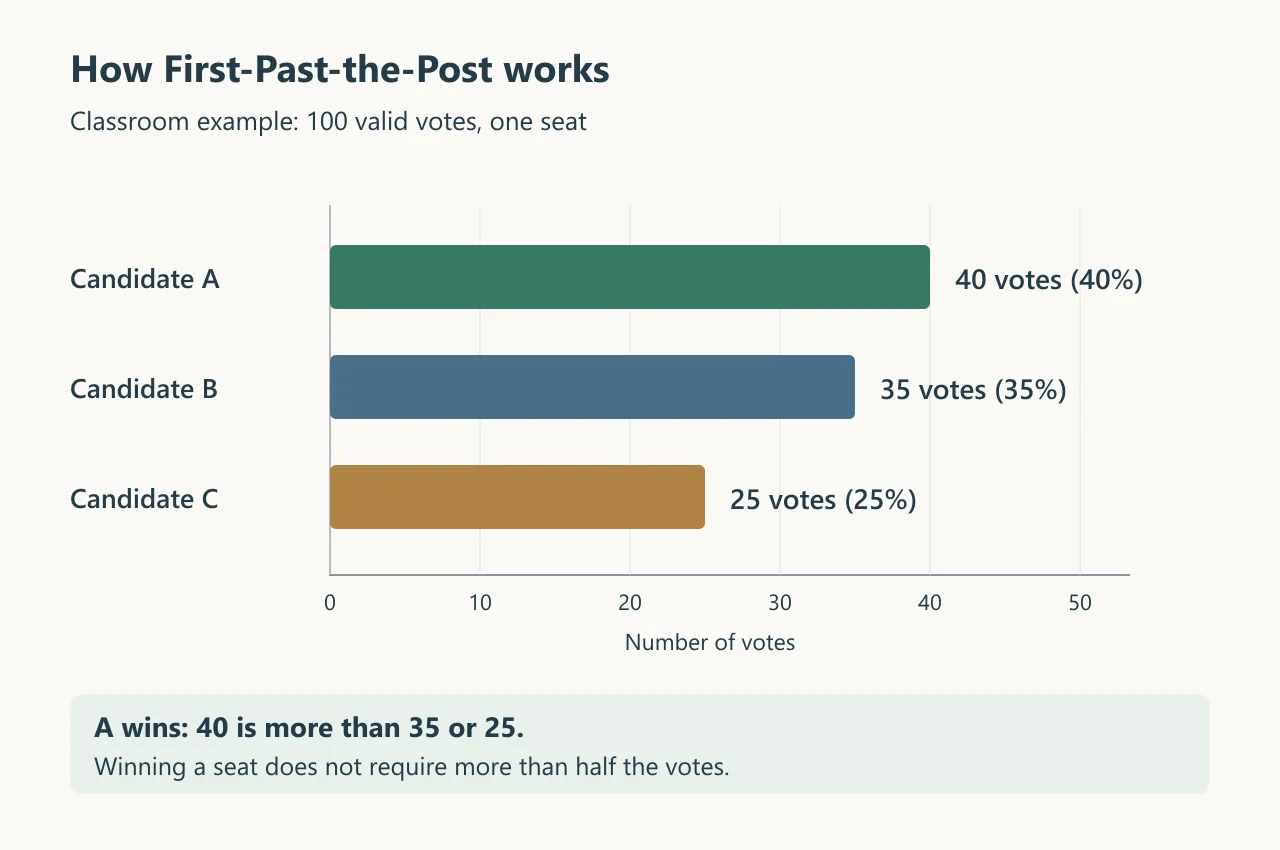
First-Past-the-Post (FPTP): the electoral system India uses for Lok Sabha and assemblies, in which the candidate getting the most votes in a constituency wins — even without 50 per cent of the votes.
EVM & VVPAT: an Electronic Voting Machine records votes electronically. The Voter Verifiable Paper Audit Trail displays the chosen candidate’s details for about seven seconds, then the slip falls into a sealed box. The voter views the slip through a window and does not take it home. Slips support verification under the applicable counting rules; electronic voting is not internet voting.
Other key terms: Coalition (two or more parties working together), Dissolution (termination of a legislative house, either before or at the end of its term), Bicameral legislature (a legislature with two houses), and the single transferable vote system used for the Rajya Sabha, President and Vice President.
The Big Questions
1. What is universal adult franchise?
Equal voting rights for eligible adult citizens regardless of social or economic background. India’s current minimum voting age is 18; electoral registration and legal eligibility are required.
2. What is an electoral system?
The connected rules, institutions and procedures for registering voters, choosing candidates, campaigning, voting, counting and translating votes into representation.
3. How does India’s electoral system work?
The ECI administers parliamentary and assembly elections. Citizens directly elect Lok Sabha MPs and MLAs through FPTP. Rajya Sabha, Presidential and Vice-Presidential elections use different indirect methods. State Election Commissions administer local-body elections.
Think About It and Let’s Explore: Activity Guidance
These are model approaches to the textbook’s in-text prompts. Use your own observations and research where required; imagined examples are not historical documents or actual survey findings.
| Textbook prompt | Model explanation or approach |
|---|---|
| Voting age and your eligibility (p. 118) | Lowering the age broadens youth representation and participation, while voter education helps new voters judge choices. The Act is titled 1988 but came into force on 28 March 1989. Calculate time until your 18th birthday; then check registration rules. Age alone is not electoral registration. |
| Literacy and franchise; add reasons to Fig. 5.4 (pp. 119–120) | Reading ability or wealth does not determine a citizen’s stake in public decisions. Suggested additional reasons: equal political dignity and peaceful transfer of power. Women received equal adult franchise under the Constitution; this does not mean India was the first country in the world to enfranchise women. |
| Accessibility and ECI research (pp. 121–122) | Look for ramps, wheelchairs, Braille features, assistance and eligible home-voting procedures. Explain which barrier each removes. Use the ECI accessibility information; ask permission before sharing any individual’s experience or photograph. |
| Survey of non-voting (p. 123) | Ask willing adults whether they faced registration, migration, access or information barriers. Do not ask which party they supported. Record anonymous counts, sample size and limitations; a small convenience survey cannot establish nationwide causes. |
| Suryodaya School caselet: process, secrecy and choices (pp. 123–125) | A neutral election officer sets rules, enables private accessible voting and counts transparently with a witness. Students can compare promises about cleanliness, peer learning and arts. A Braille ballot enables Neha to participate independently. A blank ballot does not express a candidate preference; an explicit NOTA option is different. |
| After the class election; Ms. Usha’s role (p. 125) | Students should cooperate with the chosen representative, raise concerns respectfully and check progress on commitments. Ms. Usha ensures fair rules and access; her role does not give her authority to choose everyone’s candidate. |
| Check the caselet arithmetic (p. 125) | The printed figures are Ahmed 8, Gurmat 12 and Ravi 10, totalling 30 candidate votes. One blank ballot gives 31 accounted-for ballots, although the text says 33 were cast. Two are not explained. Do not invent where they went: Gurmat has the most reported votes, but a percentage using all ballots needs consistent totals. The separate diagram below uses a fully specified example. |
| Invite an election-duty teacher (p. 128) | Ask about training, voter-list checks, accessibility, orderly queues and counting safeguards. Avoid requesting confidential voter choices or security-sensitive details. |
| EVM and VVPAT (pp. 129–130) | Explain button selection, the beep and the visible paper slip. The slip is retained in a sealed compartment. Discuss how equipment checks and paper verification support transparency; do not label electronic voting as online voting. |
| MCC complaints in Figs. 5.17–5.20 (p. 131) | Gifts offered for votes suggest bribery; abusive campaigning can breach conduct rules; government staff/resources must not be used for partisan campaigning. Cash found in a vehicle needs investigation and evidence of purpose: possession alone does not prove vote-buying. |
| Next local election and your MP/MLA (pp. 132–134) | Identify your state and constituencies, then consult official ECI or State Election Commission notices and parliamentary/assembly directories. Record names, parties and the date checked; do not infer an election date from an old news item. Compare national legislative work with state issues such as public services. |
| Why some members cannot vote for the President (p. 136) | Article 54 specifies elected MPs and eligible elected MLAs. Nominated members and legislative-council members are outside this college. Citizens participate indirectly through representatives. Elected Rajya Sabha MPs themselves are indirectly elected, so the phrase “only directly elected representatives” is too broad. |
“Questions and activities” — Full Solutions
All questions below are reproduced verbatim from the NCERT textbook’s end-of-chapter Questions and activities section. Answers are original, written in exam-ready style.
1. Why is universal adult franchise important for a healthy democracy?
2. What is the meaning of ‘secret ballot’? Why is this important in a democracy?
3. Give examples of direct and indirect elections.
4. How is the election of members to the Lok Sabha different from that to the Rajya Sabha?
5. What, in your view, are the advantages of the EVM over paper ballots?
6. Voter turnout has been declining in some urban areas of India. What could be the reasons for this trend, and what steps can be taken to encourage more people to vote?
7. Why do you think a proportion of seats in the Lok Sabha is reserved for scheduled castes and scheduled tribes? Write a short note.
In an SC- or ST-reserved constituency, all eligible registered voters of that constituency can vote. Reservation concerns who may contest the reserved seat, not who may cast a vote.
8. Social media is changing the way we experience elections — from catchy campaign reels and live speeches to political debates on Instagram and Twitter. But is this strengthening democracy or confusing it? Discuss in pairs: What are the benefits, what are the challenges, and what might the future of elections be in a digital age?
Before sharing a political claim, check the source, date and full context; compare it with an official notice or reliable reporting. An edited clip or AI-generated image is not proof. Discuss competing ideas respectfully and do not disclose another person’s voting choice.
9. Visit the website https://www.indiavotes.com, and choose a parliamentary constituency election from any year and explore its results. Do the same for an assembly election in your state.
| Field to record | How to use it |
|---|---|
| Year, constituency and election type | Keep parliamentary and assembly results separate. |
| Winner and runner-up; votes for each | Victory margin = winner’s votes minus runner-up’s votes. |
| Candidate vote share | Use the denominator stated by the results source; do not confuse vote share with turnout. |
| Electors and votes polled | Turnout = votes polled ÷ registered electors × 100, using the source’s definitions. |
| Source and access date | Cross-check the textbook’s suggested results site against official ECI results or statistical reports. Do not invent local results. |
Extra Practice Questions
These questions and MCQs are ClearStudy practice, separate from the NCERT exercise.
Short Answer Type Questions
Q1. What is universal adult franchise?
Q2. What is a constituency?
Q3. When was the Election Commission of India established, and when were the first general elections held?
Q4. What is NOTA?
Q5. What is the difference between an MP and an MLA?
Long Answer Type Questions
Q1. Describe the role and main tasks of the Election Commission of India.
Q2. Explain how the President of India is elected.
Q3. What is the Model Code of Conduct, and why is it important?
MCQs & Assertion–Reason
1. The minimum age to vote in India is:
(a) 16 years (b) 18 years (c) 21 years (d) 25 years
2. Universal adult franchise in India is provided under which Article of the Constitution?
(a) Article 21 (b) Article 326 (c) Article 370 (d) Article 14
3. The total number of Lok Sabha constituencies in India is:
(a) 245 (b) 543 (c) 552 (d) 233
4. The Election Commission of India was established in the year:
(a) 1947 (b) 1949 (c) 1950 (d) 1952
5. The electoral system used for Lok Sabha and assembly elections in India is:
(a) single transferable vote (b) proportional representation (c) First-Past-the-Post (d) electoral college
6. NOTA stands for:
(a) Names Of The Aspirants (b) None Of The Above (c) Notice On The Assembly (d) Number Of The Aspirants
7. Members of the Rajya Sabha are elected through:
(a) direct elections by the people (b) indirect elections by MLAs (c) nomination only (d) the President alone
8. The Rajya Sabha is also known as the:
(a) Lower House (b) House of the People (c) Permanent House (d) Temporary House
9. The VVPAT system is used to:
(a) register voters (b) provide a printed slip so voters can verify their vote (c) count the population (d) nominate candidates
10. The President of India is elected by:
(a) the common people directly (b) the Prime Minister (c) an electoral college of elected MPs and MLAs (d) the Chief Election Commissioner
For each Assertion–Reason question, choose: (A) Both true and the Reason correctly explains the Assertion; (B) Both true but the Reason is not the correct explanation; (C) Assertion true, Reason false; (D) Assertion false, Reason true.
A-R 1. Assertion: In India, every adult citizen has one vote of equal value.
Reason: India follows the principle of universal adult franchise under Article 326.
A-R 2. Assertion: The secret ballot is used in elections.
Reason: It allows people to vote freely without fear or pressure, keeping the process private and fair.
A-R 3. Assertion: A candidate must secure at least 50 per cent of the votes to win a Lok Sabha seat.
Reason: India uses the First-Past-the-Post system, in which the candidate with the most votes wins.
A-R 4. Assertion: The Rajya Sabha is a permanent house.
Reason: One-third of its members retire every two years, and it is never dissolved.
A-R 5. Assertion: The President of India is elected directly by all the citizens.
Reason: An electoral college of elected MPs and MLAs elects the President using the single transferable vote system.
Exam Tips & Common Mistakes
How to write a clear answer
Use the textbook’s figures with context: 18 (current voting age; originally 21), Article 326, 543 Lok Sabha constituencies, 245 allocated Rajya Sabha seats (233 elected + 12 nominated; actual membership can vary with vacancies), 84 SC and 47 ST reserved seats, ECI established in 1950, first elections 1951–52. When asked to compare Lok Sabha and Rajya Sabha, use a two-sided structure (direct vs indirect, dissolved vs permanent). For opinion and activity questions (Q5, Q6, Q8, Q9), always give clear reasons and real examples. Use the textbook’s own examples — the Suryodaya School class-rep election, T.N. Seshan’s reforms, the 2024 Lok Sabha elections — to show you have studied the chapter.
Common mistakes to avoid
- Saying a candidate needs 50 per cent of votes to win — under First-Past-the-Post, only the most votes are needed.
- Confusing direct elections (Lok Sabha, assemblies, local bodies) with indirect elections (Rajya Sabha, President, Vice President).
- Thinking the President is elected by the common people — the President is elected by an electoral college.
- Mixing up the Lok Sabha (can be dissolved) with the Rajya Sabha (permanent house).
- Assuming that NOTA cancels a Lok Sabha or assembly election; it registers rejection of candidates without automatically requiring a fresh poll.
- Leaving activity-based questions (Q8, Q9) blank — write your own reasoned response or report.
Frequently Asked Questions
What is universal adult franchise in Class 8 Social Science Chapter 5?
Universal adult franchise gives eligible adult citizens an equal vote without discrimination based on social or economic background. India adopted this principle with a minimum age of 21; the current age is 18. Article 326 applies to Lok Sabha and state assembly elections, subject to registration and legal eligibility.
How is the Lok Sabha election different from the Rajya Sabha election?
Lok Sabha MPs are directly elected through FPTP in 543 constituencies. The House can be dissolved. Rajya Sabha representatives are elected indirectly using proportional representation by single transferable vote, while 12 members are nominated by the President. The 245 allocated seats include 233 elected seats. The Rajya Sabha is permanent; nomination is not an election.
What is the exercise heading for Chapter 5 of Exploring Society?
The end-of-chapter exercise in Exploring Society: India and Beyond Chapter 5 is headed Questions and activities and contains 9 numbered questions, all answered step by step on this page.
Official checks: Sixty-first Amendment Act; ECI parliamentary-election FAQs; Vice-Presidential election FAQs; ECI EVM/VVPAT FAQs; 2024 home-voting eligibility. For the institutions behind these elections, see Chapter 6: Legislature and Executive.
Textbook reference: NCERT Chapter 5, Exploring Society: India and Beyond, Grade 8, Part I (2026–27 reprint). Answers and illustrations on this page are original ClearStudy learning aids. Reviewed 10 October 2026.