
Class 8 Social Science Chapter 6 Solutions: The Parliamentary System – Legislature and Executive
These Class 8 Social Science Chapter 6 solutions cover The Parliamentary System: Legislature and Executive from Exploring Society: India and Beyond (Part I), the NCERT textbook first published in July 2025 and reprinted for 2026–27. The chapter belongs to the theme Governance and Democracy and explains how India’s Parliament is structured, what the legislature and executive do, and how the judiciary keeps a check on both through the system of checks and balances. Below you get step-by-step answers to all Questions and activities, clear notes on key terms, extra practice, MCQs, Assertion–Reason and FAQs.
Class 8 Social Science Chapter 6 Solutions: Overview
Chapter 6, The Parliamentary System: Legislature and Executive, explains how India is governed. Citizens directly elect Lok Sabha MPs. A government must command the confidence of the Lok Sabha. Parliament comprises the President, Lok Sabha and Rajya Sabha; it makes laws within the Constitution, scrutinises government and authorises expenditure. The Council of Ministers headed by the Prime Minister runs the government and is collectively responsible to the Lok Sabha. Courts interpret laws, decide disputes and review constitutional validity. At state level, the Governor, legislative assembly and, where present, legislative council form the legislature; the Chief Minister heads the Council of Ministers.
Key Concepts & Terms
Parliament: India’s national legislature, consisting of the President, Lok Sabha and Rajya Sabha. It makes laws within its constitutional authority, scrutinises the executive and authorises public expenditure. The Constitution is supreme; Parliament does not have unlimited power.
Lok Sabha (House of the People): MPs are directly elected by registered eligible voters. There are 543 elected constituencies. Article 81 permits up to 550 elected seats (530 for states and 20 for Union Territories); this constitutional ceiling is different from the present seat allocation.
Rajya Sabha (Council of States): state representatives are elected indirectly by elected MLAs; Union Territory representation is governed by law. The President nominates 12 members. It is a permanent House, presided over by the Vice-President as ex officio Chairperson. A state’s allocation is not an equal number for every state.
Bicameral system: a legislature with two houses (‘bi’ = two, ‘cameral’ = chamber). It was adopted in the spirit of federalism so that a Council of States could represent the states.
Universal Adult Franchise: the right of all adult citizens to vote irrespective of social or economic background, gender, race or religion.
Legislature: the organ that makes laws and oversees the work of the executive.
Executive: the institutions that administer government and implement laws. The chapter introduces the President, Vice-President and Council of Ministers headed by the Prime Minister. Ministers take policy decisions and direct civil servants. The President has constitutional functions and normally acts on ministerial advice; Parliament itself does not run every government department.
Judiciary: the branch that interprets and applies laws, resolves disputes and acts as the custodian of the Constitution, checking the Legislature and the Executive.
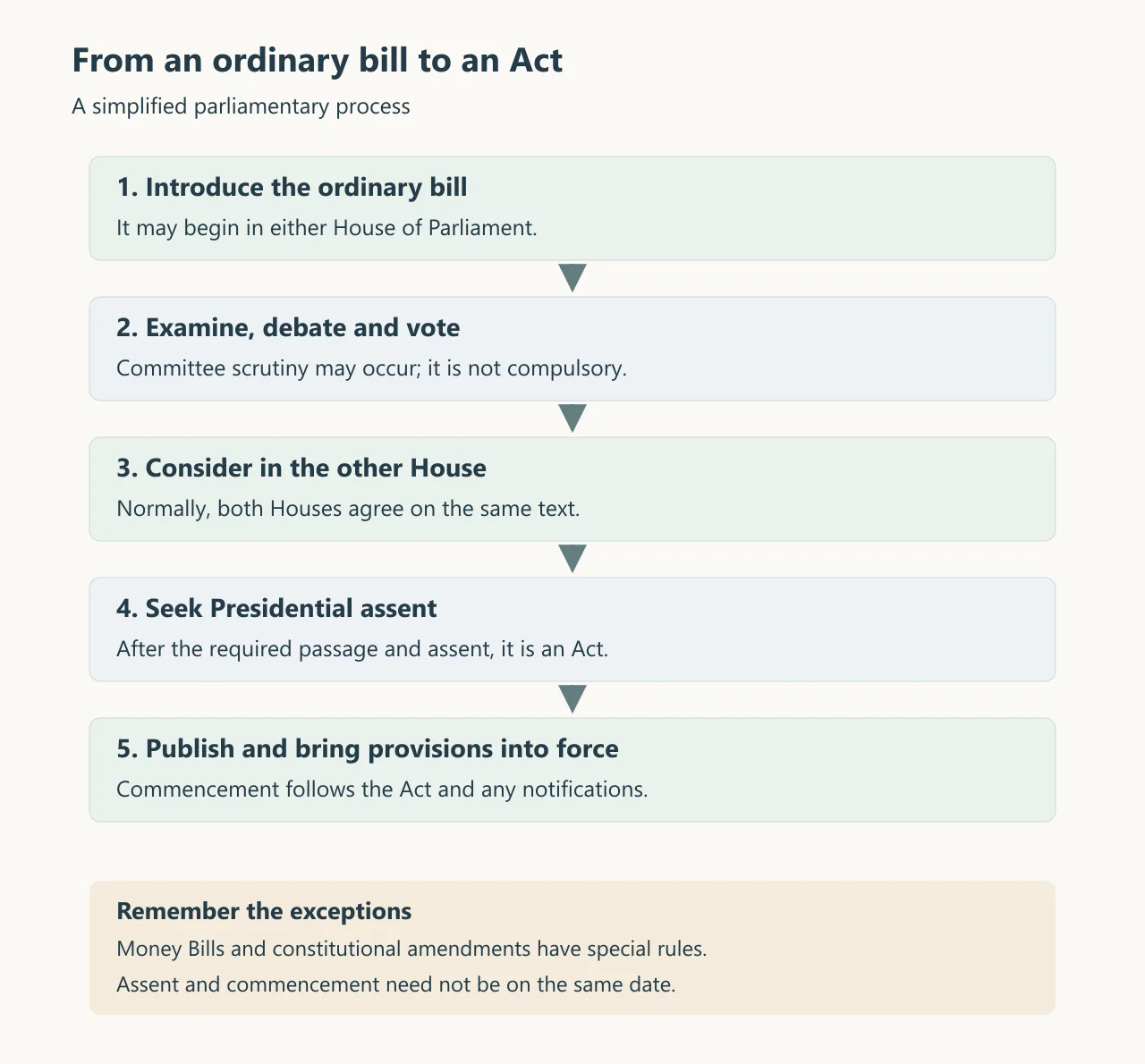
Bill and Act: a bill proposes legislation. An ordinary bill normally needs agreement of both Houses on the same text and Presidential assent to become an Act. Its provisions may commence immediately or on a later date specified by the Act or a notification. Money Bills and constitutional amendments have special procedures.
Money Bill: a bill containing only matters specified in Article 110, such as taxation or appropriation of funds, and incidental matters. It can be introduced only in the Lok Sabha, with the President’s recommendation. The Rajya Sabha can recommend changes and has 14 days to return it; the Lok Sabha may accept or reject those recommendations. Not every bill involving money is a Money Bill.
Question Hour: a select period (usually the first hour of a sitting) when MPs question ministers about government policies and activities, holding the executive accountable.
Separation of powers & checks and balances: institutions have different constitutional functions and mechanisms of accountability. India’s parliamentary system also has overlap: ministers are normally MPs and the President is part of Parliament. Separation is therefore not an absolute separation of personnel.
Union, State and Concurrent Lists: the Seventh Schedule allocates subjects primarily to Parliament, state legislatures, or both. Defence is a Union subject, police a State subject and education a Concurrent subject. For conflicting Concurrent laws, parliamentary law generally prevails, subject to the Presidential-assent exception in Article 254(2). The Constitution also provides exceptional routes for Parliament to legislate on State subjects.
State legislature: under Article 168, it includes the Governor and the legislative assembly (Vidhan Sabha), plus a legislative council (Vidhan Parishad) in bicameral states. The Governor is appointed by the President. The Chief Minister heads the Council of Ministers, collectively responsible to the assembly.
The Big Questions
1. What is India’s parliamentary system, and how is it structured?
A government led by the Prime Minister must retain Lok Sabha confidence. Parliament consists of the President and two Houses. Ministers are normally legislators, creating institutional overlap and accountability.
2. What are the key functions of Parliament?
Lawmaking, constitutional functions, scrutiny of the executive and control over public expenditure. These powers operate within the Constitution.
3. What are the roles of the legislature and executive?
The legislature debates laws and holds government answerable. The executive develops policy and implements laws with the help of civil servants. The Union Council of Ministers is collectively responsible to the Lok Sabha.
4. How are they organised at Union and state levels?
Union: President, Parliament and the Prime Minister’s Council of Ministers. State: Governor, state legislature and the Chief Minister’s Council. A state may have one or two legislative Houses; the Governor is part of its legislature.
Think About It and Let’s Explore: Activity Guidance
These are model approaches to the textbook’s in-text prompts. Use your own observations and research where required; imagined examples are not historical documents or actual survey findings.
| Textbook prompt | Model explanation or approach |
|---|---|
| Constitutional functions (p. 145) | Include constitutional amendments and MPs’ participation in Presidential and Vice-Presidential electoral colleges. Explain that the Presidential college also includes eligible MLAs. |
| RTE chart and changing the starting House (pp. 146–148) | The diagram below shows a simplified ordinary-bill sequence. An ordinary bill beginning in the Lok Sabha would then go to the Rajya Sabha; both must agree to its text. Do not apply this symmetry to a Money Bill. RTE enactment in 2009 and commencement on 1 April 2010 are different dates. |
| Standing Committee report (p. 150) | The Ministry reports action taken to the parliamentary committee. The subject is organisation of Ayush services. The committee recommends encouraging states/UTs without a separate department to establish one. The reply refers to state responsibility and steps to encourage directorates and staffing. A directorate is not necessarily identical to a separate department; evaluate the reply rather than treating it as complete compliance. |
| Why monitor expenditure? (p. 151) | Government spends public resources, including taxes and borrowing. Representatives must examine priorities, authorise spending and check whether funds achieve their intended purpose. Budget approval does not remove the need for later audit and scrutiny. |
| Order of chapters in Part V (p. 151) | The Constitution discusses Union executive offices before Parliament. The order organises the text; it does not establish that one institution has unlimited superiority. Their powers and accountability come from the substantive provisions. |
| Executive in legislature; separation of powers (p. 152) | India combines distinct functions with overlap. Ministers normally belong to Parliament and answer to it, while courts review constitutional validity. The six-month rule permits a non-member to be a minister temporarily, subject to becoming a legislator. |
| Checks on organs and judicial review (pp. 154–155) | Parliament uses questions, committees and financial scrutiny; courts assess constitutional legality. Judicial decisions can be examined through appeals and review procedures. For example, in Shreya Singhal v. Union of India (2015), the Supreme Court struck down Section 66A of the Information Technology Act for violating freedom of speech. Executive authorities cannot lawfully enforce the struck-down provision. This illustrates review of a law and a limit on its implementation, not the Court writing a replacement law. |
| Your state’s legislature (p. 157) | Check the official state legislature site for whether it has an assembly only or an assembly and council. Record the source/date. Do not assume every state has an upper House. |
| Lok Sabha sessions and sittings (p. 158) | The listed sittings decline from 677 in the 1st Lok Sabha to 567 in the 2nd, 423 in the 10th and 356 in the 13th. Sessions do not show the same steady pattern (14, 16, 16, 14). Distinguish a session from a sitting; selected periods and term lengths limit conclusions. Compare more recent official records using the same definitions. |
| Rajya Sabha productivity statement (p. 158) | The cited figures suggest time lost in the periods described, reducing opportunities for scrutiny. The 2021 quotation is historical evidence, not a current productivity measurement. Check scheduled versus actual hours; hours alone do not establish debate quality. |
| State project and meeting an MLA (p. 159) | Compile dates, sittings, questions and bills from official records. Prepare focused, respectful questions about obstacles and possible remedies. An appointment requires the representative’s availability; do not publish anyone’s private contact information. |
| Political cartoons (p. 159) | The “Monsoon Session” image uses storms as a metaphor for disruption. The candidate-scrutiny cartoon comments on concerns about criminal cases. A cartoon is commentary, not proof of guilt; pending proceedings and conviction are distinct. |
| Vajpayee’s message (p. 160) | Governments and parties change, but constitutional institutions, citizens’ rights and democratic procedures must endure. Peaceful transitions and respect for opposition preserve public trust beyond one party’s term. |
“Questions and activities” — Full Solutions
All questions below are reproduced verbatim from the NCERT textbook’s end-of-chapter Questions and activities section. Answers are original, written in exam-ready style.
1. Find out how many representatives from your state are in each House of the Parliament.
2. What makes the Indian Parliament the “voice of the people”? How does it ensure that different opinions are heard?
3. Why do you think the Constitution made the Executive responsible to the Legislature?
4. Why do you think we have chosen the system of bicameral legislature at the Union level?
The two Houses have important shared legislative powers, but their powers are not identical. The Lok Sabha has special authority over Money Bills and the confidence of the Council of Ministers.
5. Try to track the journey of a recent bill passed by the Parliament. Identify in which House it was introduced. Were there any major debates or disagreements? How long did it take for the bill to become a law? Use newspaper archives, government websites, and Lok Sabha debates, or ask your teacher for help.
6. Choose a recent law passed by the Parliament. Divide into teams to role-play different parts of the process — MPs debating in Lok Sabha and Rajya Sabha, ministers answering questions, and the President giving assent. Present a short skit showing how a bill becomes a law; enact a ‘model Parliament’.
7. The Women’s Reservation Bill, 2023, was passed with wide support. Why might it have taken over 25 years for this bill to be passed, despite being discussed for so long?
8. Sometimes the Parliament is disrupted and does not function for the number of days it is supposed to. What impact do you think this has on the quality of laws and the trust people place in their representatives?
9. Can you create ‘interest’ groups among students and list questions related to any policy that you may want to ask your MP and / or your MLA? How would these questions be different if it is to the MP instead of the MLA, and vice versa?
| Interest group | Question for the MP | Question for the MLA |
|---|---|---|
| Education | What national funding or legislative measures support RTE implementation? | What is the state plan to fill teacher vacancies and improve facilities in our schools? |
| Transport | What is being done about railway services affecting our district? | What is the state plan for bus access and state-road maintenance? |
| Public health | How will Union health programmes support states? | How will the state improve staffing and medicines at our public hospital? |
These are model questions. Some issues also involve local authorities or shared responsibilities; identify the agency that can act and ask for evidence, budgets and timelines.
10. What is the role that the Judiciary plays in Indian democracy? What could happen if we didn’t have an independent judiciary?
Courts decide cases brought before them through legal procedures. Judicial review, appeals and review petitions can examine decisions; judicial independence does not mean judges have unlimited power. A pending criminal case against a representative is not the same as a conviction.
Extra Practice Questions
These questions and MCQs are ClearStudy practice, separate from the NCERT exercise.
Short Answer Type Questions
Q1. What is the Parliament of India composed of?
Q2. What is a bicameral system?
Q3. Who presides over the Lok Sabha and the Rajya Sabha?
Q4. What is the difference between a bill and an act?
Q5. What are the three Lists that divide law-making subjects?
Long Answer Type Questions
Q1. Explain the legislative functions of the Parliament.
Q2. Describe the steps through which a bill becomes an act in Parliament.
Q3. How is the structure of government at the state level similar to and different from the Union level?
MCQs & Assertion–Reason
1. The Parliament of India is composed of the President and:
(a) one house (b) two houses (c) three houses (d) four houses
2. The members of the Lok Sabha are chosen:
(a) directly by the people (b) by the President (c) by the Prime Minister (d) by the Governor
3. The Rajya Sabha is presided over by the:
(a) Speaker (b) Prime Minister (c) President (d) Vice President of India
4. A legislature having two houses is called:
(a) unicameral (b) bicameral (c) federal (d) presidential
5. A draft of a proposed law introduced in Parliament is called a:
(a) act (b) bill (c) gazette (d) clause
6. A Money Bill can be introduced only in the:
(a) Rajya Sabha (b) Lok Sabha (c) Vidhan Parishad (d) Supreme Court
7. The Union Executive consists of the President, the Vice President and the:
(a) Council of Ministers headed by the Prime Minister (b) Speaker (c) judges (d) Governors
8. The branch of government that interprets laws and is the custodian of the Constitution is the:
(a) Legislature (b) Executive (c) Judiciary (d) Media
9. The de facto executive head at the state level is the:
(a) Governor (b) President (c) Chief Minister (d) Speaker
10. The period during which MPs question ministers about government policies is called:
(a) Zero Hour (b) Question Hour (c) recess (d) session
For each Assertion–Reason question, choose: (A) Both true and the Reason correctly explains the Assertion; (B) Both true but the Reason is not the correct explanation; (C) Assertion true, Reason false; (D) Assertion false, Reason true.
A-R 1. Assertion: The Indian Parliament is a bicameral legislature.
Reason: It consists of the President and two houses — the Lok Sabha and the Rajya Sabha.
A-R 2. Assertion: The members of the Lok Sabha are elected indirectly by an electoral college.
Reason: The people of India choose their Lok Sabha representatives through direct election based on universal adult suffrage.
A-R 3. Assertion: The Council of Ministers is collectively responsible to the Lok Sabha.
Reason: The executive is made responsible to the legislature to keep the government accountable to the people.
A-R 4. Assertion: A Money Bill can be introduced in either House of Parliament.
Reason: A Money Bill deals with financial matters such as taxation and government borrowing.
A-R 5. Assertion: The Judiciary helps maintain checks and balances in Indian democracy.
Reason: The Judiciary checks that laws passed by Parliament and actions of the Executive do not violate the Constitution.
Exam Tips & Common Mistakes
How to write a clear answer
Remember the Parliament has three parts — the President, the Lok Sabha and the Rajya Sabha. When comparing the legislature and the executive, use a clear two-sided structure (legislature = makes laws and oversees; executive = enforces laws). Learn the four legislative functions (constitutional, lawmaking, executive accountability, financial accountability) and the ordered steps of how a bill becomes an act. For state-level questions, link each Union office to its state counterpart (President–Governor, Prime Minister–Chief Minister, Lok Sabha–Vidhan Sabha, Rajya Sabha–Vidhan Parishad). Use the textbook’s own examples — the RTE Act, 2009, the Question Hour, and the bicameral states — to show you have studied the chapter.
Common mistakes to avoid
- Forgetting that the President is part of Parliament along with the two Houses.
- Saying Lok Sabha members are elected indirectly — they are elected directly by the people; Rajya Sabha has indirectly elected representatives and 12 nominated members.
- Confusing the presiding officers — the Speaker presides over the Lok Sabha, the Vice President over the Rajya Sabha.
- Thinking a Money Bill can start in either House — it can be introduced only in the Lok Sabha.
- Mixing up the legislature (makes laws) with the executive (enforces laws).
- Leaving activity-based questions (Q1, Q5, Q6, Q9) blank — write your own reasoned response, report or chart.
Frequently Asked Questions
What is the parliamentary system in Class 8 Social Science Chapter 6?
In India’s parliamentary system, the government must retain the confidence of the Lok Sabha. Parliament consists of the President, Lok Sabha and Rajya Sabha and legislates within the Constitution. The Council of Ministers headed by the Prime Minister runs the government, while independent courts interpret laws and review constitutional validity.
What is the difference between the legislature and the executive?
The legislature makes laws and scrutinises government; the executive administers government and implements laws. In India, their membership overlaps. The Union Council of Ministers, headed by the Prime Minister, is collectively responsible to the Lok Sabha; this does not describe every executive office, such as the President.
What is the exercise heading for Chapter 6 of Exploring Society?
The end-of-chapter exercise in Exploring Society: India and Beyond Chapter 6 is headed Questions and activities and contains 10 numbered questions, all answered step by step on this page.
Additional official references: Constitution of India; Lok Sabha legislation FAQs; Article 254. Review the different electoral colleges in Chapter 5: Universal Franchise and India’s Electoral System.
Textbook reference: NCERT Chapter 6, Exploring Society: India and Beyond, Grade 8, Part I (2026–27 reprint). Answers and illustrations on this page are original ClearStudy learning aids. Reviewed 10 October 2026.