
CLASS 6 · Computational Thinking
Class 6 CT and AI: Number Play Solutions
Work through Number Play from the CBSE Class 6 Computational Thinking and Artificial Intelligence handbook with explanations for each task.
Jump to a question or activity
Key ideas
Translate each clue into a constraint. For minimum or maximum questions, show both a valid example and why a better result is impossible.
Short Concept Lessons
Learn a method, follow the example, then use it in the additional practice.
Minimum and maximum: prove the limit
For a minimum, show why fewer cannot work and then give an example that reaches your answer.
To make 13 using numbers no greater than 5, two numbers can total at most 10. Three work: 5 + 5 + 3.
Remember: A working example alone does not prove that it is the minimum.
Practise this method →Place value and ordered digits
To make the greatest number from given digits, put larger digits in higher places. For the smallest number, start with the smallest non-zero digit.
With 0, 2 and 7, the greatest number is 720 and the smallest three-digit number is 207.
Remember: A number cannot begin with 0 if it must retain its digit count.
Practise this method →Translate arrows into comparisons
If an arrow points to the larger number, write a less-than comparison from its tail to its head. Apply all clues together.
If 3 points to X and X points to 5, an integer X must equal 4.
Remember: Different letters are not automatically different unless the problem says so.
Practise this method →Palindromes mirror their digits
A five-digit palindrome has the form ABCBA. The first and last digits match, and so do the second and fourth.
The number 12321 has digit sum 1 + 2 + 3 + 2 + 1 = 9.
Remember: The central digit occurs once; the other positions occur in pairs.
Practise this method →Count choices systematically
List possibilities in a fixed order. Multiply independent choices and avoid counting identical outcomes twice.
Choosing one red card from 2 and one blue card from 3 gives 2 × 3 = 6 pairs.
Remember: Check whether order matters before counting arrangements.
Practise this method →Inspect only the stated neighbours
A connection or common side defines which cells influence a clue. Test each eligible neighbour.
In the chain 2—5—8, the middle value has both a smaller and a larger neighbour.
Remember: Diagonal cells are not side-adjacent.
Practise this method →Questions and Solutions
Q1. Sachin plays a game using a standard die numbered 1 to 6.
At each roll he scores points equal to the number shown. He may roll the die any number of times. The game ends when the number 6 appears three times (the three 6’s need not be consecutive). If the total score at the end of the game is 29, what is the minimum number of rolls Sachin could have made?
Solution
Option (c) 6 rolls. Three 6s contribute 18. The other 11 points must use values at most 5, requiring at least three rolls. For example, 5,5,1,6,6,6 totals 29 and ends exactly on the third 6.
Q2. In the given grid, each white square contains 1, 2, 3, or 4 hidden coins.
Each black square shows the maximum number of coins present in any of its adjacent white squares. If every row has the same total number of coins, what is the MAXIMUM possible number of white squares that contain exactly one coin? Note: Two squares are adjacent only if they share a common side. Squares that share a common corner alone, are NOT considered as adjacent

Solution
Option (c) 7 cells. The black 1 forces its three neighbouring white cells to be 1. The black 3 then forces the white cell above it to be 3. The black 4 forces the top-row second cell to be 4 because its other neighbours are constrained to at most 2. Every row totals 6: the first row needs at least 6, while the last can reach at most 6. One valid filling, with black clue cells in brackets, is:
| 1 | 4 | [4] | 1 |
| 3 | 1 | 2 | [2] |
| [3] | 1 | 4 | 1 |
| 1 | [1] | 1 | 4 |
Only white cells contribute coins. Their one-coin counts are 2,1,2,2. Row B needs 3,2,1, so it cannot have two ones; each other row can have at most two.
Q3. If each of the given terms follows the same theme, what will be the value of P + Q + R + S?

Solution
Option (b) 136. Divide the centre into four equal values: 204 ÷ 4 = 51, giving Q = R = 51. Divide each of those by 3 for the outer values: P = S = 17. The requested sum is 17 + 51 + 51 + 17 = 136.
Q4. An arrow between any two squares, always points towards the square having a larger number.
A and B are two DIFFERENT numbers. If the largest 5-digit number is formed using all five squares, what will be the difference between the final number and 10000?

Solution
Option (d) 44,432. The arrows give 2 < B < 4, so B = 3. They also give 2 < A < 5; since A and B differ, A = 4. Arrange 5,4,4,3,2 in descending order to get 54,432. Subtracting 10,000 gives 44,432.
Q5. How many different triangles can be formed by connecting the black dots in the image below, where the sum of the numbers at their corners is 12?

Solution
Option (c) 8 triangles. Three 4s are unavailable. The only possible label combination is one 3, one 4 and one 5. There are two choices of each label, giving 2 × 2 × 2 = 8. The points lie around the perimeter, so these selections form triangles rather than straight lines.
Q6. Amat and Ankit each picked three numbers from the set {1, 2, 3, 4, 5, 6}.
– 3 different numbers picked by Amat add up to give the highest possible sum – 3 different numbers picked by Ankit add up to the second highest possible sum Which pair of numbers were picked by both Amat and Ankit?
Solution
Option (c) 5 and 6. The largest three-number sum is 4 + 5 + 6 = 15. The second-largest is 3 + 5 + 6 = 14. Their common numbers are 5 and 6.
Q7. A box contains six numbered circles coloured black and white.
A 6-digit number must be formed using all six circles, and the colours must alternate throughout the number. The first circle may be either black or white. Among all such numbers that can be formed, take the second smallest number and the second largest number. What is the difference between these two numbers?

Solution
Option (b) 684,324. White digits are 6,9,9 and black digits 2,3,4. The smallest distinct alternating number is 263949 and the next is 264939. The largest is 949362 and the next is 949263. Therefore 949263 − 264939 = 684324. Swapping the two identical 9s does not make a new number.
Q8. I am a 5-digit number made up of both even and odd digits.
I read the same backwards and forwards (palindrome). The greatest difference between at least two of my digits is 9. What is the smallest possible sum of my digits?
Solution
Option (c) 11. A digit difference of 9 requires 0 and 9. Put the 9 in the centre so it occurs once, zeros in the second and fourth places, and the smallest non-zero digit 1 at both ends. The palindrome 10901 has digit sum 11 and includes even and odd digits.
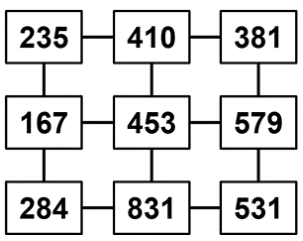
Q9. Count the number of blocks that are connected to at least one block containing a smaller number and one block containing a larger number than the number in it.
Solution
Option (c) 4. The qualifying blocks are 235 (neighbours 167 and 410), 410 (235 and 453), 453 (410 and 579), and 284 (167 and 831). The other blocks have only larger or only smaller linked neighbours.
Q10. A 3 × 3 grid of digits is given below.
Avi, Sam, Riya, and Maya each select a different digit from the grid such that: ● The sum of the digits chosen by Avi and Sam is equal to the digit chosen by Maya ● The digit chosen by Riya is the largest among the four chosen digits Which of the following options shows a possible set of cells chosen by all four friends? Note: You cannot rotate the question or option images

Solution
Option (d) The lower placement of the fourth shape. Its lower placement selects 7,4,9,3. Assign 9 to Riya, 7 to Maya, and 3 and 4 to Avi and Sam in either order. Then 3 + 4 = 7 and 9 is the largest selected digit. The pieces must retain the orientation shown.
The Thinking Spot
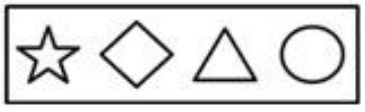
Four friends A, B, C, and D each selected a different shape from the shapes shown below, such that: • A selected a shape that is neither beside B's shape nor D's shape • C and D did not select the triangle Who among them chose the circle?
Solution
Option (d) D. A can have only C as an immediate neighbour and must occupy an end. If A chose the circle, C would have the triangle, forbidden. Thus A chooses the star, C the rhombus, B the triangle and D the circle.
Additional Practice Questions with Solutions
Choose an answer, use a hint if needed, then open the worked solution to check your reasoning.
Solved 0 of 10 · Checked 0 of 10
Your practice progress lasts until you reset or reload this page.
Apply · Minimum rolls
Practice Q1. A standard die game stops on the second 6. The final score is 23. What is the minimum possible number of rolls?
Show hint
The two 6s contribute 12; the other rolls can be at most 5.
Show worked solution
Option (b) 5.
The remaining 11 needs at least three non-6 rolls. The sequence 5,5,1,6,6 works, so the minimum is five rolls.
Common mistake: A third 6 is forbidden because the game has already ended.
Apply · Place value
Practice Q2. Use each digit 0, 3, 5 and 8 exactly once. What is the smallest four-digit number?
Show hint
The first digit cannot be zero.
Show worked solution
Option (b) 3058.
Choose 3 first, then the remaining digits in increasing order: 0,5,8. This gives 3058.
Common mistake: A leading zero does not create a four-digit number.
Apply · Comparisons
Practice Q3. X and Y are different whole numbers. The clues are 2 < X < 5 and 3 < Y < 5. What is X + Y?
Show hint
First determine Y.
Show worked solution
Option (c) 7.
Y must be 4. X can be 3 or 4, but it differs from Y, so X is 3. Their sum is 7.
Common mistake: Use the condition that X and Y differ.
Apply · Palindromes
Practice Q4. What is the smallest possible digit sum of a five-digit palindrome containing both 0 and 8?
Show hint
Place 8 in the position that appears only once.
Show worked solution
Option (c) 10.
Use 8 once in the centre, 0 in the second and fourth places, and 1 at both ends. The palindrome 10801 has digit sum 10. Repeating 8 would increase the sum.
Common mistake: Both end digits must be non-zero.
Apply · Counting choices
Practice Q5. A bag has three distinct red counters and two distinct blue counters. How many pairs containing one counter of each colour can be chosen?
Show hint
Each red counter can be paired with either blue counter.
Show worked solution
Option (b) 6.
There are 3 choices for red and 2 for blue, giving 3 × 2 = 6 different pairs.
Common mistake: Add only when choices are alternatives; here each pair needs both colours.
Apply · Neighbours
Practice Q6. In the chain 8—3—6—4—9, only consecutive numbers are connected. How many numbers have both a smaller and a larger connected neighbour?
Show hint
Inspect the three middle numbers; the endpoints have just one neighbour.
Show worked solution
Option (a) 0.
The 3 has two larger neighbours; 6 has two smaller neighbours; 4 has two larger neighbours. Neither endpoint can have both kinds, so the count is 0.
Common mistake: A number elsewhere in the chain is not necessarily a neighbour.
Apply · Largest sums
Practice Q7. Choose three different numbers from {2,3,4,5,6,7}. What is the second-largest possible sum?
Show hint
Start with the largest sum, then decrease it as little as possible.
Show worked solution
Option (b) 17.
The largest sum is 7 + 6 + 5 = 18. Replacing 5 by 4 gives 17, the next lower whole-number sum.
Common mistake: You cannot use the same number twice.
Apply · Alternating colours
Practice Q8. White cards carry 1 and 7; black cards carry 2 and 8. Use all four cards to make the greatest four-digit number with alternating colours. What is it?
Show hint
Start with the largest digit, then use the other colour.
Show worked solution
Option (a) 8721.
Start with black 8, then white 7, then black 2 and white 1: 8721. This maximises each place in turn.
Common mistake: Sorting all digits without checking colours can violate the rule.
Apply · Reverse rules
Practice Q9. A pattern has a centre number equal to four times an inner number. Each inner number is three times an outer number. If the centre is 180, what is the outer number?
Show hint
Undo both multiplications.
Show worked solution
Option (b) 15.
The inner number is 180 ÷ 4 = 45. The outer number is 45 ÷ 3 = 15. Check: 15 × 3 × 4 = 180.
Common mistake: Do not stop after finding the inner number.
Apply · Digit constraints
Practice Q10. Four different digits are chosen from {1,2,3,4,5}. The largest goes to Riya; two others must add to the fourth. Which set works?
Show hint
Remove the largest digit, then test the remaining three.
Show worked solution
Option (b) 1,3,4,5.
For {1,3,4,5}, Riya takes 5 and 1 + 3 = 4. The first and third sets fail the sum rule; the last repeats a digit.
Common mistake: The digit used as the sum cannot also be Riya’s digit.