
CLASS 6 · Computational Thinking
Class 6 CT and AI: Lines and Angles Solutions
Work through Lines and Angles from the CBSE Class 6 Computational Thinking and Artificial Intelligence handbook with explanations for each task.
Jump to a question or activity
Key ideas
Use 360° around a point, equal angular intervals and systematic placement of the clues. Clock hands move continuously; the hour hand does not stay fixed between hours.
Short Concept Lessons
Learn a method, follow the example, then use it in the additional practice.
Equal spaces around a circle
A complete turn is 360°. Divide by the number of equal spaces to find the angle of one space. Count gaps, not the marks at their ends.
Ten equally spaced seats give 360° ÷ 10 = 36° per gap. Three gaps give 3 × 36° = 108°.
Remember: For people facing the centre, left and right are from each person’s viewpoint.
Practise this method →Clock angles: both hands move
The 12 hour marks divide a clock into 30° spaces. The minute hand moves 6° per minute; the hour hand moves 0.5° per minute. At half past an hour, the hour hand is halfway to the next hour mark.
At 1:30, the minute hand is 180° clockwise from 12. The hour hand is 30° + 15° = 45° clockwise from 12. The smaller angle is 180° − 45° = 135°.
Remember: Find both hand positions before subtracting. If the difference exceeds 180°, subtract it from 360° for the smaller angle.
Practise this method →Rotation: find the smallest matching turn
When an unmarked regular shape matches its outline several times in a full turn, divide 360° by that number of matches. A full turn always matches, but it may not be the smallest turn.
An unmarked regular pentagon matches its outline five times per full turn. Its smallest positive matching rotation is 360° ÷ 5 = 72°.
Remember: A marked vertex or a colour pattern can change which rotations count as matches.
Practise this method →Combine angles without double counting
Angles around a point total 360°. A straight angle is 180°, and a right angle is 90°. Add adjacent angles; for overlapping regions, count only the shared part.
If two adjacent angles around a point are 100° and 170°, the remaining angle is 360° − 100° − 170° = 90°.
Remember: Check which region the question names before adding or subtracting.
Practise this method →Parallel lines: count every pair once
Distinct lines in the same plane that are perpendicular to one line are parallel to each other. To count pairs, list each line with the lines that come after it.
For four parallel lines labelled a, b, c and d, the pairs are ab, ac, ad, bc, bd and cd: six pairs.
Remember: The number of lines and the number of pairs are different quantities.
Practise this method →Use clues to fix an order
Translate each clue into a position or comparison. Place fixed endpoints first, then test every remaining condition. For equally spaced points, length is the number of gaps multiplied by one gap’s length.
If P is left of Q and Q is left of R, their order is P, Q, R. With equal 3 cm gaps, PQ = QR = 3 cm and PR = 6 cm.
Remember: A possible arrangement must satisfy all the clues, not just one.
Practise this method →Questions and Solutions
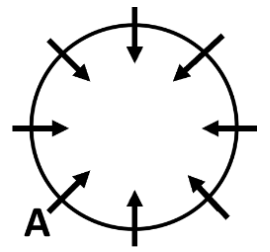
Q1. Eight friends (A, B, C, D, E, F, G, H) are sitting at equidistant positions around a circular table, each facing towards the centre, as shown below.
- A is facing North-East
- B and D are facing perpendicular directions
- B is to the immediate left of A; while C is exactly between E and F
- B and F are facing opposite directions
If G is sitting exactly between B and D, what is the angle between the directions that A and C are facing?
Solution
Option (b) 90°. Adjacent seats differ by 360° ÷ 8 = 45°. With A at the southwest seat, B is at the west seat and F at the east seat. G must fit between B and D, placing G northwest and D north. C then sits southeast between F and E (south). A faces northeast and C northwest: a difference of two intervals, or 90°.
Q2. Avi and Sam attend dance sessions in the afternoon.
- Avi’s session starts when the angle between the hour hand and the minute hand of the clock is 60 degrees
- Sam’s session starts at 1:55 PM
What is the least possible difference between the starting times of both sessions?
Solution
Option (b) 5 minutes. At 2:00 p.m. the minute hand is at 12 and the hour hand at 2, giving 60°. The preceding 60° occurrence is approximately 1:49:05 p.m., farther from 1:55 than five minutes. Thus 2:00 p.m. gives the least difference. When checking non-whole hours, include the hour hand’s movement.
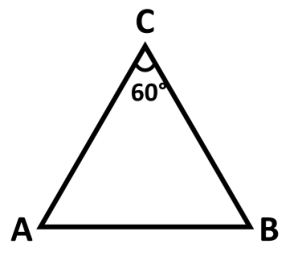
Q3. An equilateral triangle (all the angles are equal) is given below. At minimum, by how many degrees should the given triangle be rotated anticlockwise so that it looks exactly like the original triangle?
Solution
Option (c) 120°. Considering the triangle’s shape, its three identical vertex positions divide a full rotation into three equal parts: 360° ÷ 3 = 120°. A 60° turn leaves the triangle inverted rather than coincident.
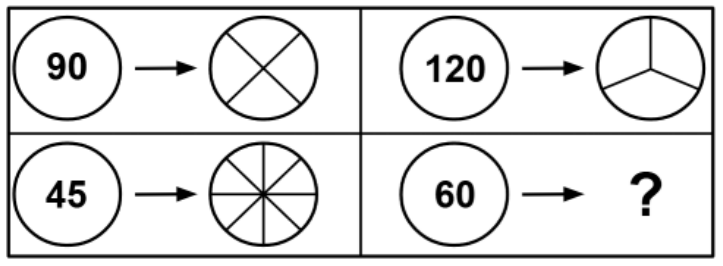
Q4. What will come in place of “?”
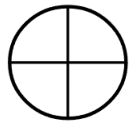


Solution
Option (c) Six equal sectors. Each central sector measures the displayed angle. Therefore 360° ÷ 60° = 6 sectors.
Q5. A and B visit a park in the evening.
- When A visited the park, the minute hand pointed at 12, and the other hand was 150° clockwise from it
- When B visited the park, the hour hand pointed at 5, and the other hand was 210° clockwise from it
Based on the given information, which of the following statements is true?
Solution
Option (c) A and B visited exactly at the same time. For A, 150° ÷ 30° = 5 hour-mark intervals from 12, so the time is 5:00 p.m. For B, seven intervals (210°) clockwise from 5 reach 12; this also gives 5:00 p.m.
Q6. What will come in place of “?”
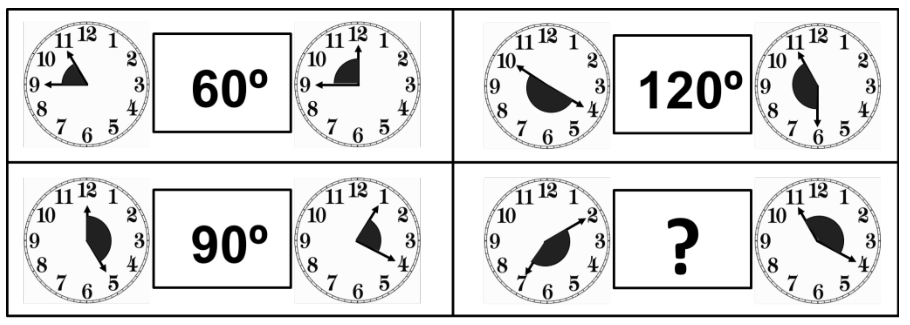
Solution
Option (b) 60°. The rule measures the overlap of the two shaded sectors. In the final pair, the common sector runs from 2 to 4: two intervals × 30° = 60°.
Q7. How many times in a day, on a 12 – hour format clock, do the minute and hour hands form a straight line (i.e., an angle of 180°)?
Solution
Option (c) 22. In 12 hours, the minute hand gains 11 full revolutions relative to the hour hand. Each relative revolution includes one 180° position, giving 11 in 12 hours and 22 in 24 hours.
Q8. In the given figure, Triangle 2 is a right-angled triangle. Both triangles are arranged such that the red circles completely overlap, meaning both triangles meet at point P. The triangles cannot be rotated or flipped. If an angle of 30° is formed between Triangle 1 and Triangle 2 at point P, find the value of ∠APD?

Solution
Option (b) 120°. Without rotating either triangle, the given gap is ∠APC = 30° and the right angle is ∠CPD = 90°. The adjacent angles combine to give ∠APD = 30° + 90° = 120°.
Q9. Sam draws three line segments AB, BC, and BD (with a common point B) on a sheet of paper
∠ABC = 108° and ∠CBD = 162°, and these angles lie on either side of the line segment BC.
Later, he draws a pair of parallel line segments EF and GH, both perpendicularly intersecting BD.
How many pairs of parallel line segments appear on the sheet, finally?
Solution
Option (c) 3 pairs. The remaining angle between BA and BD is 360° − 108° − 162° = 90°. Thus AB, EF and GH are all perpendicular to BD, so the parallel pairs are AB–EF, AB–GH and EF–GH.
Q10. A line segment AB is shown below. Five points: C, D, E, F, and G lie on the line segment AB such that
- All the points (including A and B) are at equal intervals
- The length of segment CB is equal to the length of segment GD
- Point E is immediately to the right of point C
- Point F cannot be next to E or D
Which segment among the following options is the longest?

Solution
Option (d) FD. Checking all the clues gives the unique left-to-right order: A, F, G, C, E, D, B. Taking one interval as one unit gives CB = GD = 3, and F is next to neither E nor D. The listed lengths are GC = 1, FE = 3, GE = 2 and FD = 4.
The Thinking Spot
There are four ropes: A, B, C, and D. Each rope has a different length and a different colour chosen from Blue, Red, Green, and Yellow. Rope B is longer than only the Green rope. The Blue rope is longer than B but shorter than C. Rope A is not Blue. If the Yellow rope is the longest, which rope is Red?
Solution
Option (b) B. Shortest to longest, the colours must be green, red, blue, yellow. B is second-shortest. C is longer than the blue rope and so is the yellow longest rope. Since A is not blue, A is green and D blue, leaving B red.
Additional Practice Questions with Solutions
Choose an answer, use a hint if needed, then open the worked solution to check your reasoning.
Solved 0 of 10 · Checked 0 of 10
Your practice progress lasts until you reset or reload this page.
Foundation · Equal angular gaps
Practice Q1. Twelve children stand at equally spaced positions around a circle. What angle at the centre separates two neighbouring children?
Show hint
Divide one full turn by the number of equal gaps.
Show worked solution
Option (b) 30°.
There are 12 equal gaps in a full turn. Each gap is 360° ÷ 12 = 30°.
Common mistake: Do not use the number of children minus one: the final gap closes the circle.
Foundation · Clock marks
Practice Q2. At exactly 4:00, what is the smaller angle between the hands of a 12-hour clock?
Show hint
Count the hour-mark gaps from 12 to 4.
Show worked solution
Option (c) 120°.
There are four gaps from 12 to 4, each measuring 30°. The smaller angle is 4 × 30° = 120°. The other angle is 240°.
Common mistake: The question asks for the smaller of the two angles.
Apply · Moving hour hand
Practice Q3. At 2:30, what is the smaller angle between the hands of a clock?
Show hint
The hour hand is halfway from 2 to 3.
Show worked solution
Option (b) 105°.
The minute hand is at 6, or 180° from 12. The hour hand is at 2½ hour-mark gaps, or 75° from 12. The difference is 180° − 75° = 105°.
Common mistake: Do not leave the hour hand exactly at 2 after 30 minutes.
Foundation · Rotational symmetry
Practice Q4. An unmarked square is rotated about its centre. What is the smallest positive anticlockwise rotation that makes its outline match its starting outline?
Show hint
A square has four matching orientations in one full turn.
Show worked solution
Option (d) 90°.
The four matching orientations are equally spaced. The smallest positive turn is 360° ÷ 4 = 90°. A 180° or 360° turn also matches, but is not the smallest.
Common mistake: The angle must be positive and the smallest possible matching turn.
Apply · Equal sectors
Practice Q5. A circle is divided into equal sectors, each with a central angle of 40°. How many sectors are there?
Show hint
The sector angles together make one full turn.
Show worked solution
Option (b) 9.
The number of sectors is 360° ÷ 40° = 9. Check: 9 × 40° = 360°.
Common mistake: Divide the full angle by the angle of one sector, not the other way around.
Apply · Angles around a point
Practice Q6. Three angles around a point exactly fill one full turn. Two angles measure 110° and 155°. What is the third angle?
Show hint
Subtract the two known angles from 360°.
Show worked solution
Option (b) 95°.
The known angles total 110° + 155° = 265°. The third angle is 360° − 265° = 95°.
Common mistake: Angles around a point total 360°, not 180°.
Apply · Counting parallel pairs
Practice Q7. Five distinct straight lines in the same plane are all perpendicular to a sixth line. How many pairs of parallel lines can be formed from the five lines?
Show hint
List pairs beginning with the first line, then the second, and so on.
Show worked solution
Option (c) 10.
The five lines are parallel to one another. The first forms four pairs, the second three new pairs, the third two, and the fourth one: 4 + 3 + 2 + 1 = 10 pairs.
Common mistake: Do not count the same pair twice or include the sixth line.
Challenge · Ordering points
Practice Q8. Five points A, P, Q, R and B lie on a line at equal 2 cm intervals, with A at the left endpoint and B at the right endpoint. Q is immediately to the right of P, and R is immediately to the left of B. What is the length of PR?
Show hint
Fix R next to B, then place the consecutive pair P, Q.
Show worked solution
Option (b) 4 cm.
The order is A, P, Q, R, B. From P to R there are two gaps, so PR = 2 × 2 cm = 4 cm.
Common mistake: Count the gaps between the endpoints, not the points included.
Challenge · Comparing lengths
Practice Q9. Four ribbons K, L, M and N have different lengths. L is longer than only K. M is longer than L but shorter than N. Which ribbon is the longest?
Show hint
Write the ribbons in order from shortest to longest.
Show worked solution
Option (d) N.
L is second-shortest because only K is shorter. M is above L but below N. The complete order is K < L < M < N, so N is longest.
Common mistake: Being longer than one ribbon does not necessarily mean being the longest.
Challenge · Overlapping sectors
Practice Q10. Two sectors share the same centre and the same clock-face markings. One runs clockwise from 1 to 5; the other runs clockwise from 3 to 7. What is the angle of their overlapping region?
Show hint
Find the hour-mark interval included in both sectors.
Show worked solution
Option (b) 60°.
The overlap runs from 3 to 5, covering two hour-mark gaps. Each gap is 30°, so the overlapping angle is 2 × 30° = 60°.
Common mistake: Use only the common region, not the full angle of either sector.