
CLASS 6 · Computational Thinking
Class 6 CT and AI: Patterns in Mathematics Solutions
Work through Patterns in Mathematics from the CBSE Class 6 Computational Thinking and Artificial Intelligence handbook with explanations for each task.
Jump to a question or activity
Key ideas
Track each position separately, list small cases and test a rule before extending a pattern.
Short Concept Lessons
Learn a method, follow the example, then use it in the additional practice.
Repeated terms: count positions
A value and its position are different. If each number appears that many times, add the group sizes to locate a position.
In 1, 2, 2, 3, 3, 3, …, the first three groups fill 1 + 2 + 3 = 6 positions. The four 4s occupy positions 7–10, so the 9th term is 4.
Remember: Write a running total at the end of each group.
Practise this method →Changing differences: look between terms
Subtract each term from the next. The differences may follow their own pattern. A short list can fit more than one rule, so use all the conditions in the question.
For 3, 6, 11, 18, the increases are 3, 5, 7. If the rule is to add consecutive odd numbers, the next increase is 9 and the next term is 27.
Remember: When correcting an error, check the differences on both sides.
Practise this method →Separate rules: track one part at a time
For a grid or a mixed number-and-symbol pattern, track each position separately. Combine the results only after checking every rule.
If a grid has top row 2, 4 and bottom row 6, 8, adding 3 to each entry gives top row 5, 7 and bottom row 9, 11. A separately stated shading rule must also be followed.
Remember: For a top–middle–bottom pattern, write three small lists.
Practise this method →Growing shapes: add the parts
The number of rows or levels is not the total number of objects. Add the objects in every row or level. To find a maximum, show that your choice works and the next choice fails.
A staircase with rows of 1, 2, 3, 4 and 5 blocks contains 15 blocks. Six rows contain 21. Thus, with a limit of 20 blocks and this staircase rule, five rows fit but six do not.
Remember: “More than” excludes equality; “at most” includes it.
Practise this method →Work backwards: undo the pattern
When the total is given, undo the rule to find the term number. Remember to count the starting term.
Term 1 has two rows of four dots, and each new term adds one dot to each row. With 20 dots, each row has 10. That is 10 − 4 = 6 increases after term 1, so the arrangement is term 7.
Remember: Term number = number of increases + 1 when counting starts at term 1.
Practise this method →Trace an algorithm: follow the order
Record the values after every instruction. Test the stopping condition at the point stated in the question. Do not stop merely because the total is close to the target.
Start at total = 0. Add 2, then 4, then 6, then 8, stopping after an addition when total is at least 15. The totals are 2, 6, 12, 20, so the process stops after four additions.
Remember: A target of “at least 15” allows a final total greater than 15.
Practise this method →Worked answers and activity guidance
Q1. The following series follows a fixed pattern:
2, 3, 3, 4, 4, 4, 5, 5, 5, 5, 6, …
If the pattern continues, determine how many times the number 9 appears in the NEXT 20 terms.
Solution
Option (a) 3. The number n occurs n − 1 times. One 6 is already shown, so the next terms include four more 6s, six 7s and seven 8s: 4 + 6 + 7 = 17 terms. The remaining 20 − 17 = 3 terms are 9s.
Q2. The following number series is based on a pattern. One term is incorrect. Identify the incorrect term.
2, 3, 6, 11, 18, 25, 38, 51, 66, 83
Solution
Option (b) 25. The intended successive increases are 1, 3, 5, 7, 9, 11, 13, 15 and 17. After 18 we need 27, and 27 + 11 = 38. Replacing 25 by 27 repairs both neighbouring differences.
Q3. What will come in place of "?" in the given series?
1@3, #5#, 7@9, #11#, 13@15, ?, 19@21
Solution
Option (d) #17#. Read consecutive groups of three numbers: 13,14,15 is followed by 16,17,18. Odd numbers remain visible; in this even-positioned group the even numbers become #.
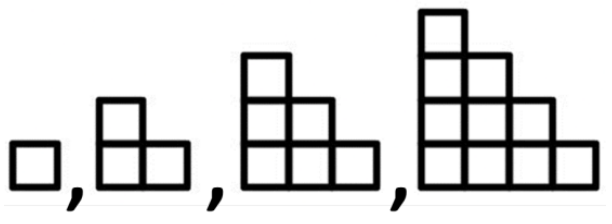
Q4. The first four terms of a block series are shown below.
If the pattern continues in the same manner, which term of the series will be the first to contain more than 20 blocks?
Solution
Option (b) 6th term. Totals are 1, 3, 6, 10, 15, 21. Each new staircase adds a row with one extra block. Term 5 has 15; term 6 has 15 + 6 = 21.
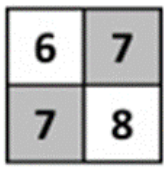
Q5. What will come in place of "?" in the given series?




Solution
Option (d). Top row: 5, 6; bottom row: 6, 7. Increase every entry by 1. The next top row is 5, 6 and the next bottom row is 6, 7; the shaded cells remain in the same positions.
Q6. What will come in place of "?" in the given series?


Solution
Option (c) 18, 37, 19. Top numbers rise by 3. Bottom increases are 1,2,3,4, so the next increase is 5: 14 + 5 = 19. The middle is the sum: 18 + 19 = 37.
Q7. The first five terms of a series formed using grey hexagons and white diamonds are given below.
If the same pattern continues, how many diamonds will be present in the term where the number of hexagons is 144?

Solution
Option (c) 121. An n-by-n arrangement has n² hexagons and (n − 1)² diamond gaps. Since 144 = 12², the gaps number 11² = 121.
Q8. Given below are two sets of numbers, P and Q. Which number from Set P can be interchanged with a number from Set Q such that both new sets follow a particular series or pattern?
Set P: (18, 22, 24, 27, 30)
Set Q: (21, 24, 27, 31, 36)
Solution
Option (c) 22. Swap P’s 22 with Q’s 21. P becomes 18,21,24,27,30, increasing by 3. Q becomes 22,24,27,31,36, with increases 2,3,4,5.
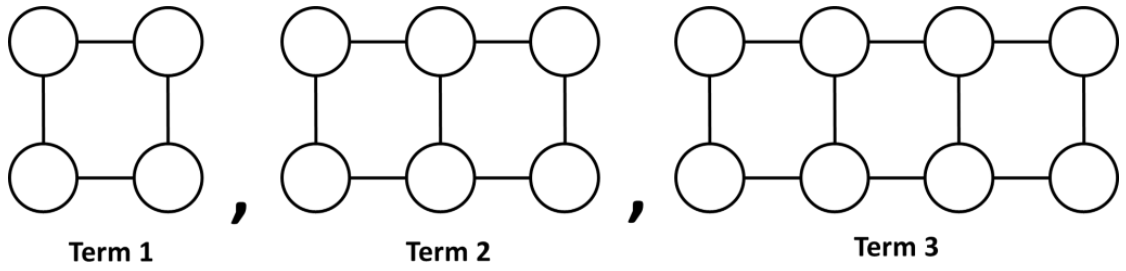
Q9. The first three terms of a series of circles are shown below. If the pattern continues in the same manner, how many circles will be there in term 91?
Solution
Option (a) 184. Term n has n + 1 columns and two circles per column. Term 91 therefore has 92 × 2 = 184 circles.
Q10. A pyramid has to be formed by combining cubes. Every level will have two fewer cubes than the level below it. If a pyramid is formed using at most 30 cubes, what is the maximum number of levels it can have?
Solution
Option (c) 5 levels. The cheapest six-level arrangement uses 1 + 3 + 5 + 7 + 9 + 11 = 36 cubes, too many. Five levels need only 25 cubes (or 30 with 2,4,6,8,10), so five is attainable and maximal.
The Thinking Spot
You must shoot exactly one item from each box, to eliminate it from its box. When an item is shot, the same item in the adjacent box is also eliminated. What is the MAXIMUM number of items that can be eliminated, after all 3 shots?

Solution
Option (d) 7 items. Shoot the triangle in middle box B to remove all three triangles. Shoot the rhombus in A to remove the rhombuses in A and B. Shoot the arrow in C to remove the arrows in C and B. Total: 3 + 2 + 2 = 7. Each end-box shot removes at most two items and the middle shot at most three, so this achieves the upper limit.
Additional Practice Questions with Solutions
Choose an answer, use a hint if needed, then open the worked solution to check your reasoning.
Solved 0 of 10 · Checked 0 of 10
Your practice progress lasts until you reset or reload this page.
Foundation · Repeated terms
Practice Q1. In the sequence 1, 2, 2, 3, 3, 3, 4, 4, 4, 4, …, each positive whole number n appears exactly n times. What is the 17th term?
Show hint
Count how many terms have appeared by the end of the five 5s.
Show worked solution
Option (b) 6.
The numbers 1 to 5 occupy 1 + 2 + 3 + 4 + 5 = 15 positions. The six 6s occupy positions 16 to 21. Therefore, position 17 contains 6.
Common mistake: The position of a term is not always the same as its value.
Foundation · Growing differences
Practice Q2. Start with 4 and add consecutive odd numbers beginning with 3: add 3, then 5, then 7, and so on. The sequence begins 4, 7, 12, 19, 28. What comes next?
Show hint
Write the differences between neighbouring terms.
Show worked solution
Option (c) 39.
The differences are 3, 5, 7 and 9. The next difference is 11, so the next term is 28 + 11 = 39.
Common mistake: Adding 9 again would ignore the change in the differences.
Foundation · Finding an error
Practice Q3. A sequence starts at 6 and should increase by 4, then 6, then 8, then 10, then 12. One number was copied incorrectly: 6, 10, 16, 24, 33, 46. Which number is incorrect?
Show hint
Rebuild the sequence from 6 using the stated increases.
Show worked solution
Option (c) 33.
The correct sequence is 6, 10, 16, 24, 34, 46. After 24, add 10 to get 34. Then 34 + 12 = 46, confirming that 33 is the incorrect entry.
Common mistake: Check both neighbours of a suspected error; do not change a correct later term.
Apply · Number and symbol patterns
Practice Q4. Write consecutive integers in groups of three, starting with 2, 3, 4. Replace the middle number in each group alternately with # and @, starting with #. The pattern is 2#4, 5@7, 8#10, 11@13, … . Which group comes next?
Show hint
Track the numbers and the alternating symbols separately.
Show worked solution
Option (d) 14#16.
The next group of integers is 14, 15, 16. After #, @, #, @, the next symbol is #. Replace 15 with # to obtain 14#16.
Common mistake: The symbol changes independently of the increase in the numbers.
Apply · Staircase totals
Practice Q5. A staircase with n rows has 1 block in its top row, 2 in the next row, and so on, up to n blocks in its bottom row. What is the smallest number of rows needed to contain more than 40 blocks?
Show hint
Add the row sizes and compare the totals for 8 and 9 rows.
Show worked solution
Option (b) 9 rows.
Eight rows contain 1 + 2 + 3 + 4 + 5 + 6 + 7 + 8 = 36 blocks. Nine rows contain 36 + 9 = 45 blocks. Since 36 is below 40 and 45 is above 40, the first possible staircase has 9 rows.
Common mistake: Count all the blocks, not only those in the bottom row.
Apply · Combining two rules
Practice Q6. In this table, the top number increases by 4 each time. The bottom number increases by 3, then 4, then 5, and so on. The middle number is the sum of the top and bottom numbers. What are the next top, middle and bottom numbers, in that order?
| Position | Term 1 | Term 2 | Term 3 | Term 4 |
|---|---|---|---|---|
| Top | 4 | 8 | 12 | 16 |
| Middle | 6 | 13 | 21 | 30 |
| Bottom | 2 | 5 | 9 | 14 |
Show hint
Work out the new top and bottom numbers before adding them.
Show worked solution
Option (a) 20, 40, 20.
The top becomes 16 + 4 = 20. The next bottom increase is 6, so the bottom becomes 14 + 6 = 20. Their sum is 20 + 20 = 40. The required order is top, middle, bottom: 20, 40, 20.
Common mistake: Do not list the bottom number before the middle number.
Apply · Position-by-position rules
Practice Q7. Each new 2 × 2 grid is made by adding 2 to every entry of the previous grid. The first grid has top row 1, 3 and bottom row 3, 5. The second has top row 3, 5 and bottom row 5, 7. What are the rows of the fourth grid?
Show hint
There are three changes between the first grid and the fourth grid.
Show worked solution
Option (c) Top: 7, 9; bottom: 9, 11.
The third grid has top row 5, 7 and bottom row 7, 9. Adding 2 once more gives top row 7, 9 and bottom row 9, 11. Equivalently, add 6 to each entry of the first grid.
Common mistake: Going from term 1 to term 4 requires three increases, not four.
Challenge · Working backwards
Practice Q8. Term 1 has two rows of three dots. Each new term adds one dot to each row. Which term contains exactly 50 dots?
Show hint
First find how many dots must be in each row.
Show worked solution
Option (b) 23rd term.
There must be 50 ÷ 2 = 25 dots in each row. Starting with 3, reaching 25 takes 25 − 3 = 22 increases. Since the starting arrangement is term 1, the required term is 1 + 22 = 23.
Common mistake: The number of increases is one less than the term number.
Challenge · A minimum-cost argument
Practice Q9. A stack has at least one cube in its top level. Every level below it has exactly three more cubes than the level immediately above it. Using at most 55 cubes, what is the greatest possible number of levels?
Show hint
Use the smallest possible top level to test the greatest number of levels.
Show worked solution
Option (d) 6 levels.
Starting with 1 cube uses the fewest cubes for any chosen number of levels. Six levels need 1 + 4 + 7 + 10 + 13 + 16 = 51 cubes, which is allowed. Seven levels would need 51 + 19 = 70 cubes, which exceeds 55. A larger top level would use more cubes, so the maximum is 6 levels.
Common mistake: “At most 55” does not mean all 55 cubes must be used.
Challenge · Tracing an algorithm
Practice Q10. Follow these steps: start with total = 0 and next = 1. Add next to total, then increase next by 2. Repeat these two actions until total is at least 50. How many repetitions are needed, and what is the final total?
Show hint
List the total after each addition and stop as soon as it reaches or passes 50.
Show worked solution
Option (a) 8 repetitions; total 64.
The numbers added are 1, 3, 5, 7, 9, 11, 13 and 15. The totals are 1, 4, 9, 16, 25, 36, 49 and 64. After 7 repetitions, 49 is still below 50. The eighth repetition produces 64, so the process stops there.
Common mistake: The stopping rule is “at least 50”, not “exactly 50”.