
CLASS 6 · Computational Thinking
Class 6 CT and AI: Perimeter and Area Solutions
Work through Perimeter and Area from the CBSE Class 6 Computational Thinking and Artificial Intelligence handbook with explanations for each task.
Jump to a question or activity
Key ideas
Area measures covered surface; perimeter measures the boundary. Joining shapes removes shared edges from the outside perimeter, while cutting can add new boundary without changing total area.
Short Concept Lessons
Learn a method, follow the example, then use it in the additional practice.
Area and perimeter measure different things
Perimeter measures the outside boundary in length units. Area measures surface coverage in square units.
A 5 cm square has perimeter 20 cm and area 25 cm².
Remember: Do not use cm² for a boundary length.
Practise this method →Use dimensions to calculate
A rectangle has perimeter 2 × (length + width) and area length × width.
A 7 cm by 3 cm rectangle has perimeter 20 cm and area 21 cm².
Remember: Include both pairs of equal sides in the perimeter.
Practise this method →Cutting changes boundary, not total area
A cut divides the surface into pieces. Both new cut edges contribute to the pieces’ combined perimeters.
Cutting a square along a diagonal preserves its total area but adds twice the diagonal to the combined perimeter.
Remember: Combined perimeter is not the original outside boundary.
Practise this method →Compare parts of equal wholes
When the whole areas are equal, compare the fractions occupied by the coloured parts.
One third of 24 cm² is 8 cm²; one quarter is 6 cm².
Remember: The wholes must be equal for a direct fraction comparison.
Practise this method →Area is necessary for a perfect fit
Pieces filling a shape must have the same total area and edges that fit without gaps or overlaps.
Pieces totalling 20 cm² cannot fill a 24 cm² rectangle.
Remember: Equal areas alone do not prove that the pieces can fit.
Practise this method →Questions and Solutions
Q1. Figures A and B represent squares which are divided into different parts, as shown in the image below.
Which of the following options correctly represents the relation between the division?

Solution
Option (c) Three small squares equal the white and red triangles together. Each original square has area 4 × 4 = 16 cm². Each coloured small square has area 4 cm². The large white triangle is 8 cm² and each small coloured triangle 4 cm². Three small squares equal one large and one small triangle: 12 = 8 + 4 cm².
Q2. The perimeter of a square X is 16 cm.
The square is cut along its diagonal to form two identical triangles. Which of these statements is DEFINITELY FALSE based on the above information?
Solution
Option (d) The combined perimeter of the triangles is 16 cm. The square has side 4 cm and area 16 cm². Cutting preserves total area, but adds the diagonal as a boundary to each triangle. Their combined perimeter is 16 cm plus twice the diagonal length, so it exceeds 16 cm.
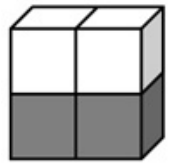
Q3. A larger block is formed using 4 small cubes (2 grey cubes and 2 white cubes), as shown below.
How many faces of the larger block have equal grey and white areas?
Solution
Option (a) 4 faces. The top pair of cubes is white and the bottom pair grey. Front, back, left and right each show equal areas of both colours. The top is entirely white and bottom entirely grey.
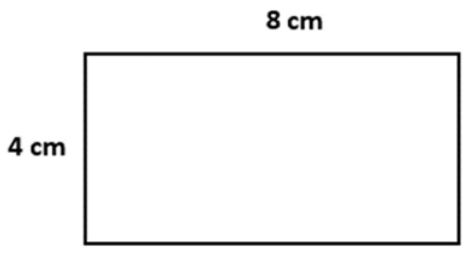
Q4. How many times should the given paper sheet be folded in half so that the perimeter of the new shape is 16 cm?
Solution
Option (b) 1 fold. Fold halfway along the 8 cm length, bringing its two ends together. The folded outline is 4 cm × 4 cm and has perimeter 4 × 4 = 16 cm.
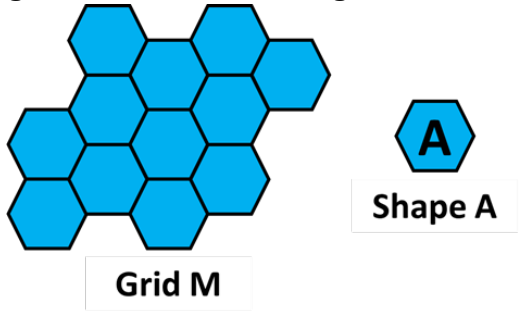
Q5. Grid M is made using regular hexagons (like Shape A), as shown.
Additional copies of Shape A may be attached only along the outer sides of Grid M, and each added shape must share at least one full side with the existing grid. The shapes must be added such that the total perimeter of the grid remains unchanged. What is the MAXIMUM number of Shape A pieces that can be added?
Solution
Option (c) 4 pieces. A new hexagon sharing k full sides changes the perimeter by 6 − 2k side-lengths. Sharing three sides gives zero change. Fill the four three-sided inward notches around Grid M; each replaces three exposed edges with three new ones.
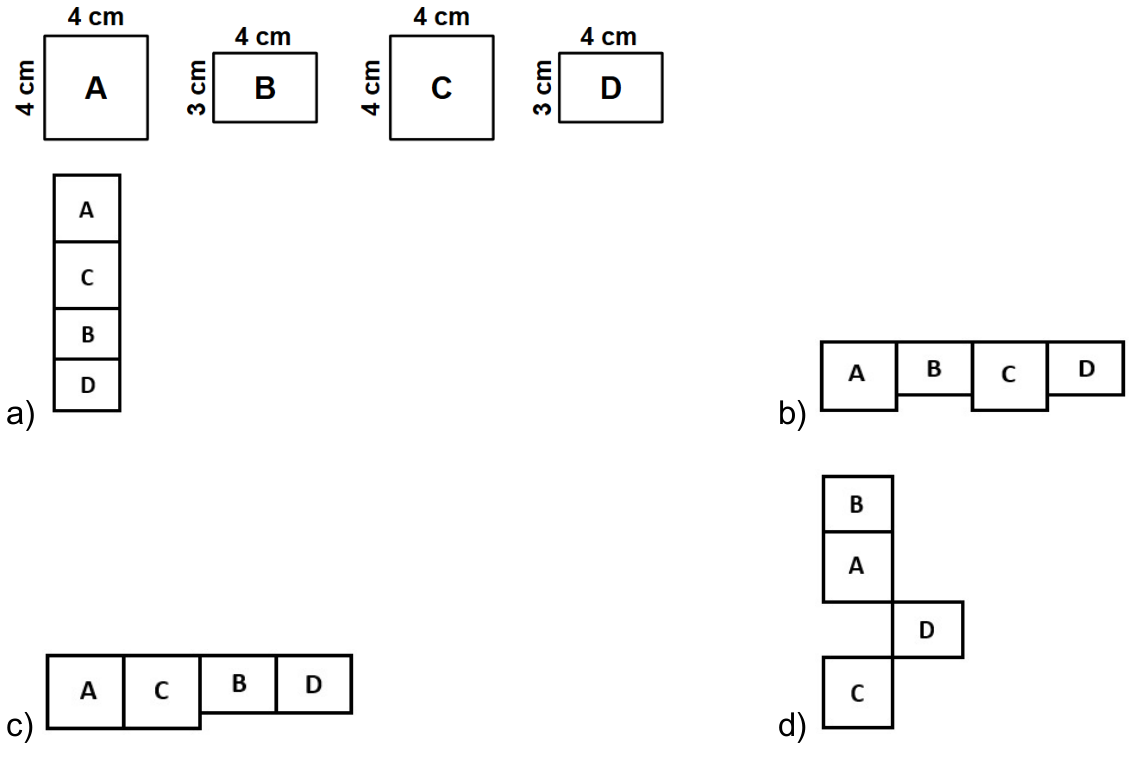
Q6. All the squares and rectangles given below are to be used to form an arrangement.
The arrangement shown in which of these options will give the HIGHEST perimeter?
Solution
Option (d) 52 cm. The four separate pieces have combined perimeter 16 + 14 + 16 + 14 = 60 cm. In (d), only A and B share a full 4 cm edge; the other contacts are at corners. Subtract that shared length twice: 60 − 8 = 52 cm. The other shown outlines measure 36,42 and 40 cm.
Q7. If figures A, B, and C are all of the same dimensions, which of the following coloured blocks has the largest area?

Solution
Option (a) Red. Yellow and green each occupy one quarter of equal-sized rectangles. Red occupies one third. Since 1/3 > 1/4, red is largest.
Q8. A square frame has a side length of 16 cm.
Inside it, four square-shaped photographs of side 4 cm are to be placed such that: – Each photograph touches the CORNER of at least one other photograph – No two photographs share a common side – The photographs do not overlap What is the LARGEST square-shaped empty space that can be seen inside the frame, finally?
Solution
Option (c) 64 cm². Arrange the 4 cm photos in corner-touching positions on a 4 cm grid. This can leave an 8 cm × 8 cm square empty, of area 64 cm². The total uncovered area is 16² − 4 × 4² = 192 cm², but it is not one empty square. The answer assumes the square photos are aligned as in the handbook’s construction.
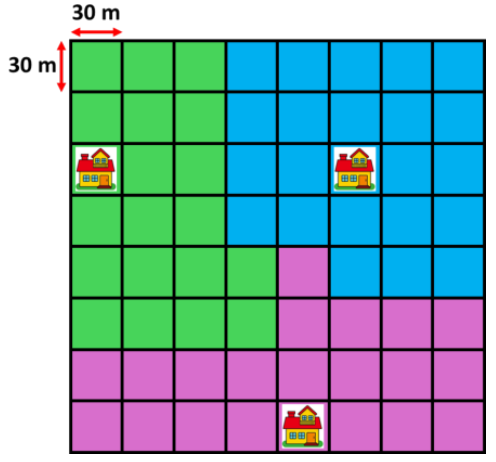
Q9. The grid shows a piece of land divided among three houses using different colours (including the area occupied by each house).
The land is then redistributed so that all three houses receive equal areas. Which of the following options is NOT the exact area of land gained or lost by any house after this redistribution?
Solution
Option (d) 900 sq. m. Each grid cell is 30 × 30 = 900 m². Green has 20 cells = 18,000 m², blue 23 = 20,700 m² and purple 21 = 18,900 m². Equal shares are 64 × 900 ÷ 3 = 19,200 m². Green gains 1,200, blue loses 1,500 and purple gains 300 m²; none changes by 900 m².
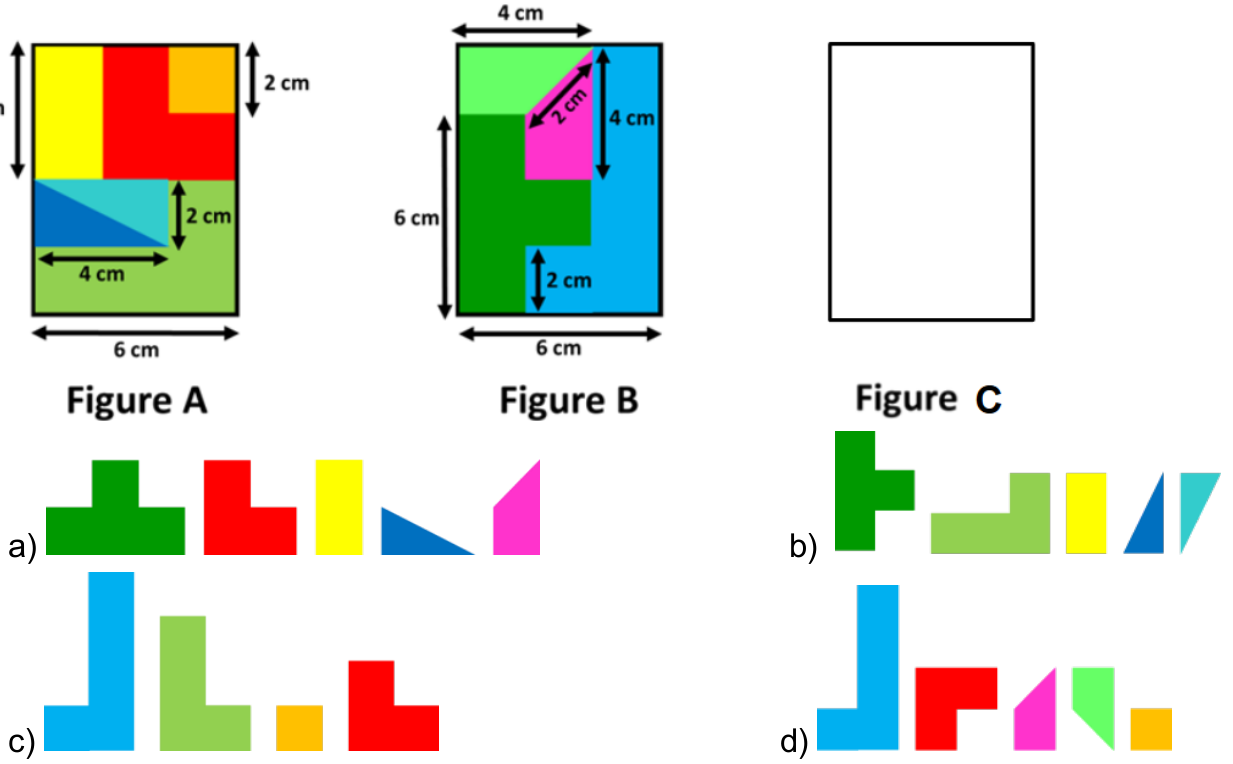
Q10. Figures A, B, and C are three rectangles of equal dimensions.
Figures A and B contain some shapes placed inside them. Using these shapes, completely fill figure C without leaving any gaps. Which set of options can be used to exactly fill figure C? Note: The shapes may be rotated but must not overlap. The dimensions of the shapes in the options are the same as the dimensions given in the question image
Solution
Option (d) The fourth set of pieces. Use the blue L-shaped piece, red L-shaped piece, pink piece, pale-green trapezium and yellow square. The blue piece fills the right-hand strip and bottom-left strip in its original orientation. The pink and pale-green pieces, together with the 2 cm yellow square in the upper-left corner, fill the top-left 4 cm × 4 cm region. Rotate the red L to fill the remaining three 2 cm squares below it. Rotation is allowed. Their areas total 20 + 12 + 6 + 6 + 4 = 48 cm², matching C’s 6 cm × 8 cm area, and the edges fit without gaps.
The Thinking Spot
The numbers given below are to be placed in the grid in such a way that the sum of two adjacent numbers in the grid should be greater than 9 but less than 17.
What will come in place of A? Numbers to be placed: 11, 3, 5, 2

Solution
Option (a) A = 5. The row is 14,2,11,5,8,3,12. Its adjacent sums are 16,13,16,13,11,15, all greater than 9 and less than 17. The neighbour of 14 must be 2; the remaining neighbour of 12 must be 3; of 11 and 5, only 5 can go next to 8.
Additional Practice Questions with Solutions
Choose an answer, use a hint if needed, then open the worked solution to check your reasoning.
Solved 0 of 10 · Checked 0 of 10
Your practice progress lasts until you reset or reload this page.
Apply · Square perimeter
Practice Q1. A square has side 7 cm. What is its perimeter?
Show hint
Add all four sides.
Show worked solution
Option (c) 28 cm.
4 × 7 = 28 cm.
Common mistake: 7 × 7 gives area, not perimeter.
Apply · Rectangle area
Practice Q2. A rectangle is 9 cm long and 4 cm wide. What is its area?
Show hint
Multiply length by width.
Show worked solution
Option (c) 36 cm².
9 × 4 = 36 cm².
Common mistake: 2 × (9 + 4) gives perimeter.
Apply · Shared edges
Practice Q3. Two squares of side 5 cm are joined along one complete side. What is the perimeter of the resulting rectangle?
Show hint
Subtract the shared edge twice from the separate perimeters.
Show worked solution
Option (b) 30 cm.
The separate perimeters total 40 cm. Subtract 2 × 5 = 10 cm to get 30 cm. Equivalently, the rectangle is 10 by 5 cm.
Common mistake: The joined edge is inside the shape.
Apply · Cutting
Practice Q4. A square of side 6 cm is cut along a diagonal into two triangles. What is their combined area?
Show hint
Cutting does not remove any surface.
Show worked solution
Option (c) 36 cm².
The original area is 6 × 6 = 36 cm². The two triangles together retain all of it.
Common mistake: Do not double the original area.
Apply · Folding
Practice Q5. A 12 cm by 6 cm sheet is folded in half by bringing its short edges together. What is the perimeter of the folded outline?
Show hint
The 12 cm dimension is halved.
Show worked solution
Option (b) 24 cm.
The folded outline is 6 cm by 6 cm, so its perimeter is 4 × 6 = 24 cm.
Common mistake: Folding halves one dimension, not both dimensions.
Apply · Hexagon boundary
Practice Q6. A regular hexagon of side 2 cm is added to a grid, sharing exactly three full sides with it. What is the change in perimeter?
Show hint
Compare new exposed sides with removed exposed sides.
Show worked solution
Option (a) 0 cm.
Three old sides of total length 6 cm disappear and three new sides of total length 6 cm appear. The change is zero.
Common mistake: Do not count internal shared sides as outside boundary.
Apply · Fractional area
Practice Q7. Three equal rectangles each have area 60 cm². Red covers one third, yellow one quarter and green one fifth. Which coloured area is largest?
Show hint
Calculate each fraction of the same total.
Show worked solution
Option (a) Red.
Red is 20 cm², yellow 15 cm² and green 12 cm². Red is largest.
Common mistake: A larger denominator gives a smaller unit fraction.
Apply · Grid area
Practice Q8. A grid contains 18 square cells, each with side 3 m. What is its total area?
Show hint
First calculate one cell’s area.
Show worked solution
Option (c) 162 m².
One cell has area 3 × 3 = 9 m². Eighteen cells have area 18 × 9 = 162 m².
Common mistake: The side length is not the cell area.
Apply · Equal redistribution
Practice Q9. Three gardens have areas 90, 120 and 150 m². They are redistributed equally. How much area does the smallest garden gain?
Show hint
Find the new equal share.
Show worked solution
Option (b) 30 m².
The total is 360 m², so each receives 120 m². The smallest gains 120 − 90 = 30 m².
Common mistake: Compare the new share with the original smallest area.
Apply · Checking fit
Practice Q10. Four pieces have areas 8, 6, 5 and 4 cm². Can they exactly fill a 6 cm by 4 cm rectangle without gaps or overlaps?
Show hint
Add the piece areas and compare with the rectangle.
Show worked solution
Option (c) No, their total area is too small.
The pieces total 23 cm², while the rectangle has area 24 cm². They cannot fill it without leaving a gap.
Common mistake: Having enough pieces is different from having enough area.