
CLASS 6 · Computational Thinking
Class 6 CT and AI: Prime Time Solutions
Work through Prime Time from the CBSE Class 6 Computational Thinking and Artificial Intelligence handbook with explanations for each task.
Jump to a question or activity
Key ideas
A repeated step on a numbered circle connects factors, multiples and geometry. Return to the starting point when the total distance counted is a multiple of the number of points.

Short Concept Lessons
Learn a method, follow the example, then use it in the additional practice.
Prime and composite numbers
A prime has exactly two positive factors: 1 and itself. A composite number has more than two.
7 has factors 1 and 7; 8 has 1,2,4,8.
Remember: 1 is neither prime nor composite; 2 is the only even prime.
Practise this method →Factors and multiples
A factor divides a number exactly. Multiples result from multiplying by whole numbers.
3 is a factor of 12, and 12 is a multiple of 3.
Remember: A number may have several prime factors.
Practise this method →Trace steps around a circle
Continue counting around the circle after the last label. Stop on the first return to the starting point.
On eight points, step 2 follows 2,4,6,8,2: four moves.
Remember: Count moves, including the final return.
Practise this method →Use common factors to predict a return
For m points and step n, the number of moves to return is m divided by HCF(m,n).
On 18 points with step 6, HCF is 6, so the return takes 3 moves.
Remember: Having a common factor is different from one number dividing the other.
Practise this method →Consecutive numbers form predictable sums
Three consecutive numbers balance around their middle number, so their sum is three times that middle number.
10 + 11 + 12 = 3 × 11 = 33.
Remember: An always-true claim must work for every allowed example.
Practise this method →Check every digit and condition
After computing, test distinct digits, allowed values and other restrictions.
If different letters must be different digits, a correct multiplication can still fail that condition.
Remember: Do not stop after checking only the arithmetic.
Practise this method →Questions and Solutions
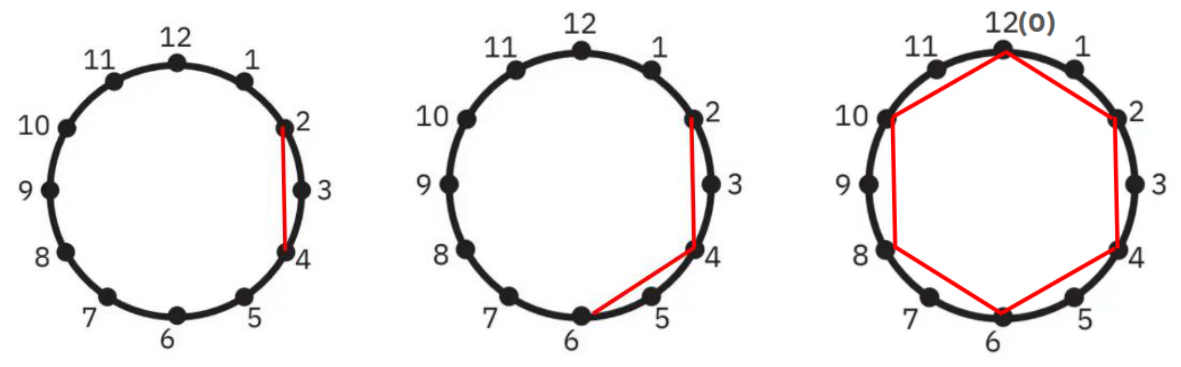
Activity 1. You are given a circle with 12 equally spaced points.
You have to connect these points using a rule.
Rule:
1. Starting from 2, add 2 to it and connect it with the next number i.e., 4.
2. Add 2 to 4, then connect it to the next.
3. Keep adding 2 until you reach the starting point.
1. How many steps did it take to reach the starting point?
Solution
Option (d) Six steps. Follow 2 → 4 → 6 → 8 → 10 → 12 → 2. The six equally spaced visited points form a regular hexagon. After 12, continue counting around the circle.
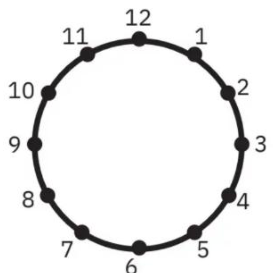
Activity 2. Now starting from 3, add 3 to it and join to the next point. Keep adding 3 until you reach the starting point.
2. How many steps did you take to reach the starting point?
Solution
Option (c) Four steps. The path is 3 → 6 → 9 → 12 → 3. The four equal chords form a square.
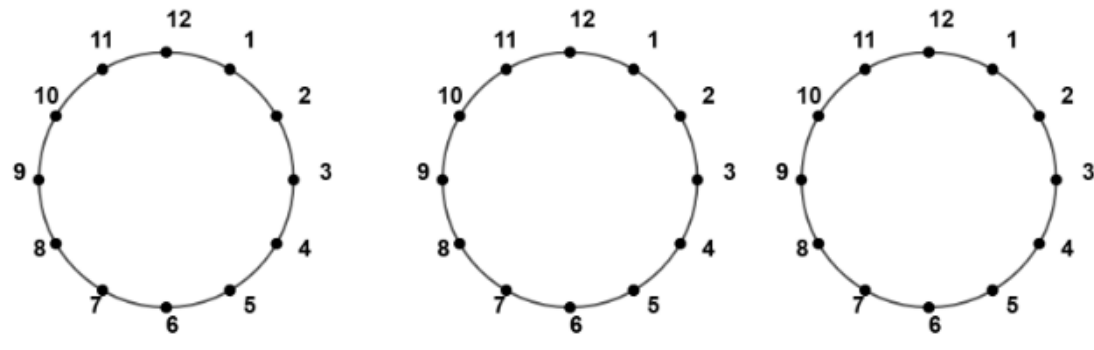
Activity table. Repeat the same process by
a) Starting from 4 and adding 4
b) Starting from 5 and adding 5
c) Starting from 6 and adding 6
Until you reach the starting point.
What shapes do you get? Record your answers in the table below.

Solution
| Step | Moves to return | Shape |
|---|---|---|
| 2 | 6 | Regular hexagon |
| 3 | 4 | Square |
| 4 | 3 | Equilateral triangle: 4 → 8 → 12 → 4 |
| 5 | 12 | 12-pointed star |
| 6 | 2 | A diameter traced out and back: 6 → 12 → 6 |
The step-5 path is 5,10,3,8,1,6,11,4,9,2,7,12,5. Count moves, not just different drawn segments.
Activity discussion. Do you notice any patterns in the numbers we are adding, the number of points on the circle, and the shape being formed in the circle?
Why did you get polygons on adding 2, 3, and 4, while a star on adding 5? Is there any relationship between these numbers and 12, the number of points on the circle?
Solution
Steps 2,3,4 divide 12 exactly, visiting 6,4,3 equally spaced points before returning. Step 5 shares no factor greater than 1 with 12, so it visits all 12 points, crossing earlier chords and making a star. More generally, moves to return = m ÷ HCF(m,n), for m points and step n. This does not mean every non-factor step always produces the same kind of star.
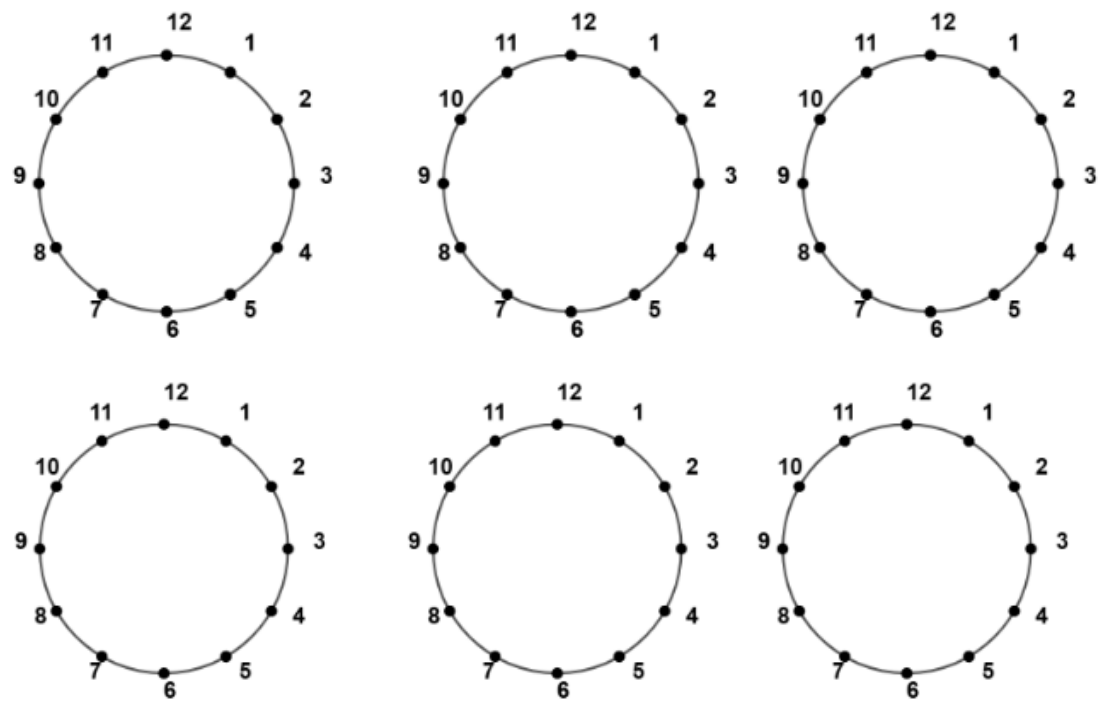
Exploration 1. What shapes will you get when you add 7, 8, 9, 10, and 11 until you reach the starting point?
Try to find out the relationship between the numbers and the number of points on a circle.
Solution
| Step | Moves | Shape |
|---|---|---|
| 7 | 12 | 12-pointed star, like step 5 in reverse |
| 8 | 3 | Equilateral triangle, like step 4 |
| 9 | 4 | Square, like step 3 |
| 10 | 6 | Regular hexagon, like step 2 |
| 11 | 12 | Regular 12-sided polygon, like step 1 |
On an m-point circle, adding m − n moves to the same next point as subtracting n. Complementary step sizes therefore trace corresponding shapes in opposite directions.
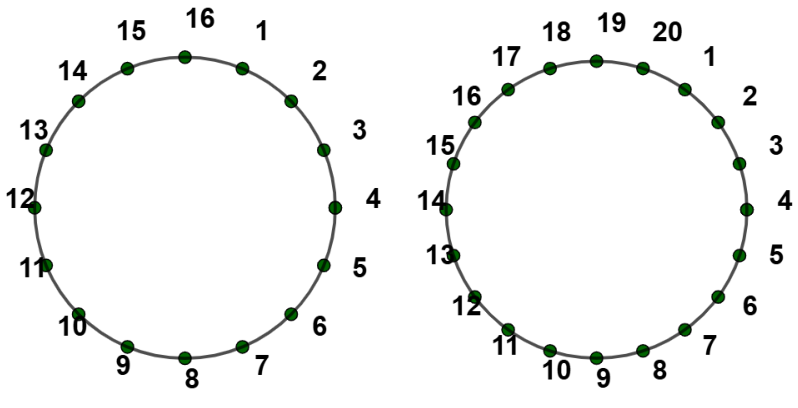
Exploration 2. Two circles, one with 16 points and the other with 20 points, are given.
Which of the two will give a square when added to which number?
Solution
Options (a), (b), (c) and (d). All four give a square. On 16 points, steps 4 and 12 make quarter-circle moves in opposite directions. On 20 points, steps 5 and 15 do the same. Each returns after four moves and visits four equally spaced vertices.
Q1. Find the ODD one out.

Solution
Option (b) The diagram with 3, 5 and 8. The white numbers multiply to the dark number: 2 × 5 = 10, 7 × 4 = 28 and 8 × 3 = 24. But 3 × 5 = 15, not 8.
Q2. If "X" is a number formed by the addition of two or more DIFFERENT single-digit prime numbers, which of the following options CANNOT be a value of the number "X"?
Solution
Option (c) 11. The primes are 2,3,5,7. Possible sums using at least two distinct primes are 5,7,8,9,10,12,14,15,17. In particular, 8 = 3 + 5, 10 = 3 + 7 and 15 = 3 + 5 + 7, while 11 is absent.
Q3. The sum of three consecutive natural numbers is equal to Y.
Which of the following numbers will Y always be divisible by?
Solution
Option (a) 3. Write the numbers as n − 1, n, n + 1. Their sum is 3n, always divisible by 3. For example, 2 + 3 + 4 = 9 shows it need not be divisible by 2 or 4.
Q4. A two-digit number is 1 more than a multiple of 3.
How many different possible values can it have?
Solution
Option (b) 30. They are 10,13,16,…,97. The count is (97 − 10)/3 + 1 = 30.
Q5. The product of a number 'PQ' and 7 is 'RSQ', where P, Q, R, and S are distinct digits.
Which of the following CANNOT be the possible value of 'RSQ'?

Solution
Option (d) 105. 30 × 7 = 210, 45 × 7 = 315 and 60 × 7 = 420 satisfy the digit clues. But 15 × 7 = 105 makes both P and R equal to 1, whereas they must differ.
Q6. Nausheen thinks of 5 consecutive numbers.
3 of these numbers are prime and 3 of these are even numbers. What is the sum of these numbers?
Solution
Option (c) 20. The sets of three primes and three evens must overlap among five numbers. Their shared member can only be the even prime 2. The valid run is 2,3,4,5,6, containing primes 2,3,5 and evens 2,4,6. Its sum is 20.
Q7. In a certain language, if 3 is coded as ‘free’, 5 is coded as ‘dive’, 10 is coded as ‘hen’, then what could be the possible code for the PRIME FACTOR of 169, in the same language?
Solution
Option (c) routine. 169 = 13 × 13, and 13 is prime. As “free” rhymes with three and “dive” with five, the intended code rhymes with thirteen: routine.
Q8. If "X" is a number formed by the multiplication of 2 single-digit prime numbers, which of the following options is ALWAYS TRUE about the number "X"?
Solution
Option (d) The number "X" is less than 50. The largest allowed prime is 7, so even allowing repetition the greatest product is 7 × 7 = 49. The product 2 × 3 = 6 disproves the claims that it must be odd or two-digit; 3 × 5 = 15 disproves being always divisible by 4.
Q9. In the letter grid below, the spelling of which prime number is immediately followed by the spelling of its succeeding number in the number series? ONEFIIVESIXTWOTHREENINETENELEVNTWELVEONEFOURSIXSEVEN
Solution
Option (d) 2. Read the string exactly as printed. The apparent five and eleven entries contain spelling differences (“FIIVE” and “ELEVN”), so they do not qualify.
Q10. Alex, Jim, and Sam were born on prime-numbered dates in the same month and year.
Sam was born on a Friday, and the month started on a Sunday. – The difference between the dates of Alex’s and Jim’s birthdays is 20 – Jim was born 10 days after Sam On which day of the week was Alex born?
Solution
Option (c) Tuesday. With Sunday on the 1st, Fridays are 6,13,20,27. The only prime Friday date is 13, so Sam was born on the 13th, Jim on the 23rd and Alex on the 3rd. The 3rd is Tuesday.
The Thinking Spot
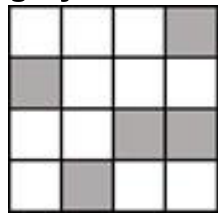
The image given below contains ONLY white and grey squares.
You can change the colour of a square by clicking on it. – If you click a white square, the colour of that square and all squares that share a common corner (but do not share a common side) with it will change – If you click a grey square, its colour and the colour of the squares that share a common side with it will change What is the minimum number of squares that must be clicked to make the number of grey and white squares equal?
Solution
Option (a) 1 click. The 4 × 4 board starts with 5 grey and 11 white squares. Click the white square in row 2, column 2. It and three white diagonal neighbours become grey, while its grey diagonal neighbour at row 3, column 3 becomes white. Grey changes by +4 − 1 = +3, giving 8 of each. Zero clicks cannot work, so one is minimal.
Additional Practice Questions with Solutions
Choose an answer, use a hint if needed, then open the worked solution to check your reasoning.
Solved 0 of 10 · Checked 0 of 10
Your practice progress lasts until you reset or reload this page.
Apply · Prime numbers
Practice Q1. Which number is prime?
Show hint
Test small possible factors.
Show worked solution
Option (c) 29.
29 is not divisible by 2,3 or 5. These cover possible prime divisors up to its square root. 21 = 3 × 7 and 39 = 3 × 13; 1 is not prime.
Common mistake: Odd numbers are not always prime.
Apply · Prime factors
Practice Q2. What is the prime factorisation of 84?
Show hint
Keep splitting composite factors.
Show worked solution
Option (a) 2 × 2 × 3 × 7.
84 = 4 × 21 = 2 × 2 × 3 × 7. Every final factor is prime.
Common mistake: A factorisation is prime only when all its factors are prime.
Apply · Circle steps
Practice Q3. On a circle with 15 equally spaced points, start at 3 and repeatedly add 3, wrapping around after 15. How many moves return to 3?
Show hint
List the visited points.
Show worked solution
Option (c) 5.
The path is 3,6,9,12,15,3. There are five moves before the first return.
Common mistake: The starting point is not an extra move.
Apply · Common factors
Practice Q4. A circle has 18 equally spaced points. Repeatedly take steps of 12. How many moves are needed to return to the start?
Show hint
Use HCF(18,12).
Show worked solution
Option (b) 3.
HCF(18,12) = 6, so the return takes 18 ÷ 6 = 3 moves. Starting at 12 gives 12,6,18,12.
Common mistake: A step size need not divide the circle size to return.
Apply · Square paths
Practice Q5. Which step size makes a square on a circle with 24 equally spaced points?
Show hint
A square uses four equally spaced vertices.
Show worked solution
Option (b) 6.
24 ÷ 4 = 6 points per quarter turn. Step 6 visits 6,12,18,24,6, making a square.
Common mistake: Four is the number of moves, not the step size here.
Apply · Consecutive sums
Practice Q6. Three consecutive natural numbers total 72. What is the middle number?
Show hint
The sum is three times the middle number.
Show worked solution
Option (b) 24.
72 ÷ 3 = 24. The numbers are 23,24,25, whose sum is 72.
Common mistake: Do not divide by the number of gaps.
Apply · Distinct primes
Practice Q7. Which total cannot be made from two different single-digit prime numbers?
Show hint
List pairs from 2,3,5,7.
Show worked solution
Option (d) 11.
The pair sums are 5,7,9,8,10,12. None is 11, so 11 cannot be formed.
Common mistake: The primes must be different.
Apply · Counting multiples
Practice Q8. How many two-digit numbers are multiples of 7?
Show hint
The first is 14 and the last is 98.
Show worked solution
Option (b) 13.
The multiples are 7 × 2 through 7 × 14. There are 14 − 2 + 1 = 13.
Common mistake: Include both endpoints.
Apply · Always true
Practice Q9. Two single-digit primes are multiplied, and repetition is allowed. What is the greatest possible product?
Show hint
Use the greatest allowed prime twice.
Show worked solution
Option (c) 49.
7 is the largest single-digit prime. Since repetition is allowed, 7 × 7 = 49 is the maximum.
Common mistake: The word prime excludes 8 and 9.
Apply · Distinct digits
Practice Q10. In PQ × 3 = RQ, P, Q and R must be different digits. Which multiplication satisfies the rule?
Show hint
Check the shared units digit and the three distinct letter values.
Show worked solution
Option (d) All three.
The triples (P,Q,R) are (1,5,4), (2,0,6), and (2,5,7). Each has three different digits and keeps the units digit Q, so all three work.
Common mistake: The repeated Q represents the same digit, not a fourth distinct digit.