
CLASS 6 · Computational Thinking
Class 6 CT and AI: Playing with Constructions Solutions
Work through Playing with Constructions from the CBSE Class 6 Computational Thinking and Artificial Intelligence handbook with explanations for each task.
Jump to a question or activity
Key ideas
Keep the orientation fixed when rotation is forbidden. Count unit cells, check every seam, and distinguish touching from overlapping.
Short Concept Lessons
Learn a method, follow the example, then use it in the additional practice.
Count cells before fitting pieces
If pieces fill a grid without gaps or overlaps, their cell counts add to the grid’s cell count.
A 4 × 4 square needs 16 unit cells.
Remember: Matching areas is necessary but the shapes must also fit.
Practise this method →Distinguish sliding, turning and flipping
Sliding preserves orientation. Turning changes direction; flipping produces a mirror image. Follow the permitted moves.
If rotation is forbidden, an upright two-cell strip must remain upright when moved.
Remember: A piece that fits after turning is invalid when turning is forbidden.
Practise this method →Count squares by size
Count small squares, then larger squares formed by combining cells.
A 2 × 2 grid contains 4 unit squares and 1 large square: 5 altogether.
Remember: Do not count only the smallest squares.
Practise this method →Separate side and corner contact
Cells are side-adjacent when they share a whole boundary segment. Diagonal cells only share a corner.
A central cell in a 3 × 3 grid has four side-neighbours.
Remember: Do not include diagonal neighbours when the rule specifies sides.
Practise this method →Fill the most restricted cell first
Use known neighbours to eliminate forbidden choices, then repeat with the new information.
If patterns A,B,C are available and a blank touches A and B, it must be C.
Remember: Check both row and column neighbours.
Practise this method →Count different values, not repeated cells
A distinct-value count includes each value only once.
The list 1,2,2,3 contains three different values.
Remember: Repeated appearances do not add new values.
Practise this method →Questions and Solutions
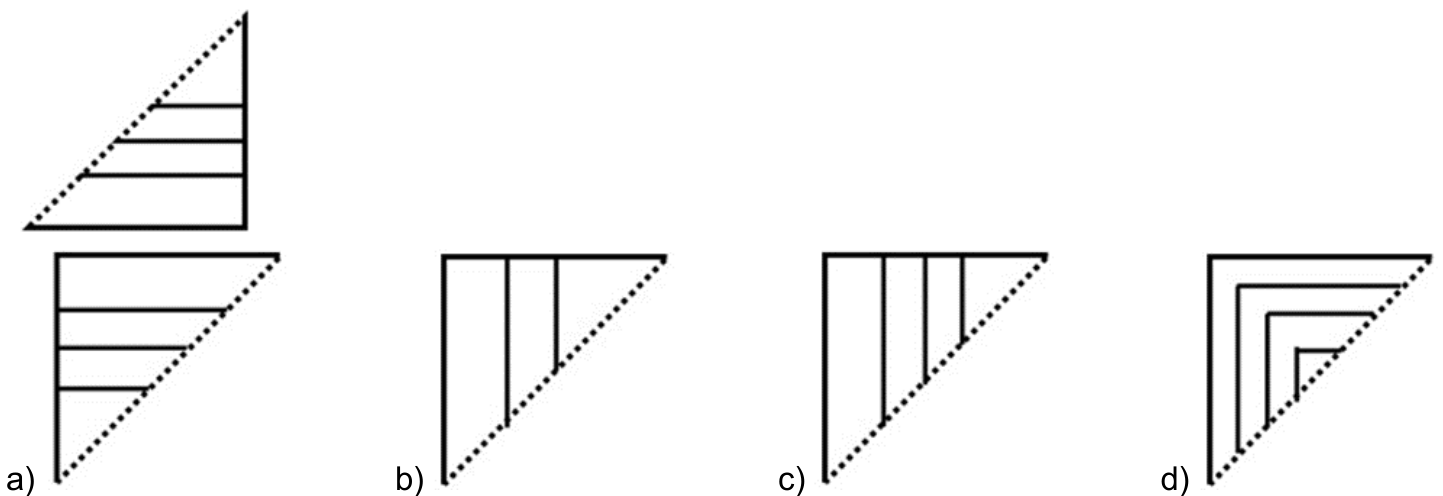
Q1. An image made of squares is cut diagonally into two halves, and one half is shown below.
Which option should be joined with the question image so that the resulting image forms exactly 4 squares? Note: You cannot rotate any of the images
Solution
Option (c) The third half-image. Align the dotted diagonal edges without rotation. The four vertical segments in (c) complete the four horizontal levels in the given half, making four nested square outlines. Option (b) supplies only three such levels.
Q2. Given below is an arrangement of squares.
What is the minimum number of straight lines required so that the total number of square shapes that appear in the final image (including the existing ones) is more than 5?

Solution
Option (a) 2 lines. The original 2 × 2 grid has four small squares and one large square. Inside one small square, draw a shorter vertical and a shorter horizontal segment joining its sides through the centre. This splits it into four still smaller squares, creating more than five overall. A single new straight segment cannot supply both missing directions for a new square.
Q3. The following arrangement is made up of matchsticks of the same dimensions.
How many additional matchsticks are needed to divide the area between the outlines of the larger outer square and the smaller inner square into three parts, each having the same area as the smaller inner square?

Solution
Option (b) 3 matchsticks. Take one matchstick as one unit. The outer square has area 4² = 16 square units and the inner one 2² = 4; the ring has area 12. Add three one-unit bridges from the inner boundary to the outer boundary to make parts of area 4 each. One construction: bridge the two lower inner corners horizontally to the left and right outer edges, then bridge the midpoint of the upper inner edge vertically to the top outer edge. The bottom strip has area 4; the two upper L-shaped regions each have area 3 + 1 = 4. Three cuts are needed to divide this ring into three regions.
Q4. Form a 3 × 3 square using exactly 3 shapes from the set given below.
Which shape will NOT be used? Note: You cannot rotate or overlap the shapes

Solution
Option (c) The third piece in Set A. Number the source pieces 1–4 from left to right. A valid grid has rows 2,2,4 / 2,4,1 / 4,4,1, with each number identifying a piece. This uses pieces 1,2,4 without rotation or overlap and fills nine cells. Piece 3 is not used.
Q5. Six pieces are given.
Using all of them, form two separate 3 × 3 square grids, each containing both letters and shapes. In both completed grids, which shape will be adjacent to a letter? Note: Two cells are considered adjacent only if they share a common side. Cells that share a common corner alone are not adjacent. Rotation of the pieces is not allowed

Solution
Option (c) Blue Pentagon. Combine the three-cell shape piece, the four-cell H–C–K–D piece and the two-cell circle–pentagon piece into one square; combine the four-cell shape piece, P–E piece and F–S–G piece into the other. Checking shared sides, one grid has letters next to red triangles and blue pentagons, while the other has letters next to blue pentagons and green circles. Blue pentagons occur in both lists. Corner-only contact does not count.
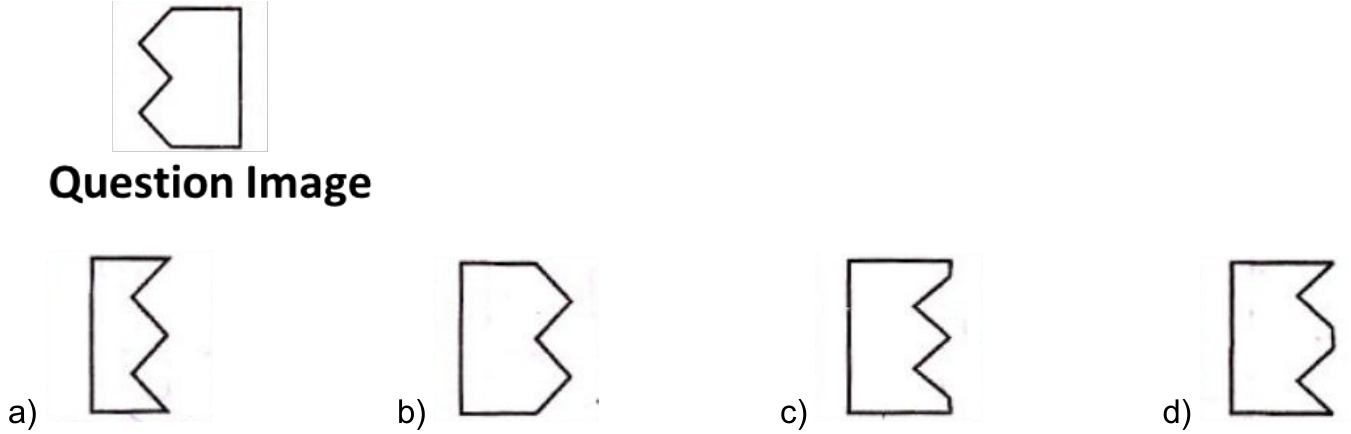
Q6. Which of these options, when combined with the question image, will form a rectangle or a square? Note: The images cannot overlap each other
Solution
Option (a) The first outline. Its inward notches receive the two outward points of the given piece, and its central pointed projection fills the inward notch. The upper and lower edges meet straight across. Option (d) has a blunted middle point, leaving a gap.
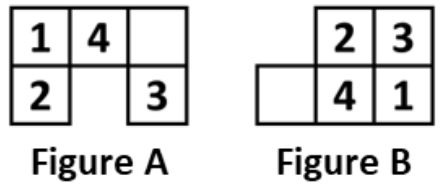
Q7. When Figure A is placed over Figure B to form a square grid, which same digits will be positioned exactly on top of each other?
Solution
Option (c) 3. Put Figure B one row lower than Figure A, with their right-hand columns aligned. Their 3-cells coincide; the union is a 3 × 3 square. The other matching-digit alignments leave an incomplete or non-square outline.
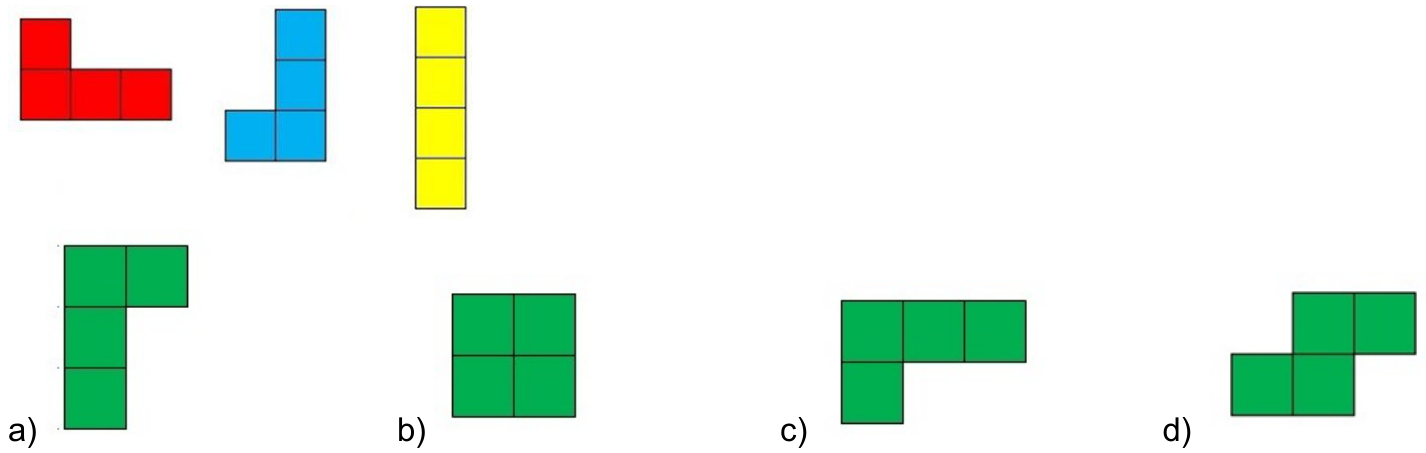
Q8. Four pieces together form a square.
Only three of these pieces are shown. Which option represents the fourth piece that, when joined with the given three pieces, will complete the square? Note: The pieces must not overlap each other and rotation is not allowed
Solution
Option (b) The 2 × 2 square. One completed 4 × 4 grid, using R for red, B for blue, Y for yellow and G for the missing green piece, has rows G,G,B,Y / G,G,B,Y / R,B,B,Y / R,R,R,Y. The remaining four cells form a 2 × 2 square, and no piece is rotated.
Q9. Two identical paper sheets are joined together at one of their sides to form a square.
Which of the following CAN DEFINITELY NOT be the shape of each of the paper sheets?
Solution
Option (b) Square. Two equal squares joined along a full side form a rectangle twice as long as it is wide. Two suitable right-isosceles triangles can form a square along their hypotenuses; two suitable rectangles can form one along their longer sides.
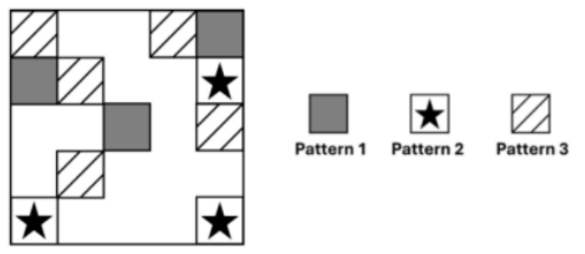
Q10. A 5 × 5 grid is formed using three different pattern blocks, as shown in the image.
Some blocks are missing from the grid. No two adjacent blocks in the grid can have the same pattern. Complete the grid and tell which pattern block is PRESENT the MOST. Note: Blocks that share common sides are considered to be adjacent. Blocks that share a common corner alone, are NOT adjacent
Solution
Option (c) Pattern 1. Using the source’s pattern numbers, the completed rows are:
| 3 | 2 | 1 | 3 | 1 |
| 1 | 3 | 2 | 1 | 2 |
| 3 | 2 | 1 | 2 | 3 |
| 1 | 3 | 2 | 3 | 1 |
| 2 | 1 | 3 | 1 | 2 |
Every side-neighbour differs. Pattern 1 appears 9 times; patterns 2 and 3 appear 8 times each.
The Thinking Spot
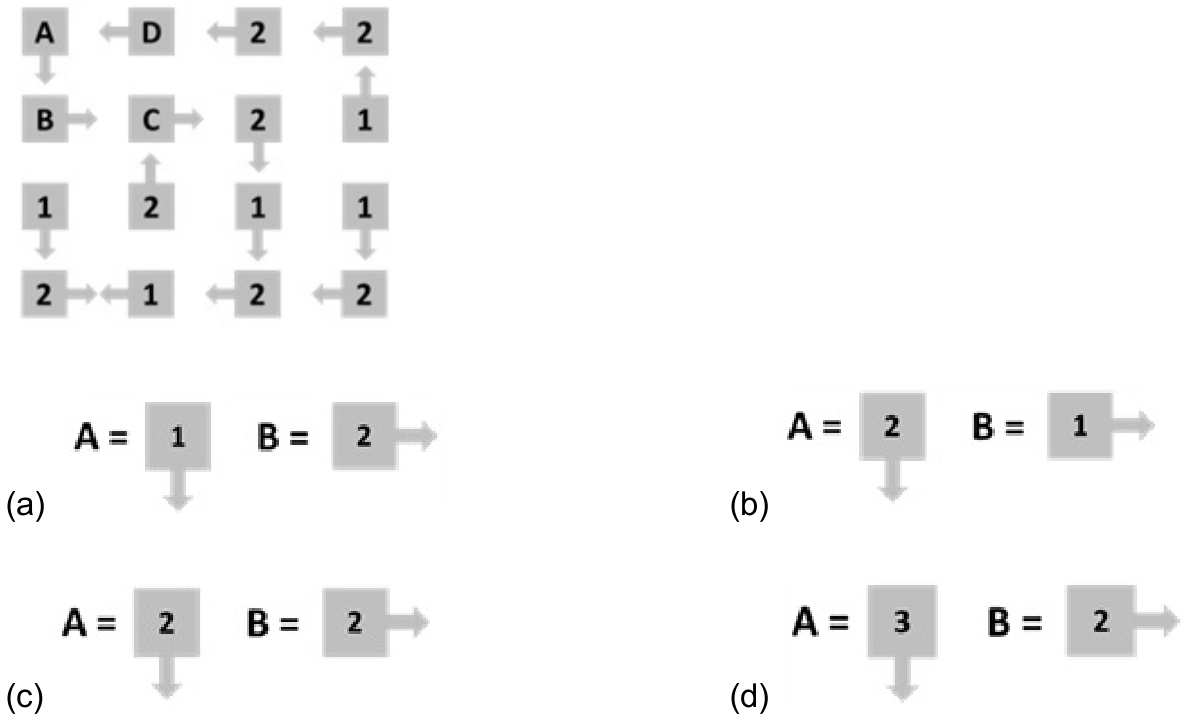
Place numbers inside every cell so that each cell indicates how many different numbers its arrow(s) point to.
What will come in place of A and B?
Solution
Option (c) A = 2 and B = 2. Count distinct values along the arrow direction, not the number of cells. C looks right at 2 and 1, so C = 2. B then looks at 2,2,1, containing two different values, so B = 2. A looks down at 2,1,2, again two different values. D = 1 because its left-pointing arrow sees only A.
Additional Practice Questions with Solutions
Choose an answer, use a hint if needed, then open the worked solution to check your reasoning.
Solved 0 of 10 · Checked 0 of 10
Your practice progress lasts until you reset or reload this page.
Apply · Cell totals
Practice Q1. A 4 × 4 grid must be filled without overlaps. Three pieces contain 3, 5 and 4 cells. How many cells must the fourth piece contain?
Show hint
Subtract the known cells from 16.
Show worked solution
Option (c) 4.
The known pieces contain 12 cells. The remaining piece must contain 16 − 12 = 4 cells.
Common mistake: This gives the needed area, not a guarantee of fit.
Apply · Counting squares
Practice Q2. How many axis-aligned squares of all sizes are in a complete 3 × 3 grid of unit squares?
Show hint
Count squares of side 1, 2 and 3.
Show worked solution
Option (d) 14.
There are 9 unit squares, 4 squares of side 2 and 1 square of side 3: 14 altogether.
Common mistake: Larger squares count too.
Apply · Fixed orientation
Practice Q3. A piece consists of two unit squares stacked vertically. Rotation and flipping are forbidden. Which gap can it fill exactly?
Show hint
Sliding cannot change its vertical orientation.
Show worked solution
Option (b) A vertical 2 × 1 gap.
The piece is two cells high and one cell wide, so only the vertical 2 × 1 gap matches.
Common mistake: Turning the piece would break the rule.
Apply · Side adjacency
Practice Q4. How many cells share a side with the centre cell of a 3 × 3 grid?
Show hint
Look above, below, left and right.
Show worked solution
Option (c) 4.
The centre has four side-neighbours. Its four diagonal neighbours share only corners.
Common mistake: Eight counts side and corner neighbours together.
Apply · Corner adjacency
Practice Q5. How many cells share only a corner, not a side, with the centre cell of a 3 × 3 grid?
Show hint
Look at the diagonal directions.
Show worked solution
Option (c) 4.
The four corner cells each share one corner with the centre cell. The other four share sides.
Common mistake: Exclude the side-neighbours.
Apply · Pattern constraints
Practice Q6. A blank cell may contain pattern 1, 2 or 3. Its side-neighbours include both pattern 1 and pattern 3. Adjacent cells must differ. Which pattern must fill the blank?
Show hint
Eliminate the patterns already touching it.
Show worked solution
Option (b) Pattern 2.
Patterns 1 and 3 are forbidden by its neighbours, leaving only pattern 2.
Common mistake: Do not ignore a neighbour in a different row.
Apply · Square rings
Practice Q7. An outer square has side 5 units and an inner square side 3 units. What is the area between their boundaries?
Show hint
Subtract the inner area from the outer area.
Show worked solution
Option (c) 16 square units.
The area is 25 − 9 = 16 square units.
Common mistake: Subtract areas, not side lengths.
Apply · Different values
Practice Q8. An arrow points along cells containing 2, 1, 2, 3 and 1. How many different numbers does it point to?
Show hint
List each value only once.
Show worked solution
Option (b) 3.
The distinct values are 1,2,3, so the answer is 3.
Common mistake: Five is the number of cells, not different values.
Apply · Joining shapes
Practice Q9. Two identical 3 cm by 6 cm rectangles are joined along their 6 cm sides without overlap. What shape results?
Show hint
The other dimensions add while the shared length remains 6 cm.
Show worked solution
Option (b) A 6 cm square.
The width becomes 3 + 3 = 6 cm and the height remains 6 cm, producing a square.
Common mistake: Joining along the shorter sides would give a different result.
Apply · No overlap
Practice Q10. A 3 × 3 grid has nine cells. Two placed pieces cover 4 and 3 cells without overlap. How many cells remain uncovered?
Show hint
Subtract the occupied cells from nine.
Show worked solution
Option (b) 2.
The pieces cover 4 + 3 = 7 cells, leaving 9 − 7 = 2 uncovered.
Common mistake: Do not subtract a shared cell because overlap is excluded.