
CLASS 6 · Computational Thinking
Class 6 CT and AI: Symmetry Solutions
Work through Symmetry from the CBSE Class 6 Computational Thinking and Artificial Intelligence handbook with explanations for each task.
Jump to a question or activity
Key ideas
A reflection must match every boundary and detail. For rotational symmetry, turn around the marked centre; for grid adjacency, count shared sides only.
Short Concept Lessons
Learn a method, follow the example, then use it in the additional practice.
Test a line of symmetry
A reflection must match every edge and detail on the opposite side of the line.
A square has two middle lines and two diagonal lines of symmetry.
Remember: Equal areas on the two sides are not enough.
Practise this method →Turn around the specified centre
Rotational symmetry means the whole shape matches after a turn smaller than a full turn.
A square matches after 90°, 180° and 270° about its centre.
Remember: A reflection and a turn are different moves.
Practise this method →Unfold by reflecting the cut
Each fold produces a reflected copy when opened. Notice whether the cut touches a fold or an outer edge.
A cut through two layers on an outer edge appears on two corresponding outer edges.
Remember: Do not move an outer-edge cut to the centre.
Practise this method →Pair reflected grid cells
Across a vertical middle line, a cell keeps its row and changes to the equally distant column on the other side.
In a five-column grid, columns 1 and 5 pair, as do 2 and 4.
Remember: A cell on the axis maps to itself.
Practise this method →Count only the allowed neighbours
Side-adjacent cells share a side. A common corner alone does not count.
A corner cell of a rectangular grid has two side-neighbours.
Remember: First identify qualifying shapes, then count neighbouring cells.
Practise this method →Test every possible case
When exactly one statement must be true, list the truth values for each possible location.
Reject a location if it makes zero or two statements true.
Remember: A statement printed on a container need not be true.
Practise this method →Questions and Solutions
Q1. Image A is placed exactly on top of Image B (exactly overlapping it).
How many shapes with vertical symmetry overlap letters that also have vertical symmetry? Note: Rotation of the images is not allowed

Solution
Option (c) 3. They are the upright triangle over M, upward arrow over V and symmetric trapezium over W. Other cells fail because either the shape or the letter lacks vertical symmetry in the printed orientation.
Q2. A square sheet of paper is folded in half, as shown in Step 1.
A triangular piece is then cut from the folded sheet, as shown in Step 2. Which option shows the final shape obtained when the paper is unfolded?

Solution
Option (c) Two matching triangular side notches. The cut is on the open outer edge of the folded sheet, not on its central fold. Unfolding reflects it to the opposite outside edge, leaving two matching triangular side notches with short vertical edges above and below them.
Q3. What will come in place of "?"
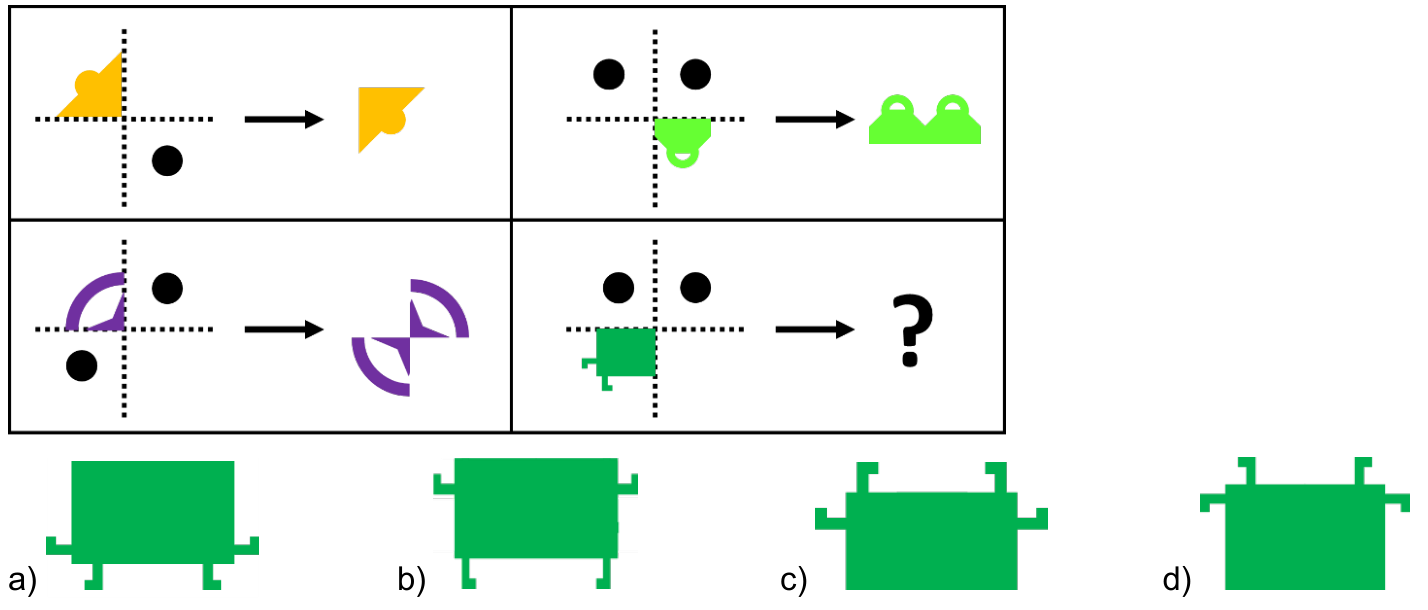
Solution
Option (c) The third green image. The black dots select the upper-left and upper-right quadrants. Reflect the lower-left green part upward, then across the vertical line. The two small upright projections must have the mirrored orientations shown in (c).
Q4. A symmetrical transparent sheet of paper is folded in half along the dotted line AB.
When the sheet is unfolded, what is the total number of triangles seen? Note: Line AB is not a part of the shape

Solution
Option (c) 5. Reflect all visible lines across AB. The three half-triangle outlines touching AB become three complete triangles; the separate full triangle on the left gains a matching one on the right. Total: 3 + 2 = 5. Do not count AB as a drawn edge.
Q5. The given shape is first folded vertically, then horizontally, and then cut along the dotted line as shown below.
After unfolding, if the resultant shape has equal sides (edges), how many lines of symmetry does the resultant shape have?
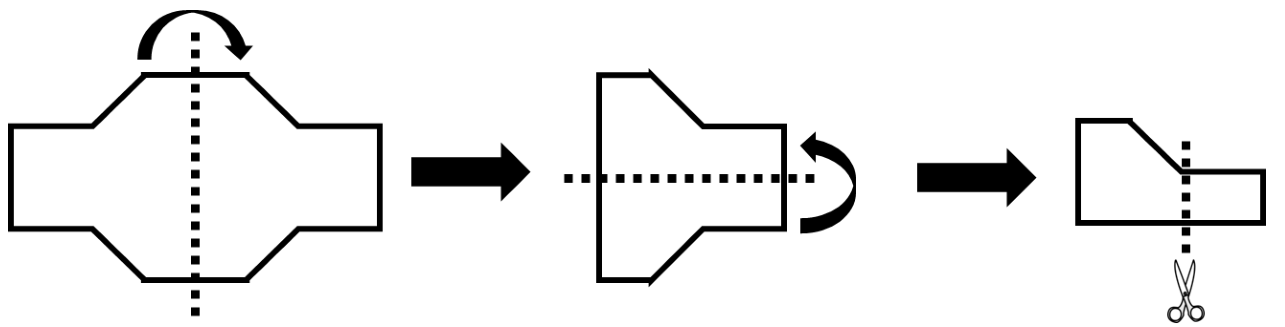
Solution
Option (d) 8. Unfolding removes the side extensions in matching pairs and leaves an eight-sided figure. With the equal side lengths and symmetric 45° corner cuts shown, it is a regular octagon: four axes join opposite vertices and four join midpoints of opposite sides. Equal side lengths alone would not guarantee eight symmetry axes for an arbitrary octagon.
Q6. The following grid is made of 6 small white squares.
Each square has a black shape inside it. Count the number of squares which are adjacent to exactly two other squares, whose shapes have an angle of rotational symmetry of 90°. Note: The red circle in each shape acts as the centre of rotation. Two squares are said to be adjacent if they share the common sides. Squares that share common corner alone are not adjacent to each other

Solution
Option (b) 2. The top-middle diamond, bottom-left curved cross and bottom-middle X match themselves after 90° around their red centres. The top-left cell neighbours the diamond and curved cross; the bottom-middle cell also neighbours those two. These are the only cells with exactly two qualifying side-neighbours.
Q7. Along which line should I cut the given paper sheet to get two identical Pentagons?
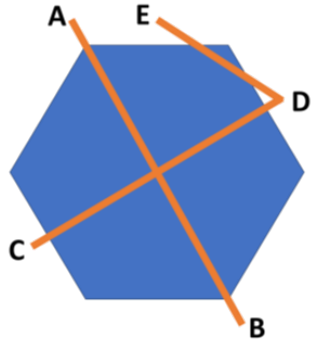
Solution
Option (b) CD. This cut crosses opposite sides in the symmetric way shown, leaving five boundary segments on each piece. AB joins opposite vertices and makes quadrilaterals instead; DE cuts off an unequal corner piece.
Q8. Eight shapes are shown below, each having a dotted line.
Count the number of shapes in which the dotted line is a line of symmetry.

Solution
Option (b) 4. The valid shapes are the top-row first and third, and bottom-row third and fourth. Reflect each boundary across its dotted line: the triangle’s horizontal line, semicircle’s vertical line and the other two unequal end/corner designs do not match.
Q9. How many of the following letters have at least one line of symmetry?

Solution
Option (b) 6 letters. I, T, H, A, C and E have at least one reflection axis in the block forms shown. R, S, L and P do not. Letter symmetry depends on the typeface, so use the displayed forms.
Q10. In the given figure, exactly one square among the labelled squares – P, Q, R, and S must be shaded grey to make the complete grid symmetric, along any one of the directions.
Which square must be shaded to satisfy the condition?
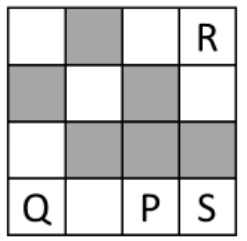
Solution
Option (d) P. Shade row 4, column 3. It pairs with the grey cell at row 3, column 4 under reflection in the top-left to bottom-right diagonal. Every other grey cell already has its reflected partner; the centre-diagonal grey cell reflects onto itself.
The Thinking Spot
There are 3 jars out of which one of them has candies and the other two are empty jars.
There is a message printed on the lid of each jar. Only one of these messages is true and the others are false. The message on the 1st jar is: "The Candies are not in this jar" and the same message is written on the 2nd jar as well. The message on the 3rd jar is: "The Candies are in the 2nd jar". Which jar has candies in it?
Solution
Option (a) 1st jar. If the candies are in jar 1, the three statements are false, true, false. If they are in jar 2, the first and third statements are true. If they are in jar 3, the first and second are true. Only jar 1 gives exactly one true statement.
Additional Practice Questions with Solutions
Choose an answer, use a hint if needed, then open the worked solution to check your reasoning.
Solved 0 of 10 · Checked 0 of 10
Your practice progress lasts until you reset or reload this page.
Apply · Reflection
Practice Q1. How many lines of symmetry does a square have?
Show hint
Include the diagonals.
Show worked solution
Option (c) 4.
A square has two middle axes and two diagonals: 4 lines.
Common mistake: Four equal sides do not mean four vertical axes.
Apply · Reflection
Practice Q2. How many lines of symmetry does a rectangle with length 8 cm and width 5 cm have?
Show hint
Its sides are unequal.
Show worked solution
Option (b) 2.
Only the horizontal and vertical middle lines work. Its diagonals are not reflection axes.
Common mistake: The four-axis rule applies to a square.
Apply · Rotation
Practice Q3. What is the smallest positive angle of rotational symmetry of a square about its centre?
Show hint
A quarter-turn takes each side to the next.
Show worked solution
Option (b) 90°.
One quarter of 360° is 90°, and the square matches at that turn.
Common mistake: A 45° turn does not align the sides.
Apply · Rotation
Practice Q4. What is the smallest positive angle of rotational symmetry of a regular hexagon about its centre?
Show hint
Divide a full turn into six equal parts.
Show worked solution
Option (c) 60°.
360° ÷ 6 = 60°. Each vertex moves to the next vertex.
Common mistake: Use the six equal sectors.
Apply · Paper folding
Practice Q5. A sheet is folded once into two layers. One small circular hole is punched through both layers, away from the fold. How many holes appear after unfolding?
Show hint
Each layer receives one hole.
Show worked solution
Option (b) 2.
The two holes are reflected partners on opposite sides of the fold, so there are 2.
Common mistake: A hole on the fold would need separate analysis.
Apply · Grid reflection
Practice Q6. In a 5 × 5 grid, which cell is the reflection of row 2, column 1 across the vertical middle line?
Show hint
Keep the row; reflect the column.
Show worked solution
Option (a) Row 2, column 5.
Column 1 pairs with column 5, while row 2 remains unchanged.
Common mistake: Vertical reflection does not change the row.
Apply · Grid reflection
Practice Q7. Which cell is the reflection of row 2, column 4 across the top-left to bottom-right diagonal of a square grid?
Show hint
Swap the row and column numbers.
Show worked solution
Option (b) Row 4, column 2.
Reflection in this diagonal changes (2,4) to (4,2).
Common mistake: This diagonal is not a horizontal mirror.
Apply · Adjacency
Practice Q8. How many side-neighbours does a corner cell in a 3 × 3 grid have?
Show hint
Ignore the diagonally touching cell.
Show worked solution
Option (b) 2.
One neighbour lies along the row and one along the column: 2 altogether.
Common mistake: A corner contact does not count as a shared side.
Apply · Regular polygons
Practice Q9. How many lines of symmetry does a regular pentagon have?
Show hint
Each vertex has a matching axis.
Show worked solution
Option (c) 5.
There are 5 axes, each joining a vertex to the midpoint of the opposite side.
Common mistake: Count each complete axis once.
Apply · Logical cases
Practice Q10. One of boxes A, B and C contains a token. A says “The token is in B.” B says “The token is in A.” C says “The token is not in A.” Exactly one statement is true. What can we conclude?
Show hint
Test all three locations.
Show worked solution
Option (d) It can be in A or C.
In A, the statements are false, true, false. In B, they are true, false, true. In C, they are false, false, true. Thus A and C both satisfy the rule.
Common mistake: Exactly one true statement need not determine a unique location.