
The Chair — Class 6 English Poorvi Questions and Answers
The Chair questions and answers: read Mario’s story in Class 6 Poorvi with the friendship word search, comprehension, suffixes, adjective–noun phrases and listening answers.
Source: NCERT Poorvi, Grade 6, Unit 2, printed pages 59–70; listening transcript 73; supplied reprint 2026–27. Open-ended and personal responses are examples to adapt. These explanations are study support, not an official NCERT answer key.
About the chapter
“The Chair” is a light, humorous story from Unit 2, ‘Friendship’. It is about a boy named Mario who loves to boast about how many friends he has. His wise grandfather makes a playful bet with him and gives him a ‘special’ invisible chair. When Mario tries to sit on it in front of his classmates at school, only three of them – Guneet, Asma and Deepa – help to hold him up, while the others simply laugh at his falls. Through this clever test, Mario learns the difference between true friends and mere companions.
About the story
“The Chair” appears in the NCERT Class 6 English textbook Poorvi, in the unit on Friendship. The textbook does not print a separate author by-line for this piece; it is a short, modern teaching story chosen for the theme of friendship. Written in simple, playful English, it uses the funny idea of an ‘invisible chair’ to teach a serious value – that real friends are the ones who support and care for us, not those who enjoy our troubles. Its tone is warm and gently humorous, making it easy and enjoyable for young readers.
Summary
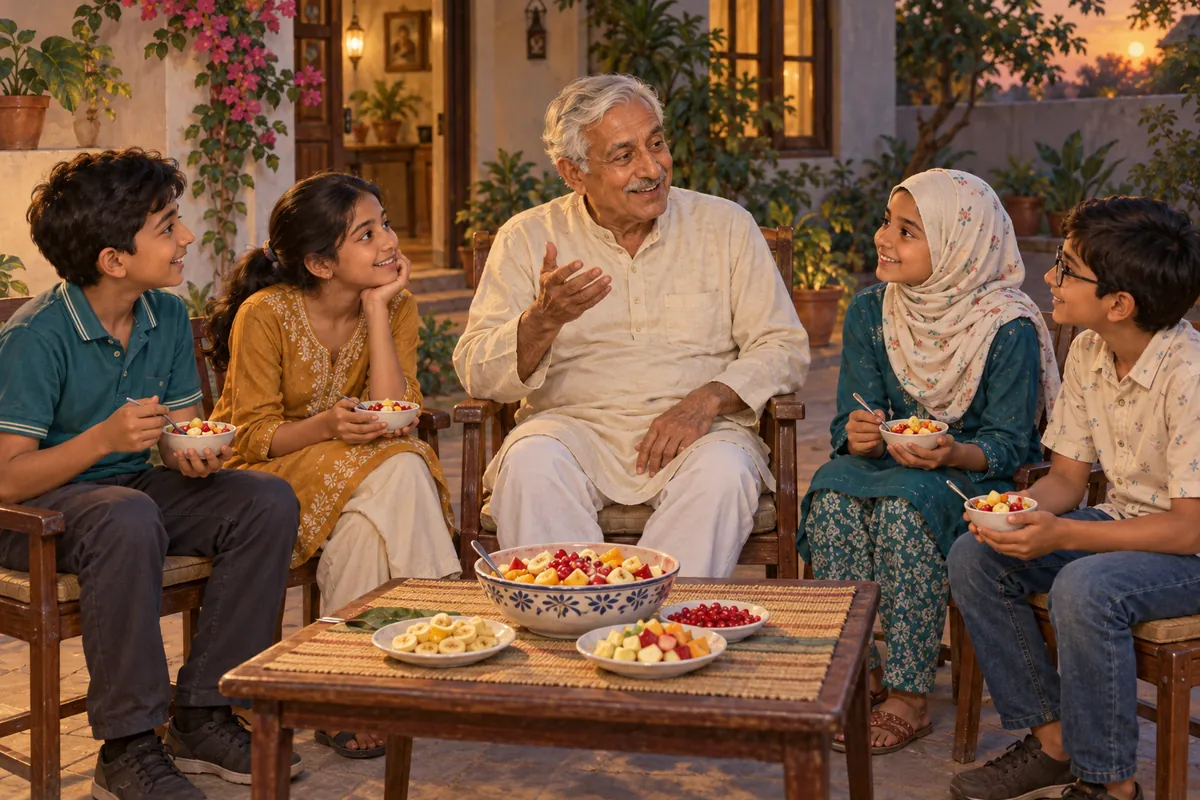
There was a boy called Mario who loved to have lots of friends. He showed off a great deal, always talking about how many friends he had at school and how friendly he was with everyone. One day his grandfather made him a bet of a fruit chaat, saying that Mario did not really have as many friends as he thought – many of them, he felt, were nothing more than companions or partners.
Mario accepted the bet readily, but he did not know how to test whether his schoolmates were real friends. So he asked his grandfather for help. Grandpa went up to the attic and came back as though carrying something, though Mario could see nothing in his hands. He handed Mario a ‘very special’ invisible chair, explaining that because it was invisible it was tricky to sit on. If Mario could take it to school and manage to sit on it, the magic would work and he would be able to tell who his real friends were.
Brave and determined, Mario carried the strange chair to school. At break time he asked everyone to form a circle and stood in the middle. He tried to sit on the chair, but each time he missed and fell to the ground, and his classmates laughed. Mario would not give up. He kept trying until, suddenly, he sat without falling – hanging in mid-air. Then he saw the magic: Guneet, Asma and Deepa, three of his buddies, were holding him up so he would not fall, while the others had only made fun of him and enjoyed every fall. Mario realised that true friends are those who care for us, not those who take joy in our bad luck. That evening the four children visited Grandpa, who had won the bet, and enjoyed stories and fruit chaat together.
Theme & message
The central theme is the difference between true friends and mere companions. Through the clever ‘invisible chair’ test, the story shows that real friends are the ones who support and care for us in difficult moments, while false friends laugh at our troubles. The message is that the value of friendship lies in quality, not in numbers – it is far better to have a few caring, loyal friends than many who do not truly stand by us. The story also gently celebrates the wisdom of elders and learning from them.
Word meanings
| Word | English meaning | Hindi meaning |
|---|---|---|
| showed off | boasted; tried to impress others | दिखावा / शेखी बघारना |
| bet | an agreement on who is right, with a prize | शर्त / बाजी |
| companions | people you spend time with | साथी / संगी |
| partners | people you do activities together with | साझीदार |
| accepted | agreed to | स्वीकार करना |
| readily | willingly; without any problem | खुशी-खुशी / बिना दिक्कत के |
| attic | a storage space just under the roof | अटारी / छत के नीचे का भंडार-घर |
| invisible | impossible to see | अदृश्य / जो दिखाई न दे |
| tricky | difficult to do | मुश्किल / पेचीदा |
| magic | a special, surprising power | जादू / सम्मोहन |
| determined | firm in decision; not giving up | दृढ़निश्चयी |
| amazing | very surprising | आश्चर्यजनक |
| backside | the lower back part of the body | पिछवाड़ा / नितंब |
| buddies | an informal word for friends | यार / दोस्त |
| experienced | felt; went through | अनुभव किया |
| made fun of | laughed at; mocked | मजाक उडाना |
| occasions | particular times or events | अवसर / मौके |
Before we read — pages 59–60
Two personal association words might be trust and kindness; other responses are welcome.
1. Eight words in the printed grid
Rows and columns are counted from the top-left corner, starting at 1.
| Word | Location |
|---|---|
| LAUGHTER | Row 1, columns 1–8 → |
| HELPFUL (given) | Row 3, columns 2–8 → |
| HOPE | Row 5, columns 1–4 → |
| LOYAL | Row 7, columns 2–6 → |
| LOVING | Row 10, columns 1–6 → |
| CARING | Column 5, rows 6–11 ↓ |
| TRUST | Column 8, rows 5–9 ↓ |
| SUPPORT | Column 11, rows 5–11 ↓ |
2. Words for friends
(i) partner; (ii) buddies; (iii) companion; (iv) classmates.
3. Your own language — sample
In Hindi I might say मित्र or दोस्त. Give the term used in your own language.
Let us discuss
Part I
1. Mario was very proud of having so many friends. State whether True or False.
2. What did the grandfather take from the attic?
3. Will Mario face any challenges?
4. Will Mario be able to use the magic?
Part II
1. Mario successfully sat on the invisible chair on his first attempt. State whether True or False.
2. Fill in the blank with a suitable word. Mario’s grandfather challenged him to a bet of __________.
3. Match the following characters with their action.
Let us think and reflect
I.1. “Take it. It’s a very special chair. As it’s invisible, it’s rather tricky to sit on it. But if you take it to school and manage to sit on it, then the magic will work and you’ll be able to tell who your real friends are.”
I.2. “Wait, wait, just a slight technical problem,” he said, trying again. But again, he missed the seat, causing more surprised looks and laughter. Mario wouldn’t give up.
II. Answer the following questions.
Let us learn
I. Root words and suffixes
Read the following words from the text – friendly, suddenly, talking, carrying, called, showed – and complete the table by dividing the words into two parts (Column A = root word, Column B = suffix). One has been done for you.
II. Match root words with suffixes and make sentences
Match the following root words with suitable suffixes (-ing, -al, -ful, -ly, -ed, -tion, -ous, -ship). You can use a suffix more than once. One has been done for you (magic + -al = magical).
III. Describe Mario (adjectives)
Read the line ‘Mario, brave and determined, took the strange invisible chair…’ You have already described the chair. Now describe what kind of a person Mario is. (Use words from the story; you may also use your own.)
IV. Match adjectives with nouns
Match each adjective in Column A with a suitable noun in Column B. You can make more than one combination. One has been done as an example (brave + soldier → The brave soldier marched ahead).
V. Complete the paragraph with adjective-noun pairings
Complete the paragraph with suitable adjective-noun pairings from the box (old book, magical adventures, happy boy, amazing stories, fantastic adventures, colourful creatures, old castles).
Let us listen, speak, write & explore
Let us listen
You will listen to Manu talk about her friend, Monika. As you listen, fill in the blanks with words that you hear. (refer to the transcript)
Note: This is a listening task. The key uses the page-73 transcript; blank 3 is inferred from Monika making Manu comfortable, rather than a verbatim sentence in the audio. The other answers come directly from it (Manu describing how Monika, a supportive friend, guided her, introduced her to others and shared her notes). In class, listen carefully and fill in exactly what you hear.
Let us speak
Work in pairs. Read the qualities of a friend (loving, kind, loyal, honest, caring, polite, respectful, team-worker, understanding). Choose any four positive qualities you would like your friend to have and give a reason, using the hints provided.
Note: This is a speaking (pair-work) task. Your choices and reasons may differ – the answer above is only a model. Speak confidently using the hint sentences.
Let us write
1. Choose the correct word given in brackets to complete Mario’s message to Guneet.
2. Now, write your own message to your best friend. You may take ideas from the story ‘The Unlikely Best Friends’ and the poem ‘A Friend’s Prayer’.
Note: This is a writing task; your own message will be different. Keep it warm, honest and about the value of true friendship.
Let us explore
1. Find out more stories about ‘Friendship’ from your state, other states or other countries, and share them with your class. 2. Write an acrostic poem describing your friends using the letters F-R-I-E-N-D-S. 3. Talk to people of different age groups about what friendship means to them, then discuss, reflect and present your findings.
Note: These are project and discussion tasks to be done with classmates; the responses above are only examples to guide you.
Additional ClearStudy questions
This practice is separate from the printed textbook exercises.
Short answer (30–40 words)
1. Why did the grandfather make a bet with Mario?
2. What was special about the chair the grandfather gave Mario?
3. How did Mario’s classmates react when he tried to sit on the chair?
4. What did Mario learn from the magic chair test?
5. What happened in the evening after the chair test?
Long answer (100–120 words)
6. Describe how the grandfather’s clever plan helped Mario discover his true friends.
7. What message does ‘The Chair’ give us about friendship? Explain with reference to the story.
ClearStudy MCQs and assertion–reason practice
1. What was the name of the boy in the story?
(a) Abhishek (b) Mario (c) Guneet (d) Gajaraj
2. What did Mario love to do?
(a) study hard (b) play alone (c) show off about having many friends (d) cook fruit chaat
3. What did the grandfather bet?
(a) a chair (b) a fruit chaat (c) some money (d) a book
4. Where did the grandfather get the special chair from?
(a) the market (b) the garden (c) the attic (d) the school
5. What was unusual about the chair?
(a) it was very big (b) it was invisible (c) it was golden (d) it could talk
6. Where did Mario try to sit on the chair?
(a) at home (b) in the garden (c) at school during break time (d) in the attic
7. What happened the first few times Mario tried to sit on the chair?
(a) he sat easily (b) he missed the seat and fell (c) the chair broke (d) he flew away
8. Who held Mario up so that he would not fall?
(a) the teacher (b) Guneet, Asma and Deepa (c) his grandfather (d) all the classmates
9. What did the rest of the classmates do?
(a) helped Mario (b) called the teacher (c) made fun of him and laughed (d) went away
10. What did Mario finally learn from the test?
(a) magic is real (b) true friends are those who care for us (c) chairs are useful (d) he should not go to school
Assertion–Reason – choose: (a) A and R true, R explains A; (b) A and R true, R does not explain A; (c) A true, R false; (d) A false, R true.
1. Assertion (A): The grandfather made a bet with Mario.
Reason (R): He believed many of Mario’s friends were only companions or partners, not real friends.
2. Assertion (A): Mario found it very hard to sit on the chair.
Reason (R): The chair was invisible, so it was tricky to sit on it.
3. Assertion (A): Mario kept trying to sit on the chair even after falling many times.
Reason (R): Mario was strong-willed and would not give up.
4. Assertion (A): All of Mario’s classmates helped him when he was falling.
Reason (R): Only Guneet, Asma and Deepa held Mario up, while the others laughed at him.
5. Assertion (A): The grandfather won the bet.
Reason (R): The test proved that Mario had only a few real friends, not as many as he had claimed.
Exam tips & common mistakes
Exam tips
• Remember the order of events: boasting → the bet → the invisible chair → falling at school → three friends hold him up → lesson learned → fruit chaat with Grandpa.
• Always name the three true friends correctly – Guneet, Asma and Deepa.
• In theme questions, clearly state the message: true friends support us; quality matters more than number of friends.
• For character questions, use adjectives from the story like brave, determined, strong-willed for Mario.
Common mistakes
• Do not write that Mario sat on the chair on his first try – he fell several times first.
• The bet was for a fruit chaat, not money or a chair – do not change this detail.
• Do not write that all classmates helped him; only three did, the rest laughed.
• The chair was invisible (impossible to see), not just magical-looking – this is why it was tricky to sit on.
FAQs
What is the story ‘The Chair’ about?
It is about a boy named Mario who boasts about his many friends. His grandfather gives him an invisible ‘magic’ chair, and through trying to sit on it at school, Mario discovers who his real friends truly are.
Who are Mario’s real friends in the story?
Mario’s real friends are Guneet, Asma and Deepa. They held him up so he would not fall, while the other classmates only laughed at him.
What is the main message of ‘The Chair’?
The story teaches that true friends are those who care for and support us in difficult times. It shows that the quality of friendship matters more than the number of friends.
Why did the grandfather give Mario an invisible chair?
He gave Mario the invisible chair as a clever test. Because it was tricky to sit on, only Mario’s real friends would help hold him up, revealing who truly cared for him.
Textbook-based exercises and additional ClearStudy practice are identified separately. Use your textbook alongside these explanations.