
Neem Baba — Class 6 English Poorvi Questions and Answers
Neem Baba questions and answers: study Amber’s dialogue in Class 6 Poorvi with its fact sheet, compound words, verb forms, personification and listening key.
Source: NCERT Poorvi, Grade 6, Unit 3, printed pages 75–84; listening transcript 101; supplied reprint 2026–27. Open-ended and personal responses are examples to adapt. These explanations are study support, not an official NCERT answer key.
About the chapter
“Neem Baba” is a lively conversation piece from Unit 3, ‘Nurturing Nature’. A girl named Amber sits in the shade of the neem tree in her courtyard and imagines that the old tree is speaking to her. She lovingly calls it ‘Neem Baba’, and through their friendly dialogue she learns how very old the tree is, where it grew up, the many names it has, and the countless ways it helps people – in medicine, farming, cleanliness and daily life. The lesson celebrates the neem tree as ‘nature’s gift to man’ and gently urges children to value, protect and discover more about trees.
About the author
The textbook identifies this dialogue as adapted from Neem Baba by S. I. Farooqi. Giving a tree human speech is personification. Its stories about age, naming and traditional uses should be read as statements in the passage, rather than independently proven scientific or medical claims.
Summary
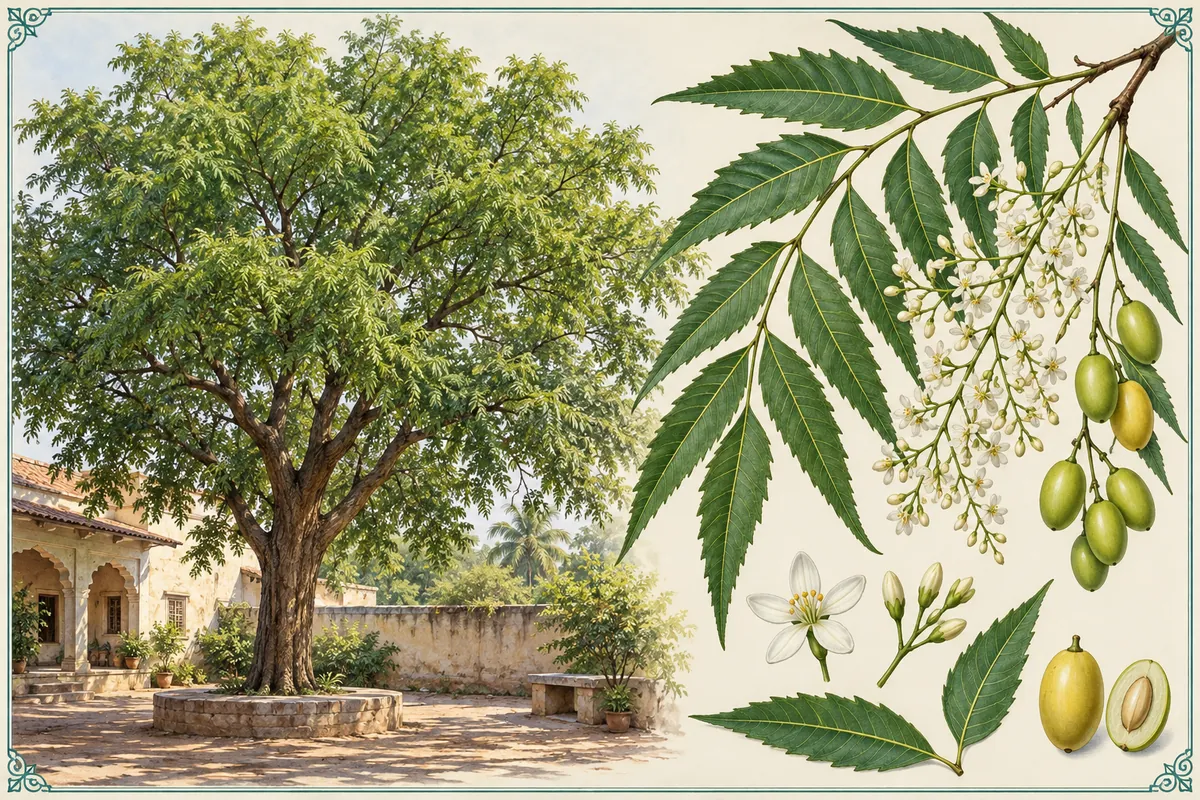
Amber sits beneath the neem tree in her courtyard after school and feels that it whispers to her. She greets it, and the tree invites her to call it Neem Baba. It tells her about its family’s spread, Sanskrit and regional names, and the names associated with its usefulness.
The dialogue describes uses of neem in traditional remedies, crop protection, household products and wood. Amber recalls what her family told her, while Neem Baba stresses that remedies require trained, experienced people. She asks questions and promises to investigate more of the tree’s qualities when she grows up.
Reading context: the ‘millions of years’ statement concerns the tree’s personified family/history, not the measured age of the individual courtyard tree. Health statements below answer questions about this text; they are not treatment directions. Children should involve a qualified health professional and should not replace medical care with homemade neem remedies. See NIH guidance on complementary health approaches for children.
Word meanings
| Word | English meaning | Hindi meaning |
|---|---|---|
| courtyard | an open space surrounded by walls inside a house | आँगन |
| whispering | speaking very softly | फुसफुसाना |
| thought-provoking | interesting; making one think deeply | विचारोत्तेजक / रोचक |
| grace | blessing | आशीर्वाद / कृपा |
| twigs | small thin branches | टहनियाँ / दातुन |
| measles | a disease with fever and red spots on the skin | खसरा |
| itching | the feeling that makes one want to scratch | खुजली |
| breed | to grow or multiply in number | पनपना / ब୪ना |
| remedies | cures or treatments for an illness | उपचार / इलाज |
| locusts | flying insects that damage crops | टिड्डियाँ / सल्ली |
| termites | insects that damage wood and buildings | दीमक |
| stagnant | (of water) not flowing; still | ठहरा / रुका हुआ |
| cost-effective | giving a good result for very little money | कम खर्च में लाभदायक |
| yield | the amount of crop produced | उपज |
| purifies | removes harmful particles; makes clean | शुद्ध करता है |
| experience | knowledge gained from doing something | अनुभव |
Let us do these activities before we read
I. A tree is useful to us in many ways. Mention some of these uses. (Some parts of trees are used in preparing medicines.)
II. Neem is a common tree in our country. Discuss in groups of four and fill Columns 1 and 2 with what you know about the neem tree and what you want to know.
This is a group brainstorming activity; the answers above are samples – your own ideas may differ.
Let us discuss
I. Let us know our neem — according to the dialogue
| Item | Textbook answer |
|---|---|
| Common name / given by | Neem / the Iranians |
| Period of birth / born at | Millions of years ago / North India or Myanmar, as Neem Baba tells Amber |
| Found in | Many Asian and African countries and some parts of America |
| Common names listed | Nimb, Nim, Leemba, Nimori, Nimbamond, Nimbe, Nimo |
| Names associated with scientists — any two | ‘Bitter grace of God’ and ‘nature’s gift to man’; the text also lists ‘cleanliness-parting tree’ |
| Names given by others | ‘Magic tree’; ‘the tree of the twentieth century’ |
Arishta, Nimba and Nimbaca are Sanskrit names, not answers under ‘names given by scientists’.
II.1. Usefulness to farmers
According to Neem Baba, seed powder helps protect crops from locusts, termites and other crop-eating insects, discourages mosquito breeding in rice-field water and protects stored grain. Describe what the passage says; actual pesticide use requires approved products and their directions.
II.2. Other uses
The dialogue mentions twigs for cleaning teeth, leaves for protecting clothes, parts used in traditional medicines, oil in soaps and toothpaste, wood for furniture and the tree’s contribution to the surroundings.
Let us think and reflect
I. Two surprising details — sample
I was surprised by the many names listed for neem and the range of farming and household uses described. Choose two details that genuinely interested you.
II. Sentence completions — based on the text
- the neem tree
- locusts, termites and other crop-eating insects
- Putting neem seed powder in stagnant water
- the germ-destroying properties and relief from itching described by Neem Baba
Answer 4 reports the dialogue’s explanation of Amber’s brother’s care; it is not a recommendation for treating measles.
III. Parts used for medicines in the passage
Leaves, bark, flowers, fruits and roots.
IV. Why thought-provoking?
A familiar tree has many names and uses, prompting Amber to ask questions. The conversation encourages readers to observe nature, investigate claims and care for trees rather than overlook them.
Let us learn
I. Compound words
Study these words from the text and put them in their trees: something, neem oil, cleanliness-parting, well known, grandmother, seed powder, childhood, well trained, thought-provoking. (Open = spaces between words; Closed = no spaces; Hyphenated = hyphens between words.) You may add some more words.
II. Verbs – match the present form to the past form
Match the verbs in the first column (present) to verbs in the second column (past). Make a sentence with any one form. (One done: 1. become → (iv) became.)
III. Personification
Amber speaks to Neem Baba as if speaking to a person. This figure of speech is called personification. (Examples: The leaves whispered in the wind. / The flowers danced merrily in the breeze.) Now, discuss it with your classmates and teacher.
Let us listen / speak / write / explore
Let us listen — Peepal Baba, transcript 101
Select 1, 3 and 4. The mother expresses surprise and interest, and Rahul agrees that they should plant trees and encourage others. Statements 2 and 5 are incorrect: she admires the work and he does not express worry.
Let us speak — leaf-card process
Collect already fallen dry leaves from four familiar plants. Draw each shape on a folded card; put its name and one verified use inside. Describe collecting, observing, drawing, colouring and labelling, then invite classmates to identify the plant before opening the card. Sample: ‘I found a fallen neem leaf, drew its outline and labelled the card. This tree gives shade.’
Let us write — sample paragraph
The Neem in Our Park
A tall neem tree stands beside the path in our neighbourhood park. Its rough trunk supports a spreading crown. The leaves are made up of several narrow, toothed leaflets. I like the shade it provides and enjoy watching birds on its branches. The tree makes this part of the park pleasant. I would like to help protect it and learn more about its seasonal changes.
Let us explore — regional names
The textbook supplies the names but does not provide a language answer key. Do not assign unfamiliar names to languages by guessing. The National Academies neem monograph records Hindi: neem, nimb and Sanskrit: nimba, nimbou, arishtha. IISc’s India Trees entry also records Nim and Nimb in Marathi, illustrating overlap across languages.
For Leemba, Nimori, Nimbamond, Nimbe and Nimo, consult a reliable regional botanical source or a knowledgeable speaker with your teacher, record the language and spelling, and cite the source. The former blanket ‘South-Indian’ mapping has been removed because it was not verified.
Additional ClearStudy questions
This practice is separate from the printed textbook exercises.
1. Why the name Neem Baba?
The tree invites Amber to use this affectionate, respectful name. Its human-like speech makes it seem like an older guide.
2. Who gave the name Neem, according to the passage?
The Iranians.
3. What family experiences does Amber report?
She recalls a bark-based medicine for her cough and flower-based kajal for her father’s itchy eyes. These are events she reports in the dialogue, not recipes or medically established instructions.
4. What does cost-effective mean?
It means a useful result with relatively few resources. Amber uses the term for the seed-powder method described by Neem Baba.
5. Name two household products mentioned.
Soap and toothpaste made using neem oil.
6. Explain personification.
The tree speaks, remembers Amber and answers her questions. These human actions make an informative conversation possible and encourage attention to the natural world.
ClearStudy MCQs and assertion–reason practice
1. Where did Amber sit when she returned from school?
(a) on the roof (b) in the shade of the neem tree (c) under a mango tree (d) near the well
2. According to Neem Baba, where was it born?
(a) South India or Sri Lanka (b) North India or Myanmar (c) Africa (d) America
3. Who gave the neem tree the name ‘Neem’?
(a) the Iranians (b) the British (c) the Chinese (d) the Greeks
4. The Sanskrit name ‘Arishta’ means:
(a) the magic tree (b) the one who cures diseases (c) the tallest tree (d) the bitter tree
5. According to Neem Baba in the dialogue, neem leaves are used because they:
(a) smell sweet (b) destroy germs and give comfort (c) are very soft (d) keep the body warm
6. Which part of the neem tree is NOT mentioned as being used to make medicine?
(a) bark (b) flowers (c) thorns (d) roots
7. How does neem seed powder help farmers?
(a) it makes the soil red (b) it keeps away locusts and termites (c) it adds colour to crops (d) it dries the fields
8. Neem oil is used to make:
(a) paper (b) soaps and toothpaste (c) petrol (d) cloth
9. The Latin (scientific) name of neem is:
(a) Ficus religiosa (b) Azadirachta indica (c) Mangifera indica (d) Ocimum sanctum
10. The figure of speech used when Amber talks to the tree as if it were a person is called:
(a) simile (b) metaphor (c) personification (d) alliteration
Assertion–Reason – choose: (a) A and R true, R explains A; (b) A and R true, R does not explain A; (c) A true, R false; (d) A false, R true.
1. Assertion (A): Amber reports that a doctor advised neem leaves for her brother’s bed.
Reason (R): Neem Baba says neem leaves have chemical properties that destroy germs and give comfort from itching.
2. Assertion (A): Amber describes neem seed powder as a cost-effective way to stop mosquitoes from breeding.
Reason (R): Neem Baba tells Amber that it stops mosquito breeding in standing water.
3. Assertion (A): The neem tree is well known to people.
Reason (R): People find the neem tree very useful, so they know it well.
4. Assertion (A): Anyone can freely prepare and use neem medicines at home.
Reason (R): Neem remedies should be used only by people who are well trained and experienced.
5. Assertion (A): Furniture made from neem wood lasts well.
Reason (R): Neem wood is not eaten by termites.
Exam tips & common mistakes
Study reminders
- Separate Sanskrit names from the descriptive names in the fact sheet.
- Follow the printed spacing when sorting compound words; well known and well trained are open compounds in the exercise.
- Match become/became, find/found, make/made, discover/discovered, tell/told and give/gave.
- The listening choices are 1, 3 and 4.
- Refer to traditional uses as statements in the passage; do not try homemade medicines or pesticides.
- Verify regional names instead of assigning a vague language group.
FAQs
Who wrote Neem Baba?
The textbook identifies the dialogue as adapted from Neem Baba by S. I. Farooqi.
What is the figure of speech?
Personification: the neem tree speaks to Amber, remembers her and gives explanations like a person.
What is neem’s scientific name?
Azadirachta indica is the botanical name. The textbook exploration connects its name with the Persian expression Azad Darakhte Hindi.
Are the remedy answers medical instructions?
No. They explain what the dialogue says. For actual illness, involve a qualified health professional and do not replace treatment with homemade remedies.