
What a Bird Thought — Class 6 English Poorvi Questions and Answers
What a Bird Thought questions and answers: follow the bird’s widening view in Class 6 Poorvi, with stanza meanings, picture matching, rhyming words and listening activities.
Source: NCERT Poorvi, Grade 6, Unit 3, printed pages 85–92; listening transcript 102; supplied reprint 2026–27. Open-ended and personal responses are examples to adapt. These explanations are study support, not an official NCERT answer key.
- Poem Overview
- About the Poem
- Central Idea & Stanza Summary
- Word Meanings
- NCERT textbook exercises
- Extra Questions
- MCQs & Answer Key
- Assertion–Reason Questions
- FAQs
Poem Overview
“What a Bird Thought” is a charming little poem told from the point of view of a baby bird as it slowly discovers the world around it. In each stanza the bird grows a little older and moves to a bigger space — from its egg-shell, to its nest, to the leafy tree, and finally out into the wide open sky. With every step the bird is sure it now knows exactly what the world is made of, only to find out, again and again, that the world is far larger than it had imagined. By the end, the grown bird humbly admits that neither it nor its neighbours truly know how the world is made. The poem gently teaches that the world is vast, that learning never ends, and that we should stay curious and humble as we grow.
About the Poem
The supplied NCERT text credits the poem as Anonymous. It has four four-line stanzas. Its speaking bird is an imaginative narrator; this is a poem about perspective, rather than a factual account of an embryo observing an eggshell.
Central Idea & Stanza Summary
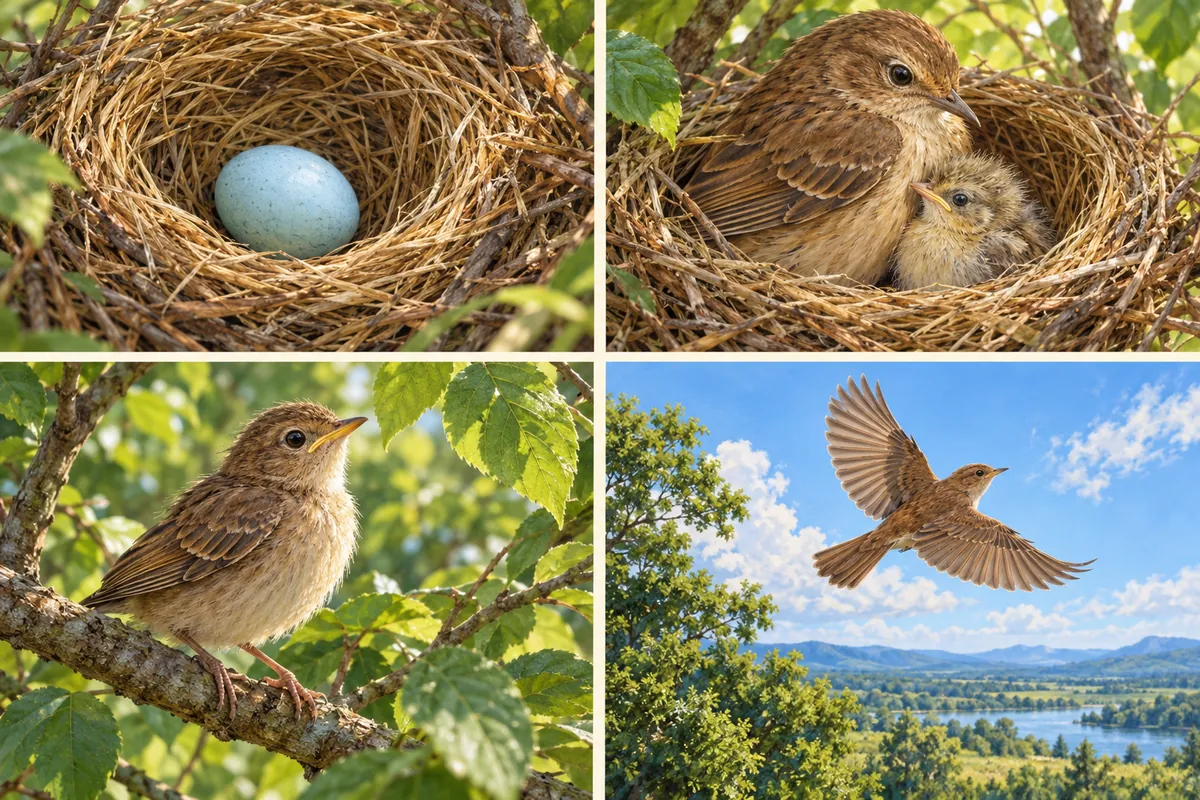
Central idea: As the baby bird grows and explores more of its surroundings, it keeps deciding that it now understands the whole world — first thinking it is a small blue shell, then straw, then leaves — until at last, fully grown, it honestly admits it does not really know how the world is made, and neither do its neighbours. The poem shows that the world is much bigger than we first think and that true wisdom lies in staying curious and admitting how much we still have to learn.
Stanza 1 – Inside the egg: The bird’s first home was a little house — its egg. Living happily there, it believed the whole world was small, round and made of a pale, blue shell, because that shell was all it could see.
Stanza 2 – In the nest: Next the bird lived in a cosy little nest, snuggled close to its mother and needing nothing more. Now it decided the world must be made of straw, since the warm nest of straw was its whole world.
Stanza 3 – Out of the nest: One day the bird fluttered out of the nest to see what it could find. Seeing leaves all around, it announced that the world was made of leaves and admitted that, until then, it had been “very blind” to the larger world.
Stanza 4 – Beyond the tree: At last, grown up and fit for adult tasks, the bird flew beyond the tree into the open sky. Now wiser, it honestly confesses that it does not know how the world is really made — and neither do its neighbours. The bird has finally learnt that the world is too big and wonderful to be fully understood.
Word Meanings (शब्दार्थ)
| Word | English Meaning | हिंदी अर्थ |
|---|---|---|
| pale | light in colour; not dark | हल्के रंग का, फीका |
| shell | the hard outer cover of an egg | अंडे का छिलका |
| nest | a bird’s home made of straw and twigs | घोंसला |
| straw | dried stalks of grain crops | पुआल, तिनके |
| nestled | settled snugly and comfortably | आराम से सिमटकर बैठना |
| fluttered | flew with quick, light wing movements | फड़फड़ाकर उड़ना |
| blind | unable to see; (here) unaware | अंधा, अनजान |
| at length | after some time; finally | अंततः, आख़िरकार |
| beyond | further than; on the far side of | परे, आगे |
| grown-up | fully developed; adult | वयस्क, बड़ा हुआ |
| labours | hard work or tasks | परिश्रम, मेहनत के काम |
| neighbours | those who live nearby | पड़ोसी |
| cosy | warm and comfortable | आरामदायक, गरमाहट भरा |
| round | shaped like a circle or ball | गोल |
NCERT textbook exercises
Before we read — printed page 85
I. Picture and hard work — sample: I see a leafy tree, a nest with chicks and birds nearby. When I practised drawing every day, I improved and felt proud of my effort. Use your own experience.
II. I see birds in trees, gardens and near buildings. They may fly, perch, search for food or carry nesting material.
III. Sample: I would like to fly because I could see a wider landscape. A reasoned ‘no’ is also possible.
IV. A baby bird might imagine that its familiar nest and nearby surroundings are the whole world.
V. Vocabulary replacements in row order: light; fluttered; at last; labour. These replace pale; moved lightly and quickly; finally; hard work.
Let us discuss
I. Read the poem again. Identify the main idea of each stanza. There are two extra sentences given. 1. The bird steps out into the world. 2. The bird lived happily in a small world. 3. The bird becomes blind due to leaves. 4. The bird flies away as an adult. 5. The bird is unhappy with the straw nest. 6. The bird lived in a cosy nest with its mother.
| Stanza | Main idea |
|---|---|
| Stanza 1 | 2. The bird lived happily in a small world. |
| Stanza 2 | 6. The bird lived in a cosy nest with its mother. |
| Stanza 3 | 1. The bird steps out into the world. |
| Stanza 4 | 4. The bird flies away as an adult. |
II. Look at the pictures 1–4 and write the matching line from the poem for each.
| Picture | Matching line from the poem |
|---|---|
| 1. The egg / shell | “I thought the world was small and round, / And made of pale, blue shell.” |
| 2. The nest | “I thought the world was made of straw, / And nestled by my mother.” |
| 3. Among the leaves | “I said the world is made of leaves, / I have been very blind.” |
| 4. Flying in the sky | “At length I flew beyond the tree, / Quite fit for grown-up labours.” |
III. Answer the following with a word from the poem and check the answers with your partner. 1. What was the shape of the bird’s first house? _ O _ _ _ 2. What was the bird’s second nest made of? _ _ R _ _ 3. What did the bird see when it came out of its nest? L _ _ _ E _ 4. What did the bird do at the end? _ _ _ W
IV. Now, recite the poem aloud along with your teacher and classmates.
Let us think and reflect
I. Write whether the following sentences are True or False. 1. The bird changed its house two times. 2. The neighbours tell the bird about the world.
II.1. Read the following lines from the poem and answer the questions given below. “I thought the world was made of straw, / And nestled by my mother.”
(i) Who lived in the nest along with the baby bird?
(ii) Complete the following by choosing the correct option. The bird thought the world was made of straw because __________. A. it lived in a straw hut B. its nest was made of straw C. its mother fed straw to it D. there was straw all around
(iii) Which word tells us that the baby bird was warm and comfortable?
II.2. Read the following lines from the poem and answer the questions given below. “I said the world is made of leaves, / I have been very blind.”
(i) Why did the bird think the world was made of leaves?
(ii) What does the set of words ‘I said’ mean? A. flew B. shouted C. spoke D. cried
(iii) Fill in the blanks to complete the sentence. The bird felt that it had been very blind because it could not __ __ __ the leaves from __ n __ __ __ e the nest.
III. Why did the baby bird think that its first world was small, round and blue?
IV. Where did the bird go when it fluttered from its straw nest?
V. What quality did the bird say it had, when it flew away?
VI. Who do you think were the bird’s neighbours? Why do you think so? Discuss.
Let us learn
I. Let us write some rhyming words. One has been done for you. (Find rhyming words from the poem for each stanza, then write new rhyming words.)
| Stanza | Rhyming words from the poem | New rhyming words |
|---|---|---|
| Stanza 1 | well – shell | fell, bell, tell, sell |
| Stanza 2 | other – mother | brother, another (not ‘bother’, which has a different vowel sound) |
| Stanza 3 | find – blind | kind, mind, behind; wind only when pronounced /waɪnd/ as in winding a clock, not wind /wɪnd/ meaning moving air |
| Stanza 4 | labours – neighbours | (few exact rhymes) flavours, favours |
But one thing I surely know,
Whenever I wish to rest,
My little nest is the best.
II. The poet uses words like ‘pale’, ‘blue’, ’round’, ‘straw’ and ‘little’ to describe the bird’s nest. (Read more describing words: pointed, small, green, wooden, thin, hanging, brown, round.) Now, use the describing words given in the box to create six sentences based on the given picture.
- The small brown bird is at the birdhouse entrance.
- The birdhouse is wooden.
- It has a round entrance.
- A thin cord holds it below the branch.
- The birdhouse is hanging from the tree.
- Green leaves grow above its pointed roof.
These sample sentences describe the actual page-90 picture; it does not show a straw cup-nest or a pointed metal hook.
Let us listen
You will listen to a short poem. As you listen, fill in the missing words. (refer to page 102 for transcript) I’m a parrot, my name is Paro, / My feathers are __ __ __ g __ __ and they glow. / In the morning, I spread my wings, / ___ ___ ___ around and see wonderful things. / Come with me through the skies so ___ l ___ ___, / To places old and places new. / Among the ___ ___ e ___ ___, where the breeze is light, / Many new s t __ __ __ ___ s, oh, what a sight!
Let us speak
Speak about which bird you would like to be. Include: Which bird are you? What do you look like? Where do you live? What do you do during the day? Do you have any message for humans?
Let us write
I. Read how the bird perceived its world. (Sample paragraph given in the book.) II. Now, discuss how you think the world would look to the following: 1. a baby 2. a fish. III. Now, write five sentences each, for both 1 and 2, in your notebooks.
Let us explore
I. The bird’s first home was made of a shell. Later its home was among leaves and made of straw. Look at your home and make a list of all the materials it is made of; why are our homes not made of straw; what would your dream home look like; how is a home different from a house; and list workers who build houses and their work (e.g. mason – lays bricks and stones; painter, electrician, plumber, carpenter, architect).
| Worker | Their work |
|---|---|
| mason (example) | lays bricks and stones |
| 1. painter | paints the walls, doors and windows |
| 2. electrician | fits wires, switches, fans and lights |
| 3. plumber | fits water pipes, taps and drains |
| 4. carpenter | makes doors, windows and furniture of wood |
| 5. architect | plans and designs the building |
II. Look at the different kinds of nests and homes the birds make. Have you seen any? Discuss these types of nests with your teacher and classmates.
Additional ClearStudy questions
This practice is separate from the printed textbook exercises.
Short Answer Questions (30–40 words)
Inside the egg, the bird thought the world was small and round and made of a pale, blue shell, because the shell was the only thing it could see around itself. Q2. How did the bird’s idea of the world keep changing?
The bird first thought the world was a blue shell, then made of straw, then made of leaves, and finally admitted it did not know how the world was made at all. Its idea grew bigger as it grew up. Q3. Why does the bird say it had been “very blind”?
The bird calls itself blind because, while it was inside the nest, it could not see the leaves and the larger world outside. It realised it had known only a tiny part of the world. Q4. What does the bird finally admit at the end of the poem?
At the end the grown-up bird honestly admits that it does not know how the world is really made, and that even its neighbours do not know. The world is simply too big to fully understand. Q5. What lesson does the poem teach us?
The poem teaches that the world is far larger than we first think and that we should stay curious and humble. There is always more to learn, so we should never believe we already know everything.
Long Answer Questions (100–120 words)
The poem follows a baby bird as it grows. In stanza one, inside the egg, it thinks the whole world is a small, round, blue shell. In stanza two, in its straw nest beside its mother, it decides the world is made of straw. In stanza three it flutters out, sees leaves everywhere and believes the world is made of leaves, admitting it had been “very blind” before. In the last stanza, grown up and “fit for grown-up labours”, it flies beyond the tree into the open sky and honestly says it does not know how the world is made — and neither do its neighbours. The bird learns that the world is vast and that learning never ends. Q2. How does the poem show that growing up means learning to be humble?
As a tiny bird, the chick is very sure of itself — each time it sees a little more of its surroundings, it confidently announces what the whole world must be made of. But every confident guess turns out to be wrong as its world grows bigger. By the time it is fully grown and flying in the open sky, the bird has learnt something important: it openly admits it does not know how the world is really made, and that even its neighbours do not know. This honest confession shows that true growing up is not about knowing everything, but about becoming humble enough to accept how much we still have to learn. Q3. Why do you think the poet chose a bird to give this message?
The poet chose a bird because a bird’s life clearly shows steady growth and discovery — it begins inside a tiny egg, moves to a nest, then explores the leaves, and finally flies into the wide open sky. Each stage gives the bird a bigger view of the world, which makes it the perfect example to show how our understanding grows with experience. A bird is also small, gentle and familiar to children, so its innocent thoughts feel charming and easy to relate to. Through the bird’s simple journey, the poet teaches a deep lesson about curiosity, humility and lifelong learning in a light and pleasant way.
ClearStudy MCQ practice
1. Where did the bird live first?
(a) in a nest (b) in a little house (the egg) (c) on a leaf (d) in the sky
2. What colour did the bird think the world was at first?
(a) green (b) brown (c) pale blue (d) golden
3. The bird thought its second world was made of —
(a) leaves (b) straw (c) shell (d) water
4. Who was with the bird in the nest?
(a) its father (b) its mother (c) its friends (d) no one
5. When the bird fluttered from its nest, it thought the world was made of —
(a) straw (b) shell (c) leaves (d) clouds
6. The word ‘fluttered’ means —
(a) slept (b) flew with quick light wing-beats (c) sang (d) walked
7. The bird said it had been “very ________” while inside the nest.
(a) blind (b) happy (c) clever (d) lazy
8. At the end, the bird flew —
(a) into the nest (b) inside the egg (c) beyond the tree (d) under the leaves
9. At the end, the bird admits that it —
(a) knows everything (b) does not know how the world is made (c) hates the world (d) will never fly
10. The main lesson of the poem is that —
(a) birds cannot fly (b) the world is small (c) the world is vast and learning never ends (d) nests are the best homes
ClearStudy assertion–reason practice
For each, choose: (a) Both A and R are true and R is the correct explanation of A. (b) Both A and R are true but R is NOT the correct explanation of A. (c) A is true but R is false. (d) A is false but R is true.
1. Assertion (A): The bird first thought the world was small, round and blue.
Reason (R): It lived inside an egg with a pale, blue shell, which was all it could see.
Answer: (a) — R correctly explains why the bird had that idea of the world.
2. Assertion (A): The bird thought the world was made of straw.
Reason (R): Its nest was built of straw and was its whole world at that time.
Answer: (a) — R correctly explains the bird’s belief.
3. Assertion (A): The bird’s neighbours explained to it how the world was made.
Reason (R): The poem says “neither do my neighbours” know how the world is made.
Answer: (d) — A is false (the neighbours did not explain anything); R is true.
4. Assertion (A): The bird called itself “very blind”.
Reason (R): While inside the nest it could not see the leaves and larger world outside.
Answer: (a) — R correctly explains why the bird felt it had been blind.
5. Assertion (A): The poem teaches that we should be humble about how much we know.
Reason (R): Even after growing up, the bird honestly admits it does not fully understand the world.
Answer: (a) — R correctly explains the poem’s message.
📌 Exam Tips
• Remember the order of the bird’s homes: egg-shell → straw nest → leaves → open sky. A common question asks what the bird thought the world was made of at each stage.
• Learn the rhyme pairs: well–shell, other–mother, find–blind, labours–neighbours.
• Quote short lines — “made of pale, blue shell”, “I have been very blind”, “neither do my neighbours” — to support your answers.
• For the message, link it to curiosity, humility and lifelong learning.
⚠ Common Mistakes to Avoid
• Do not write that the bird’s neighbours told it about the world — the poem says even they do not know.
• “Blind” here does not mean the bird actually lost its eyesight; it means it had been unaware of the larger world.
• The bird was happy in its nest, not unhappy — do not say it disliked the straw nest.
• Do not invent a poet’s name; the poem is anonymous.
• Spell the key words correctly: fluttered, nestled, beyond, labours, neighbours.
Frequently Asked Questions (FAQs)
Who is the poet of What a Bird Thought?
The supplied NCERT Poorvi text credits the poem as Anonymous.
What is the sequence of the bird’s ideas?
Its view changes from a pale blue shell, to straw, to leaves, then to recognising that it does not know how the wider world is made.
What are the True/False answers?
The intended answers are True and False: the exercise broadly counts egg-to-nest and nest-to-tree as two changes; the neighbours do not explain the world to the bird. Flying beyond the tree is another stage of perspective, not explicitly a new house.
What are the listening blanks?
From the page-102 Paro transcript: bright, Fly, blue, trees and stories.