
Spices that Heal Us — Class 6 English Poorvi Questions and Answers
Spices that Heal Us questions and answers: study Daadi’s letter in Class 6 Poorvi with comprehension, spice identification, modal verbs and the Tulsi listening fact sheet.
Source: NCERT Poorvi, Grade 6, Unit 3, printed pages 93–100; listening transcript 102; supplied reprint 2026–27. Open-ended and personal responses are examples to adapt. These explanations are study support, not an official NCERT answer key.
About the chapter
“Spices that Heal Us” appears in Unit 3, ‘Nurturing Nature’. It is written in the form of a warm, affectionate letter from a grandmother (Daadi) to her two grandchildren, Vikram and Vaibhavi, who have just recovered from an illness. In the letter, Daadi shares the everyday healing uses of common kitchen spices – turmeric, fenugreek, cumin, asafoetida, cinnamon, clove, ginger, black pepper, fennel, carom seeds and cardamom. The piece celebrates the wisdom of traditional Indian home remedies passed down through generations, while reminding readers to always consult an experienced elder before using any cure.
About the piece
The piece is presented as a letter from Daadi to Vikram and Vaibhavi, without a separate author byline in the supplied text. Daadi is the letter’s speaker, not a verified name for the lesson’s author. Its affectionate language explores family knowledge and intergenerational learning.
Summary
Daadi responds to Vikram and Vaibhavi’s message that they are feeling better. She recalls learning traditional home remedies from her own grandmother, describes the uses she associates with common kitchen spices, and encourages the children to remember and share this knowledge.
The letter mentions turmeric, fenugreek, cumin, asafoetida, cinnamon, clove, ginger, black pepper, fennel, carom seeds and cardamom. Its closing asks the children to identify spices in the kitchen and consult an elder before using them.
Passage-based learning: remedy descriptions and the Tulsi transcript below explain the textbook, not proven treatments or dosing advice. Natural products can have risks, and actual illness needs qualified medical guidance; do not replace prescribed care with home remedies. See NIH information for children and families.
Theme & message
The letter highlights affection, learning from elders and preserving family knowledge. Readers can value those experiences while asking questions and checking health claims. The story’s advice to consult an elder is important for children, but an elder’s familiarity is not a substitute for appropriate healthcare.
Word meanings
| Word | English meaning | Hindi meaning |
|---|---|---|
| spice | a part of a plant used to flavour food | मसाला / ख़ुशबू |
| heal | to make healthy or well again | स्वस्थ करना / ठीक करना |
| remedy | a cure or treatment for an illness | उपचार / दवा |
| cure | something that makes an illness end | इलाज / निदान |
| digestion | the process of breaking down food in the body | पाचन |
| sleeplessness | the inability to sleep | अनिद्रा / नींद न आना |
| relief | the easing of pain or discomfort | आराम / राहत |
| respiratory | connected with breathing | श्वसन से संबंधित |
| weather-related | caused by or linked to the weather | मौसम से जुड़ा हुआ |
| illness | the state of being unwell or sick | बीमारी |
| soak | to leave something in water for a while | भिगोना / पानी में डालना |
| grate | to rub food into small pieces with a grater | कदूकस से घिसना |
| affectionately | in a loving, caring way | स्नेहपूर्वक |
| aashirwaad | a blessing from an elder | आशीर्वाद |
| generation | all the people born at about the same time | पीढ़ी |
| consult | to ask someone for advice or information | सलाह लेना / परामर्श करना |
| property | a quality or feature of something | गुण / विशेषता |
Let us do these activities before we read
I. A spice is any seed, fruit, root, bark, leaf or any other part of a plant used to give taste and colour to our food. Try to recall the names of three spices that are used for cooking in your home.
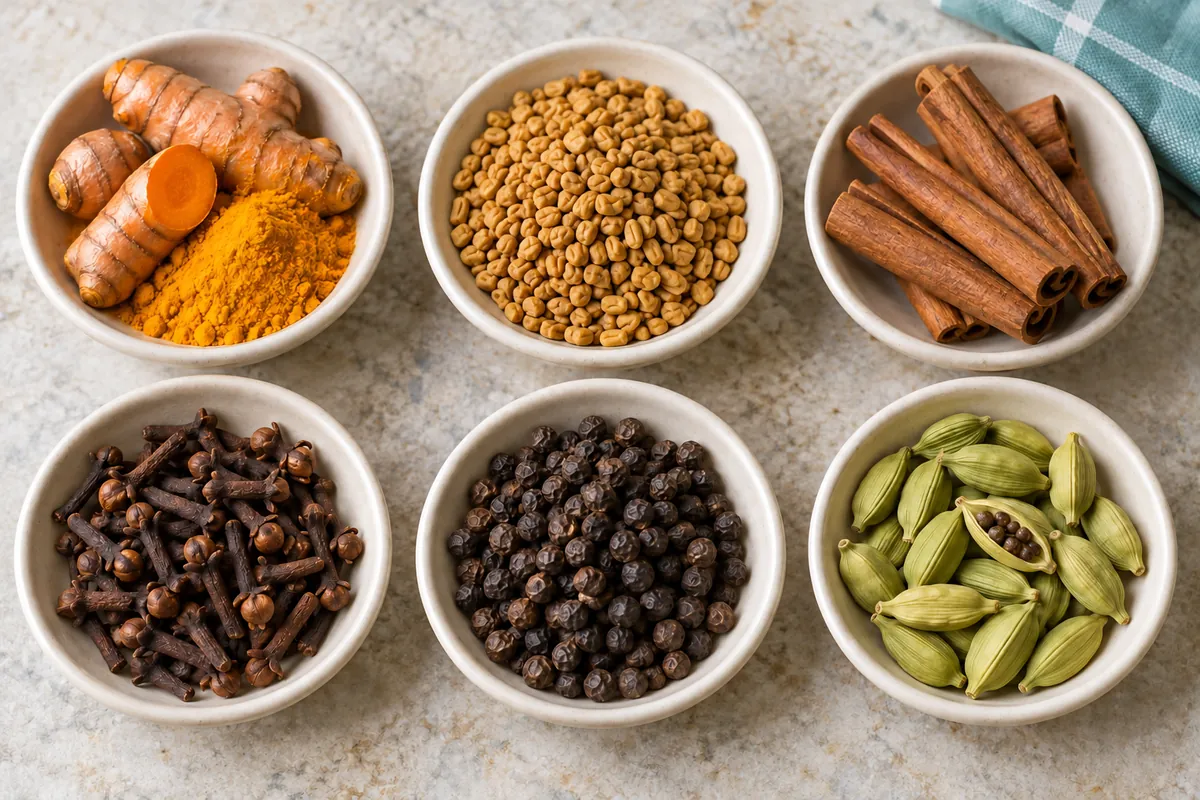
II. Given below are pictures of some spices. Work in pairs and write what you call them in your language. Their names in English are given in the last column.
III. Do you know if these spices can be used for something else other than cooking? Let us find out by reading the letter given below.
Let us think and reflect
I. Questions about Daadi’s grandmother
- She found the ingredients in the spices and herbs kept in the kitchen.
- Cough or cold is an example associated with seasonal changes in the letter. Avoid saying that a change in weather alone causes an infection or fever.
- The speaker’s memories suggest a close, affectionate relationship: she learned from her grandmother and still remembers her advice.
II. Methi blanks
her sugar level and her body weight, according to Daadi’s account.
III. Spice not mentioned for body pain
2. Fennel seeds. The letter associates these with digestion, while turmeric, ginger and black pepper are mentioned for pain.
IV. Why share the knowledge?
Daadi believes the remedies helped the children and wants others to benefit. This explains her intention; it does not establish the effectiveness of every remedy.
V. Final advice
Identify the spices in the kitchen and consult an elder before using them.
VI. How knowledge passes between generations
Daadi learned from her grandmother and now writes to her grandchildren. The letter shows inherited knowledge being remembered and shared.
VII. Why learn about spices? — sample view
Learning helps us recognise foods and understand family traditions. We should also distinguish culinary uses from medicinal claims and seek qualified guidance about illness.
Let us learn
I. Spice observation table
Colour, texture and taste depend on whether you observe the whole spice or its powder. These are model observations.
| Spice | Plant part | Colour | Texture | Taste |
|---|---|---|---|---|
| Turmeric | Rhizome: an underground stem; ‘root’ is the closest broad category in the exercise box | Orange-yellow inside; powder yellow | Fresh outer surface rough; powder fine | Earthy, slightly bitter |
| Fenugreek | Seeds | Yellowish-brown | Hard, angular | Bitter |
| Cinnamon | Bark | Brown | Layered, rough | Sweet-spicy |
| Clove | Dried flower buds | Dark brown | Hard, rough | Pungent/spicy |
| Black pepper | Dried fruit | Black | Wrinkled | Pungent/spicy |
| Cardamom | Seeds inside a fruit capsule/pod | Green pod; dark brown to black seeds | Pod ridged; seeds small and hard | Aromatic, sweet-spicy |
II.1. Helping verbs and functions in the printed table
(i) may → B suggestion; (ii) should → D advice; (iii) can → E ability; (iv) must → C compulsion; (v) need to → F necessity; (vi) used to → A past habit.
These functions apply to this exercise; modals can have other uses in other contexts. ‘Need to’ and ‘used to’ are included as helping expressions, although they do not behave exactly like core modal verbs.
II.2. Dialogue — one suitable grammar model
Use each once: should; must; can; need to. This completes the printed dialogue’s wording; it is not medical advice endorsing its claim about cures. Other combinations may be discussed if grammatical and meaningful.
Let us listen / speak / write / explore
Let us listen — The Wonder Herb, transcript 102
Complete the numbered fact sheet in its original order:
- Family: basil
- First found in: north central India
- Now found: everywhere in India (given)
- Known as the Queen of herbs
- Levels of glucose and cholesterol
- Breathing and digestion
- Mouth wash and toothpaste
- raw; tea
The origin and health statements above report the audio’s wording. They are not independently established here as medical recommendations.
Let us speak — headband and sample
Make a paper band, draw and colour a spice on a small card, attach it and introduce yourself as that spice. Sample: ‘I am turmeric, or haldi. I come from a rhizome, an underground stem. I am orange-yellow and taste earthy and slightly bitter. My outside is rough. I add colour and flavour to food. Daadi’s letter also describes traditional medicinal uses.’
Let us write I — missing phrases, not a dosing guide
For the first passage, insert: a piece of fresh ginger; the mixture; you can have it; for cough. For the second: home remedy; grind to get; amount of honey. Unused: some leaves of basil; for high fever. Work with the printed paragraphs in the textbook; these are language answers, not instructions to prepare or administer a remedy.
Let us write II — paragraph based on the transcript
Sample: The listening passage introduces Tulsi as a shrub in the basil family. It says that the herb was first found in north central India and now grows widely in India. It calls Tulsi the Queen of Herbs and describes traditional health uses and products such as mouth wash and toothpaste. It also mentions leaves eaten raw or added to tea. These details summarise the transcript rather than prescribe treatment.
Let us explore — riddles
I.1. Asafoetida (heeng) matches Daadi’s account of the grandmother’s use for a baby’s tummy. I.2. Ginger (adrak) matches the underground spice and the historical use described.
II. Complete the methi riddle: yellow; bitter; control, based on the letter. Original sample riddle: ‘I am a little green pod / with dark seeds tucked inside; / I bring a fragrant flavour / when cooks open me wide.’ Answer: cardamom.
III. With your teacher, observe suitable spices by smell and touch. Identify their shapes and aromas; do not taste unknown material or inhale dry powders.
Additional ClearStudy questions
This practice is separate from the printed textbook exercises.
1. Who sends the letter?
Daadi writes affectionately to Vikram and Vaibhavi.
2. How does it show learning across generations?
Daadi recalls her grandmother’s knowledge and passes it on through a letter to her grandchildren.
3. What spices are associated with digestion in the letter?
Turmeric, cumin, black pepper, fennel, carom seeds and cardamom.
4. Why does the letter mention a dentist?
It describes cinnamon and clove as temporary relief until consulting a dentist, showing that the speaker recognises a need for professional care.
5. What distinguishes a green cardamom pod from its seeds?
The outer capsule is green; the small aromatic seeds inside are dark.
ClearStudy MCQs and assertion–reason practice
1. Who wrote the letter in ‘Spices that Heal Us’?
(a) a doctor (b) Daadi (the grandmother) (c) Vikram (d) the teacher
2. To whom was the letter written?
(a) Amber (b) her own grandmother (c) Vikram and Vaibhavi (d) a dentist
3. What is haldi called in English?
(a) fenugreek (b) cumin (c) turmeric (d) ginger
4. How does Daadi use methi (fenugreek) seeds?
(a) she fries them (b) she soaks them overnight and drinks the water (c) she eats them dry (d) she makes oil from them
5. According to the letter, which spices give relief from toothache till one sees a dentist?
(a) turmeric and cumin (b) cinnamon and clove (c) ginger and pepper (d) fennel and cardamom
6. For how long has ginger been used in cooking, according to the letter?
(a) 100 years (b) 500 years (c) more than 4000 years (d) 10,000 years
7. According to Daadi, which spices are served at the end of a meal to help digestion?
(a) saunf and ajwain (b) heeng and haldi (c) laung and dalchini (d) methi and jeera
8. From whom did Daadi learn these home remedies?
(a) a doctor (b) a book (c) her grandmother (d) her school
9. What was Daadi’s final advice to the children?
(a) eat more spices (b) consult an elder before using the remedies (c) never use spices (d) buy new spices
10. In the ‘Wonder Herb’ fact sheet, Tulsi is known as the ____ of herbs.
(a) King (b) Queen (c) Prince (d) Doctor
Assertion–Reason – choose: (a) A and R true, R explains A; (b) A and R true, R does not explain A; (c) A true, R false; (d) A false, R true.
1. Assertion (A): Daadi asked the children to share the natural cures with their friends.
Reason (R): She wanted this useful traditional knowledge to be remembered and passed on to others.
2. Assertion (A): Daadi warned the children to consult an elder before using the remedies.
Reason (R): Spices and home remedies must be used carefully under proper guidance.
3. Assertion (A): The letter lists fennel seeds (saunf) for relieving body pain.
Reason (R): The letter says fennel seeds are served after meals to help in the digestion of food.
4. Assertion (A): Daadi learnt the home remedies from her own grandmother.
Reason (R): Her grandmother used to find cures for common weather-related illnesses in the kitchen.
5. Assertion (A): Heeng (asafoetida) water was used on a baby’s tummy.
Reason (R): Daadi says she used it to give the babies relief from gas.
Exam tips & common mistakes
Study reminders
- Learn the English and local names from the page-93 activity.
- Fennel is the body-pain question’s odd choice according to the letter.
- Remember the modal functions in their exercise context.
- Distinguish a turmeric rhizome from a true root and cardamom pods from seeds.
- Report health claims as the speaker’s words; do not treat textbook grammar passages as prescriptions.
FAQs
What is Spices that Heal Us about?
It is a letter from Daadi to Vikram and Vaibhavi about kitchen spices and traditional knowledge learned from her own grandmother.
What are the methi blanks and the body-pain answer?
The blanks are her sugar level and her body weight. The spice not listed for body pain is fennel seeds.
Is turmeric a root?
Botanically it is a rhizome, an underground stem. The exercise’s broad word box offers root as the closest category.
Are the remedies instructions to self-treat?
No. These answers explain the textbook letter and language tasks. Actual illness needs appropriate medical guidance; do not replace prescribed care with home remedies.