
Change of Heart — Class 6 English Poorvi Questions and Answers
Change of Heart questions and answers: follow Prabhat and Surya’s story in Class 6 Poorvi with comprehension, consecutive-letter word puzzles, past perfect tense and listening notes.
Source: NCERT Poorvi, Grade 6, Unit 4, printed pages 103–114; listening transcript 128; supplied reprint 2026–27. Open-ended and personal responses are examples to adapt. These explanations are study support, not an official NCERT answer key.
About the chapter
“Change of Heart” is a short, two-part school story from Unit 4, ‘Sports and Wellness’. It is about Prabhat, a boy who always wanted to win and simply could not bear to lose – not even at marbles. When a cheerful new student, Surya, joins the school, Prabhat cheats to beat him in a friendly badminton match. To his surprise, Surya does not mind losing at all and keeps enjoying every game he plays, whether he is good at it or not. Watching Surya slowly changes Prabhat’s heart, and he learns that the real joy of sport lies in playing and enjoying, not only in winning.
About the story
“Change of Heart” appears in Poorvi, the NCERT English reader for Class 6, in the unit themed on sports and wellness. The textbook does not give a separate author’s name for the story; it is presented as a simple narrative chosen to teach young readers about sporting spirit, fair play and well-being. The story is told in two parts, each followed by short ‘Let us discuss’ questions, and uses an everyday school setting – friendly Friday matches, a badminton court and a basketball game – so that children can easily relate to Prabhat’s feelings about winning and losing and learn from the gentle change in his attitude.
Summary
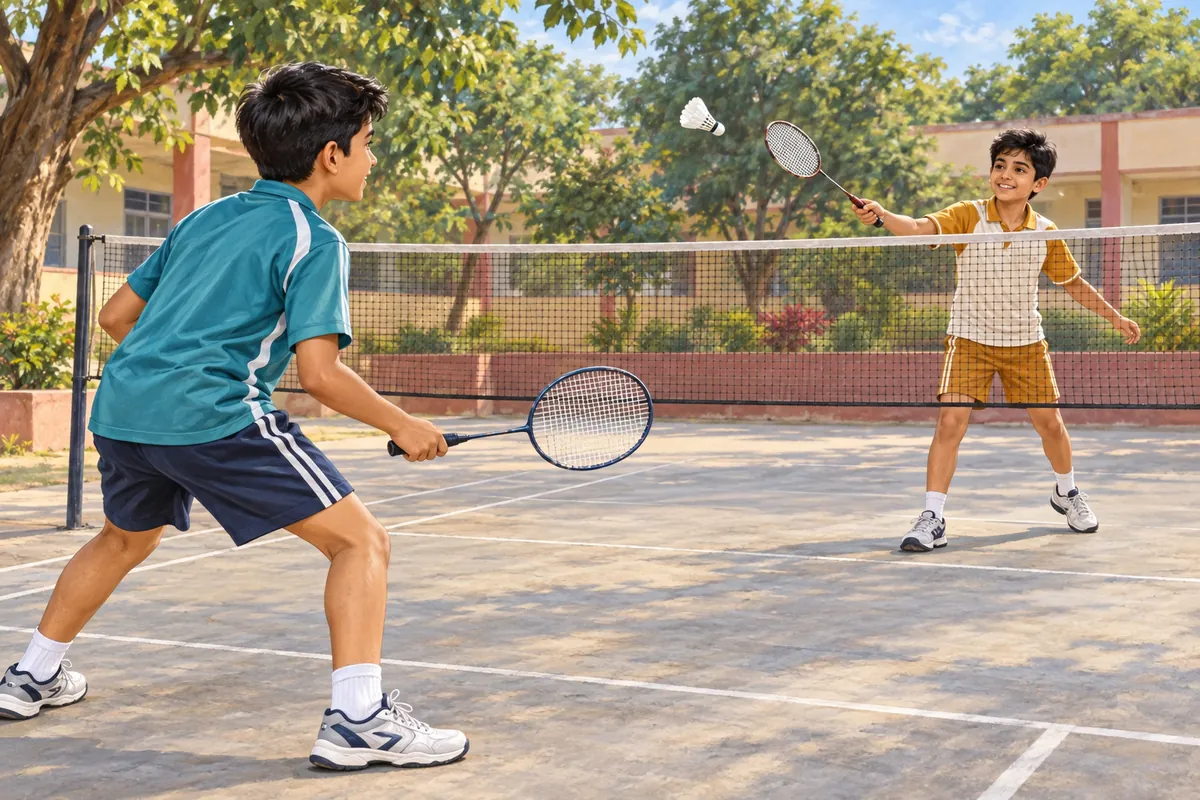
Prabhat was a boy who always wanted to win. His parents, teachers and friends all felt that he did not know how to accept defeat. Losing made him feel terrible, while winning made him feel wonderful, so he refused to play any game he was not sure of winning. He took part only in games he was really good at, such as badminton.
A new student named Surya joined the school. Surya was an excellent badminton player, but he was always relaxed, smiling and cracking jokes. On the last Friday of the month, when the coach held friendly matches, Prabhat and Surya were chosen to play against each other, with Prabhat keeping the score. Surya played brilliantly but paid little attention to the scoreboard, so Prabhat secretly changed the scoreboard and won by cheating. He made a big fuss about his win, but it did not matter to Surya, who only said it had been fun and they should play again.
That night Prabhat could not sleep. He had won, yet he did not feel as happy as usual. He was puzzled that Surya did not feel bad about losing, and even more puzzled to see Surya happily playing basketball the next day, even though he could not score a basket for ten minutes. Prabhat watched Surya for several days and noticed that he enjoyed every game equally, whether he was good or bad at it. Slowly Prabhat realised that you do not need a scoreboard to enjoy a game – what matters is trying your best and enjoying every moment. His own heart changed: he began playing hide and seek, joked during badminton, and soon the other students agreed that Prabhat now had a great sporting spirit.
Theme & message
The central theme of the story is sporting spirit and the true meaning of playing a game. Through Prabhat’s journey from a poor loser who even cheats to win, to a cheerful player who enjoys every game, the story shows that the joy of sport lies in taking part, trying your best and having fun – not only in winning. It teaches young readers important values of honesty, fair play, accepting defeat gracefully and looking after one’s own wellness and happiness. The title, ‘Change of Heart’, captures how a person’s attitude can change for the better through observation and self-reflection.
Word meanings
| Word | English meaning | Hindi meaning |
|---|---|---|
| defeat | loss; not winning | हार |
| on the contrary | just the opposite | इसके विपरीत / बल्कि |
| terrible | very bad; unhappy | बहुत बुरा / भयानक |
| sensed | had known or felt | भांप लिया / महसूस किया |
| significant | important | महत्वपूर्ण |
| conducted | organised; arranged | आयोजित किया |
| seriousness | being serious; full attention | गंभीरता |
| phenomenon | someone who has special qualities | असाधारण व्यक्ति / अद्भुत प्रतिभा |
| opponent | someone you compete with | प्रतिद्वंद्वी / विरोधी |
| scoreboard | a board that shows the points | अंक दिखाने वाला बोर्ड |
| cheating | acting dishonestly to win | धोखा / बेईमानी |
| hopeless | having no skill in something | बहुत कमजोर / निराशाजनक |
| kept a close watch on | observed carefully | ध्यान से देखना / निगरानी रखना |
| realised | understood clearly | समझ गया / एहसास हुआ |
| tally | a record of points in a game | अंकों का लेखा-जोखा |
| sporting spirit | being fair and respecting each player | खेल-भावना / खेल भावना |
Before we read — printed page 103
I–III. Personal examples: I play badminton and hide-and-seek. I play hide-and-seek for fun and badminton in friendly games or competitions. Winning makes me happy; after losing I try to learn and congratulate the other player. Your choices and feelings may differ.
IV. Meaning choices: 1 (ii); 2 (i); 3 (ii); 4 (ii). A friendly match is played outside a formal competition; it may still have opponents and scores. Sporting spirit includes fairness and respect, rather than merely observing rules.
Let us discuss
Part I
1. State whether the following is True or False. Prabhat would accept losing to anyone easily.
2. What was special about the last Friday of each month?
3. Who was responsible for maintaining the score for the match?
4. Do you think Prabhat wished to play another match with Surya? Why do you think so?
Part II
1. How did Surya feel about playing?
2. What was it about Surya that Prabhat observed?
Let us think and reflect
I.1. Extract – “If Prabhat sensed that he would lose a game, he would not play it. He would take part only when he was sure of winning, even if the game lasted only for a minute. You could not stop him from playing the kind of games he was really good at, like badminton.”
I.2. Extract – “Surprisingly, Prabhat could not sleep well that night. He had won the game but he did not feel as happy as he usually did. What was surprising was that Surya did not feel bad about losing. What was more surprising was that Prabhat saw Surya playing basketball the next day.”
II. Answer the following questions.
Let us learn
I. Words using consecutive letters
Do not rearrange letters or skip them. The following ordinary words occur as uninterrupted runs:
- BADMINTON: bad, admin, mint, in, into, ton, on.
- PHENOMENON: he, hen, no, omen, me, men, on.
- BASKETBALL: bask, ask, basket, ball, all.
‘Mind’ cannot be formed from BADMINTON because it ends with d; ‘none’ is not consecutive in PHENOMENON. Avoid fragments such as ‘phen’, ‘bas’ and ‘ket’ as ordinary English answers.
New sample puzzle: RAINBOW → rain, in, bow. Try another word and check each answer against its letter order.
II. Verbs to circle
- was discussing; had played
- had won; did not feel; did (the last ‘did’ stands for the usual feeling)
- was; had not felt. ‘Losing’ is also a verb-ing form used after ‘about’, rather than a finite past-tense verb.
The printed third sentence omits ‘is’ after ‘surprising’. In normal prose it would read ‘What was more surprising is/was that…’; the exercise’s earlier/later comparison focuses on had not felt and was.
III. Earlier and later situations
| Earlier action or feeling | Later situation |
|---|---|
| had played | was discussing (given) |
| had won | did not feel as happy |
| had not felt bad | was surprising |
The past perfect uses had + past participle; it places an event before the later past situation.
IV. Past-perfect blanks
- had already finished
- had played
- had already won
- had never met
- had practised
Let us listen, speak, write & explore
Let us listen
I. You will listen to an announcement. As you listen, circle the pair that was chosen to play chess. (Rima – Dhiraj / Gita – Hitesh / Sarita – Nupur)
II. Listen to the announcement again and fill in the notes with important details.
Let us speak
In pairs, take turns to use the three magic words — ‘please’, ‘thank you’ and ‘sorry’ — for the given situations (requesting to join a team, asking for help, apologising for spilling water, forgetting a friend’s file, speaking rudely, and thanking others).
This is a speaking activity to be done in pairs in class – the lines above are model answers; you may use your own polite words.
Let us write
Complete Prabhat’s diary page (about the badminton match) using the phrases given in the box.
This is a guided writing task; the order above fits the diary, but small changes in wording are acceptable as long as each phrase makes sense in the sentence.
Let us explore
Read the brief bio-sketches of Indian sportspersons (Deepika Kumari and Neeraj Chopra) and visit the given links to learn about other Indian sportspersons and Arjuna Awardees.
The sports bio-sketches above summarise the supplied textbook, including Neeraj Chopra’s Paris 2024 silver. For the dated award activity, read the Government of India National Sports Awards 2023 announcement (the awards ceremony was in January 2024). Treat it as a dated list, not the current year’s awardees.
Additional ClearStudy questions
This practice is separate from the printed textbook exercises.
Short answer (30–40 words)
1. Why did everyone say that Prabhat did not know how to accept defeat?
2. How did Prabhat manage to win the badminton match against Surya?
3. Why could Prabhat not sleep well after winning the match?
4. What did Prabhat notice when he watched Surya for some days?
5. How did the other students react to the change in Prabhat?
Long answer (100–120 words)
6. Describe the change that came over Prabhat by the end of the story and what caused it.
7. What lesson about sports and wellness does ‘Change of Heart’ teach young readers?
ClearStudy MCQs and assertion–reason practice
1. What was Prabhat’s biggest problem at the start of the story?
(a) he was a poor student (b) he could not bear to lose (c) he had no friends (d) he could not play any game
2. Which game was Prabhat really good at?
(a) basketball (b) chess (c) badminton (d) kho-kho
3. What was special about the last Friday of each month?
(a) a holiday (b) friendly matches were held (c) a test was held (d) a school trip
4. Who was the new student who joined Prabhat’s school?
(a) Surya (b) Hitesh (c) Dhiraj (d) Nupur
5. How did Prabhat win the badminton match against Surya?
(a) by playing better (b) by luck (c) by cheating and changing the scoreboard (d) Surya gave up
6. How did Surya feel about losing the match?
(a) very angry (b) very sad (c) he did not feel bad at all (d) he cried
7. What did Prabhat see Surya doing the next day?
(a) playing basketball (b) playing chess (c) studying (d) staying at home
8. What did Prabhat finally realise about enjoying a game?
(a) you must always win (b) you need a scoreboard (c) you should enjoy the game for its own sake (d) you must play alone
9. What did the other students say about Prabhat at the end?
(a) that he was the best player (b) that he had a great sporting spirit (c) that he was a cheat (d) that he never played
10. In which unit of Poorvi does ‘Change of Heart’ appear?
(a) Sports and Wellness (b) Friendship (c) Nature (d) Festivals
Assertion–Reason – choose: (a) A and R true, R explains A; (b) A and R true, R does not explain A; (c) A true, R false; (d) A false, R true.
1. Assertion (A): Prabhat refused to play games he was not sure of winning.
Reason (R): He could not bear losing and felt terrible whenever he lost.
2. Assertion (A): Prabhat cheated to win the badminton match against Surya.
Reason (R): Surya was a hopeless badminton player who could not win any point.
3. Assertion (A): Prabhat could not sleep well after winning the match.
Reason (R): He did not feel as happy as usual and was puzzled by Surya’s calm reaction to losing.
4. Assertion (A): Surya stopped playing games after losing to Prabhat.
Reason (R): Surya enjoyed every game equally and kept playing happily even when he was bad at it.
5. Assertion (A): By the end of the story, Prabhat developed a great sporting spirit.
Reason (R): Watching Surya helped him realise that the real joy of a game is in playing and enjoying it.
Exam tips & common mistakes
Exam tips
• Remember the order of events: Prabhat hates losing → Surya joins → friendly match → Prabhat cheats → he cannot sleep → he watches Surya → his heart changes.
• Always contrast the two boys clearly – Prabhat plays only to win; Surya plays to enjoy.
• In theme answers, use the keywords sporting spirit, fair play, honesty and enjoying the game.
• For the title question, link ‘Change of Heart’ to the change in Prabhat’s attitude.
Common mistakes
• Do not write that Surya was a poor badminton player – he was an excellent player; Prabhat won only by cheating.
• Do not say Prabhat won fairly – he secretly changed the scoreboard.
• Do not confuse the games: the friendly match was badminton; the next day Surya played basketball.
• Remember the chosen chess pair in the listening task was Sarita – Nupur, not the other pairs.
FAQs
What is the story ‘Change of Heart’ about?
It is about a boy named Prabhat who always wanted to win and even cheated to do so, until watching a cheerful classmate, Surya, taught him that the real joy of a game is in playing and enjoying it, not just in winning.
Why is the story titled ‘Change of Heart’?
The title refers to the change in Prabhat’s attitude. He moves from caring only about winning to developing a true sporting spirit, so his ‘heart’ truly changes for the better.
How did Prabhat win the badminton match?
He won unfairly. While Surya was distracted and not watching the score, Prabhat secretly changed the scoreboard and won by cheating.
What lesson does ‘Change of Heart’ teach?
It teaches honesty, fair play and sporting spirit – that we should enjoy games, try our best and accept both winning and losing gracefully, which is also good for our wellness.
Textbook-based exercises and additional ClearStudy practice are identified separately. Use your textbook alongside these explanations.