
NCERT Solutions for Class 6 Social Science (Exploring Society) Chapter 9: Family and Community
These Class 6 Social Science Exploring Society Chapter 9 solutions cover Family and Community from Exploring Society: India and Beyond, the NCERT textbook (2026–27 reprint). The chapter belongs to the theme Governance and Democracy and answers two Big Questions: why the family unit is important, and what a community is and what role it plays. It explores joint and nuclear families, the rich kinship terms of Indian languages, the roles and responsibilities of family members, family values such as ahimsa, dāna, sevā and tyāga, and many real-life examples of communities supporting one another. Below you get step-by-step answers to all Questions, activities and projects, clear notes on key terms, extra practice, MCQs, Assertion–Reason and FAQs.
Class 6 Social Science Exploring Society Chapter 9 – Overview
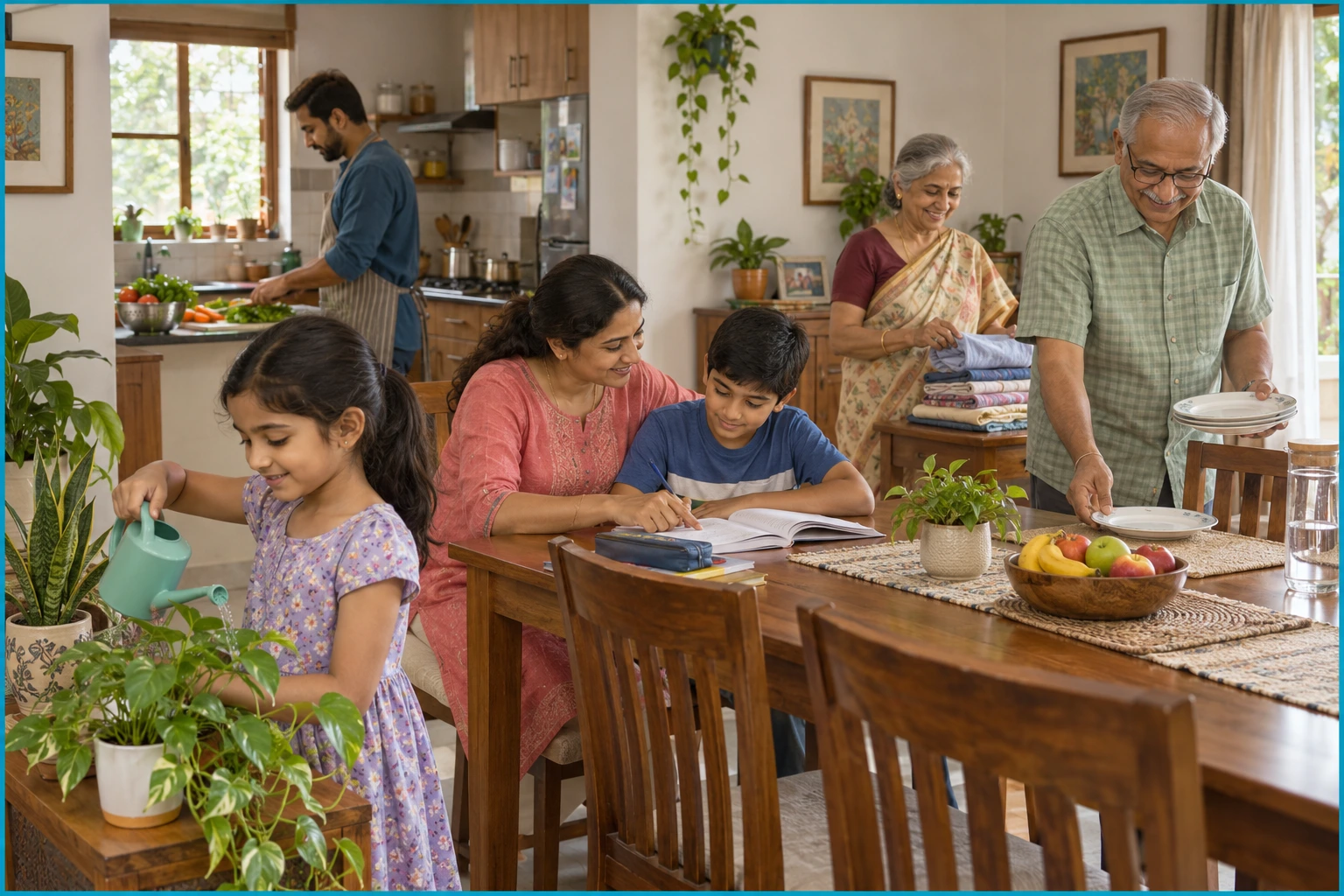
Chapter 9, Family and Community, explains that the family is the fundamental and most ancient unit of society. In India today there are several types of families — from joint families, where several generations such as grandparents, parents, uncles, aunts, brothers, sisters and cousins live together, to nuclear families limited to a couple and their children (or one parent and children). Indian languages have far more kinship terms than English — words like bua, tau, tai, chacha, mausi, nana, nani — and cousins are often addressed as brothers and sisters. NCERT uses this practice to illustrate close bonds; precise kinship terms vary by language and family. Relationships rest on love, care, cooperation and interdependence, with each member having a role and responsibility. The family is also a ‘school’ for values such as ahimsa, dāna (giving), sevā (service) and tyāga (sacrifice). Through stories from Kerala (Shalini) and Meghalaya (Tenzing) and real examples like the Bhil halma tradition, the Chennai floods and Kamal Parmar’s classes, the chapter shows how a community — a group of connected people — supports its members, follows shared rules, and is ultimately interdependent.
Key Concepts & Terms
Family: the fundamental and most ancient unit of any society; almost all of us live in one. Relationships within a family are based on love, care, cooperation and interdependence.
Joint family: a family in which several generations live together — grandparents, parents, uncles and aunts, brothers, sisters and cousins.
Nuclear family: a family limited to a couple and their children, and sometimes one parent and children.
Kinship terms: the words used for family relationships. Indian languages have many more such terms than English — in Hindi, for example, bua, tau, tai, chacha, mausi, nana, nani. Cousins are often addressed as brothers and sisters, sometimes with words that specify the relationship. Usage varies by language and community.
Cooperation: ‘working together’. Each member of a family has a role and responsibility towards the others.
Dharma: doing one’s duty; following our dharma has been an important principle of Indian culture.
Family values: the family is also a ‘school’ where children learn values such as ahimsa (non-violence), dāna (giving), sevā (service) and tyāga (sacrifice). Members may set aside a preference to help one another. Sharing should respect everyone’s essential needs and should not place all duties on one person.
Community: a group of connected people, including families and the people around them. Members come together for festivals, feasts, weddings, farming and other events. (The word has other meanings too, depending on the context.)
Community rules: practices — rarely written down — that communities agreed upon for the use of shared natural wealth like water, grazing lands and forest produce, giving everyone secure access while also giving each family duties to perform.
Halma: a tradition of the Bhil community of coming together to support any individual or family in times of crisis; near Jhabua (Madhya Pradesh) the Bhils planted thousands of trees and built water-harvesting structures to serve Mother Earth.
Residents’ Welfare Association (RWA): a new type of urban community in which residents make their own rules about waste management, cleanliness of common areas, care of pets, and so on.
Interdependence: in our complex societies everyone depends on a number of other people and communities — an RWA, for example, depends on the trading community for supplies and on municipal workers to handle waste.
Jāti: a jāti, or a subdivision of it, is also often called a community.
“Questions, activities and projects” — Full Solutions
These solutions follow NCERT’s end-of-chapter questions. Answers and teaching illustrations are ClearStudy explanations; personal and group activities use model responses to adapt.
1. What are some of the rules you follow in your family and neighbourhood? Why are they important?
2. Do you think some rules are unfair to a few people in the family or community? Why?
3. Describe several situations that you have observed where community support makes a difference. You can draw or write about these.
In-text activity: Shalini’s family tree
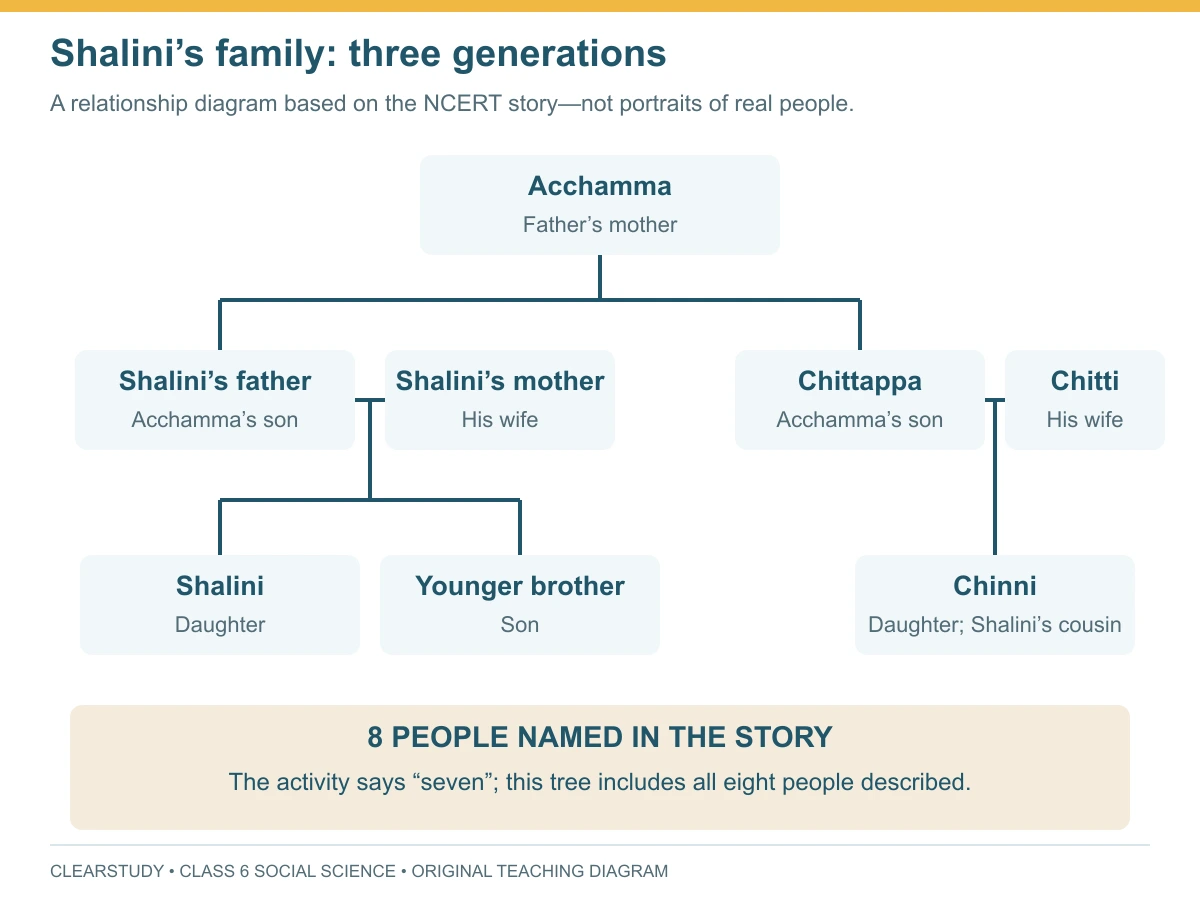
The story describes Acchamma, her two sons and their wives, and three children: Shalini, her younger brother and Chinni. That is eight people. The activity wording says seven; the diagram includes everyone actually mentioned in the story.
Extra Practice Questions
These questions and MCQs are ClearStudy practice, separate from the NCERT exercise.
Short Answer Type Questions
Q1. What is a family? Why is it called the most ancient unit of society?
Q2. What is the difference between a joint family and a nuclear family?
Q3. What does NCERT illustrate by describing cousins as brothers and sisters?
Q4. Name the four values that the chapter says children learn in the family as a ‘school’.
Q5. What is the halma tradition of the Bhil community?
Long Answer Type Questions
Q1. Explain how the relationships among family members are based on love, care, cooperation and interdependence.
Q2. What is a community? Describe, with examples, the different ways in which the word ‘community’ is used.
Q3. ‘Communities are ultimately interdependent.’ Explain this statement with examples.
MCQs & Assertion–Reason
1. The fundamental and most ancient unit of any society is the:
(a) community (b) family (c) village (d) school
2. A family in which several generations live together — grandparents, parents, uncles, aunts and cousins — is called a:
(a) nuclear family (b) joint family (c) single family (d) small family
3. A family limited to a couple and their children is called a:
(a) joint family (b) extended family (c) nuclear family (d) community
4. The word ‘cooperation’ means:
(a) competing with others (b) working together (c) staying alone (d) giving orders
5. Which of the following is not one of the values the chapter says children learn in the family?
(a) ahimsa (b) dāna (c) tyāga (d) competition
6. According to the chapter, which relatives are often addressed as brothers and sisters?
(a) brother (b) sister (c) cousin (d) uncle
7. The halma tradition belongs to which community?
(a) Parsi (b) Bhil (c) Sikh (d) Tamil
8. During which event of 2015 did many groups cook and distribute food to people in need?
(a) Chennai floods (b) Kerala floods (c) Gujarat earthquake (d) Mumbai rains
9. Residents’ Welfare Associations in urban areas are examples of:
(a) joint families (b) new types of communities (c) nuclear families (d) government offices
10. The statement ‘everyone depends on a number of other people and communities’ describes:
(a) independence (b) interdependence (c) competition (d) isolation
For each Assertion–Reason question, choose: (A) Both true and the Reason correctly explains the Assertion; (B) Both true but the Reason is not the correct explanation; (C) Assertion true, Reason false; (D) Assertion false, Reason true.
A-R 1. Assertion: Calling cousins brothers and sisters can express family closeness.
Reason: In Indian families, cousins are treated as brothers and sisters, showing the deep bonds among all the children.
A-R 2. Assertion: English has many more kinship terms than Indian languages.
Reason: Hindi has terms such as bua, tau, tai, chacha, mausi, nana and nani.
A-R 3. Assertion: A community is ultimately interdependent.
Reason: A Residents’ Welfare Association depends on the trading community for supplies and on municipal workers to handle waste.
A-R 4. Assertion: The family can be called a ‘school’.
Reason: Children learn important values such as ahimsa, dāna, sevā and tyāga within the family.
A-R 5. Assertion: Communities follow rules about the use of shared resources like water, grazing lands and forest produce.
Reason: Such rules give all families and individuals specific duties so that the community functions smoothly.
Exam Tips & Common Mistakes
How to write a clear answer
Learn the two Big Questions — why the family is important and what a community is. Be ready to give a clear two-sided comparison of joint vs nuclear families with examples. Remember the four family values (ahimsa, dāna, sevā, tyāga) and the meaning of cooperation and dharma. For community questions, use the textbook’s own real-life examples — the Bhil halma tradition near Jhabua, the Chennai floods of 2015, Kamal Parmar’s evening classes in Ahmedabad and Residents’ Welfare Associations — and always end with the idea that communities are interdependent. For personal-observation questions, write neat examples from your own home and neighbourhood.
Common mistakes to avoid
- Confusing a joint family (several generations together) with a nuclear family (a couple and their children).
- Saying English has more kinship terms than Indian languages — it is the other way round.
- Treating the textbook’s kinship example as a rule for every language: terms and forms of address vary.
- Mixing up the four values — dāna is giving, sevā is service, tyāga is sacrifice and ahimsa is non-violence.
- Treating a community as one fixed thing — remember it is a flexible concept with many meanings (jāti, religion, region, work, interest, school clubs, RWAs).
- Leaving personal-observation questions (Q1, Q3) blank — always write your own examples.
Frequently Asked Questions
What is Chapter 9 of Class 6 Social Science Exploring Society about?
Chapter 9, Family and Community, explains why the family is the most ancient and fundamental unit of society, the difference between joint and nuclear families, the rich kinship terms of Indian languages, the roles, responsibilities and values learnt in a family, and what a community is — how it supports its members, follows shared rules and is ultimately interdependent.
What is the difference between a joint family and a nuclear family?
A joint family has several generations living together — grandparents, parents, uncles, aunts, brothers, sisters and cousins. A nuclear family is limited to a couple and their children, and sometimes one parent and children. The distinction concerns family relationships and household structure, not a fixed number of people.
What is the exercise heading for Chapter 9 of Exploring Society?
The end-of-chapter exercise in Exploring Society: India and Beyond Chapter 9 is headed Questions, activities and projects and contains 3 numbered questions, all answered step by step on this page.
Reviewed against NCERT, Exploring Society: India and Beyond, Chapter 9 (2026–27 reprint). Content reviewed 9 October 2026.