
CLASS 7 · Computational Thinking
Class 7 CT and AI: Large Numbers Around Us Solutions
Practise place value, digit constraints and systematic elimination with these Class 7 handbook solutions.
Jump to a question or activity
Key ideas
Start with the most restrictive clue. Use a place-value table or a list of possibilities, then verify every condition rather than choosing a number that merely looks large.
Short Concept Lessons
Learn a method, follow the example, then use it in the additional practice.
Expand a number by place value
Multiply each count by its place value, then add. A count may be greater than nine, so regrouping can be needed.
12 hundreds + 15 tens + 6 ones = 1200 + 150 + 6 = 1356.
Remember: Do not join the written counts together.
Practise this method →Build the largest or smallest number
Decide the leftmost digit first because it has the greatest place value. Then fill the remaining places while respecting every condition.
Using 0, 2, 5 once each, the smallest three-digit number is 205. Zero cannot be the first digit.
Remember: A locally large choice must still allow a valid complete number.
Practise this method →Compare numbers from the left
For numbers of equal length, the first unequal digit decides which is larger. If a digit is unknown, test the boundary value.
For d34 less than 534, d may be 1, 2, 3 or 4. At d = 5, the numbers are equal.
Remember: Strictly less than does not include equality.
Practise this method →Turn clues into a checklist
Translate each clue into a condition. List the possibilities systematically and reject any that fail even one condition.
With digits 1, 3 and 5 used once and 3 in the tens place, the possibilities are 135 and 531.
Remember: Check the number of digits, repetition rules and fixed positions.
Practise this method →Count zeros and recognise zero products
A power of ten has one followed by zeros. In multiplication, one zero factor makes the whole product zero.
One lakh is 1,00,000 with five zeros. The product 9 × 7 × 0 × 4 is zero.
Remember: Zero is even: it is divisible by 2 with no remainder.
Practise this method →Use fixed clues to eliminate choices
Start with a clue that leaves few possibilities. Record each assignment, then use it to narrow the remaining choices.
If three different scores are 10, 20 and 30, and A scored more than B and B more than C, A = 30, B = 20 and C = 10.
Remember: Verify the completed arrangement against every original clue.
Practise this method →Questions and Solutions
Q1. ‘X’ is a 6-digit number formed using exactly three different digits.
One of the digits appears once, another appears twice, and the third appears three times. When 2 lakhs are added to ‘X’, the resulting number ‘Y’ is still a 6-digit number. What is the highest possible value of ‘Y’?
Solution
Q2. What is the product of all the numbers on a telephone dial-pad?
Solution
Q3. Sam forms two different 6-digit numbers, X and Y, using digits from 0 to 9 (without repetition within a number).
Exactly two digits are common between X and Y.
● The digit 9 appears in the same position in both numbers
● Y ends with 0, has only one even digit, and its digits are arranged in descending order
● 6 is present in X, and the number of even digits on its left is equal to the number of even digits on its right
If X is the largest possible number, what is the difference between X and Y?
Solution
Q4. If each of the rows follows the same theme, what will come in place of “?”

Solution
Q5. What will come in place of “?”

Solution
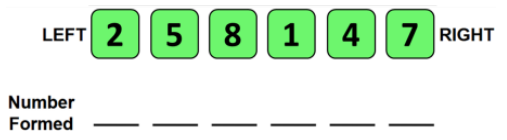
Q6. Six number tokens are given.
Rearrange them to form a 6-digit number such that:
● The difference between the first and last digits is as small as possible
● The hundreds digit is double the thousands digit
● No consecutive digits appear next to each other
● All given tokens must be used exactly once
How many different 6-digit numbers between 2 lakhs and 8 lakhs can be formed under these conditions?
Solution
Q7. Two five-digits numbers are formed using different digits from 0 to 9.
Both numbers have some digits missing, as shown below:
Number 1: _ 1 _ 9 _
Number 2: _ 4 _ 6 _
No two consecutive digits of the number series are present in the same number.
What is the maximum possible difference of the numbers formed?
Solution
Q8. A, B, C, D, and E each have a different number card among one hundred, one thousand, ten thousand, one lakh, and ten lakhs.
– C has an even number of zeros in his number
– A’s number has 2 zeros less than C’s number
– D’s number has 4 zeros more than A’s number
– The number of zeros in B is more than that of A but less than C
Which number card does E have?
Solution
Q9. 4 friends, Alex, Bob, Calvin and David have a different profession – Doctor, Lawyer, Cricketer, and Engineer and earn a different salary – ₹40,000, ₹50,000, ₹60,000 and ₹70,000 per year.
(not necessarily in the same order)
– The cricketer earns the highest
– Alex earns more than Bob, while the doctor earns more than David, who is the engineer
– Bob is the lawyer, and neither Bob nor David has an exact salary of ₹50,000
Which of these options shows the correct profession and salary of Calvin?
Solution
Q10. The following are the clues to the 6-digit password of Nisha’s laptop:
35 tens
31 thousands
25 ones
423 hundreds
14 ten thousands
What is Nisha’s password?
Solution
The Thinking Spot
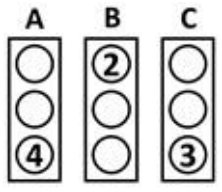
Columns A, B, and C contain 3 numbers each, such that:
– The number of times each number appears in all 3 columns combined, is equal to its value (e.g., 2 appears twice, 3 appears thrice, etc.)
– Each column contains AT LEAST TWO different numbers
If column A is the only column with THREE different numbers, then which column has the highest sum?
Solution
Additional Practice Questions with Solutions
Choose an answer, use a hint if needed, then open the worked solution to check your reasoning.
Solved 0 of 10 · Checked 0 of 10
Your practice progress lasts until you reset or reload this page.
Apply · place-value
Practice Q1. What number is represented by 17 hundreds, 23 tens and 8 ones?
Show hint
Multiply each count by its place value.
Show worked solution
Option (b) 1938.
17 × 100 + 23 × 10 + 8 = 1700 + 230 + 8 = 1938.
Common mistake: Adding place values is different from joining digit strings.
Apply · largest
Practice Q2. A six-digit number uses 1 once, 2 twice and 3 three times. What is the largest possible number?
Show hint
Place the greatest digits in the leftmost places.
Show worked solution
Option (c) 333221.
Three 3s come first, followed by two 2s and one 1: 333221.
Common mistake: Check both the order and the required repetition counts.
Apply · largest
Practice Q3. Use each digit 0, 1, 2, 3, 4 and 5 once. What is the smallest six-digit number?
Show hint
Choose the smallest nonzero leading digit, then order the rest.
Show worked solution
Option (b) 102345.
Start with 1, place 0 next, then 2, 3, 4 and 5: 102345.
Common mistake: A leading zero does not create a six-digit number.
Apply · compare
Practice Q4. In the three-digit number d34, d is nonzero and d34 < 534. What is the largest possible d?
Show hint
Test whether d = 5 gives strict inequality.
Show worked solution
Option (b) 4.
At d = 5, both numbers are 534, which are equal. The largest smaller leading digit is 4.
Common mistake: Strict inequality excludes the equal case.
Apply · constraints
Practice Q5. Use 1, 3 and 5 exactly once to form a three-digit number with 3 in the tens place. How many numbers are possible?
Show hint
Only the first and last digits remain to be placed.
Show worked solution
Option (b) 2.
The two arrangements are 135 and 531. Each uses every digit once and keeps 3 in the tens place.
Common mistake: A fixed position reduces the number of arrangements.
Apply · zeros
Practice Q6. What is 8 × 7 × 6 × 0 × 5?
Show hint
Check for a zero factor before multiplying.
Show worked solution
Option (c) 0.
Any product containing a factor of zero equals zero.
Common mistake: Do not ignore the zero factor.
Apply · zeros
Practice Q7. How many zeros are in ten lakhs, written as a whole number?
Show hint
Write ten lakhs as 10,00,000 and count the zeros.
Show worked solution
Option (c) 6.
10,00,000 is 1 followed by six zeros. Commas separate place-value groups; they are not digits.
Common mistake: One lakh and ten lakhs have different zero counts.
Apply · largest
Practice Q8. Which is the greatest six-digit number X for which X + 3,00,000 is still six-digit?
Show hint
The sum cannot exceed 9,99,999.
Show worked solution
Option (a) 6,99,999.
X can be at most 9,99,999 − 3,00,000 = 6,99,999. Adding 3,00,000 then gives 9,99,999.
Common mistake: Check the next larger number to confirm the maximum.
Apply · deduce
Practice Q9. A, B and C have different scores: 10, 20 and 30. A scored more than B, and B scored more than C. What is B’s score?
Show hint
B must be between A and C.
Show worked solution
Option (b) 20.
The order is A > B > C, so their scores are 30, 20 and 10 respectively. B has 20.
Common mistake: Use all the comparison clues together.
Apply · constraints
Practice Q10. A four-digit number uses 2, 4, 7 and 8 once each. Its first and last digits differ by 1. What is the largest possible number?
Show hint
The end digits must be 7 and 8. Maximise from the left.
Show worked solution
Option (c) 8427.
Only 7 and 8 differ by 1. Put 8 first and 7 last, then arrange 4 before 2 in the middle: 8427.
Common mistake: Check the end condition before maximising the middle.