
CLASS 7 · Computational Thinking
Class 7 CT and AI: Arithmetic Expressions Solutions
Use operation order, reverse reasoning and path tracing to solve each arithmetic puzzle.
Jump to a question or activity
Key ideas
Multiplication and division take precedence over addition and subtraction. Brackets change which part is evaluated first. When a task describes a sequence of events, keep a running total.
Short Concept Lessons
Learn a method, follow the example, then use it in the additional practice.
Use the correct operation order
Evaluate brackets first. Then multiply and divide from left to right; finally add and subtract from left to right.
24 ÷ 3 × 2 = 8 × 2 = 16. Multiplication does not always come before division.
Remember: Operations at the same level are handled from left to right.
Practise this method →Notice what brackets change
Brackets make a group of operations act as one quantity. Preserve them when filling blanks or swapping operators.
(6 + 4) × 3 = 30, while 6 + 4 × 3 = 18.
Remember: Do not invent extra brackets that the question does not give.
Practise this method →Undo a sequence backwards
Start from the final result. Reverse the last operation first, then work back to the start.
If adding 5 and then doubling gives 30, first divide 30 by 2, then subtract 5: the start was 10.
Remember: Undo addition with subtraction and multiplication with division.
Practise this method →Swap symbols before calculating
Write the entire changed expression, then evaluate it using normal operation order.
Swapping + and × in 6 + 4 × 2 gives 6 × 4 + 2 = 26.
Remember: Move only the symbols specified; keep the numbers in place.
Practise this method →Trace one legal path
Follow every operation on a chosen path in its stated order. Keep a running value and obey movement restrictions.
Starting at 5, then ×3, +4 and −6 gives 5 → 15 → 19 → 13.
Remember: Sequential instructions differ from one unbracketed expression.
Practise this method →Check constraints and extremes
A maximum or minimum must satisfy all conditions. Compare the allowed cases and show why a better result cannot occur.
For whole-number n, 2n = 9 has no valid solution because 4.5 is not a whole number.
Remember: Check the allowed number type and strict or inclusive limits.
Practise this method →Questions and Solutions
Q1. Identify the odd one out from the following expressions, after INTERCHANGING their operators.
Solution
Q2. There is a seminar from 11:00 AM to 2:00 PM, where students must spend AT LEAST 1 hour in the seminar.
The table displays the number of students entering and exiting the seminar at different times. What is the MAXIMUM possible number of students who spent at least 2 hours in the seminar?
| SR. NO | TIME | IN | OUT |
|---|---|---|---|
| 1. | 11:00 AM | 120 | |
| 2. | 12:00 PM | 40 | 60 |
| 3. | 1:00 PM | 80 | 40 |
| 4. | 2:00 PM | 140 |
Solution
Q3. In the given expression, '8 @ 7 – 15 < 4 × 2 × 5' which operator cannot be used in place of '@', such that the condition remains valid?
Solution
Q4. A bus has 40 seats, and some seats are already occupied, with one passenger in each seat.
● At the first stop, 5 passengers get off and 8 passengers get in
● At the second stop, 2 passengers get off and 4 passengers get in
● At the third stop, exactly half of the passengers get off
After this, half of the bus seats are occupied.
Which of the following expressions represents the number of passengers on the bus at the beginning?
Solution
Q5. The following expression has a whole number ‘n’.
If a blank can either take ‘×4’ or ‘–12’, what is the least possible value of ‘n’?
Expression: (n ____ ____ ) ____ = 96
Solution
Q6. Which operators should be interchanged to get the minimum value of the given expression?
8 × 4 + 2 – 1
Solution
Q7. In certain code, 1 is coded as 2, 3 is coded as 10, 5 is coded as 26.
In the same way, 4 is coded as A and 6 is coded as B.
If C is the sum of A and B, which of the following is correct regarding C?
Solution
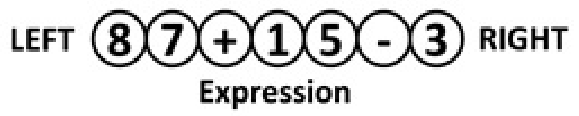
Q8. In the following expression, each ball with a mathematical operator is swapped with the ball immediately to its left, to form a new arithmetic expression.
What will be the value of NEW EXPRESSION – ORIGINAL EXPRESSION?
Solution
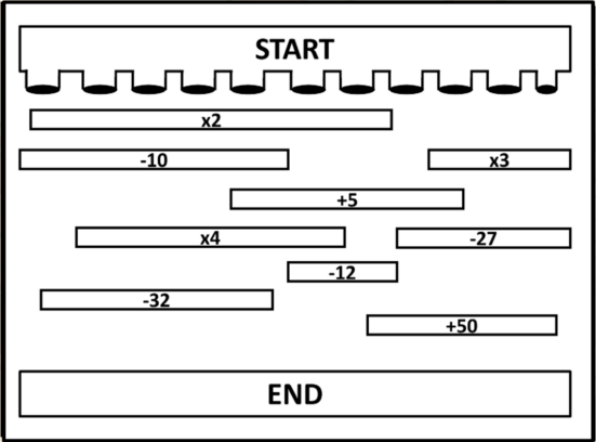
Q9. A stone with an initial value of 10 is dropped through one of the holes at the START and moves in a straight path to reach the END.
As it passes each numbered bar along the way, its value changes according to the operation shown on that bar. What is the maximum value the stone can have when it reaches the END?
Solution
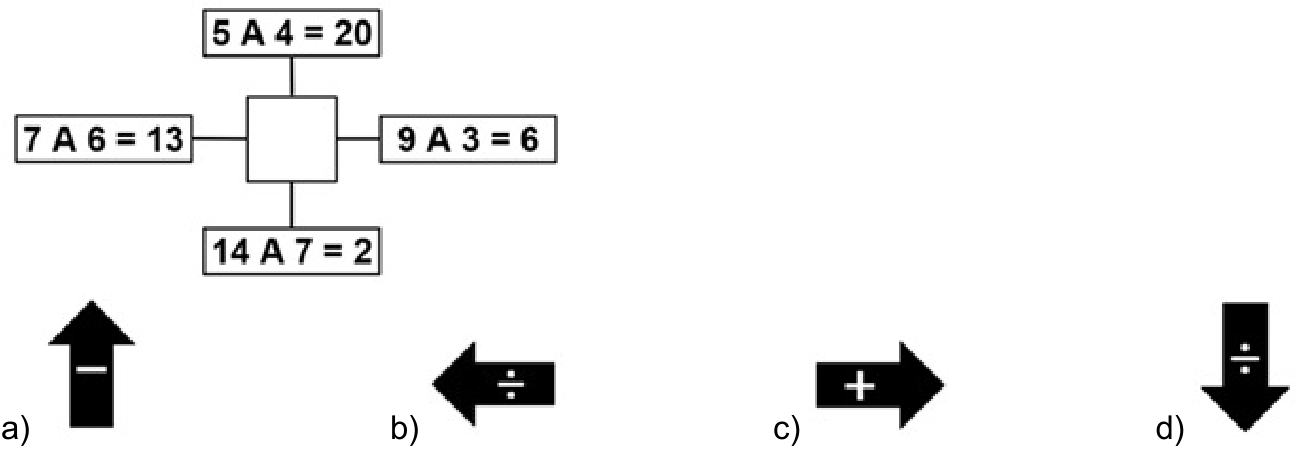
Q10. Each arrow has a mathematical operator.
When placed in the centre box, its operator replaces the letter A in the equation it points to. Which arrow satisfies an equation based on this rule?
Solution
The Thinking Spot
Tom, Sam, Mariya, John, and Bob each selected a shape.
They placed their shapes in the grid below.
Tom’s shape is neither a circle nor a triangle
Sam’s shape is in column number 3
Mariya’s shape is not in the first three rows
John’s shape is neither square nor circle
Which of the following shapes is chosen by Bob?

Solution
Additional Practice Questions with Solutions
Choose an answer, use a hint if needed, then open the worked solution to check your reasoning.
Solved 0 of 10 · Checked 0 of 10
Your practice progress lasts until you reset or reload this page.
Apply · order
Practice Q1. What is 24 ÷ 3 × 2?
Show hint
Division and multiplication have equal priority.
Show worked solution
Option (c) 16.
Work from left to right: 24 ÷ 3 = 8, then 8 × 2 = 16.
Common mistake: Do not group 3 × 2 unless brackets say to.
Apply · brackets
Practice Q2. What is (6 + 4) × 3 − 5?
Show hint
Complete the brackets before multiplying.
Show worked solution
Option (b) 25.
6 + 4 = 10; 10 × 3 = 30; 30 − 5 = 25.
Common mistake: Keep the final subtraction.
Apply · swap
Practice Q3. Interchange + and × in 6 + 4 × 2. What is the new value?
Show hint
First write 6 × 4 + 2.
Show worked solution
Option (d) 26.
The new expression is 6 × 4 + 2 = 24 + 2 = 26.
Common mistake: Changing operators does not add brackets.
Apply · reverse
Practice Q4. A number is increased by 7 and then doubled. The result is 50. What was the starting number?
Show hint
Undo doubling before undoing the addition.
Show worked solution
Option (a) 18.
50 ÷ 2 = 25, and 25 − 7 = 18. Check: (18 + 7) × 2 = 50.
Common mistake: Reverse the operations in reverse order.
Apply · reverse
Practice Q5. A bus has some passengers. At a stop, 4 leave and 9 board. There are then 27 passengers. How many were there before the stop?
Show hint
The stop produces a net increase of 5.
Show worked solution
Option (b) 22.
The net change is −4 + 9 = +5. Therefore the earlier count was 27 − 5 = 22.
Common mistake: Account for both leaving and boarding.
Apply · trace
Practice Q6. Start at 5 and follow these instructions in order: multiply by 3, add 4, subtract 6. What is the result?
Show hint
Record the value after every instruction.
Show worked solution
Option (a) 13.
5 × 3 = 15; 15 + 4 = 19; 19 − 6 = 13.
Common mistake: The instructions apply to the running value.
Apply · order
Practice Q7. Which operator makes 9 @ 3 − 4 < 10 false?
Show hint
Compare each resulting value with 10.
Show worked solution
Option (d) ×.
With ×, 9 × 3 − 4 = 23, so 23 < 10 is false. The other values are 8, 2 and −1, all less than 10.
Common mistake: Check the whole inequality, not just the first operation.
Apply · limits
Practice Q8. In (n __ __) = 18, each blank may contain ×2 or +3. What is the least possible whole-number n?
Show hint
Check all four choices using normal operation order.
Show worked solution
Option (d) 12.
The choices give n = 4.5, 7.5, 12 and 12. The least whole-number value is 12; both n + 3 × 2 and n + 3 + 3 then equal 18.
Common mistake: A fractional solution is not a whole-number solution.
Apply · trace
Practice Q9. Path A applies ×2 then +6 to a starting value of 8. Path B applies +6 then ×2. Which gives the larger result?
Show hint
Keep each path’s operation order.
Show worked solution
Option (b) Path B, 28.
Path A gives 8 × 2 + 6 = 22. Path B gives (8 + 6) × 2 = 28, which is larger.
Common mistake: The same operations can give different results in a different order.
Apply · order
Practice Q10. An original expression has value 45, and a new expression has value 28. What is NEW − ORIGINAL?
Show hint
Use the subtraction order requested.
Show worked solution
Option (c) −17.
28 − 45 = −17. The new value is 17 less than the original.
Common mistake: Do not reverse a subtraction to obtain a positive result.