
Rani Abbakka — Class 7 English Poorvi Questions and Answers
Rani Abbakka questions and answers for Class 7 Poorvi follow the NCERT graphic narrative panel by panel. Review the corrected riddle, cause-and-effect table, vocabulary, reported speech, Gaidinliu listening key and sample conversation.
Source: NCERT Poorvi, Grade 7, Unit 5, printed pages 206–222 (listening transcript 224–225); supplied reprint 2026–27. Open-ended and personal responses are examples to adapt. These explanations are study support, not an official NCERT answer key.
Read both the illustrated panels and their captions on pp. 207–212. The summary below follows this textbook narrative; it is not a complete historical biography.
About the chapter
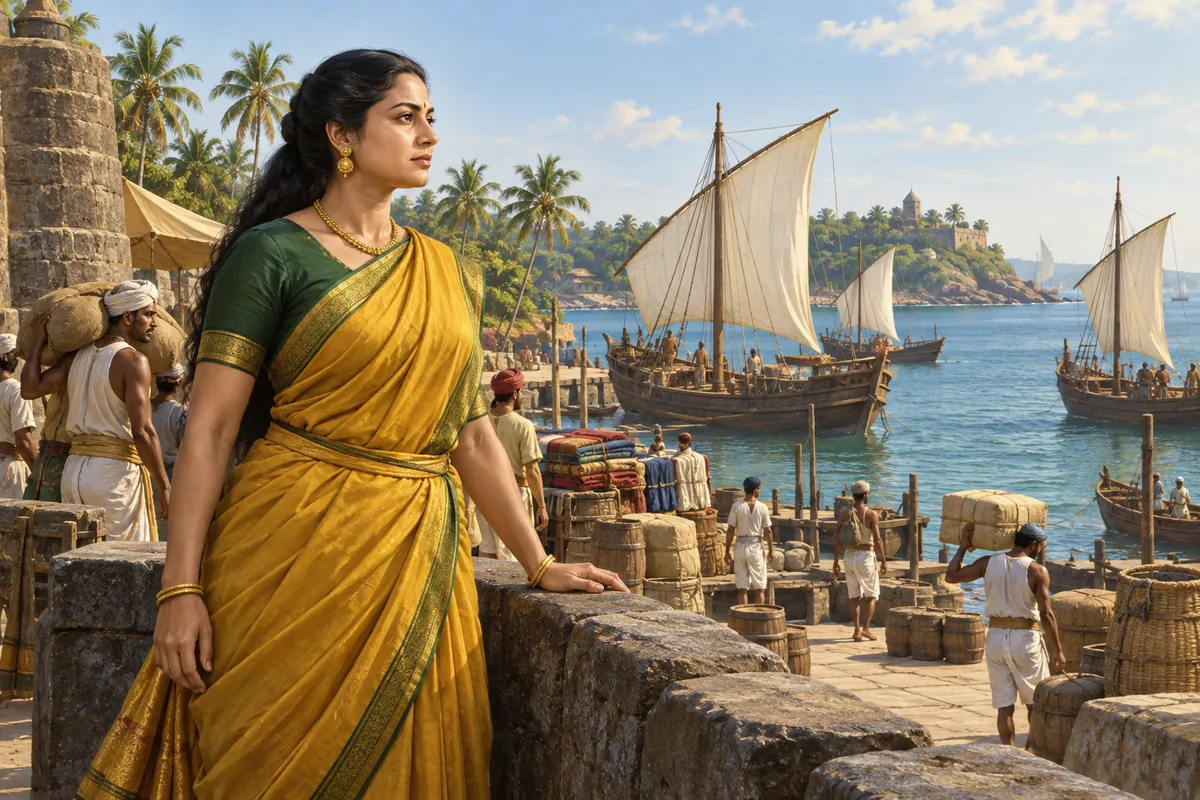
“Rani Abbakka” is the final piece in Unit 5, ‘Bravehearts’, and is presented as a graphic novel. It dramatises the life of Rani Abbakka Chowta, the sixteenth-century Tuluva queen of Ullal, a small coastal kingdom in present-day Karnataka. When the powerful Portuguese demanded an annual tribute, Abbakka refused, declaring that Ullal was a sovereign country. She built merchant ships, allied with the Zamorin of Kozhikode, and led her people in a fierce, long resistance against a far stronger colonial force. The chapter celebrates her courage, leadership, independence and love for her motherland – the qualities that make her one of India’s earliest freedom-fighting queens.
About the text
This graphic narrative tells the story through captions, pictures and dialogue. The supplied pages do not give an individual author byline; p. 212 cites the Ministry of Culture’s Unsung Heroes project. Historical accounts vary and may discuss more than one Abbakka: the IGNCA account explains this issue. Use the actual NCERT sequence for reading-comprehension answers, and identify outside history separately.
Summary
In the opening panel, Queen Hiriya Abbakka is on her deathbed. Her daughter and successor, Abbakka Devi, promises to drive the Portuguese from the west coast. After being crowned the next day, she asks for cooperation to make Ullal stronger, secure and free. She then tells her husband, Veera Narasimha of Bangadi, that she will stop paying tribute and selling spices and cloth to the Portuguese. He fears their anger and orders soldiers to stop her, but the soldiers choose to follow her.
Other rajas reject her request for united resistance, strengthening her resolve. When the Portuguese envoy demands overdue tribute, she asserts Ullal’s sovereignty. She builds merchant ships and, with the Zamorin of Kozhikode, develops profitable trade with Arabia.
The Portuguese navy intercepts returning ships. The commander’s ship does not return after he helps the others escape. Abbakka sends an envoy to Mangalore, but the Portuguese respond with an attack. Her forces counterattack their fort; the commander Ribero escapes to Goa for help. During the next attack, Ullal’s forces hold out through four days of battle and the Portuguese retreat. The final caption refers to Abbakka’s later help to Venkatappa Nayak and to Shivappa Nayak’s eventual expulsion of the Portuguese from Mangalore. The NCERT narrative ends with victory; it does not show Abbakka’s capture or death.
सार — पाठ की घटनाओं के अनुसार
रानी हिरिया अब्बक्का की पुत्री अब्बक्का देवी उल्लाल को स्वतंत्र बनाने का संकल्प लेती हैं। राज्याभिषेक के बाद वे पुर्तगालियों को कर देने और उन्हें मसाले तथा कपड़ा बेचने से मना करती हैं। पति और अन्य राजाओं की असहमति के बावजूद सैनिक उनका साथ देते हैं। वे ज़ामोरिन के सहयोग से अरब के साथ व्यापार बढ़ाती हैं। पुर्तगालियों द्वारा जहाज़ रोके जाने और आक्रमण किए जाने पर उनकी सेना प्रतिकार करती है। चार दिनों के युद्ध के बाद पुर्तगाली पीछे हटते हैं। पाठ का अंत विजय से होता है; इसमें रानी की गिरफ्तारी या मृत्यु नहीं दिखाई गई है।
Theme & message
The central theme is courage, sovereignty and resistance to foreign domination. Long before India’s organised freedom struggle, a small coastal queen dared to tell a great colonial power that her land was free and would pay no tribute. The story celebrates fearless leadership, self-respect and patriotism, and the strength that comes from uniting one’s people and forging wise alliances. Its message is that bravery and determination matter more than size or wealth, and that defending one’s freedom and dignity is a duty worth any sacrifice. Abbakka’s example reminds students that India’s ‘bravehearts’ include many forgotten heroes, especially women.
Word meanings
| Word | English meaning | Hindi meaning |
|---|---|---|
| vassal | a state controlled by a more powerful country and made to pay tribute | आश्रित / करद देने वाला राज्य |
| tribute | money a weaker state is forced to pay a stronger one | खिराज / भेंट |
| sovereign country | a country with its own government and complete authority | स्वतंत्र / सार्वभौम देश |
| coronation | the ceremony at which a person is made king or queen | राज्याभिषेक / ताजपोशी |
| successor | a person who comes after another and takes their place | उत्तराधिकारी |
| rash | acting without thinking about the consequences | उतावला / बिना सोचे |
| league | an association or partnership | संघ / गठबंधन |
| seize | to take hold of suddenly or by force; to capture | बलपूर्वक छीनना / कब्जा करना |
| wrath | extreme anger | क्रोध / प्रचंड क्रोध |
| resolve | firm determination | दृढ़ संकल्प / निश्चय |
| raged | happened in a violent way | भड़कना / उग्र रूप से चलना |
| decisive | showing the ability to make decisions effectively | निर्णायक / दृढ़निश्चयी |
| apprehended | caught or arrested | पकड़ा गया / गिरफ्तार किया गया |
| dauntless | fearless and brave | निर्भीक / भयमुक्त |
| avenge | to take revenge for a wrong | बदला लेना |
| envoy | a messenger or representative sent on a mission | दूत / संदेशवाहक |
| defy | to openly refuse to obey | चुनौती देना / आज्ञा न मानना |
| integrity | the state of being whole and undivided (here, a nation’s wholeness) | अखंडता |
Let us do before we read
I. Riddle — p. 206
II. Other women who resisted British rule — sample discussion
You could discuss Rani Lakshmibai, Rani Chennamma of Kittur or Captain Lakshmi Sahgal. The Ministry of Culture account of the Rani of Jhansi Regiment is one starting point for research. Do not describe every admired historical queen as a participant in the modern anti-British independence struggle; their periods and roles differ.
Let us discuss
I. Match the words in Column 1 with their meanings in Column 2
Match the words in Column 1 with their meanings in Column 2. Share your answers with your classmates and the teacher.
| Column 1 (word) | Matched meaning (Column 2) |
|---|---|
| 1. vassal (n) | (x) a country/state that is controlled by a more powerful country and has to pay money when needed |
| 2. coronation (n) | (vi) a ceremony at which a person is made king or queen |
| 3. successor (n) | (xi) a person who succeeds another |
| 4. rash (adj.) | (iv) acting or doing something without thinking about the consequences |
| 5. sovereign country (n) | (ix) a country with a government having complete authority |
| 6. league (n) | (v) association or partnership |
| 7. wrath (n) | (i) extreme anger |
| 8. seize (v) | (ii) take hold of suddenly or forcibly |
| 9. resolve (n) | (xiv) determination |
| 10. raged (v) | (iii) happen in a violent way |
| 11. decisive (adj.) | (xiii) showing the ability to make decisions effectively |
| 12. apprehended (v) | (viii) capture |
| 13. dauntless (adj.) | (vii) fearless |
| 14. avenge (v) | (xii) take revenge for |
Quick key: 1-(x), 2-(vi), 3-(xi), 4-(iv), 5-(ix), 6-(v), 7-(i), 8-(ii), 9-(xiv), 10-(iii), 11-(xiii), 12-(viii), 13-(vii), 14-(xii).
II. Cause and effect — pp. 208–211
| Cause | Effect |
|---|---|
| 1. Ullal had been captured by the Portuguese. | (i) It had to pay tribute to the colonial power (given). |
| 2. Abbakka decided to stop paying tribute and to stop selling spices and cloth to the Portuguese. | (ii) Veera Narsimha felt this was a hasty decision. |
| 3. Veera Narsimha ordered the soldiers to stop and seize Abbakka. | (iii) Not a soldier moved; they decided to follow their brave queen. |
| 4. The rajas said their forces were no match for the Portuguese and advised her not to provoke them. | (iv) Their reactions strengthened her resolve; she decided to fight even without their support. |
| 5. The Portuguese responded to her envoy by attacking Ullal. | (v) Abbakka’s forces counterattacked the Portuguese fort. |
These answers are checked against the visible panels, rather than inferred from general history.
Let us think and reflect
I. Read the extract given below and answer the questions that follow.Portuguese envoy: Our Governor has sent me to remind you that the annual tribute from Ullal is long overdue and… Rani Abbakka: We are a sovereign country. We don’t pay tribute to Portugal. And we don’t take orders from the Portuguese! Portuguese envoy: Your Majesty, you will regret your stand. Abbakka ordered merchant ships to be built and in alliance with the Zamorin of Kozhikode, she defied the Portuguese and established a hugely profitable trading relation with Arabia.
II. Answer the following questions.
Let us learn
I. Fill in the blanks with ‘ie’ or ‘ei’
Spelling aid: ‘i’ before ‘e’ except after ‘c’ is a limited mnemonic, not a universal rule (for example: receive, deceive). Now, fill in the blanks with ‘ie’ or ‘ei’ for the following words.
Exceptions in this task include protein and weight. The pattern also depends on pronunciation, so check an unfamiliar spelling rather than applying the mnemonic mechanically.
II. Silent letters
Study the highlighted word: “…and Bangadi too may have to face their wrath.” Was the initial letter ‘w’ pronounced? Words where certain letters are spelt but not pronounced are called ‘silent letters’ (for example: campaign, knowledge, pneumonia, honour, calm). Now, find more words with silent letters.
III. ‘Laugh’ expressions
Read the expressions from the text: laughing stock, last laugh. Use the dictionary page to find the meanings of: burst out laughing, don’t make me laugh, laugh until you cry, have a good laugh. Now, use these expressions in sentences of your own.
IV. Direct speech to indirect (reported) speech
Rewrite the following sentences in direct speech to indirect speech. Remember to make the necessary changes.
Backshift is the exercise’s convention. A continuing fact can remain in the present: “women of valour have made…” is also acceptable. Pronouns depend on who reports the speech; they do not always change in one fixed way. Singular “they” avoids assuming the player’s gender.
V. Transform the dialogue into reported speech
Read the conversation between the Captain and the team and complete the paragraph by transforming the dialogue into the indirect form of speech.Captain: We need to focus on our strategy for the final match. Player: I have some ideas on how we can improve our strategy. Captain: Make sure to share those ideas with the team during practice.
Let us listen, speak, write & explore
Let us listen — pp. 220–221; transcript pp. 224–225
- 26
- Manipur
- 13
- 1932
- 16
- Rani
- Padma Bhushan
- statue
- 2015
Source inconsistency: the transcript says she was born on 26 January 1915, joined in 1927 aged 13, and was arrested in 1932 aged 16. These ages do not agree with its dates: 1927 would make her about 12, and 1932 makes her 17. The table above records what a listener hears; do not repeat the inconsistent ages as verified history. An IGNOU historical account identifies her as seventeen at arrest. Check sources separately for a biographical project.
Let us speak — p. 221
| Word | Practice |
|---|---|
| vassal | VAS-uhl: stress the first syllable. Its ending is similar to that of “apple”, but the complete words do not rhyme. |
| successor | suhk-SES-uh: stress the second syllable. Final r is omitted in non-rhotic accents and pronounced in rhotic accents. |
| rash | One syllable; a as in rat. |
| league | One syllable; long ee as in seed. |
| wrath | Silent w; the vowel differs between accents. |
| seize | “seez”, with long ee and final z; different from “size”. |
| resolve | ri-ZOLV: stress the second syllable; s sounds like z. |
A one-syllable word has no choice of an internally stressed syllable, but it can still receive stress in a sentence. The book’s statement that such words have “no stress” is an oversimplification.
Let us write — pp. 221–222
Original sample: six turns each, with six sentences for each student.
Pratap: Tarana, I respect Rani Abbakka for defending Ullal’s freedom.
Tarana: Her story shows us that leadership is not limited by gender.
Pratap: Women have also helped shape India through teaching, farming and public service.
Tarana: We should notice that everyday work as well as famous achievements.
Pratap: Kalpana Chawla’s journey into space encourages students to study science.
Tarana: Girls need equal opportunities to develop such interests and skills.
Pratap: At home and school, we can share responsibilities fairly.
Tarana: We can also listen to women’s ideas and respect their choices.
Pratap: For our presentation, let us research one contribution using reliable sources.
Tarana: We should explain both the achievement and the preparation behind it.
Pratap: That will help us understand how many people contribute to a strong nation.
Tarana: I agree that respect should lead to fair opportunities and responsible action.
Let us explore — p. 222
In a group of five, select one of the women listed in the book or another well-supported choice. Divide research into childhood, training/education, achievements, contributions and what you learned. Keep the person’s dates and role clear, cite a reliable biography, and identify a source for each image. Present in your own words; this open research activity has no single fixed answer.
Additional ClearStudy questions
This practice is separate from the printed textbook exercises.
Text-based revision questions
1. How does the narrative begin?
2. Why does Veera Narasimha oppose her plans?
3. Why do the soldiers refuse to seize Abbakka?
4. How does she develop trade?
5. Why does she counterattack the fort?
6. What does the final battle show about her leadership?
7. Why is it important to distinguish the story from a full biography?
ClearStudy MCQs and assertion–reason practice
1. In the NCERT Poorvi textbook, ‘Rani Abbakka’ is presented in the form of a –
(a) poem (b) graphic novel (comic strip) (c) play script (d) letter
2. Rani Abbakka was the queen of –
(a) Jhansi (b) Kittur (c) Ullal (d) Kozhikode
3. Which colonial power demanded a tribute from Ullal?
(a) the British (b) the French (c) the Dutch (d) the Portuguese
4. What did Rani Abbakka mean when she said, “We are a sovereign country”?
(a) Ullal was very rich (b) Ullal was free and self-ruling (c) Ullal was at war (d) Ullal was small
5. With whom did Rani Abbakka form an alliance to defy the Portuguese?
(a) the Zamorin of Kozhikode (b) the Nizam of Hyderabad (c) the Marathas (d) the Mughals
6. To strengthen her kingdom, Rani Abbakka ordered the building of –
(a) temples (b) merchant ships (c) palaces (d) bridges
7. Rani Abbakka established a hugely profitable trading relation with –
(a) Arabia (b) China (c) Portugal (d) Africa
8. The word ‘dauntless’, used for Rani Abbakka, means –
(a) wealthy (b) fearless (c) clever (d) gentle
9. When the Portuguese envoy said, “you will regret your stand,” he was –
(a) apologising (b) praising her (c) threatening her (d) joking
10. The unit in which ‘Rani Abbakka’ appears is titled –
(a) Environment (b) Bravehearts (c) Travel (d) Wonders
Assertion–Reason – choose: (a) A and R true, R explains A; (b) A and R true, R does not explain A; (c) A true, R false; (d) A false, R true.
1. Assertion (A): Rani Abbakka refused to pay tribute to the Portuguese.
Reason (R): She believed Ullal was a sovereign country that did not take orders from Portugal.
2. Assertion (A): Rani Abbakka ordered merchant ships to be built and traded with Arabia.
Reason (R): She wanted to strengthen her kingdom and defy the Portuguese.
3. Assertion (A): The story of Rani Abbakka is told in the form of a graphic novel.
Reason (R): Graphic novels use illustrated panels and dialogue to tell a story.
4. Assertion (A): Rani Abbakka was easily frightened by the Portuguese threats.
Reason (R): She was a dauntless queen who fought the Portuguese for years.
5. Assertion (A): The people and soldiers of Ullal supported Rani Abbakka in her fight.
Reason (R): They were loyal and shared her love of freedom and self-rule.
Exam tips & common mistakes
Exam tips
• Remember the key facts: queen of Ullal, Chowta dynasty, fought the Portuguese, allied with the Zamorin of Kozhikode, traded with Arabia.
• In quality answers, use words from the chapter such as sovereign, tribute, defy, dauntless, resolve – and support your interpretation with a panel or caption.
• For the reported-speech exercise, change the tense one step back, and adjust pronouns and time/place words (last year → the previous year).
• For value-based questions, highlight courage, patriotism, leadership and self-respect.
Common mistakes
• Do not confuse Rani Abbakka with Rani Lakshmibai of Jhansi – Abbakka ruled Ullal and fought the Portuguese, not the British.
• In reported speech, do not forget to back-shift the tense (won → had won) and change ‘our/we’ to ‘their/they’.
• The ‘w’ in wrath is silent – do not mark it as pronounced.
• Remember ‘i before e except after c’: it is ceiling, perceive, receive (ei), but believe, achieve, friend (ie).
FAQs
Who is Rani Abbakka in Class 7 Poorvi?
The graphic narrative presents Abbakka Devi as queen of Ullal on the Karnataka coast, resisting Portuguese demands for tribute and supporting independent trade.
Who is the answer to the pre-reading queen riddle?
Rani Lakshmibai of Jhansi. The sword and child on her back are the clues; the riddle is not about Rani Abbakka simply because it precedes her chapter.
How does the NCERT narrative end?
After four days of battle, the Portuguese retreat and Ullal is free in the narrative. The final caption refers to later actions involving Venkatappa Nayak and Shivappa Nayak; the chapter does not show Abbakka’s capture or death.
The listening answers record the supplied transcript. Its age/date inconsistency is explained above. Creative responses are samples, and additional practice is separate from NCERT exercises.