
My Dear Soldiers — Class 7 English Poorvi Questions and Answers
My Dear Soldiers questions and answers for Class 7 Poorvi explain A.P.J. Abdul Kalam’s tribute, imagery and tone. Study the vocabulary and collocation answers, listening key, recitation guidance, an original acrostic and a 50-word gratitude note.
Source: NCERT Poorvi, Grade 7, Unit 5, printed pages 199–205 (listening transcript 224); supplied reprint 2026–27. Open-ended and personal responses are examples to adapt. These explanations are study support, not an official NCERT answer key.
- Poem Overview
- About the Poet
- Central Idea & Summary
- Word Meanings
- Poetic Devices
- NCERT textbook exercises
- Extra Questions
- MCQs & Answer Key
- Assertion–Reason Questions
- FAQs
Poem Overview
“My Dear Soldiers” is a short, heartfelt tribute written by Dr. A.P.J. Abdul Kalam to the soldiers who guard the borders of India. The poem addresses the soldiers directly as the “defenders of borders” and the “great sons” of the land — a phrase the textbook note explains as including all soldiers, both men and women. While ordinary citizens sleep peacefully, the soldiers stay awake, faithfully performing their duty in every kind of weather and across every kind of terrain — mountains, valleys, deserts, marshes, seas and skies. The poet marvels that they give the prime of their youth to the nation. The poem ends on a prayerful note, with the speaker offering thanks, respect and a blessing for the brave soldiers’ well-being. Its mood is admiring, grateful and reverent.
About the Poet – A.P.J. Abdul Kalam
NCERT credits the poem to A.P.J. Abdul Kalam (1931–2015), the aerospace scientist who served as India’s 11th President from 2002 to 2007. He received the Bharat Ratna in 1997. See the official presidential profile. In literary answers, describe the speaker’s voice as that of a grateful citizen addressing the soldiers.
Central Idea & Summary
Central idea: The poem is a tribute to the soldiers who protect the country’s borders. It celebrates their tireless vigilance, courage and sacrifice — guarding the nation across all seasons and all terrains while citizens live in peace — and ends with a heartfelt prayer for their well-being. The central message is one of gratitude and respect for the brave men and women of the armed forces.
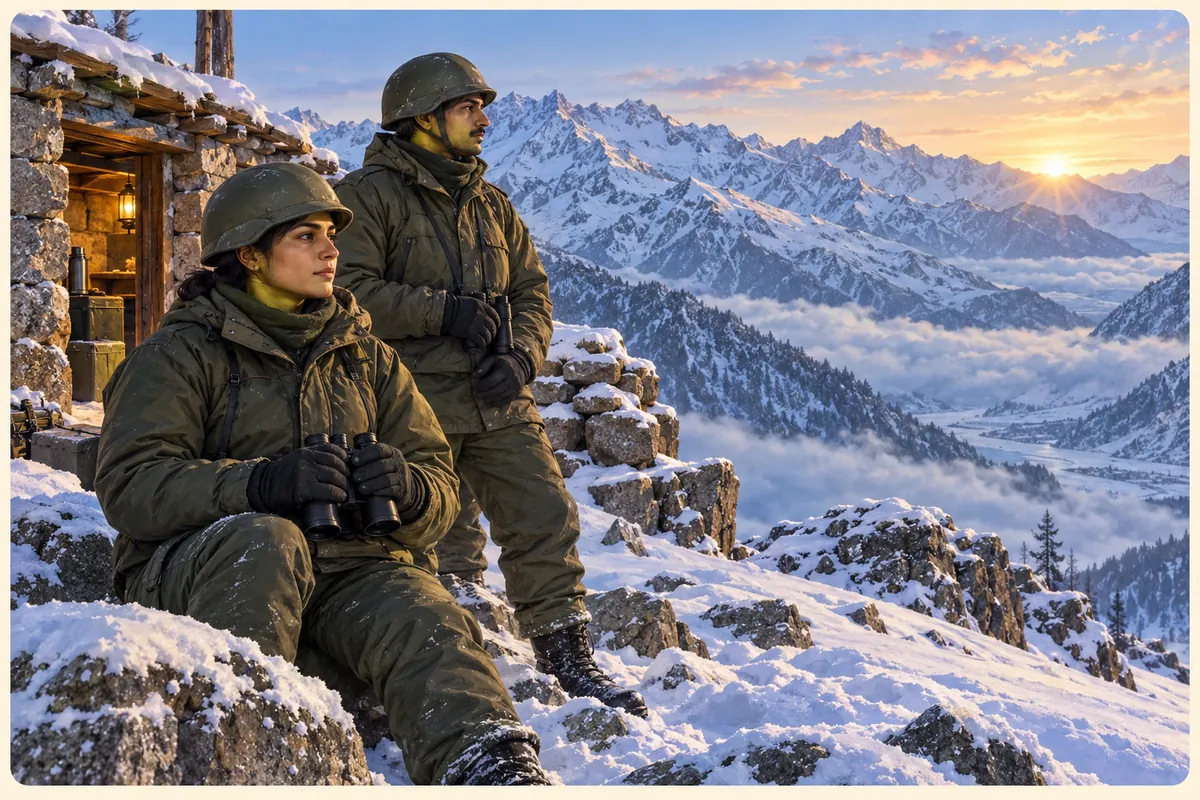
The poet begins by calling out to the soldiers as the “defenders of borders” and the “great sons” of his land. He points out that when everyone else is asleep, the soldiers stay faithfully on duty, holding firm to their responsibility. Whether it is a windy season, snowy days or the scorching, sweltering heat of the sun, the soldiers remain awake and alert, guarding the country at all times.
The poet then describes how the soldiers move like yogis across lonely, empty stretches of land — climbing high mountains, striding through valleys, defending deserts, guarding marshes, keeping watch over the seas and securing the air. They give the prime (the best, youngest years) of their youth to the service of the nation.
In the closing lines, the poet says that the very wind chimes of his land seem to vibrate with the soldiers’ great deeds. He offers a prayer for these brave men (and women), asking the Lord to bless them all. The poem thus moves from admiration to deep gratitude and finally to a sincere blessing.
Word Meanings (शब्दार्थ)
| Word | English Meaning | हिंदी अर्थ |
|---|---|---|
| defenders | those who protect or guard | रक्षक, रक्षा करने वाले |
| borders | the edges or boundaries of a country | सीमाएँ |
| deed | duty; a task or action carried out | कर्तव्य, कार्य |
| scorching | very hot; burning | झुलसाने वाली, अत्यधिक गर्म |
| sweltering | uncomfortably hot | तपती, उमस भरी गर्मी |
| rays | narrow beams of light or heat | किरणें |
| guarding | protecting and keeping watch | पहरा देना, रक्षा करना |
| treading | walking; stepping carefully | चलना, कदम रखना |
| expanses | wide, open stretches of land | विस्तृत खुले भू-भाग |
| yogis | persons who practise yoga; calm, self-disciplined hermits | योगी, तपस्वी |
| striding | walking with long, steady steps | लंबे कदमों से चलना |
| valleys | low land lying between hills or mountains | घाटियाँ |
| marshes | low, wet, soft land | दलदली भूमि |
| surveillance | close watch kept over a place | निगरानी |
| prime | the best and strongest period (of youth) | यौवन का सर्वोत्तम काल |
| wind chimes | hanging objects that make musical sounds in the wind | हवा से बजने वाली घंटियाँ |
| vibrate | to shake or resound; to echo | कंपन करना, गूँजना |
| feat | a great or brave achievement | वीरतापूर्ण कार्य, उपलब्धि |
Poetic Devices in the Poem
| Device | Explanation / Example from the poem |
|---|---|
| Apostrophe | The poet directly addresses the soldiers; this address is commonly discussed as apostrophe: “Oh! Defenders of borders / You are great sons of my land”. |
| Imagery | Vivid pictures of weather and terrain: “snowy days”, “scorching sun’s sweltering rays”, “Climbing the heights or striding the valleys”. |
| Simile | The soldiers are compared to hermits: “Treading the lonely expanses as yogis” — calm, disciplined and detached like yogis. |
| Metaphor | “Wind chimes of my land vibrate your feat” — the land itself is imagined as ringing with the soldiers’ brave deeds. |
| Repetition | The words “you” and “we” are repeated to set the selfless soldiers (“you”) against the protected citizens (“we”). |
| Alliteration | Repetition of opening sounds: “season or snowy”, “sun’s sweltering”, “Surveillance in seas”. |
| Tone | Admiring, respectful, grateful and finally prayerful — fitting a tribute to the soldiers. |
NCERT textbook exercises and activity examples
Let us discuss
I. Complete the summary with an exact word from the poem. An example has been done for you. Share your answers with your classmates and the teacher. The poem is a tribute to the soldiers of the 1. land who defend the 2. _______ of their country. It highlights their untiring commitment and sacrifices as they guard the nation. The soldiers remain vigilant and dedicated, whether it’s windy, snowy, or 3. _______ hot. They walk on 4. _______ stretches of land like the yogis. Their duty takes them to different terrains, including mountains, valleys, 5. _______, and marshes. The poet acknowledges that they have given a major part of their 6. _______ to protect the nation. The poet says the wind chimes show their respect to the soldiers’ 7. _______. The poet concludes with prayers for their well-being and blessings.
II. Select the correct option for the following questions. 1. The theme of the poem is ___. (i) patriotism and sacrifice (ii) heroism and awareness (iii) nature and hardship (iv) seasons and terrains 2. The tone of the poem is ___. (i) admiring (ii) sad (iii) respectful (iv) grateful (v) prayerful A. Only (v) B. (i) and (iii) C. (ii), (iii) and (v) D. (i), (iii), (iv) and (v)
III. Complete the following sentences by explaining why the poet has used the following poetic devices. 1. Imagery because _______. 2. Simile because the soldiers are likened to _______. 3. Metaphor because the poet uses wind chimes _______. 4. Repetition of the words ‘you’ and ‘we’ because _______. 5. Alliteration such as ‘season or snowy’ and _______ to create _______.
Let us think and reflect
I. Read the extract given below and answer the questions that follow. When we are all asleep / You still hold on to your deed / Windy season or snowy days / Or scorching sun’s sweltering rays / You are there guarding all the time awake / Treading the lonely expanses as yogis
1. Identify a set of opposite words from the extract.
2. Complete the sentence appropriately. The phrase ‘still hold on to your deed’ refers to the soldier’s attitude of _______.
3. Identify whether the following statement is true or false. The soldiers walk across the deserted stretches of land.
4. Give evidence from the extract to show that soldiers face harsh weather conditions.
5. Which quality of the soldiers is highlighted in this extract? (i) modesty (ii) optimism (iii) simplicity (iv) dedication
II. Answer the following questions.
The speaker is a grateful citizen; in this poem we can identify that voice with poet A.P.J. Abdul Kalam. We can say so because he repeatedly uses “we” for the protected citizens and “my land”, and he directly addresses the soldiers as “you”, offering them thanks, respect and prayers — the voice of someone who loves the nation and admires its defenders. 2. How is the theme of the poem conveyed through imagery? Support your answer with examples from the poem.
The theme of patriotism and sacrifice is brought alive through vivid imagery of weather and terrain. Images such as “Windy season or snowy days”, “scorching sun’s sweltering rays”, “Climbing the heights or striding the valleys” and “Defending the deserts or guarding the marshes” help us picture exactly how hard and varied the soldiers’ duty is. This sensory detail makes the reader feel their hardship and admire their dedication, reinforcing the theme of selfless service. 3. How does the poet highlight the commitment of the soldiers? Provide examples from the poem to support your answer.
The poet highlights their commitment by showing that the soldiers stay on duty when “we are all asleep”, remaining “awake” and “guarding all the time”. They serve in every season and every terrain — heights, valleys, deserts, marshes, seas and air — and they give the “Prime of your youth” to the nation. These details emphasise their sustained dedication to protecting the country. 4. What is the significance of the line ‘Prime of your youth given to the nation!!’ with reference to sacrifice and service?
The line means that soldiers devote the best and strongest years of their lives — their youth — to serving the country instead of pursuing personal comfort or ambitions. This is a great sacrifice: they give up an easy, settled life and risk everything so that the nation stays safe. The double exclamation marks show the poet’s wonder and deep respect for such selfless service. 5. The poem ends with a prayer for the soldiers’ well-being and blessings. Why is it important for each one of us to pray for the well-being of soldiers?
Soldiers leave their families and face danger every day so that ordinary citizens can live in peace and freedom. Praying for their well-being is a small way of showing gratitude and acknowledging their sacrifice. It reminds us that our safety is owed to them, strengthens the bond between citizens and the armed forces, and gives the soldiers moral support, encouraging them in their difficult duty.
Let us learn
I. The poem mentions a few terrains (physical features of land)—valleys, deserts, and marshes. Identify the terrains from the box given below. There are two that you do not need. [ ghats river plateau delta bay peninsula mountains ]
II. Study the following phrases from the poem. • treading the lonely expanses • climbing the heights • scorching sun Such phrases are word pairs that come together in combinations and are called collocations. Fill in the blanks by choosing the words given in the brackets that collocate appropriately. 1. The hikers reached the _______ (summit/peak) of the mountain after several days of trekking through challenging conditions. 2. The _______ (empty/barren) landscape of the desert made it nearly impossible to find any water sources. 3. In the rainforest, the _______ (heavy/dense) forest provides a habitat for a diverse range of wildlife. 4. Chitra is a very _______ (heroic/adventurous) person and enjoys mountain climbing. 5. I’ll try to get back in time, but I’m not _______ (doing/making) any promises.
Before reading — p. 199
I. Sample ideas: soldiers, firefighters and rescue workers may help others while facing danger. Discuss genuine examples you know rather than inventing personal encounters. II. Three sample interview questions: What inspired you to choose your work? What training helps you respond to difficult situations? How do you care for your team and the people you help?
Let us listen — pp. 203–204; transcript p. 224
These are checked against the printed transcript, rather than guessed from the rhyme. The exercise prints “Our beloved India” while the transcript says “Our India”; that small wording difference does not change any blank.
Let us speak — p. 204
Practise with a partner, using the slash marks and highlighted words in your textbook. Pause briefly between thought groups; pause longer after announcing the title and poet. Keep a steady pace, with stronger emphasis for pride and a softer ending for the prayer. Then recite in a group of eight to ten, taking care that every voice is heard.
Let us write — p. 205
I. The textbook’s example spells PATRIOT. The new task asks for SOLDIER. Each opening letter below forms that word; the lines are an original sample.
Over hills and open plain,
Loyal service, patient care,
Duty carried everywhere,
In our hearts your courage stays,
Each new dawn brings grateful praise,
Respect we offer all our days.
II. Sample gratitude note — 50 words including the salutation:
I would like to thank you for your service. You face difficult conditions and spend time away from your families to protect our country. Your courage and discipline inspire me to act responsibly. I wish you safety, strength and good health. Please accept my sincere gratitude and respect.
Write your own acrostic and note; these are models, not an official answer key.
Let us explore — p. 205
I. Badge idea: create your own shield shape with a rising sun and two supportive hands. Add an original slogan such as “Courage with Care”. Use cardboard and colours or a digital design. This is a classroom appreciation badge, not an official military medal.
II. Regional-language presentation: choose a poem or story in your mother tongue, name its writer, briefly summarise how it portrays bravery and explain your response. If Hindi is your chosen language, Pushp ki Abhilasha by Makhanlal Chaturvedi is a relevant option already referred to in this unit. Select another verified work if your language is different.
Additional ClearStudy questions
This practice is separate from the printed textbook exercises.
Short Answer Questions (30–40 words)
The soldiers who guard the country’s borders are addressed as the “great sons of my land”. The textbook note explains that the phrase actually refers to all soldiers — both men and women — serving the nation. Q2. What does the soldier do while the rest of the country sleeps?
While everyone else is asleep, the soldier stays awake and faithfully “holds on to his deed” — guarding the nation’s borders all the time, never letting down his watch. Q3. In what different weather conditions do the soldiers serve?
The soldiers serve in every kind of weather — the windy season, snowy days, and the scorching sun’s sweltering, burning heat. They remain alert and on duty through all of them. Q4. Why does the poet compare soldiers to yogis?
Like yogis, soldiers walk alone across lonely, empty stretches of land with calm, self-discipline and detachment. They perform their hard duty patiently and without complaint, just as yogis lead a disciplined, dedicated life. Q5. How does the poem end?
The poem ends on a prayerful note. The poet says the wind chimes of his land vibrate with the soldiers’ deeds, then prays for the brave men and women and asks the Lord to bless them all.
Long Answer Questions (100–120 words)
Throughout the poem, the poet expresses deep gratitude and respect for the soldiers. He addresses them lovingly as “defenders of borders” and “great sons of my land”, honouring both men and women in uniform. He contrasts the sleeping, protected citizens (“we”) with the ever-watchful soldiers (“you”), making clear how much “we” owe to “you”. By describing the harsh weather and difficult terrains they endure, and by noting that they give the prime of their youth to the nation, the poet underlines their sacrifice. Finally, he imagines the land itself ringing with their deeds and offers a sincere prayer asking the Lord to bless them — the ultimate mark of respect. Q2. Describe the various terrains and conditions in which the soldiers perform their duty, as shown in the poem.
The poem shows that soldiers serve everywhere and in every condition. In terms of weather, they guard the nation through the “windy season”, “snowy days” and the “scorching sun’s sweltering rays”. In terms of terrain, they tread “lonely expanses” like yogis, climb the heights of mountains, stride through valleys, defend the deserts and guard the marshes. They even keep “surveillance in seas” and secure the air. This sweeping range — from icy peaks to burning deserts, and from the sea to the sky — shows that there is no place the soldiers will not go to protect the country, highlighting their endurance, courage and total commitment to the nation. Q3. What values can young students learn from the poem ‘My Dear Soldiers’?
The poem teaches young readers several important values. First, it teaches gratitude — to remember and thank those who keep us safe. Second, it teaches the value of duty and discipline, shown by soldiers who stay awake and alert no matter how hard the conditions. Third, it teaches sacrifice, as the soldiers give the best years of their youth to the nation rather than to personal comfort. It also teaches patriotism and respect for selfless service. By admiring the courage of these “bravehearts”, students are inspired to be responsible, hard-working and devoted citizens who value the freedom and security they enjoy.
ClearStudy MCQ practice
1. Who is the poet of ‘My Dear Soldiers’?
(a) Rabindranath Tagore (b) A.P.J. Abdul Kalam (c) Sarojini Naidu (d) Makhanlal Chaturvedi
2. The soldiers are addressed in the poem as the ‘great sons of my ___’.
(a) country (b) home (c) land (d) world
3. What do the soldiers do while everyone is asleep?
(a) they also rest (b) they hold on to their deed and stay awake (c) they return home (d) they celebrate
4. The soldiers are compared to ___ as they tread the lonely expanses.
(a) kings (b) yogis (c) travellers (d) priests
5. Which of these is NOT a terrain mentioned in the poem?
(a) heights/valleys (b) deserts (c) marshes (d) forests
6. ‘Prime of your youth given to the nation’ refers to the soldiers’ ___.
(a) wealth (b) sacrifice (c) education (d) holiday
7. The phrase ‘scorching sun’s sweltering rays’ is an example of ___.
(a) imagery and alliteration (b) simile (c) rhyme only (d) irony
8. According to the poet, what vibrates with the soldiers’ feat?
(a) the seas (b) the wind chimes of his land (c) the mountains (d) the temples
9. The tone at the end of the poem is best described as ___.
(a) angry (b) sad (c) prayerful (d) humorous
10. The textbook note clarifies that ‘great sons’ actually refers to ___.
(a) only male soldiers (b) all soldiers, men and women (c) only officers (d) only the poet’s relatives
ClearStudy assertion–reason practice
For each, choose: (a) Both A and R are true and R is the correct explanation of A. (b) Both A and R are true but R is NOT the correct explanation of A. (c) A is true but R is false. (d) A is false but R is true.
1. Assertion (A): The soldiers stay awake while citizens sleep.
Reason (R): It is their duty to guard the nation’s borders at all times.
Answer: (a) — R correctly explains why the soldiers remain awake and on watch.
2. Assertion (A): The poet compares the soldiers to yogis.
Reason (R): Like yogis, the soldiers are calm, disciplined and walk the lonely stretches of land patiently.
Answer: (a) — R correctly explains the simile used by the poet.
3. Assertion (A): The poem ends with a prayer for the soldiers.
Reason (R): The poet asks the Lord to bless all the brave soldiers for their well-being.
Answer: (a) — R correctly explains the prayerful ending of the poem.
4. Assertion (A): The phrase ‘great sons of my land’ refers only to male soldiers.
Reason (R): The textbook note clarifies that it refers to all soldiers, both men and women.
Answer: (d) — A is false (it includes women too); R is true and is given in the textbook note.
5. Assertion (A): The soldiers serve only in pleasant weather.
Reason (R): The poem describes them guarding the land in the windy season, snowy days and scorching heat.
Answer: (d) — A is false (they serve in all weather); R is true.
📌 Exam Tips
• Remember the poet — Dr. A.P.J. Abdul Kalam, the “Missile Man of India” and 11th President — useful background for revision.
• Learn the device examples: simile (“as yogis”), metaphor (“wind chimes… vibrate your feat”), apostrophe (“Oh! Defenders of borders”).
• Quote short lines like “When we are all asleep / You still hold on to your deed” to support answers on dedication and sacrifice.
• Note the textbook clarification that “great sons” includes both men and women soldiers.
• For the theme, link it to patriotism and sacrifice; for the tone, remember it is admiring, respectful, grateful and prayerful.
⚠ Common Mistakes to Avoid
• Do not say the poem is “sad” — its tone is admiring, grateful and prayerful, not sorrowful.
• Do not call “Treading the lonely expanses as yogis” a metaphor — the word “as” makes it a simile.
• In the terrains exercise, remember that river and bay are the unused water-body choices; select the land features.
• Spell the poet’s name correctly: A.P.J. Abdul Kalam.
• Do not write that “great sons” means only men — include women soldiers as the textbook note states.
Frequently Asked Questions (FAQs)
Who wrote the poem ‘My Dear Soldiers’ in Class 7 Poorvi?
The poem was written by Dr. A.P.J. Abdul Kalam (1931–2015), the famous Indian scientist known as the “Missile Man of India” and the 11th President of India.
What is the main theme of ‘My Dear Soldiers’?
The main theme is patriotism and sacrifice. The poem is a tribute to the soldiers who guard the nation’s borders through all seasons and terrains, and it ends with a heartfelt prayer for their well-being.
Why does the poet say ‘great sons of my land’ when soldiers include women too?
The poem includes a textbook note explaining that when he says “great sons” he is actually referring to all soldiers — both men and women — who serve and protect the nation.