
Class 7 Maths Ganita Prakash Chapter 1 Solutions (NCERT 2026–27) – Large Numbers Around Us
These Class 7 Maths Ganita Prakash Chapter 1 solutions cover Large Numbers Around Us from the new NCF-2023 textbook (Reprint 2026–27). Find worked answers, place-value diagrams, checked button-click and number-card puzzles, rounding examples and toothpick activities. Use the textbook alongside these explanations.
- Chapter overview
- Key concepts & definitions
- Important formulas & patterns
- Figure it Out (Page 3 — A Lakh Varieties)
- Figure it Out (Page 6 — Land of Tens)
- Figure it Out (Page 7 — Fewest Button Clicks)
- Figure it Out (Page 9 — Of Crores and Crores)
- Figure it Out (Page 19–21 — Did You Ever Wonder)
- Math Talk & Try This (answered)
- Common mistakes to avoid
- Practice MCQs & Assertion–Reason
- Quick revision summary
- FAQs
Chapter 1 Overview
Chapter 1 of Ganita Prakash, Large Numbers Around Us, follows Roxie and Estu as they get a feel for really big numbers — starting from one lakh (1,00,000) and building up to crores and arabs. The chapter teaches the Indian place value system (the 3-2-2-2 comma pattern) alongside the American/International system (the 3-3-3 pattern with millions and billions), reading and writing large number names, the “Land of Tens” calculator puzzles, exact vs approximate values and rounding to the nearest thousand/lakh/crore, comparing city populations, and clever patterns in products that make multiplication quicker. The solutions below explain the textbook exercises and selected explorations with checked working.
Key Concepts & Definitions
One lakh: the smallest 6-digit number, written 1,00,000 — it is 1 followed by 5 zeroes, and equals a hundred thousand (100 × 1000).
One crore: a hundred lakhs, written 1,00,00,000 — it is 1 followed by 7 zeroes.
One arab: a hundred crores, written 1,00,00,00,000 — it is 1 followed by 9 zeroes; it is the same as one billion.
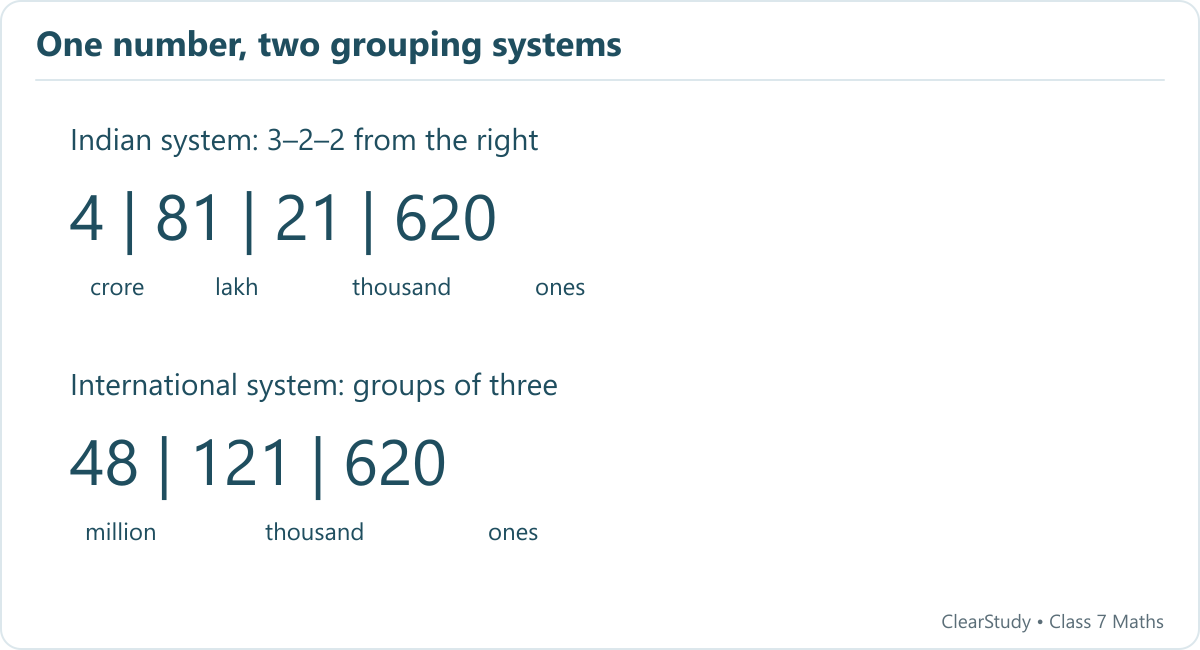
Indian place value system: commas group digits as 3-2-2-2… from the right (thousands, lakhs, crores). Used in India, Nepal, Sri Lanka, Pakistan, Bangladesh and more.
American / International system: commas group digits as 3-3-3… from the right (thousands, millions, billions). 1 million = 10,00,000 = ten lakhs; 1 billion = 100 crore.
Rounding up: approximating to a number that is more than the actual value (e.g. 732 → 750).
Rounding down: approximating to a number that is less than the actual value (e.g. ₹470 → ₹450).
Nearest neighbours: the nearest thousand, ten thousand, lakh, ten lakh and crore of a number.
Important Formulas & Patterns (Chapter 1)
Place-value links: 1 lakh = 100 thousand • 1 crore = 100 lakh = 10 million • 1 arab = 100 crore = 1 billion.
Zeroes: 1 lakh = 1 followed by 5 zeroes; 1 crore = 1 followed by 7 zeroes; 1 million = 1 followed by 6 zeroes; 1 arab/billion = 1 followed by 9 zeroes.
Fewest button clicks: the minimum number of +1, +10, +100… clicks equals the sum of the digits of the number, and the click expression is exactly its Indian place-value expansion.
Multiply by 5: n × 5 = n × (10 ÷ 2) = (n ÷ 2) × 10. Multiply by 25 = ×(100 ÷ 4); by 125 = ×(1000 ÷ 8).
Digits in a product: a (p-digit) × (q-digit) number has either (p + q − 1) or (p + q) digits.
Stage-wise large calculation: break long multiplications/divisions into easy stages (e.g. per day → per year → per 10 years).
Figure it Out — A Lakh Varieties (Page 3)
1. According to the 2011 Census, the population of the town of Chintamani was about 75,000. How much less than one lakh is 75,000?
2. The estimated population of Chintamani in the year 2024 is 1,06,000. How much more than one lakh is 1,06,000?
3. By how much did the population of Chintamani increase from 2011 to 2024?
Figure it Out — Land of Tens (Page 6)
For each number given below, write expressions for at least two different ways to obtain the number through button clicks (Creative Chitti has buttons +1, +10, +100, +1000, +10000, +100000, +1000000). Think like Chitti and be creative.
(a) 8300
(b) 40629
(c) 56354
(d) 66666
(e) 367813
Creative Chitti has some questions for you — (a) You have to make exactly 30 button presses. What is the largest 3-digit number you can make? What is the smallest 3-digit number you can make? (b) 997 can be made using 25 clicks. Can you make 997 with a different number of clicks?
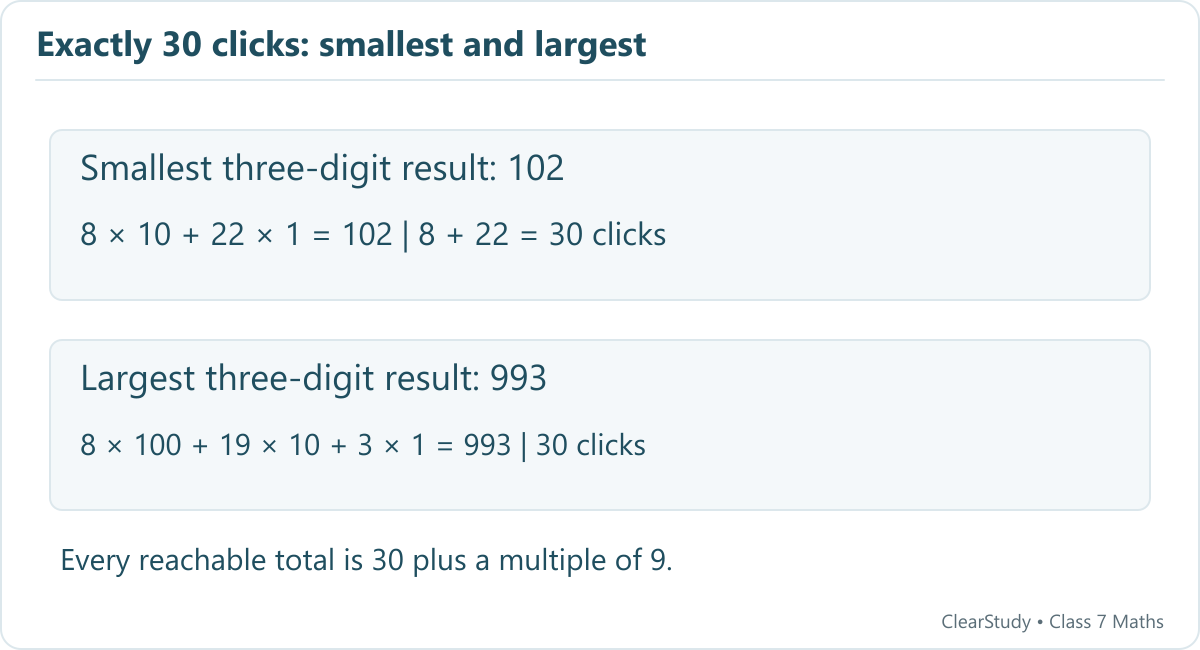
Figure it Out — Fewest Button Clicks (Page 7)
Systematic Sippy (buttons +1, +10, +100, +1000, +10000, +100000) wants to use as few clicks as possible.
1. For the numbers in the previous exercise, find out how to get each number by making the smallest number of button clicks and write the expression. (numbers: 8300, 40629, 56354, 66666, 367813)
2. Do you see any connection between each number and the corresponding smallest number of button clicks?
3. If you notice, the expressions for the least button clicks also give the Indian place value notation of the numbers. Think about why this is so.
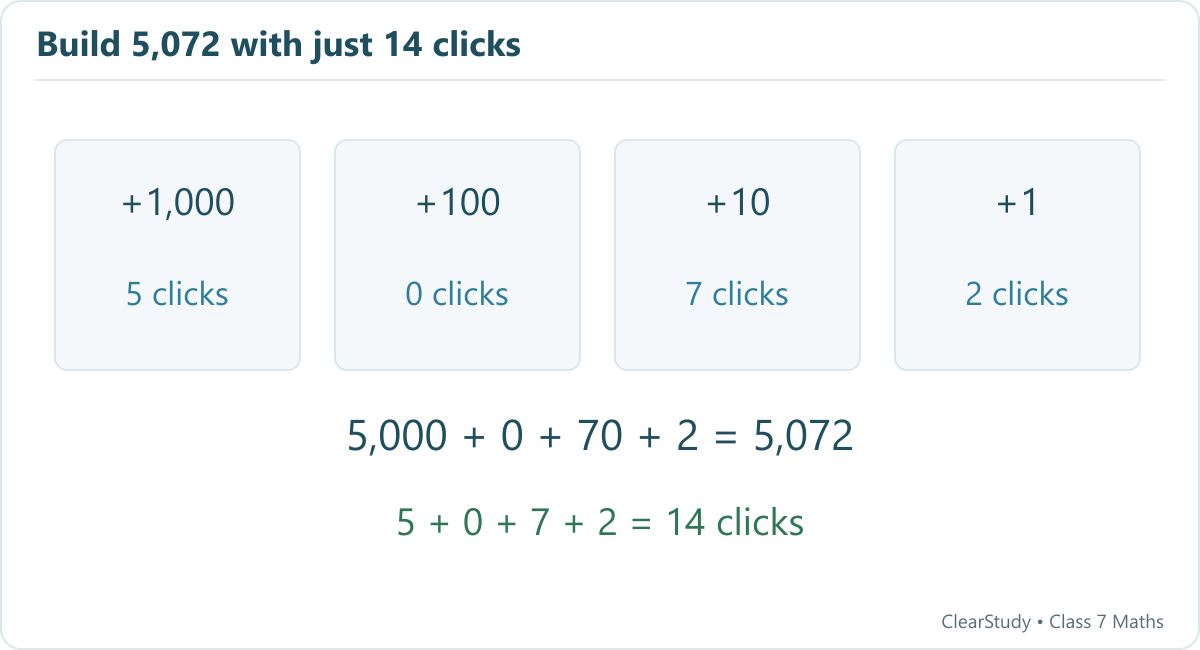
Figure it Out — Of Crores and Crores (Page 9)
1. Read the following numbers in Indian place value notation and write their number names in both the Indian and American systems: (a) 4050678 (b) 48121620 (c) 20022002 (d) 246813579 (e) 345000543 (f) 1020304050
2. Write the following numbers in Indian place value notation: (a) One crore one lakh one thousand ten (b) One billion one million one thousand one (c) Ten crore twenty lakh thirty thousand forty (d) Nine billion eighty million seven hundred thousand six hundred
3. Compare and write ‘<’, ‘>’ or ‘=’: (a) 30 thousand ____ 3 lakhs (b) 500 lakhs ______ 5 million (c) 800 thousand ____ 8 million (d) 640 crore ______ 60 billion
Figure it Out — Did You Ever Wonder…? (Page 19–21)
1. Using all digits from 0 – 9 exactly once (the first digit cannot be 0) to create a 10-digit number, write the — (a) Largest multiple of 5 (b) Smallest even number
2. The number 10,30,285 in words is Ten lakhs thirty thousand two hundred eighty five, which has 43 letters. Give a 7-digit number name which has the maximum number of letters.
3. Write a 9-digit number where exchanging any two digits results in a bigger number. How many such numbers exist?
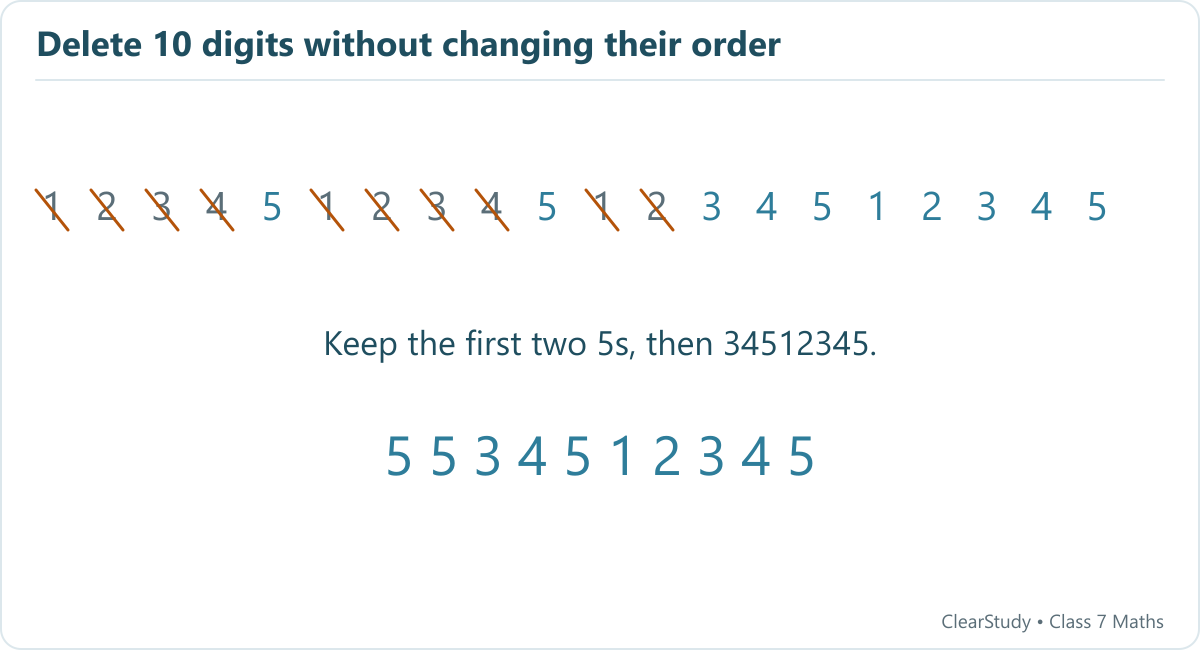
4. Strike out 10 digits from the number 12345123451234512345 so that the remaining number is as large as possible.
5. The words ‘zero’ and ‘one’ share letters ‘e’ and ‘o’. The words ‘one’ and ‘two’ share a letter ‘o’, and the words ‘two’ and ‘three’ also share a letter ‘t’. How far do you have to count to find two consecutive numbers which do not share an English letter in common?
6. Suppose you write down all the numbers 1, 2, 3, 4, …, 9, 10, 11, … The tenth digit you write is ‘1’ and the eleventh digit is ‘0’, as part of the number 10. (a) What would the 1000th digit be? At which number would it occur? (b) What number would contain the millionth digit? (c) When would you have written the digit ‘5’ for the 5000th time?
7. A calculator has only ‘+10,000’ and ‘+100’ buttons. Write an expression describing the number of button clicks to be made for the following numbers: (a) 20,800 (b) 92,100 (c) 1,20,500 (d) 65,30,000 (e) 70,25,700
8. How many lakhs make a billion?
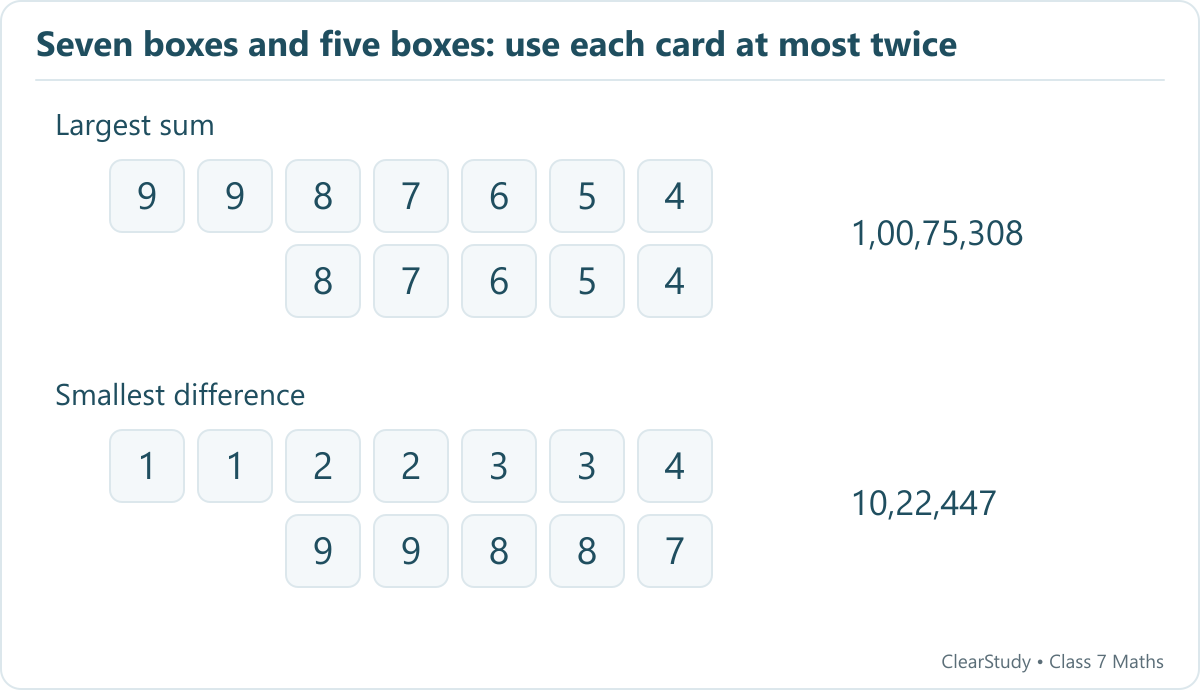
9. You are given two sets of number cards numbered from 1 – 9. Place a number card in each box below to get the (a) largest possible sum (b) smallest possible difference of the two resulting numbers.
10. You are given some number cards; 4000, 13000, 300, 70000, 150000, 20, 5. Using the cards get as close as you can to the numbers below using any operation you want. Each card can be used only once for making a particular number. (a) 1,10,000: Closest I could make is 4000 × (20 + 5) + 13000 = 1,13,000 (b) 2,00,000: (c) 5,80,000: (d) 12,45,000: (e) 20,90,800:
11. Find out how many coins should be stacked to match the height of the Statue of Unity. Assume each coin is 1 mm thick.
12. Grey-headed albatrosses have a roughly 7-feet wide wingspan. They are known to migrate across several oceans. Albatrosses can cover about 900 – 1000 km in a day. One of the longest single trips recorded is about 12,000 km. How many days would such a trip take to cross the Pacific Ocean approximately?
13. A bar-tailed godwit holds the record for the longest recorded non-stop flight. It travelled 13,560 km from Alaska to Australia without stopping. Its journey started on 13 October 2022 and continued for about 11 days. Find out the approximate distance it covered every day. Find out the approximate distance it covered every hour.
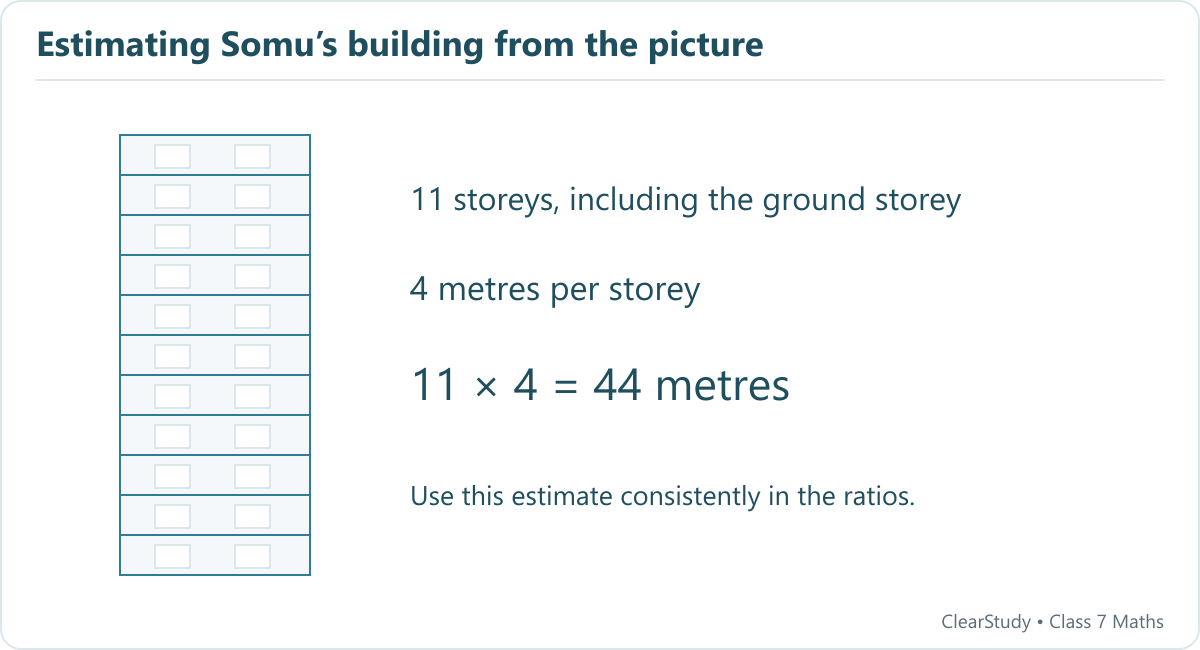
14. Bald eagles are known to fly as high as 4500 – 6000 m above the ground level. Mount Everest is about 8850 m high. Aeroplanes can fly as high as 10,000 – 12,800 m. How many times bigger are these heights compared to Somu’s building?
More in-text worked examples
Reading numbers and filling the early patterns (pages 2–5)
The consecutive milestones are 999, 1,000, 9,999, 10,000, 99,999 and 1,00,000. The missing number-line values are 99,997, 99,999 and 1,00,000.
| Number | Indian number name |
|---|---|
| 3,00,600 | Three lakh six hundred |
| 5,04,085 | Five lakh four thousand eighty-five |
| 27,30,000 | Twenty-seven lakh thirty thousand |
| 70,53,138 | Seventy lakh fifty-three thousand one hundred thirty-eight |
The number-name questions on page 5 give 1,23,456; 4,07,704; 50,05,050; 10,00,235, respectively.
Single-button calculators (pages 5–6)
| Calculator | Answers in textbook order |
|---|---|
| Thoughtful Thousands | (a) 3; (b) 10; (c) 53; (d) 90; (e) 100 presses; (f) 1,53,000; (g) 100 thousands. |
| Tedious Tens | (a) 50; (b) 78; (c) 100; (d) 370; (e) 1,000; (f) 10,000 presses; (g) 4,350. |
| Handy Hundreds | (a) 4; (b) 37; (c) 100; (d) 530; (e) 900; (f) 976; (g) 1,000 presses; (h) 58,200; (i) 100 hundreds; (j) 1,000 hundreds. |
For 321, both 32 × 10 + 1 and 2 × 100 + 12 × 10 + 1 work. For 5,072, use 5 × 1,000 + 7 × 10 + 2 × 1: 14 clicks. Ten presses of +10,00,000 give one crore, with seven zeroes. A thousand lakhs is 10,00,00,000, with eight zeroes; a hundred thousand has five zeroes.
Nearest neighbours (page 11)
| Round to nearest | 3,87,69,957 | 29,05,32,481 |
|---|---|---|
| Thousand | 3,87,70,000 | 29,05,32,000 |
| Ten thousand | 3,87,70,000 | 29,05,30,000 |
| Lakh | 3,88,00,000 | 29,05,00,000 |
| Ten lakh | 3,90,00,000 | 29,10,00,000 |
| Crore | 4,00,00,000 | 29,00,00,000 |
Round up when ordering enough sweets; round down when estimating how many complete groups fit a budget; either direction may suit a rough crowd estimate. Telephone numbers, account numbers and exact payments must not be rounded.
City populations (pages 12–13)
Use the textbook’s 2001 and 2011 data, not present-day population estimates. A suitable title is “Populations of selected Indian cities in 2001 and 2011”. Most increased; Kolkata decreased from 45,72,876 to 44,86,679.
Pune’s 2011 population was 31,15,431, about 31 lakh. Its increase was 31,15,431 − 25,38,473 = 5,76,958, approximately 6 lakh. Bengaluru had the largest increase in the table: 84,25,970 − 43,01,326 = 41,24,644.
Bengaluru, Hyderabad, Surat and Vadodara are approximately doubled examples (about 1.96, 1.87, 1.84 and 2.10 times respectively). Mumbai ÷ Patna in 2011 is 1,24,42,373 ÷ 16,84,222 ≈ 7.39, so multiplying Patna by about 7 gives a close whole-number estimate.
Large quantities in stages (pages 18–19)
Using the textbook assumptions: 5,000 ships × 2,500 people = 1,25,00,000, enough for the stated Mumbai population, with 57,627 places spare. At 100 km/day, travel in a year is 36,500 km and in ten years 3,65,000 km: 19,400 km short of the Moon’s stated distance.
At 1,000 km/day, 14,70,00,000 km to the Sun would take 1,47,000 days, about 403 years. One lakh sheets at 5 g each weigh 500 kg, too heavy for a person to lift together. At 250 births/minute, a day gives 250 × 60 × 24 = 3,60,000, below a million. At one coin/second, a million coins takes 1,000,000 ÷ 86,400 ≈ 11.57 days without breaks.
Height comparisons (page 3)
Using the illustrated building estimate of 44 m: the textbook’s approximately 180 m statue is 136 m taller; the approximately 450 m waterfall is 406 m taller. At 4 m per storey, 450 ÷ 4 = 112.5 storeys, so 113 full storeys would reach at least that height.
Math Talk & Try This — Answered
These are the in-text Math Talk reflections and Try This / explore tasks in the chapter; the determinate ones are answered, the open ones are guided.
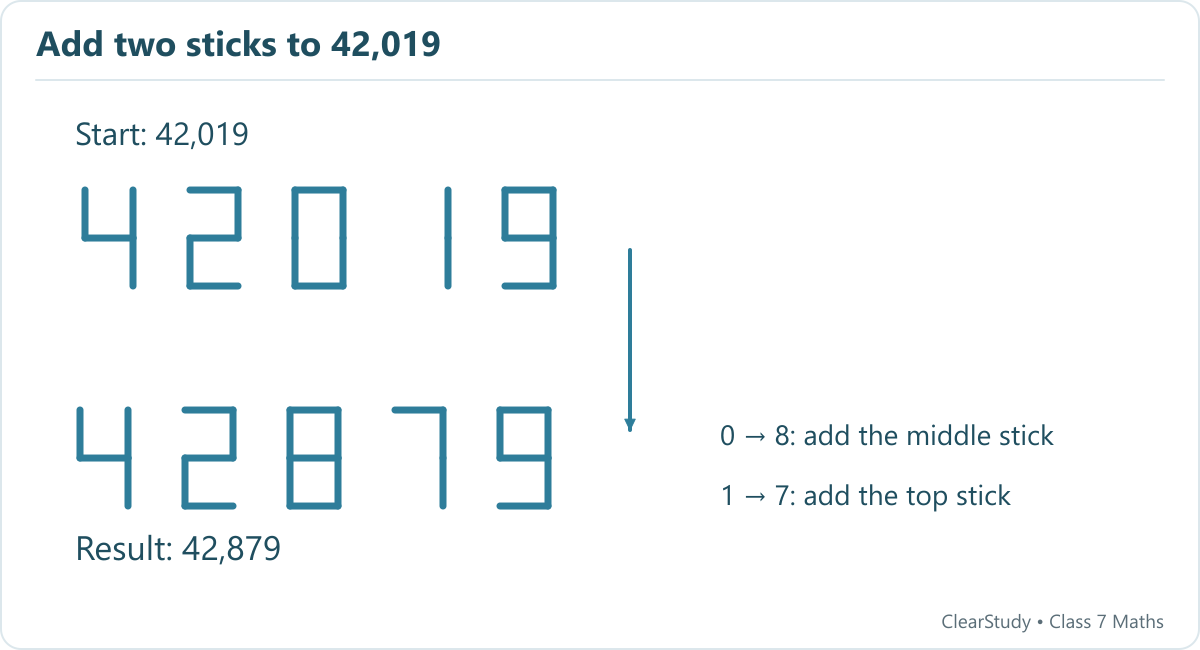
Inserting a new digit 1 into 42019 gives the distinct numbers 142019, 412019, 421019, 420119 and 420191. The largest is 4,21,019.
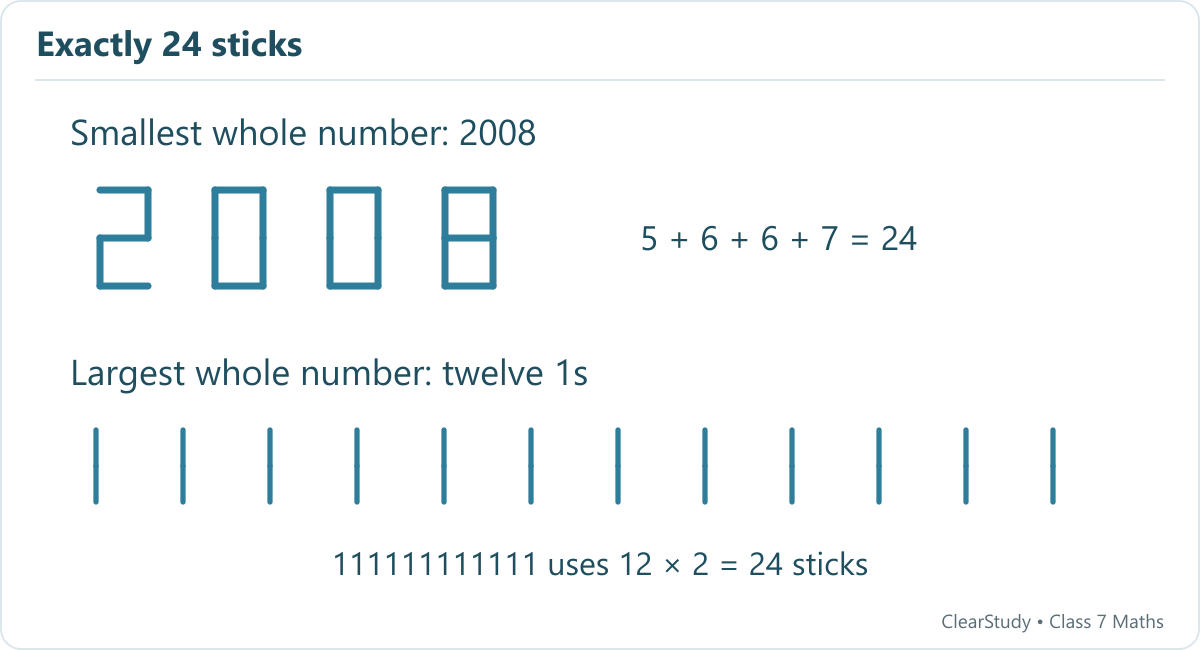
With exactly 24 sticks, the largest whole number is 111111111111: twelve 1s use 24 sticks. No digit uses fewer than two sticks. The smallest is 2008: 5+6+6+7=24. Three digits can use at most 21 sticks, and a four-digit number starting with 1 can use at most 23; starting with 2, choose 0, 0, then 8.
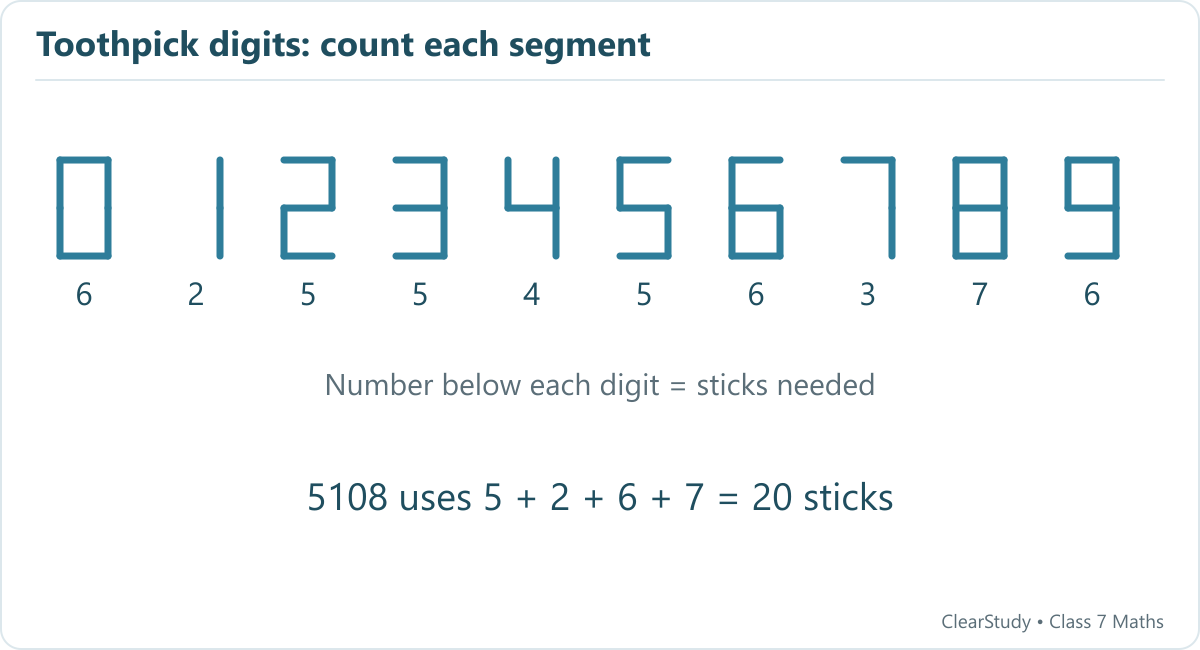
For the four-stick rearrangement of 63,890, one valid larger result is 99,006. Move the lower-left segment of the first 6 to its upper-right (6→9); remove the middle segment of 8 and use it as the upper-left of 3 (8→0, 3→9); move the middle segment of the fourth digit to its lower-left (9→0); move the upper-right of the last 0 to its middle (0→6). These are exactly four moved sticks.
Common Mistakes to Avoid
Watch out for these
- Putting commas in the wrong places — the Indian system groups 3-2-2-2 from the right (1,00,000) while the American system groups 3-3-3 (100,000). Don’t mix them.
- Confusing a million with a lakh: 1 million = 10,00,000 = ten lakhs, not one lakh.
- Miscounting zeroes: 1 lakh has 5 zeroes, 1 crore has 7, 1 arab/billion has 9.
- Forgetting that the fewest button clicks equals the sum of the digits, not the number of digits.
- Rounding the wrong way — rounding up gives a value larger than the actual; rounding down gives a smaller one.
- In “digits in a product”, forgetting that the answer can be either (p + q − 1) or (p + q) digits, not a fixed count.
Practice MCQs & Assertion–Reason
1. One lakh is the same as:
(a) ten thousand (b) hundred thousand (c) ten million (d) one crore
2. How many zeroes are there in one crore?
(a) 5 (b) 6 (c) 7 (d) 9
3. In the Indian place value system, commas are placed in the pattern (from the right):
(a) 3-3-3 (b) 3-2-2-2 (c) 2-2-2 (d) 4-4-4
4. One million equals:
(a) one lakh (b) ten lakhs (c) one crore (d) hundred lakhs
5. The smallest number of button clicks (using +1, +10, +100…) needed to make a number equals its:
(a) number of digits (b) sum of digits (c) largest digit (d) product of digits
6. How many lakhs make one billion?
(a) 100 (b) 1,000 (c) 10,000 (d) 1,00,000
7. The number 4,81,21,620 in words (Indian system) is:
(a) four crore eighty one lakh twenty one thousand six hundred twenty (b) forty eight lakh… (c) four lakh… (d) forty eight crore…
8. The exact value of 4,63,128 + 4,19,682 is:
(a) 8,72,810 (b) 8,82,810 (c) 8,83,128 (d) 9,00,000
9. The product of two 2-digit numbers can have at most:
(a) 2 digits (b) 3 digits (c) 4 digits (d) 5 digits
10. The nearest lakh of 6,72,85,183 is:
(a) 6,72,85,000 (b) 6,73,00,000 (c) 6,70,00,000 (d) 7,00,00,000
For each Assertion–Reason question, choose: (A) Both Assertion and Reason are true and the Reason is the correct explanation of the Assertion; (B) Both are true but the Reason is not the correct explanation; (C) Assertion is true but Reason is false; (D) Assertion is false but Reason is true.
A-R 1. Assertion: One crore is written as 1,00,00,000.
Reason: One crore is a hundred lakhs and equals 1 followed by 7 zeroes.
A-R 2. Assertion: One million is equal to one lakh.
Reason: In the American system, a million is grouped as 1,000,000.
A-R 3. Assertion: The fewest button clicks to make 8300 with +1, +10, +100… buttons is 11.
Reason: The minimum number of clicks equals the sum of the digits of the number.
A-R 4. Assertion: 10,000 lakhs make one billion.
Reason: One billion has 9 zeroes and one lakh has 5 zeroes, and 109 ÷ 105 = 104.
A-R 5. Assertion: In the Indian place value system, commas are placed uniformly in groups of three from the right.
Reason: The Indian system groups digits as thousands, lakhs and crores.
Quick Revision Summary
- One lakh = 1,00,000 (1 followed by 5 zeroes); one crore = 1,00,00,000 (1 followed by 7 zeroes); one arab = one billion = 1 followed by 9 zeroes.
- Indian system groups digits 3-2-2-2 from the right; American/International groups 3-3-3 (thousand, million, billion).
- 1 million = 10 lakhs; 1 billion = 100 crore = 10,000 lakhs.
- The fewest place-value button clicks for a number = the sum of its digits, and equals its Indian place-value expansion.
- Round up (value larger than actual) or round down (value smaller) when only an approximation is needed; find nearest thousand/lakh/crore.
- Multiply quickly by factorising: ×5 = ÷2 then ×10; ×25 = ×100÷4; ×125 = ×1000÷8.
- A (p-digit) × (q-digit) product has (p + q − 1) or (p + q) digits; break big calculations into stages.
How to score full marks in this chapter
Always place the commas before reading or writing a number, and state which system (Indian or American) you are using. For button-click questions, write the place-value expansion and add the digits for the fewest clicks. When estimating, say whether you are rounding up or down and by roughly how much, then give the exact answer where asked. Use factorising shortcuts (×5, ×25, ×125) to avoid long multiplication, and break very large calculations into easy stages so each step earns its mark.
Frequently Asked Questions
What is Class 7 Maths Ganita Prakash Chapter 1 about?
Chapter 1, Large Numbers Around Us, covers reading and writing large numbers (lakhs, crores, arabs) in the Indian and American/International systems, the “Land of Tens” button-click puzzles, exact versus approximate values and rounding, comparing city populations, and quick patterns in products.
How many Figure it Out exercises are there in Chapter 1?
There are six “Figure it Out” sets — on page 3 (A Lakh Varieties), page 6 (Land of Tens), page 7 (fewest button clicks), page 9 (Of Crores and Crores) page 14 (quick products) and pages 19–21 (Did You Ever Wonder) — plus several Math Talk and Try This tasks, all solved on this page.
How many zeroes are there in a lakh, a crore and a billion?
One lakh has 5 zeroes (1,00,000), one crore has 7 zeroes (1,00,00,000) and one billion (one arab) has 9 zeroes (1,00,00,00,000). One million has 6 zeroes and equals ten lakhs.
Are these Class 7 Maths Ganita Prakash Chapter 1 solutions free?
Yes. All solutions are free and follow the official NCERT Ganita Prakash (Part I) textbook for the 2026–27 session, with worked exercises and illustrated explanations.
Textbook reference: NCERT Ganita Prakash, Chapter 1 (official PDF). ClearStudy diagrams and worked explanations are original teaching aids.