
Class 7 Maths Ganita Prakash Chapter 2 Solutions (NCERT 2026–27) – Arithmetic Expressions
These Class 7 Maths Ganita Prakash Chapter 2 solutions cover Arithmetic Expressions from the new NCF-2023 textbook (Reprint 2026–27). Every Figure it Out question is solved step by step — comparing expressions, identifying terms, removing brackets and using the distributive property — so you can master the chapter and revise it quickly.
- Chapter overview
- Key concepts & definitions
- Important formulas & properties
- Figure it Out (Page 25 – Comparing expressions)
- Figure it Out (Pages 34–35 — Terms and situations)
- Figure it Out (Page 37 – Removing brackets)
- Figure it Out (Page 41 – Distributive property)
- Figure it Out (Pages 42–44 – Applications)
- Math Talk & Try This (answered)
- Common mistakes to avoid
- Practice MCQs & Assertion–Reason
- Quick revision summary
- FAQs
Chapter 2 Overview
Chapter 2 of Ganita Prakash, Arithmetic Expressions, teaches how to read, compare and evaluate mathematical phrases like 13 + 2, 20 − 4 and 5 × 25. It starts with simple expressions and how to compare them using =, < and > through reasoning rather than full calculation. It then introduces brackets and the powerful idea of terms (the parts of an expression separated by a ‘+’ sign, with subtraction rewritten as adding the inverse). Using terms, the chapter explains the commutative and associative properties of addition, the rules for removing brackets, and the distributive property — that a multiple of a sum equals the sum of the multiples. The Class 7 Maths Ganita Prakash Chapter 2 solutions below work through the exercises and in-text tasks with checked working.
Key Concepts & Definitions
Arithmetic expression: a mathematical phrase formed with numbers and the operations +, −, ×, ÷, e.g. 13 + 2 or 12 × 5. Its value is the single number it evaluates to (the value of 13 + 2 is 15).
Comparing expressions: two expressions are compared by their values using ‘=’, ‘<’ or ‘>’, e.g. 10 + 2 > 7 + 1 because 12 > 8.
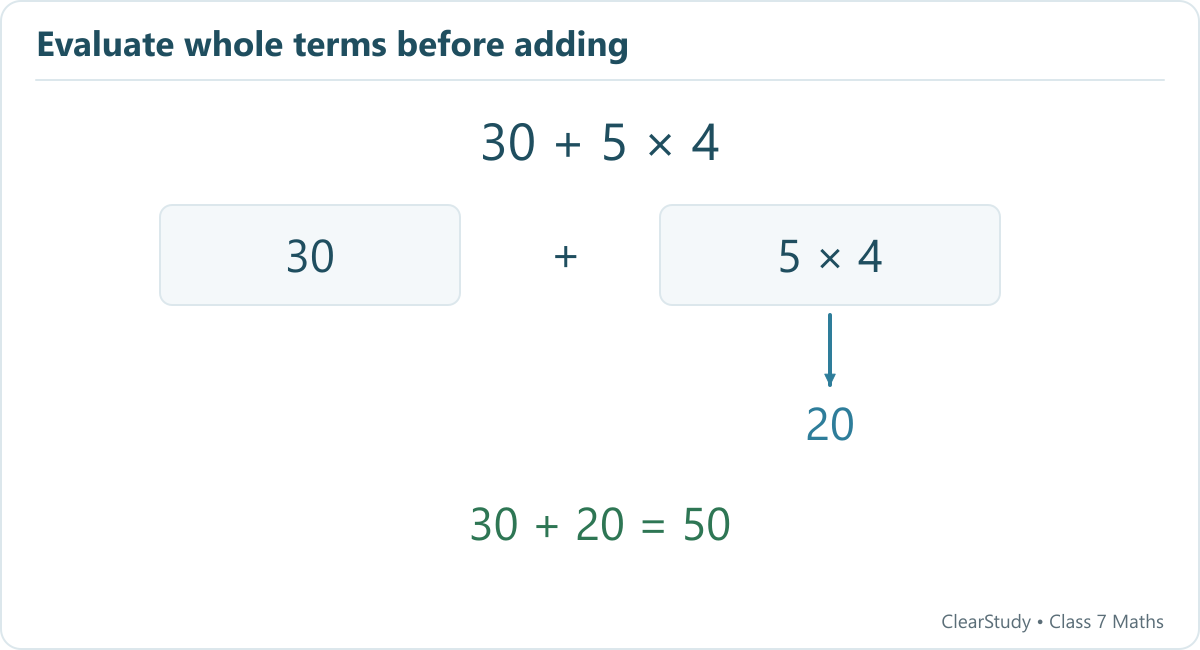
Brackets: the part inside brackets is always evaluated first, e.g. 30 + (5 × 4) = 30 + 20 = 50.
Terms: the parts of an expression separated by a ‘+’ sign. To find the terms, rewrite every subtraction as adding the inverse, e.g. 83 − 14 = 83 + (−14), so the terms are 83 and −14. Products such as 6 × 5 are single terms.
Evaluating with terms: evaluate each term first, then add all the terms, e.g. 30 + 5 × 4 = 30 + (5 × 4) = 30 + 20 = 50.
Additive inverse of a number: the same number with the opposite sign; the inverse of 14 is −14 and the inverse of −14 is 14. Subtracting a number is the same as adding its inverse.
Taxicab-style reasoning: many comparisons can be settled by reasoning about how terms change, without computing the values at all.
Important Formulas & Properties (Chapter 2)
Commutative property of addition: Term 1 + Term 2 = Term 2 + Term 1 — swapping terms does not change the value.
Associative property of addition: (Term 1 + Term 2) + Term 3 = Term 1 + (Term 2 + Term 3) — grouping terms does not change the value. Adding terms in any order gives the same value.
Brackets after ‘+’: a + (b + c) = a + b + c and a + (b − c) = a + b − c — signs inside do not change.
Brackets after ‘−’: a − (b + c) = a − b − c and a − (b − c) = a − b + c — every sign inside changes.
Distributive property: a × (b + c) = a × b + a × c and a × (b − c) = a × b − a × c — the multiple of a sum (difference) is the sum (difference) of the multiples.
Handy version: (b + c) × a = b × a + c × a, useful for quick mental products like 97 × 25 = (100 − 3) × 25.
Figure it Out — Comparing Expressions (Page 25)
1. Fill in the blanks to make the expressions equal on both sides of the = sign: (a) 13 + 4 = ____ + 6 (b) 22 + ____ = 6 × 5 (c) 8 × ____ = 64 ÷ 2 (d) 34 – ____ = 25
2. Arrange the following expressions in ascending (increasing) order of their values. (a) 67 – 19 (b) 67 – 20 (c) 35 + 25 (d) 5 × 11 (e) 120 ÷ 3
Figure it Out — Terms and situations (pages 34–35)
1. Find the terms and values.
(b) 39 − 2 × 6 + 11: terms 39, −(2 × 6), 11; value 39 − 12 + 11 = 38.
(c) 40 − 10 + 10 + 10: terms 40, −10, 10, 10; value 50.
(d) 48 − 10 × 2 + 16 ÷ 2: terms 48, −(10 × 2), 16 ÷ 2; value 48 − 20 + 8 = 36.
(e) 6 × 3 − 4 × 8 × 5: terms 6 × 3 and −(4 × 8 × 5); value 18 − 160 = −142.
2. Write a situation for each expression.
(b) Five boxes contain 12 pencils each; six pencils are used: 5 × 12 − 6 = 54 pencils.
(c) Four bags contain nine apples each, and two bags contain six each: 4 × 9 + 2 × 6 = 48 apples.
3(a). Elsa doubles 100 coins; Anna keeps half of 100.
3(b). Adult metro tickets cost ₹40 and child tickets ₹20.
(ii) Two groups of three adults: 2 × (3 × 40) is one product term, giving ₹240.
3(c). Find the window height from the diagram.
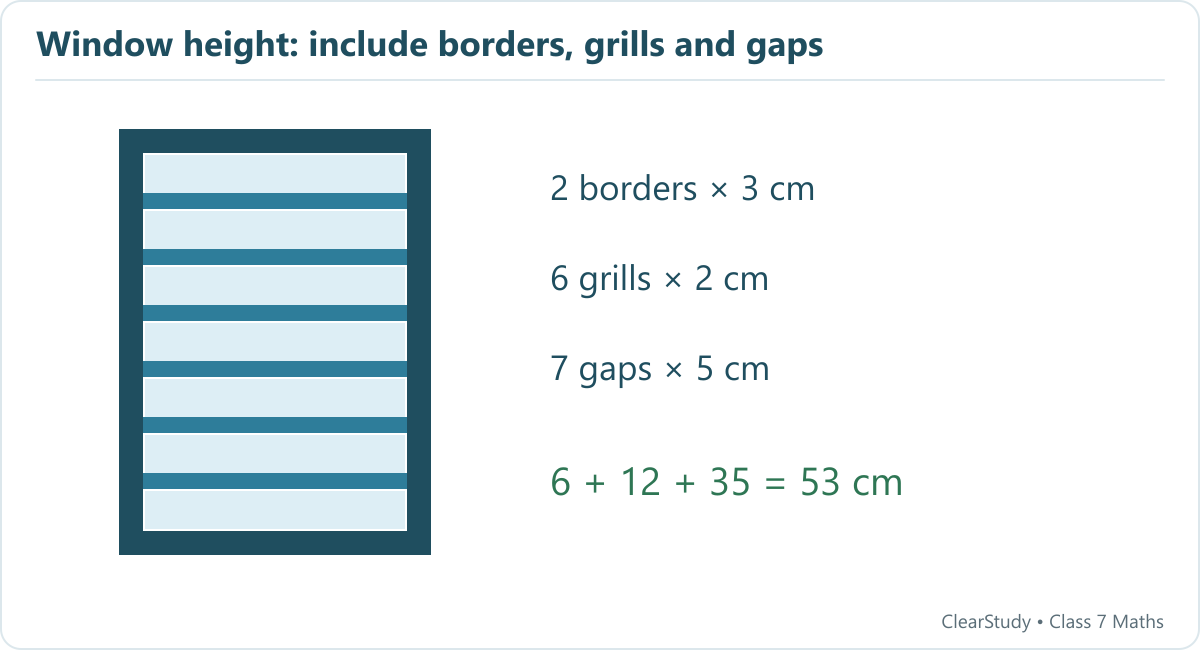
Figure it Out — Removing Brackets (Page 37)
1. Fill in the blanks with numbers, and boxes with operation signs such that the expressions on both sides are equal. (a) 24 + (6 – 4) = 24 + 6 _____ (b) 38 + (_____ _____) = 38 + 9 – 4 (c) 24 – (6 + 4) = 24 [ ] 6 – 4 (d) 24 – 6 – 4 = 24 – 6 _____ (e) 27 – (8 + 3) = 27 [ ] 8 [ ] 3 (f) 27 – (_____ _____) = 27 – 8 + 3
2. Remove the brackets and write the expression having the same value. (a) 14 + (12 + 10) (b) 14 – (12 + 10) (c) 14 + (12 – 10) (d) 14 – (12 – 10) (e) –14 + 12 – 10 (f) 14 – (–12 – 10)
3. Find the values of the following expressions. For each pair, first try to guess whether they have the same value. When are the two expressions equal? (a) (6 + 10) – 2 and 6 + (10 – 2) (b) 16 – (8 – 3) and (16 – 8) – 3 (c) 27 – (18 + 4) and 27 + (–18 – 4)
4. In each of the sets of expressions below, identify those that have the same value. Do not evaluate them, but rather use your understanding of terms. (a) 319 + 537, 319 – 537, – 537 + 319, 537 – 319 (b) 87 + 46 – 109, 87 + 46 – 109, 87 + 46 – 109, 87 – 46 + 109, 87 – (46 + 109), (87 – 46) + 109
5. Add brackets at appropriate places in the expressions such that they lead to the values indicated. (a) 34 – 9 + 12 = 13 (b) 56 – 14 – 8 = 34 (c) –22 – 12 + 10 + 22 = – 22
6. Using only reasoning of how terms change their values, fill the blanks to make the expressions on either side of the equality (=) equal. (a) 423 + ______ = 419 + ______ (b) 207 – 68 = 210 – ______
7. Using the numbers 2, 3 and 5, and the operators ‘+’ and ‘–’, and brackets, as necessary, generate expressions to give as many different values as possible. For example, 2 – 3 + 5 = 4 and 3 – (5 – 2) = 0.
8. Whenever Jasoda has to subtract 9 from a number, she subtracts 10 and adds 1 to it. For example, 36 – 9 = 26 + 1. (a) Do you think she always gets the correct answer? Why? (b) Can you think of other similar strategies? Give some examples. (Math Talk)
9. Consider the two expressions: a) 73 – 14 + 1, b) 73 – 14 – 1. For each of these expressions, identify the expressions from the following collection that are equal to it. (a) 73 – (14 + 1) (b) 73 – (14 – 1) (c) 73 + (– 14 + 1) (d) 73 + (– 14 – 1)
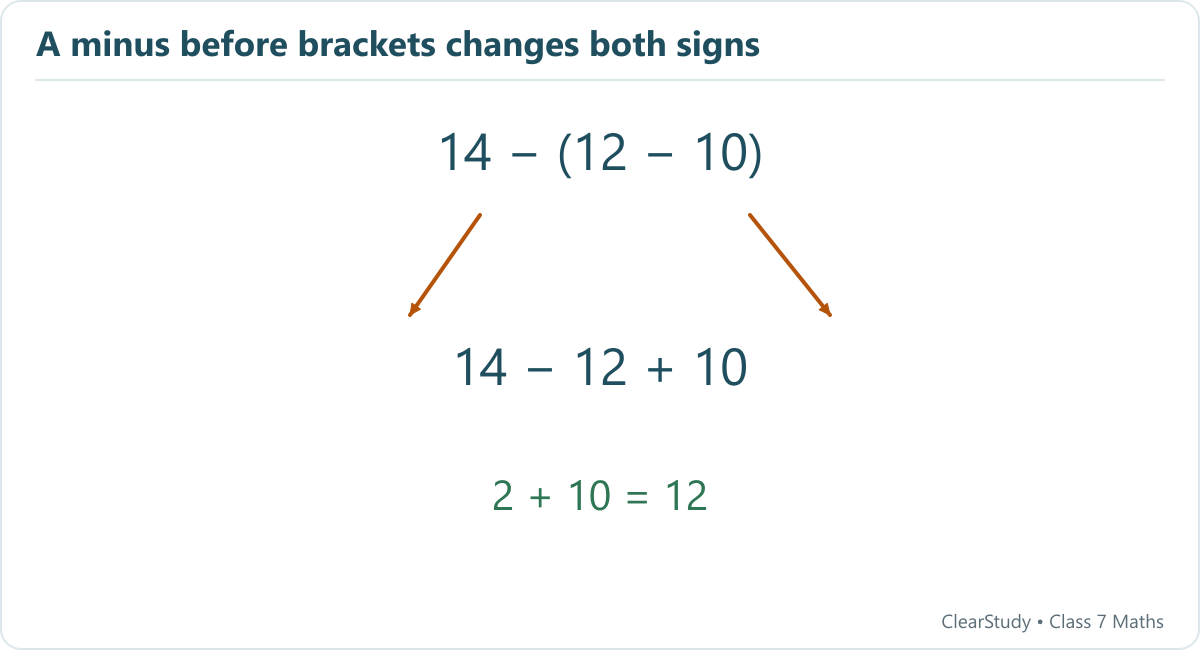
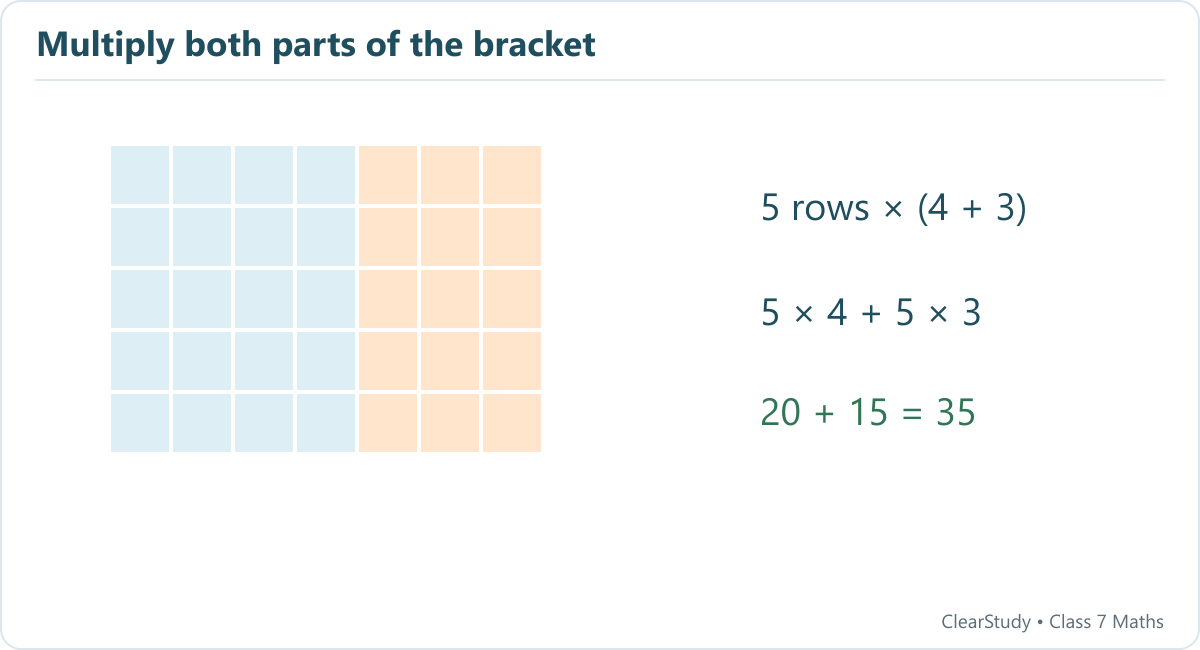
Figure it Out — Distributive Property (Page 41)
1. Fill in the blanks with numbers, and boxes by signs, so that the expressions on both sides are equal. (a) 3 × (6 + 7) = 3 × 6 + 3 × 7 (b) (8 + 3) × 4 = 8 × 4 + 3 × 4 (c) 3 × (5 + 8) = 3 × 5 [ ] 3 × ____ (d) (9 + 2) × 4 = 9 × 4 [ ] 2 × ____ (e) 3 × (____ + 4) = 3 ____ + ____ (f) (____ + 6) × 4 = 13 × 4 + ____ (g) 3 × (____ + ____) = 3 × 5 + 3 × 2 (h) (____ + ____) × ____ = 2 × 4 + 3 × 4 (i) 5 × (9 – 2) = 5 × 9 – 5 × ____ (j) (5 – 2) × 7 = 5 × 7 – 2 × ____ (k) 5 × (8 – 3) = 5 × 8 [ ] 5 × ____ (l) (8 – 3) × 7 = 8 × 7 [ ] 3 × 7 (m) 5 × (12 – ____) = ____ [ ] 5 × ____ (n) (15 – ____) × 7 = ____ [ ] 6 × 7 (o) 5 × (____ – ____) = 5 × 9 – 5 × 4 (p) (____ – ____) × ____ = 17 × 7 – 9 × 7
2. In the boxes below, fill ‘<’, ‘>’ or ‘=’ after analysing the expressions on the LHS and RHS. Use reasoning and understanding of terms and brackets to figure this out and not by evaluating the expressions. (a) (8 – 3) × 29 [ ] (3 – 8) × 29 (b) 15 + 9 × 18 [ ] (15 + 9) × 18 (c) 23 × (17 – 9) [ ] 23 × 17 + 23 × 9 (d) (34 – 28) × 42 [ ] 34 × 42 – 28 × 42
3. Here is one way to make 14: _2_ × ( _1_ + _6_ ) = 14. Are there other ways of getting 14? Fill them out below: (a) _____ × (_____ + _____) = 14 (b) _____ × (_____ + _____) = 14 (c) _____ × (_____ + _____) = 14 (d) _____ × (_____ + _____) = 14
4. Find out the sum of the numbers given in each picture below in at least two different ways. Describe how you solved it through expressions.
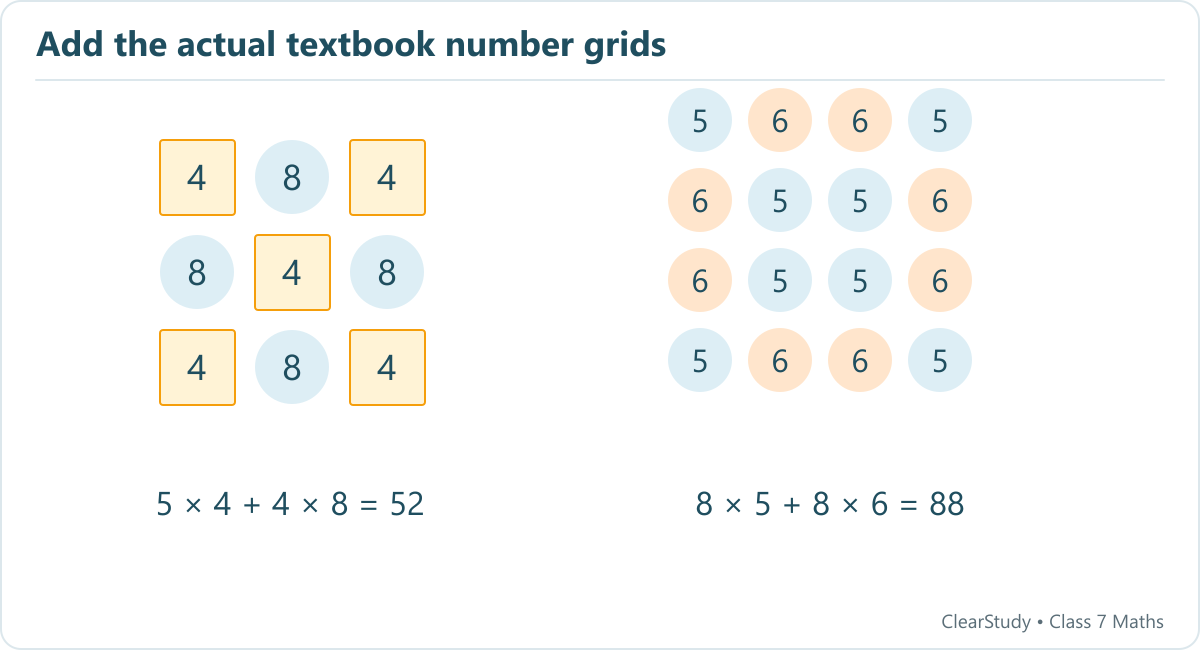
Figure it Out — Applications (Pages 42–44)
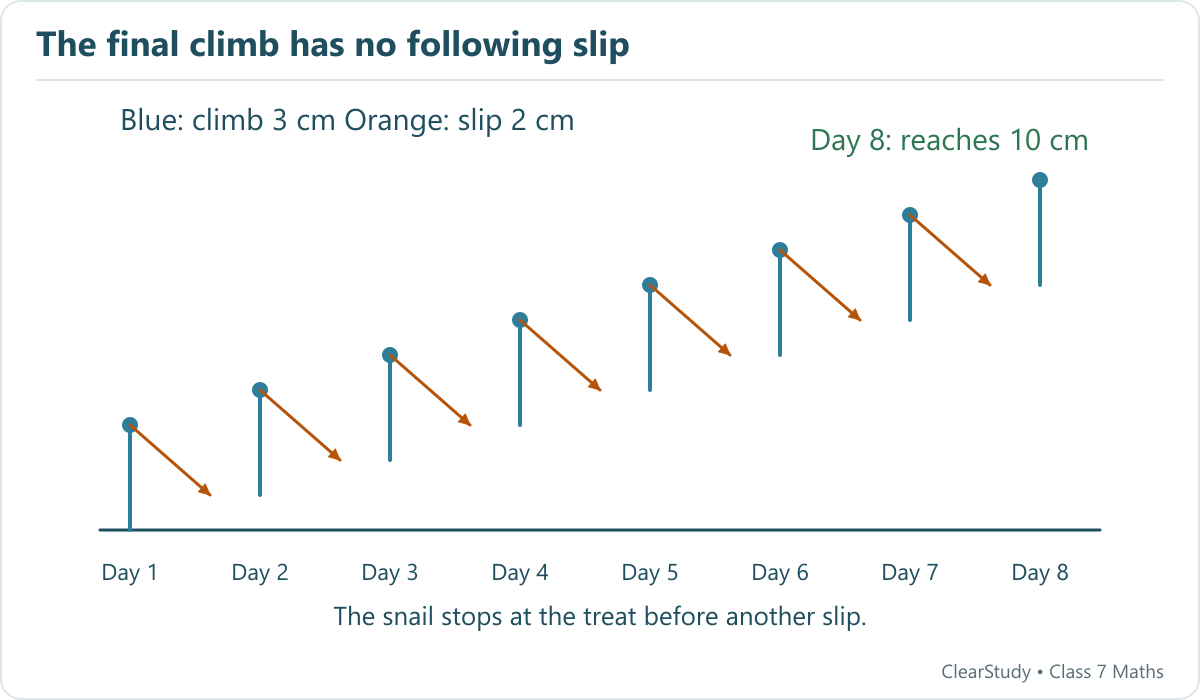
1. Read the situations given below. Write appropriate expressions for each of them and find their values. (a) The district market in Begur operates on all seven days of a week. Rahim supplies 9 kg of mangoes each day from his orchard and Shyam supplies 11 kg of mangoes each day from his orchard to this market. Find the amount of mangoes supplied by them in a week to the local district market. (b) Binu earns ₹20,000 per month. She spends ₹5,000 on rent, ₹5,000 on food, and ₹2,000 on other expenses every month. What is the amount Binu will save by the end of a year? (c) During the daytime a snail climbs 3 cm up a post, and during the night while asleep, accidentally slips down by 2 cm. The post is 10 cm high, and a delicious treat is on its top. In how many days will the snail get the treat?
2. Melvin reads a two-page story every day except on Tuesdays and Saturdays. How many stories would he complete reading in 8 weeks? Which of the expressions below describes this scenario? (a) 5 × 2 × 8 (b) (7 – 2) × 8 (c) 8 × 7 (d) 7 × 2 × 8 (e) 7 × 5 – 2 (f) (7 + 2) × 8 (g) 7 × 8 – 2 × 8 (h) (7 – 5) × 8
3. Find different ways of evaluating the following expressions: (a) 1 – 2 + 3 – 4 + 5 – 6 + 7 – 8 + 9 – 10 (b) 1 – 1 + 1 – 1 + 1 – 1 + 1 – 1 + 1 – 1
4. Compare the following pairs of expressions using ‘<’, ‘>’ or ‘=’ or by reasoning. (a) 49 – 7 + 8 [ ] 49 – 7 + 8 (b) 83 × 42 – 18 [ ] 83 × 40 – 18 (c) 145 – 17 × 8 [ ] 145 – 17 × 6 (d) 23 × 48 – 35 [ ] 23 × (48 – 35) (e) (16 – 11) × 12 [ ] –11 × 12 + 16 × 12 (f) (76 – 53) × 88 [ ] 88 × (53 – 76) (g) 25 × (42 + 16) [ ] 25 × (43 + 15) (h) 36 × (28 – 16) [ ] 35 × (27 – 15)
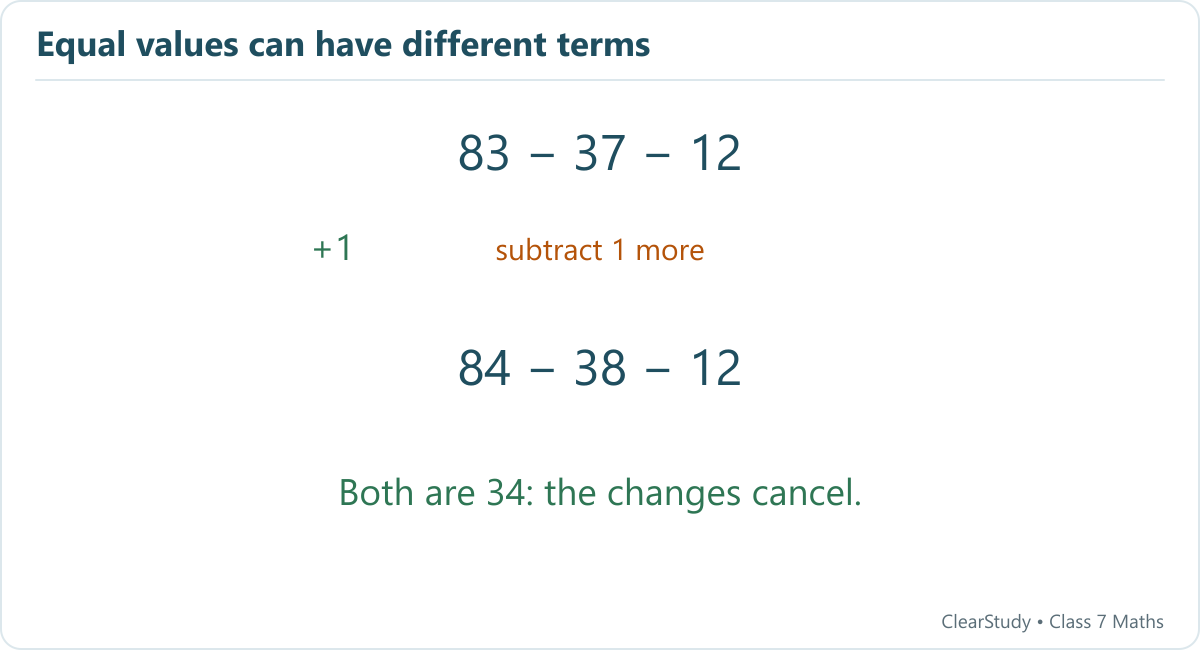
5. Identify which of the following expressions are equal to the given expression without computation. You may rewrite the expressions using terms or removing brackets. There can be more than one expression which is equal to the given expression. (a) 83 – 37 – 12 (i) 84 – 38 – 12 (ii) 84 – (37 + 12) (iii) 83 – 38 – 13 (iv) – 37 + 83 – 12 (b) 93 + 37 × 44 + 76 (i) 37 + 93 × 44 + 76 (ii) 93 + 37 × 76 + 44 (iii) (93 + 37) × (44 + 76) (iv) 37 × 44 + 93 + 76
6. Choose a number and create ten different expressions having that value. (Numbered “5” in the book; it is the final task of this set.)
More worked in-text tasks
Tinker the Terms I (page 37): 52 − 16 = 36; 53 − 15 = 38; 53 − 17 = 36; −87 − 16 = −103; −88 − 15 = −103; −86 − 18 = −104; −97 − 26 = −123.
Rice packets: 4 + 100 ÷ 2 = 54 packets; terms 4 and 100 ÷ 2. ₹432: another payment is 4 × 100 + 3 × 10 + 2 × 1, with those three product terms. Three friends ordering both items: 3 × (43 + 24) = 3 × 67 = ₹201. Changing a product: from 53 × 18 = 954, adding ten more groups of 18 gives 63 × 18 = 954 + 180 = 1,134.
Math Talk & Try This — Answered
These are the in-text reflective and short tasks in the chapter; the determinate ones are answered, the open ones are guided.
Four 4s with only +, −, ×, ÷ and brackets: 1 = (4 ÷ (4+(4-4))); 2 = (4 × (4 ÷ (4+4))); 3 = ((4+(4+4)) ÷ 4); 4 = (4+(4 × (4-4))); 5 = ((4+(4 × 4)) ÷ 4); 6 = (4+((4+4) ÷ 4)); 7 = (4+(4-(4 ÷ 4))); 8 = (4-(4-(4+4))); 9 = (4+(4+(4 ÷ 4))); 12 = (4 × (4-(4 ÷ 4))); 15 = ((4 × 4)-(4 ÷ 4)); 16 = (4+(4+(4+4))); 17 = ((4 × 4)+(4 ÷ 4)); 20 = (4 × (4+(4 ÷ 4))). Under these strict rules, 10, 11, 13, 14, 18 and 19 cannot be formed; the textbook request for every value 1–20 therefore needs additional permitted notation. For example, allowing joined digits makes (44 − 4) ÷ 4 = 10; this uses an extra convention, so agree on it first.
Using 1–5 once: 1 + 2 + 3 + 4 − 5 = 5; 1 − 2 − 3 − 4 + 5 = −3; (5 − 4 − 1) × (3 + 2) = 0; (5 − 3) × (4 + 2 − 1) = 10; (3 − 5) × (4 + 2 − 1) = −10. Each number is used once.
Using 0–9 once: 1 + 2 + 3 + 4 + 5 + 6 + 7 + 8 × 9 + 0 = 28 + 72 = 100.
Common Mistakes to Avoid
Watch out for these
- Evaluating left-to-right blindly — in 30 + 5 × 4 you must do 5 × 4 first (it is a single term), giving 50, not 140.
- Forgetting to flip signs when removing a bracket that follows a minus: 100 − (15 + 56) = 100 − 15 − 56, not 100 − 15 + 56.
- Flipping signs when the bracket follows a plus — a + (b − c) keeps the signs: 28 + (35 − 10) = 28 + 35 − 10.
- Treating 5 × 4 + 3 the same as 5 × (4 + 3) — the bracket changes which numbers get multiplied.
- Saying a × (b − c) = a×b − c — you must multiply every term inside: a×b − a×c.
- When finding terms, missing that subtraction means adding the inverse, so 83 − 14 has terms 83 and −14.
Practice MCQs & Assertion–Reason
1. The value of the expression 30 + 5 × 4 is:
(a) 140 (b) 50 (c) 35 (d) 120
2. The terms of the expression 83 – 14 are:
(a) 83 and 14 (b) 83 and –14 (c) –83 and 14 (d) 83 × 14
3. 100 – (15 + 56) is equal to:
(a) 100 – 15 + 56 (b) 100 + 15 – 56 (c) 100 – 15 – 56 (d) 100 + 15 + 56
4. Which expression equals 23 × (17 – 9)?
(a) 23 × 17 + 23 × 9 (b) 23 × 17 – 23 × 9 (c) 23 × 17 – 9 (d) 23 + 17 – 9
5. “Swapping terms does not change the sum” is called the:
(a) associative property (b) distributive property (c) commutative property (d) identity property
6. To make the blank true: 22 + ____ = 6 × 5, the missing number is:
(a) 6 (b) 8 (c) 12 (d) 30
7. Which comparison is correct?
(a) 10 + 2 < 7 + 1 (b) 13 – 2 > 4 × 3 (c) 10 + 2 > 7 + 1 (d) 5 × 11 < 120 ÷ 3
8. Using the method (100 – 3) × 25, the value of 97 × 25 is:
(a) 2425 (b) 2500 (c) 2475 (d) 2375
9. (8 – 3) × 29 compared with (3 – 8) × 29 is:
(a) less than (b) greater than (c) equal to (d) cannot say
10. Melvin reads daily except Tuesdays and Saturdays; in 8 weeks the number of reading days is given by:
(a) 7 × 8 (b) (7 – 2) × 8 (c) (7 + 2) × 8 (d) 7 × 2 × 8
For each Assertion–Reason question, choose: (A) Both Assertion and Reason are true and the Reason is the correct explanation of the Assertion; (B) Both are true but the Reason is not the correct explanation; (C) Assertion is true but Reason is false; (D) Assertion is false but Reason is true.
A-R 1. Assertion: 30 + 5 × 4 = 50.
Reason: 5 × 4 is a single term, so it is evaluated before adding it to 30.
A-R 2. Assertion: 24 – (6 + 4) = 24 – 6 + 4.
Reason: When a bracket is preceded by a minus sign, the signs of all terms inside change on removal.
A-R 3. Assertion: a × (b + c) = a × b + a × c.
Reason: This is the distributive property — the multiple of a sum is the sum of the multiples.
A-R 4. Assertion: The terms of 83 – 14 are 83 and –14.
Reason: Subtracting a number is the same as adding its inverse.
A-R 5. Assertion: Adding the terms of an expression in any order gives the same value.
Reason: Addition obeys the commutative and associative properties.
Quick Revision Summary
- An arithmetic expression is built from numbers and +, −, ×, ÷; its value is the number it evaluates to.
- Compare expressions by their values using =, < and > — often by reasoning, without full calculation.
- Brackets are evaluated first; terms are the parts separated by ‘+’, with each subtraction rewritten as adding the inverse.
- Evaluate by working out each term first, then adding all the terms (so 30 + 5 × 4 = 30 + 20 = 50).
- Commutative & associative properties: terms can be swapped and regrouped without changing the value.
- Removing a bracket after ‘−’ flips every inside sign; after ‘+’ the signs stay the same.
- Distributive property: a × (b ± c) = a×b ± a×c — great for quick mental multiplication like 97 × 25.
How to score full marks in this chapter
Always rewrite subtractions as “+ inverse” before identifying terms, and evaluate each product/quotient term before adding. When removing brackets, write one line stating whether the sign before the bracket is + (keep signs) or − (flip signs). For comparisons, look at how each term changes rather than computing both sides, and use the distributive property to break big multiplications into easy ones — showing each step earns full method marks.
Frequently Asked Questions
What is Class 7 Maths Ganita Prakash Chapter 2 about?
Chapter 2, Arithmetic Expressions, covers reading and comparing simple expressions, brackets, the idea of terms (parts separated by ‘+’), the commutative and associative properties of addition, rules for removing brackets, and the distributive property for multiplication over addition and subtraction.
What are “terms” in an arithmetic expression?
Terms are the parts of an expression separated by a ‘+’ sign. To find them, rewrite each subtraction as adding the inverse — so 83 − 14 = 83 + (−14) has the terms 83 and −14, while a product like 6 × 5 stays as one single term.
What happens to the signs when we remove brackets?
If the bracket is preceded by a plus sign, the signs inside stay the same: a + (b − c) = a + b − c. If it is preceded by a minus sign, every sign inside changes: a − (b + c) = a − b − c and a − (b − c) = a − b + c.
Are these Class 7 Maths Ganita Prakash Chapter 2 solutions free?
Yes. All solutions are free and follow the official NCERT Ganita Prakash (Part I) textbook for the 2026–27 session, with every Figure it Out, Math Talk and Try This task solved step by step.
Textbook reference: NCERT Ganita Prakash, Chapter 2 (official PDF). ClearStudy diagrams and worked explanations are original teaching aids.