Class 7 Maths Chapter 3 Solutions — A Peek Beyond the Point
Study decimals with these NCERT Ganita Prakash Class 7 Chapter 3 solutions. Follow worked exercises, labelled number lines, place-value diagrams, conversions and digit puzzles. Notes identify inconsistent textbook printings where the answer depends on the intended notation.
Class: 7Subject: MathematicsBook: Ganita Prakash (Part I)Chapter: 3Exercises: Figure it Out (pp. 58, 75, 78–80)Session: 2026–27
Chapter 3 of Ganita Prakash, A Peek Beyond the Point, starts with Sonu watching his mother fix a toy with screws of slightly different lengths and uses it to explain why we need units smaller than one. Step by step the chapter builds the idea of a tenth (split a unit into 10 equal parts), a hundredth (split each tenth into 10), and a thousandth, leading to the full decimal place value system and the decimal point. It then covers reading and writing decimals, length (mm–cm–m), weight (g–kg–mg) and rupee–paise conversions, locating and comparing decimals on the number line, the “zero dilemma” (trailing zeros), and the standard method for adding and subtracting decimals. Use the worked solutions and original teaching diagrams below to check each step.
Key Concepts & Definitions
Tenth: when a unit is split into 10 equal parts, each part is one-tenth = 1⁄10 of a unit. Ten one-tenths make one unit.
Hundredth: when each one-tenth is split into 10 equal parts, each part is one-hundredth = 1⁄100 of a unit. 10 hundredths = 1 tenth and 100 hundredths = 1 unit.
Thousandth: splitting each hundredth into 10 gives one-thousandth = 1⁄1000 of a unit; 10 thousandths = 1 hundredth.
Decimal point: a point or period (‘.’) that separates the whole-number part of a number from its fractional part, e.g. in 7.05 the 7 is units and 05 is the fractional part.
Decimal place value: reading left to right after the point, the places are tenths, hundredths, thousandths, … Each place is 10 times smaller than the one to its left, e.g. 70.5 = 7 × 10 + 5 × 1⁄10 and 7.05 = 7 × 1 + 5 × 1⁄100.
Decimal system: a way of writing numbers based on 10 (“decem” = ten in Latin, cognate with Sanskrit daśha), extending the Indian place value system to numbers below one.
Trailing zeros: zeros placed at the right end after the decimal point do not change a decimal’s value, e.g. 0.2 = 0.20 = 0.200, but 0.2, 0.02 and 0.002 are all different.
Important Formulas & Conversions (Chapter 3)
Place value chain: 1 unit = 10 tenths = 100 hundredths = 1000 thousandths.
Length: 1 cm = 10 mm, so 1 mm = 0.1 cm; 1 m = 100 cm, so 1 cm = 0.01 m; 1 m = 1000 mm, so 1 mm = 0.001 m.
Weight: 1 kg = 1000 g, so 1 g = 0.001 kg; 1 g = 1000 mg, so 1 mg = 0.001 g.
Reading decimals: read digit by digit after the point, e.g. 0.274 = “zero point two seven four” = 2 tenths + 7 hundredths + 4 thousandths.
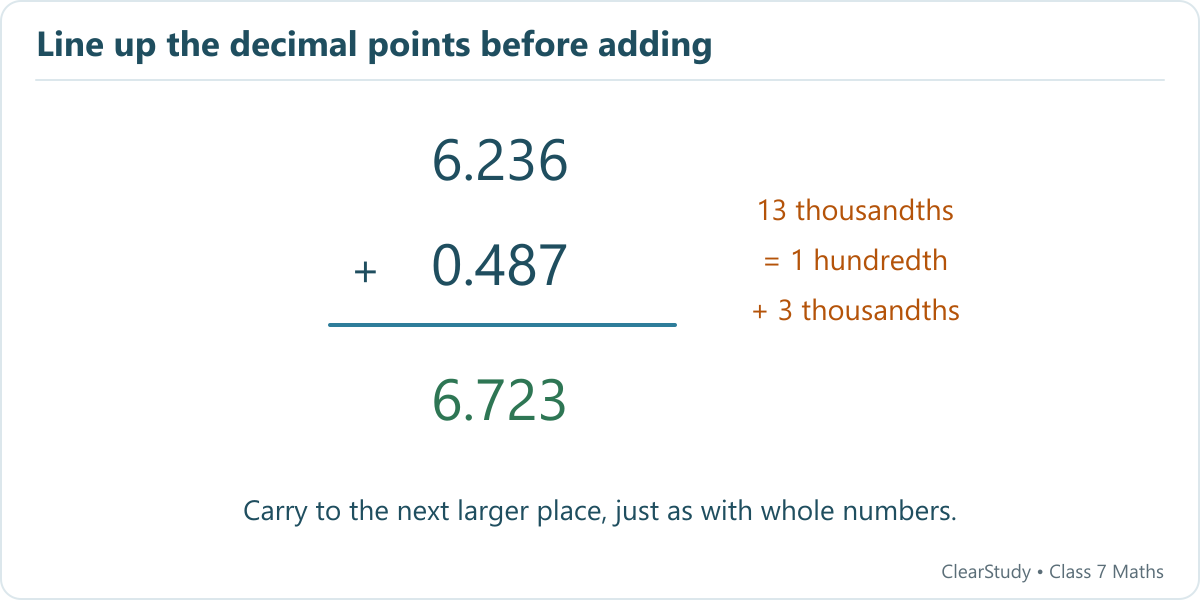
Adding/subtracting decimals: line up the decimal points (and so the place values), then add or subtract just like whole numbers, regrouping or borrowing as usual.
Comparing decimals: compare the highest place value first; move to the next smaller place only when digits are equal — the first place with a bigger digit decides the larger number.
Figure it Out — Find the Sums and Differences (Page 58)
SOLUTION(a) 0.30 + 3.04 = 3.34.(b) 9.57 + 2.13 = 11.70: ten hundredths regroup as one tenth.(c) 15.64 + 14.36 = 30.00.(d) 7.07 − 4.04 = 3.03. (e) 8.06 − 5.03 = 3.03.(f) With 6 tenths and 2 hundredths, 12.62 − 0.99 = 11.63. Printing note: the supplied textbook PDF prints both fractions as hundredths (6/100 and 2/100). Read literally, that gives 12.08 − 0.99 = 11.09. The answer 11.63 applies only when the first fraction is 6/10, as written in the question above.
3. What decimal number does each letter represent in the number line below?
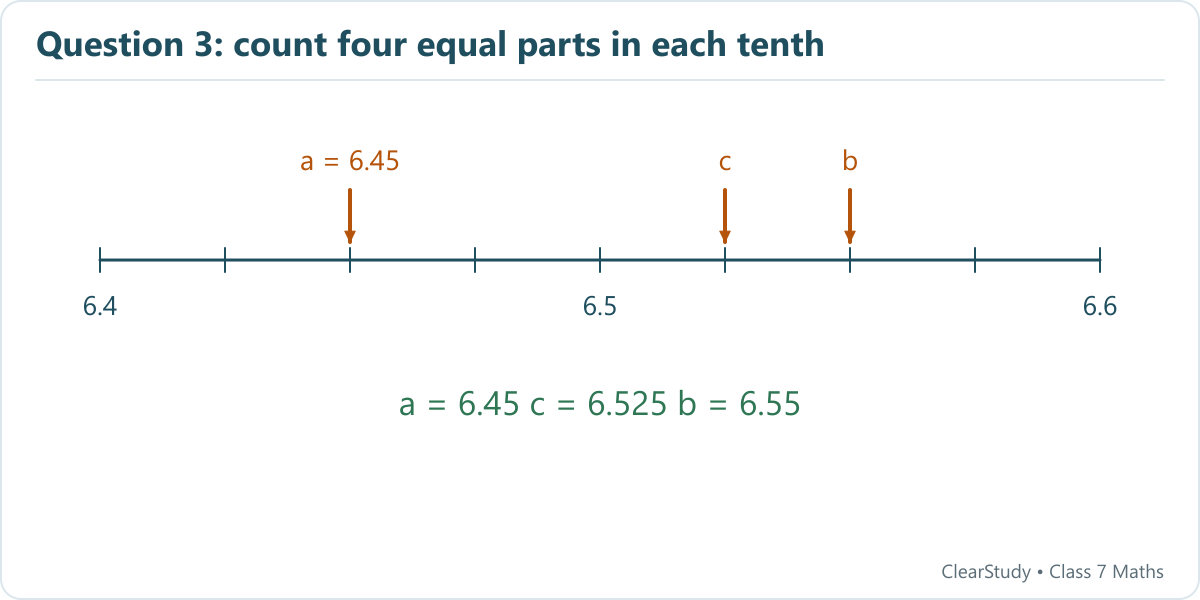
SOLUTIONThe gap from 6.4 to 6.5 has four equal intervals, so each interval is 0.1 ÷ 4 = 0.025.a is two steps after 6.4: a = 6.45. c is one step after 6.5: c = 6.525. b is two steps after 6.5: b = 6.55. Count intervals, not just the labelled numbers.
Four intervals fill the gap from 6.4 to 6.5. Thus a = 6.45, c = 6.525 and b = 6.55.
4. Arrange the following quantities in descending order:
(a) 11.01, 1.011, 1.101, 11.10, 1.01(b) 2.567, 2.675, 2.768, 2.499, 2.698(c) 4.678 g, 4.595 g, 4.600 g, 4.656 g, 4.666 g(d) 33.13 m, 33.31 m, 33.133 m, 33.331 m, 33.313 m
SOLUTIONCompare the whole-number part first, then tenths, hundredths, thousandths.(a) 11.10 > 11.01 > 1.101 > 1.011 > 1.01.(b) 2.768 > 2.698 > 2.675 > 2.567 > 2.499.(c) 4.678 g > 4.666 g > 4.656 g > 4.600 g > 4.595 g.(d) 33.331 m > 33.313 m > 33.31 m > 33.133 m > 33.13 m (note 33.31 = 33.310, which is bigger than 33.133 and 33.13).
5. Using the digits 1, 4, 0, 8, and 6 make:
(a) the decimal number closest to 30(b) the smallest possible decimal number between 100 and 1000.
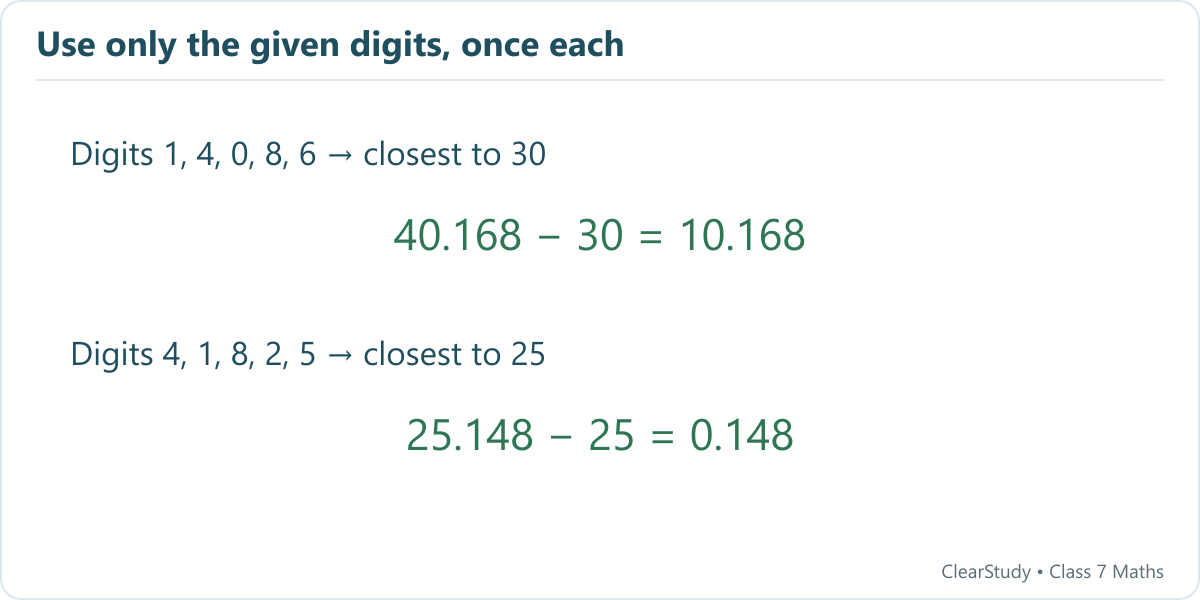
SOLUTION(a) 40.168. We cannot form a number starting with 2 or 3. The largest possible number below 30 is 18.640, at distance 11.360. The smallest above 30 is 40.168, at distance 10.168, so it is closer. Numbers with a one-digit whole part or at least three whole-number digits are farther away.(b) 104.68. Use the smallest possible three-digit whole part, 104, then arrange the remaining digits as .68. Each supplied digit appears once.
The closest allowed decimals are 40.168 to 30 and 25.148 to 25; each uses exactly the five supplied digits.
6. Will a decimal number with more digits be greater than a decimal number with fewer digits?
SOLUTIONNo. The number of digits does not decide the value — place value does.Example: 0.9 has fewer digits than 0.125 but 0.9 > 0.125, because 9 tenths is more than 1 tenth. So a longer decimal can still be smaller.
7. Mahi purchases 0.25 kg of beans, 0.3 kg of carrots, 0.5 kg of potatoes, 0.2 kg of capsicums, and 0.05 kg of ginger. Calculate the total weight of the items she bought.
SOLUTIONLine up the points and add: 0.25 + 0.30 + 0.50 + 0.20 + 0.05.Hundredths: 5 + 0 + 0 + 0 + 5 = 10 = 1 tenth carried. Tenths: 2 + 3 + 5 + 2 + 0 + 1 = 13 = 1 unit and 3 tenths.Total weight = 1.30 kg.
8. Pinto supplies 3.79 L, 4.2 L, and 4.25 L of milk to a milk dairy in the first three days. In 6 days, he supplies 25 litres of milk. Find the total quantity of milk supplied to the dairy in the last three days.
SOLUTIONFirst-three-days total = 3.79 + 4.20 + 4.25 = 12.24 L.Last three days = total − first three days = 25 − 12.24 = 12.76 L.
9. Tinku weighed 35.75 kg in January and 34.50 kg in February. Has he gained or lost weight? How much is the change?
SOLUTIONFebruary weight (34.50 kg) is less than January (35.75 kg), so Tinku has lost weight.Change = 35.75 − 34.50 = 1.25 kg lost.
SOLUTIONThe printed sequence is inconsistent with a simple alternating +0.9, −0.01 rule. In particular, 7.28 → 6.18 is −1.10, not +0.90. The printed terms alone do not specify a unique continuation.If the intended rule is alternately add 0.9 and subtract 0.01, the corrected sequence is 5.50, 6.40, 6.39, 7.29, 7.28, 8.18, 8.17, 9.07, 9.06. The next two terms under that stated correction are 9.07 and 9.06. Check the printing used in your class.
11. How many millimeters make 1 kilometer?
SOLUTION1 km = 1000 m, 1 m = 100 cm, 1 cm = 10 mm.So 1 km = 1000 × 100 × 10 mm = 10,00,000 mm (one million millimetres).
12. Indian Railways offers optional travel insurance for passengers who book e-tickets. It costs 45 paise per passenger. If 1 lakh people opt for insurance in a day, what is the total insurance fee paid?
SOLUTION45 paise = ₹0.45. For 1 lakh (1,00,000) passengers: total = 0.45 × 1,00,000.= ₹45,000.
13. Which is greater?
(a) 10⁄1000 or 1⁄10?(b) One-hundredth or 90 thousandths?(c) One-thousandth or 90 hundredths?
SOLUTION(a) 10⁄1000 = 0.010 and 1⁄10 = 0.100. So 1⁄10 is greater.(b) One-hundredth = 0.010 = 10 thousandths; 90 thousandths = 0.090. So 90 thousandths is greater.(c) One-thousandth = 0.001; 90 hundredths = 0.900. So 90 hundredths is greater.
14. Write the decimal forms of the quantities mentioned (an example is given):
(a) 87 ones, 5 tenths and 60 hundredths = 88.10(b) 12 tens and 12 tenths(c) 10 tens, 10 ones, 10 tenths, and 10 hundredths(d) 25 tens, 25 ones, 25 tenths, and 25 hundredths
SOLUTIONAdd up each place, regrouping where a place exceeds 9 (10 of one place make 1 of the next bigger place). The example: 87 + 0.5 + 0.60 = 87 + 0.5 + 0.6 = 88.10. ✓(b) 12 tens = 120; 12 tenths = 1.2. Total = 120 + 1.2 = 121.2.(c) 10 tens = 100; 10 ones = 10; 10 tenths = 1.0; 10 hundredths = 0.10. Total = 100 + 10 + 1.0 + 0.10 = 111.10.(d) 25 tens = 250; 25 ones = 25; 25 tenths = 2.5; 25 hundredths = 0.25. Total = 250 + 25 + 2.5 + 0.25 = 277.75.
15. Using each digit 0–9 not more than once, fill the boxes below so that the sum is closest to 10.5 (each number has one digit before the point and three after it).
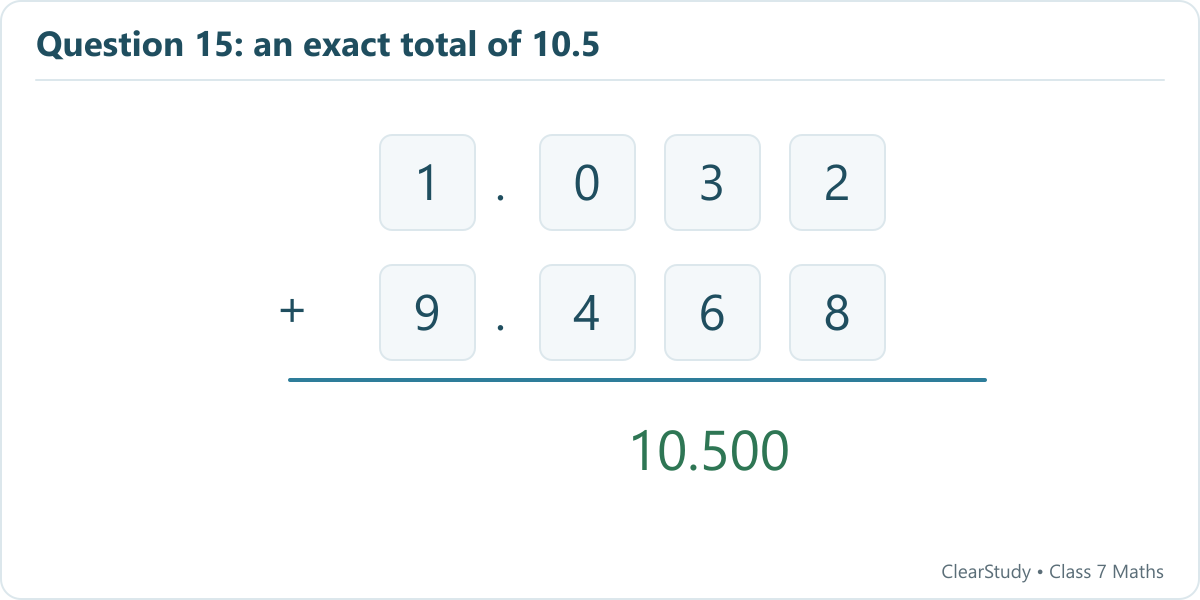
SOLUTIONAn exact total is possible: 1.032 + 9.468 = 10.500 = 10.5.The eight box digits are 1, 0, 3, 2, 9, 4, 6 and 8; no digit is repeated. The difference from the target is zero, so this is as close as possible. The sum is not subject to the no-repeat condition, which applies to the input boxes.
1.032 + 9.468 = 10.500. The eight digits 1, 0, 3, 2, 9, 4, 6 and 8 are all different.
16. Write the following fractions in decimal form:
(a) 1⁄2 (b) 3⁄2 (c) 1⁄4 (d) 3⁄4 (e) 1⁄5 (f) 4⁄5
SOLUTIONMake an equivalent fraction with denominator 10 or 100, then read off the decimal.(a) 1⁄2 = 5⁄10 = 0.5.(b) 3⁄2 = 15⁄10 = 1.5.(c) 1⁄4 = 25⁄100 = 0.25.(d) 3⁄4 = 75⁄100 = 0.75.(e) 1⁄5 = 2⁄10 = 0.2.(f) 4⁄5 = 8⁄10 = 0.8.
Math Talk & Try This — Answered
These are the in-text reflective tasks, Math Talks, Try This activities and shorter fill-in questions in the chapter; determinate ones are answered fully and open/measuring ones are guided.
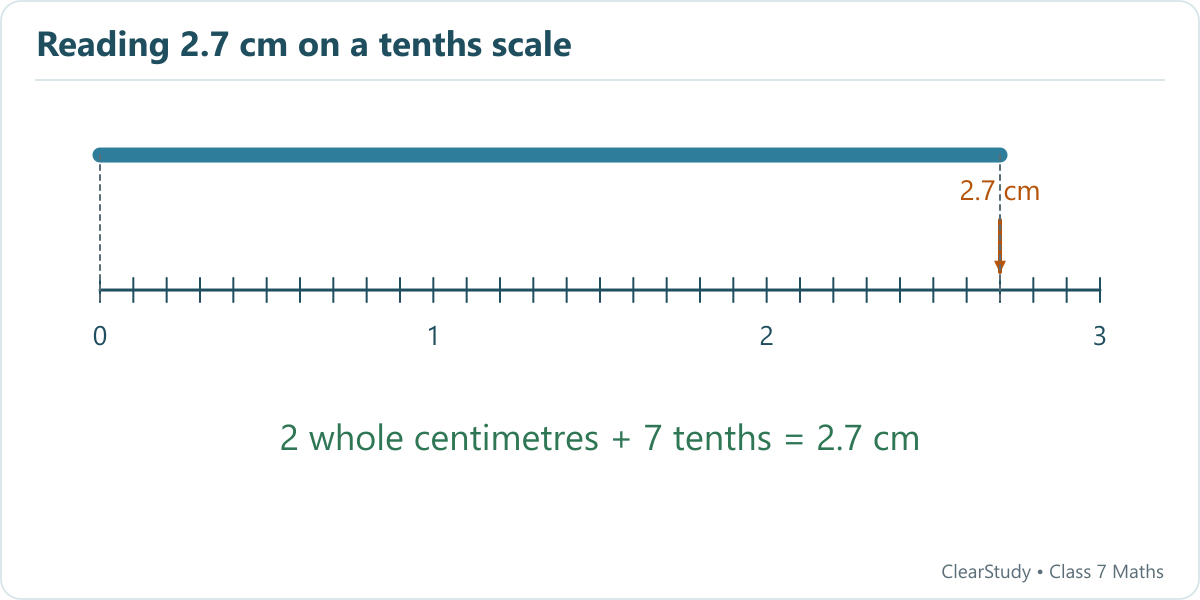
Measuring the screws (3.1)Measure the screws above the scale and write their lengths; which scale helped you measure accurately and why? What is the meaning of 27⁄10 cm?Answer. The scale whose unit is divided into 10 equal small parts gives the more accurate reading, because a smaller unit lets us measure lengths that fall between whole centimetres. 27⁄10 cm (read “two and seven-tenth centimetres”) means going from 0 to 2 cm and then taking 7 of the ten equal parts of the next centimetre — i.e. 2 cm and 7⁄10 cm = 2.7 cm.
A model length ends at the seventh small mark after 2 cm. Every centimetre is divided into ten equal parts.
Why split the unit into smaller parts?Can you explain why the unit was divided into smaller parts to measure the screws?Answer. Two screws can differ by less than one whole centimetre. Whole-centimetre marks are too coarse to show that tiny difference, so we split each centimetre into 10 equal parts (tenths) to measure and compare the lengths exactly.
Arrange 41⁄10, 4⁄10, 41⁄10, 411⁄10Arrange the following lengths in increasing order: 41⁄10, 4⁄10, 41⁄10, 411⁄10.Answer. As decimals: 41⁄10 = 4.1, 4⁄10 = 0.4, 41⁄10 = 4.1, 411⁄10 = 41.1. Increasing order: 4⁄10 (0.4) < 41⁄10 = 41⁄10 (4.1) < 411⁄10 (41.1) — note 41⁄10 and 41⁄10 are equal (both 4.1).
Total length of the honeybeeHead = 23⁄10 units, Thorax = 54⁄10 units, Abdomen = 75⁄10 units. Find its total length.Answer. Add units and tenths: (2 + 5 + 7) units + (3 + 4 + 5) tenths = 14 units + 12 tenths = 14 + 12⁄10 = 152⁄10 units = 15.2 units.
Length of the longest finger (Shylaja)Shylaja’s hand is 124⁄10 units and her palm is 67⁄10 units. What is the length of the longest (middle) finger?Answer. Finger = hand − palm = 12.4 − 6.7. Borrow: 12.4 = 1114⁄10, then 14 − 7 = 7 tenths and 11 − 6 = 5 units. So the finger is 57⁄10 units = 5.7 units. (We start from the tenths and split one unit into 10 tenths because we cannot take 7 tenths from 4 tenths.)
Difference in fish lengthsA Celestial Pearl Danio’s length is 24⁄10 cm and a Philippine Goby is 9⁄10 cm. What is the difference in their lengths?Answer. 2.4 − 0.9: borrow — 2.4 = 114⁄10, so 14 − 9 = 5 tenths and 1 − 0 = 1 unit. Difference = 15⁄10 cm = 1.5 cm. Both fish are about the size of (or smaller than) a finger.
Math Talk — 45 one-hundredths (3.3)How many one-hundredths make one-tenth? Can we also say the length is 4 units and 45 one-hundredths?Answer. 10 one-hundredths make one-tenth. So 4 units, 4 tenths and 5 hundredths = 4 units + (40 + 5) hundredths = 4 units and 45 one-hundredths = 4.45. Yes, both descriptions name the same length.
Three ways to write the same lengthThe length of the wire is written as 11⁄104⁄100, 114⁄100 and 114⁄100. Can you see how they denote the same length?Answer. 1 unit and 1 tenth and 4 hundredths = 1 + 0.10 + 0.04 = 1.14. Also 114⁄100 = 1 + 0.14 = 1.14, and 114⁄100 = 114 hundredths = 1.14. All three equal 1.14, since 1 tenth = 10 hundredths and 100 hundredths = 1 unit.
Sum 153⁄104⁄100 + 26⁄108⁄100What will be the sum of 153⁄104⁄100 and 26⁄108⁄100? Are the methods shown different?Answer. 15.34 + 2.68. Hundredths: 4 + 8 = 12 (write 2, carry 1 tenth). Tenths: 3 + 6 + 1 = 10 (write 0, carry 1 unit). Units: 15 + 2 + 1 = 18. Sum = 18.02 = 182⁄100. The methods (adding by parts, the column form, and converting everything to hundredths) all give 18.02 — they are the same calculation organised differently.
Math Talk — comparing with 483 + 268Observe the addition 483 + 268. Do you see similarities with the decimal methods above?Answer. Yes. Just as 80 + 60 = 140 forces a carry into the hundreds place in 483 + 268, in the decimals 4 + 8 = 12 hundredths carries 1 into the tenths and 3 + 6 + 1 = 10 tenths carries 1 into the units. Whole-number addition and decimal addition use the same place-value carrying.
Difference 259⁄10 − 64⁄107⁄100 (Math Talk)What is the difference 259⁄10 − 64⁄107⁄100? Solve by converting to hundredths.Answer. 25.90 − 6.47. In hundredths: 2590 − 647 = 1943 hundredths = 19.43 = 194⁄103⁄100 (writing 259⁄10 as 258⁄1010⁄100 before subtracting gives the same answer).
Math Talk — comparing with 653 − 268Observe the subtraction 653 − 268. Do you see similarities with the methods above?Answer. Yes. In 653 − 268 we cannot take 8 ones from 3, so we borrow a ten; in the decimals we cannot take 8 hundredths from 4 hundredths, so we borrow a tenth. The same borrowing across place values is used in both.
How Big? (thousandths)(a) How many thousandths make one unit? (b) one tenth? (c) one hundredth? (d) How many tenths make one ten? (e) How many hundredths make one ten?Answer. (a) 1000 thousandths = 1 unit. (b) 100 thousandths = 1 tenth. (c) 10 thousandths = 1 hundredth. (d) 100 tenths = 1 ten (since 10 tenths = 1 unit and 10 units = 1 ten). (e) 1000 hundredths = 1 ten.
Math Talk — writing 42⁄10 as 42?Can 42⁄10 be written as 42, skipping the 1⁄10? How would we tell 42 (four tens, two units) from 4 units and 2 tenths?Answer. No — we cannot simply drop the 1⁄10, because “42” would then mean two different quantities (4 tens 2 ones, or 4 units 2 tenths). To keep them distinct we use a decimal point: 42 stays 42, while 4 units and 2 tenths is written 4.2.
Place-value table taskWrite each quantity in decimal form: (a) 2 ones, 3 tenths and 5 hundredths; (b) 1 ten and 5 tenths; (c) 4 ones and 6 hundredths; (d) 1 hundred, 1 one and 1 hundredth; (e) 8⁄100 and 9⁄10; (f) 5⁄100; (g) 1⁄10; (h) 21⁄100, 41⁄10 and 77⁄1000.Answer. (a) 2.35: 2 ones + 3 tenths + 5 hundredths. (b) 10.5: 1 ten + 5 tenths. (c) 4.06: 4 ones + 6 hundredths. (d) 101.01: 1 hundred + 1 one + 1 hundredth.
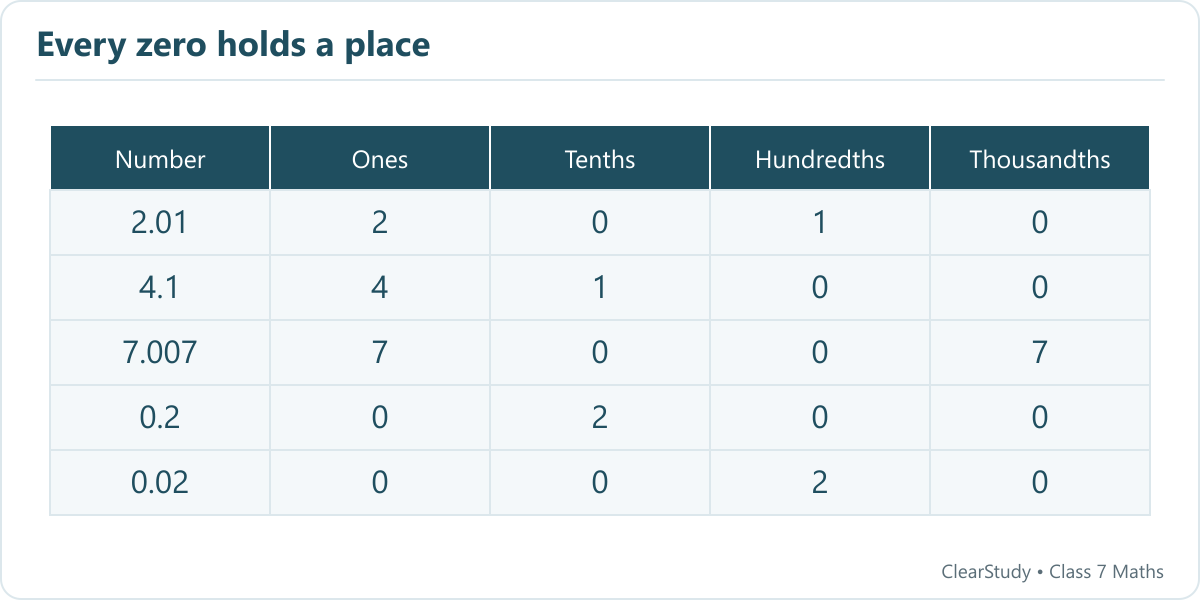
(e) The listed quantities individually are 0.08 and 0.9; if combined as one quantity, their sum is 0.98. (f) 0.05. (g) 0.1. (h) The three listed mixed quantities are 2.01, 4.1 and 7.007, respectively. Read the digits after the point separately: two point zero one; four point one; seven point zero zero seven. They are separate quantities, not a request to add them.
Place-value table for 2.01, 4.1, 7.007, 0.2 and 0.02. Moving a digit to a different place changes its value.
Length conversions: mm ↔ cmFill in the blanks (mm ↔ cm): 70 mm = ?; ? = 0.9 cm; 134 mm = ?; ? = 203.6 cm.Answer. 70 mm = 7.0 cm; 9 mm = 0.9 cm; 134 mm = 13.4 cm; 2036 mm = 203.6 cm.
Length conversions: cm ↔ mFill in the blanks (cm ↔ m): 36 cm = ?; 50 cm = ?; ? = 0.89 m; 4 cm = ?; 325 cm = ?; ? = 2.07 m.Answer. 36 cm = 0.36 m; 50 cm = 0.50 m; 89 cm = 0.89 m; 4 cm = 0.04 m; 325 cm = 3.25 m; 207 cm = 2.07 m.
Weight conversions: g ↔ kgFill in the blanks (g ↔ kg): 465 g = ?; 68 g = ?; 1560 g = ?; 704 g = ?; ? = 0.56 kg; ? = 2.5 kg.Answer. 465 g = 0.465 kg; 68 g = 0.068 kg; 1560 g = 1.560 kg; 704 g = 0.704 kg; 560 g = 0.56 kg; 2500 g = 2.5 kg.
Money conversions: rupee ↔ paiseFill in the blanks (rupee ↔ paise): 10 p = ?; ? p = ₹0.05; ? p = ₹0.36; ? = ₹0.50; 99 p = ?; 250 p = ?.Answer. 10 p = ₹0.10; 5 p = ₹0.05; 36 p = ₹0.36; 50 p = ₹0.50; 99 p = ₹0.99; 250 p = ₹2.50.
Try This — old pricesDiscuss with adults the prices of products during their childhood; try to find old coins and stamps.Answer (guide). Ask family members what everyday items (a bus ticket, milk, a notebook, a postage stamp) cost when they were young and record the prices in rupees and paise. You will usually find amounts like ₹0.50 or 2–3 paise — far smaller than today — which shows how paise were used as the hundredth part of a rupee. Compare a few old coins/stamps with current prices.
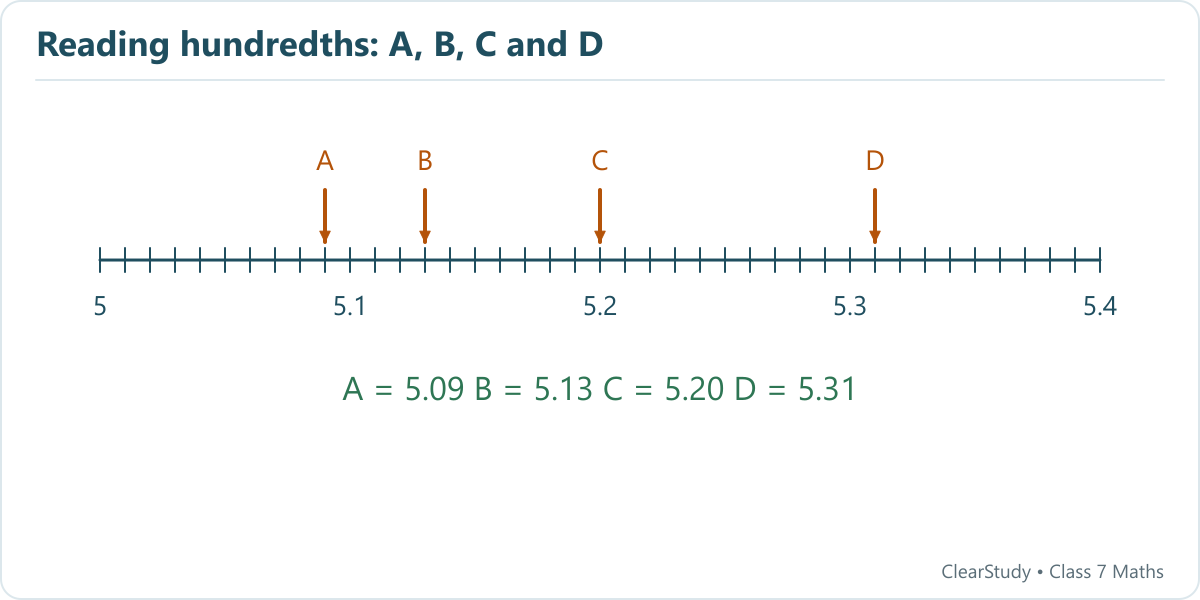
Number line: divisions, letters and Zero Dilemma (3.6)Name all the divisions between 1 and 1.1; identify the decimals at A, B, C, D between 5 and 5.4 (one mark 1.04 and one 5.1 are given); is 0.2 = 0.20 = 0.200? Which of 4.5, 4.05, 0.405, 4.050, 4.50, 4.005, 04.50 are the same?Answer. The nine interior marks between 1 and 1.1 are 1.01, 1.02, 1.03, 1.04, 1.05, 1.06, 1.07, 1.08 and 1.09. There are ten intervals, each of size 0.01.
On the second line, each tenth has ten small intervals: A = 5.09, B = 5.13, C = 5.20, D = 5.31.
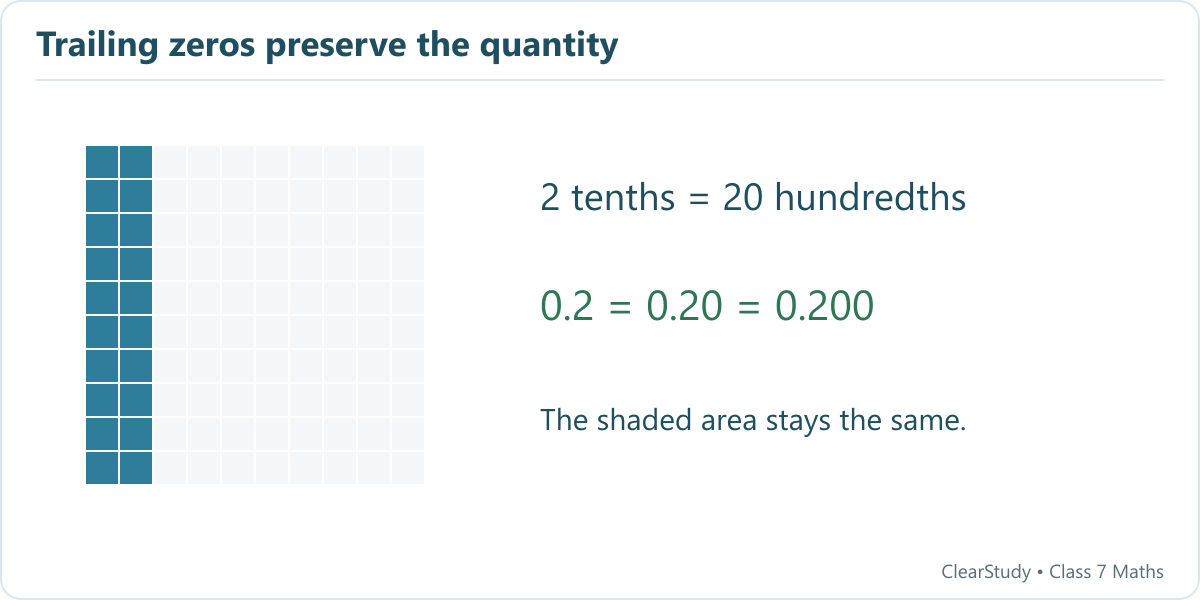
0.2 = 0.20 = 0.200, because trailing zeros preserve the place of 2. In contrast, 0.2 > 0.02 > 0.002. The equal groups are 4.5 = 4.50 = 04.50 and 4.05 = 4.050. Neither 0.405 nor 4.005 equals those groups.
Each small interval is 0.01. The letters mark 5.09, 5.13, 5.20 and 5.31.Two of ten columns shade twenty of one hundred squares: 0.2 and 0.20 represent the same amount.
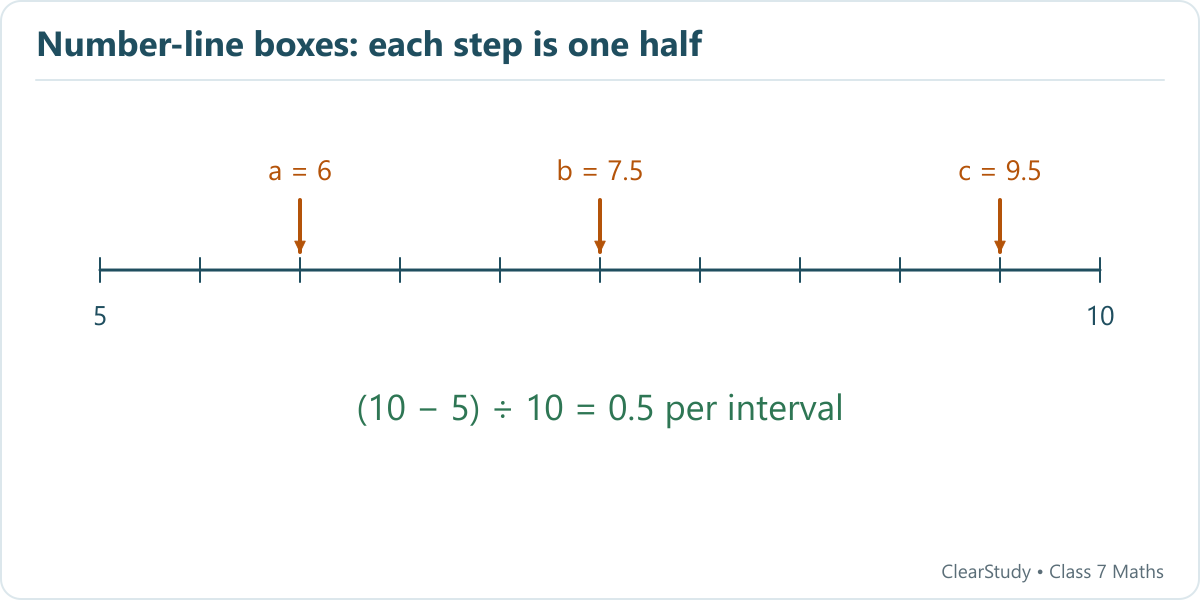
Number-line boxes a, b, c (between 5 and 10)In the number line from 5 to 10 split into 10 equal parts, box b is 7.5. What do a and c denote?Answer. Each interval is (10 − 5) ÷ 10 = 0.5. The second, fifth and ninth marks after 5 give a = 6, b = 7.5 and c = 9.5.
The second, fifth and ninth marks after 5 are 6, 7.5 and 9.5.
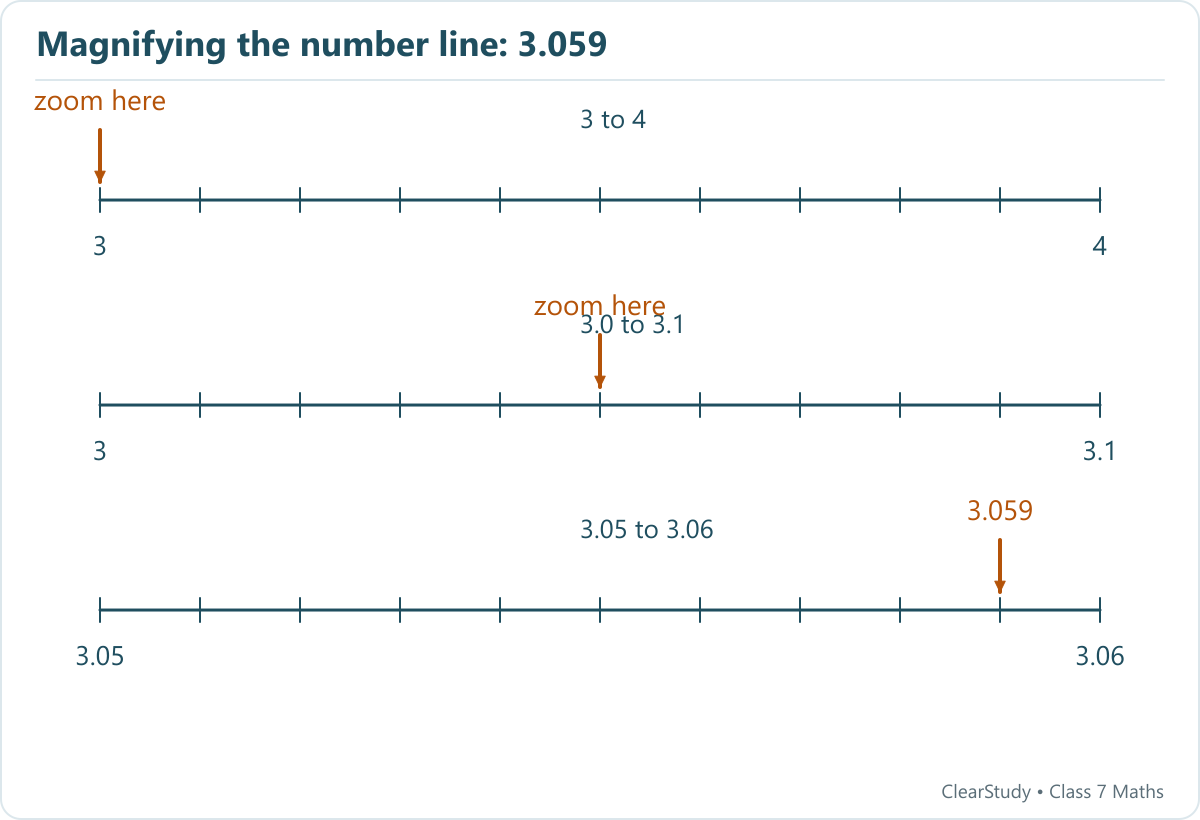
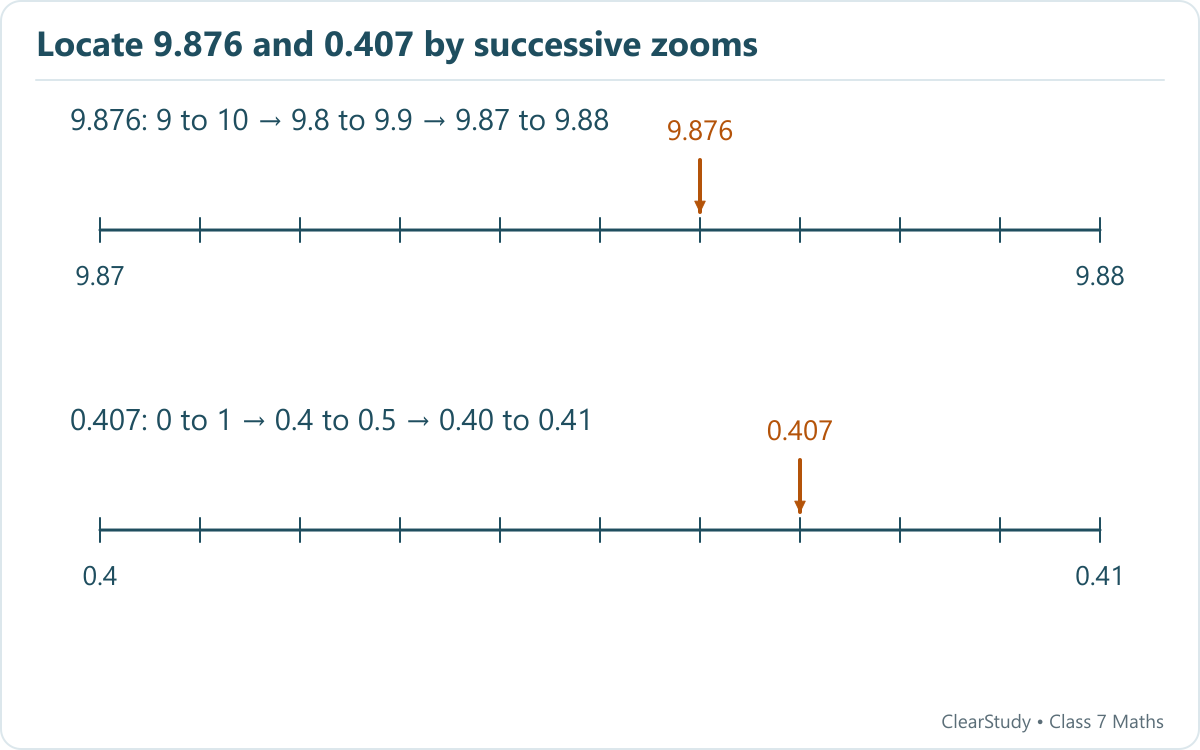
Magnified number lines (page 71)Identify the decimal in figure (b), then locate 9.876 and 0.407 by successive magnification.Answer. Figure (b) zooms from 3–4 into 3.0–3.1 and then 3.05–3.06. The arrow reaches the ninth thousandth after 3.05: 3.059. For 9.876, zoom 9–10 → 9.8–9.9 → 9.87–9.88 and take the sixth small step. For 0.407, zoom 0–1 → 0.4–0.5 → 0.40–0.41 and take the seventh small step.
Zoom from 3–4 to 3.0–3.1, then 3.05–3.06. The ninth thousandth after 3.05 is 3.059.9.876 is the sixth thousandth after 9.87. 0.407 is the seventh thousandth after 0.40.
Math Talk — why stop comparing early?When comparing decimals, why can we stop at the first place where the digits differ? Can the later digits change the conclusion?Answer. No. Once one number has a bigger digit at the highest differing place value, that place value outweighs everything to its right put together (even all 9s after it add less than one of that place). So the later digits can never overturn the result — the first differing place decides it.
Which decimal is greater?(a) 1.23 or 1.32 (b) 3.81 or 13.800 (c) 1.009 or 1.090.Answer. (a) 1.32 (3 tenths > 2 tenths). (b) 13.800 (13 units > 3 units). (c) 1.090 (at the tenths place 0.0 vs 0.0 are equal, but 0 hundredths vs 9 hundredths → 1.090 > 1.009).
Closest decimalsWhich of 0.9, 1.1, 1.01, 1.11 is closest to 1.09? Which of 3.56, 3.65, 3.099 is closest to 4? Which of 0.8, 0.69, 1.08 is closest to 1?Answer. Closest to 1.09: 1.1 (distance 0.01, smaller than 1.11’s 0.02 and 1.01’s 0.08). Closest to 4: 3.65 (distance 0.35, less than 3.56’s 0.44 and 3.099’s 0.901). Closest to 1: 1.08 (distance 0.08, less than 0.8’s 0.20 and 0.69’s 0.31).
Math Talk — make a number close to 25Use the digits 4, 1, 8, 2, and 5 exactly once to make a decimal number as close as possible to 25.Answer.25.148 is 0.148 above 25. The closest choice below 25 is 24.851, which is 0.149 below. Since 0.148 < 0.149, 25.148 is closer. Both arrangements use all five given digits once.
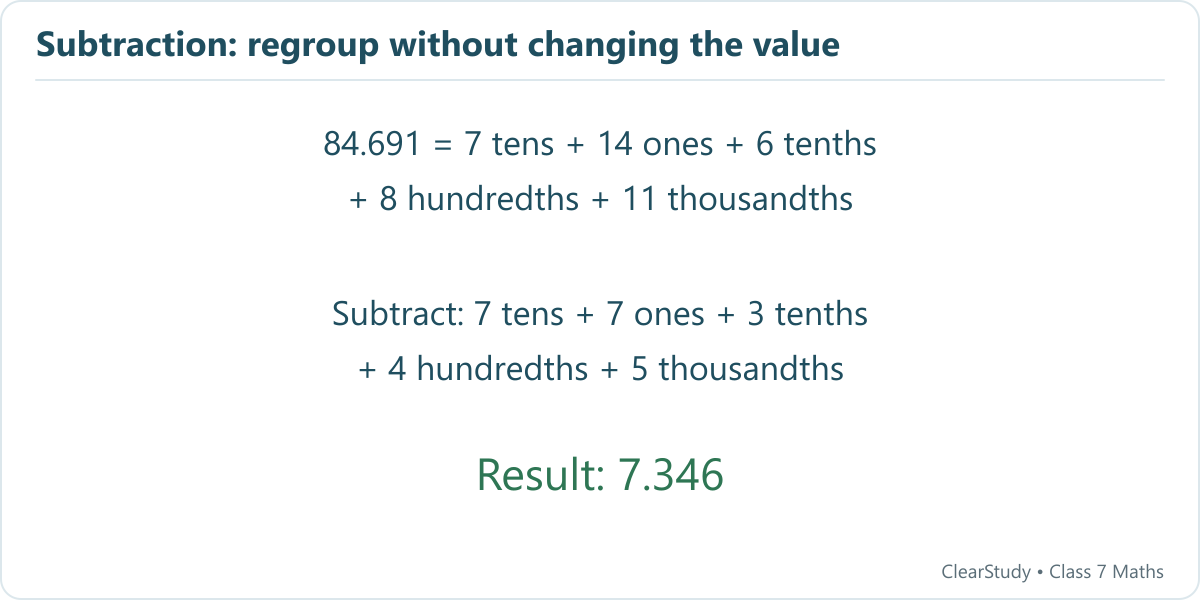
Try This — detailed subtraction 84.691 − 77.345Write the detailed place value computation for 84.691 − 77.345 and its compact form.Answer. Exchange one hundredth for 10 thousandths: the hundredths become 8 and the thousandths 11. Exchange one ten for 10 ones: the tens become 7 and the ones 14. Subtract from right to left: 11 − 5 = 6 thousandths; 8 − 4 = 4 hundredths; 6 − 3 = 3 tenths; 14 − 7 = 7 ones; 7 − 7 = 0 tens. Thus 84.691 − 77.345 = 7.346. Check: 77.345 + 7.346 = 84.691.
Exchange one hundredth for ten thousandths and one ten for ten ones. Then 84.691 − 77.345 = 7.346.
Math Talk — Sonu’s estimation claimSonu claims the sum of two decimals is always greater than the sum of their whole-number parts and less than 2 more than that sum. Verify for 25.936 + 8.202; does it work for any two decimals? What about 25.93603259 + 8.202?Answer. Let S be the sum of the whole-number parts. For non-negative decimals, each fractional part is at least 0 and less than 1, so S ≤ sum < S + 2. The sum is strictly above S when at least one fractional part is non-zero; equality holds only when both are zero. Here S = 33 and 25.936 + 8.202 = 34.138, so 33 < 34.138 < 35. Also 25.93603259 + 8.202 = 34.13803259, in the same range.
Try This — range for a differenceCome up with a way to narrow down the range of whole numbers within which the difference of two decimal numbers will lie.Answer. For a − b, the difference lies between (whole part of a − whole part of b) − 1 and (whole part of a − whole part of b) + 1. For example 25.936 − 8.202: 25 − 8 = 17, so the difference is between 16 and 18 — and indeed 25.936 − 8.202 = 17.734.
Math Talk — decimal-looking non-decimals“The bus reaches 4.5 hours post noon” / “Overs left: 5.5” — where else do we see such ‘non-decimals’ with decimal-like notation?Answer.4.5 hours is a decimal measurement: 4 hours + 0.5 × 60 minutes = 4 hours 30 minutes. Thus 4.5 hours after noon is 4:30 pm. In cricket notation, 5.5 overs means 5 overs and 5 balls, not five and a half overs. Context matters. Standard 5.6 ft means 5.6 decimal feet, not 5 feet 6 inches; use explicit units when writing feet and inches.
Try This — detailed place value sum 75.345 + 86.691Verify the detailed place value computation for 75.345 + 86.691 and its compact form.Answer. Adding place by place with carries: 5 + 1 = 6 thousandths; 4 + 9 = 13 (write 3, carry 1) hundredths; 3 + 6 + 1 = 10 (write 0, carry 1) tenths; 5 + 6 + 1 = 12 (write 2, carry 1) units; 7 + 8 + 1 = 16 tens. Sum = 162.036.
Common Mistakes to Avoid
Watch out for these
Adding or subtracting decimals without lining up the decimal points — always align place values (e.g. write 18 as 18.0 before adding 8.8).
Thinking a decimal with more digits is bigger — 0.9 > 0.125; compare place values, not the count of digits.
Reading 0.274 as “zero point two hundred seventy-four” — read each digit after the point: “two seven four”.
Believing trailing zeros change a value — 0.2 = 0.20 = 0.200, but 0.2, 0.02 and 0.002 are different.
Reading 4.5 hours as 4 h 50 min: half an hour is 30 minutes. Cricket notation is different: 5.5 overs means 5 overs and 5 balls.
Mixing up the conversions: 1 cm = 0.01 m, 1 mm = 0.1 cm, 1 g = 0.001 kg, 1 paisa = 0.01 rupee.
Practice MCQs & Assertion–Reason
1. The decimal form of 254⁄1000 is:
(a) 2.54 (b) 0.254 (c) 25.4 (d) 0.0254
2. 12 mm in centimetres is:
(a) 0.12 cm (b) 120 cm (c) 1.2 cm (d) 12.0 cm
3. Which of these is the greatest?
(a) 1.009 (b) 1.090 (c) 1.019 (d) 1.001
4. 75 paise written in rupees is:
(a) ₹7.5 (b) ₹0.075 (c) ₹0.75 (d) ₹75
5. 5.3 + 2.6 equals:
(a) 7.9 (b) 8.9 (c) 7.09 (d) 5.56
6. The value of 18 − 8.8 is:
(a) 10.8 (b) 9.2 (c) 10.2 (d) 9.8
7. Which number is equal to 0.2?
(a) 0.02 (b) 0.200 (c) 0.002 (d) 2.0
8. How many thousandths make one tenth?
(a) 10 (b) 100 (c) 1000 (d) 1
9. 254 g expressed in kilograms is:
(a) 2.54 kg (b) 0.254 kg (c) 25.4 kg (d) 0.0254 kg
10. “The bus reaches 4.5 hours post noon” means it reaches at:
For each Assertion–Reason question, choose: (A) Both Assertion and Reason are true and the Reason is the correct explanation of the Assertion; (B) Both are true but the Reason is not the correct explanation; (C) Assertion is true but Reason is false; (D) Assertion is false but Reason is true.
A-R 1. Assertion: 0.2 = 0.20 = 0.200.
Reason: Writing zeros at the right end after the decimal point does not change the value of a decimal.
A-R 2. Assertion: 1.090 is greater than 1.009.
Reason: A decimal number with more digits is always greater than one with fewer digits.
A-R 3. Assertion: 1 cm = 0.01 m.
Reason: 1 metre = 100 centimetres, so each centimetre is one-hundredth of a metre.
A-R 4. Assertion: 5.5 overs in cricket means 5 overs and 5 balls.
Reason: One over has 6 balls, so the digit after the point counts balls, not tenths.
A-R 5. Assertion: 234 hundredths written as a decimal is 2.34.
To measure more accurately we split a unit into 10 equal parts (tenths), each tenth into 10 (hundredths), each hundredth into 10 (thousandths).
1 unit = 10 tenths = 100 hundredths = 1000 thousandths; each place is 10× smaller than the one to its left.
A decimal point (‘.’) separates the whole-number part from the fractional part; read digits after the point one by one (0.274 = “point two seven four”).
Trailing zeros do not change value (0.2 = 0.20), but 0.2, 0.02, 0.002 are different.
Conversions: 1 mm = 0.1 cm, 1 cm = 0.01 m, 1 mm = 0.001 m (and 1 km = 10,00,000 mm); 1 g = 0.001 kg; 1 paisa = 0.01 rupee.
Compare decimals place by place from the highest value; stop at the first place where digits differ.
Add/subtract decimals by aligning the points and carrying/borrowing exactly like whole numbers.
How to score full marks in this chapter
Always rewrite numbers with the same number of decimal places (using trailing zeros) before comparing, adding or subtracting — line up the decimal points neatly in a column. State the conversion you are using (1 cm = 0.01 m, 1 g = 0.001 kg, 1 paisa = 0.01 rupee) before plugging in numbers, and read decimals digit-by-digit. When a question gives mixed fractions of tenths and hundredths, convert each to a clean decimal first; keep your working tidy so every step earns its mark.
Frequently Asked Questions
What is Class 7 Maths Ganita Prakash Chapter 3 about?
Chapter 3, A Peek Beyond the Point, introduces decimals: tenths, hundredths and thousandths, decimal place value and the decimal point, reading and writing decimals, length/weight/money conversions, locating and comparing decimals on the number line, and adding and subtracting decimals.
How many Figure it Out exercises are there in Chapter 3?
There are three Figure it Out sets, on pages 58, 75 and 78–80, plus in-text activities.
Does adding zeros at the end of a decimal change its value?
No. Zeros placed at the right end after the decimal point do not change the value, so 0.2 = 0.20 = 0.200. However, 0.2, 0.02 and 0.002 are different numbers because the 2 sits in a different place value in each.
Are these Class 7 Maths Ganita Prakash Chapter 3 solutions free?
Yes. All solutions are free and follow the official NCERT Ganita Prakash (Part I) textbook for the 2026–27 session, with worked exercises and original teaching diagrams.