
Class 7 Maths Chapter 4 Solutions — Expressions Using Letter-Numbers
Learn algebra with these NCERT Ganita Prakash Class 7 Chapter 4 solutions. Follow worked simplifications, number machines, calendar patterns and original matchstick diagrams. Each pattern is read from the textbook drawing, with notes where the printed operations are inconsistent.
- Chapter overview
- Key concepts & definitions
- Important formulas & patterns
- Figure it Out (Page 84–85)
- Mind the Mistake, Mend the Mistake (Page 87)
- Figure it Out (Page 93–94)
- Mind the Mistake, Mend the Mistake (Page 94–95)
- Figure it Out (Page 102–105)
- Math Talk & Try This (answered)
- Common mistakes to avoid
- Practice MCQs & Assertion–Reason
- Quick revision summary
- FAQs
Chapter 4 Overview
Chapter 4 of Ganita Prakash, Expressions Using Letter-Numbers, introduces the idea of using a letter to stand for a number. Starting from everyday situations — Shabnam’s and Aftab’s ages, Parthiv’s matchstick ‘L’s, Ketaki’s coconut–jaggery laddus — the chapter shows how a relationship can be captured in a short algebraic expression such as s = a + 3 or c × 35 + j × 60. You then learn to drop the multiplication sign (4 × n = 4n), to simplify expressions by combining like terms (5c + 3c + 10c = 18c), to add and subtract expressions, and to use the distributive property to open brackets. The chapter closes with pattern hunting — number machines, saree-border designs, calendar squares and matchstick patterns — where algebra is used to explain why a pattern always holds. The worked solutions below explain the exercises and in-text patterns.
Key Concepts & Definitions
Letter-number: a letter (such as a, n, x) used to represent a number. Its value can change from one situation to another.
Algebraic expression: a mathematical expression that contains one or more letter-numbers, e.g. a + 3, 2n, 40x + 75y. It takes a number value once the letters are replaced by numbers.
Term: the parts of an expression that are added together. In 40x + 75y the terms are 40x and 75y; a subtraction a − b is read as the sum a + (−b).
Coefficient: the number multiplying a letter-number in a term, e.g. in 5c the coefficient of c is 5.
Omitting the multiplication sign: 4 × n is written 4n, with the number first and the letter after it; 5 × m + 3 is written 5m + 3.
Like terms: terms with the same variable part (the same letters raised to the same powers), e.g. (5c, c, 10c) or (12n, −4n). Only like terms can be added or subtracted into a single term.
Unlike terms: terms with different letter-numbers, e.g. {18c, 11d}; they cannot be combined, so 18c + 11d is already in simplest form.
Simplified form: an equal but shorter expression obtained by opening brackets, swapping/grouping and adding like terms, e.g. l + b + l + b = 2l + 2b.
Formula: a general mathematical relation written as an expression, e.g. perimeter of a square = 4q where q is the sidelength.
Important Formulas & Patterns (Chapter 4)
Replacing a letter: the value of an expression is found by replacing each letter-number with its number, e.g. a + 3 with a = 23 gives 26.
Drop the × sign: 4 × n = 4n • 5 × m + 3 = 5m + 3 • 7 × k = 7k.
Combine like terms (distributive law): 5c + 3c + 10c = (5 + 3 + 10)c = 18c; in general ma + na = (m + n)a.
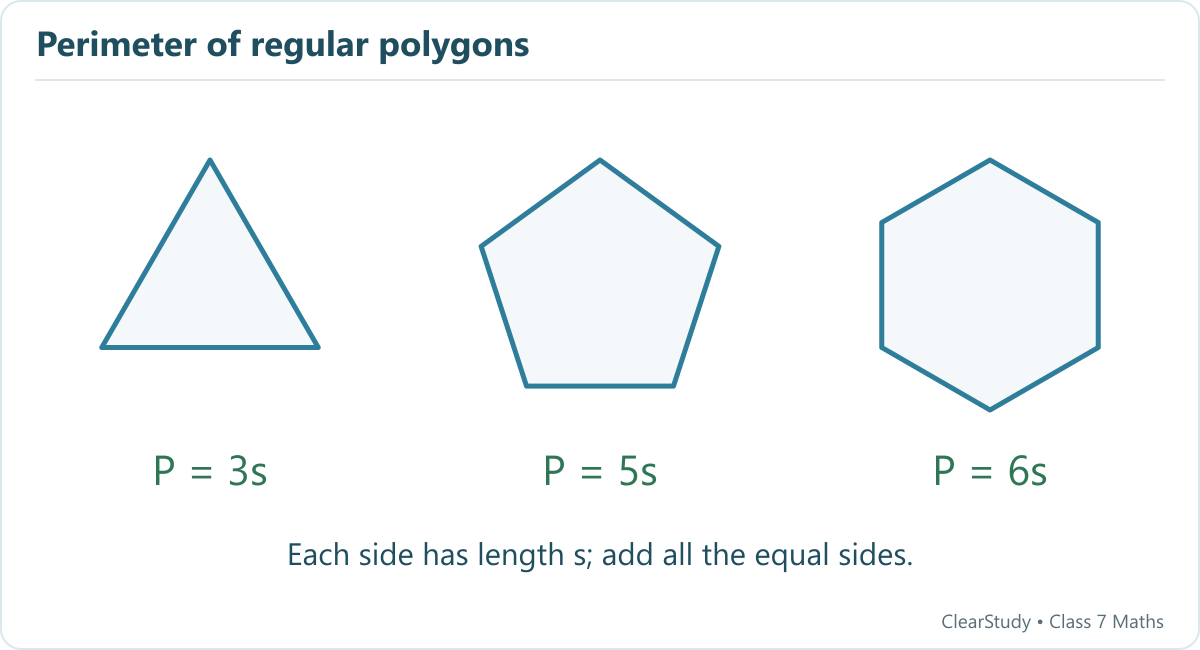
Perimeter formulas: equilateral triangle = 3s • regular pentagon = 5s • regular hexagon = 6s • square = 4q • rectangle = 2l + 2b.
Opening brackets: a(x + y) = ax + ay; −(x + y) = −x − y; a − (x + y) = a − x − y.
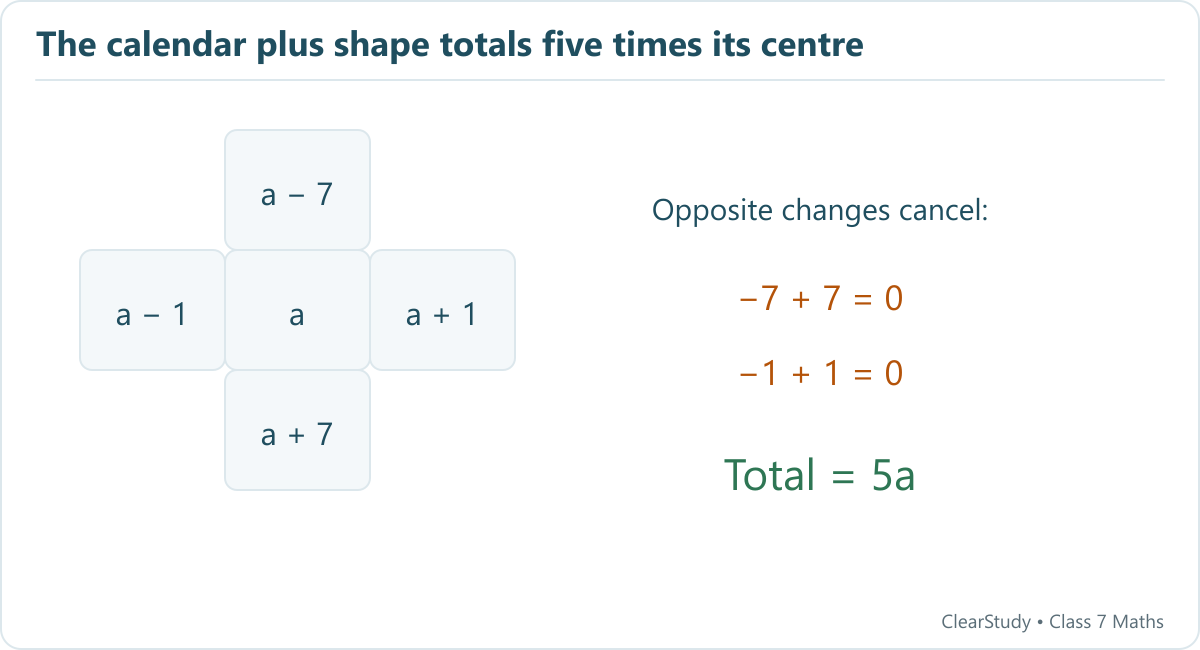
Calendar 2 × 2 square: with top-left number a the cells are a, a + 1, a + 7, a + 8; both diagonal sums equal 2a + 8.
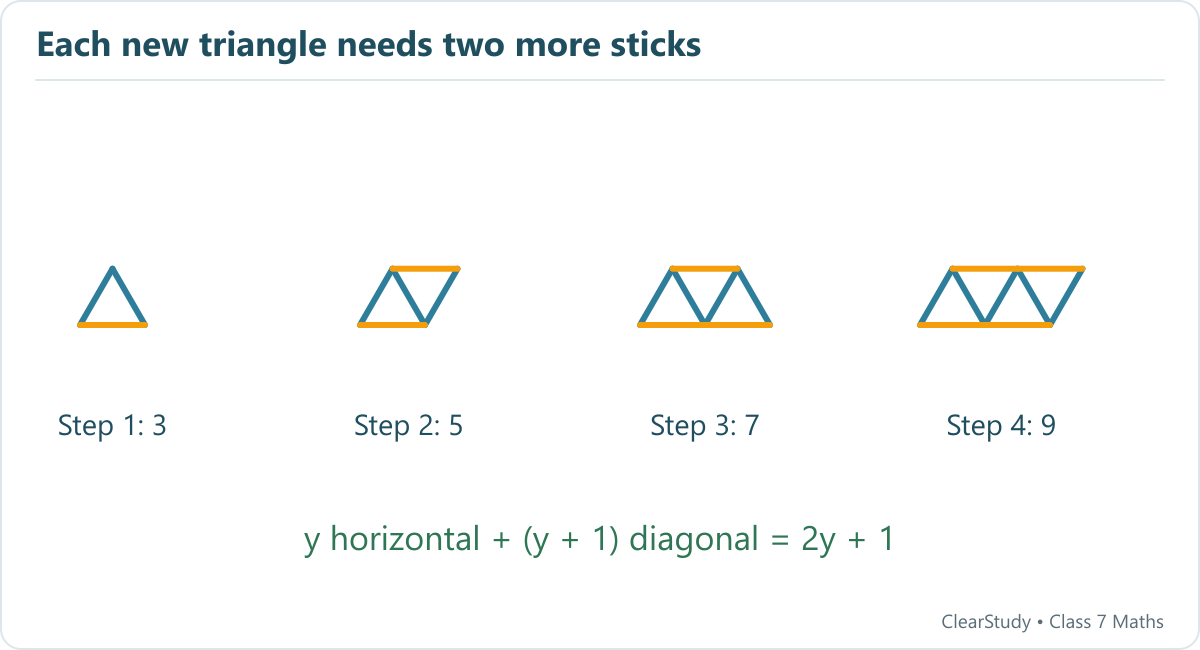
Triangle matchstick pattern: matchsticks at Step y = 3 + 2(y − 1) = 2y + 1.
Figure it Out — Page 84–85
1. Write formulas for the perimeter of: (a) triangle with all sides equal. (b) a regular pentagon (as we have learnt last year, we use the word ‘regular’ to say that all sidelengths and angle measures are equal) (c) a regular hexagon
2. Munirathna has a 20 m long pipe. However, he wants a longer watering pipe for his garden. He joins another pipe of some length to this one. Give the expression for the combined length of the pipe. Use the letter-number ‘k’ to denote the length in meters of the other pipe.
3. What is the total amount Krithika has, if she has the following numbers of notes of ₹100, ₹20 and ₹5? Complete the following table:
| ₹100 notes | ₹20 notes | ₹5 notes | Expression and total amount |
|---|---|---|---|
| 3 | 5 | 6 | 3 × 100 + 5 × 20 + 6 × 5 = 300 + 100 + 30 = ₹430 |
| 6 | 4 | 3 | 6 × 100 + 4 × 20 + 3 × 5 = 695 (given) |
| 8 | 4 | z | 8 × 100 + 4 × 20 + z × 5 = 800 + 80 + 5z = 880 + 5z |
| x | y | z | 100x + 20y + 5z |
4. Venkatalakshmi owns a flour mill. It takes 10 seconds for the roller mill to start running. Once it is running, each kg of grain takes 8 seconds to grind into powder. Which of the expressions below describes the time taken to completely grind ‘y’ kg of grain, assuming the machine is off initially? (a) 10 + 8 + y (b) (10 + 8) × y (c) 10 × 8 × y (d) 10 + 8 × y (e) 10 × y + 8
5. Write algebraic expressions using letters of your choice. (a) 5 more than a number (b) 4 less than a number (c) 2 less than 13 times a number (d) 13 less than 2 times a number
6. Describe situations corresponding to the following algebraic expressions: (a) 8 × x + 3 × y (b) 15 × j – 2 × k
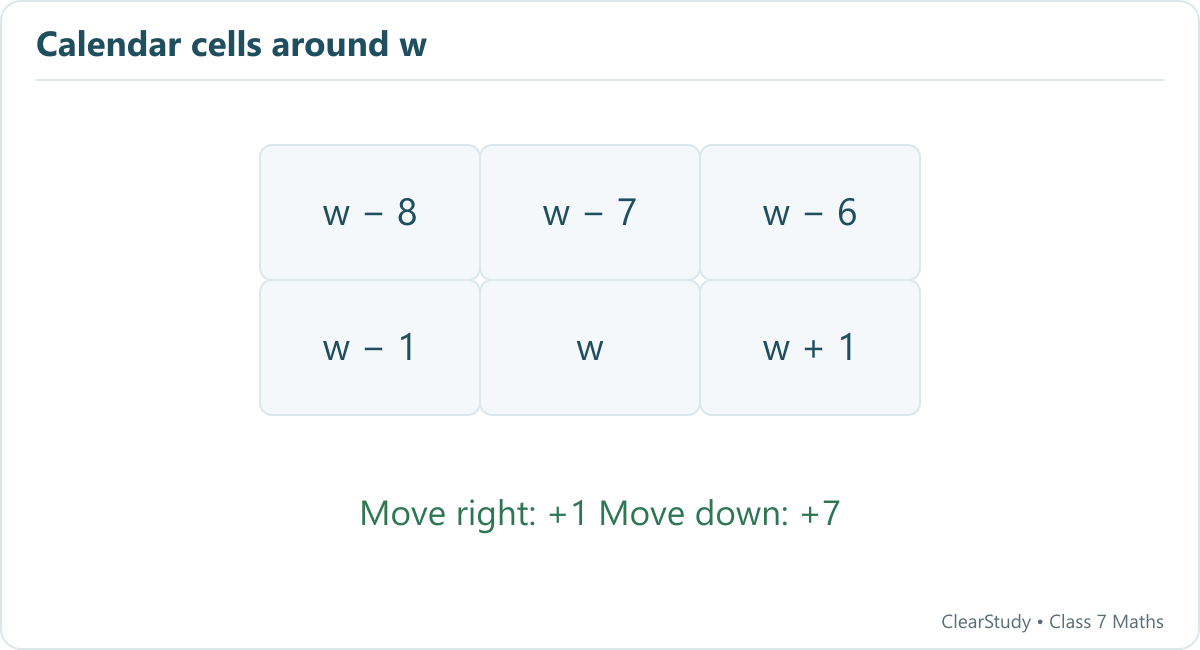
7. In a calendar month, if any 2 × 3 grid full of dates is chosen as shown in the picture, write expressions for the dates in the blank cells if the bottom middle cell has date ‘w’.
| w − 8 | w − 7 | w − 6 |
|---|---|---|
| w − 1 | w | w + 1 |
Mind the Mistake, Mend the Mistake — Page 87
Each line replaces the letter-number by a number and gives a value. Identify the mistake (if any), explain it, then give the correct value.
1. If a = −4, then 10 − a = 6.
2. If d = 6, then 3d = 36.
3. If s = 7, then 3s − 2 = 15.
4. If r = 8, then 2r + 1 = 29.
5. If j = 5, then 2j = 10.
6. If m = −6, then 3(m + 1) = 19.
7. If f = 3, g = 1, then 2f − 2g = 2.
8. If t = 4, b = 3, then 2t + b = 24.
9. If h = 5, n = 6, then h − (3 − n) = 4.
Figure it Out — Page 93–94
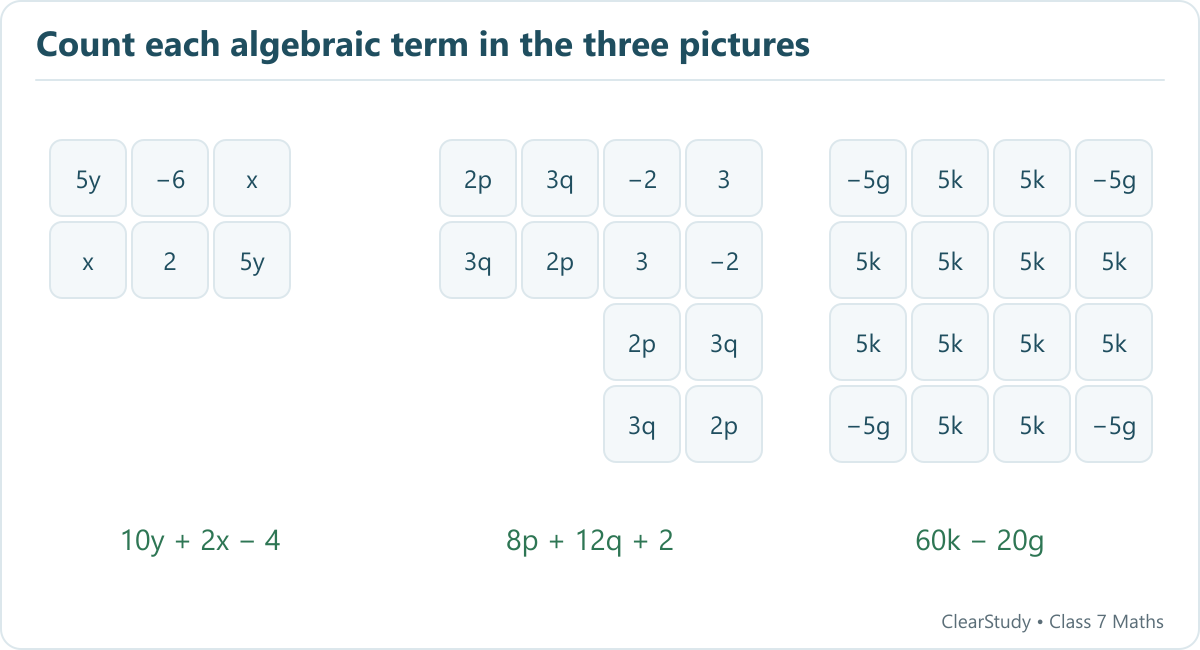
1. Add the numbers in each picture below. Write their corresponding expressions and simplify them. Try adding the numbers in each picture in a couple different ways and see that you get the same thing.
2. Simplify each of the following expressions: (a) p + p + p + p, p + p + p + q, p + q + p − q, (b) p − q + p − q, p + q − p + q, (c) p + q − (p + q), p − q − p − q (d) 2d − d − d − d, 2d − d − d − c, (e) 2d − d − (d − c), 2d − (d − d) − c, (f) 2d − d − c − c
Mind the Mistake, Mend the Mistake — Page 94–95
The right-hand side should be the simplest form. Spot the mistake, explain it, then simplify correctly.
1. 3a + 2b → 5
2. 3b − 2b − b → 0
3. 6(p + 2) → 6p + 8
4. (4x + 3y) − (3x + 4y) → x + y
5. 5 − (2 − 6z) → 3 − 6z
6. 2 + (x + 3) → 2x − 6
7. 2y + (3y − 6) → −y + 6
8. 7p − p + 5q − 2q → 7p + 3q
9. 5(2w + 3x + 4w) → 10w + 15x + 20w
10. 3j + 6k + 9h + 12 → 3(j + 2k + 3h + 4)
11. 4(2r + 3s + 5) → −20 − 8r − 12s
Figure it Out — Page 102–105
For the problems asking you to find suitable expression(s), first try to understand the relationship between the different quantities in the situation described. If required, assume some values for the unknowns and try to find the relationship.
1. One plate of Jowar roti costs ₹30 and one plate of Pulao costs ₹20. If x plates of Jowar roti and y plates of pulao were ordered in a day, which expression(s) describe the total amount in rupees earned that day? (a) 30x + 20y (b) (30 + 20) × (x + y) (c) 20x + 30y (d) (30 + 20) × x + y (e) 30x − 20y
2. Pushpita sells two types of flowers on Independence day: champak and marigold. ‘p’ customers only bought champak, ‘q’ customers only bought marigold, and ‘r’ customers bought both. On the same day, she gave away a tiny national flag to every customer. How many flags did she give away that day? (a) p + q + r (b) p + q + 2r (c) 2 × (p + q + r) (d) p + q + r + 2 (e) p + q + r + 1 (f) 2 × (p + q)
3. A snail is trying to climb along the wall of a deep well. During the day it climbs up ‘u’ cm and during the night it slowly slips down ‘d’ cm. This happens for 10 days and 10 nights. (a) Write an expression describing how far away the snail is from its starting position. (b) What can we say about the snail’s movement if d > u?
4. Radha is preparing for a cycling race and practices daily. The first week she cycles 5 km every day. Every week she increases the daily distance cycled by ‘z’ km. How many kilometers would Radha have cycled after 3 weeks?
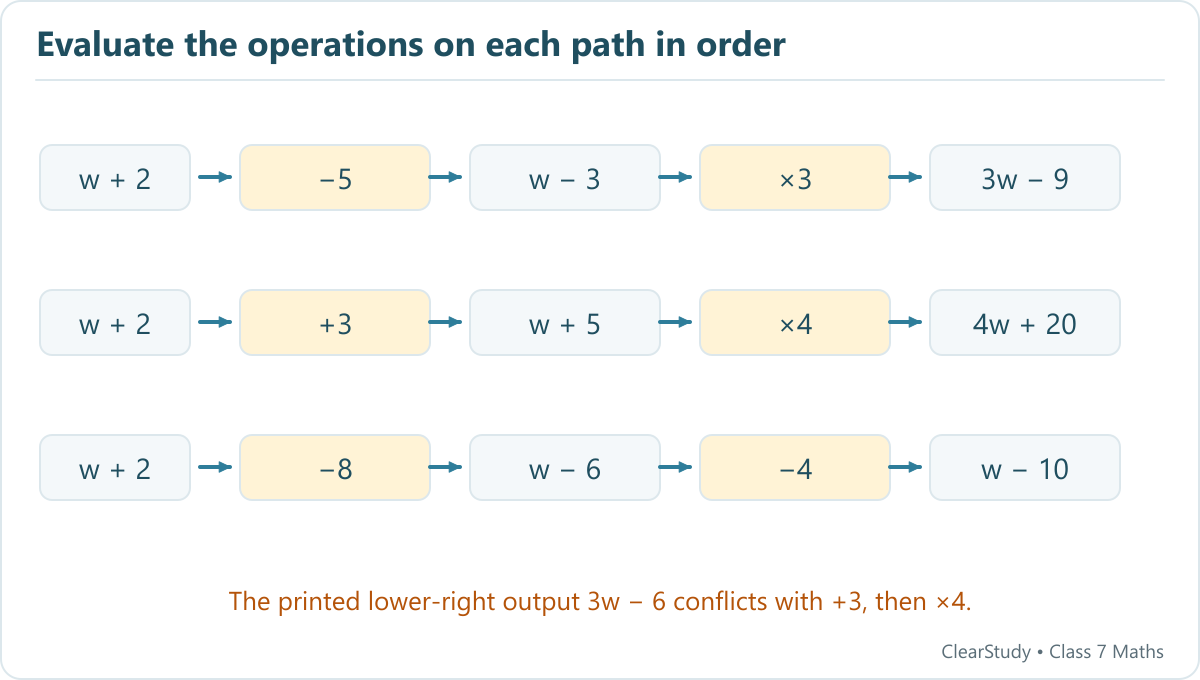
5. In the following figure, observe how the expression w + 2 becomes 4w + 20 along one path. Fill in the missing blanks on the remaining paths. The ovals contain expressions and the boxes contain operations.
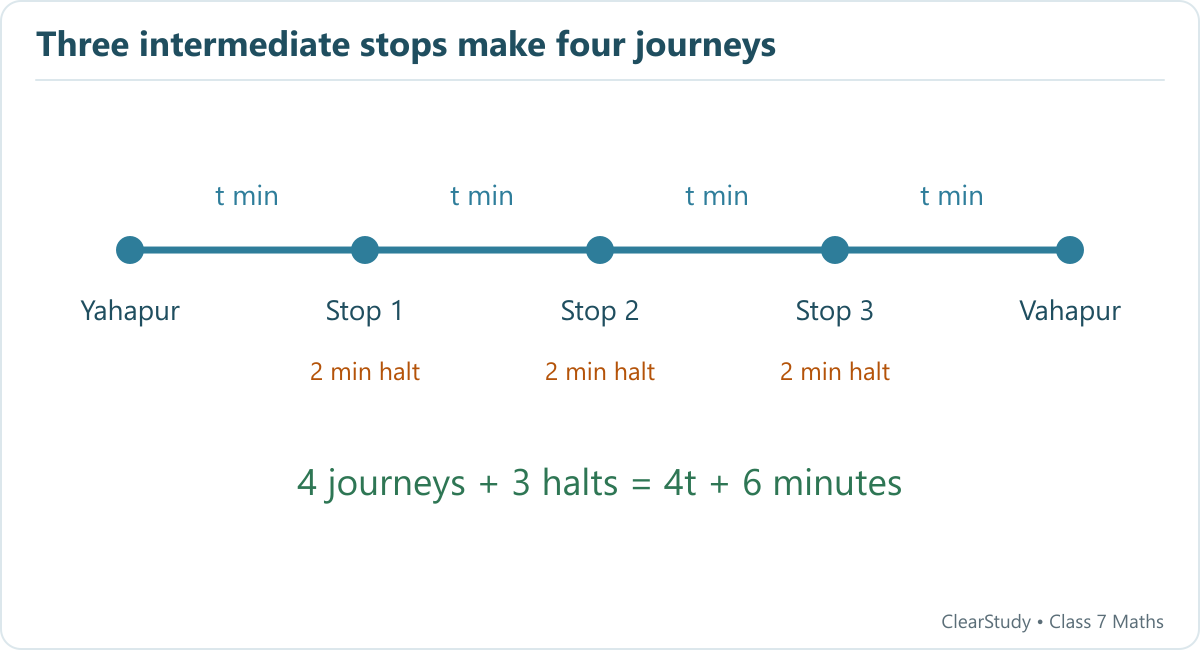
6. A local train from Yahapur to Vahapur stops at three stations at equal distances along the way. The time taken in minutes to travel from one station to the next station is the same and is denoted by t. The train stops for 2 minutes at each of the three stations. (a) If t = 4, what is the time taken to travel from Yahapur to Vahapur? (b) What is the algebraic expression for the time taken to travel from Yahapur to Vahapur? [Hint: Draw a rough diagram to visualise the situation]
7. Simplify the following expressions: (a) 3a + 9b − 6 + 8a − 4b − 7a + 16 (b) 3(3a − 3b) − 8a − 4b − 16 (c) 2(2x − 3) + 8x + 12 (d) 8x − (2x − 3) + 12 (e) 8h − (5 + 7h) + 9 (f) 23 + 4(6m − 3n) − 8n − 3m − 18
8. Add the expressions given below: (a) 4d − 7c + 9 and 8c − 11 + 9d (b) −6f + 19 − 8s and −23 + 13f + 12s (c) 8d − 14c + 9 and 16c − (11 + 9d) (d) 6f − 20 + 8s and 23 − 13f − 12s (e) 13m − 12n and 12n − 13m (f) −26m + 24n and 26m − 24n
9. Subtract the expressions given below: (a) 9a − 6b + 14 from 6a + 9b − 18 (b) −15x + 13 − 9y from 7y − 10 + 3x (c) 17g + 9 − 7h from 11 − 10g + 3h (d) 9a − 6b + 14 from 6a − (9b + 18) (e) 10x + 2 + 10y from −3y + 8 − 3x (f) 8g + 4h − 10 from 7h − 8g + 20
10. Describe situations corresponding to the following algebraic expressions: (a) 8x + 3y (b) 15x − 2x
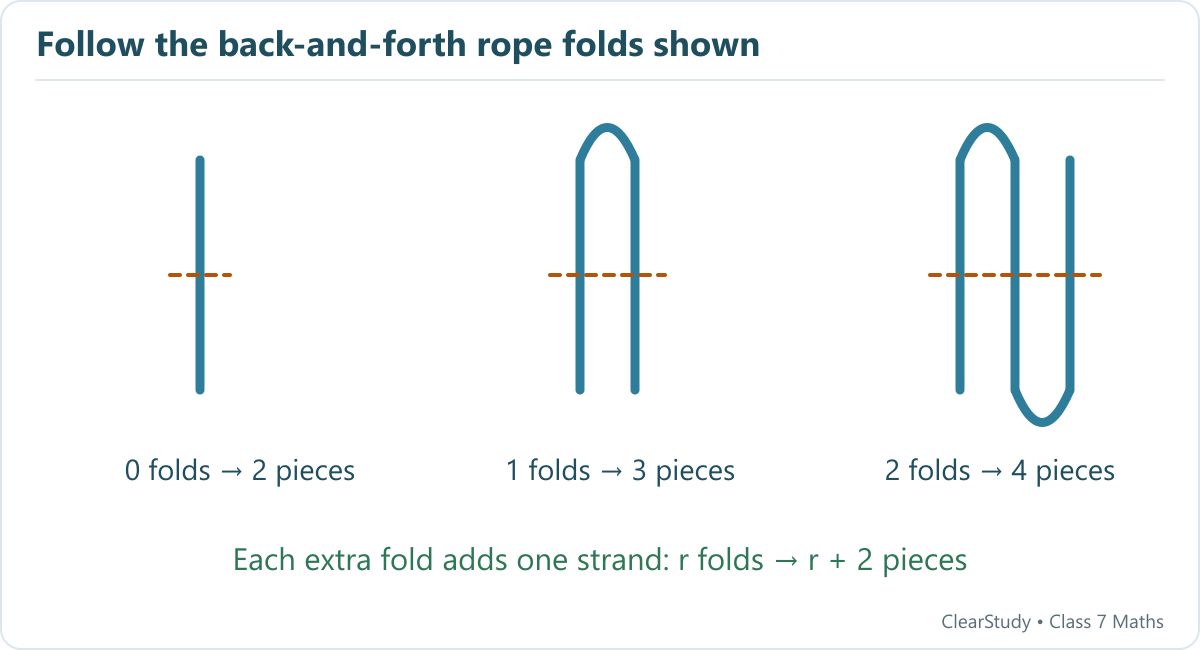
11. Imagine a straight rope. If it is cut once as shown in the picture, we get 2 pieces. If the rope is folded once and then cut as shown, we get 3 pieces. Observe the pattern and find the number of pieces if the rope is folded 10 times and cut. What is the expression for the number of pieces when the rope is folded r times and cut?
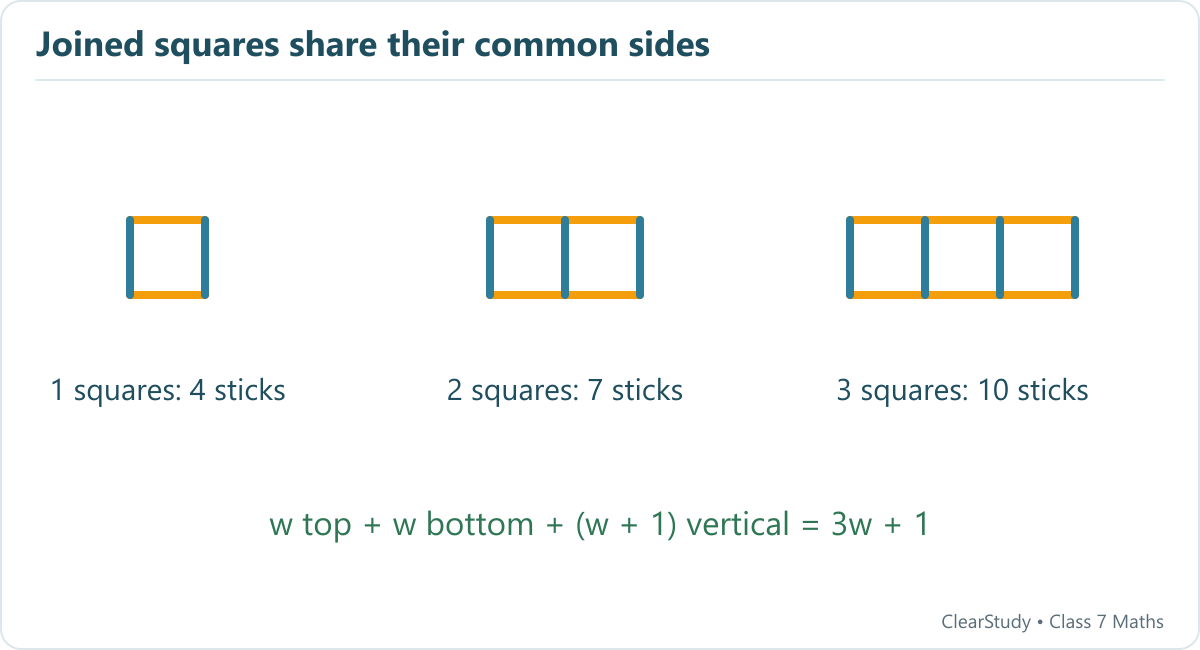
12. Look at the matchstick pattern below. Observe and identify the pattern. How many matchsticks are required to make 10 such squares. How many are required to make w squares?
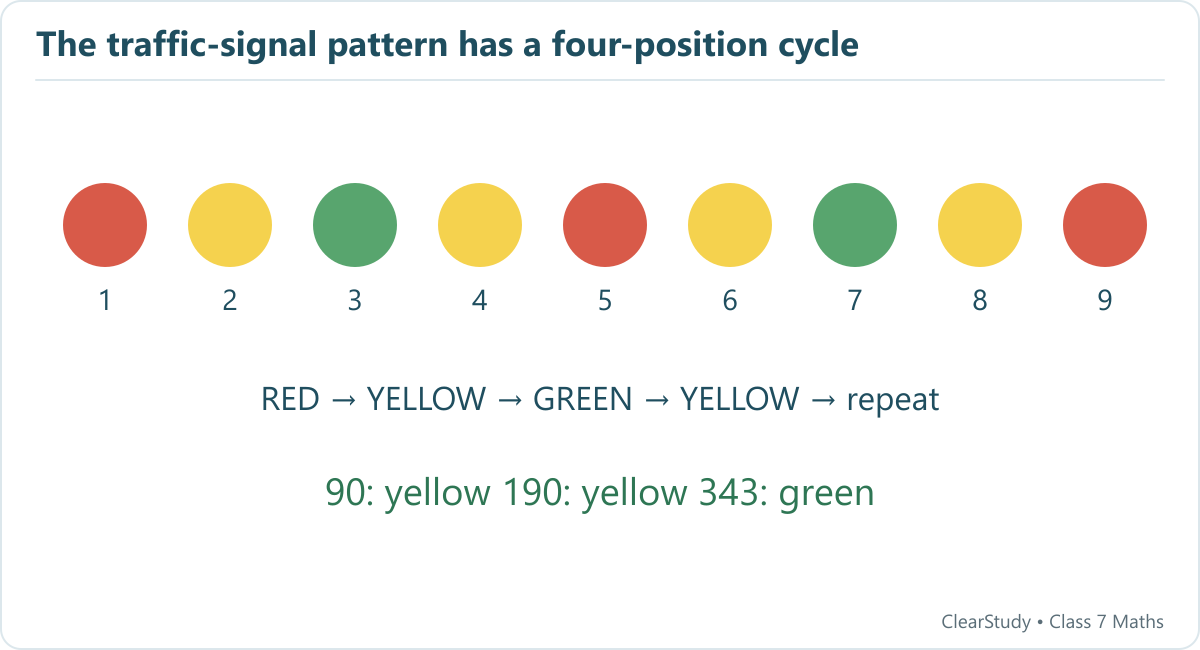
13. Have you noticed how the colours change in a traffic signal? The sequence of colour changes is shown below. Find the colour at positions 90, 190, and 343. Write expressions to describe the positions for each colour.
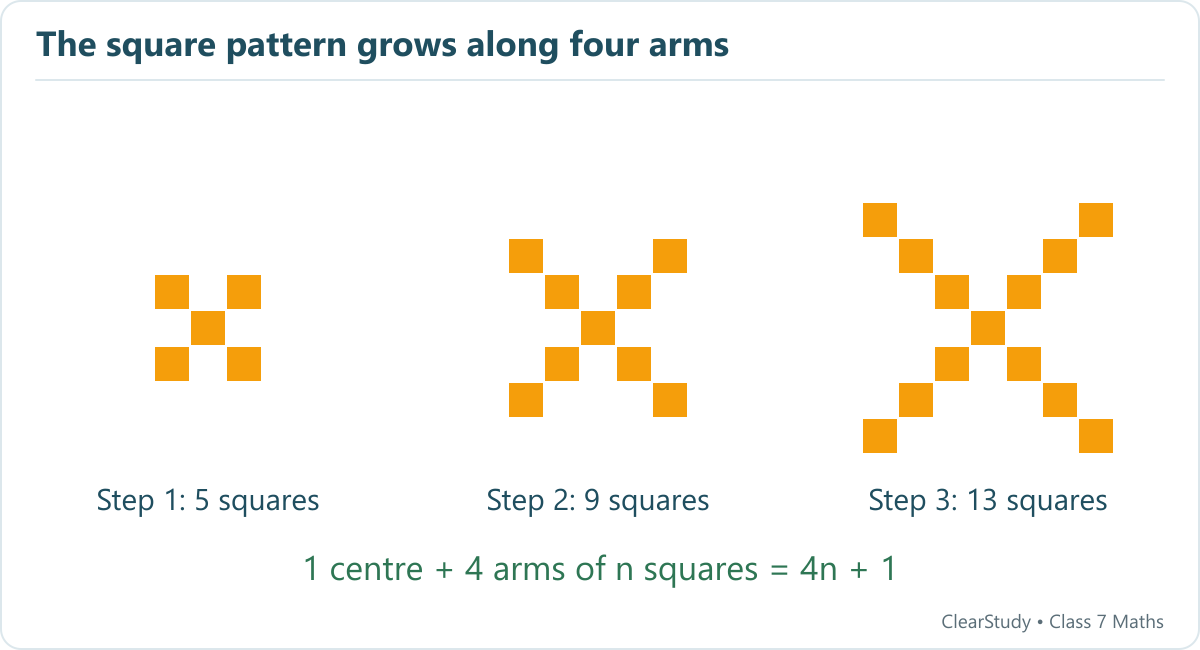
14. Observe the pattern below. How many squares will be there in Step 4, Step 10, Step 50? Write a general formula. How would the formula change if we want to count the number of vertices of all the squares?
15. Numbers are written in a particular sequence in this endless 4-column grid. (a) Give expressions to generate all the numbers in a given column (1, 2, 3, 4). (b) In which row and column will the following numbers appear: (i) 124 (ii) 147 (iii) 201 (c) What number appears in row r and column c? (d) Observe the positions of multiples of 3. Do you see any pattern in it? List other patterns that you see.
Terms and letter-numbers after simplification (page 95)
For the linear expressions in this exercise, each surviving letter-number contributes one term, and there may be one additional constant term. For example, 8r + 12s + 20 has two letter-numbers and three terms. Terms may disappear when their coefficients add to zero. This observation is specific to these expressions, not a rule for every possible algebraic expression.
Math Talk & Try This — Answered
These are the in-text reflective prompts (Math Talk) and short tasks (Try This) in the chapter; the determinate ones are answered, the open ones are guided.
For y = 0, 2, 7, 10, 10y − 3 gives −3, 17, 67, 97, while 10(y − 3) gives −30, −10, 40, 70. Their difference is always 27, so these two never agree.
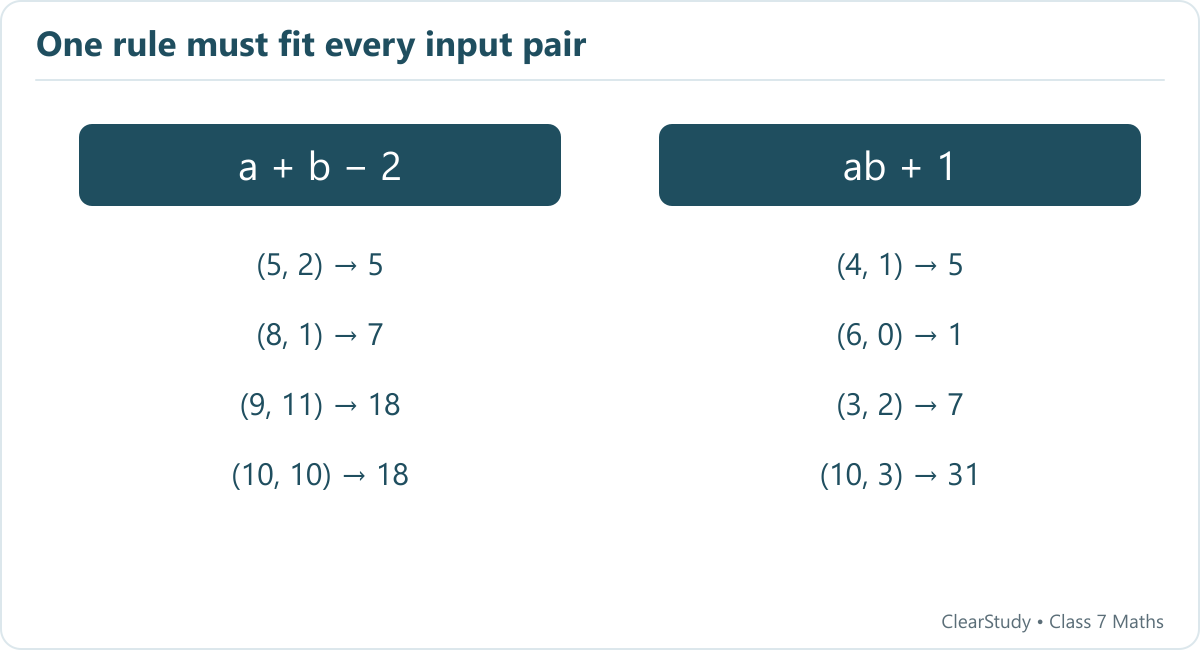
First new machine: a + b − 2. The checks are 5 + 2 − 2 = 5; 8 + 1 − 2 = 7; 9 + 11 − 2 = 18; 10 + 10 − 2 = 18.
Second new machine: ab + 1. The checks are 4 × 1 + 1 = 5; 6 × 0 + 1 = 1; 3 × 2 + 1 = 7. For (10, 3), the missing output is 31.
Make your own: choose a + 2b. Inputs (1, 2), (3, 4) and (5, 1) give 5, 11 and 7. Ask a classmate to find a simple rule fitting every example.
Common Mistakes to Avoid
Watch out for these
- Reading 3d as the digits “3” and “d” joined — 3d means 3 × d, so with d = 6 it is 18, not 36.
- Adding unlike terms: 3a + 2b is already simplest; you cannot make it 5 or 5ab.
- Forgetting to multiply every term inside a bracket: 6(p + 2) = 6p + 12, not 6p + 8.
- Not changing signs when a minus sign sits before a bracket: a − (x + y) = a − x − y, and a − (x − y) = a − x + y.
- In “subtract A from B”, computing A − B instead of the correct B − A.
- Mishandling negatives when substituting: 10 − a with a = −4 is 10 + 4 = 14, not 6.
- Leaving like terms uncombined inside a bracket: 5(2w + 3x + 4w) should first become 5(6w + 3x) = 30w + 15x.
Practice MCQs & Assertion–Reason
1. The expression “5 less than 3 times a number x” is:
(a) 5x − 3 (b) 3x − 5 (c) 5 − 3x (d) 3 − 5x
2. The value of 5m + 3 when m = 2 is:
(a) 10 (b) 13 (c) 16 (d) 25
3. The simplest form of 5c + 3c + 10c is:
(a) 18 (b) 18c (c) 8c (d) 150c
4. Which of these are like terms?
(a) 5c and 11d (b) 12n and −4n (c) 3x and 3y (d) 2p and 2q
5. The perimeter of a rectangle of length l and breadth b is:
(a) lb (b) l + b (c) 2l + 2b (d) 4l
6. Opening the brackets, 6(p + 2) equals:
(a) 6p + 2 (b) 6p + 8 (c) 6p + 12 (d) 8p
7. The simplest form of (4x + 3y) − (3x + 4y) is:
(a) x + y (b) x − y (c) 7x + 7y (d) 0
8. In a 2 × 2 calendar square with top-left number a, the bottom-right number is:
(a) a + 1 (b) a + 7 (c) a + 8 (d) a + 14
9. The number of matchsticks in Step y of the triangle pattern (3, 5, 7, 9, …) is:
(a) 2y (b) 2y + 1 (c) 3y (d) y + 2
10. Subtracting 9a − 6b + 14 from 6a + 9b − 18 gives:
(a) 15a + 3b − 4 (b) −3a + 15b − 32 (c) 3a − 15b + 32 (d) −3a − 3b − 4
For each Assertion–Reason question, choose: (A) Both Assertion and Reason are true and the Reason is the correct explanation of the Assertion; (B) Both are true but the Reason is not the correct explanation; (C) Assertion is true but Reason is false; (D) Assertion is false but Reason is true.
A-R 1. Assertion: The expression 18c + 11d cannot be simplified further.
Reason: 18c and 11d are unlike terms because they contain different letter-numbers.
A-R 2. Assertion: 3d = 36 when d = 6.
Reason: 3d means 3 multiplied by d.
A-R 3. Assertion: 5u and 5 + u are not equal for most values of u.
Reason: 5u means 5 times u, while 5 + u means 5 added to u.
A-R 4. Assertion: In any 2 × 2 calendar square the two diagonal sums are equal.
Reason: With top-left number a, both diagonals add up to 2a + 8.
A-R 5. Assertion: 6(p + 2) simplifies to 6p + 8.
Reason: By the distributive property, the 6 must be multiplied with every term inside the bracket.
Quick Revision Summary
- A letter-number is a letter that stands for a number; an expression with letter-numbers is an algebraic expression.
- Replace the letter with its number to find the value, e.g. a + 3 with a = 23 gives 26.
- Drop the multiplication sign: 4 × n = 4n; write the number first, then the letter.
- Like terms (same letter-numbers) can be combined: 5c + 3c + 10c = 18c; unlike terms (18c + 11d) cannot.
- Use the distributive property to open brackets: a(x + y) = ax + ay; mind the sign of a minus before a bracket.
- “Subtract A from B” means B − A; change every sign of A and add.
- Perimeters as formulas: triangle 3s, pentagon 5s, hexagon 6s, square 4q, rectangle 2l + 2b.
- Algebra explains why patterns hold — e.g. calendar diagonal sums always equal 2a + 8, and the triangle pattern has 2y + 1 matchsticks.
How to score full marks in this chapter
Read each word problem carefully and write the relationship in plain words before turning it into an expression. Always show your terms (a subtraction is a + of a negative term), open brackets fully with the distributive property, and watch the sign in front of every bracket. Combine like terms one letter at a time, and use substitution as an error check. Agreement at one value does not prove an identity; justify equality by valid algebraic steps. For “subtract A from B” questions, write B − A first so you never reverse the order.
Frequently Asked Questions
What is Class 7 Maths Ganita Prakash Chapter 4 about?
Chapter 4, Expressions Using Letter-Numbers, introduces algebra: using letters to stand for numbers, writing relationships and formulas as algebraic expressions, dropping the multiplication sign (4 × n = 4n), combining like terms, adding and subtracting expressions, the distributive property, and using algebra to explain number patterns in calendars, matchsticks and grids.
What is the difference between like terms and unlike terms?
Like terms contain exactly the same letter-numbers, such as 5c, 3c and 10c, and can be added into a single term (18c). Unlike terms contain different letter-numbers, such as 18c and 11d, and cannot be combined — so 18c + 11d is already in its simplest form.
How do you simplify an expression like 6(p + 2)?
Use the distributive property: multiply the number outside by every term inside the bracket. So 6(p + 2) = 6 × p + 6 × 2 = 6p + 12. A common mistake is multiplying only the first term and writing 6p + 8.
Are these Class 7 Maths Ganita Prakash Chapter 4 solutions free?
Yes. All solutions are free and follow the official NCERT Ganita Prakash (Part I) textbook for the 2026–27 session, with every Figure it Out, Math Talk and Try This task solved and the simplifications verified.
Textbook reference: NCERT Ganita Prakash, Chapter 4 (official PDF). ClearStudy diagrams and worked explanations are original teaching aids.