Class 7 Maths Chapter 5 Solutions — Parallel and Intersecting Lines
Use these NCERT Ganita Prakash Class 7 Chapter 5 solutions to practise parallel and intersecting lines. Original diagrams show the marked angle regions, while worked explanations identify linear pairs, vertically opposite, corresponding, alternate and co-interior angles.
Class: 7Subject: MathematicsBook: Ganita Prakash (Part I)Chapter: 5Exercises: Figure it Out (p. 108), Figure it Out (p. 113–114), Figure it Out (p. 119), Figure it Out (p. 123–125)Session: 2026–27
Chapter 5 of Ganita Prakash, Parallel and Intersecting Lines, explores the relationship between lines on a flat (plane) surface. It begins with what happens when two lines intersect — the four angles formed, the idea of a linear pair (adjacent angles that add up to 180°) and vertically opposite angles (which are always equal). It then introduces perpendicular lines (intersecting at 90°) and parallel lines (which never meet however far they are extended). The heart of the chapter is the transversal — a line crossing two others — and the eight angles it forms: corresponding angles, alternate angles and co-interior (same-side interior) angles. The Class 7 Maths Ganita Prakash Chapter 5 solutions below work through every Figure it Out, Math Talk, Activity and Try This task step by step.
Key Concepts & Definitions
Intersecting lines: two lines that meet each other at one point on a plane. Two straight lines can intersect at only one point.
Linear pair: the two adjacent angles formed on a straight line by an intersecting line. A linear pair always adds up to 180°.
Vertically opposite angles: the angles “across” the point of intersection (like ∠a and ∠c). Vertically opposite angles are always equal.
Perpendicular lines: two lines that intersect so that all four angles are equal, i.e. each is a right angle (90°).
Parallel lines: a pair of lines on the same plane that never meet, however far they are extended at both ends.
Transversal: a line that crosses a pair of (other) lines. It forms 8 angles in all — two sets of four.
Corresponding angles: angles in the same position at the two intersections (e.g. ∠1 and ∠5). When a transversal cuts a pair of parallel lines, corresponding angles are equal.
Alternate angles: a pair of angles on opposite sides of the transversal between the two lines. For parallel lines they are equal.
Co-interior (interior) angles: the two interior angles on the same side of the transversal. For parallel lines they add up to 180°.
Important Properties & Angle Rules (Chapter 5)
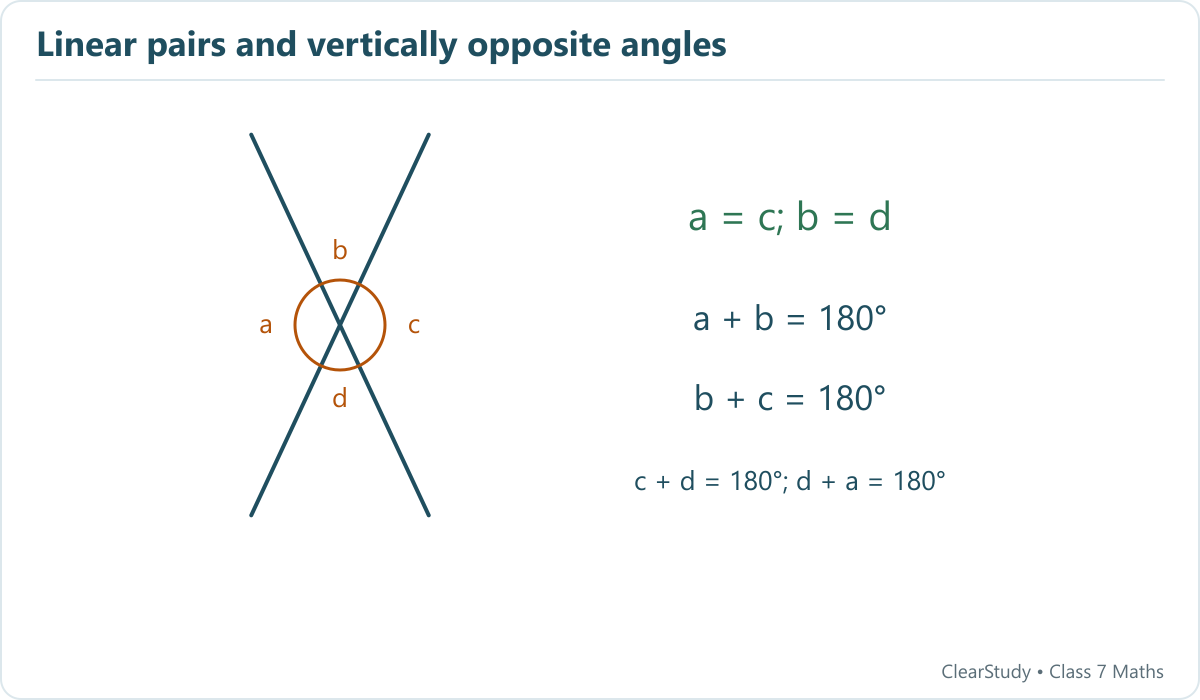
Linear pair: ∠a + ∠b = 180° (adjacent angles on a straight line).
Vertically opposite angles: ∠a = ∠c and ∠b = ∠d at any intersection.
Perpendicular test: all four angles equal ⇒ each angle = 90°.
Parallel test (corresponding): if a transversal makes a pair of corresponding angles equal, the two lines are parallel — and the reverse is also true.
Alternate angles (parallel lines): alternate angles are equal.
Co-interior angles (parallel lines): the two interior angles on the same side of the transversal add up to 180°.
Number of distinct angles: a transversal across two lines makes 8 angles with at most 4 distinct measures (at most 2 distinct measures when the lines are parallel; only 1 when the transversal is perpendicular).
Figure it Out — Intersecting Lines (Page 108)
List all the linear pairs and vertically opposite angles you observe in Fig. 5.3.
SOLUTIONIn Fig. 5.3 two lines l and m intersect at one point, forming four angles labelled ∠a, ∠b, ∠c and ∠d in order around the point.Linear pairs (adjacent angles that together form a straight line, summing to 180°): ∠a and ∠b; ∠b and ∠c; ∠c and ∠d; ∠d and ∠a. (4 linear pairs in all.)Vertically opposite angles (pairs across the point, always equal): ∠a and ∠c; ∠b and ∠d. (2 pairs in all.)
At the crossing, opposite pairs a and c, and b and d, are equal. Each neighbouring pair sums to 180°.
Figure it Out — Parallel Lines & Notation (Page 113–114)
These five tasks are based on dot-paper figures (Fig. 5.10–5.13). Original teaching diagrams below illustrate the directions and construction methods. Some angle figures are rotated or simplified while retaining the relationships needed for the solution.
1. Draw some lines perpendicular to the lines given on the dot paper in Fig. 5.10.
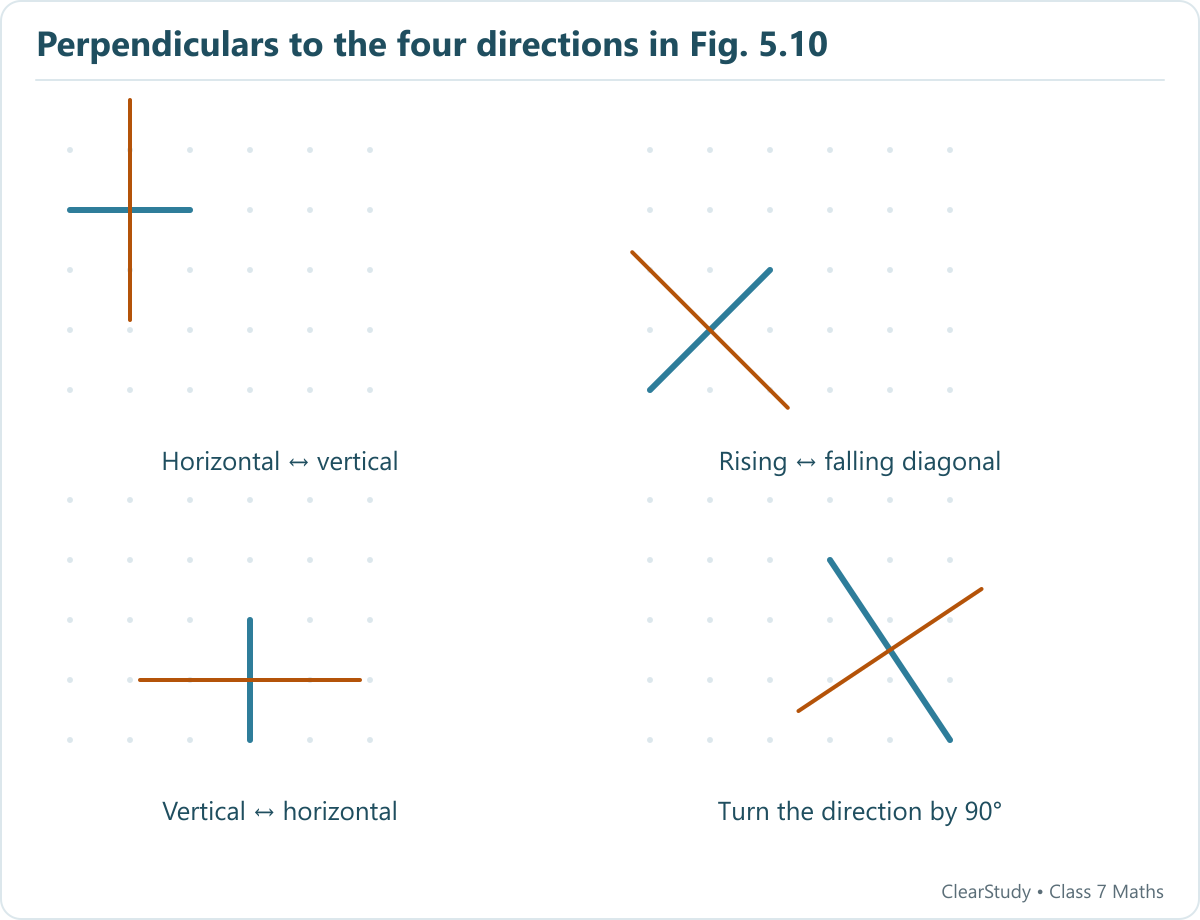
SOLUTIONFor each given line, place the corner of a set square (or the corner of any right-angled card) on the line. Slide it until one edge lies along the given line; the second edge of the set square is then perpendicular to it.Draw along that second edge so the new line passes through dots. Mark the meeting point with a small square symbol to show the 90° angle. On a square dot grid, a line drawn straight across (horizontal) is perpendicular to a line drawn straight up (vertical), so use the grid directions as a quick check.
Blue segments reproduce the four given directions. Each orange line crosses its blue segment at 90°. The fourth direction needs a perpendicular with horizontal and vertical steps swapped and one reversed.
2. In Fig. 5.11, mark the parallel lines using the notation given above (single arrow, double arrow etc.). Mark the angle between perpendicular lines with a square symbol.
(a) How did you spot the perpendicular lines?(b) How did you spot the parallel lines?
SOLUTIONMark each set of parallel lines with matching arrowheads: one set with a single arrow (>), a second set with a double arrow (>>), and so on. Where two lines meet at a right angle, draw a small square in the corner.(a) Perpendicular lines were spotted by checking the angle at the crossing — if it is a right angle (a square corner fits exactly), the lines are perpendicular.(b) Parallel lines were spotted because they keep the same direction (the same slope on the dot grid) and the gap between them stays the same everywhere; extended either way, they would not meet.
3. In the dot paper following, draw different sets of parallel lines. The line segments can be of different lengths but should have dots as endpoints.
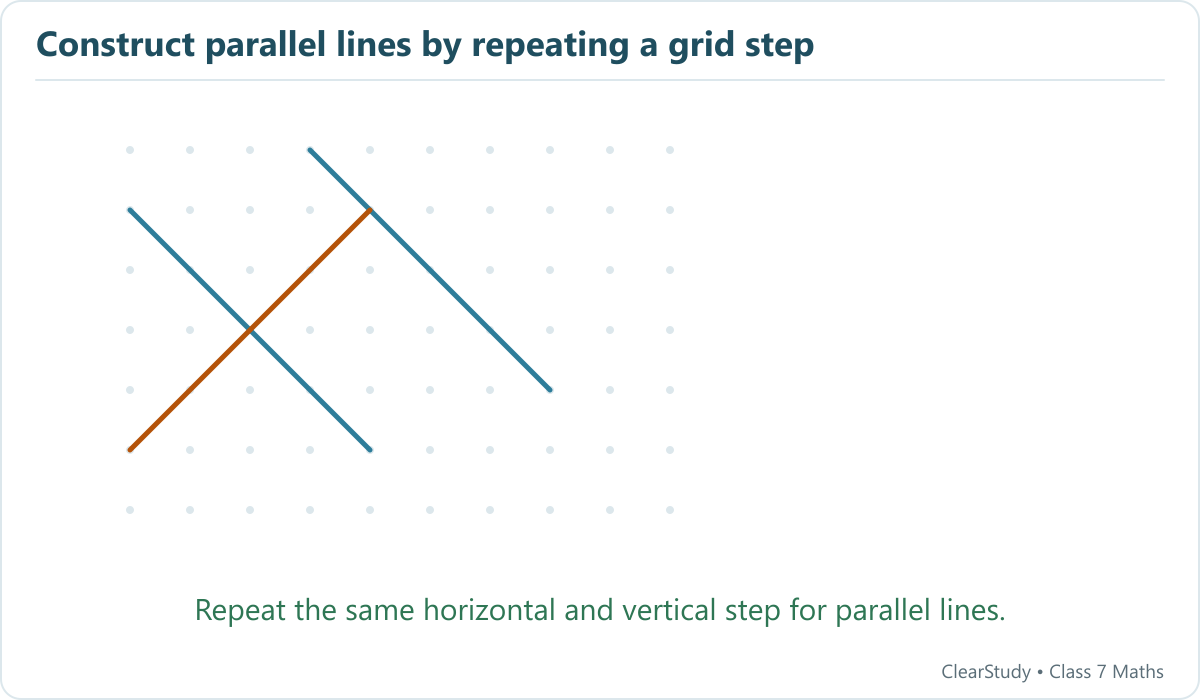
SOLUTIONChoose a direction (slope) by counting dots — for example “2 dots right, 1 dot up”. Draw a segment with dots as its two endpoints.For a parallel segment, start at any other dot and step exactly the same way (2 right, 1 up). Equal steps guarantee the same slope, so the segments are parallel. Repeat with a different slope to make a second set of parallel lines. Lengths may differ; only the direction must match.
The two blue segments have the same direction. A perpendicular direction reverses and swaps the horizontal and vertical steps.
4. Using your sense of how parallel lines look, try to draw lines parallel to the line segments on this dot paper.
(a) Did you find it challenging to draw some of them?(b) Which ones?(c) How did you do it?
SOLUTIONFor each given segment, read off its slope as a dot step (e.g. “3 right, 2 up”), then draw a new segment from another dot using the same step — this keeps it parallel.(a) Yes, some are harder than others.(b) Horizontal, vertical and 45° (slanted “1 right, 1 up”) segments are easy. The tilted segments with an uneven slope (such as 3 right, 1 up) are the challenging ones, because their direction does not line up neatly with the grid.(c) By counting the exact dot step of the original segment and repeating the same horizontal-and-vertical count from a fresh dot, so the new segment runs in exactly the same direction.
5. In Fig. 5.13, which line is parallel to line a — line b or line c? How do you decide this?
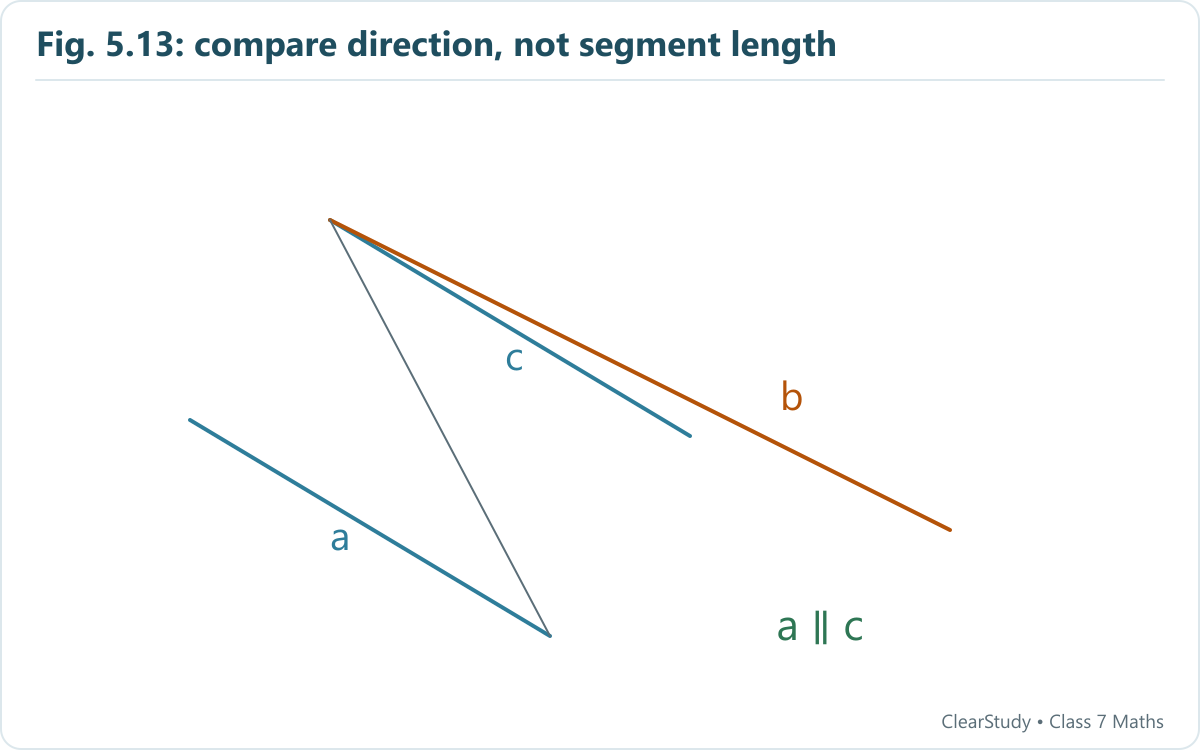
SOLUTIONLine c is parallel to line a. Compare their directions using a ruler and set square, or a transversal and equal corresponding angles. Line b has a slightly different direction.Length alone cannot decide parallelism. The sketch is not a square dot grid, so do not invent a count of horizontal and vertical grid steps from these isolated endpoints.
Line c has the same direction as a. Line b differs slightly in direction and would meet a if extended.
Figure it Out — Drawing Parallel Lines (Page 119)
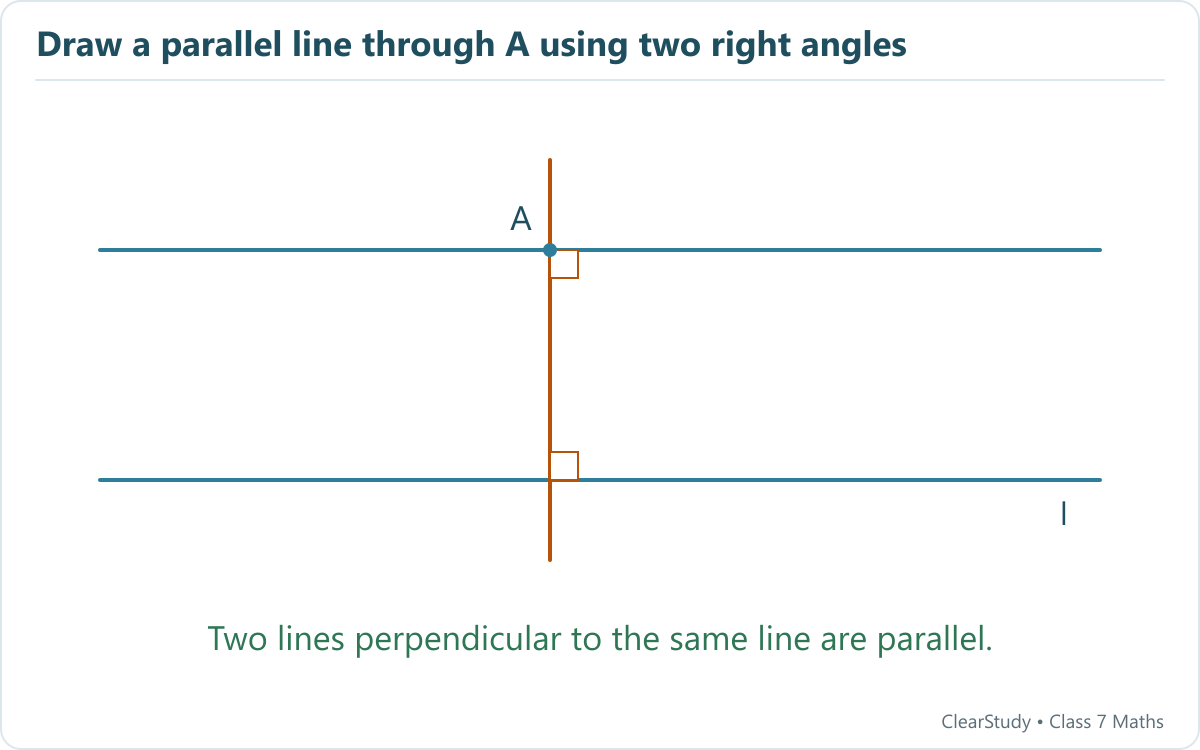
Can you draw a line parallel to l, that goes through point A? How will you do it with the tools from your geometry box? Describe your method.
SOLUTIONMethod using a ruler and a set square (sliding method):Step 1. Place one edge of the set square along line l, and rest a ruler firmly against a second edge of the set square.Step 2. Holding the ruler still, slide the set square along the ruler until the edge that lay on l reaches point A.Step 3. Draw a line along that edge through A. Because the set square kept the same angle with the ruler throughout, the new line makes the same angle with the sliding direction as l does — the corresponding angles are equal, so the new line is parallel to l and passes through A.Alternative (two right angles): drop a perpendicular from A to l, then at A draw a line perpendicular to that perpendicular. Two lines perpendicular to the same line are parallel, so this line through A is parallel to l.
Draw a perpendicular from A to l, then a perpendicular to that helper through A. The new line is parallel to l.
Figure it Out — Transversal Angles (Page 123–125)
Solutions use the figure’s given angle marks together with the linear-pair, vertically-opposite, corresponding, alternate and co-interior angle rules; every result is verified.
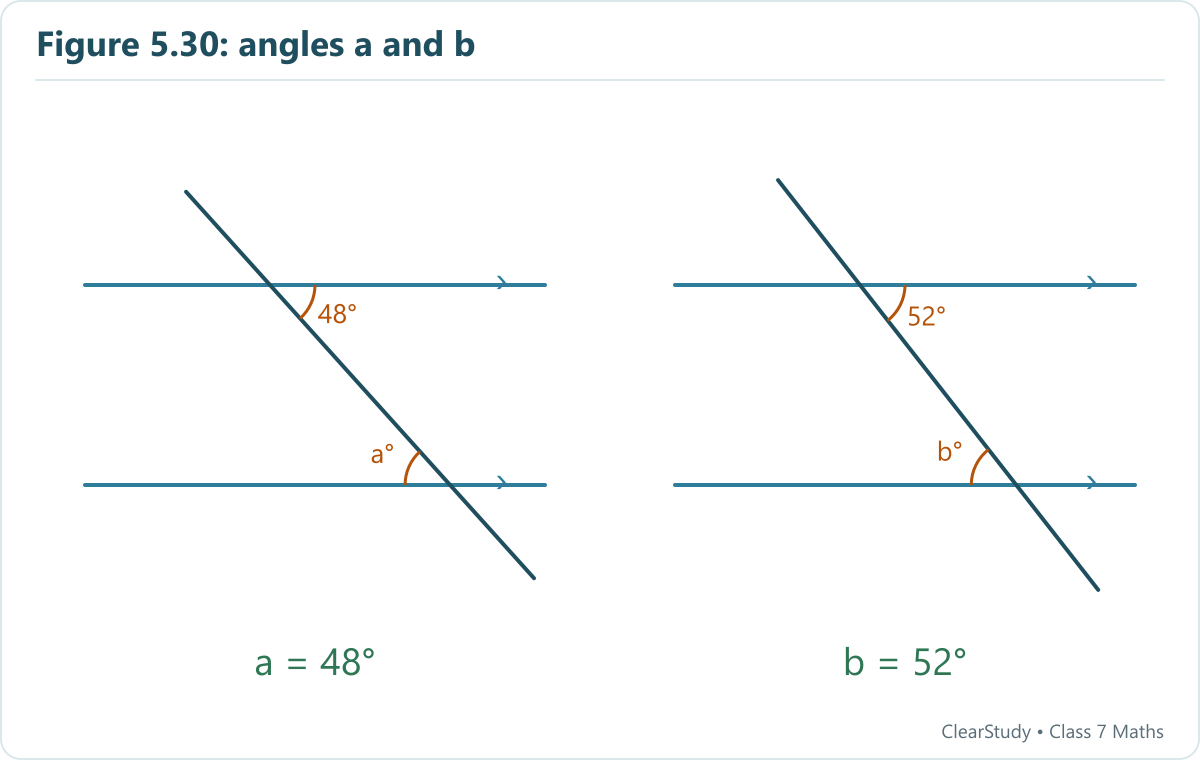
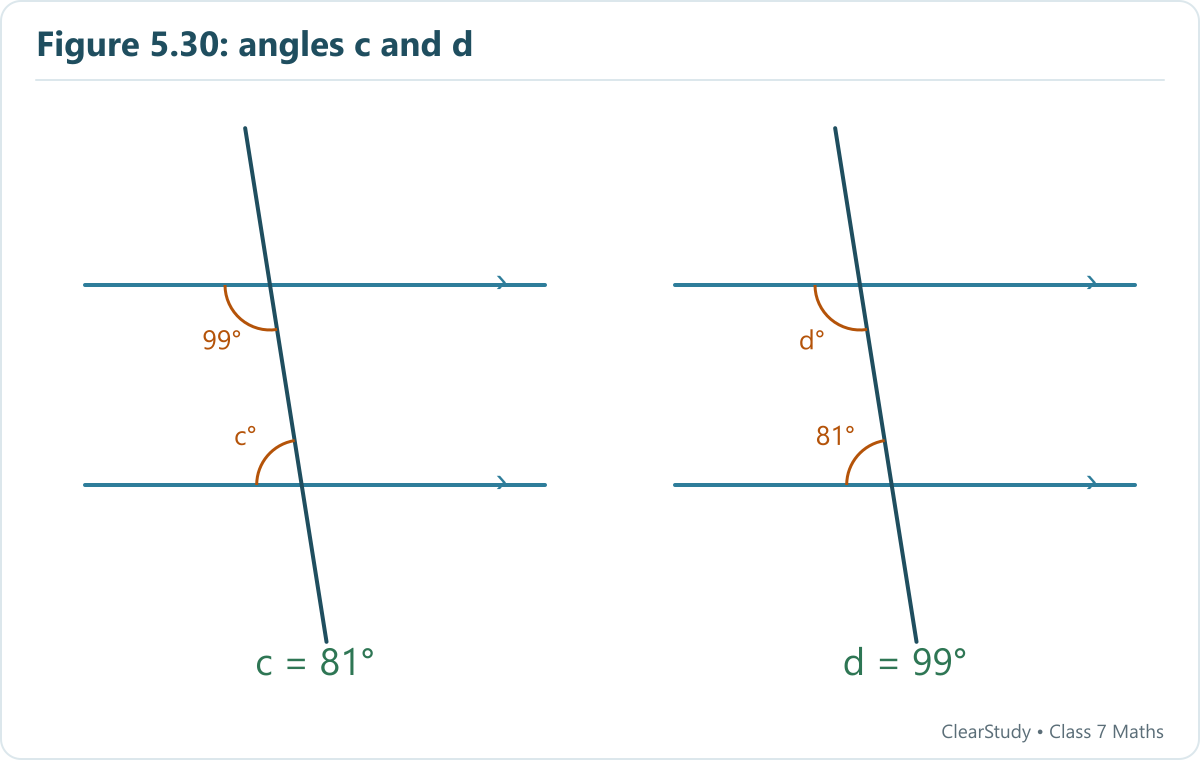
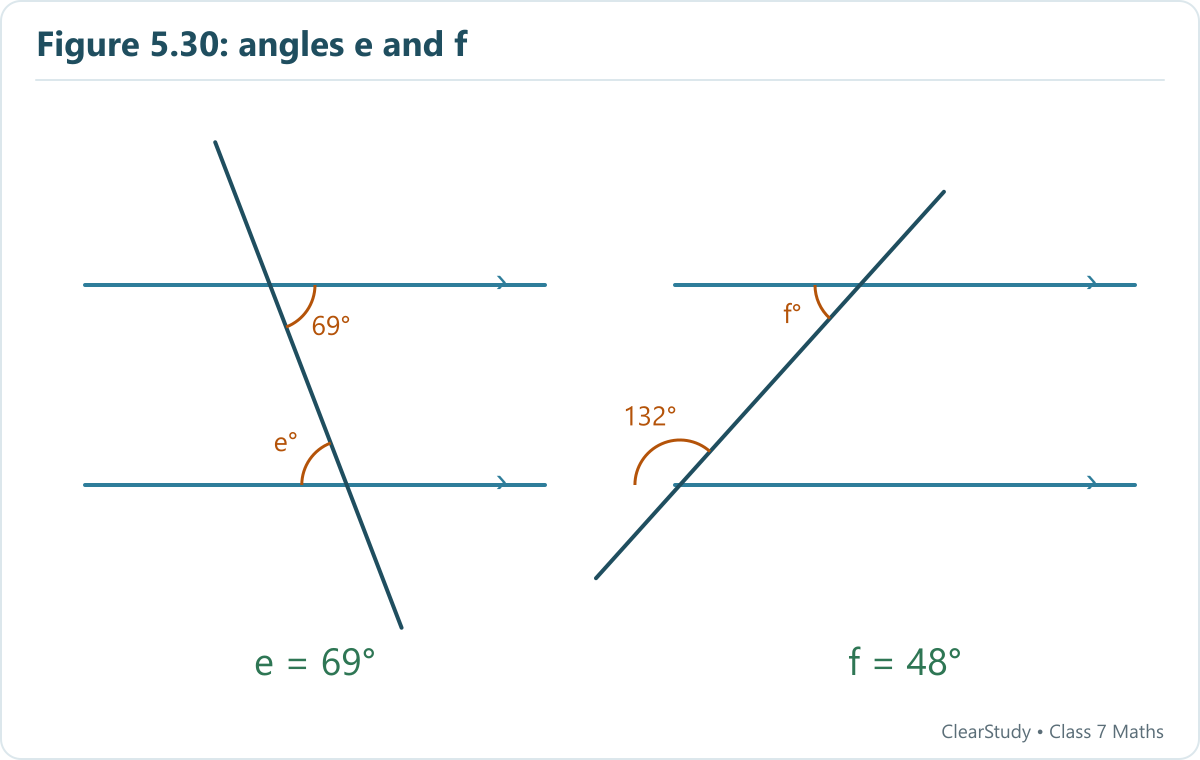
1. Find the angles marked below (Fig. 5.30).
a, b, c, d, e, f, g, h, i, j
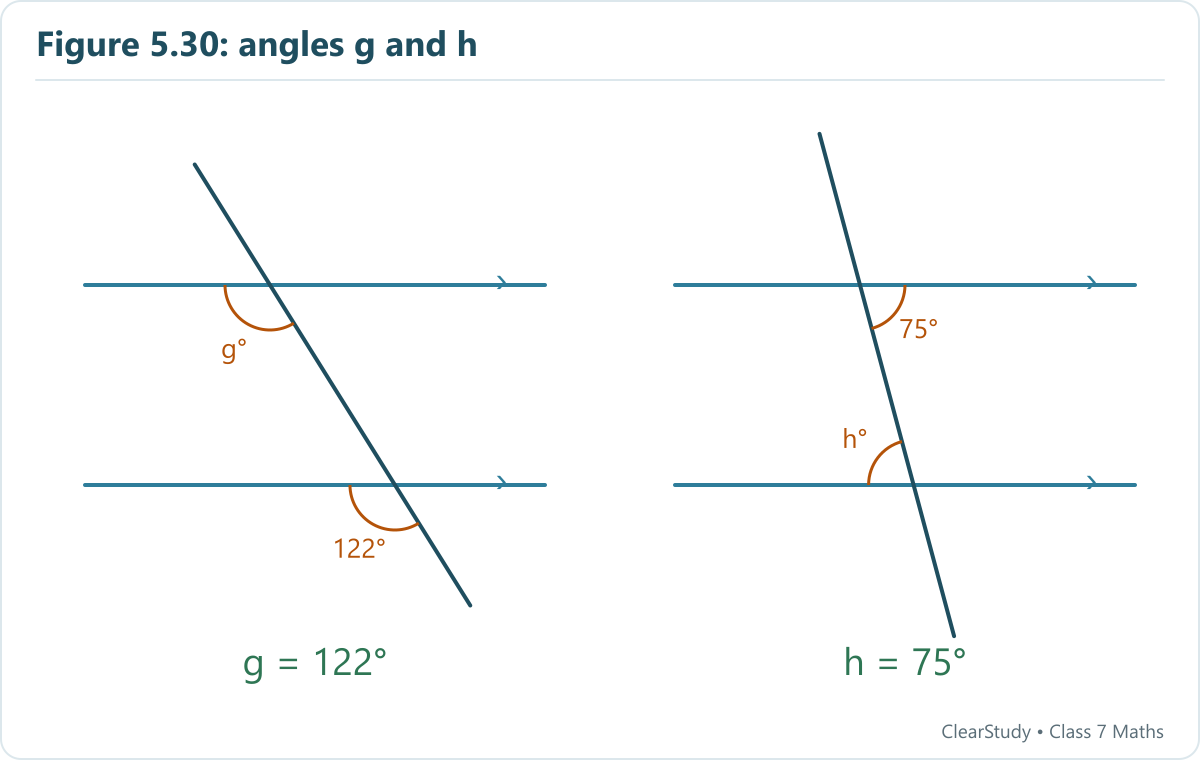
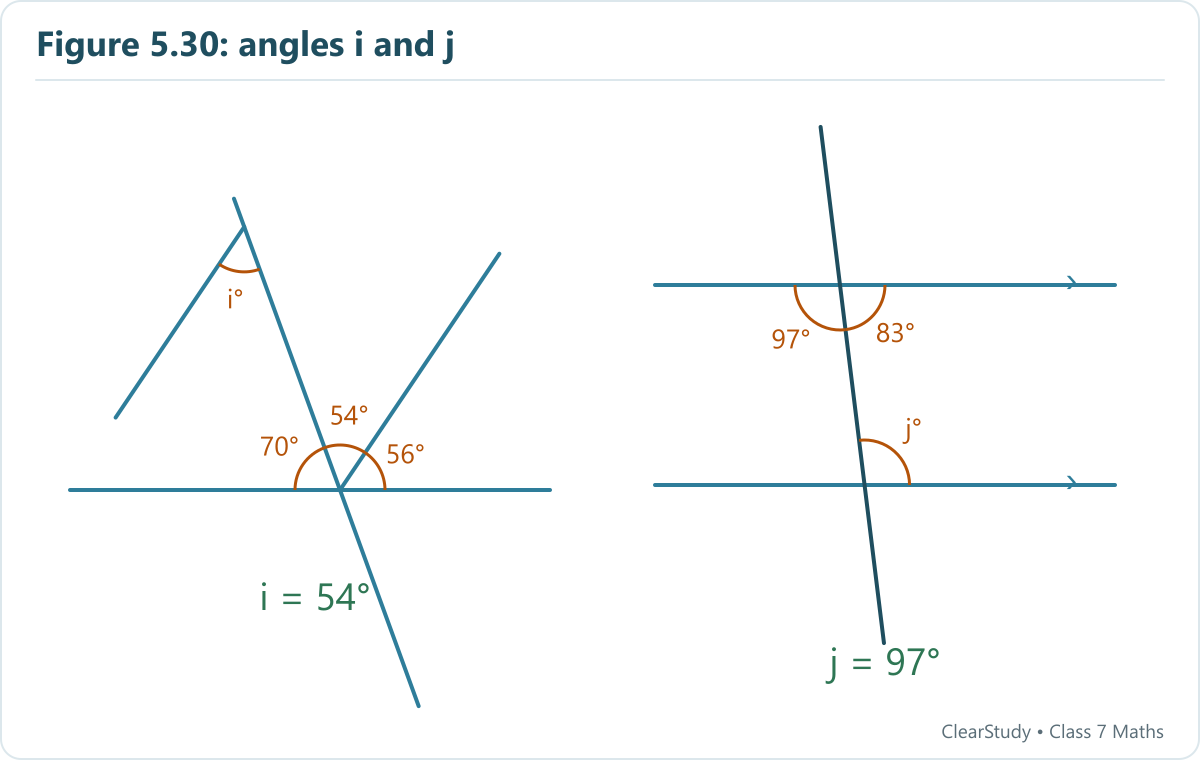
SOLUTIONa = 48°: alternate interior angles on the marked parallel lines.b = 52°: alternate interior angles.c = 81°: c + 99° = 180° (co-interior angles), or use the alternate angle to 81°.d = 99°: d + 81° = 180° (co-interior angles).e = 69°: alternate interior angles for the right-hand transversal. The 97° and 83° marks belong to the other transversal.f = 48°: f + 132° = 180° (co-interior angles).g = 122°: corresponding obtuse angles. The acute partner is 58°.h = 75°: alternate interior angles on the right-hand transversal. The 120° mark is on the other transversal.i = 54°: alternate interior angles for the two slanted parallel lines. The 70°, 54° and 56° angles at the base sum to 180°.j = 97°: transfer 97° to the third parallel line by corresponding angles, then use its vertically opposite angle j. The 27° and 124° marks are unnecessary for this route.
Parallel-line angle relationships give a = 48° and b = 52°. Drawings are rotated for clear comparison.Parallel-line angle relationships give c = 81° and d = 99°. Drawings are rotated for clear comparison.Parallel-line angle relationships give e = 69° and f = 48°. Drawings are rotated for clear comparison.Parallel-line angle relationships give g = 122° and h = 75°. Drawings are rotated for clear comparison.i equals its alternate interior angle, 54°. j equals the angle opposite the corresponding 97° angle. Unneeded transversals are omitted from the j teaching diagram.
2. Find the angle represented by a (Fig. 5.31).
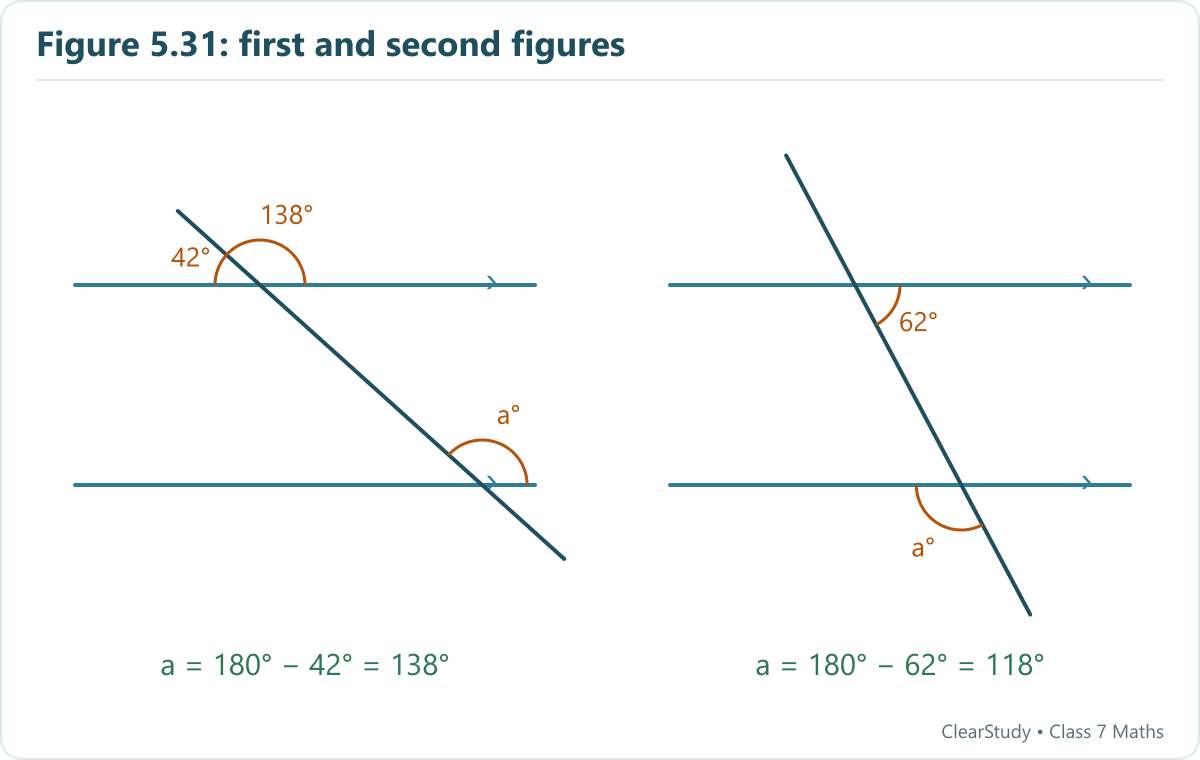
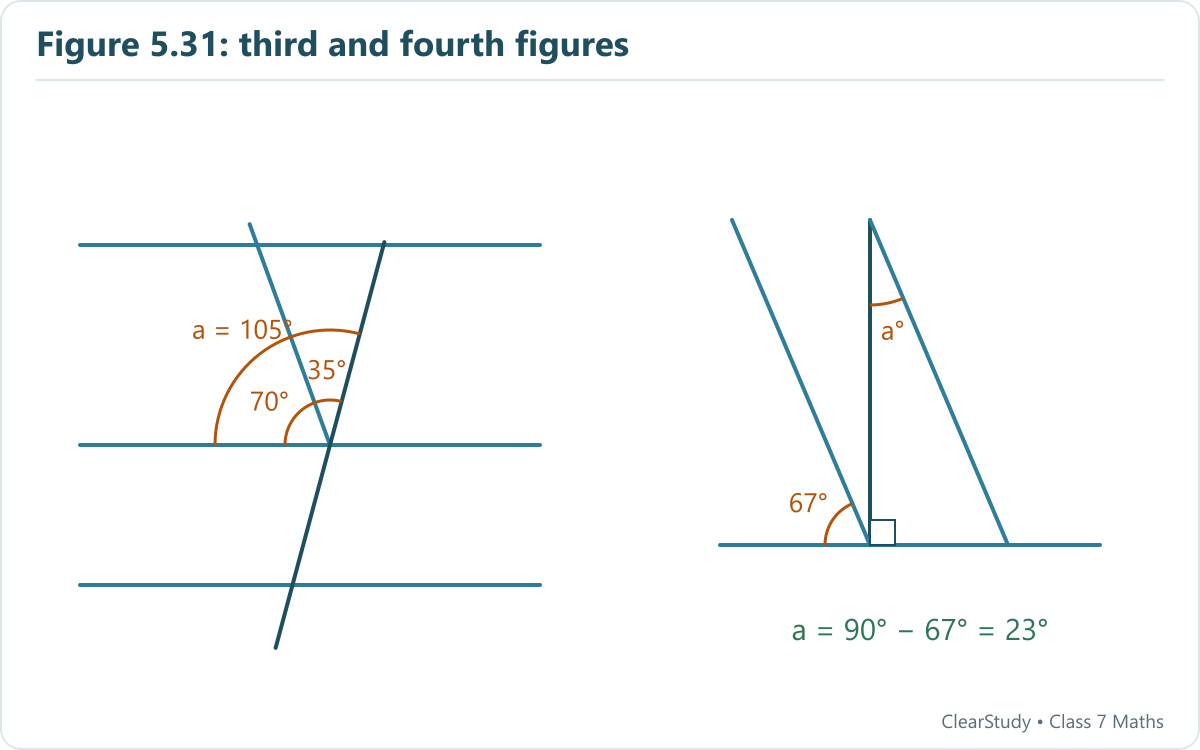
SOLUTIONRead the four figures from left to right, top row first.First: a = 138°. The angle corresponding to 42° at the lower line is 42°. It and a are a linear pair, so a = 180° − 42°. The 100° angle is on a different transversal.Second: a = 118°. Use the two parallel-line pairs to carry the 62° acute angle to the lower-left intersection. The marked a is its adjacent obtuse angle: 180° − 62° = 118°.Third: a = 105°. The upper-left angle beside the 110° mark is 70°. Its corresponding angle at the middle line is also 70°. Add the 35° angle between the two transversals: 70° + 35° = 105°. This angle corresponds to a on the lowest line.Fourth: a = 23°. The vertical is perpendicular to the base, so the angle between it and the left slanted line is 90° − 67° = 23°. Transfer it to the right slanted parallel line.
First figure: a = 138°. Second figure: a = 118°. The second teaching diagram carries the given 62° across the other parallel pair first.Third figure: a = (180° − 110°) + 35° = 105°. Fourth figure: a = 90° − 67° = 23°.
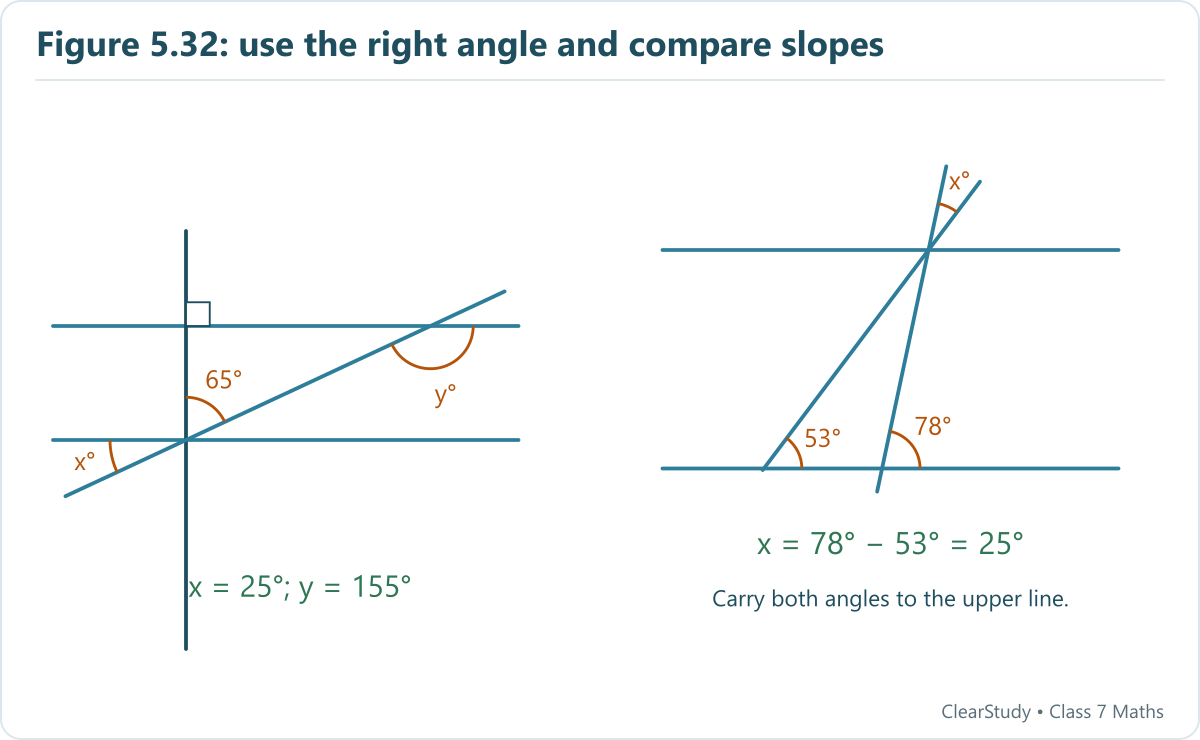
3. In the figures below, what angles do x and y stand for? (Fig. 5.32)
SOLUTIONFirst figure: the vertical line is perpendicular to both horizontal parallel lines. The rising diagonal makes 90° − 65° = 25° with the lower horizontal. Its vertically opposite angle is x = 25°. At the upper horizontal, the corresponding acute angle is 25°; y is its linear-pair partner, so y = 155°.Second figure: the two slanted lines make 53° and 78° with the horizontal. By corresponding angles these same inclinations appear at the upper horizontal. The small angle between them is x = 78° − 53° = 25°.
First figure: x = 90° − 65° = 25° and y = 180° − 25° = 155°. Second figure: x = 78° − 53° = 25°.
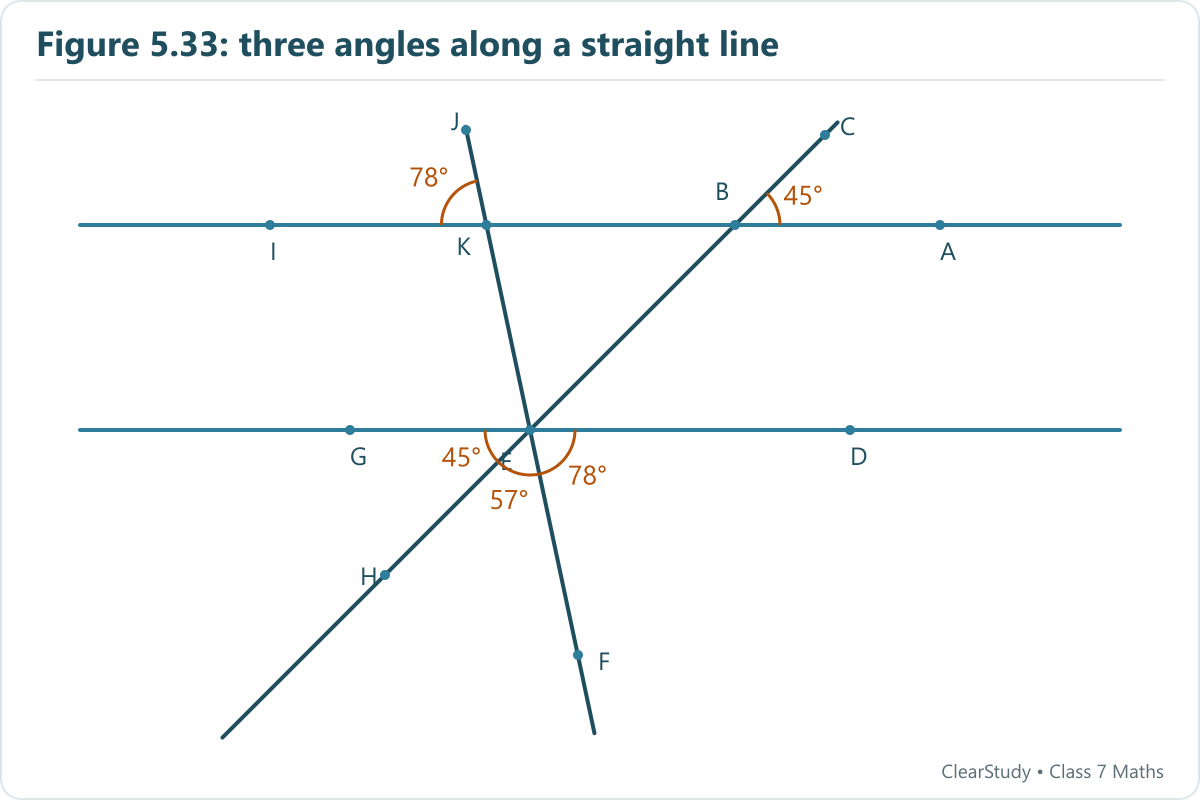
4. In Fig. 5.33, ∠ABC = 45° and ∠IKJ = 78°. Find angles ∠GEH, ∠HEF, ∠FED.
SOLUTIONThe two horizontal lines are parallel. The acute angle at B is 45°, so the corresponding acute angle at E is 45°; its vertically opposite angle is ∠GEH = 45°.The 78° angle at K corresponds to the upper-left angle at E. Its vertically opposite angle is ∠FED = 78°.GE and ED are opposite rays, so the three angles below the line total 180°: 45° + ∠HEF + 78° = 180°. Thus ∠HEF = 57°.
At E, ∠GEH = 45°, ∠HEF = 57° and ∠FED = 78°. The three adjacent angles total 180°.
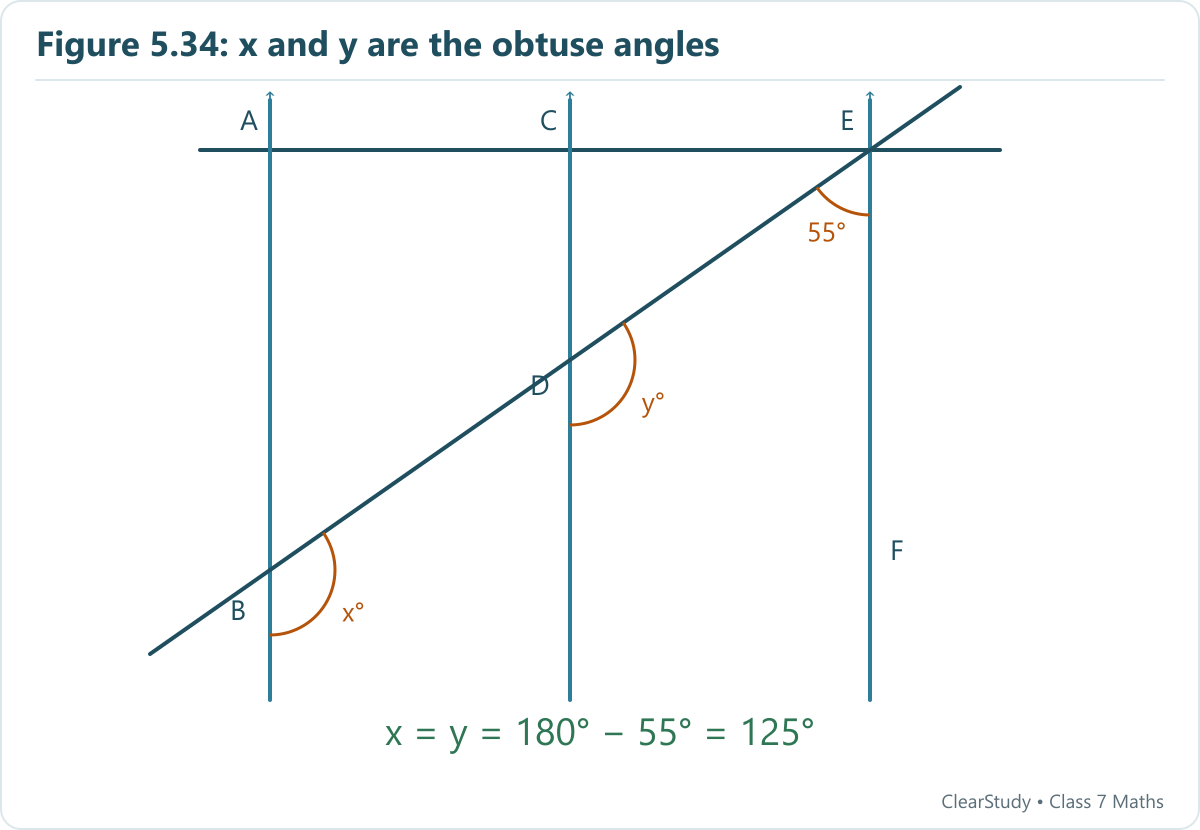
5. In Fig. 5.34, AB is parallel to CD and CD is parallel to EF. Also, EA is perpendicular to AB. If ∠BEF = 55°, find the values of x and y.
SOLUTIONAB, CD and EF are parallel vertical lines. The sloping line BE is a transversal.At E the given acute angle is 55°. Its adjacent obtuse angle is 180° − 55° = 125°. The angles labelled x at B and y at D occupy the corresponding obtuse positions, so x = 125° and y = 125°.The perpendicular EA supplies a right angle elsewhere in the diagram. It does not mean x and y split that right angle; their arcs are beside the sloping transversal.
The 55° acute angle has an adjacent 125° angle. Corresponding obtuse angles at B and D give x = y = 125°.
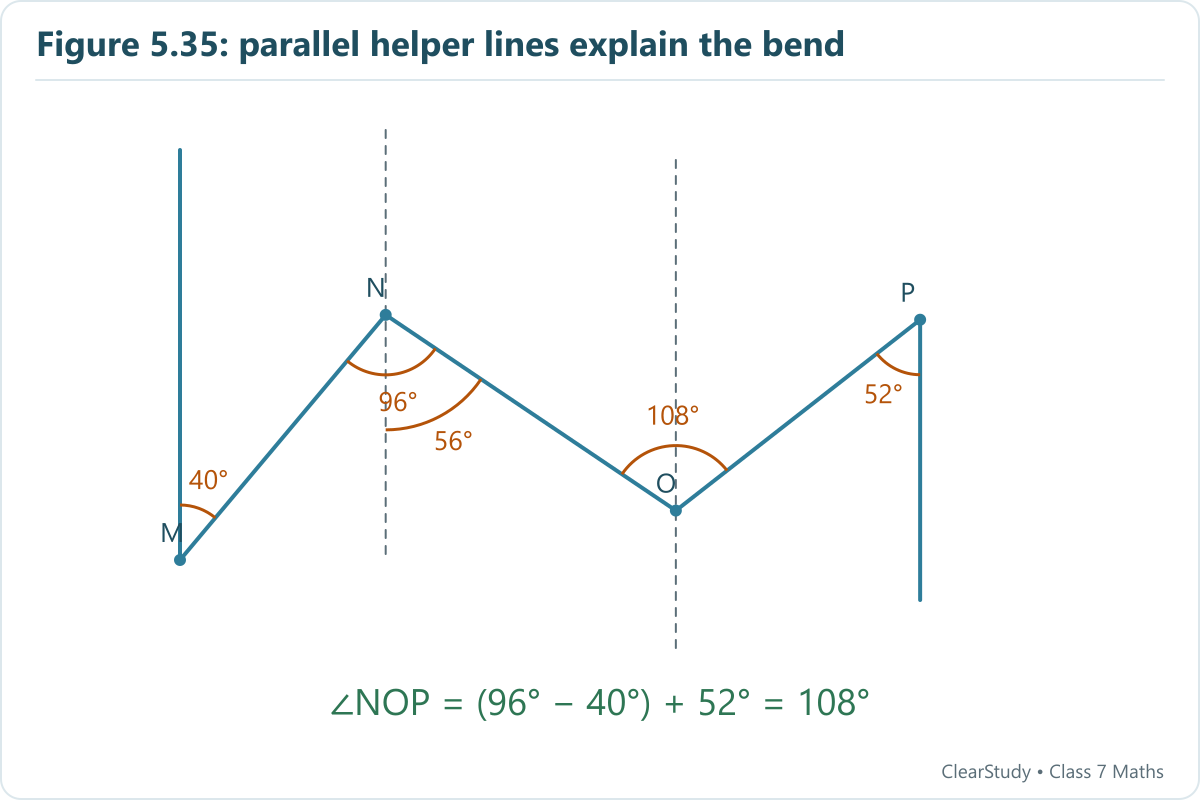
6. What is the measure of angle ∠NOP in Fig. 5.35?
[Hint: Draw lines parallel to LM and PQ through points N and O.]
SOLUTIONFollow the hint: through N and O draw helper lines parallel to LM and PQ, splitting the bend angles into parts that are alternate (Z-shape) angles with the known marks 96°, 40° and 52°.At N the 96° angle and the 40° mark on LM give the alternate part 96° − 40° = 56° carried to the helper line.At O the angle a° with the 52° mark on PQ, by alternate angles, completes the bend so that ∠NOP = 52° + (96° − 40°) = 52° + 56° = 108°.∴ ∠NOP = 108°.
Draw vertical helper lines through N and O. The first bend leaves 56° beside the helper; add 52° to obtain ∠NOP = 108°.
Math Talk, Activities & Try This — Answered
These are the in-text reflective questions, activities and worked examples in the chapter; the determinate ones are answered, the exploratory ones are guided.
In-text — Can two straight lines intersect at more than one point?When two lines intersect, can they meet at more than one point?Answer. No. Two distinct straight lines can intersect at only one point. If they had two common points, the two lines would coincide completely (be the same line), because exactly one straight line passes through any two given points.
In-text — Finding ∠b, ∠c, ∠d from ∠a (Fig. 5.2)In Fig. 5.2, if ∠a is 120°, can you figure out ∠b, ∠c and ∠d without measuring?Answer. ∠a and ∠b are a linear pair, so ∠b = 180° − 120° = 60°. ∠b and ∠c are a linear pair, so ∠c = 180° − 60° = 120°. ∠c and ∠d are a linear pair, so ∠d = 180° − 120° = 60°. So ∠a = ∠c = 120° and ∠b = ∠d = 60° — vertically opposite angles are equal.
Activity 1 — Patterns among the four anglesDraw four pairs of intersecting lines, measure the four angles each time. What patterns do you observe?Answer. Every time you will find the vertically opposite angles are equal and each linear pair adds up to 180°, no matter how the lines are tilted. (Small differences come only from measuring error and line thickness.)
In-text — Perpendicular lines (Section 5.2)Can you draw a pair of intersecting lines such that all four angles are equal? What is the measure of each angle?Answer. Yes. If the four angles are equal and they add to 360° around the point, each is 360° ÷ 4 = 90°. Such lines are perpendicular.
Section 5.3 — Describe how the segments meet (Fig. 5.5)Are line segments ST and UV likely to meet if extended? Are OP and QR likely to meet if extended?Answer. If two segments keep the same direction (the same slope) and a constant gap, they will not meet however far they are extended — they are parallel. If their directions differ, they will eventually meet. So compare the slope of ST with UV, and of OP with QR: equal slope ⇒ they will not meet (parallel); different slope ⇒ they will meet when extended.
Activity 2 — Paper folding (Section 5.4)Describe the opposite and adjacent edges of a square sheet; count parallel lines after each fold.Answer. Opposite edges are parallel to each other; adjacent edges are perpendicular to each other. After one horizontal fold the new crease is parallel to the top and bottom edges, giving 3 horizontal parallel lines (top edge, crease, bottom edge). A second fold gives 5, a third gives 9 — the pattern is 3, 5, 9, 17, … (each time, doubling the gaps and adding 1). A vertical fold is perpendicular to all the horizontal lines.
Section 5.5 — Eight angles of a transversal (Fig. 5.14)Is it possible for all eight angles to be different? What about five different angles?Answer. No. At each crossing the angles come in linear pairs and vertically opposite pairs, so each set of four has at most 2 distinct measures. Across both crossings there are at most 4 distinct measures — never eight, and never as many as five.
Activity 3 — Equal corresponding angles make parallel linesDraw a line and a transversal, then a second line making the same angle with the transversal. What do you observe about the two lines?Answer. The two lines come out parallel. When the corresponding angles a transversal makes with two lines are equal, the lines are parallel to each other.
Activity 6 — Alternate angle of ∠f (Fig. 5.25)If ∠f is 120°, what is the measure of its alternate angle ∠d?Answer. ∠b is the corresponding angle of ∠f, so ∠b = 120°. ∠d is vertically opposite ∠b, so ∠d = 120°. Hence the alternate angles ∠f and ∠d are equal (120°) — alternate angles between parallel lines are always equal.
Worked Example 1 — All angles when ∠6 = 135° (Fig. 5.26)Parallel lines l and m are cut by transversal t. If ∠6 = 135°, find the other angles.Answer. ∠2 = 135° (corresponding to ∠6), ∠8 = 135° (vertically opposite ∠6), ∠4 = 135° (corresponding to ∠8). The remaining ∠5 = 180° − 135° = 45° (linear pair with ∠6), and likewise ∠1 = ∠3 = ∠7 = 45°. So four angles are 135° and four are 45°.
Worked Example 3 — Interior angles (Fig. 5.28)Parallel lines l and m are cut by transversal t. If ∠3 = 50°, what is ∠6?Answer. ∠2 = 180° − 50° = 130° (linear pair with ∠3); ∠6 = ∠2 = 130° (corresponding). Check: the interior angles ∠3 and ∠6 add to 50° + 130° = 180°, as co-interior angles must. So ∠6 = 130°.
Try This — Parallel lines around youName some parallel lines you can spot in your classroom, and pairs that appear parallel in Fig. 5.6.Answer. In a classroom: the two long edges of the blackboard, opposite edges of a window or door, the lines of a ruled notebook, and opposite edges of the floor tiles are all parallel. In Fig. 5.6 the lines that keep the same direction (same slope) and never meet are the parallel pairs — check each pair by its slope.
Parallel illusions (Section 5.9)Surrounding slanted, radiating or contrasting lines can make straight parallel lines appear bent or tilted. Check the target lines with a straightedge and compare corresponding angles or perpendicular distances. An optical impression is not a proof that the lines intersect.
Common Mistakes to Avoid
Watch out for these
Calling angles vertically opposite when they are actually a linear pair — vertically opposite angles are equal; linear pairs add to 180°.
Assuming corresponding/alternate angles are equal for any two lines — these equalities hold only when the lines are parallel.
Mixing up alternate angles (equal) with co-interior angles (add to 180°) on parallel lines.
Thinking two lines can cross at more than one point — two distinct straight lines have at most one common point.
Believing two lines on different surfaces that never meet must be parallel — parallel lines must lie in the same plane.
Trusting a slightly-off protractor reading over reasoning — the exact angle comes from the geometry rule, not from a measurement that may carry small errors.
Practice MCQs & Assertion–Reason
1. When two straight lines intersect, the number of angles formed is:
(a) 2 (b) 3 (c) 4 (d) 8
2. The two adjacent angles formed on a straight line (a linear pair) always add up to:
(a) 90° (b) 180° (c) 270° (d) 360°
3. Vertically opposite angles are always:
(a) equal (b) supplementary (c) complementary (d) right angles
4. If two lines intersect so that all four angles are equal, each angle measures:
(a) 45° (b) 60° (c) 90° (d) 120°
5. Two lines in the same plane that never meet, however far extended, are called:
For each Assertion–Reason question, choose: (A) Both Assertion and Reason are true and the Reason is the correct explanation of the Assertion; (B) Both are true but the Reason is not the correct explanation; (C) Assertion is true but Reason is false; (D) Assertion is false but Reason is true.
A-R 1. Assertion: When two lines intersect, the vertically opposite angles are equal.
Reason: Each of the two vertically opposite angles forms a linear pair with the same third angle.
A-R 2. Assertion: A linear pair of angles always adds up to 180°.
Reason: The two angles of a linear pair together form a straight angle.
A-R 3. Assertion: Corresponding angles are always equal for any two lines cut by a transversal.
Reason: Corresponding angles formed by a transversal are equal only when the two lines are parallel.
A-R 4. Assertion: If a transversal makes a pair of corresponding angles equal, the two lines are parallel.
Reason: Equality of corresponding angles is both necessary and sufficient for two lines to be parallel.
A-R 5. Assertion: The co-interior angles on parallel lines are always equal to each other.
Reason: The co-interior (same-side interior) angles on a transversal cutting parallel lines add up to 180°.
Answer key: 1-(A), 2-(A), 3-(D), 4-(A), 5-(D).
Quick Revision Summary
Two intersecting lines form four angles; vertically opposite angles are equal and each linear pair adds to 180°.
Two distinct intersecting lines meet at exactly one point; parallel lines do not meet.
Perpendicular lines intersect at 90° (all four angles equal).
Parallel lines lie in the same plane and never meet, however far extended.
A transversal across two lines forms 8 angles — corresponding, alternate and co-interior angles.
For parallel lines: corresponding angles are equal, alternate angles are equal, and co-interior angles add to 180°.
Equal corresponding (or alternate) angles ⇔ the lines are parallel.
How to score full marks in this chapter
Before writing any angle value, name the rule you are using — “linear pair”, “vertically opposite”, “corresponding”, “alternate” or “co-interior”. For figures with bends, use the textbook hint and draw a helper line parallel to the given lines so each part becomes an alternate or co-interior angle. Always check that linear pairs sum to 180° and that co-interior angles on parallel lines sum to 180° — these checks catch most errors and earn the reasoning marks.
Frequently Asked Questions
What is Class 7 Maths Ganita Prakash Chapter 5 about?
Chapter 5, Parallel and Intersecting Lines, covers intersecting lines and the four angles they form (linear pairs and vertically opposite angles), perpendicular lines, parallel lines, and the transversal — including corresponding angles, alternate angles and co-interior angles on parallel lines.
What is the difference between a linear pair and vertically opposite angles?
A linear pair is two adjacent angles on a straight line that add up to 180°. Vertically opposite angles are the two angles “across” the point of intersection — they are always equal to each other.
How do corresponding angles tell us that two lines are parallel?
When a transversal crosses two lines, if a pair of corresponding angles is equal, the lines are parallel. This is both necessary and sufficient — parallel lines always give equal corresponding angles, and equal corresponding angles always mean the lines are parallel.
Are these Class 7 Maths Ganita Prakash Chapter 5 solutions free?
Yes. All solutions are free and follow the official NCERT Ganita Prakash (Part I) textbook for the 2026–27 session, with every Figure it Out answer worked out and verified.