These NCERT Ganita Prakash Class 7 Chapter 6 solutions explain height sequences, parity, magic squares, the Virahāṅka–Fibonacci sequence and cryptarithms. Follow the original diagrams and worked checks to understand how each puzzle is solved.
Class: 7Subject: MathematicsBook: Ganita Prakash (Part I)Chapter: 6Exercises: Figure it Out (p. 128, 131, 136, 137, 143–144)Session: 2026–27
Chapter 6 of Ganita Prakash, Number Play, is a playful tour through five ideas. It begins with children calling out how many taller people stand in front of them, showing how a sequence can record an arrangement. It then develops parity — the even/odd property of a number — and uses pictures of pairs to prove rules for the parity of sums, differences and products. Next come magic squares, where every row, column and diagonal share one magic sum, leading to a neat generalised form. The chapter then meets the Virahāṁka–Fibonacci numbers 1, 2, 3, 5, 8, 13, 21, 34, …, first discovered by Indian poets counting rhythms, and ends with cryptarithms (“digits in disguise”). The Class 7 Maths Ganita Prakash Chapter 6 solutions below work through every Figure it Out, Math Talk and Try This task step by step.
Key Concepts & Definitions
Height sequence: each person calls out the number of people standing in front of them who are taller than them. The first person always says 0 (no one is in front).
Parity: the property of a number being even (can be arranged in pairs, no leftover) or odd (one more than a collection of pairs).
Parity of sums: even + even = even, odd + odd = even, even + odd = odd. The sum of an even count of odd numbers is even; the sum of an odd count of odd numbers is odd.
Magic square: a square grid of numbers in which every row, every column and both diagonals add up to the same number, called the magic sum.
Virahāṁka–Fibonacci numbers: the sequence 1, 2, 3, 5, 8, 13, 21, 34, 55, … in which each term is the sum of the two terms before it. They count the rhythms of short (1 beat) and long (2 beat) syllables.
Cryptarithm (alphametic): an arithmetic puzzle in which each letter stands for one fixed digit (0–9); you must work out which digit each letter is.
Important Formulas & Patterns (Chapter 6)
n-th even number: 2n. n-th odd number: 2n − 1.
Parity of a sum: the total is odd only when an odd number of odd numbers is added; even numbers never change parity.
Parity of products / grids: a row × column grid has an even number of small squares unless both dimensions are odd (odd × odd = odd).
3 × 3 magic square (1–9): total of all numbers = 45; magic sum = 45 ÷ 3 = 15; the centre must be 5; 1 and 9 sit in middle (edge) cells, never corners.
Generalised 3 × 3 magic square with centre m: every line sums to 3m; adding c to each cell makes the sum 3(m + c); doubling makes it 6m.
Virahāṁka rule: Tn = Tn−1 + Tn−2; the number of rhythms with n beats is the n-th Virahāṁka number.
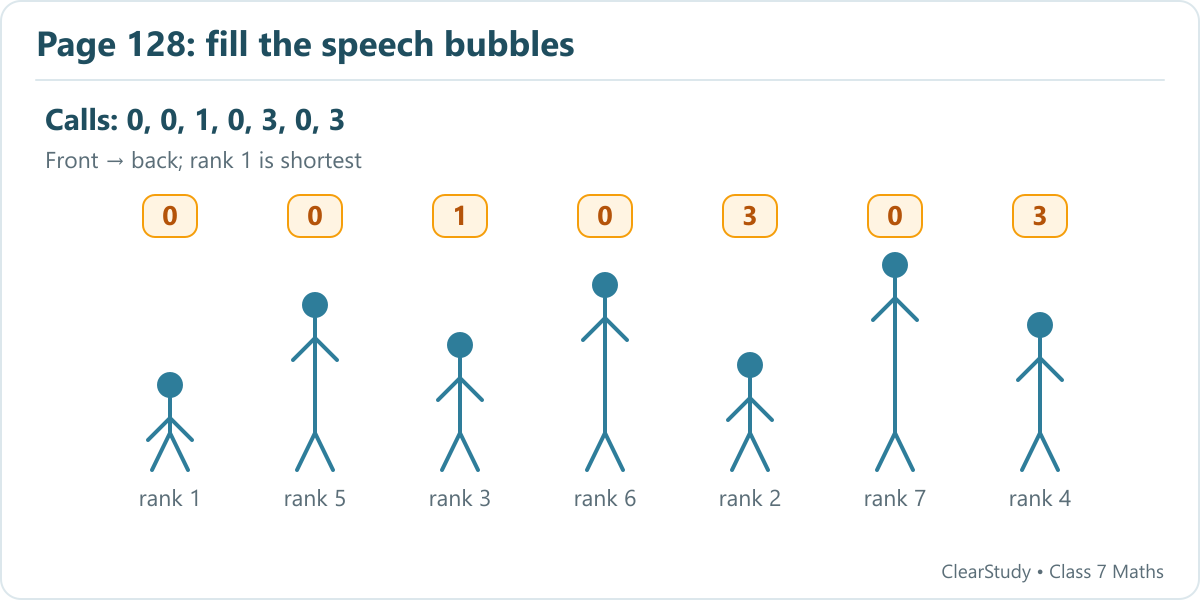
Opening activity — page 128Using the line shown in the textbook, and reading front to back from left to right, the calls are 0, 0, 1, 0, 3, 0, 3. For example, the fifth child has three taller children ahead, while the sixth child is taller than everyone ahead.
Reading the illustrated line from left to right, the calls are 0, 0, 1, 0, 3, 0, 3. Heights are shown as relative ranks.
Figure it Out — Numbers Tell us Things (Page 128)
Use the textbook questions alongside these original worked solutions and diagrams. Rule: each child says the number of children in front of them who are taller than them.
1. Arrange the stick figure cutouts given at the end of the book or draw a height arrangement such that the sequence reads:
(a) 0, 1, 1, 2, 4, 1, 5(b) 0, 0, 0, 0, 0, 0, 0(c) 0, 1, 2, 3, 4, 5, 6(d) 0, 1, 0, 1, 0, 1, 0(e) 0, 1, 1, 1, 1, 1, 1(f) 0, 0, 0, 3, 3, 3, 3
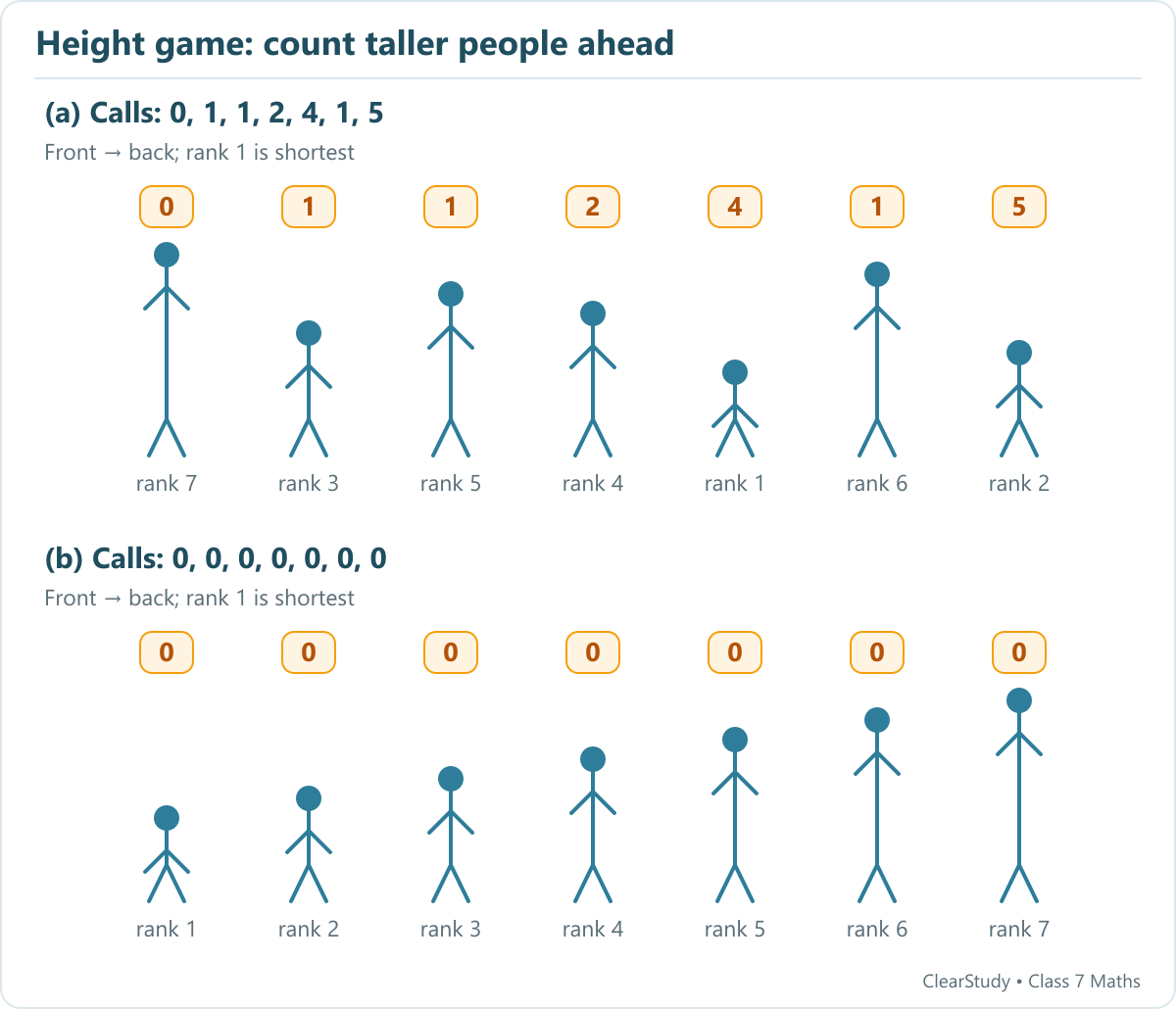
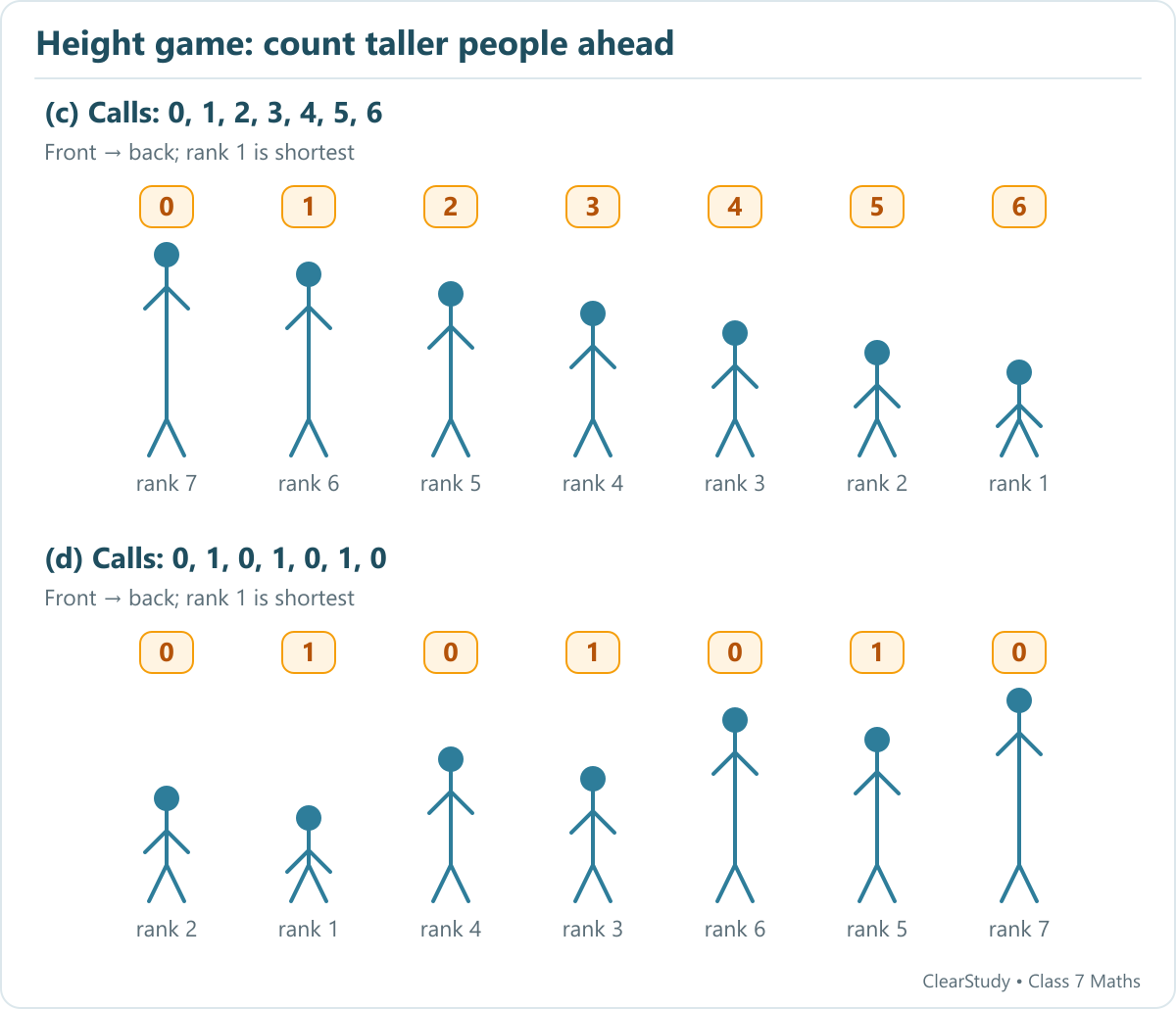
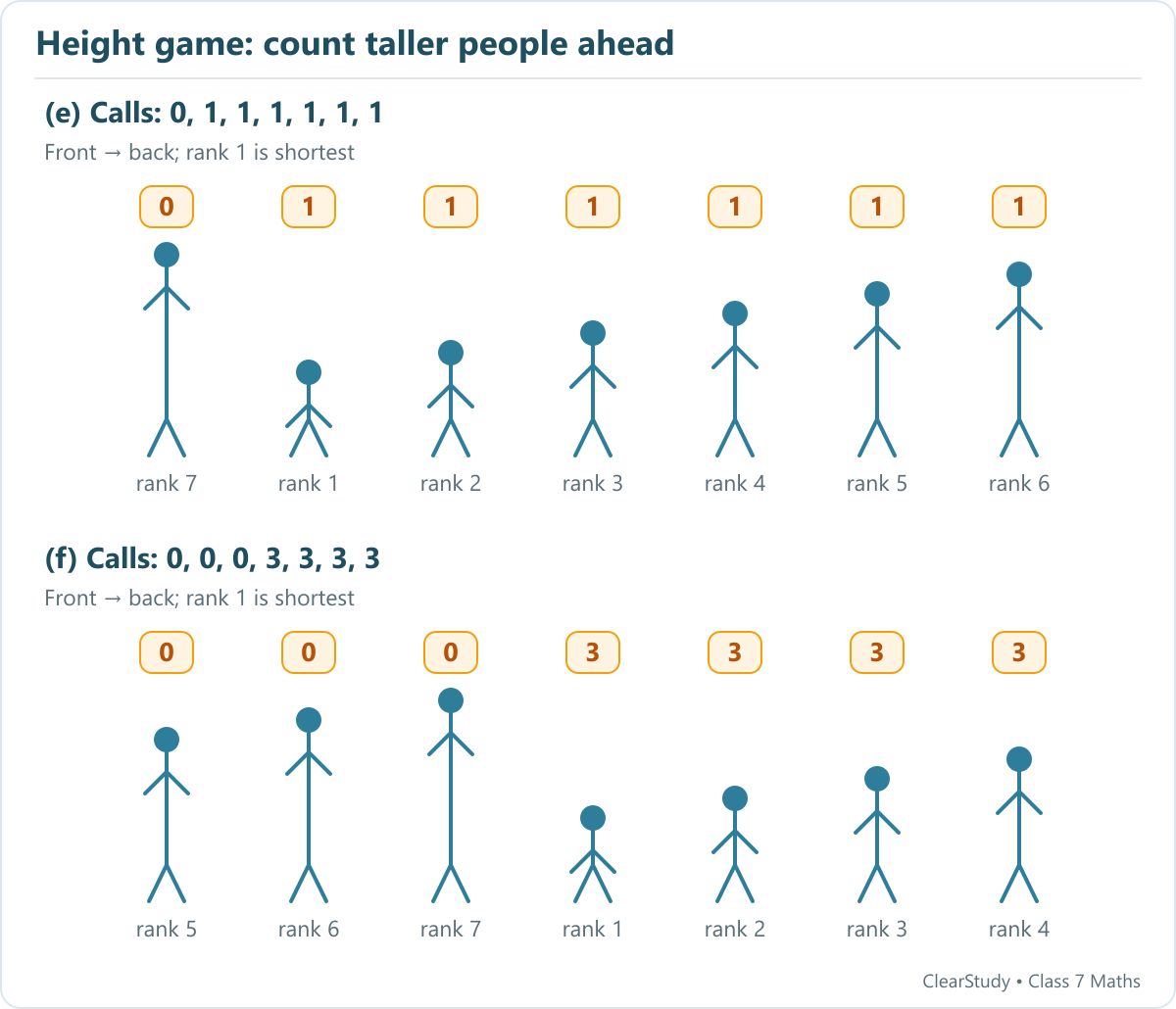
SOLUTIONMethod: read the sequence from the front. The k-th person must have exactly that many taller people standing ahead of them. So assign heights (we use ranks 1 = shortest to 7 = tallest) so that, for each person, exactly the stated number of earlier people are taller. The first person always says 0. For seven distinct height ranks, these counts determine the relative order. Actual heights can vary while preserving that order. One fully verified set of heights (front→back) is given for each part in the table below.
Height arrangements for parts a and b. Orange boxes show the number called; the ranks below show relative heights.Height arrangements for parts c and d. Orange boxes show the number called; the ranks below show relative heights.Height arrangements for parts e and f. Orange boxes show the number called; the ranks below show relative heights.
1, 2, 3, 4, 5, 6, 7 (each new person taller than all before)
Every person is taller than everyone ahead, so nobody sees a taller person → all say 0. (Equal heights also work.)
(c) 0, 1, 2, 3, 4, 5, 6
7, 6, 5, 4, 3, 2, 1 (tallest first, descending)
Each new person is shorter than all before, so the counts climb 0, 1, 2, 3, 4, 5, 6.
(d) 0, 1, 0, 1, 0, 1, 0
2, 1, 4, 3, 6, 5, 7
2→0; 1→1 (2); 4→0 (new tallest); 3→1 (4); 6→0 (new tallest); 5→1 (6); 7→0 (tallest).
(e) 0, 1, 1, 1, 1, 1, 1
7, 1, 2, 3, 4, 5, 6 (one tall leader, then six shorter)
The tallest stands first and says 0; each of the next six sees exactly one taller person (the leader) → says 1.
(f) 0, 0, 0, 3, 3, 3, 3
5, 6, 7, 1, 2, 3, 4 (three increasing tall people, then four shorter)
First three are each a new tallest → 0, 0, 0; each of the last four has the same three tall people (5, 6, 7) ahead → says 3.
2. For each of the statements given below, think and identify if it is Always True, Only Sometimes True, or Never True. Share your reasoning.
(a) If a person says ‘0’, then they are the tallest in the group.(b) If a person is the tallest, then their number is ‘0’.(c) The first person’s number is ‘0’.(d) If a person is not first or last in line (i.e., if they are standing somewhere in between), then they cannot say ‘0’.(e) The person who calls out the largest number is the shortest.(f) What is the largest number possible in a group of 8 people?
SOLUTION(a) Only Sometimes True. A person says 0 when no one taller stands in front — this happens for the tallest, but also for anyone who is taller than everyone ahead of them (e.g. the first person in any line). So saying 0 does not prove they are the tallest.(b) Always True. Nobody is taller than the tallest person, so the count of taller people in front is always 0.(c) Always True. The first person has no one in front, so the count of taller people ahead is 0.(d) Only Sometimes True. A middle person says 0 whenever they are taller than everyone ahead of them; it is not forbidden. So “cannot say 0” is not always correct.(e) Only Sometimes True. The largest count means the most taller people stand ahead. The shortest person can produce a large number, but the position in line matters — the shortest person standing first would say 0. It is true only when the shortest stands far enough back.(f) In a group of 8 people, the most taller people anyone can have in front is 7 (everyone else, all taller, standing ahead of the shortest person at the back). So the largest possible number is 7.
Figure it Out — Picking Parity (Page 131)
1. Using your understanding of the pictorial representation of odd and even numbers, find out the parity of the following sums:
(a) Sum of 2 even numbers and 2 odd numbers (e.g., even + even + odd + odd)(b) Sum of 2 odd numbers and 3 even numbers(c) Sum of 5 even numbers(d) Sum of 8 odd numbers
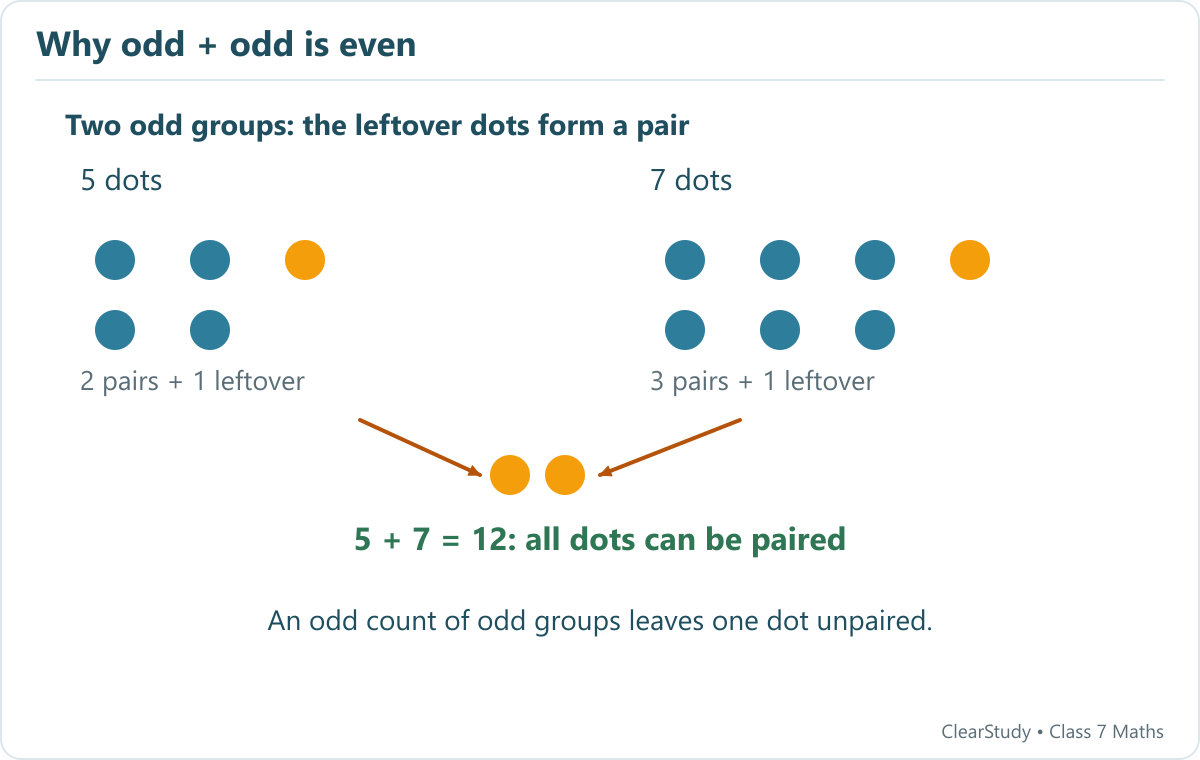
SOLUTIONEven numbers never change the parity of a sum; only the count of odd numbers decides it. The sum is odd if that count is odd, and even if that count is even.(a) 2 odd numbers (even count) → the two odds make an even, plus evens stays even. Parity = even.(b) 2 odd numbers (even count) + 3 evens → even.(c) 0 odd numbers → even.(d) 8 odd numbers (even count) → even.
Each odd group has one leftover. The two leftovers form a pair, so the total is even.
2. Lakpa has an odd number of ₹1 coins, an odd number of ₹5 coins and an even number of ₹10 coins in his piggy bank. He calculated the total and got ₹205. Did he make a mistake? If he did, explain why. If he didn’t, how many coins of each type could he have?
SOLUTIONLook at the parity of each part of the total. Value from ₹1 coins = (odd count) × 1 = odd. Value from ₹5 coins = (odd count) × 5 = odd × odd = odd. Value from ₹10 coins = (even count) × 10 = even.Total parity = odd + odd + even = even + even = even.But ₹205 is an odd number. An even total can never equal an odd number, so Lakpa made a mistake — this combination of coins can never total ₹205.
3. We know that:
(a) even + even = even(b) odd + odd = even(c) even + odd = oddSimilarly, find out the parity for the scenarios below:(d) even − even = ___________________(e) odd − odd = ___________________(f) even − odd = ___________________(g) odd − even = ___________________
SOLUTIONSubtraction follows the same parity rules as addition (subtracting an odd flips parity, subtracting an even keeps it).(d) even − even = even (e.g. 8 − 2 = 6).(e) odd − odd = even (e.g. 9 − 3 = 6).(f) even − odd = odd (e.g. 8 − 3 = 5).(g) odd − even = odd (e.g. 9 − 2 = 7).
IN-TEXT: SMALL SQUARES IN GRIDS (p. 132)Find the parity of the number of small squares in these grids:The number of small squares = rows × columns. A product is odd only when both factors are odd; otherwise it is even.(a) 27 × 13 = odd × odd = odd (351).(b) 42 × 78 = even × even = even (3276).(c) 135 × 654 = odd × even = even (88290).
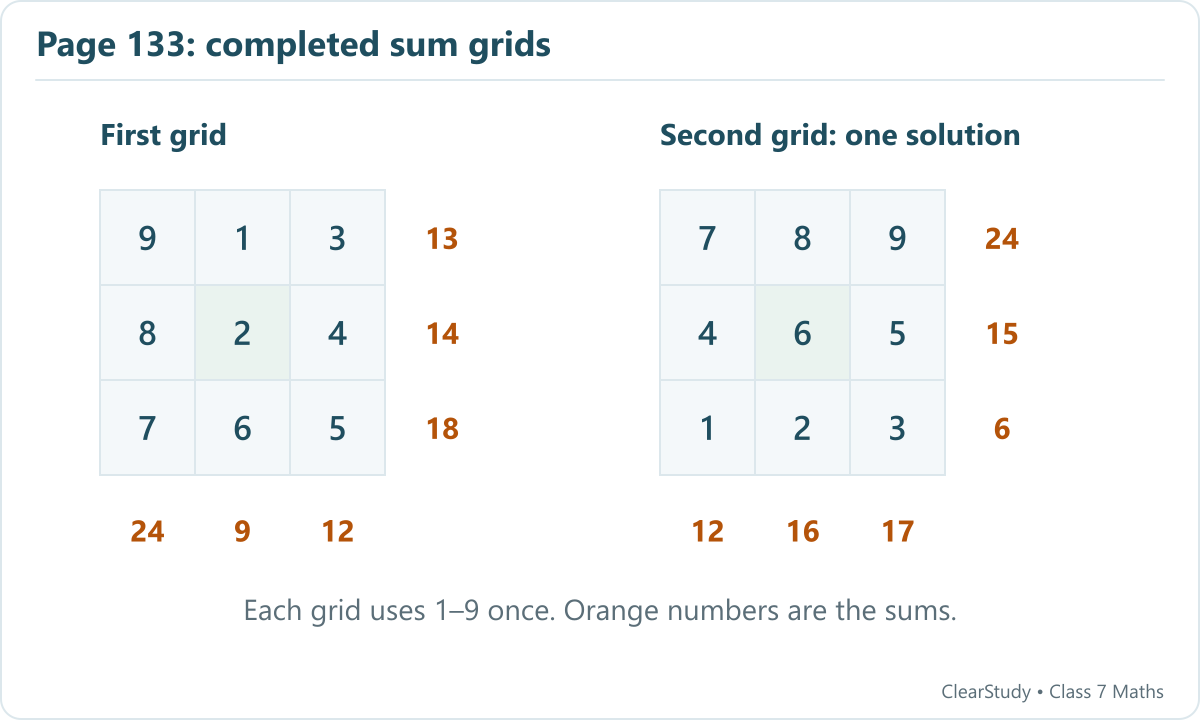
Row-and-column sum puzzles — page 133The first grid is 9,1,3 / 8,2,4 / 7,6,5. The first column must be 9,8,7 because it totals 24. The first row then needs 1 and 3. Applying the other sums fixes the remaining entries.For the second grid, one solution is 7,8,9 / 4,6,5 / 1,2,3. Another is 7,9,8 / 4,5,6 / 1,2,3. Check row sums 24,15,6 and column sums 12,16,17 in each. Each uses 1–9 exactly once.
First grid: 9,1,3 / 8,2,4 / 7,6,5. Second grid: 7,8,9 / 4,6,5 / 1,2,3. The second grid also works with columns 2 and 3 changed to 9,5,2 and 8,6,3.
Figure it Out — Magic Squares (Page 136)
A magic square has equal row, column and diagonal sums. For a 3 × 3 square using 1–9 the magic sum is 15 and the centre is 5.
1. How many different magic squares can be made using the numbers 1 – 9? (Math Talk)
SOLUTIONEvery 3 × 3 magic square with 1–9 has 5 fixed at the centre. There is essentially one basic pattern (the Lo Shu square). From it we get all others by rotating it (4 quarter-turns) and reflecting it (a mirror image of each).4 rotations × 2 (original + mirror) = 8 different magic squares.
2. Create a magic square using the numbers 2 – 10. What strategy would you use for this? Compare it with the magic squares made using 1 – 9.
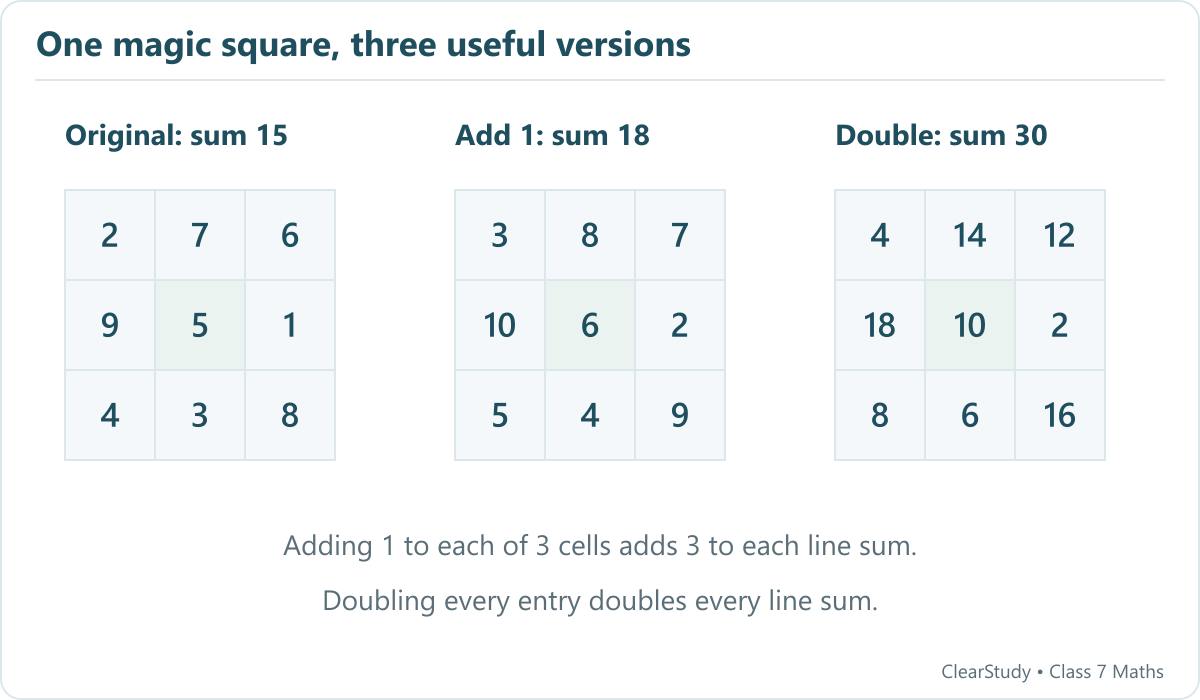
SOLUTIONStrategy: the numbers 2–10 are just the numbers 1–9 with 1 added to each. So take any 1–9 magic square and add 1 to every cell.Starting from the Lo Shu square (rows: 2,7,6 / 9,5,1 / 4,3,8), add 1 to each cell:3, 8, 7 / 10, 6, 2 / 5, 4, 9. Each row, column and diagonal now sums to 18.Comparison: the structure is identical; only the magic sum changes. Old sum 15, new sum 15 + 3 = 18 (because 3 cells each gained 1). The centre is now 6 (= 5 + 1).
3. Take a magic square, and
(a) increase each number by 1(b) double each numberIn each case, is the resulting grid also a magic square? How do the magic sums change in each case?
SOLUTIONTake the Lo Shu square with magic sum 15.(a) Add 1 to each number. Every line of 3 cells gains 3, so each line still has the same sum — it is still a magic square, with magic sum 15 + 3 = 18.(b) Double each number. Every line is doubled, so all lines remain equal — it is still a magic square, with magic sum 2 × 15 = 30.Rule: adding c to every cell adds 3c to the magic sum; multiplying every cell by k multiplies the magic sum by k.
Add 1 to every Lo Shu entry to use 2–10 and obtain sum 18. Double every entry to obtain sum 30.
4. What other operations can be performed on a magic square to yield another magic square? (Math Talk)
SOLUTIONSeveral operations keep the magic property:• Add the same number to every cell (sum increases by 3 × that number).• Subtract the same number from every cell.• Multiply every cell by the same number, or divide every cell by the same non-zero number.• Rotate the whole square by 90°, 180° or 270°, or reflect it (mirror image) — the sums do not change at all.Each of these gives a grid whose rows, columns and diagonals are still equal.
5. Discuss ways of creating a magic square using any set of 9 consecutive numbers (like 2 – 10, 3 – 11, 9 – 17, etc.).
SOLUTIONAny 9 consecutive numbers from a starting value s are just 1–9 with (s − 1) added to each. So:Step 1: Take a known 1–9 magic square (centre 5, magic sum 15).Step 2: Add (s − 1) to every cell, where s is the smallest number in your set.For 9–17, add 8 to each cell → centre becomes 13, magic sum becomes 15 + 24 = 39. In general the centre is the middle (5th) number of the set, and the magic sum is 3 × centre.
Figure it Out — Generalising the Magic Square (Page 137)
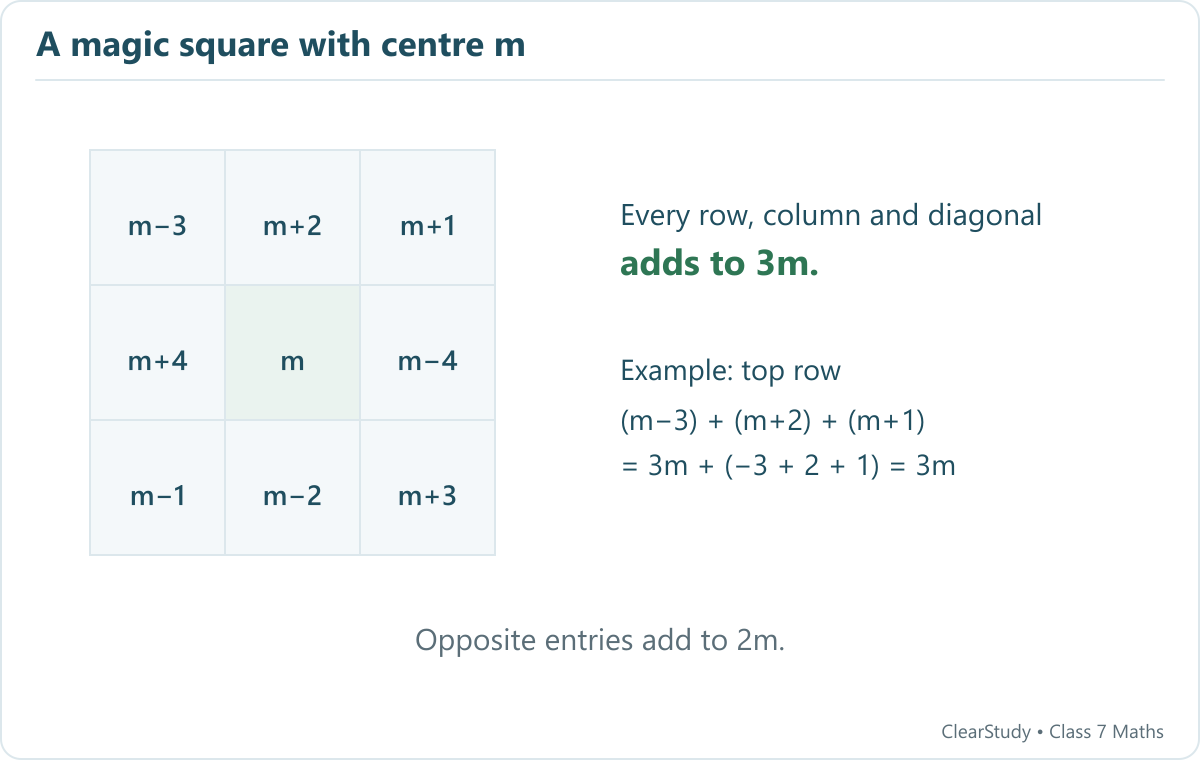
A 3 × 3 magic square of consecutive numbers can be written around its centre m. Using the standard pattern, every line adds to 3m, the centre is m, and the cells are m and m ± small gaps.
1. Using this generalised form, find a magic square if the centre number is 25.
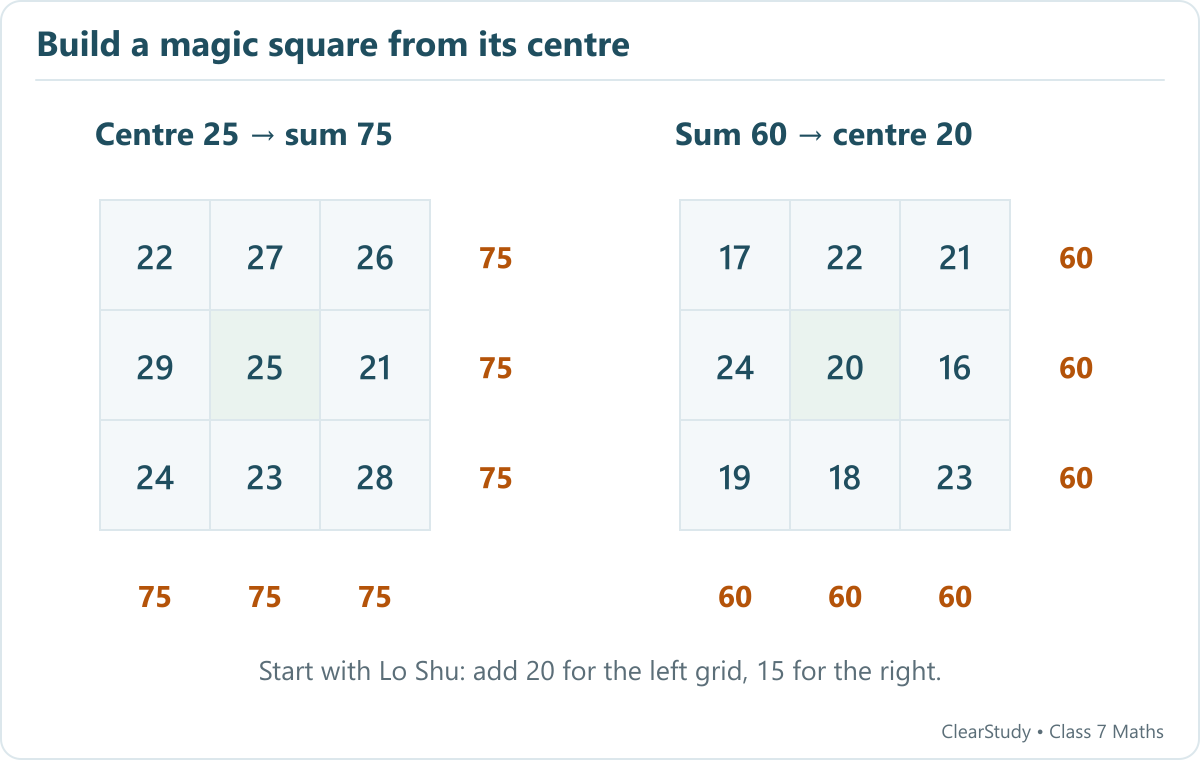
SOLUTIONFor consecutive numbers the centre is the middle value, so the nine numbers are 21, 22, 23, 24, 25, 26, 27, 28, 29. The magic sum = 3 × 25 = 75.Take the Lo Shu pattern (2,7,6 / 9,5,1 / 4,3,8) and add 20 to each cell (since centre 5 → 25):22, 27, 26 / 29, 25, 21 / 24, 23, 28. Check: 22 + 27 + 26 = 75, 29 + 25 + 21 = 75, 24 + 23 + 28 = 75, and both diagonals (22 + 25 + 28 = 75, 26 + 25 + 24 = 75). ✓
2. What is the expression obtained by adding the 3 terms of any row, column or diagonal?
SOLUTIONIn the generalised form every line is built so the gaps above and below the centre cancel. Each row, column and diagonal passes through cells that average to m, so the three terms add to 3m (three times the centre number).
3. Write the result obtained by—
(a) adding 1 to every term in the generalised form.(b) doubling every term in the generalised form
SOLUTION(a) Adding 1 to each cell raises the centre to (m + 1); each line now sums to 3m + 3 = 3(m + 1). Still a magic square.(b) Doubling each cell makes the centre 2m; each line now sums to 6m = 2 × 3m. Still a magic square.
4. Create a magic square whose magic sum is 60.
SOLUTIONMagic sum = 3 × centre, so the centre must be 60 ÷ 3 = 20. Use nine consecutive numbers centred on 20: 16, 17, 18, 19, 20, 21, 22, 23, 24.Add 15 to every cell of the Lo Shu square (centre 5 → 20):17, 22, 21 / 24, 20, 16 / 19, 18, 23. Check: 17 + 22 + 21 = 60, 24 + 20 + 16 = 60, 19 + 18 + 23 = 60, diagonals 17 + 20 + 23 = 60 and 21 + 20 + 19 = 60. ✓
Centre 25 gives rows 22,27,26 / 29,25,21 / 24,23,28. Magic sum 60 gives rows 17,22,21 / 24,20,16 / 19,18,23.
5. Is it possible to get a magic square by filling nine non-consecutive numbers? (Try This)
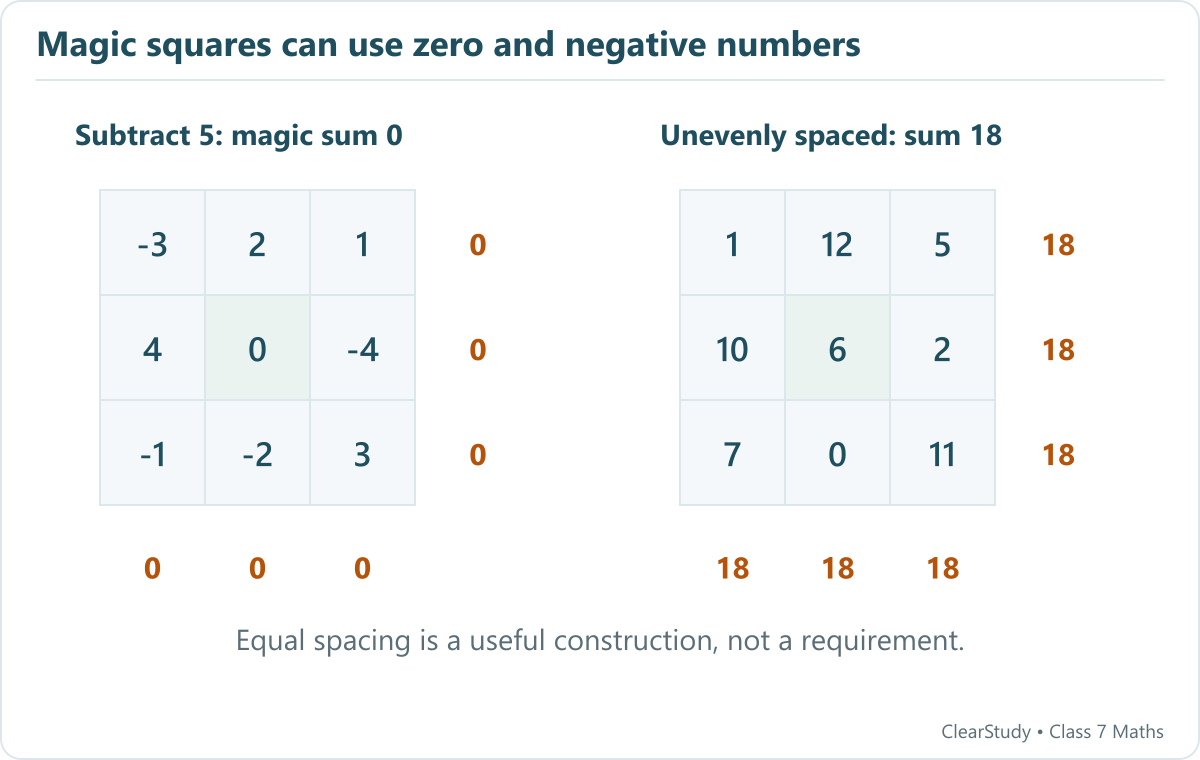
SOLUTIONYes. A simple construction is to replace every entry x of a 1–9 magic square with 3x − 2. This gives 4, 19, 16 / 25, 13, 1 / 10, 7, 22, using nine numbers spaced 3 apart. Every line totals 39.Even spacing is sufficient, but not necessary. For example, 1, 12, 5 / 10, 6, 2 / 7, 0, 11 has nine distinct, unevenly spaced values. Every row, column and both diagonals total 18. A diagram of this example appears beside the zero-sum exercise below.
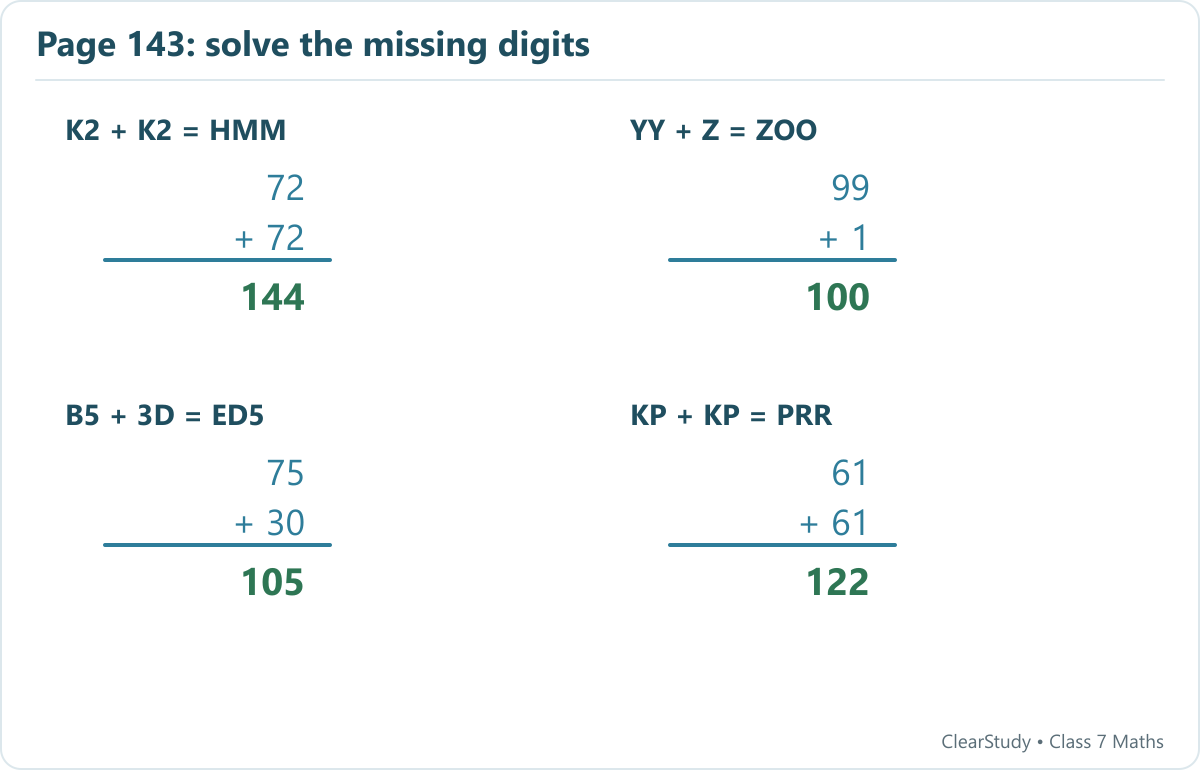
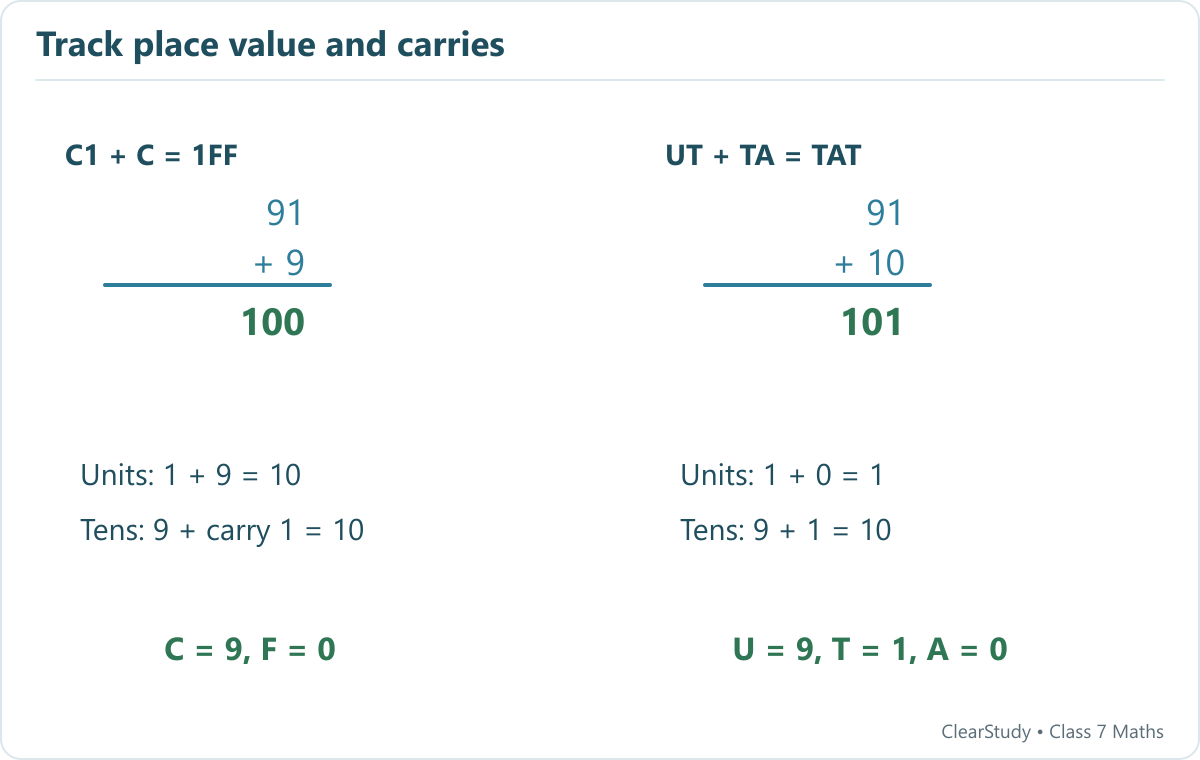
In-text cryptarithms — page 143K2 + K2 = HMM: units 2+2=4 gives M=4. A three-digit sum of two two-digit numbers has H=1. Then 2K=14, so K=7: 72+72=144.YY + Z = ZOO: the hundreds carry makes Z=1. The sum is then at most 99+1=100, so Y=9 and O=0: 99+1=100.B5 + 3D = ED5: units 5+D ending in 5 gives D=0 with no carry. Tens B+3 must end in 0 and carry 1, so B=7, E=1: 75+30=105.KP + KP = PRR: the hundreds carry gives P=1. Units 1+1=2 gives R=2. Tens 2K=12 gives K=6: 61+61=122.C1 + C = 1FF: a three-digit result forces C=9 because 81+8 is only 89. Hence F=0: 91+9=100.
The verified sums are 72+72=144, 99+1=100, 75+30=105 and 61+61=122. Work from units to tens, carrying when a column totals 10 or more.C1+C=1FF gives 91+9=100. UT+TA=TAT gives 91+10=101; the tens column carries 1 into hundreds.
Figure it Out — Digits in Disguise (Page 143–144)
1. A light bulb is ON. Dorjee toggles its switch 77 times. Will the bulb be on or off? Why?
SOLUTIONEach toggle flips the state: ON→OFF→ON→… After an even number of toggles the bulb returns to its start; after an odd number it is the opposite.77 is odd, so the bulb ends in the opposite state. Starting ON, after 77 toggles it will be OFF.
2. Liswini has a large old encyclopaedia. When she opened it, several loose pages fell out of it. She counted 50 sheets in total, each printed on both sides. Can the sum of the page numbers of the loose sheets be 6000? Why or why not?
SOLUTIONEach sheet has two page numbers, and they are consecutive — one odd (front) and one even (back), e.g. 5 and 6. Their sum is odd + even = odd.There are 50 sheets, so we are adding 50 odd numbers. The sum of an even count of odd numbers is even, so the total could be even — parity does not rule out 6000.Now check size. Each sheet’s two pages sum to (2k − 1) + 2k = 4k − 1 for some sheet number k. Adding 50 such sums gives a number of the form 4×(sum of k’s) − 50. The smallest possible total (sheets 1–50, i.e. pages 1…100) is 1 + 2 + … + 100 = 5050, and any 50 sheets give a larger or equal total. 6000 exceeds this lower bound, but that alone does not prove it is attainable. Checking the form: 6000 = 4t − 50 ⇒ 4t = 6050 ⇒ t = 1512.5, which is not a whole number. Since t (the total of the sheet numbers) must be a whole number, the page-number sum can never equal 6000.Answer: No — the sum of the page numbers of 50 double-sided sheets can never be exactly 6000.
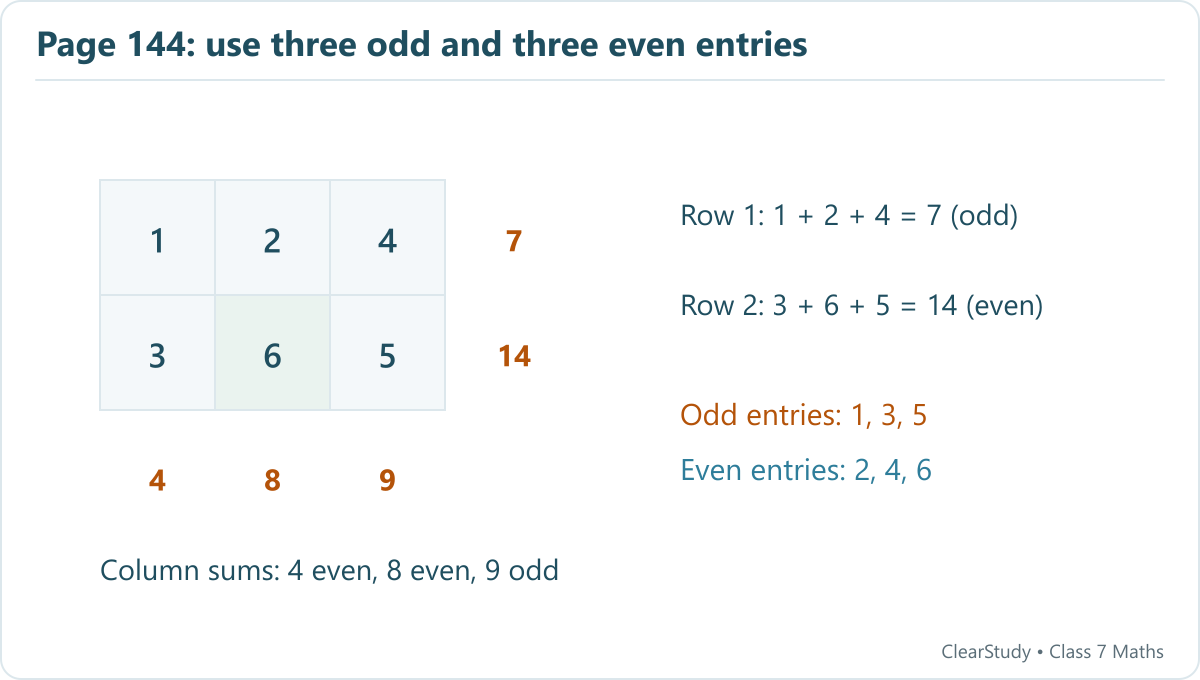
3. Here is a 2 × 3 grid. For each row and column, the parity of the sum is written in the circle; ‘e’ for even and ‘o’ for odd. Fill the 6 boxes with 3 odd numbers (‘o’) and 3 even numbers (‘e’) to satisfy the parity of the row and column sums.
Row 1 sum: o Row 2 sum: e Column sums: e, e, o
SOLUTIONWe need 3 odd cells (o) and 3 even cells (e) placed so that: Row 1 sum is odd, Row 2 sum is even, Column 1 even, Column 2 even, Column 3 odd.Useful rules: a row of 3 cells is odd only with an odd count of odd cells; a column of 2 cells is odd only when its two cells have different parity (one odd, one even).Column 3 must be odd → its two cells differ in parity. Columns 1 and 2 must be even → each holds two cells of the same parity. Put two odd entries in Column 1 and two even entries in Column 2. Column 3 then needs one even and one odd entry. A placement that fits is:Row 1: o, e, e (1 odd → row sum odd ✓) Row 2: o, e, o (2 odds → row sum even ✓).Columns: Col 1 = o + o = even ✓; Col 2 = e + e = even ✓; Col 3 = e + o = odd ✓. Odd cells used = 3, even cells used = 3 ✓.One numeric answer: Row 1 = 1, 2, 4; Row 2 = 3, 6, 5. (Odds 1, 3, 5; evens 2, 4, 6.) Row 1 = 7 (odd) ✓; Row 2 = 14 (even) ✓; Col 1 = 1 + 3 = 4 (even) ✓; Col 2 = 2 + 6 = 8 (even) ✓; Col 3 = 4 + 5 = 9 (odd) ✓.
A valid grid is 1,2,4 / 3,6,5. Its row parities are odd, even and its column parities are even, even, odd.
4. Make a 3 × 3 magic square with 0 as the magic sum. All numbers can not be zero. Use negative numbers, as needed.
SOLUTIONIf the magic sum is 0, the centre must be 0 (sum = 3 × centre). Take the Lo Shu square centred on 5 and subtract 5 from every cell (so the centre becomes 0):Lo Shu: 2,7,6 / 9,5,1 / 4,3,8. Subtract 5: −3, 2, 1 / 4, 0, −4 / −1, −2, 3.Check: −3 + 2 + 1 = 0, 4 + 0 + (−4) = 0, −1 + (−2) + 3 = 0; columns and diagonals also give 0. ✓
Left: subtracting 5 from Lo Shu produces sum 0. Right: 1,12,5 / 10,6,2 / 7,0,11 has sum 18 although its nine distinct values are not evenly spaced.
5. Fill in the following blanks with ‘odd’ or ‘even’:
(a) Sum of an odd number of even numbers is ______(b) Sum of an even number of odd numbers is ______(c) Sum of an even number of even numbers is ______(d) Sum of an odd number of odd numbers is ______
SOLUTION(a) even — any number of evens added is even.(b) even — odds pair up two-by-two into evens.(c) even — evens always sum to an even number.(d) odd — an odd count of odds leaves one odd unpaired.
6. What is the parity of the sum of the numbers from 1 to 100?
SOLUTIONFrom 1 to 100 there are 50 odd numbers (1, 3, …, 99) and 50 even numbers. The evens do not affect parity; the 50 odds are an even count, so they add to an even number.So the total is even. (Check: 1 + 2 + … + 100 = 100 × 101 ÷ 2 = 5050, which is even.)
7. Two consecutive numbers in the Virahāṁka sequence are 987 and 1597. What are the next 2 numbers in the sequence? What are the previous 2 numbers in the sequence?
SOLUTIONEach term is the sum of the two before it; to go backwards, subtract.Next two: 987 + 1597 = 2584; then 1597 + 2584 = 4181.Previous two: the number before 987 = 1597 − 987 = 610; the one before that = 987 − 610 = 377.So the sequence runs …, 377, 610, 987, 1597, 2584, 4181, …
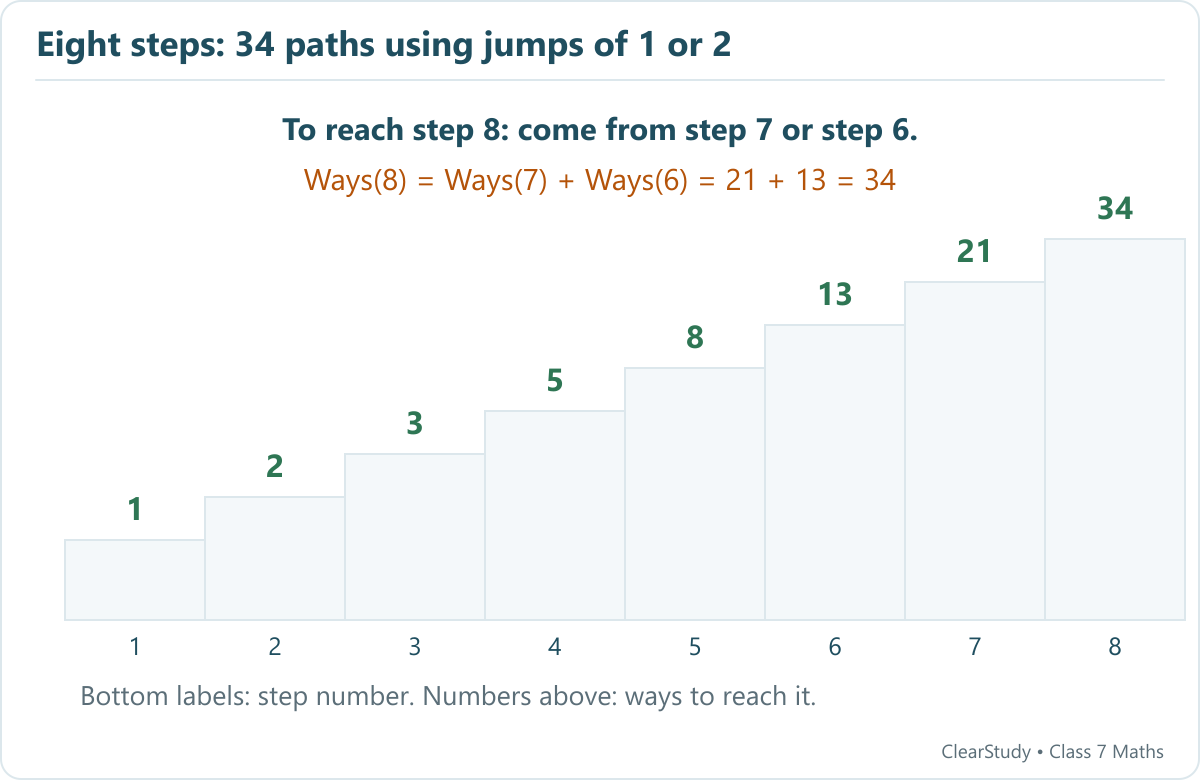
8. Angaan wants to climb an 8-step staircase. His playful rule is that he can take either 1 step or 2 steps at a time. For example, one of his paths is 1, 2, 2, 1, 2. In how many different ways can he reach the top?
SOLUTIONThe number of ways to climb n steps using 1s and 2s is exactly the number of ways to write n as a sum of 1s and 2s — the Virahāṁka sequence.Ways for n = 1, 2, 3, … are 1, 2, 3, 5, 8, 13, 21, 34.For 8 steps the answer is the 8th term: 34 different ways.
The numbers of paths for steps 1–8 are 1,2,3,5,8,13,21,34. The final move reaches step 8 from step 7 or step 6.
9. What is the parity of the 20th term of the Virahāṁka sequence?
SOLUTIONWrite the parity of each term of 1, 2, 3, 5, 8, 13, 21, 34, 55, 89, …: o, e, o, o, e, o, o, e, o, o, … The parities repeat in a cycle of three: odd, even, odd (because odd + even = odd, even + odd = odd, odd + odd = even).So the even terms sit at positions 2, 5, 8, 11, 14, 17, 20, … — every position of the form 3k − 1.Since 20 = 3 × 7 − 1, the 20th term falls on a position occupied by an even-valued term. The 20th Virahāṁka number is therefore even (in fact it equals 10946).
10. Identify the statements that are true.
(a) The expression 4m − 1 always gives odd numbers.(b) All even numbers can be expressed as 6j − 4.(c) Both expressions 2p + 1 and 2q − 1 describe all odd numbers.(d) The expression 2f + 3 gives both even and odd numbers.
SOLUTION(a) True. 4m is always even, so 4m − 1 is always odd.(b) False. 6j − 4 gives 2, 8, 14, 20, … (step 6) — it misses many even numbers such as 4, 6, 10, so not all evens.(c) True. For positive odd numbers, take p = 0, 1, 2, … in 2p + 1 and q = 1, 2, 3, … in 2q − 1. Both give 1, 3, 5, …. Allowing all integer values gives all odd integers.(d) False. 2f is always even, so 2f + 3 is always odd; it never gives an even number.True statements: (a) and (c).
11. Solve this cryptarithm:
U T + T A = T A T
SOLUTIONA 2-digit number plus a 2-digit number gives a 3-digit number TAT, so the hundreds digit T = 1 (the largest carry from adding two 2-digit numbers is 1).With T = 1 the sum is UT + TA = 1A1, i.e. U1 + 1A = 1A1.Units column: T + A = 1 + A must end in T = 1, so 1 + A ends in 1 only when A = 0: units 1 + 0 = 1 ✓ (carry 0). Tens column: U + T = U + 1 must end in A = 0 with a carry of 1 into the hundreds (to make the leading 1). So U + 1 = 10 ⇒ U = 9, carry 1 ✓.Check: U = 9, T = 1, A = 0 ⇒ UT = 91, TA = 10, sum = 91 + 10 = 101 = TAT (T A T = 1 0 1). ✓Answer: U = 9, T = 1, A = 0; 91 + 10 = 101.
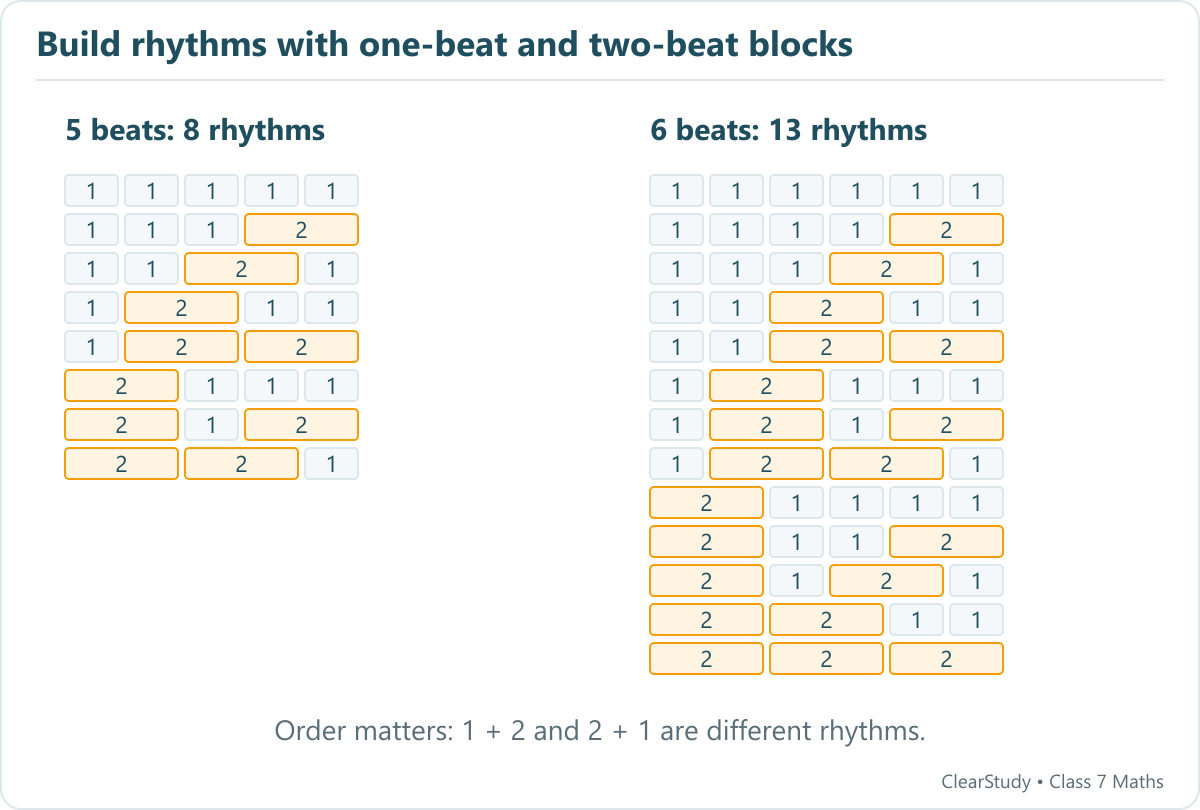
Rhythms with 5 and 6 beats — pages 140–141A one-beat syllable is represented by 1 and a two-beat syllable by 2. Order matters. A 5-beat rhythm begins with 1 followed by a 4-beat rhythm (5 choices), or with 2 followed by a 3-beat rhythm (3 choices): 5+3=8 ways.Likewise, 6 beats gives 8+5=13 ways. All arrangements are shown below. Repeating this rule gives 21 ways for 7 beats and 34 ways for 8 beats.
All 8 five-beat rhythms and all 13 six-beat rhythms. Blue-tinted short blocks have 1 beat; gold long blocks have 2 beats.
Math Talk & Try This — Answered
These are the in-text reflective and short tasks in the chapter; determinate ones are answered, open ones are guided with worked examples.
Picking Parity — Kishor’s puzzle (p. 129–130)There are 5 boxes; each holds one odd-number card and the five should sum to 30. Is it possible?Answer. No. Adding 5 odd numbers means an odd count of odds, so the sum is always odd. But 30 is even, so it can never be reached.
Try This — Sums of odd numbers (p. 130)Explore what happens to the sum of (a) 4 odd numbers, (b) 5 odd numbers, (c) 6 odd numbers.Answer. (a) 4 odds → even count → even. (b) 5 odds → odd count → odd. (c) 6 odds → even count → even. An odd sum appears only when the number of odd terms is odd.
Math Talk — Martin and Maria’s ages (p. 130–131)Born one year apart, can the sum of their ages be 112?Answer. Their ages are consecutive numbers (one even, one odd), so their sum is always odd. 112 is even, so it is impossible.
Math Talk — Parity of expressions (p. 132)Give an expression that is always even, one always odd, and one that can be either.Answer. Always even: 2n (or 100p, 48w − 2). Always odd: 2n + 1 (or 4m − 1). Either parity: 3n + 4 (odd when n is odd, even when n is even). All even numbers are listed by 2n; all odd numbers by 2n − 1.
Math Talk — nth even and nth odd number (p. 132–133)What is the 100th even number, and the 100th odd number? Write a formula for the nth odd number.Answer. 100th even = 2 × 100 = 200; 100th odd = 200 − 1 = 199. The nth even number is 2n and the nth odd number is 2n − 1.
Some Explorations in Grids — impossible grid (p. 134)Why is the grid with circle sums 5 and 26 impossible?Answer. A row or column uses three different numbers from 1–9. The smallest such sum is 1 + 2 + 3 = 6 and the largest is 7 + 8 + 9 = 24. A circle sum of 5 (too small) or 26 (too large) lies outside 6–24, so no arrangement can produce it.
Math Talk — Why row + column sums = 45 (p. 134)Why do all three row sums (or all three column sums) always add to 45?Answer. Together the three rows contain every one of the numbers 1–9 exactly once, and 1 + 2 + … + 9 = 45. The same is true for the three columns, so each set of three sums totals 45.
Math Talk — Centre, corners of a magic square (p. 135–136)Which numbers cannot be at the centre? Where must 1 and 9 go?Answer. Let c be the centre. Add the four complete lines through it: their total is 4 × 15 = 60. These lines count every other entry once and the centre four times, so the same total is 45 + 3c. Hence 3c = 15 and c = 5; all eight other digits are excluded. A corner belongs to three lines. For 1, only the pairs (5,9) and (6,8) complete a total of 15; for 9, only (1,5) and (2,4) do. Therefore 1 and 9 must occupy opposite edge-middle cells.
Generalising — centre as a letter-number (p. 136–137)If m is the centre, how are the other cells related to m?Answer. For this consecutive-number pattern, the offsets from m sum to zero in every row, column and diagonal, so each line totals 3m. Opposite cells also average to m. Example (gaps 3, 1, 4 in the Lo Shu pattern): m−3, m+2, m+1 / m+4, m, m−4 / m−1, m−2, m+3.
The displayed consecutive-number pattern has centre m and magic sum 3m. The offsets cancel in each row, column and diagonal.
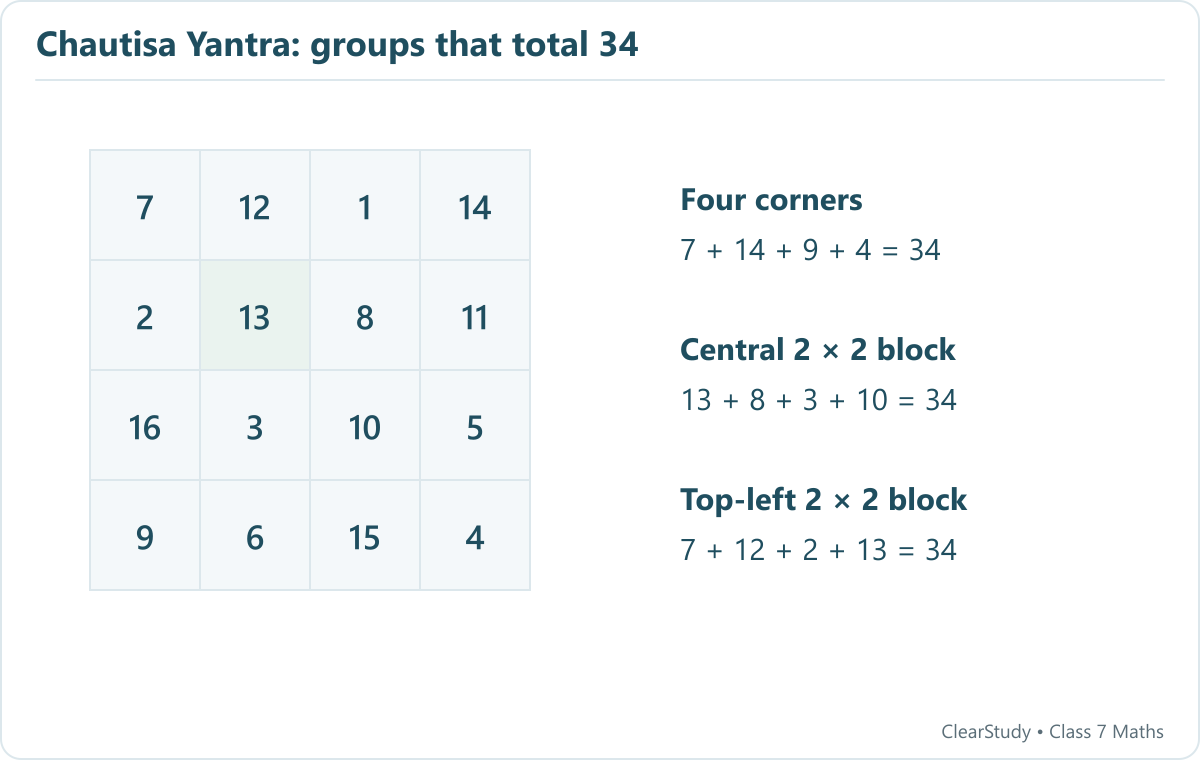
4 × 4 Chautīsā Yantra (p. 137)Why is the Khajuraho square called Chautīsā, and what other groups of four add to 34?Answer. “Chaũtīs” means 34, and every row, column and diagonal adds to 34. Other groups of four also give 34 — e.g. the four corners (7 + 14 + 9 + 4 = 34), the central 2 × 2 block (13 + 8 + 3 + 10 = 34), and each 2 × 2 corner block. This rich pattern is why it is so admired.
Every row, column and main diagonal adds to 34. The four corners, centre block and each corner 2 by 2 block also total 34.
Digits in Disguise — T + T + T = UT (p. 142–143)A one-digit number added to itself twice gives a 2-digit number whose units digit equals that digit. Find T and U.Answer. 3T must end in T, so 3T − T = 2T ends in 0 ⇒ T = 5 (2 × 5 = 10). Then 3 × 5 = 15, so UT = 15, i.e. T = 5, U = 1.
Virahāṁka sequence — next numbers & parity (p. 141–142)Write the next 3 numbers after 89 and describe the pattern of parities.Answer. After 89: 55 + 89 = 144, 89 + 144 = 233, 144 + 233 = 377. The parities run odd, even, odd, odd, even, odd, … — the even terms occur at positions 2, 5, 8, 11, …; the rest are odd. The term after 377 is even, because 233 and 377 are both odd.
Common Mistakes to Avoid
Watch out for these
Thinking a person who says “0” must be the tallest — anyone taller than everyone ahead of them also says 0 (e.g. the first person).
Believing every magic square needs consecutive or evenly spaced numbers. Equal spacing is one useful construction; it is not required.
Forgetting that only the count of odd numbers decides the parity of a sum; even numbers never change it.
Mixing up “odd count of odds” (sum odd) with “even count of odds” (sum even).
Saying a 3 × 3 magic square can have any centre — for numbers 1–9 the centre is fixed at 5 and the magic sum at 15.
Assuming Fibonacci was first — the sequence was given by Virahāṁka (~700 CE), about 500 years earlier.
Practice MCQs & Assertion–Reason
1. In the height game, the first person in the line always says:
(a) the largest number (b) 1 (c) 0 (d) their own height
2. The sum of an even number of odd numbers is always:
(a) odd (b) even (c) zero (d) prime
3. The number of small squares in a 27 × 13 grid is:
(a) even (b) odd (c) a multiple of 10 (d) a perfect square
4. The magic sum of a 3 × 3 magic square using the numbers 1–9 is:
(a) 9 (b) 12 (c) 15 (d) 45
5. The number that must occupy the centre of a 1–9 magic square is:
(a) 1 (b) 5 (c) 9 (d) any number
6. The number of different 3 × 3 magic squares using 1–9 is:
(a) 1 (b) 4 (c) 8 (d) 16
7. The next number in the Virahāṁka sequence 1, 2, 3, 5, 8, 13, 21, 34, 55 is:
(a) 76 (b) 89 (c) 99 (d) 110
8. The number of ways to climb 8 steps taking 1 or 2 steps at a time is:
(a) 16 (b) 21 (c) 34 (d) 64
9. The formula for the nth odd number is:
(a) 2n (b) 2n + 2 (c) 2n − 1 (d) n + 1
10. In the cryptarithm UT + TA = TAT, the digit T equals:
For each Assertion–Reason question, choose: (A) Both Assertion and Reason are true and the Reason is the correct explanation of the Assertion; (B) Both are true but the Reason is not the correct explanation; (C) Assertion is true but Reason is false; (D) Assertion is false but Reason is true.
A-R 1. Assertion: Five odd numbers can never add up to 30.
Reason: The sum of an odd number of odd numbers is always odd.
A-R 2. Assertion: The number of small squares in a 42 × 78 grid is even.
Reason: A product is even whenever at least one factor is even.
A-R 3. Assertion: In a 3 × 3 magic square using 1–9, the centre number must be 5.
Reason: The magic sum of such a square is 45.
A-R 4. Assertion: A bulb that is ON will be OFF after 77 toggles.
Reason: An odd number of toggles changes the bulb to the opposite state.
A-R 5. Assertion: The Virahāṁka–Fibonacci sequence was first written about by Fibonacci.
Reason: Each term of the sequence is the sum of the two preceding terms.
Answer key: 1-(A), 2-(A), 3-(C), 4-(A), 5-(D).
Quick Revision Summary
A sequence can record an arrangement — each person says how many taller people stand in front; the first always says 0.
Parity = even (arrangeable in pairs) or odd. even ± even = even, odd ± odd = even, even ± odd = odd.
Only the count of odd numbers fixes a sum’s parity: odd count → odd sum, even count → even sum.
A grid of r × c small squares is odd only when both r and c are odd.
3 × 3 magic square (1–9): total 45, magic sum 15, centre 5; 1 and 9 sit on edges; magic sum = 3 × centre.
Virahāṁka–Fibonacci numbers 1, 2, 3, 5, 8, 13, 21, 34, 55, … — each is the sum of the two before; the n-th counts the rhythms (or stair-climbs) of n beats/steps.
nth even number = 2n; nth odd number = 2n − 1. Cryptarithms replace digits with letters.
How to score full marks in this chapter
For every “is it possible” puzzle, check parity first — compare the parity of the two sides before doing any arithmetic. For magic-square questions, remember magic sum = 3 × centre and build new squares by adding or multiplying every cell of a known square. For Virahāṁka problems, add the two previous terms (or subtract to go backwards) and use the “every third term is even” rule for parity. In cryptarithms, start from the leading carry digit (often 1) and work column by column. Always write the rule you are using so each step earns its mark.
Frequently Asked Questions
What is Class 7 Maths Ganita Prakash Chapter 6 about?
Chapter 6, Number Play, covers recording arrangements as number sequences, parity (even and odd) and its rules for sums and products, magic squares and their generalised form, the Virahāṁka–Fibonacci numbers, and cryptarithms (digit puzzles).
How many Figure it Out exercises are there in Chapter 6?
There are five “Figure it Out” sets — on page 128 (height sequences), page 131 (parity), page 136 (magic squares), page 137 (generalised magic square) and pages 143–144 (digits in disguise) — plus several Math Talk and Try This tasks, all solved on this page.
Why is the magic sum of a 3 × 3 magic square with 1–9 equal to 15?
The numbers 1 to 9 add to 45. The three rows share this total equally, so each row (and column and diagonal) must add to 45 ÷ 3 = 15. This also forces the centre number to be 5.
Are these Class 7 Maths Ganita Prakash Chapter 6 solutions free?
Yes. All solutions are free and follow the official NCERT Ganita Prakash (Part I) textbook for the 2026–27 session, with worked exercise answers and original teaching diagrams.